The monthly edition
Management Review
The monthly edition, in numbered issues: each one a management question checked against the best research, on the role, KPIs, strategy, people, operations and AI. Ten pages, with the sources, the charts and a tool to use on Monday.
Correction, 12 Oc
How the series works. Numbered issues in series of 40, each dated by the month it went online. Issues 1 to 80, the first two series, went online between 8 and 11 October 2026; the third series began in November 2026 with issues 81 to 110. The page of each issue gives the day. What the dates mean
Correction, 27 Oc
-
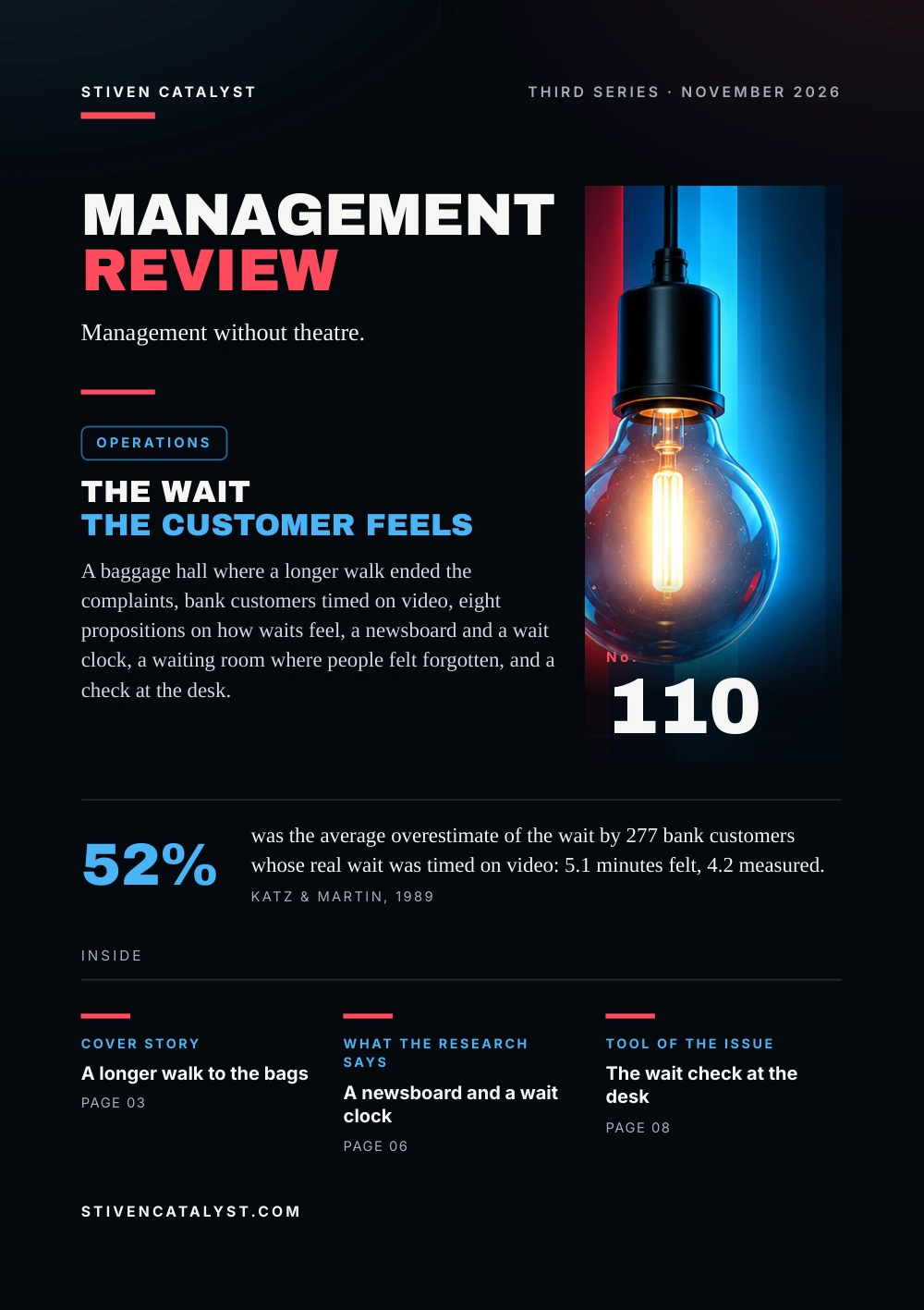 The wait the cus
t omer feels November 2026 The clock and the customer do not measure the same wait. In a Boston bank, 277 customers timed on video thought they had waited 5.1 minutes on average; they had waited 4.2. Issue 110 shows why a longer walk ended the complaints in a baggage hall, what eight propositions say about how waits feel, what a newsboard and a wait clock changed, how feeling forgotten changed the wait patients felt, and ends with a check at the desk. -
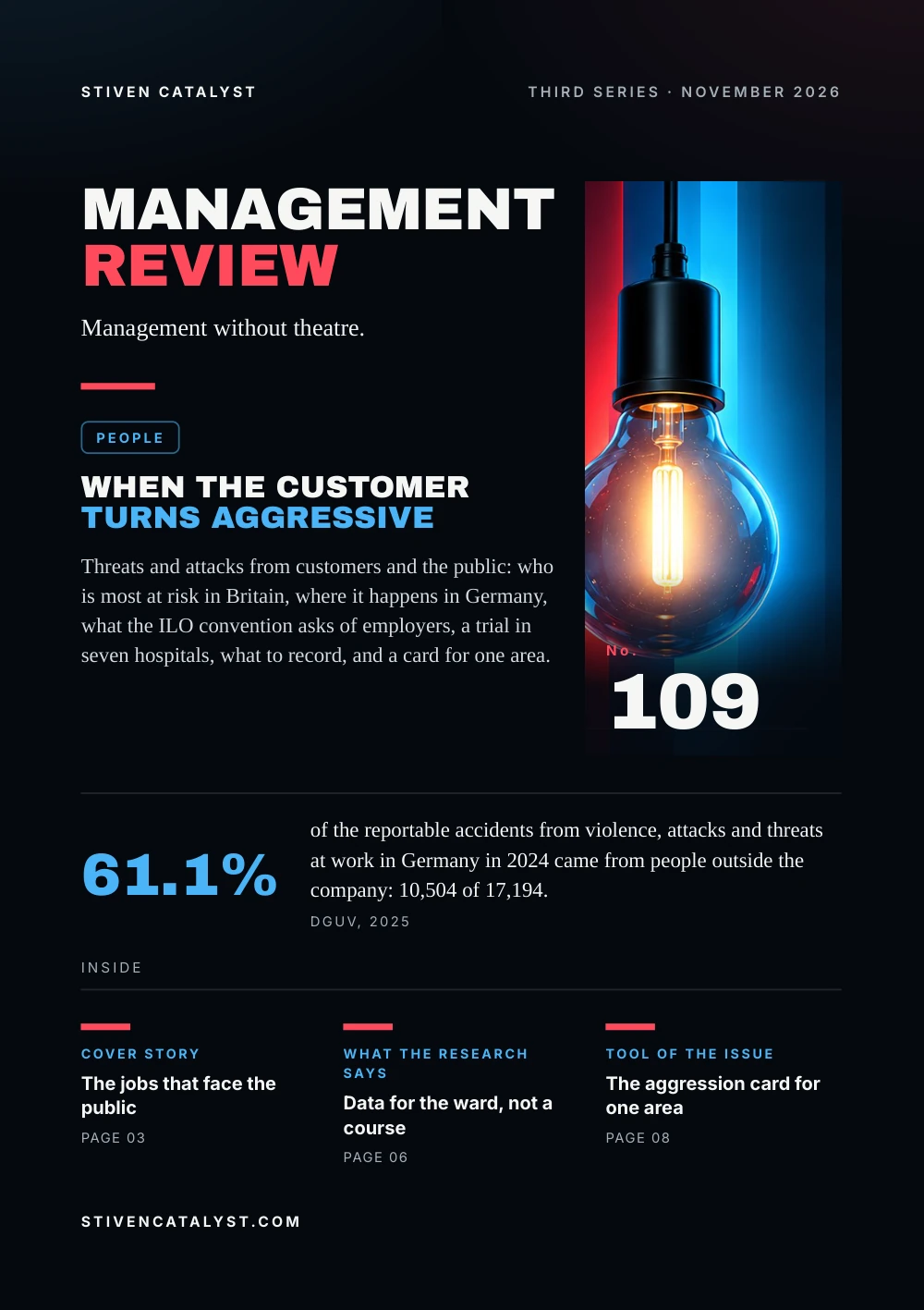 When the cus
t omer turns aggressive November 2026 Most violence at work does not come from colleagues. In Germany, 61% of the reportable accidents from violence, attacks and threats in 2024 came from people outside the company. Issue 109 shows which jobs carry the risk, what the ILO convention of 2019 asks of employers, what a trial in seven hospitals and a review of training found, what to record when it happens, and ends with a card for one area. -
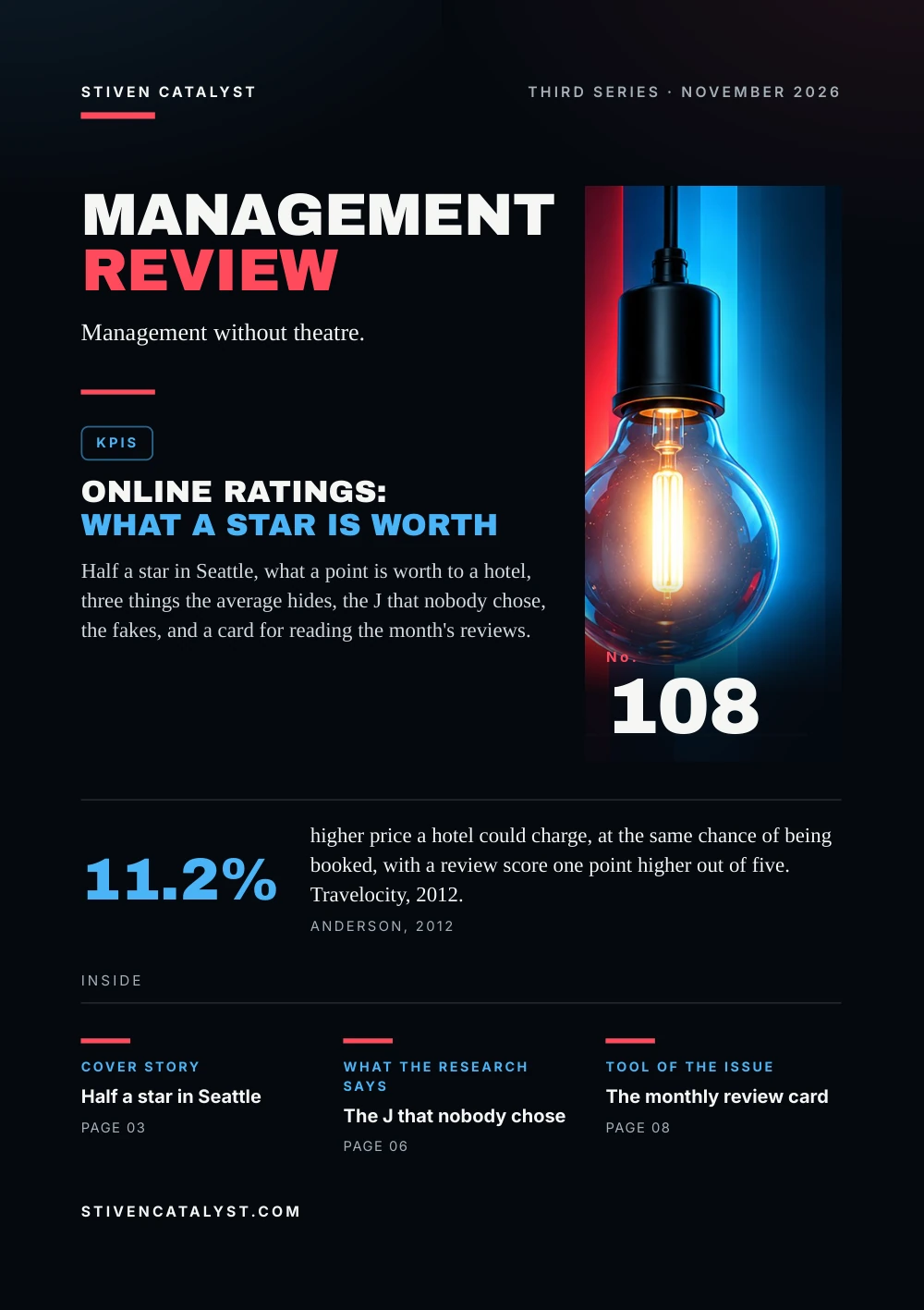 Online ratings: what a star is wo
r th November 2026 A guest choosing between two hotels sees 4.1 against 4.4 and books the second. Issue 108 asks what one star is worth: about 5% to 9% of revenue for an independent restaurant in Seattle, and 11.2% of price for a hotel on a booking site in 2012. Then it shows what the single average hides: how few people wrote, a J-shaped pile of fives and ones, and the share of reviews a platform flags as fake. A card for reading the month's reviews closes it. -
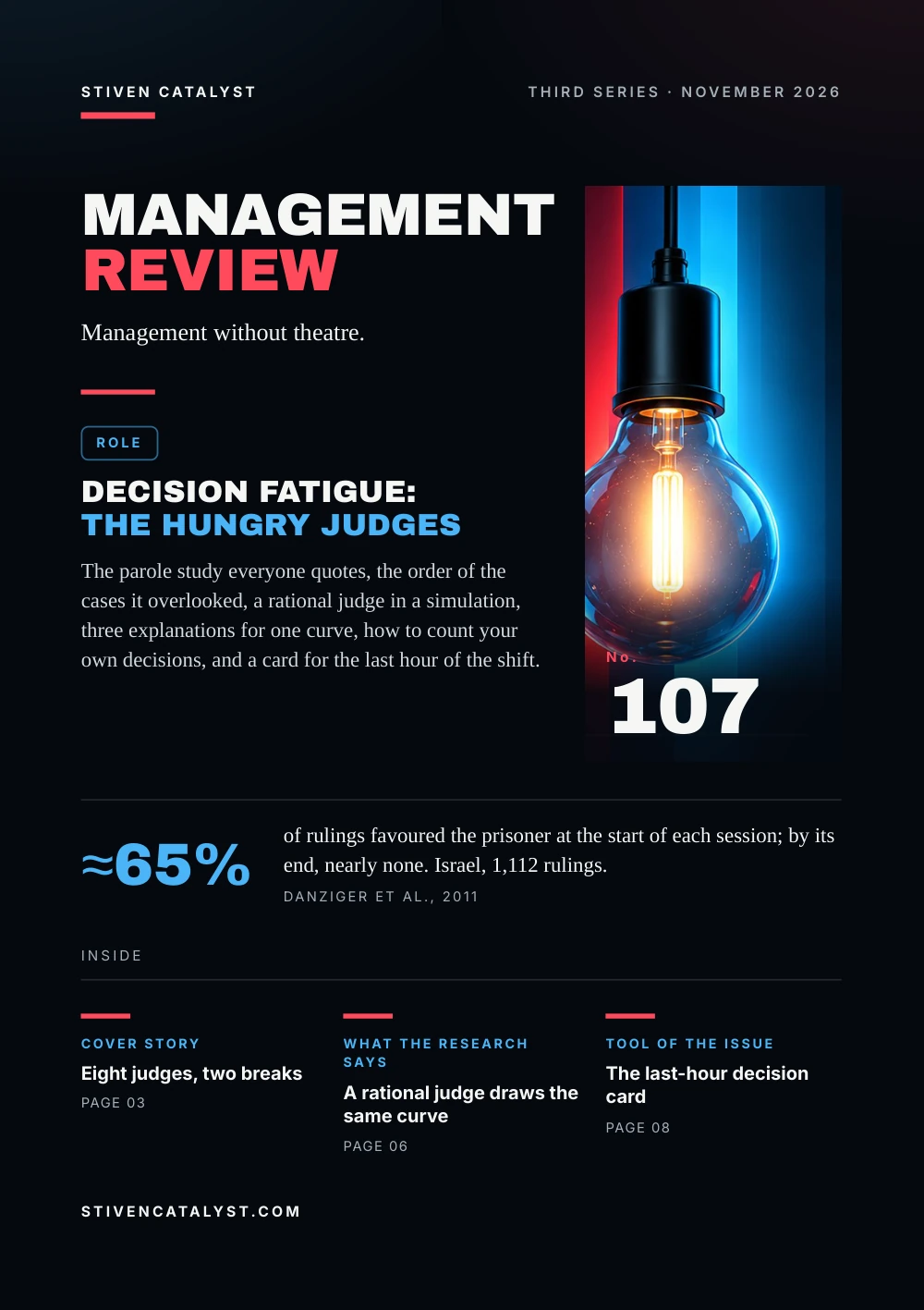 Decision fatigue: the hungry judges
November 2026
Few studies are quoted as often as the hungry judges: Israeli parole boards granted about 65% of requests at the start of a session and almost none at its end, until a food break reset them. Issue 107 reads the study, the letter that found the cases were not in random order, and a simulation in which a perfectly rational judge draws a similar curve. What remains is smaller, and still useful: a card for the decisions that come at the end of a shift.
-
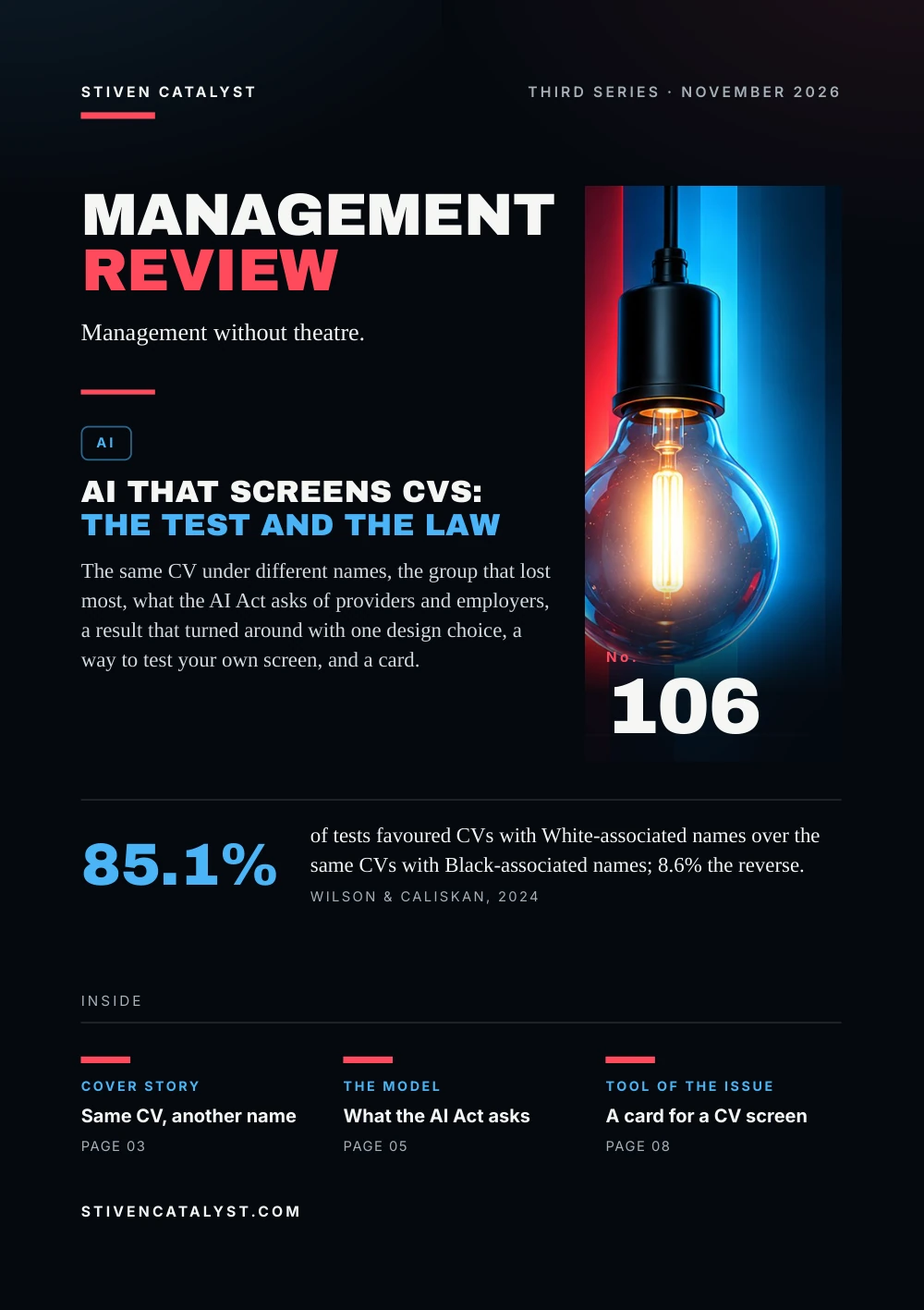 AI that screens CVs: the test and the law
November 2026
Two researchers at the University of Washington gave three AI models the same CVs, changing only the name at the top, and asked which CVs best fitted real job ads. CVs with names associated with White people were favoured in 85.1% of the tests; those with Black men's names never beat White men's. Issue 106 reads the study and its correction of 2026, then the rules the EU AI Act sets for AI that filters or ranks applicants: what the provider must check, what the employer must do, and when an employer becomes the provider. It ends with a name-swap test and a card for any system that screens CVs.
-
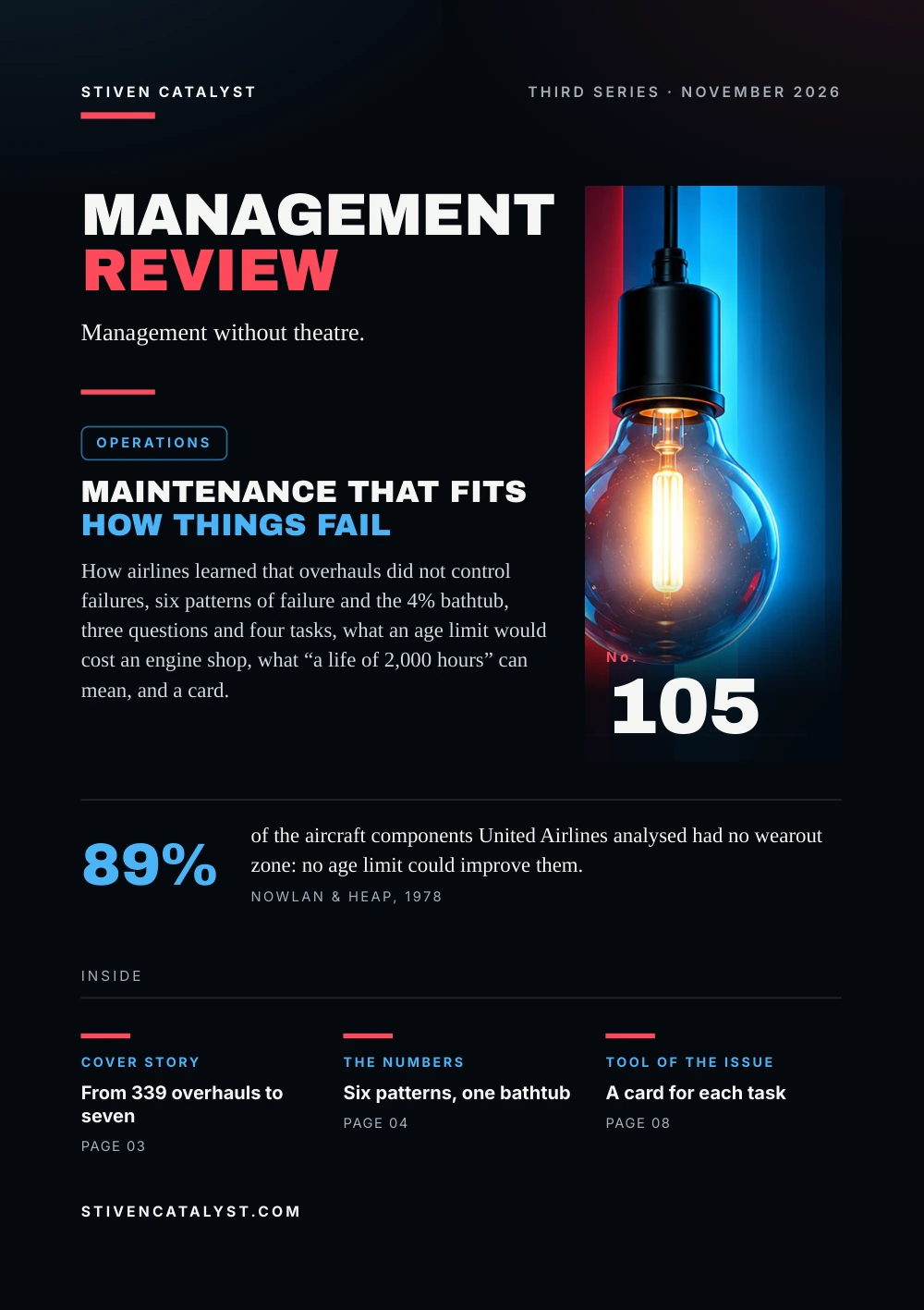 Maintenance that fits how things fail
November 2026
For decades the rule was simple: overhaul a machine often enough and it will not fail. When United Airlines charted the failure records of its aircraft components, 89% showed no age at which failures piled up, and only 4% followed the bathtub curve. Issue 105 reads the 1978 report by Nowlan and Heap that turned this into reliability-centred maintenance: three questions about the consequences of a failure, four kinds of task, the engine example that shows what an age limit costs, and NASA's guide that carried the method to buildings and plant. A card for each maintenance task closes the issue.
-
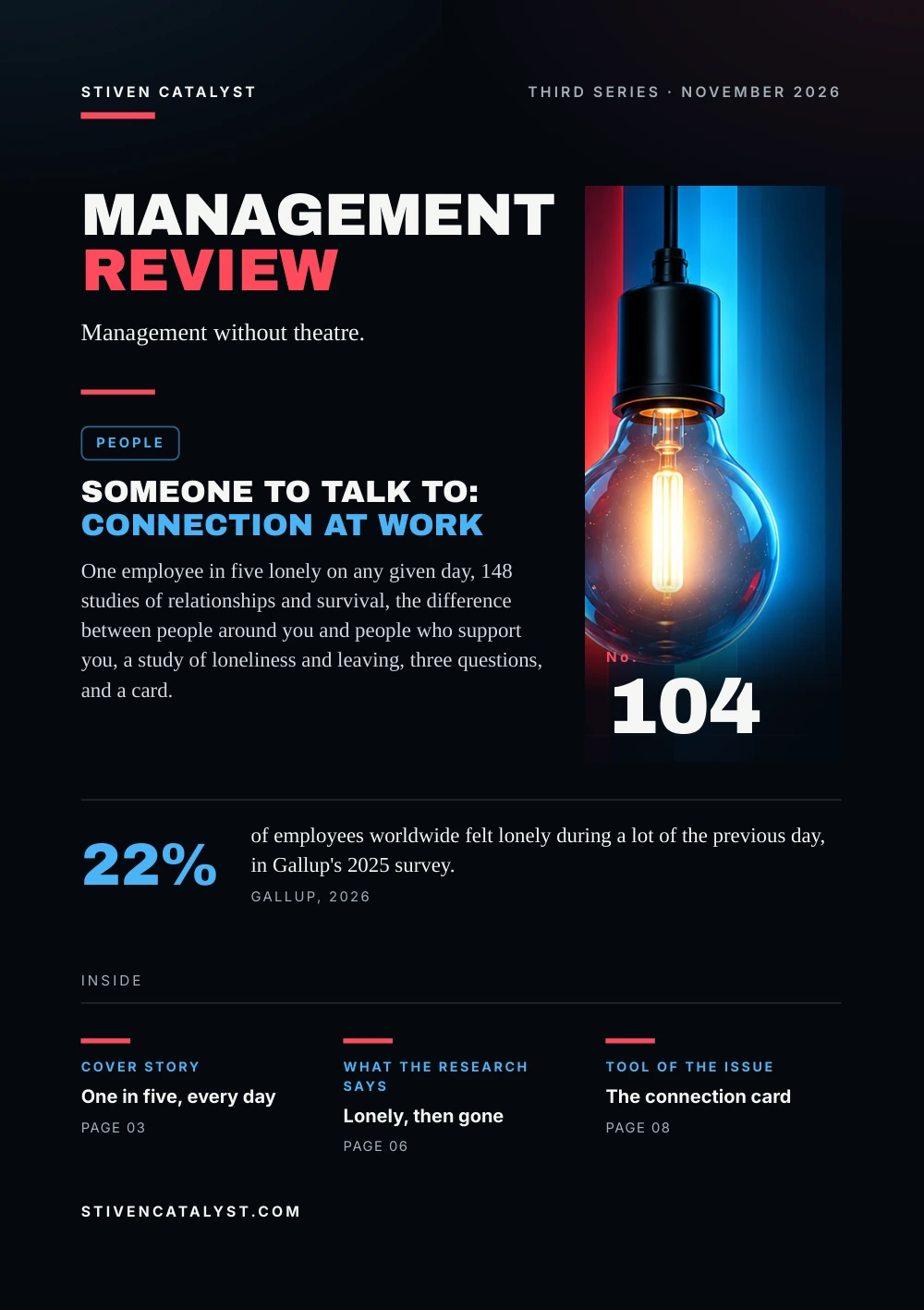 Someone
t o talkt o: connection at work November 2026 In Gallup's world survey, 22% of employees said they had felt lonely during a lot of the previous day. Issue 104 reads that data, a review of 148 studies that linked stronger relationships with 50% higher odds of survival, and the first study to follow workplace loneliness to people actually leaving their jobs. It separates being among people from being supported by them, offers three short questions a team can ask itself, and ends with a card for a leader's week. -
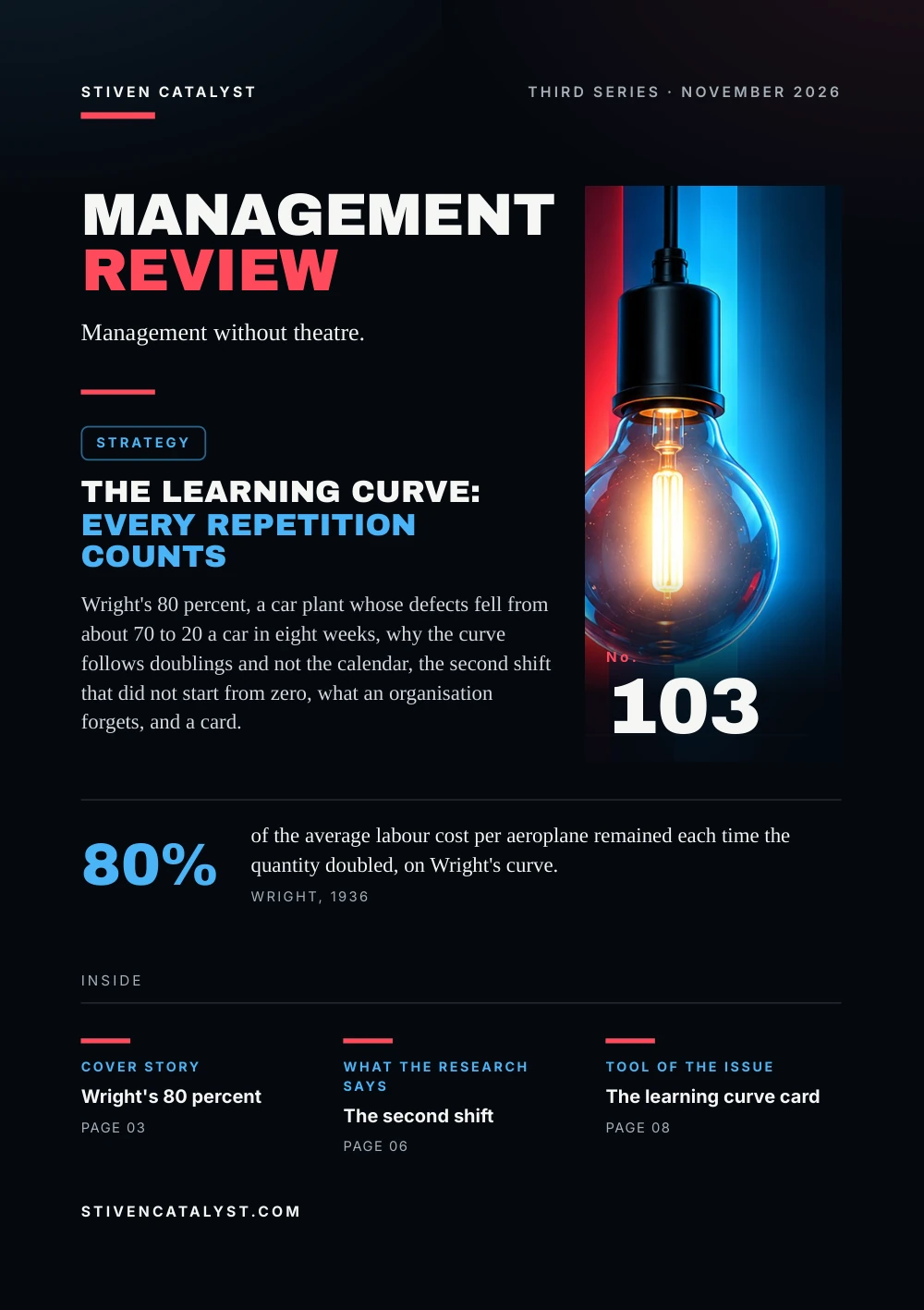 The learning curve: every rep
e tition counts November 2026 In 1936 an aircraft engineer wrote down a rule he had used since 1922: each time the quantity doubles, the average labour per aeroplane falls to about 80 percent. Issue 103 reads his paper, a test of six such laws on 62 technologies, a car plant whose defects fell by 70 percent in eight weeks and whose second shift began below the first, and an airliner whose labour hours rose again when experience was lost. It ends with a card for timing the first repetitions of a new process. -
 Ove
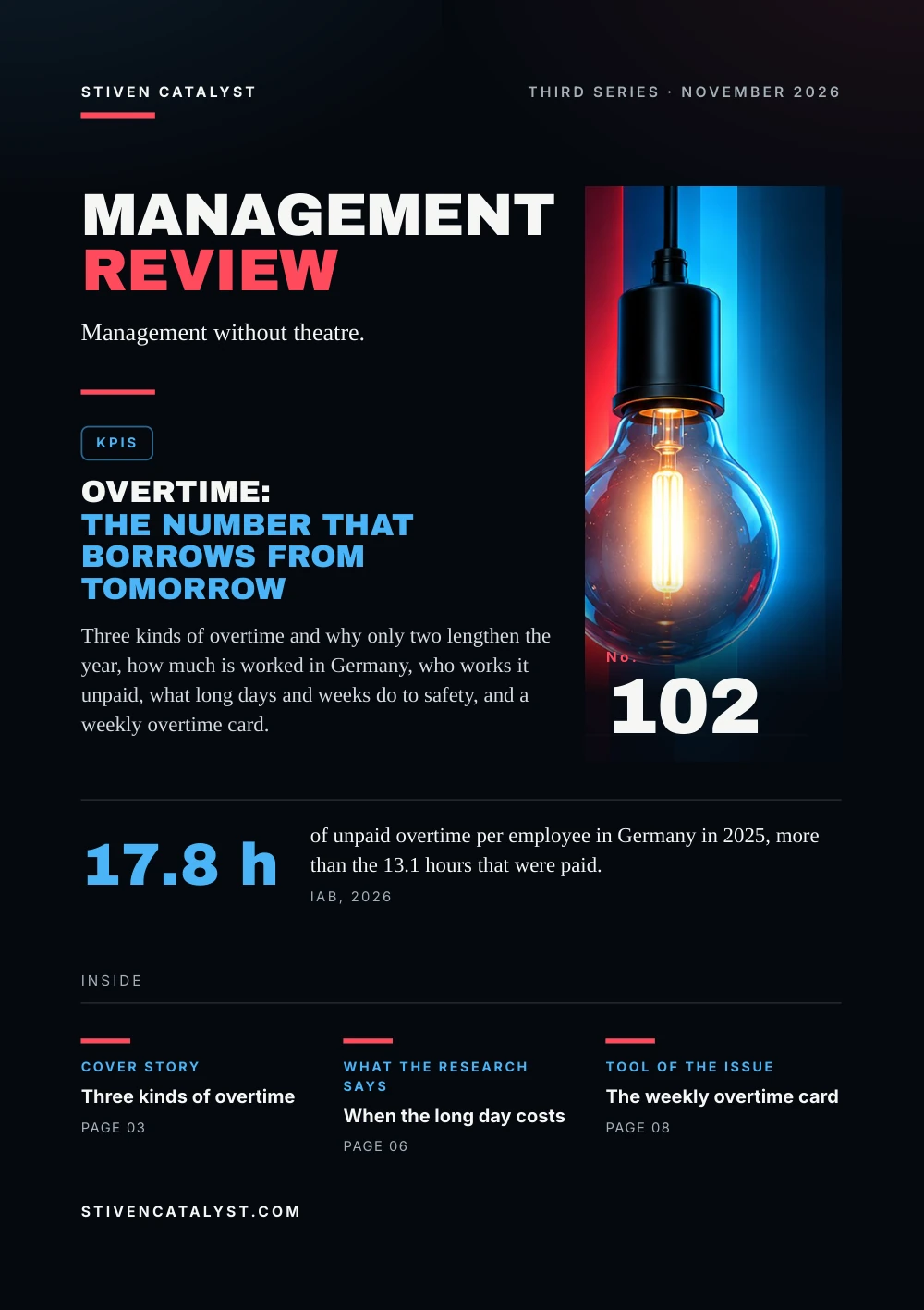
r time: the number that borrows fromt omorrow November 2026 Overtime is the cheapest way to cover a gap this week, and so it often becomes the plan. Issue 102 shows how the IAB counts it: paid, unpaid, and hours banked on a time account. In 2025 each employee in Germany worked 13.1 paid and 17.8 unpaid overtime hours on average. It then reads what a meta-analysis found about long days and weeks and safety incidents, what the law asks a site to record, and ends with a weekly overtime card. -
 Listening: what the other person takes away
November 2026
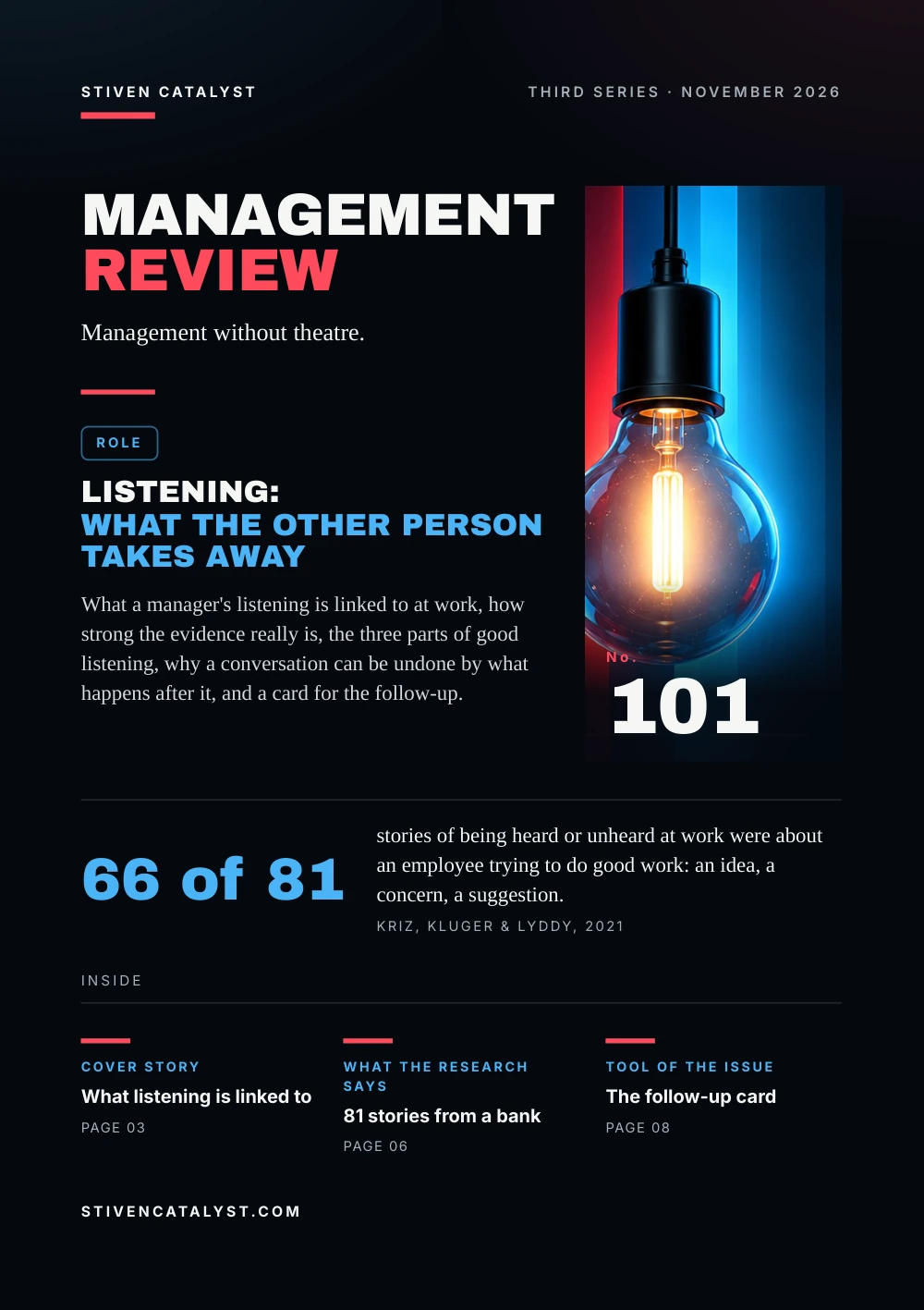
Managers are trained to present, to decide and to give feedback. Listening is rarely trained, and many think they already do it well. Issue 101 reads a meta-analysis of 664 effects on what feeling listened to is linked to at work, and how much of that holds once the self-reports are set aside. It then follows 81 stories told by bank employees, in which a good conversation was often undone by what did not happen after it, and ends with a card for the follow-up.
-
 Slips, trips and falls: the ordinary accident
November 2026
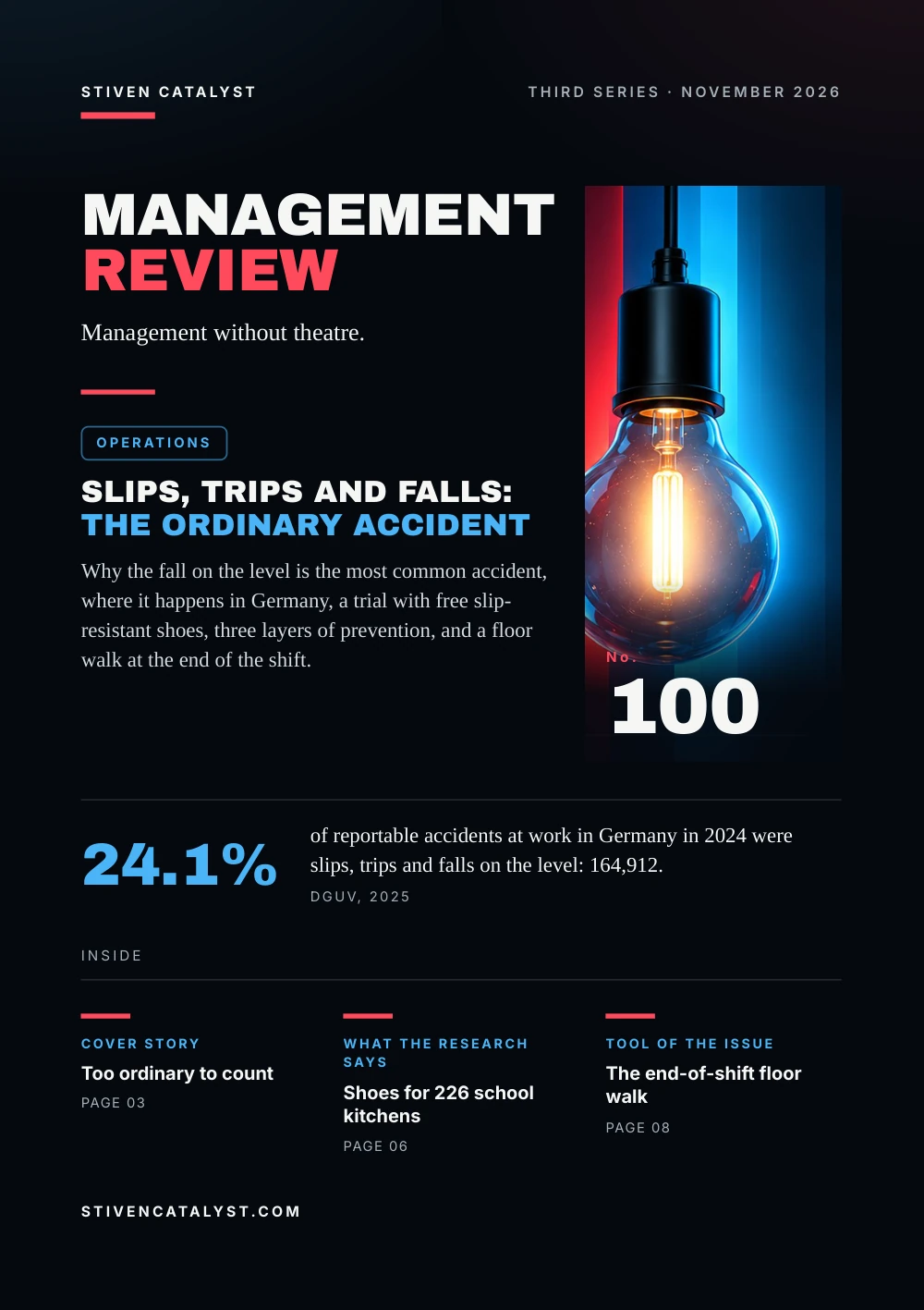
A wet floor seldom gets an inquiry. Yet slips, trips and falls on the same level are the most common injury employers report in Great Britain, and one in four reportable accidents at work in Germany. Issue 100 shows how serious these ordinary falls are, where they happen, what free slip-resistant shoes did in 226 school districts, how prevention is built in three layers, and ends with a floor walk for the end of the shift.
-
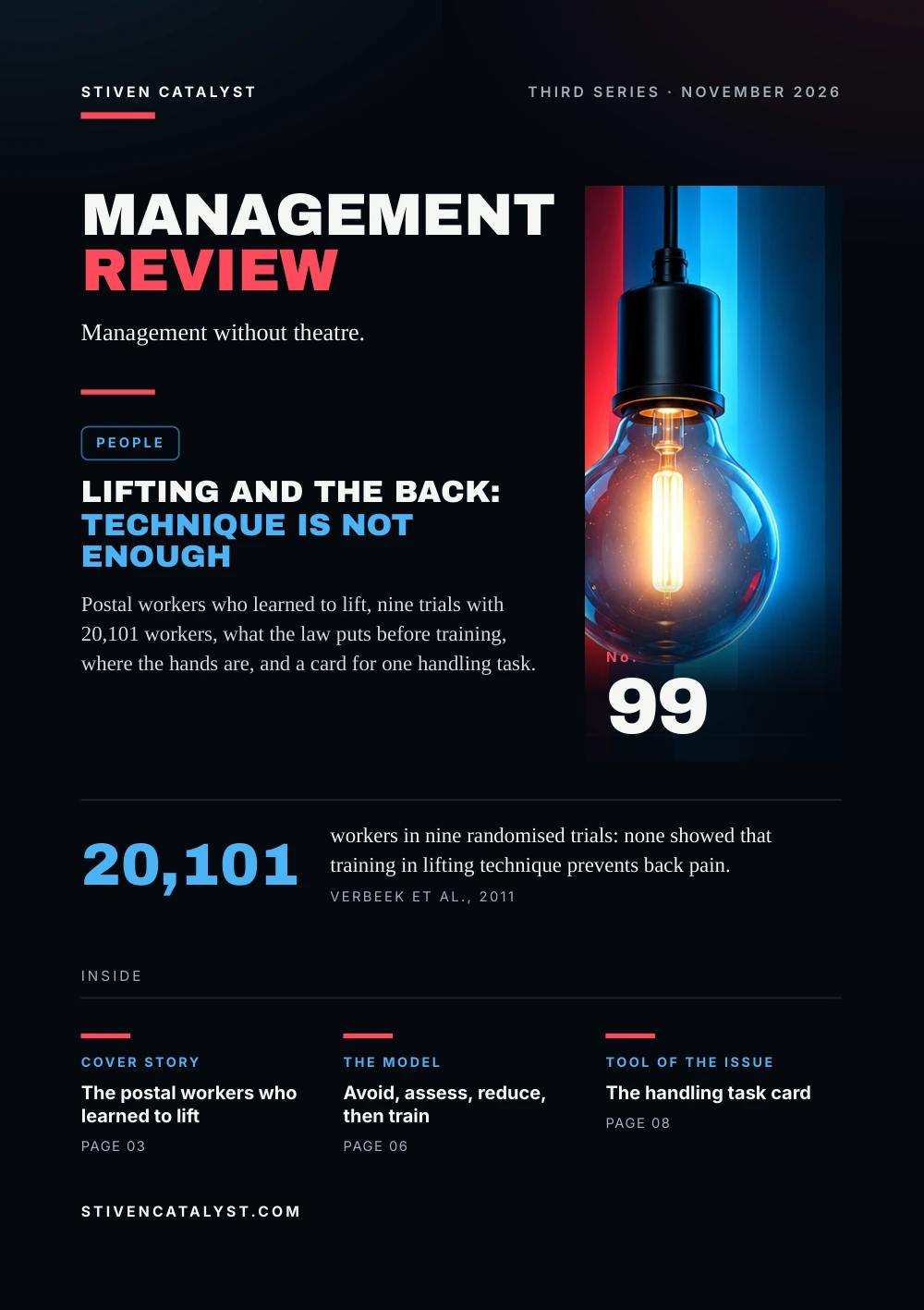 Li
f ting and the back: technique is not enough November 2026 The lifting course is the most common answer to back pain in heavy work. Issue 99 follows 3,597 postal workers who were trained to lift and watched for five and a half years, then reads the Cochrane review of nine trials with 20,101 workers. It sets beside them how common back pain is in Europe, the order of measures that EU law and HSE prescribe, HSE's filter of weights by where the hands are, and a card for one handling task. -
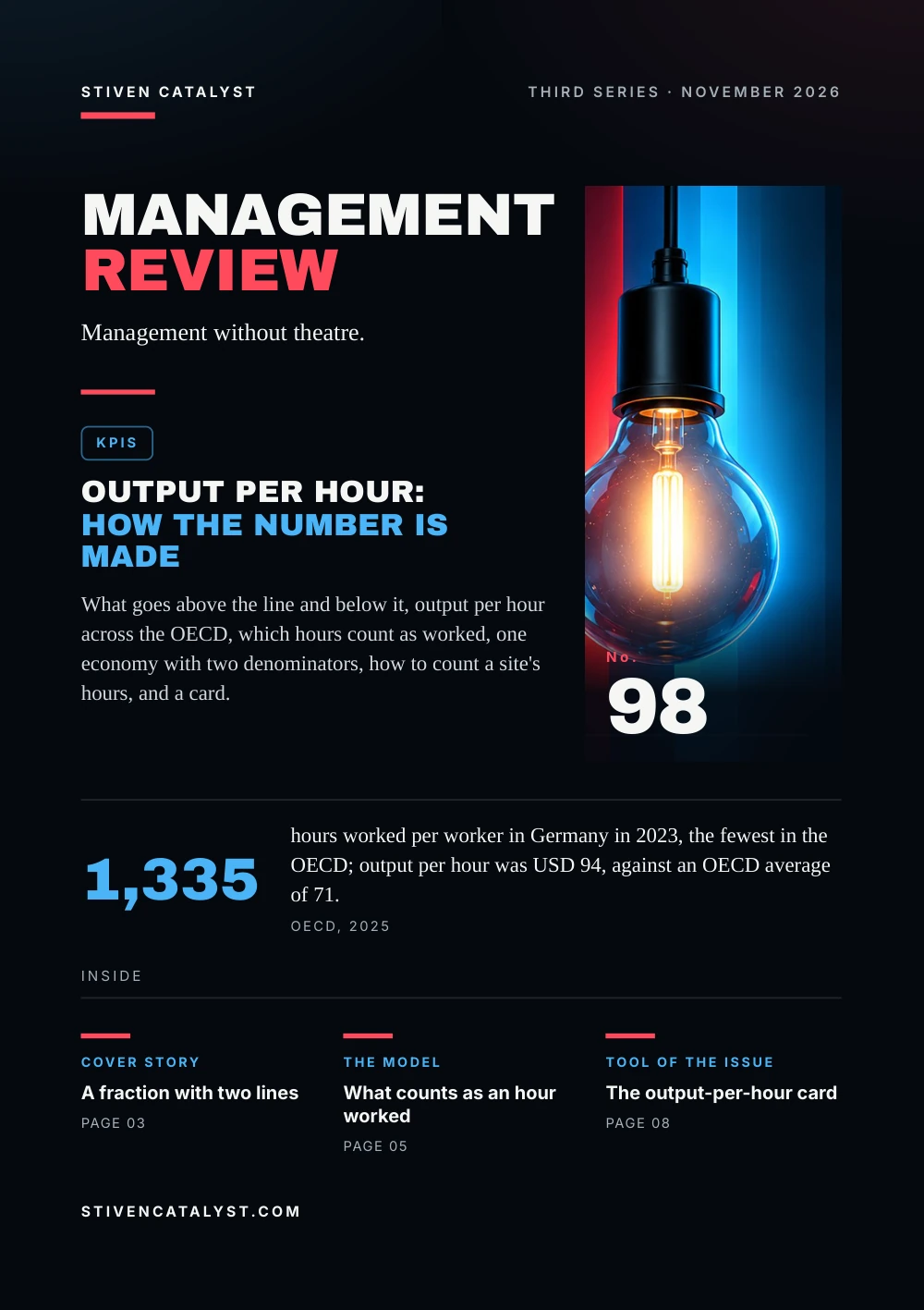 Output per hour: how the number is made
November 2026
Productivity per hour is a fraction: output above the line, hours actually worked below it. Issue 98 takes it apart. It follows the OECD's choices for both lines, sets output per hour in five economies and the OECD average beside the hours each worker puts in, and reads the ILO's rule for what counts as an hour worked, waiting at a stopped machine included. Germany's figures for 2022 to 2025 show one economy giving two answers per person and per hour. It ends with a way to count a site's hours, and a card.
-
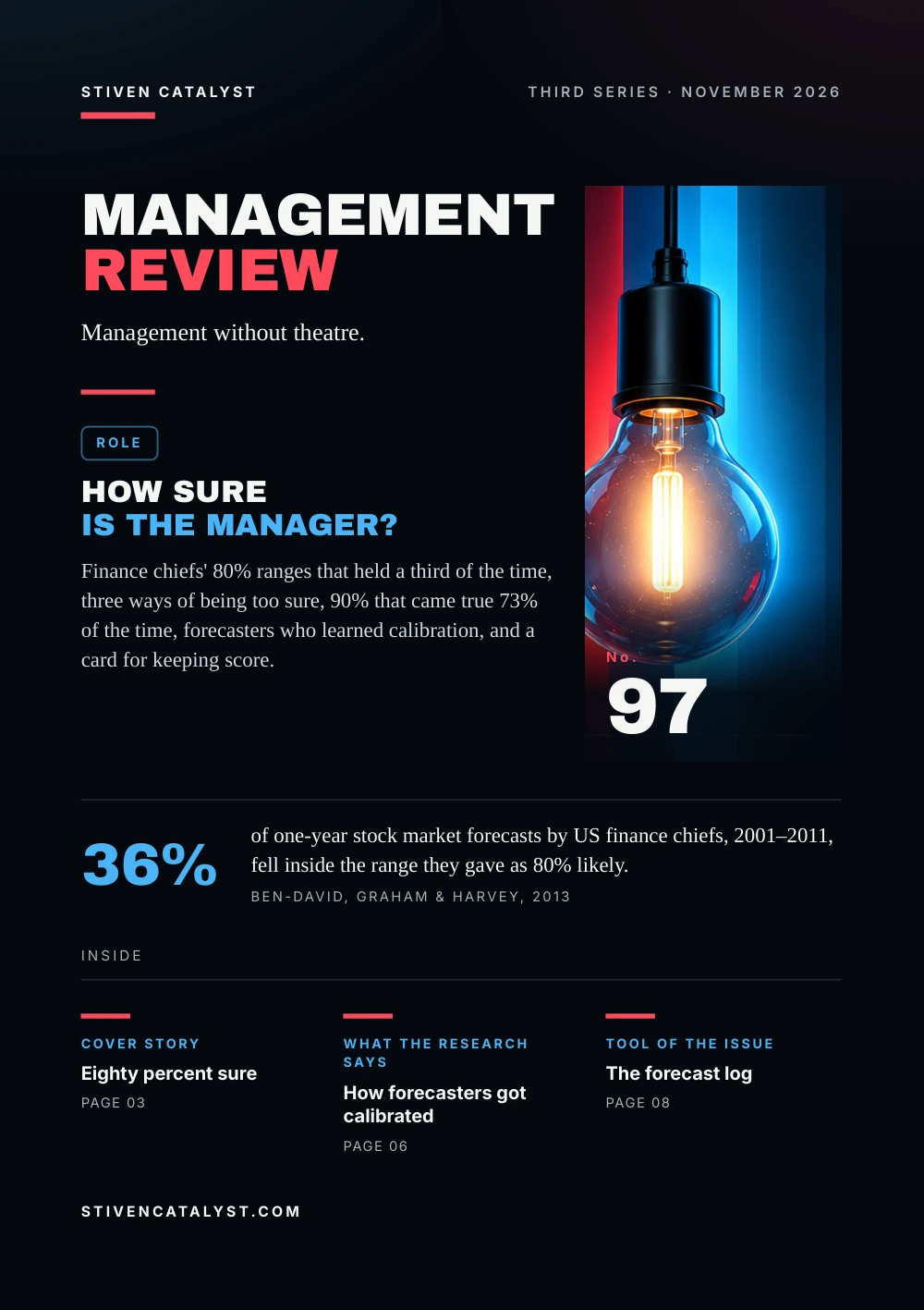 How sure is the manager?
November 2026
For ten years, finance chiefs of US companies gave a forecast for the stock market with a range they were 80% sure of; the market landed inside it about a third of the time. Issue 97 starts there. It separates three ways of being too sure, follows students whose 90% ranges were right 73% of the time, and turns to a forecasting tournament in which thousands of volunteers became almost as well calibrated as weather forecasters. It ends with a way to keep score of your own certainty, and a card.
-
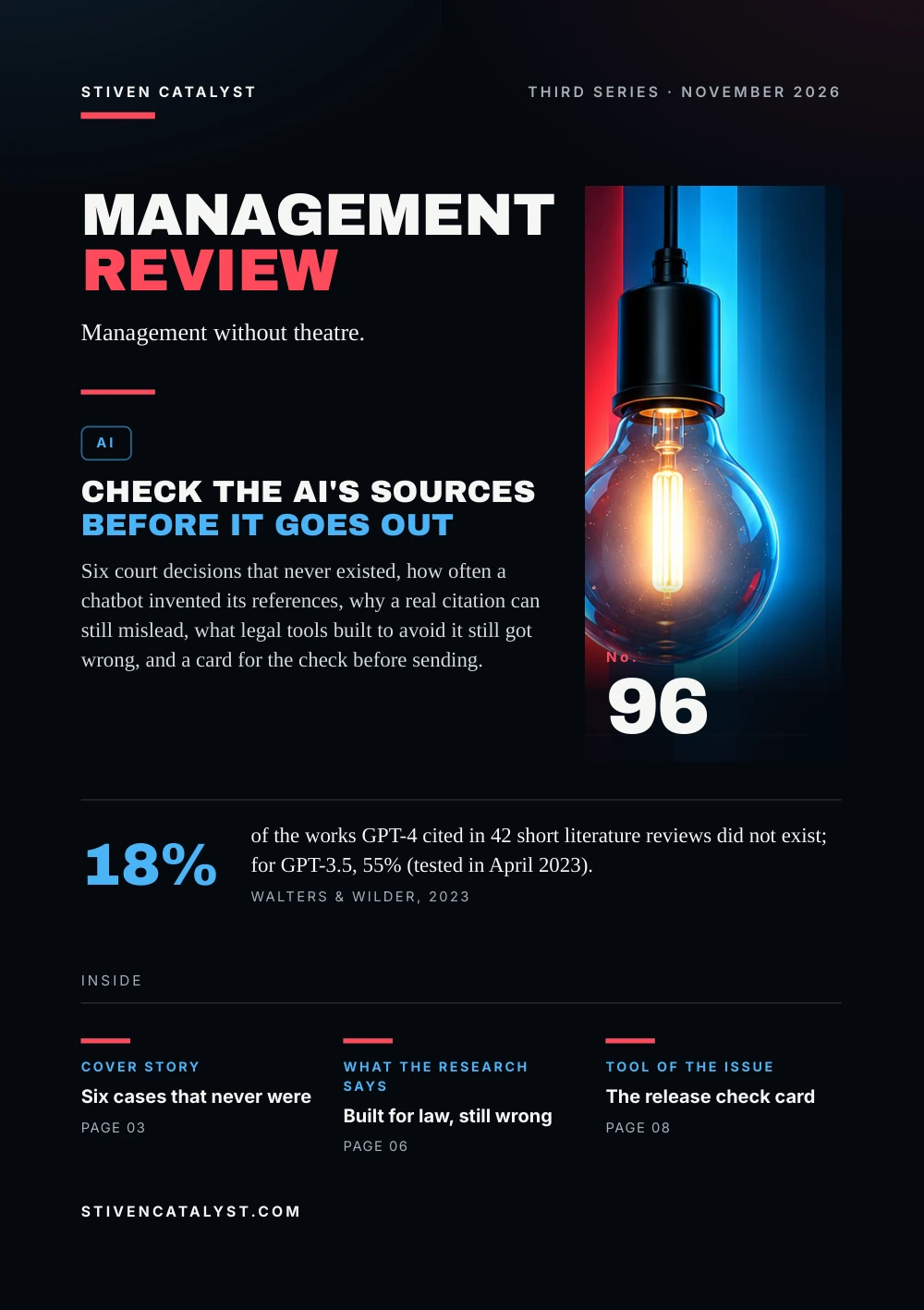 Check the AI's sources before it goes out
November 2026
In 2023 a New York court fined two lawyers and their firm for a filing that cited six decisions ChatGPT had made up. Issue 96 follows that case, then a study that checked 636 references written by two versions of ChatGPT, and a test of legal research tools marketed as avoiding such errors. It separates the false answer from the real source cited for what it does not say, and ends with the questions to ask of every source before an AI-assisted text leaves the team.
-
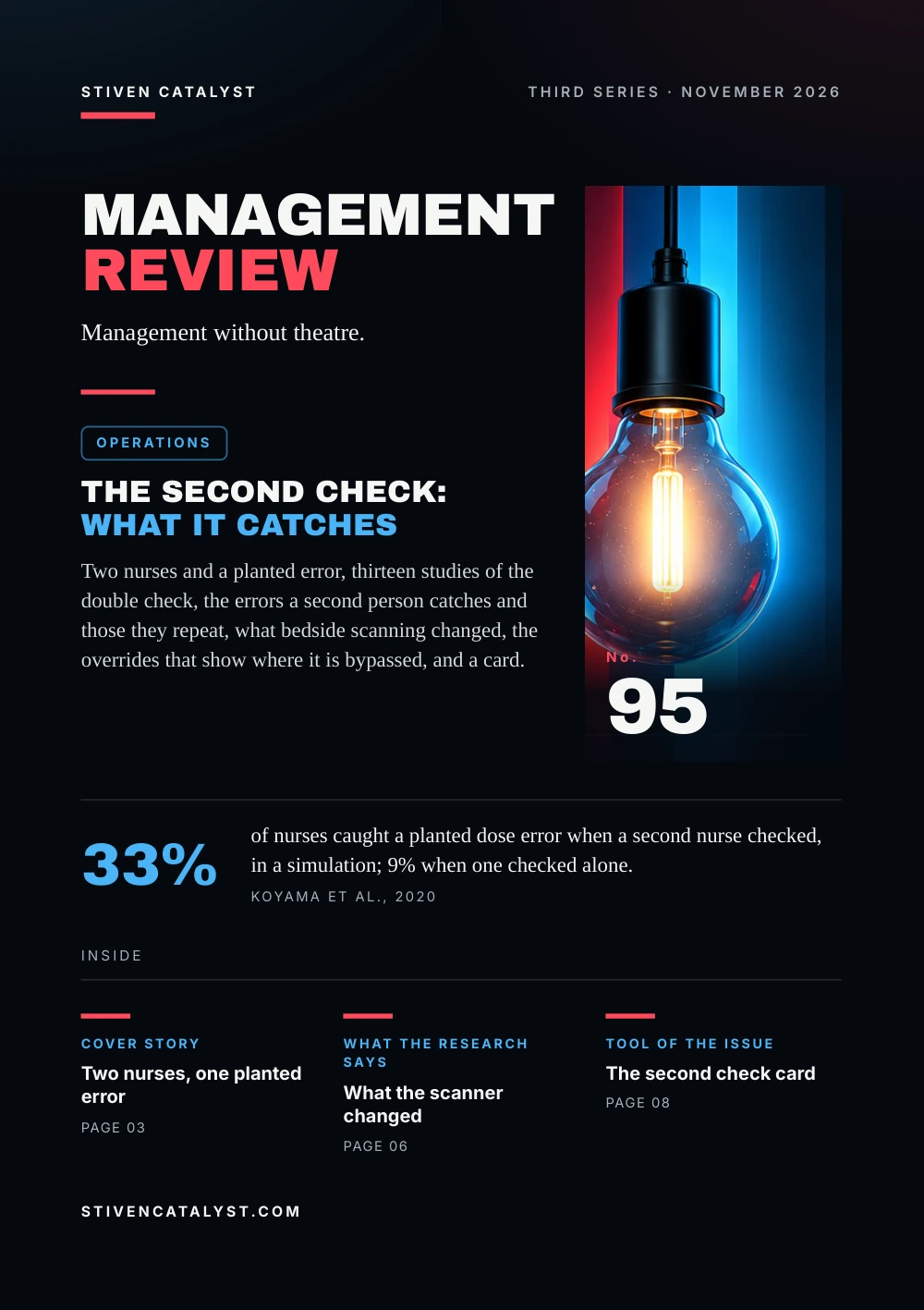 The second check: what it ca
t ches November 2026 In a simulation, two nurses caught every wrong vial and still missed two dose errors in three. Issue 95 reads a review of 13 hospital studies of the double check, which found little proof that it lowers errors, and the advice of the Institute for Safe Medication Practices on when a second person helps. It then looks at what bar-code scanning at the bedside changed, at the override logs that show where scanning is bypassed, and ends with a card for each check a team relies on. -
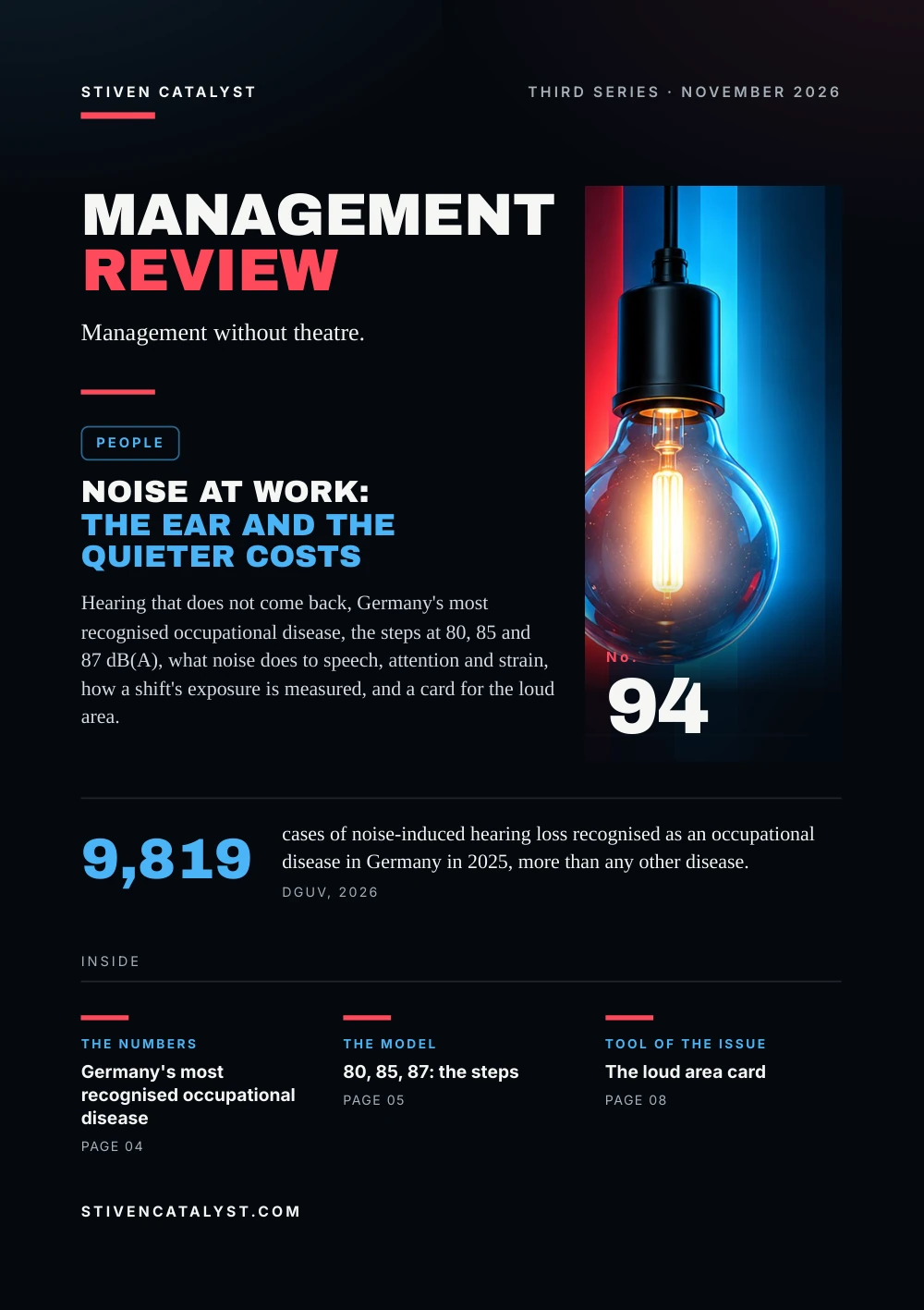 Noise at work: the ear and the qui
e ter costs November 2026 Noise takes hearing slowly and does not give it back. Issue 94 starts with the ear: why noise-induced hearing loss is permanent and what it does to speech and attention. It shows that in Germany it was the most often recognised occupational disease in 2024 and 2025, sets out the EU and German steps at 80, 85 and 87 dB(A), reads what noise costs below those levels, explains how a shift's exposure is measured, and ends with a card for the loud area, from the source to the ear. -
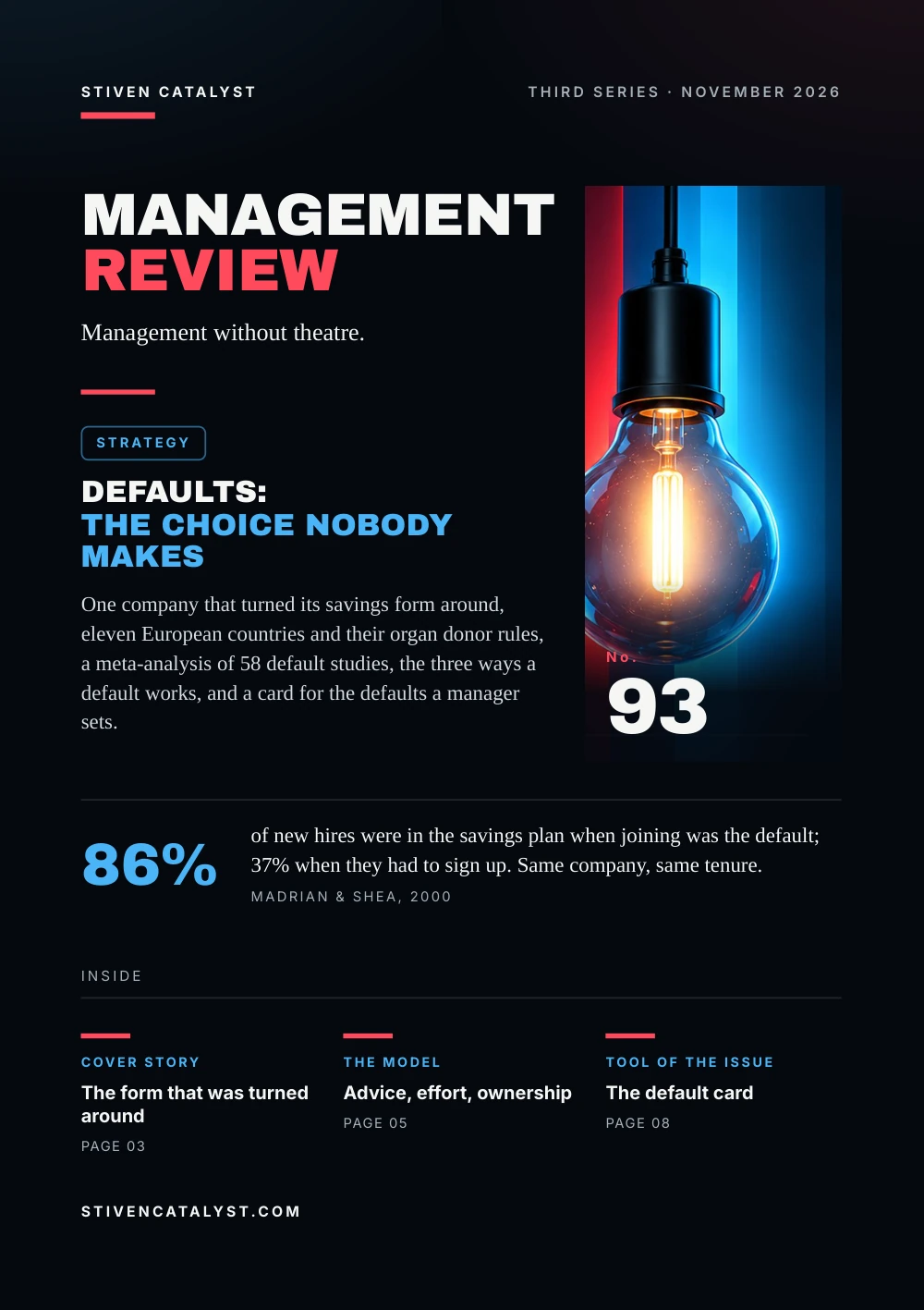 Defaults: the choice nobody makes
November 2026
Every form, roster and checklist has an answer already filled in for those who do nothing. Issue 93 follows a US company that made its savings plan opt-out: joining more than doubled, and most new members stayed exactly where the form had put them. It compares European countries whose organ donor rules differ by one default, reads a meta-analysis of 58 studies, explains the three ways a default works, and ends with a card for auditing the defaults a manager sets.
-
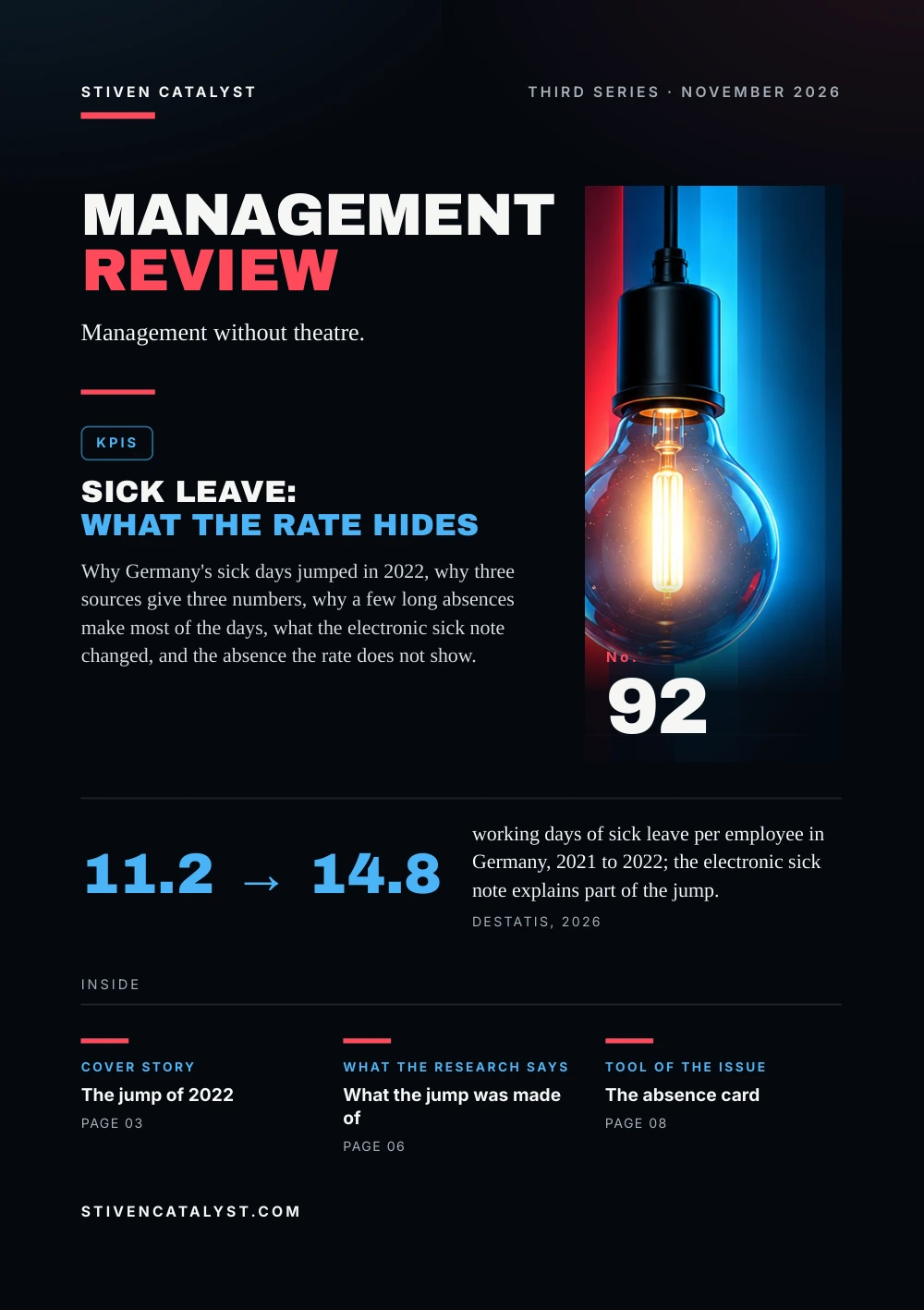 Sick leave: what the rate hides
November 2026
In 2022 German employees were suddenly off sick for 14.8 working days instead of 11.2. Issue 92 asks how much of that was illness and how much was counting. It sets three official and insurer figures side by side, shows that a few long absences make up most of the days, follows DAK's analysis of the jump after the electronic sick note, and looks at what the rate does not show: the people who came to work sick. A card for reading the team's rate closes the issue.
-
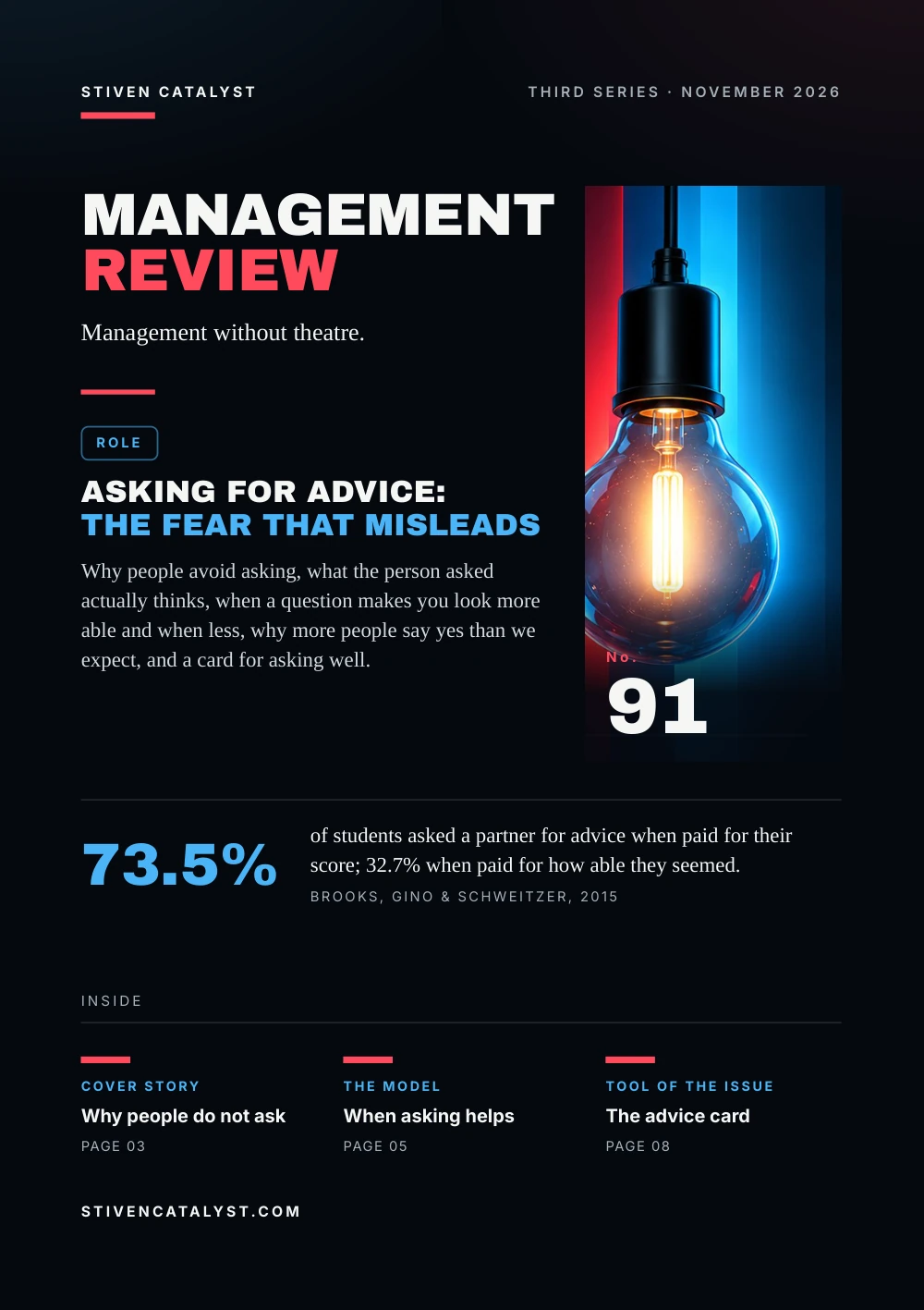 Asking for advice: the fear that misleads
November 2026
People hold back a question because they fear it will make them look less able. Issue 91 reads two research papers that tested this fear. In eight studies the person asked rated the asker as more capable, not less, as long as the task was hard, the request came to them and they knew the subject. In six more, people asking strangers for help needed far fewer of them than they had predicted. The issue ends with a card for asking well.
-
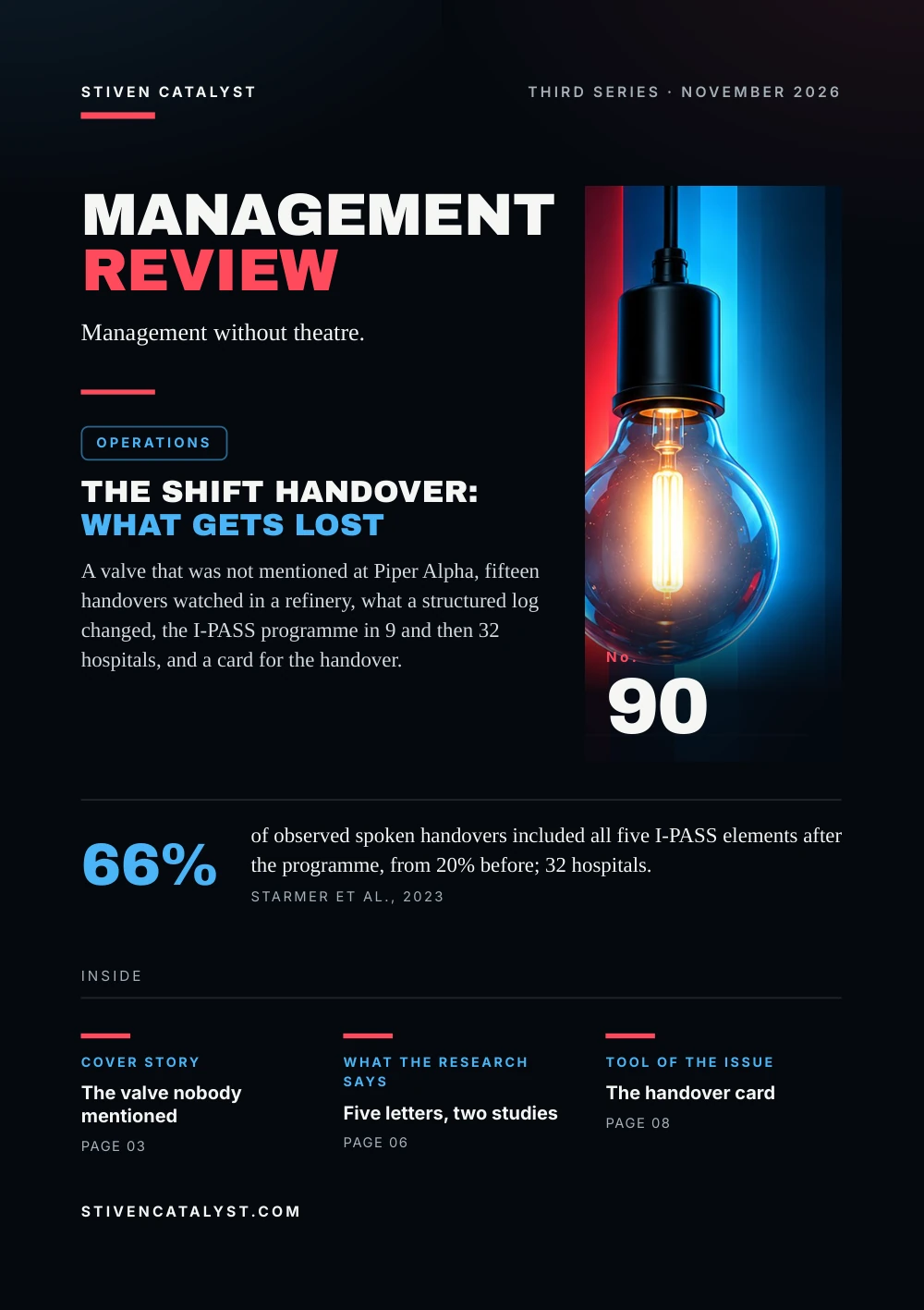 The shi
f t handover: what ge ts lost November 2026 On 6 July 1988 the night shift on Piper Alpha restarted a pump whose safety valve had been removed; the evening handover had not passed that on. Issue 90 reads the inquiry's chapter on handovers, then watches fifteen handovers in a refinery and follows what a structured log changed there. It sets the five parts of I-PASS beside the refinery's log, gives the results of the programme in 9 and then 32 hospitals, and ends with the marks of a handover that works and a card. -
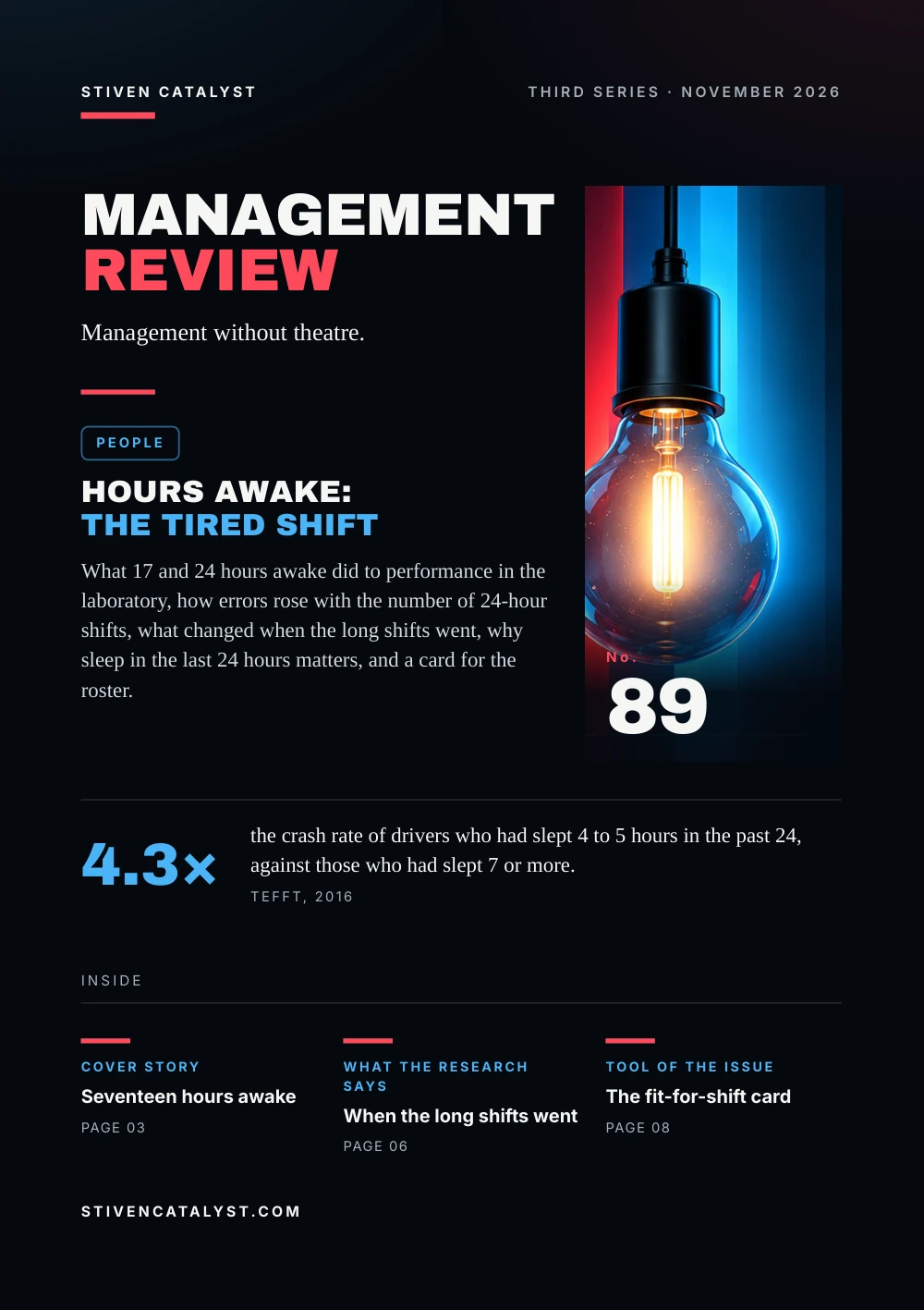 Hours awake: the tired shi
f t November 2026 In the laboratory, people kept awake for 17 to 19 hours performed on some tests as they did with a blood alcohol level of 0.05%. Issue 89 follows the hours awake from the laboratory to the hospital ward and the road: fatigue-related errors in months with many 24-hour shifts, a trial that removed those shifts, and a study of crashes by sleep in the last 24 hours. It ends with three things a roster can count and a card to check a shift before it starts. -
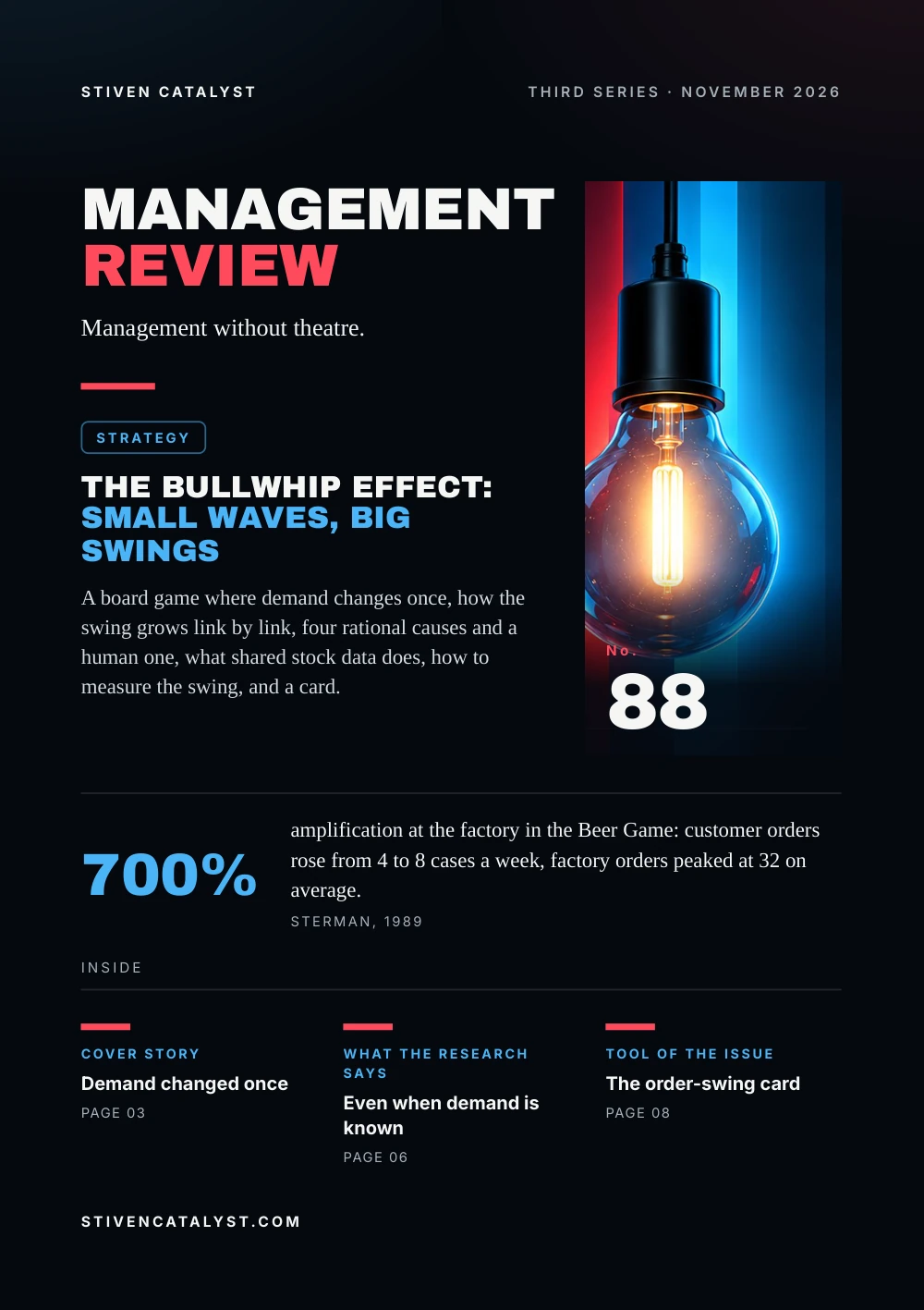 The bullwhip effect: small waves, big swings
November 2026
In the Beer Game, customer demand rises once, from four cases a week to eight, and stays there. Factory orders still peaked at 32 on average. Issue 88 follows the swing from the shop to the factory, sets the four causes that Lee, Padmanabhan and Whang found in rational ordering beside the one Sterman found in people, and shows what shared inventory data did in a later experiment. A ratio for measuring the swing and a card for one link close the issue.
-
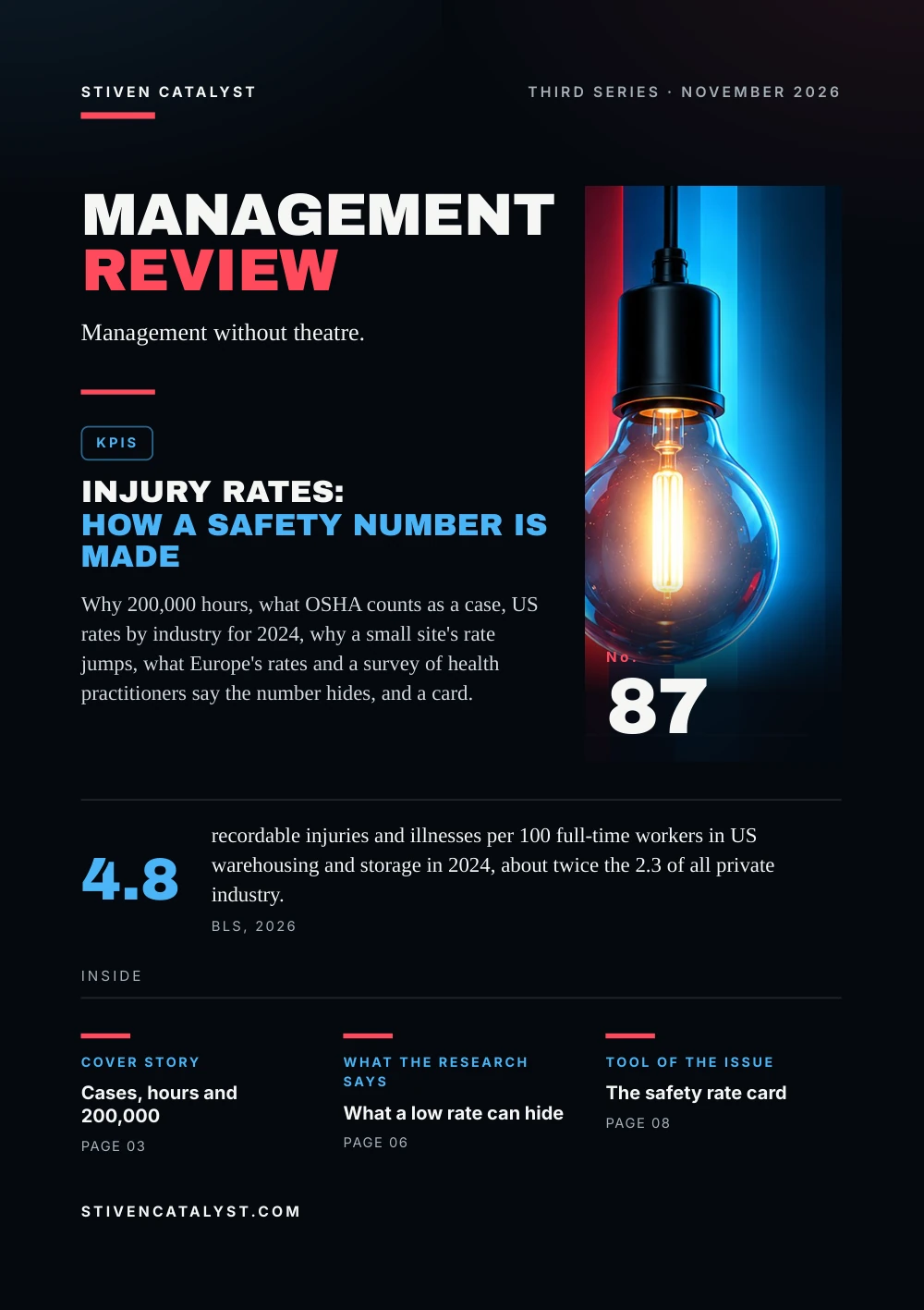 Injury rates: how a saf
e t y number is made November 2026 A safety rate is a fraction: cases on top, hours below, and a constant that turns it into cases per 100 full-time workers. Issue 87 takes the number apart. It follows the US formula and OSHA's line between first aid and a recordable case, sets the 2024 rates of six industries beside the private-sector average, and shows why one case can double a small site's rate. Eurostat's country figures and a survey of occupational health practitioners show what a low rate can hide. A card for reading a safety number ends the issue. -
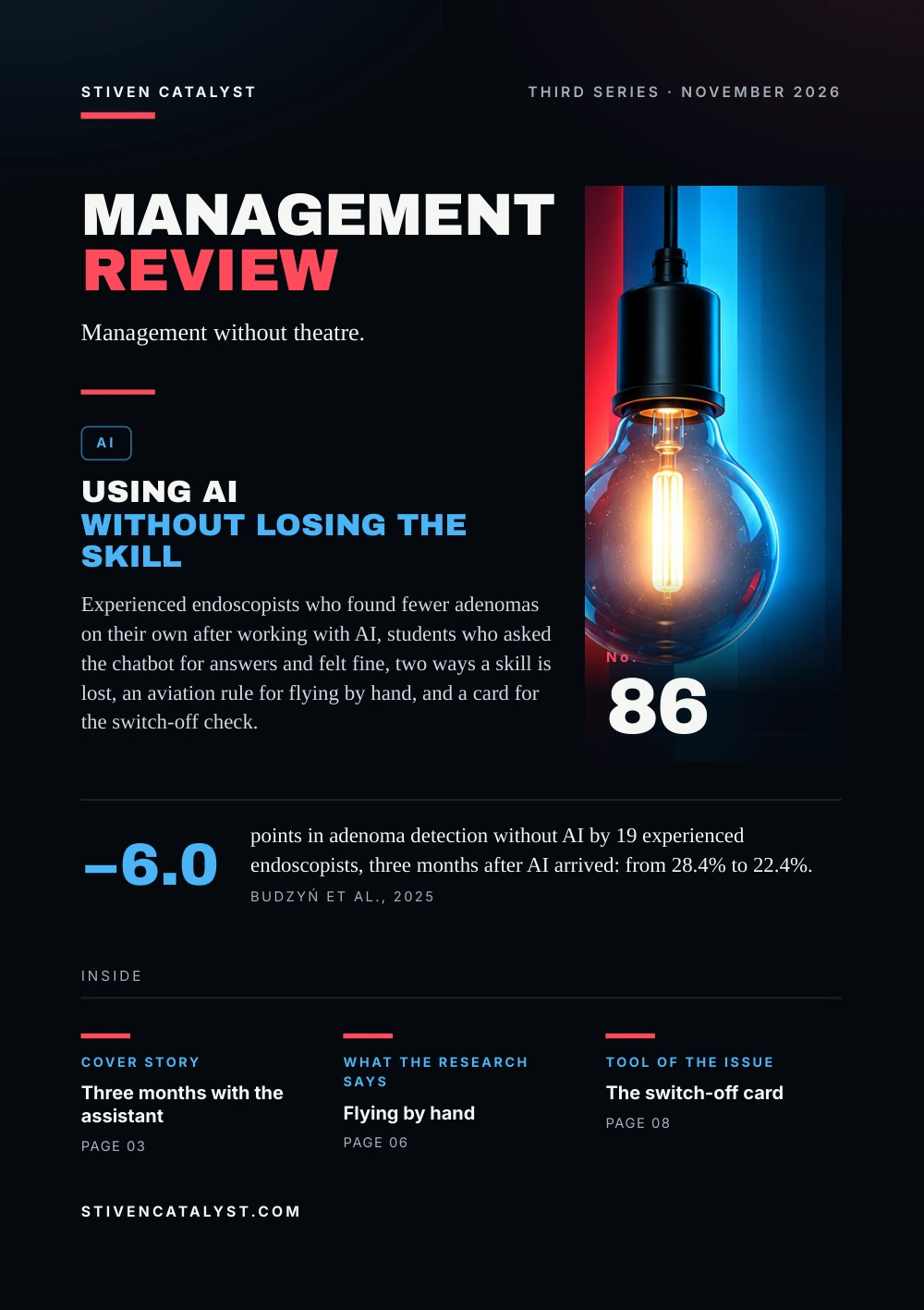 Using AI without losing the skill
November 2026
Most studies of AI at work measure what people do with the tool. Issue 86 asks what they can still do without it. In four Polish clinics, experienced endoscopists found fewer adenomas on the days the AI was off, three months after it arrived. In a Turkish school, students with an open chatbot mostly asked for the answer and did not notice they had learned less. A theory of two ways to lose a skill, aviation's long experience with autopilots, five marks of a team that keeps its skill and a card close the issue.
-
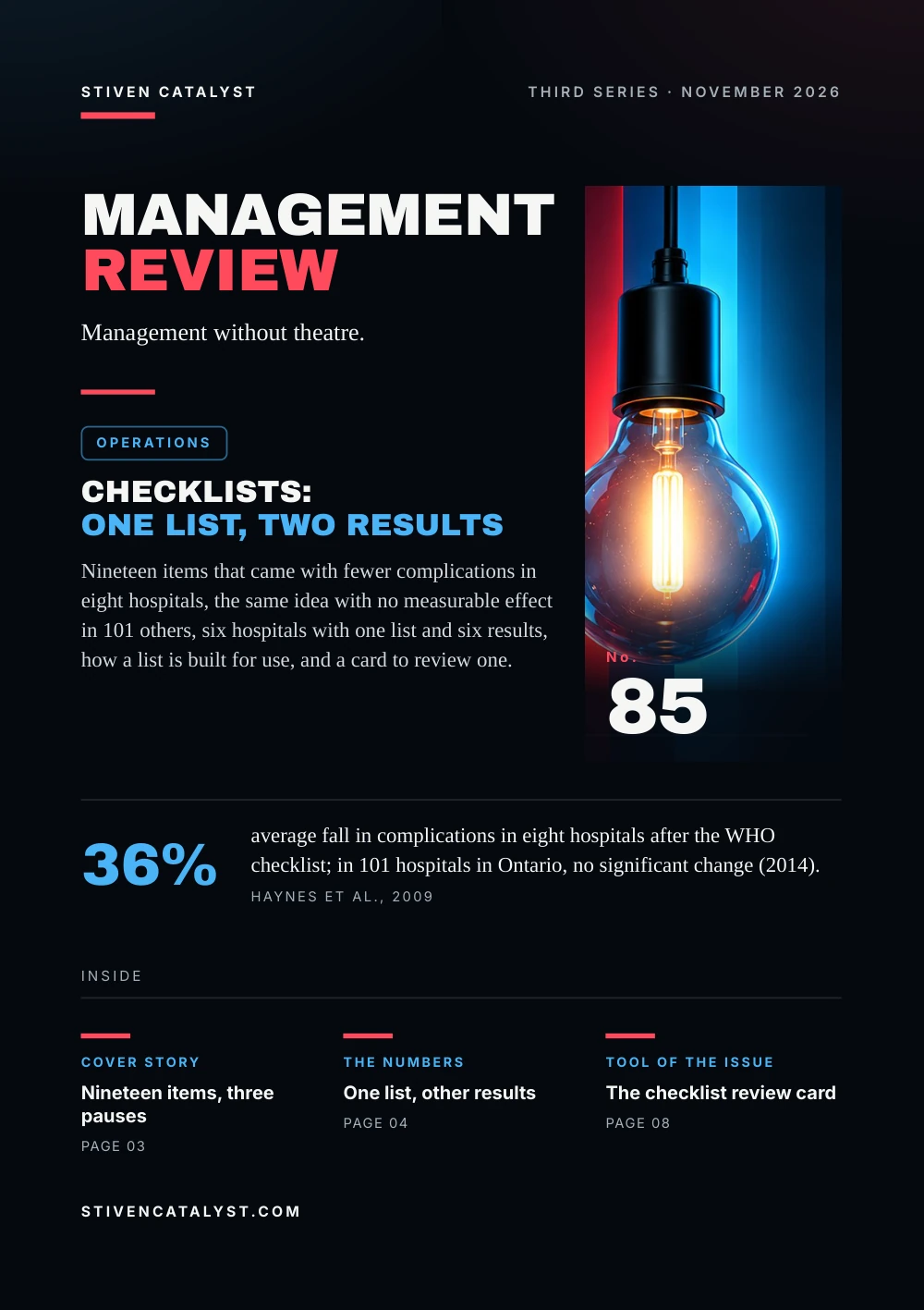 Checklists: one list, two results
November 2026
In 2009 a 19-item checklist of the World Health Organization was followed by fewer complications and deaths in eight hospitals around the world. Five years later, 101 hospitals in Ontario showed no significant change after adopting checklists. Issue 85 sets the studies side by side, follows one Dutch list through six hospitals with six different results, and takes the design rules of NASA's checklist research and the WHO manual. A card to review a list closes the issue.
-
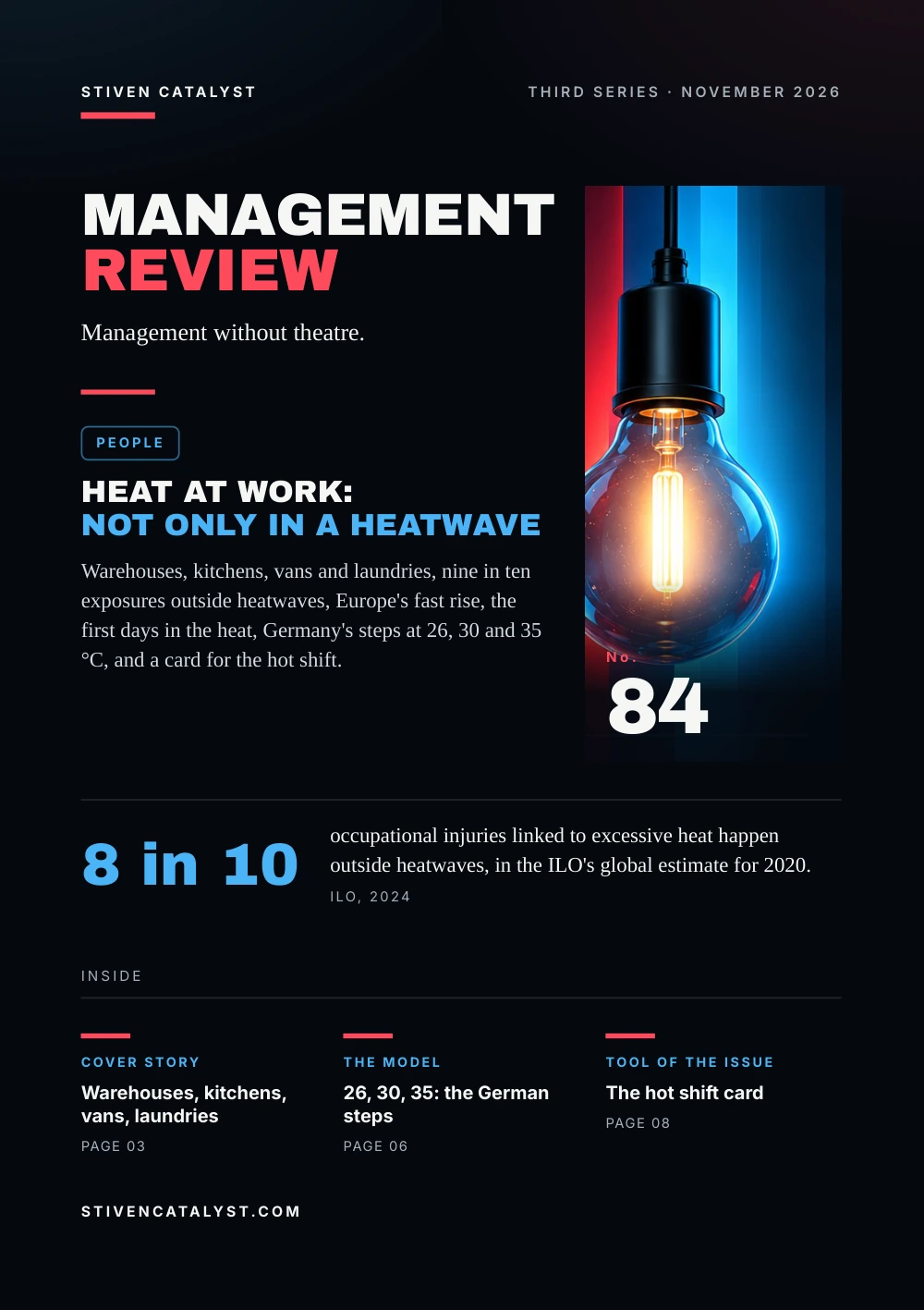 Heat at work: not only in a heatwave
November 2026
Heat at work is not only a building site at noon. Issue 84 starts indoors and on the road: warehouses, kitchens, delivery vans and laundries. It shows that nine in ten exposures to excessive heat happen outside heatwaves, that Europe has the lowest share and the fastest rise, and why the first days in the heat are the riskiest. Germany's steps at 26, 30 and 35 °C, how to measure, and a card for the hot shift end the issue.
-
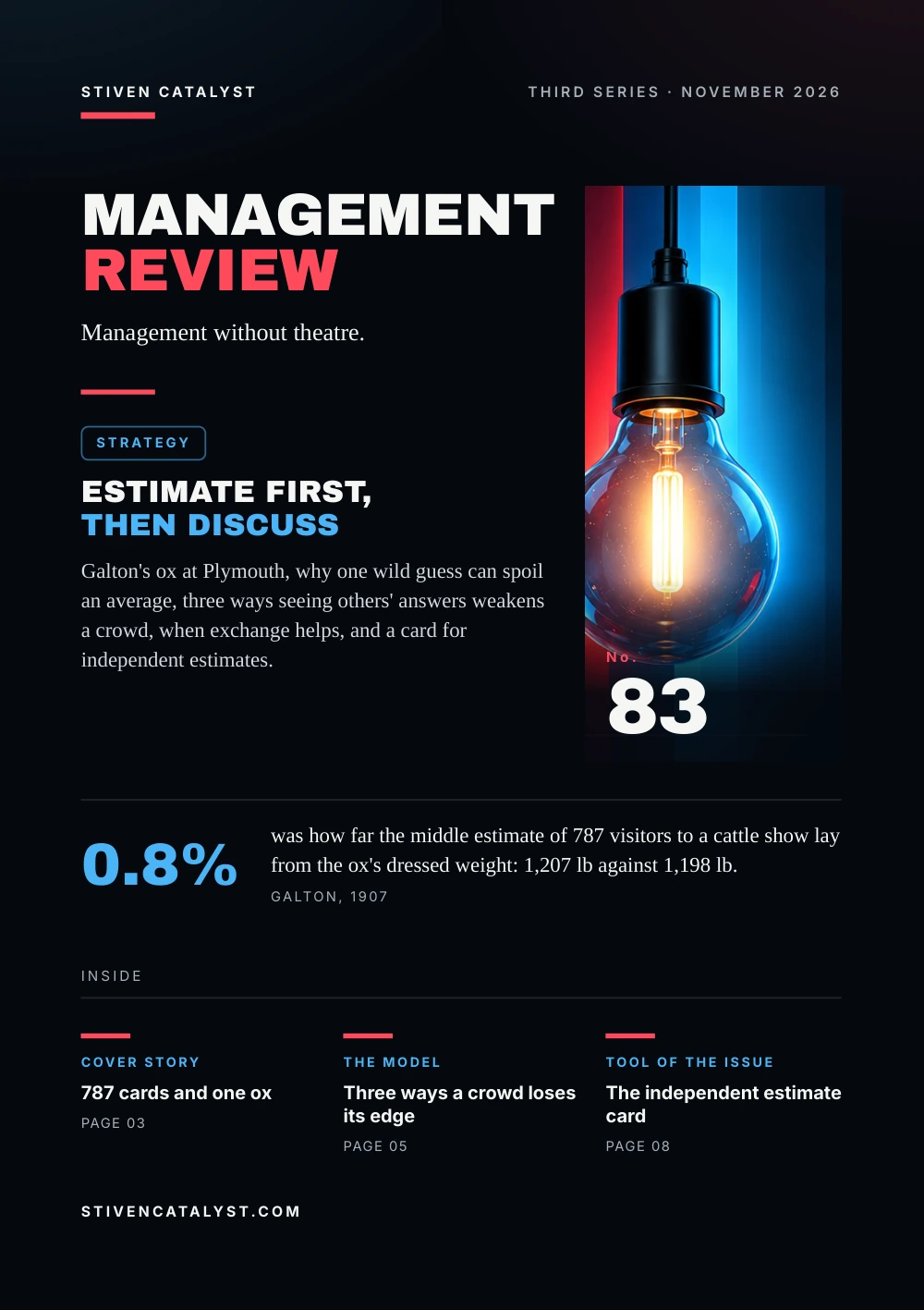 Estimate first, then discuss
November 2026
In 1907 Francis Galton sorted 787 cards from a cattle show and found that the middle estimate of an ox's weight was 0.8% too high. Issue 83 asks what made that crowd wise: each card was written alone. It follows an experiment in Zurich in which seeing the others' answers narrowed the group without making it more accurate, and one in which exchange helped, as long as no single voice reached everyone. A card for independent estimates ends the issue.
-
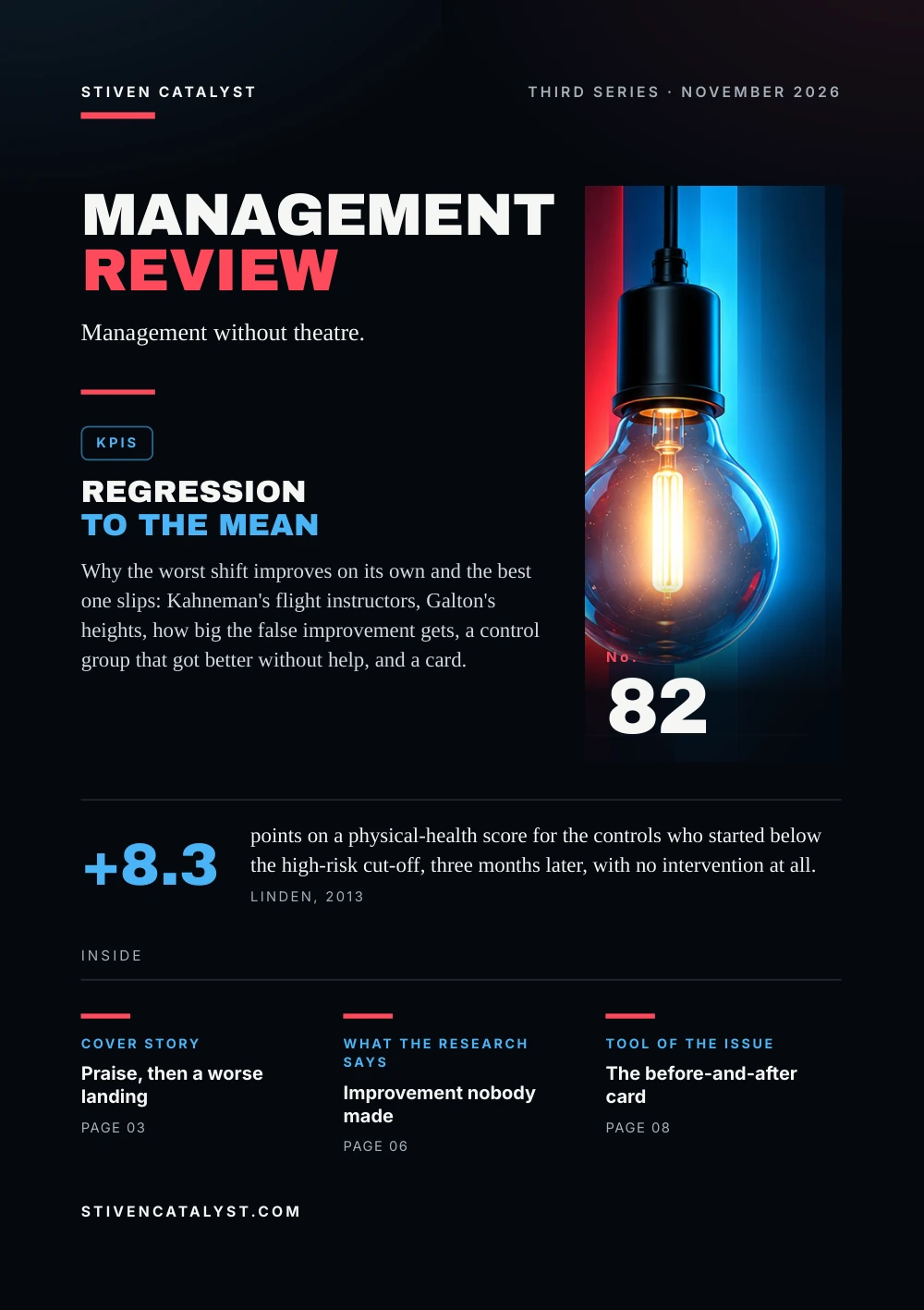 Regression
t o the mean November 2026 A flight instructor told Daniel Kahneman that praise made cadets worse and shouting made them better. Issue 82 explains why he saw what he saw. It goes back to Galton's table of 1886, shows how large a false improvement gets when two measurements agree only loosely, and follows a control group whose worst scorers improved by eight points with no help at all. Five checks before a fix gets the credit, and a card for any before-and-after claim, close the issue. -
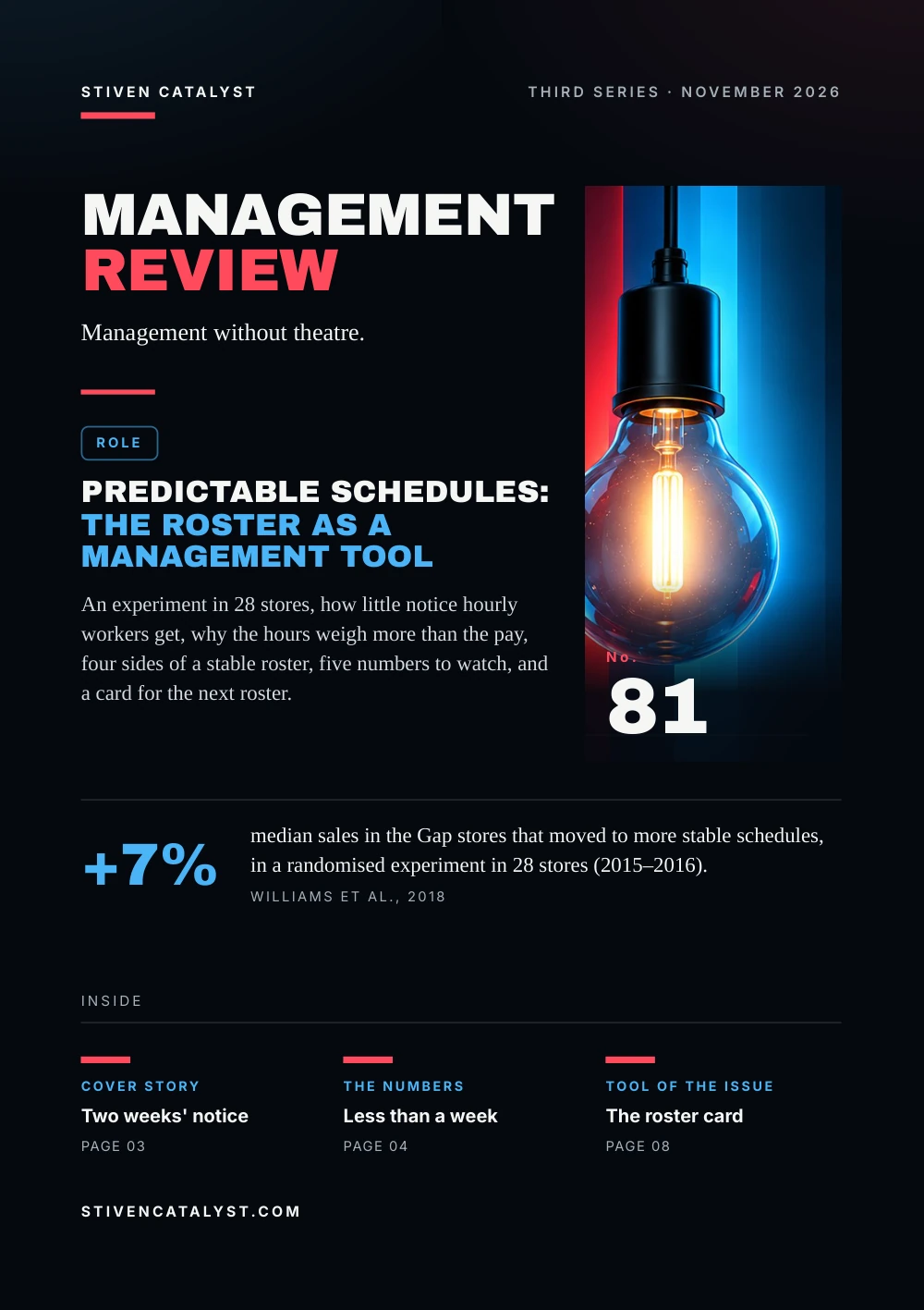 Predictable schedules: the roster as a management
t ool November 2026 In 2015 Gap required its US stores to publish schedules two weeks ahead and stopped on-call shifts; researchers then tested five more practices in 28 stores. Issue 81 follows that experiment, counts how much notice hourly workers in large US firms receive, and sets changes to the roster beside a raise in pay. It describes four sides of a stable roster, five numbers that show how stable it is, the legal floor in the EU and Germany, and a card for the next roster. It opens the third series. -
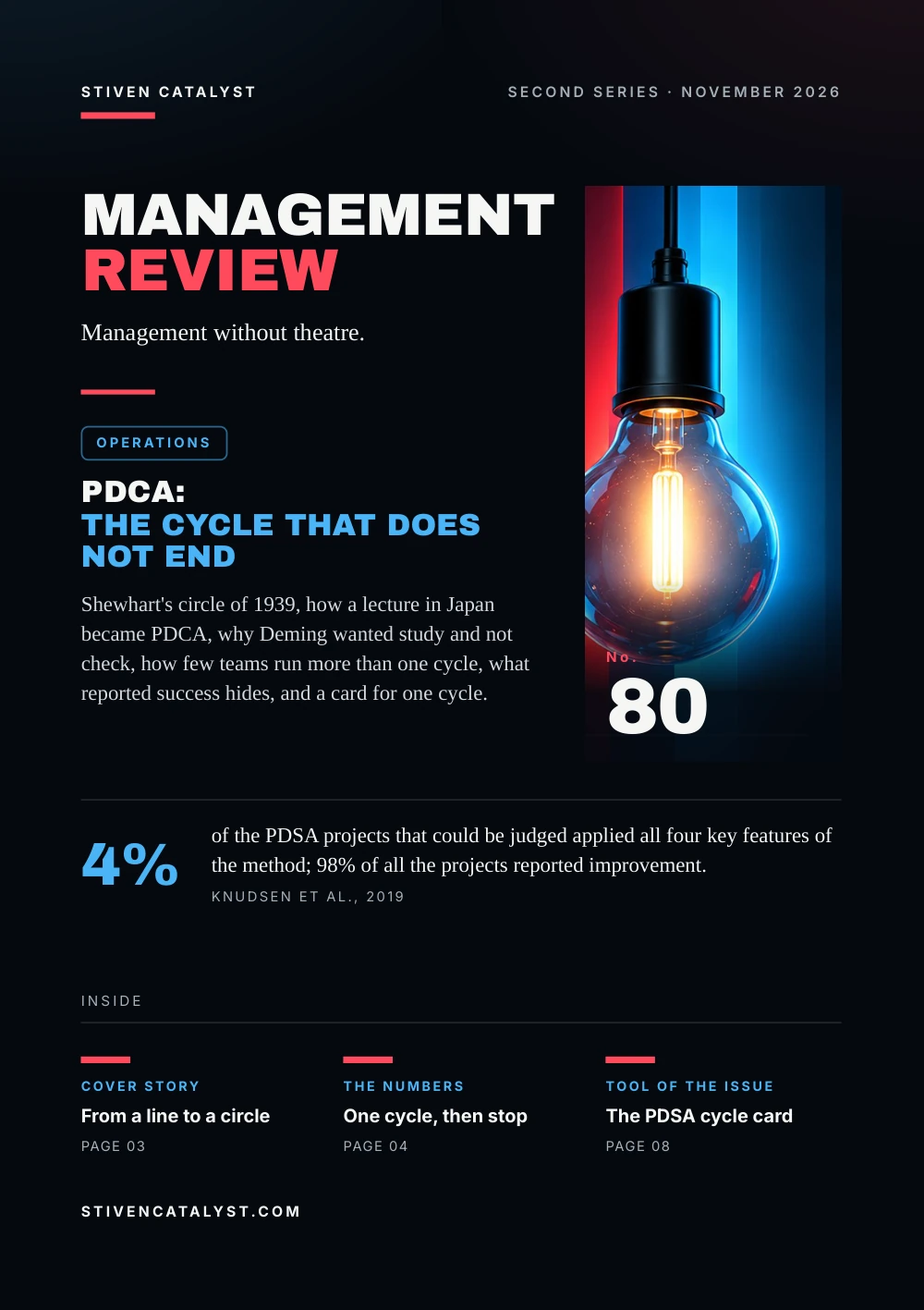 PDCA: the cycle that does not end
October 2026
In 1939 Walter Shewhart drew specification, production and inspection as a circle. Issue 80 follows the cycle to Deming's lectures in Japan and back as PDCA, and sets Deming's Plan-Do-Study-Act beside Ishikawa's six steps. It counts how many published reports ran more than one linked cycle and asks what it means that almost every project reports success. The marks of a cycle that closes and a card for one cycle end the issue, and with it the second series.
-
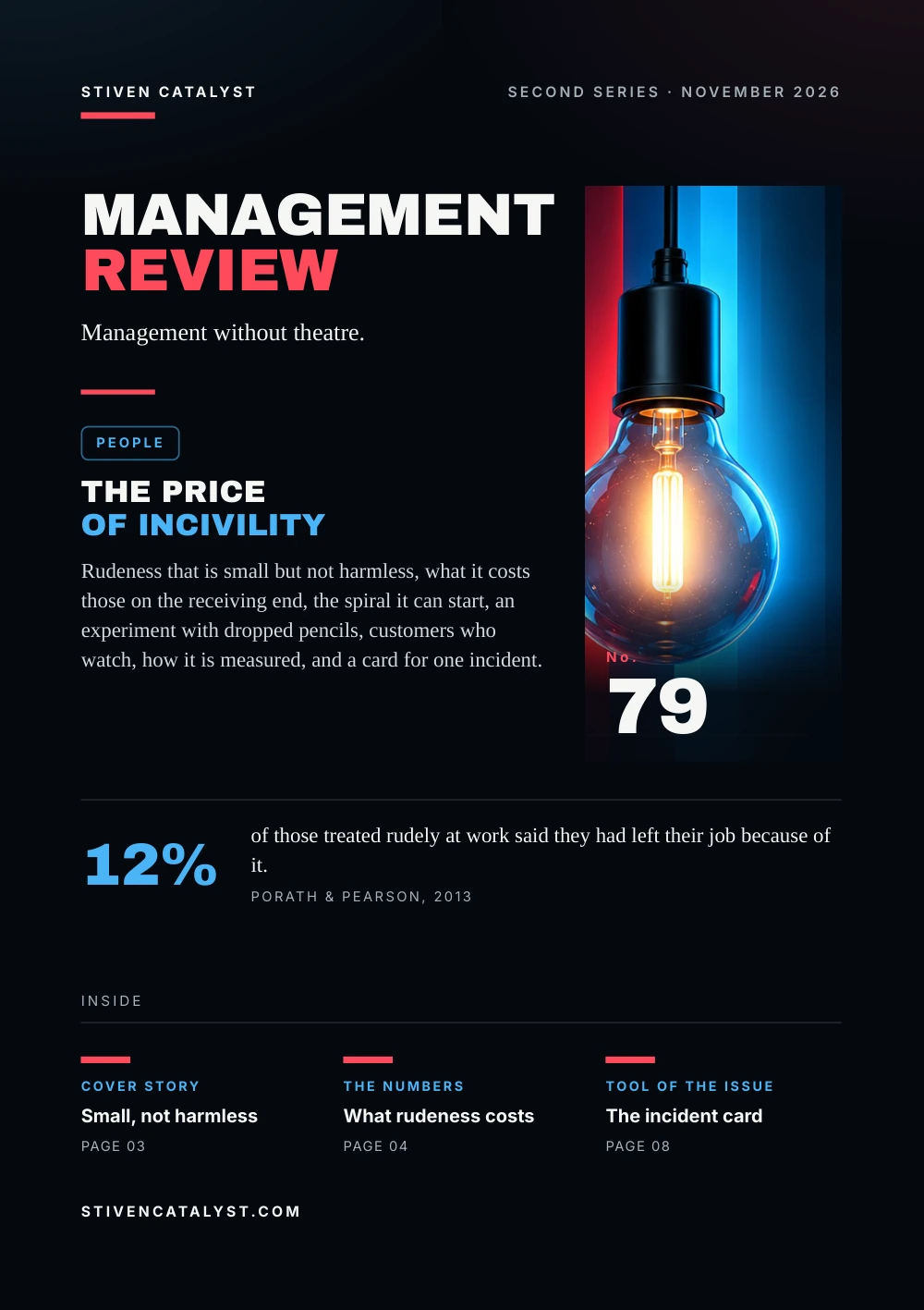 The price of incivili
t y October 2026 Researchers call it incivility: rudeness of low intensity, with no clear intent to harm. Issue 79 follows a poll of 800 managers and employees in which those treated rudely reported holding back effort and commitment, and traces how one rude remark can spiral. Experiments show rudeness lowering performance and helpfulness, and customers who merely watch it judging the whole company. The issue then sets out how incivility is measured and ends with a card for one incident. -
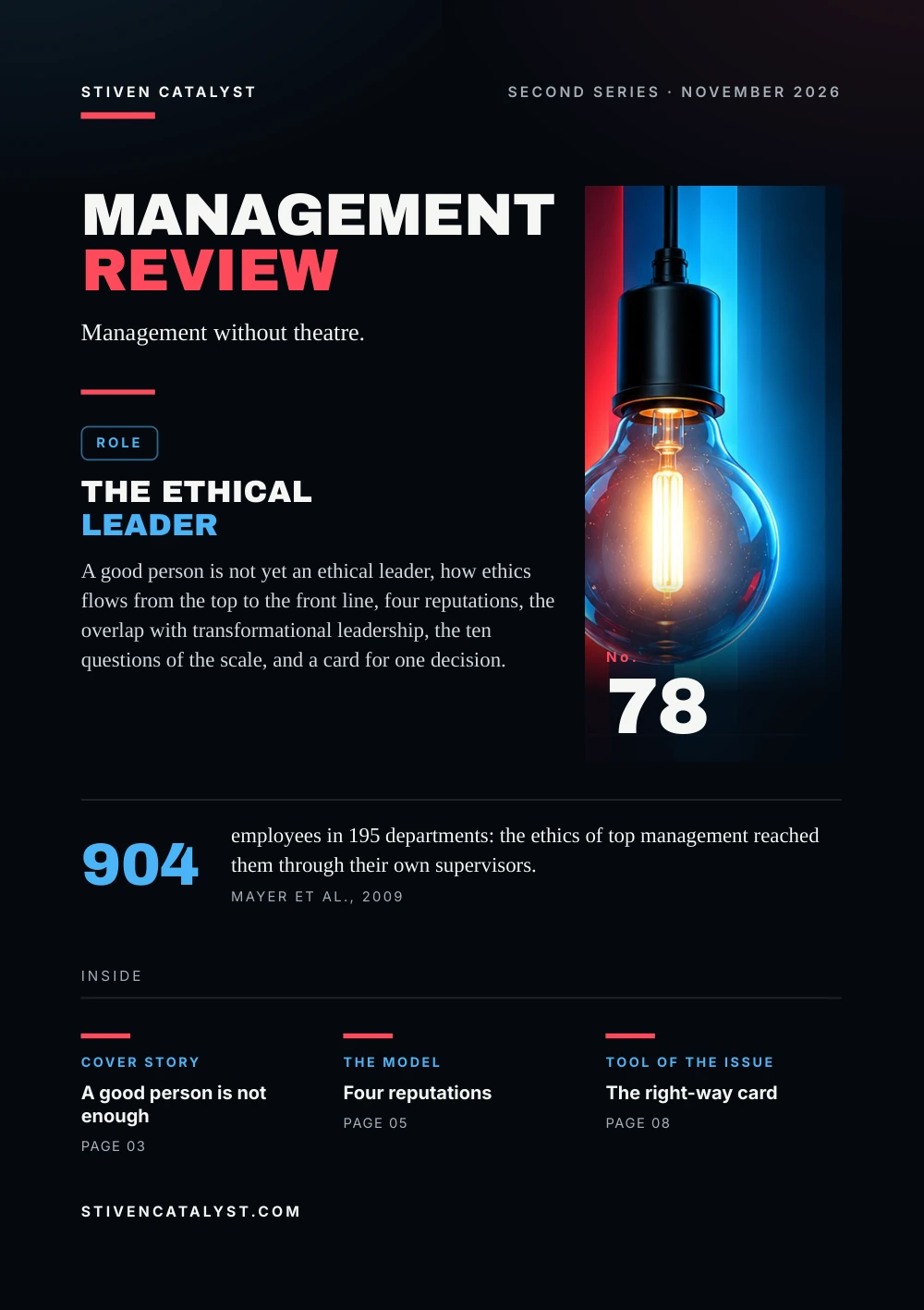 The
e thical leader October 2026 What earns a leader a reputation for ethics? Issue 78 starts with the answers senior executives and ethics officers gave in interviews, then follows a study of 195 departments in which the ethics of top management reached employees through their own supervisors. Two pillars, crossed, give four reputations. The issue weighs how far ethical leadership is more than good leadership in general, sets out the ten questions employees use to rate it, and ends with a card for one decision that tests the standard. -
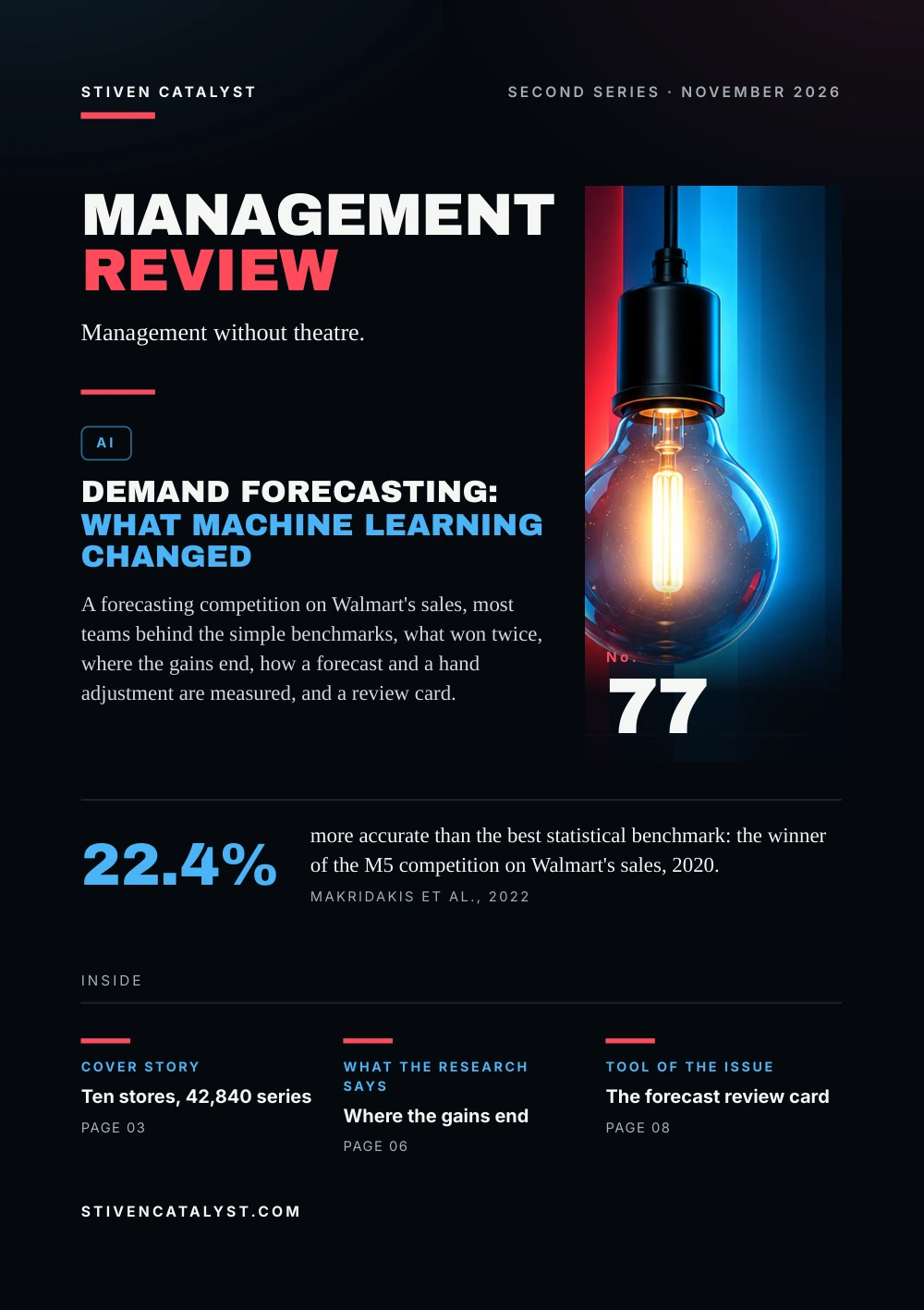 Demand forecasting: what machine learning changed
October 2026
In the M5 competition, thousands of teams forecast the daily sales of 3,049 Walmart products in ten stores, and most of them failed to beat the simple benchmarks. Issue 77 compares what won in M5 with what won in M4 two years earlier, then follows the gains of machine learning down to one product in one store, where they almost disappear. It explains how forecasts and hand adjustments are measured, and ends with a card for a monthly forecast review.
-
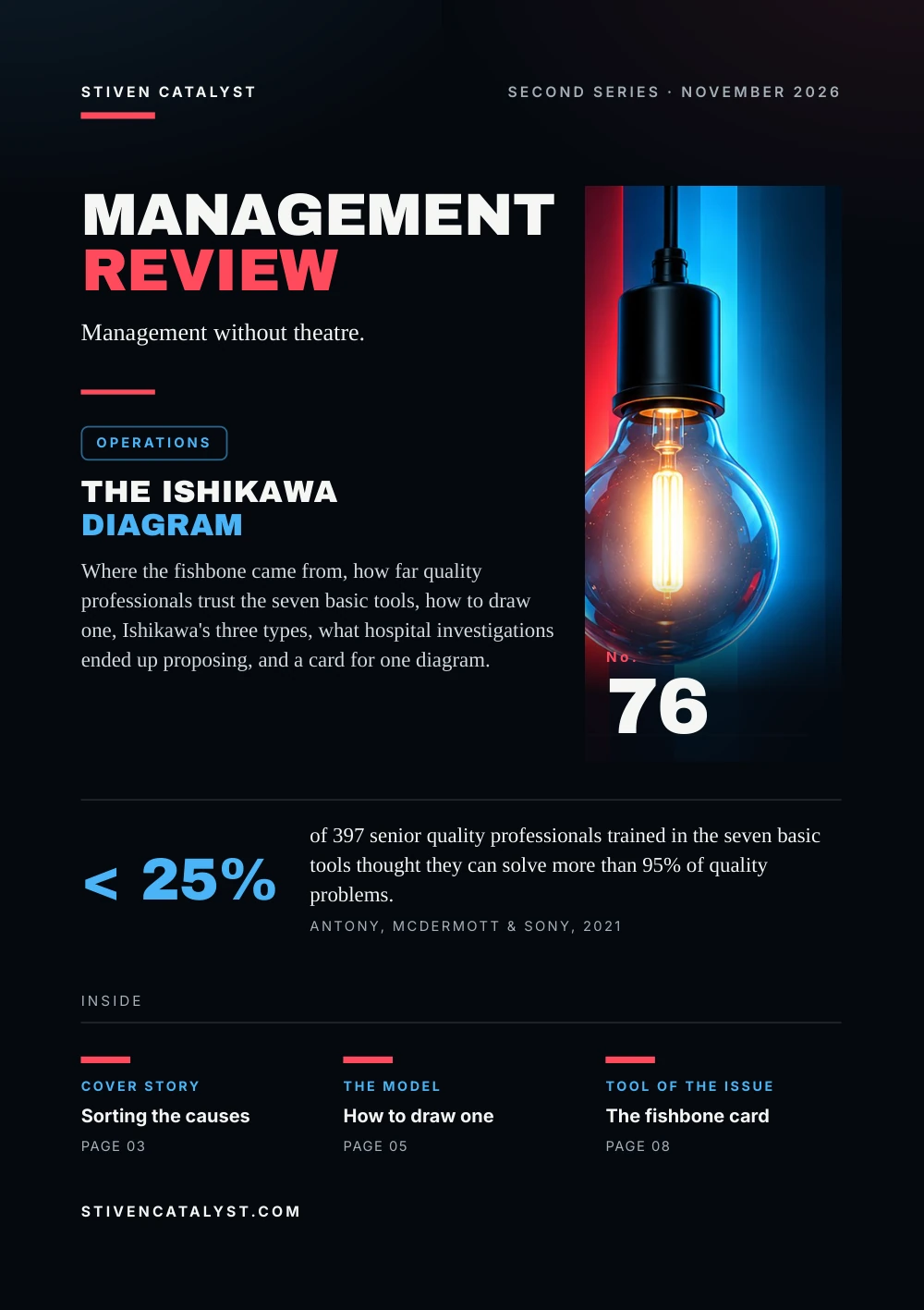 The Ishikawa diagram
October 2026
Kaoru Ishikawa is credited with drawing the first fishbone for engineers at Kawasaki Steel in 1943. Issue 76 asks how far 456 quality professionals share his faith in the seven basic tools, shows how to draw the diagram with the 6M categories, and sets out his three types beside the warning that a “root cause” is rarely single. Eight years of hospital root cause analyses lead to the fixes they proposed, and a card closes the issue.
-
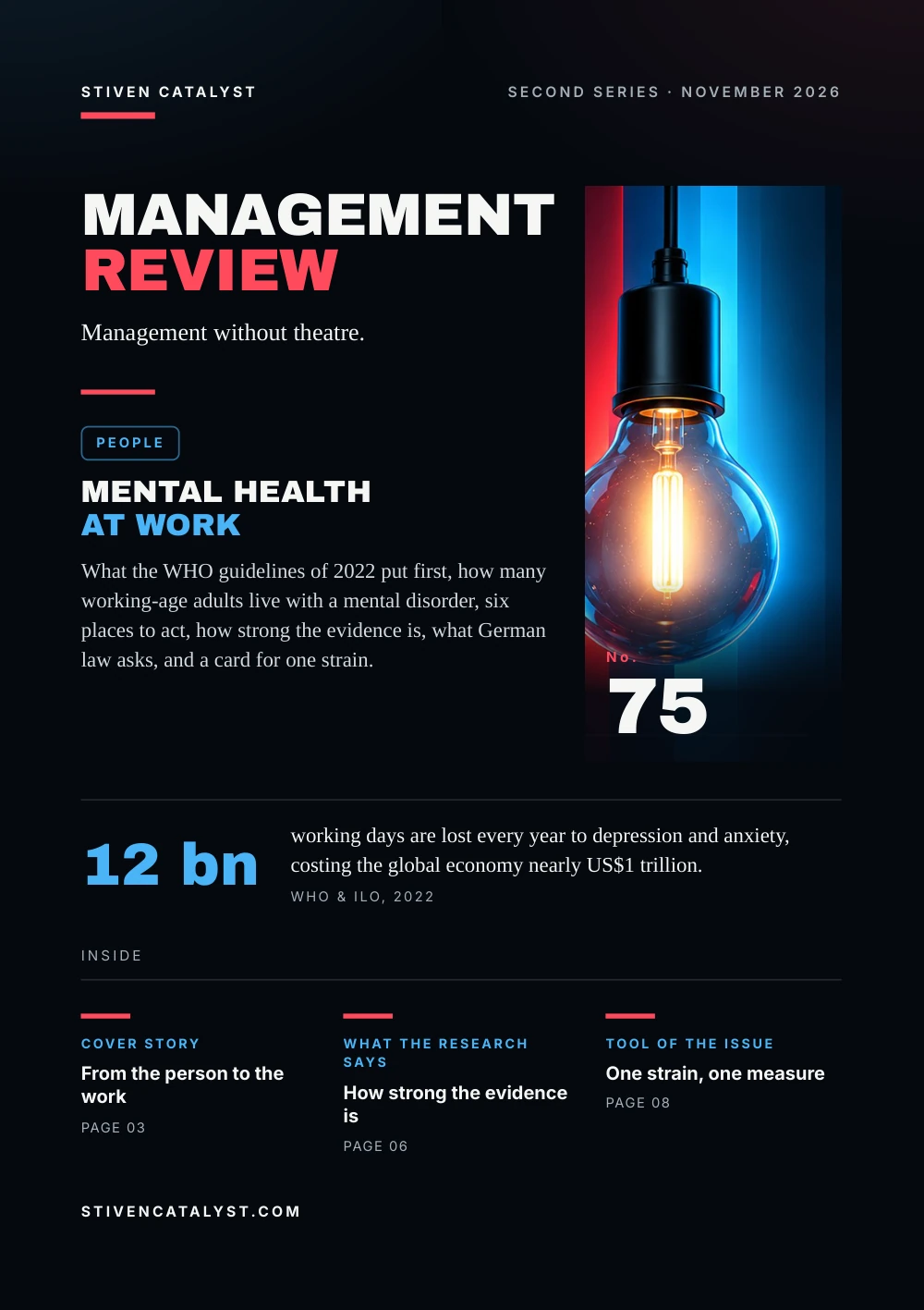 Mental health at work
October 2026
The WHO's guidelines on mental health at work, published in 2022, begin with the conditions of work, and so does Issue 75. It follows the estimates of how many working-age adults live with a mental disorder and how many working days are lost, sets out where the guidelines recommend action, and weighs how strong and how certain each recommendation is. Then it reads what the German Occupational Safety and Health Act asks of employers, and closes with a card for one strain at work.
-
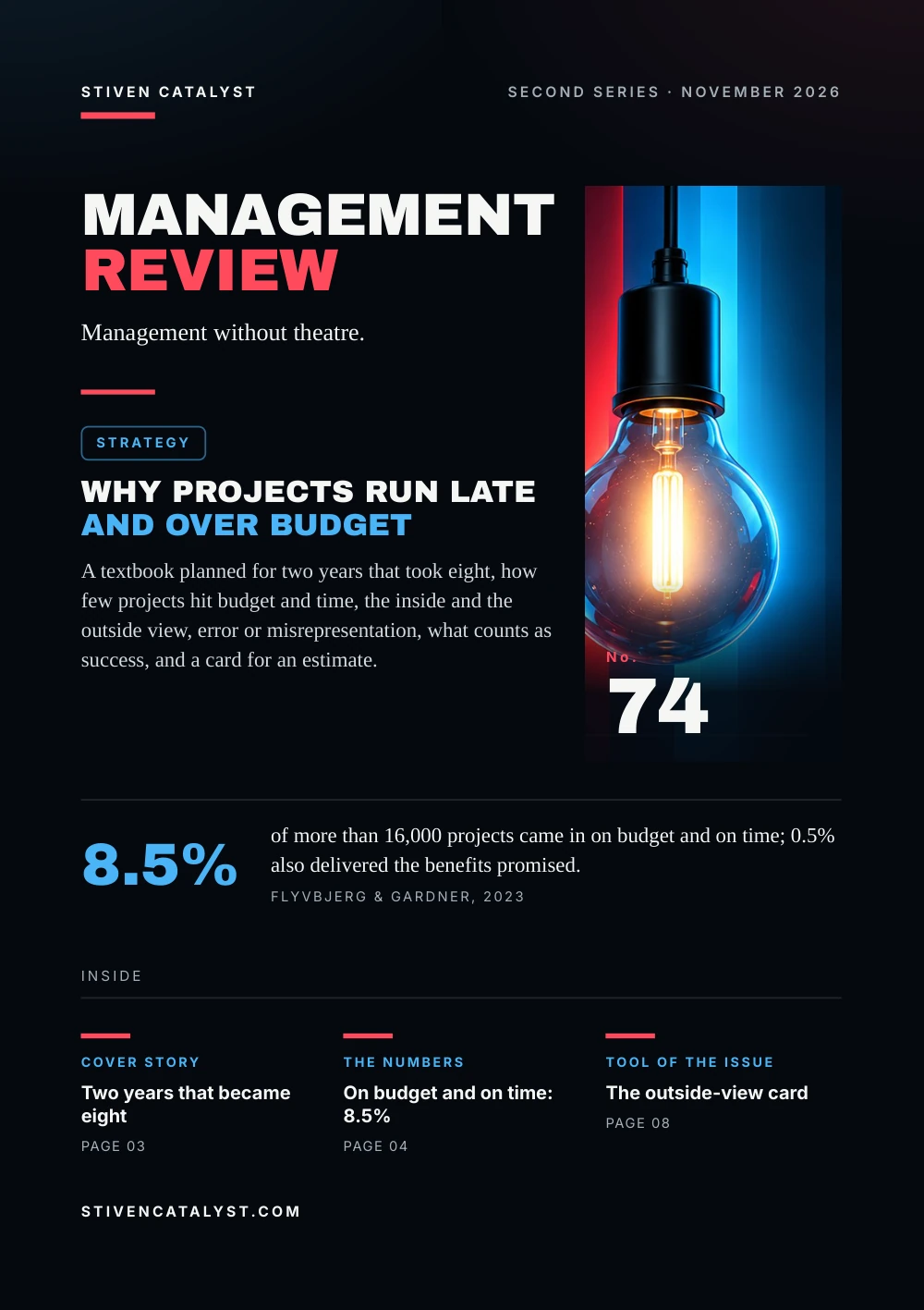 Why projects run late and over budg
e t October 2026 A textbook team expected to need two more years and needed eight. In a database of more than 16,000 projects, 8.5% came in on budget and on time. Issue 74 sets the inside view of a plan beside the outside view of the record, weighs whether low estimates are honest errors or strategic misrepresentation, and asks which number an overrun is measured against. It ends with a card for an estimate checked against similar projects. -
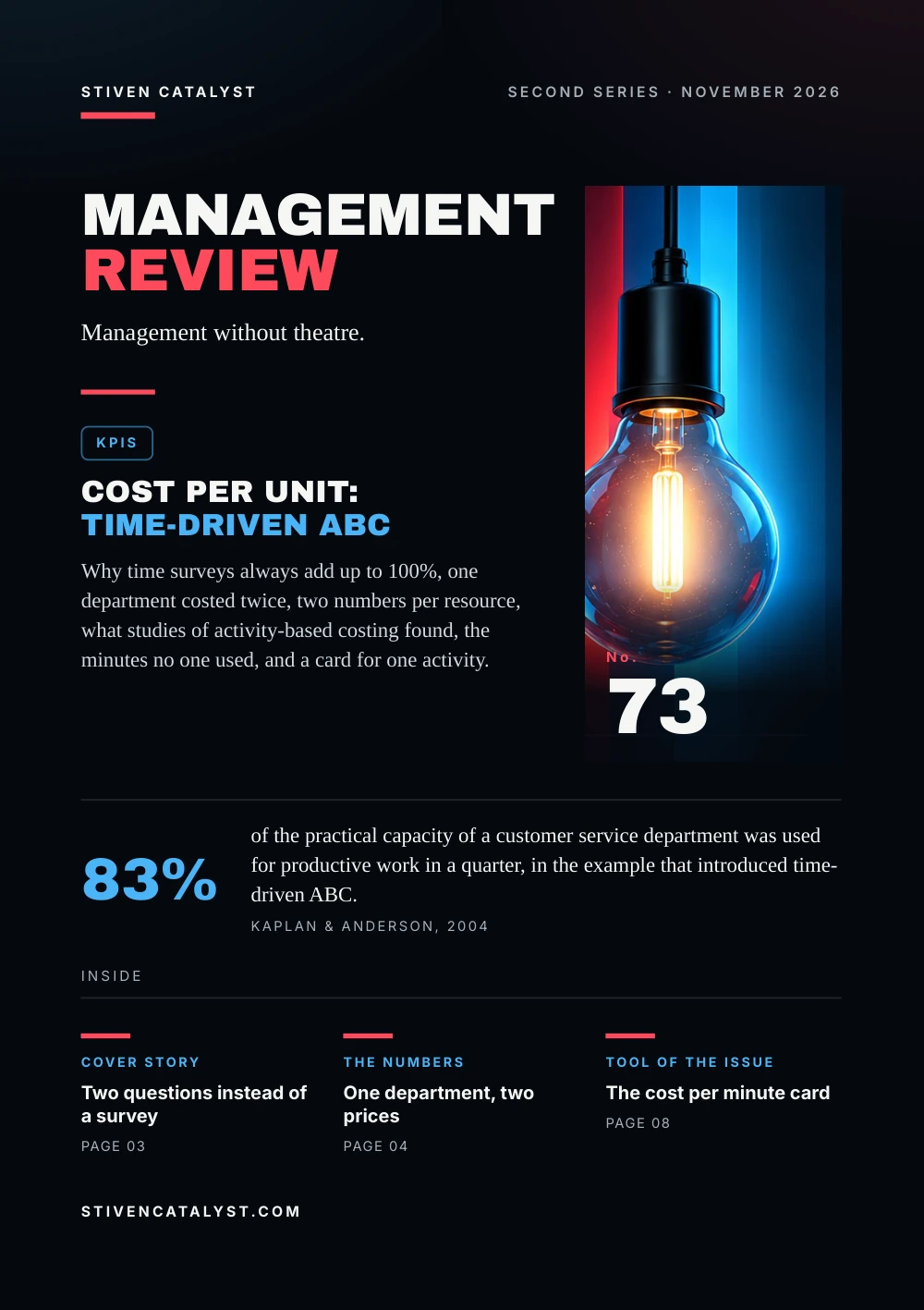 Cost per unit: time-driven ABC
October 2026
Activity-based costing traced overhead to the work that uses it, and many firms then abandoned it because of its surveys. Issue 73 follows Kaplan and Anderson's customer service department, costed once from a survey and once from minutes, and sets out the two numbers time-driven ABC needs for each resource, along with the time equation. Studies in plants, large companies and hospitals come next, then the capacity that was paid for and not used. A card works out the cost per minute of one activity.
-
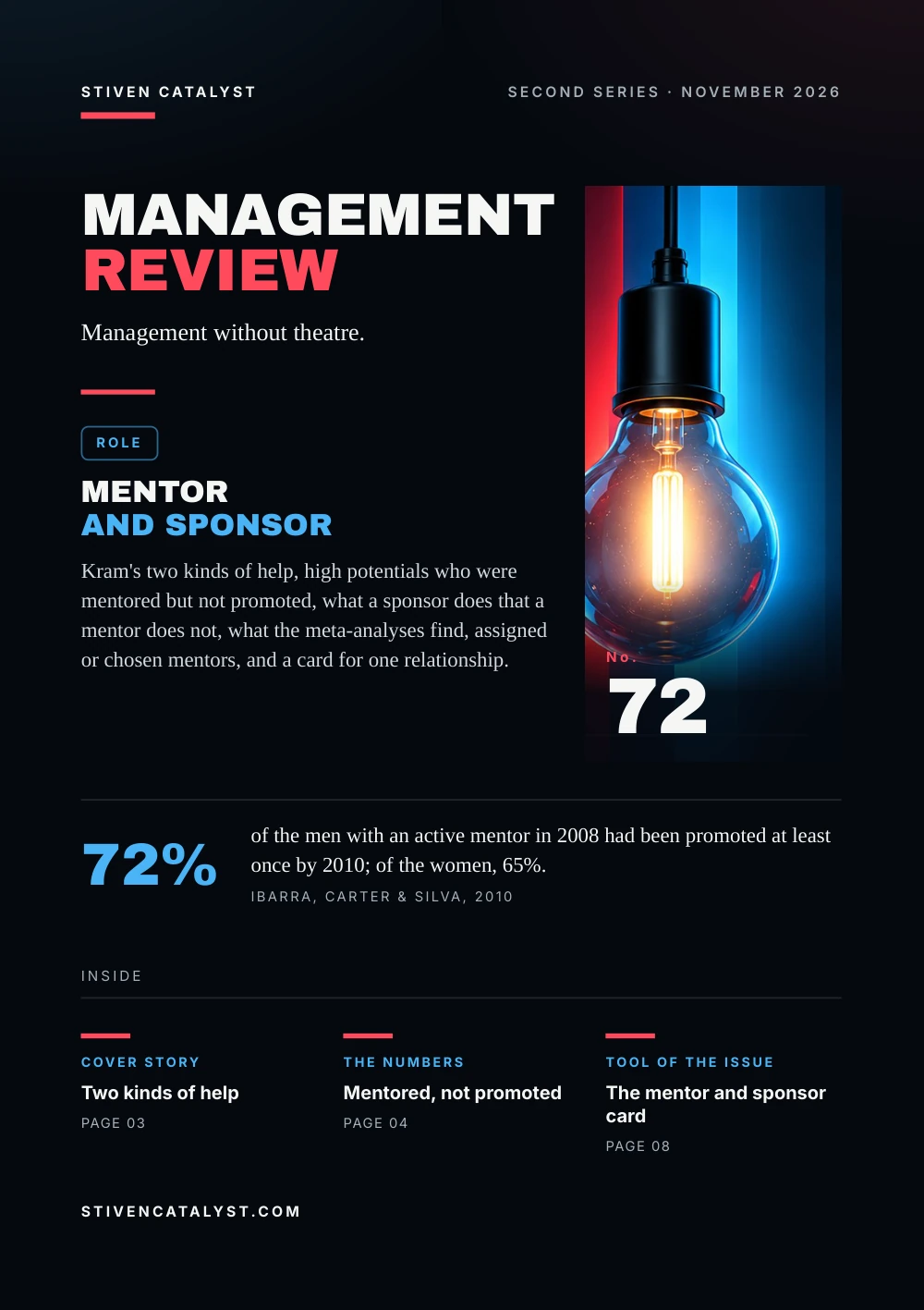 Men
t or and sponsor October 2026 Kathy Kram found two kinds of help in mentoring relationships. In a Catalyst survey, more women than men had mentors, yet fewer of the mentored women were promoted, and Issue 72 sets the mentor beside the sponsor who speaks for you where decisions are made. It weighs what two meta-analyses find mentoring is worth, compares assigned and self-found mentors, and ends with a card for one mentoring or sponsorship relationship. -
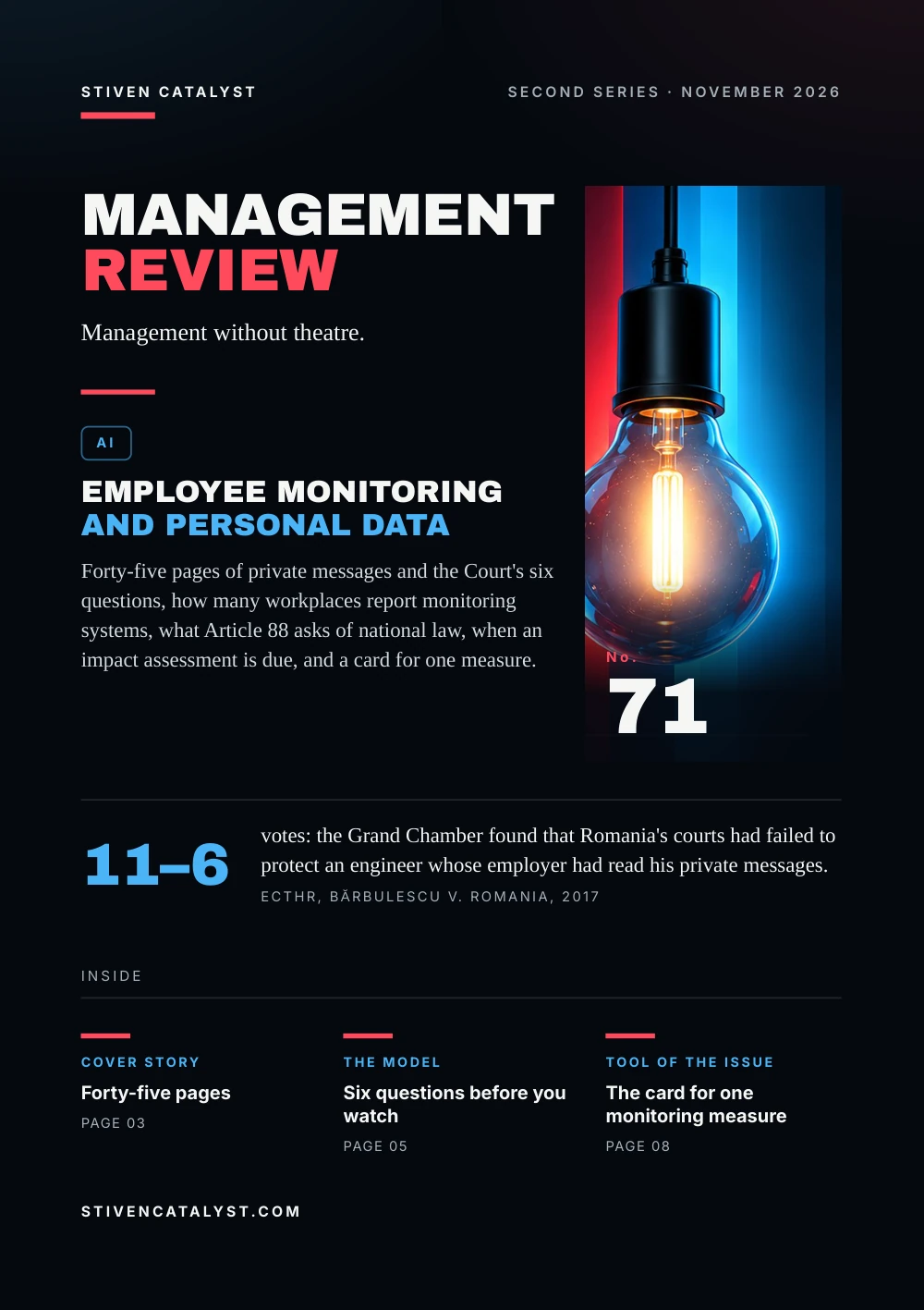 Employee moni
t oring and personal data October 2026 An engineer in Bucharest was shown 45 pages of his own private messages, printed by his employer. From his case the European Court of Human Rights drew six questions for any such monitoring, and Issue 71 starts there. It then counts the EU workplaces that report systems monitoring their staff, follows Article 88 of the GDPR from the EU Court to Germany's Federal Labour Court, and shows when a data protection impact assessment is due. A card checks one measure before it starts. The issue describes the law and does not give legal advice. -
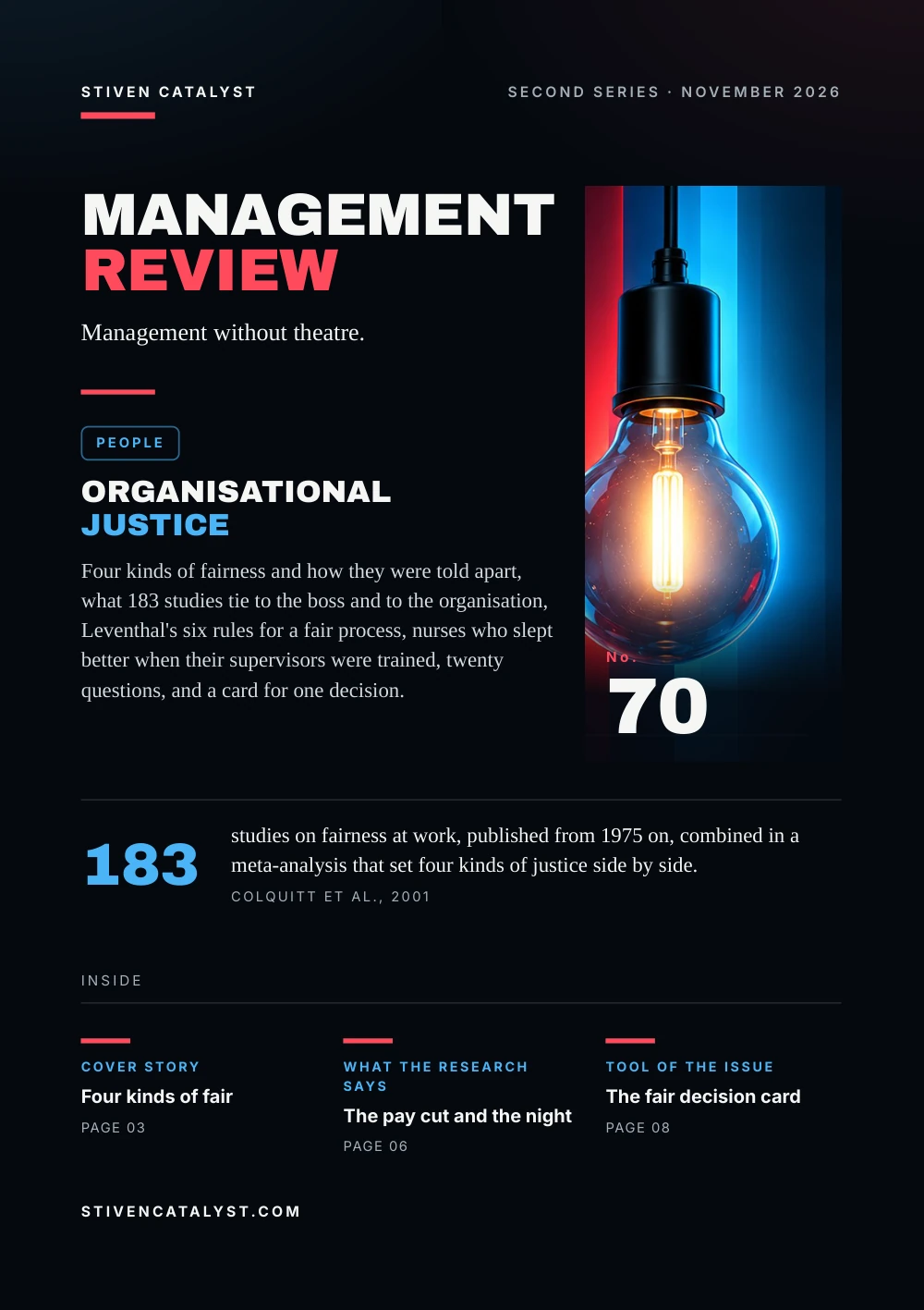 Organisational justice
October 2026
Jason Colquitt tested whether people tell apart four kinds of fairness, and they do. Issue 70 shows, from a meta-analysis of 183 studies, which kinds are tied to the boss and which to the organisation, and sets out Gerald Leventhal's six rules for a fair process, which matters most when the outcome is bad. Then come nurses whose pay was cut while their supervisors learned to treat and inform them fairly, Colquitt's twenty questions, and a card for checking one decision.
-
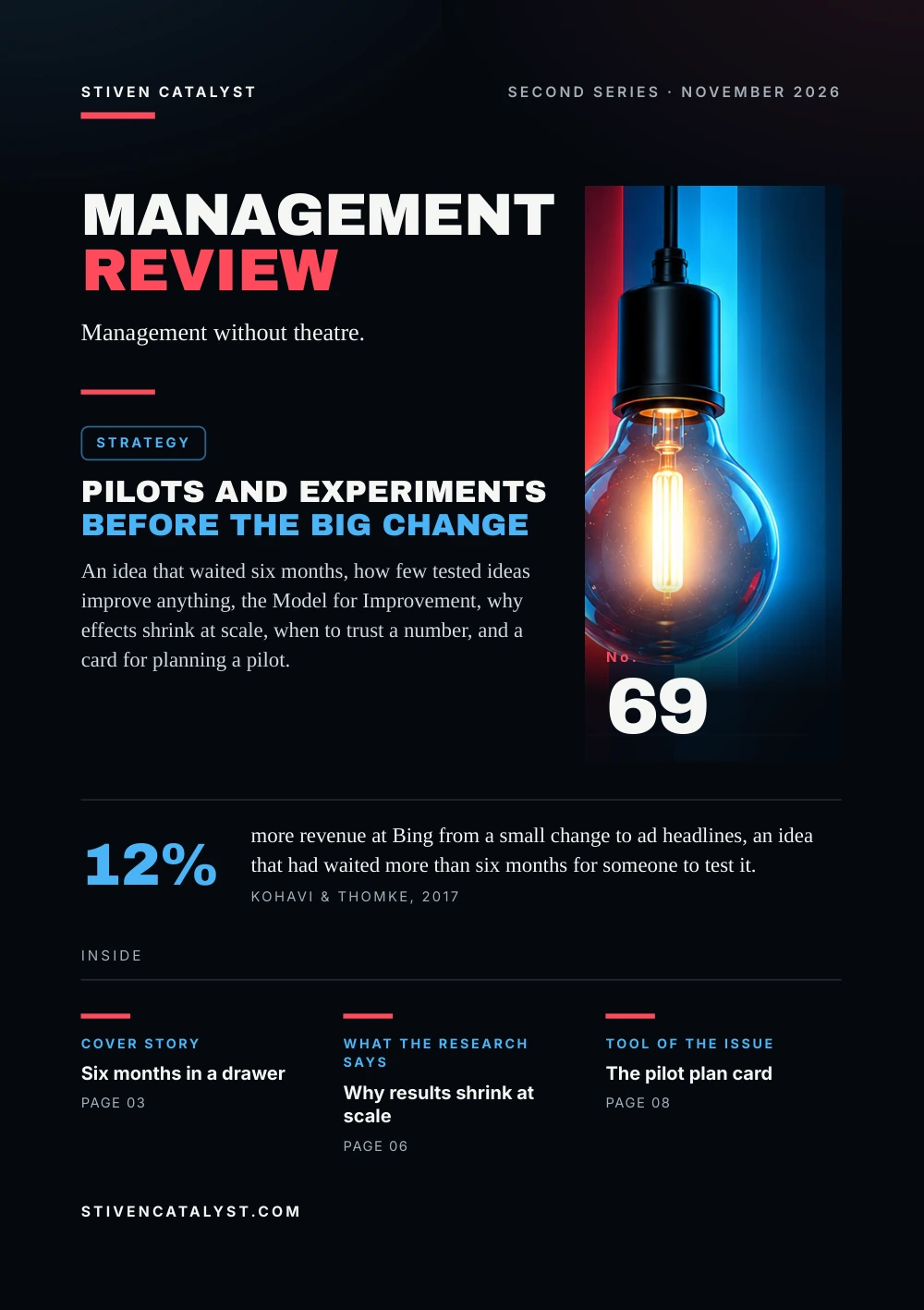 Pilots and experiments before the big change
October 2026
An idea at Bing sat for more than six months; once tested, it raised revenue by 12%. Most tested ideas do far less, and Issue 69 shows how rarely they improve what they were meant to, sets out the three questions and small cycles of the Model for Improvement, and asks why effects from published trials shrink when governments run them at scale. Four checks come before a pilot result is trusted, and a card helps plan the pilot.
-
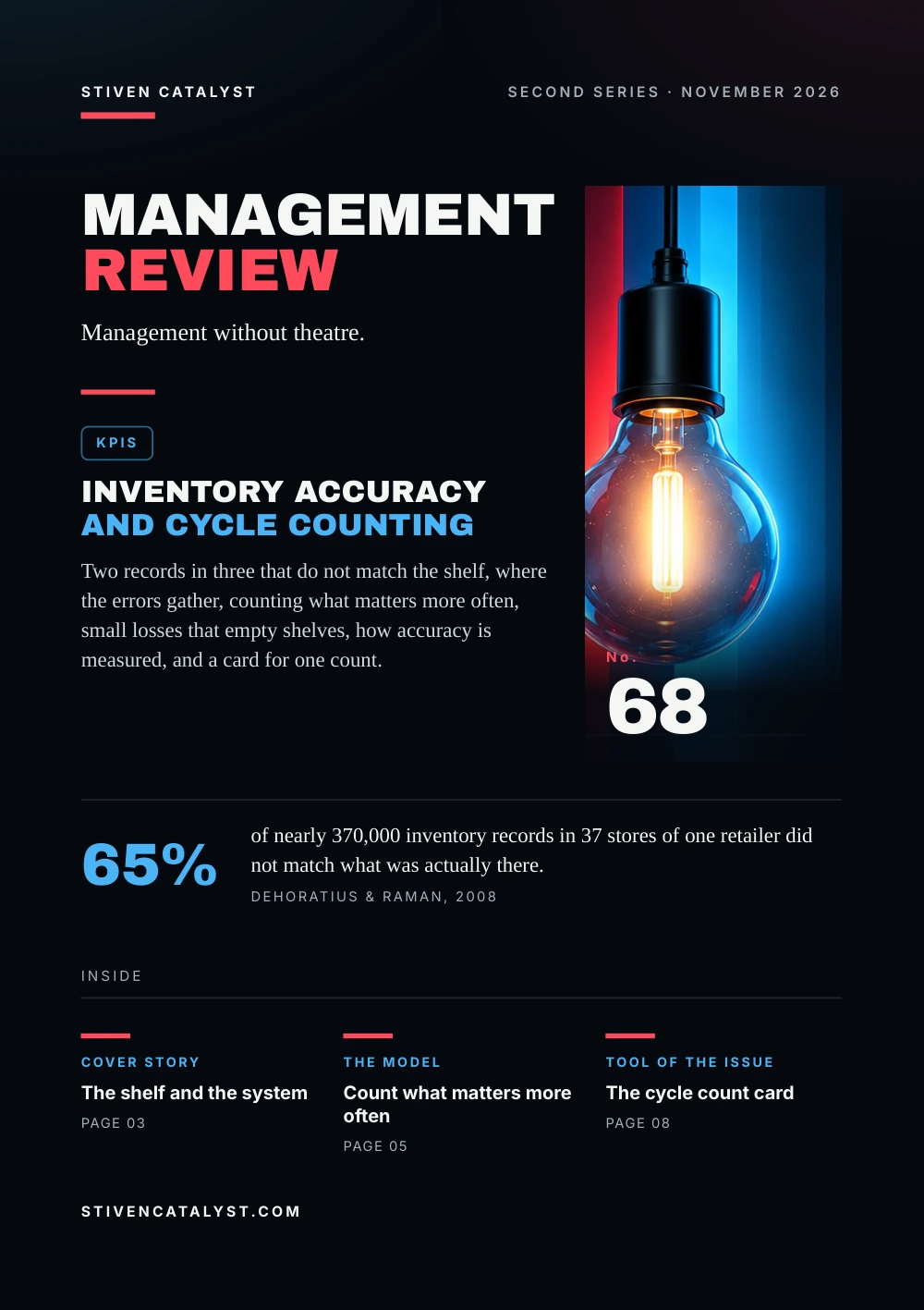 Inven
t ory accuracy and cycle counting October 2026 At one retailer, two inventory records in three did not match what was in the store, and the errors gathered by product rather than by store. Issue 68 follows the leading companies that count the important items more often, and the research on small undetected losses, staffing and RFID. It closes with the measure, a tolerance and a blind count, and a card for one cycle count. -
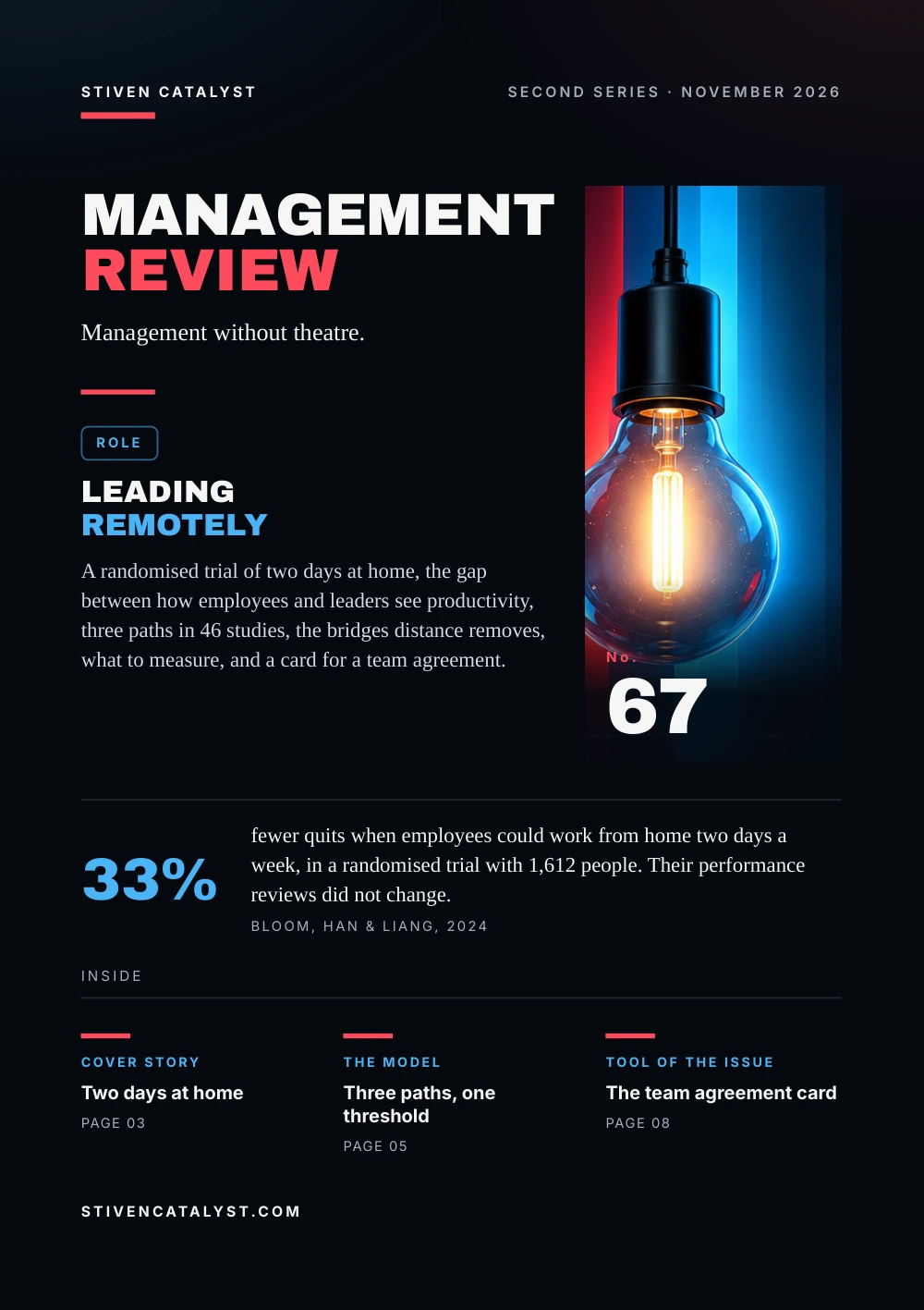 Leading remotely
October 2026
In a randomised trial, 1,612 employees of a travel company could work from home two days a week; Issue 67 begins with what happened. It sets what employees say about their productivity against what their leaders believe, and follows a meta-analysis of 46 studies to three paths and one threshold. It then looks at what distance does to the ties between groups and to feedback, asks what a remote leader should measure, and closes with a card for a team's working agreement.
-
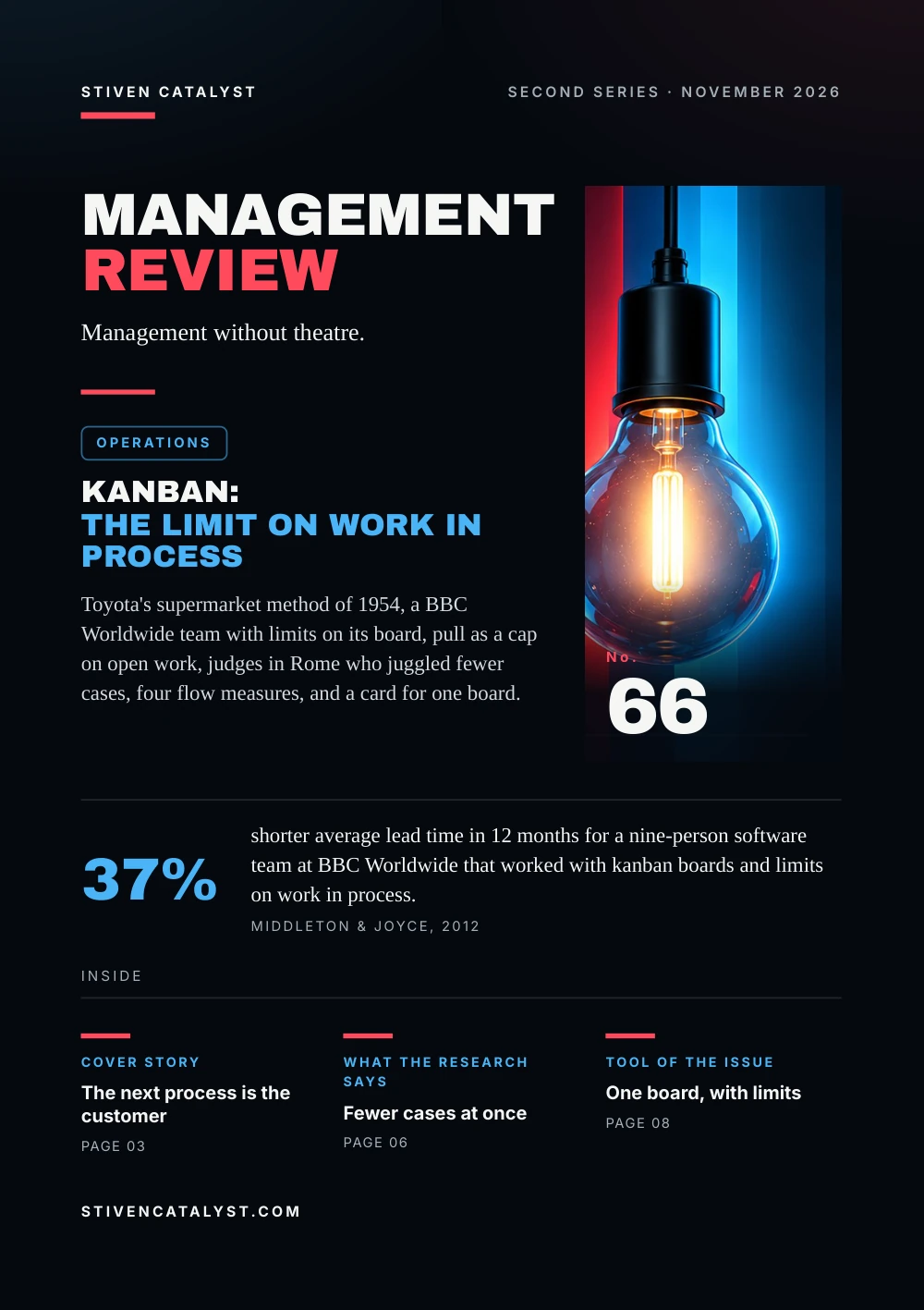 Kanban: the limit on work in process
October 2026
In 1954 Toyota set out to end the month-end rush with what it called the supermarket method. Half a century later a nine-person software team at BBC Worldwide put limits on its kanban boards, and two operations researchers describe pull as, in essence, a cap on work in process. Issue 66 also follows six judges in Rome who juggled fewer cases and finished them sooner, explains the four flow measures of the Kanban Guide and closes with a card for one board with limits.
-
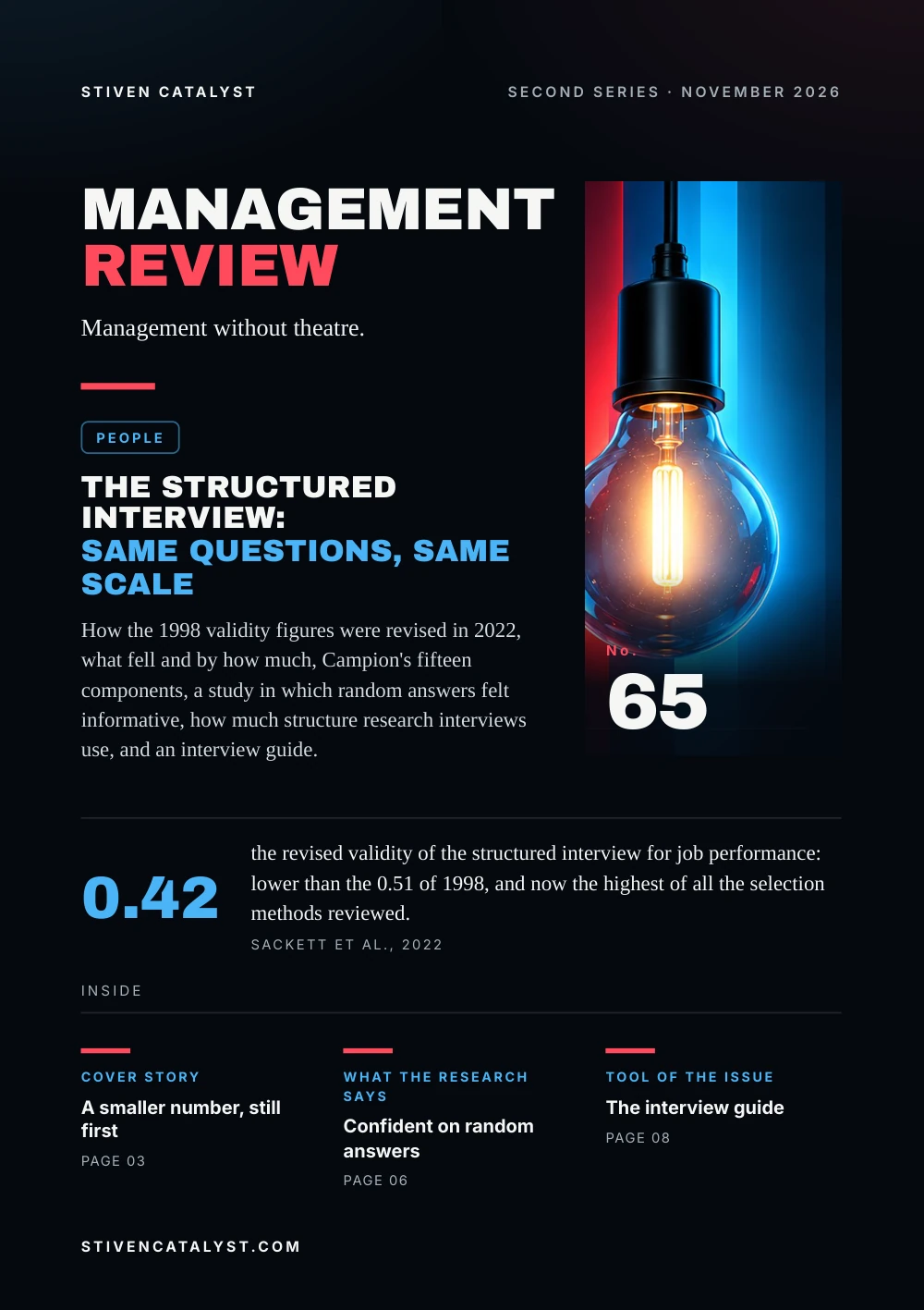 The structured interview: same questions, same scale
October 2026
In 1998 Frank Schmidt and John Hunter gave the structured interview a validity of 0.51; in 2022 Paul Sackett and colleagues put it at 0.42. Issue 65 shows how a correction for range restriction had inflated the old figures and sets the old and new estimates side by side. It lists the fifteen components of structure defined by Michael Campion and colleagues, looks at a study in which interviewers felt just as informed after random answers, and counts how much structure research interviews actually use. A guide for a structured interview closes the issue.
-
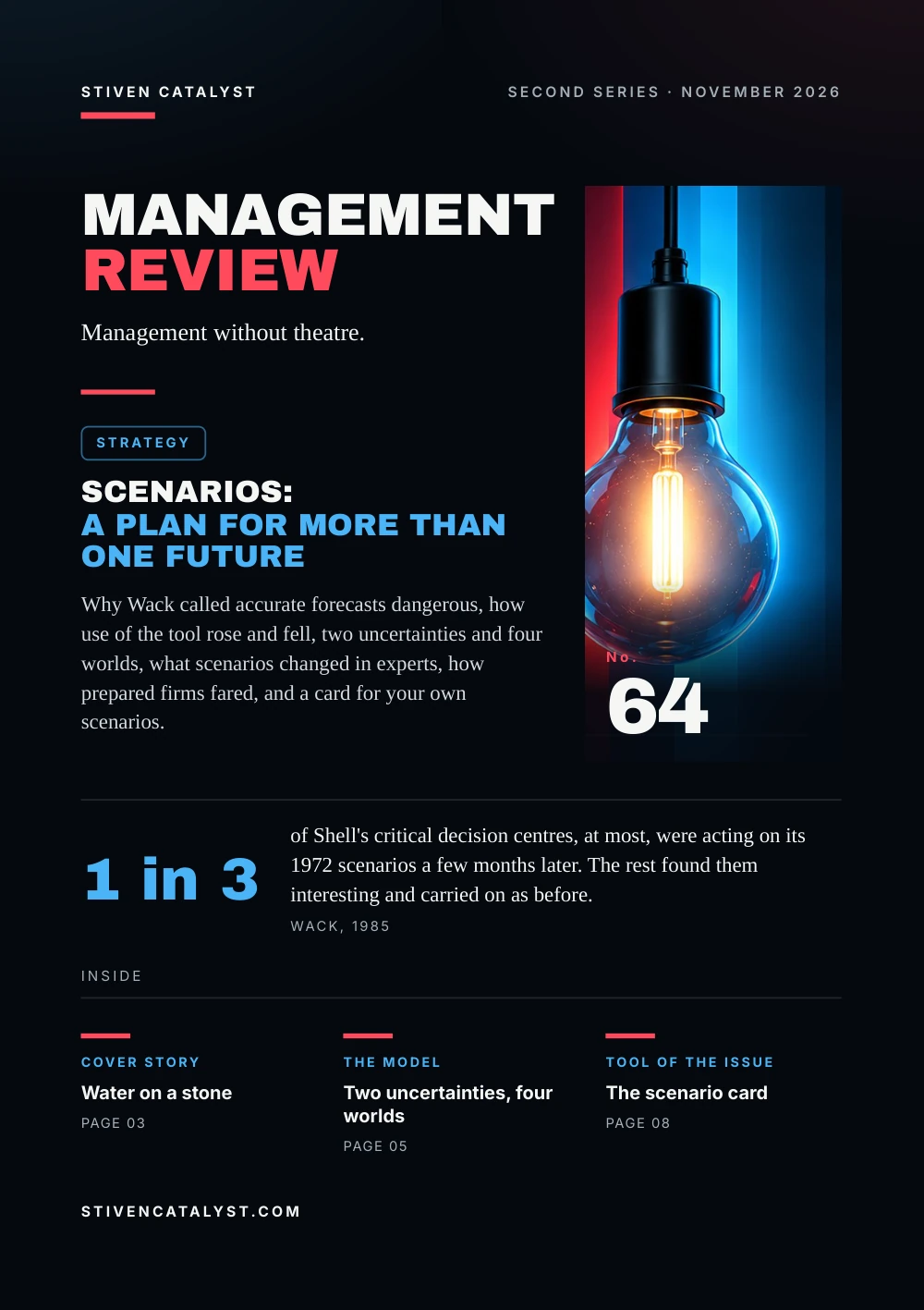 Scenarios: a plan for more than one future
October 2026
Pierre Wack warned that forecasts are dangerous precisely because they are often right, and Issue 64 opens with that warning. It follows the use of scenario planning in Bain's surveys from 1993 to 2017 and, with Paul Schoemaker, crosses two uncertainties into four worlds. A field study shows scenarios changing experts' judgments but not their confidence; a second asks how firms prepared for the future fared seven years later. A card for building your own scenarios closes the issue.
-
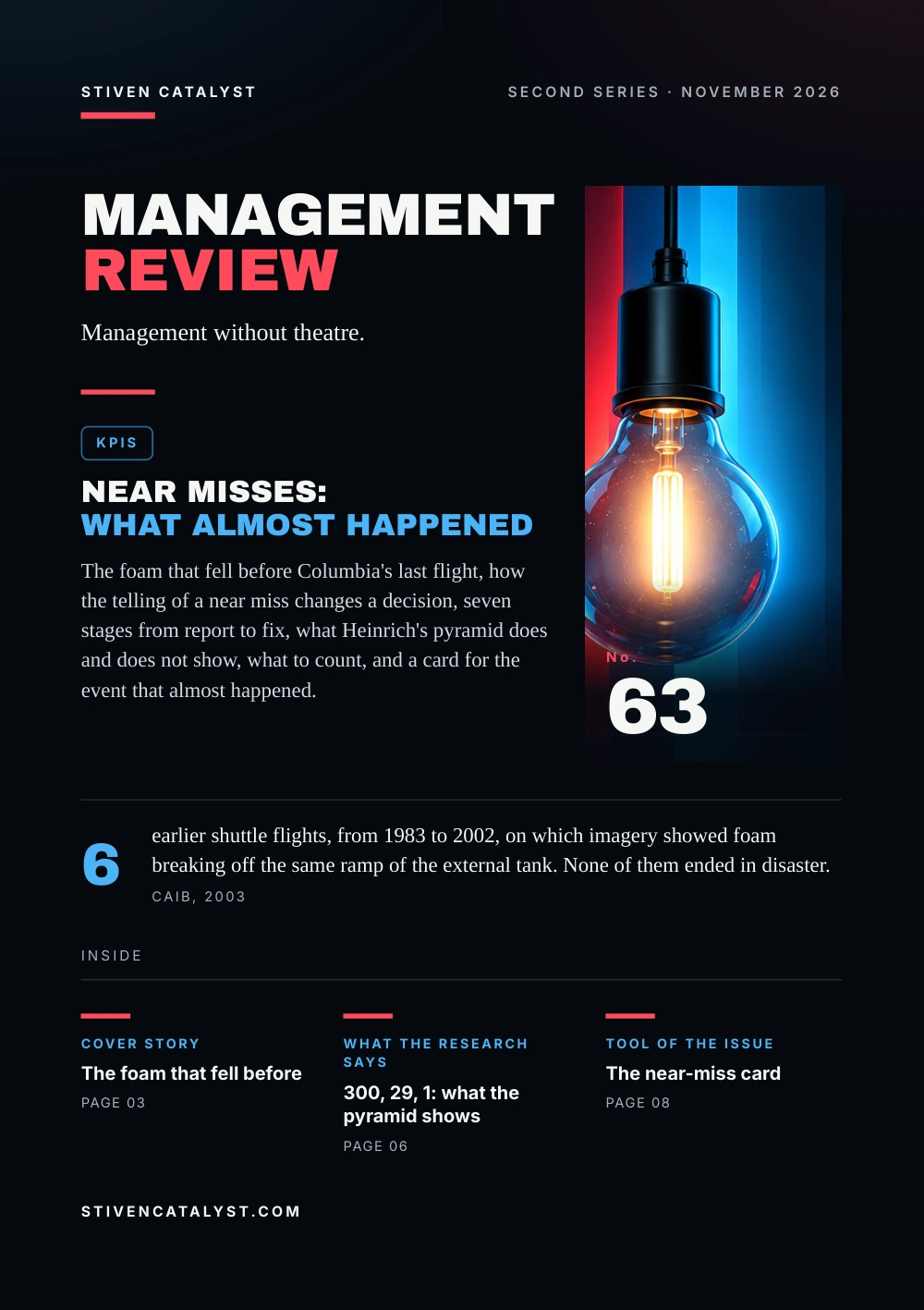 Near misses: what almost happened
October 2026
Foam had broken off the same ramp of the shuttle's tank six times before it brought down Columbia; Issue 63 begins with that record. Experiments then show how the telling of a near miss turns it into reassurance or into a warning, and James Phimister's seven stages trace the path from noticing to fixing. The issue asks what Heinrich's 300-29-1 pyramid does and does not show, sets out what to count, and ends with a card for the event that almost happened.
-
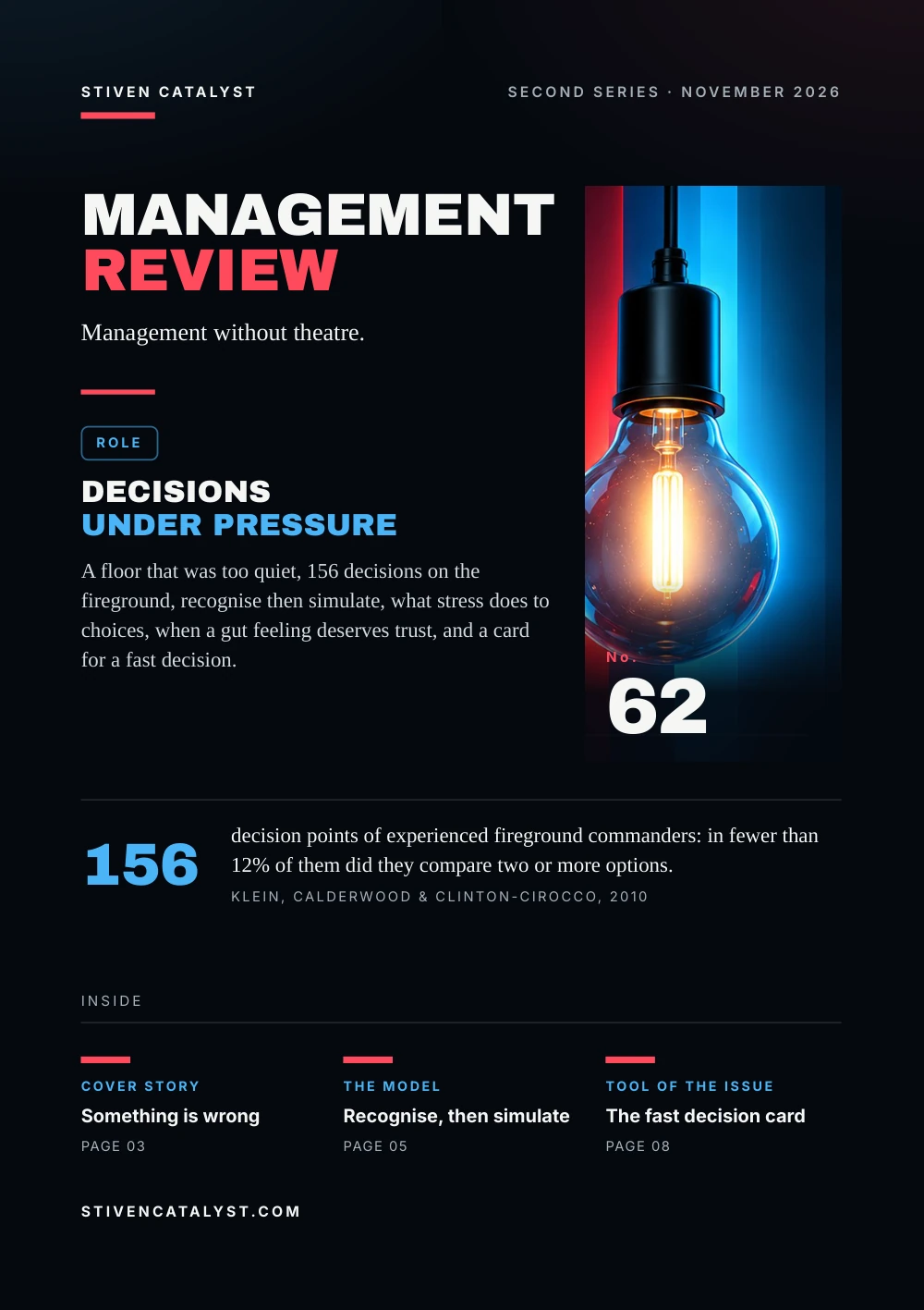 Decisions under pressure
October 2026
A fire lieutenant ordered his crew out of a house moments before the floor gave way: Issue 62 starts there. It follows a study by Gary Klein and colleagues of 156 decisions by experienced fireground commanders, sets out the recognition-primed decision model and looks at what stress does to the search for options. With Daniel Kahneman and Klein it asks when a professional's intuition deserves trust, and it closes with a card for a fast decision.
-
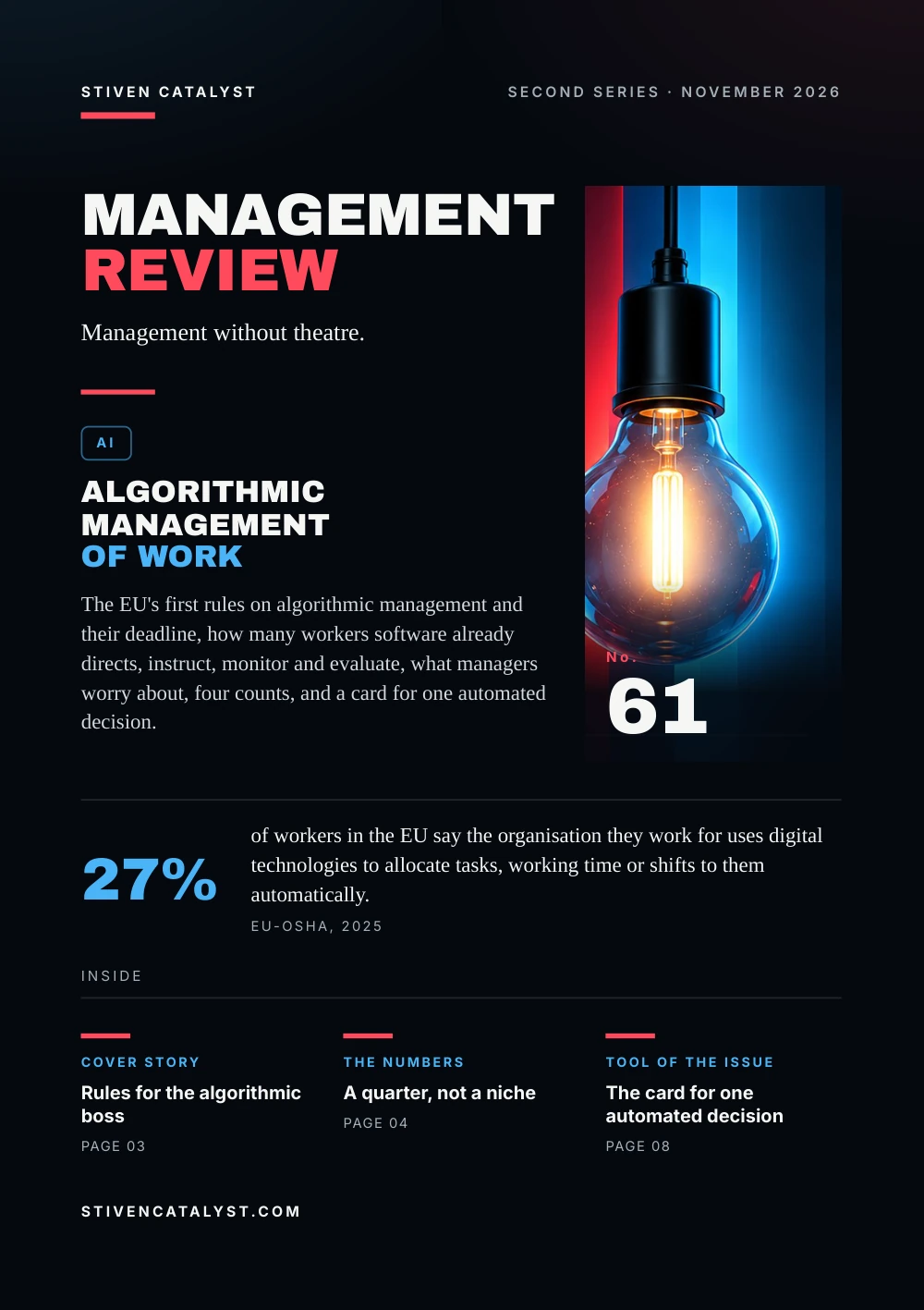 Algorithmic management of work
October 2026
The EU's first rules on algorithmic management sit in the platform work directive, which Member States must transpose by 2 December 2026. Issue 61 sets them out and shows that software already allocates, instructs, rates or monitors about a quarter of all workers in the EU. It sorts the tools into instructing, monitoring and evaluating, weighs what managers gain and what worries them, adds a Swedish study of logistics workers, and closes with four counts for one system and a card for one automated decision.
-
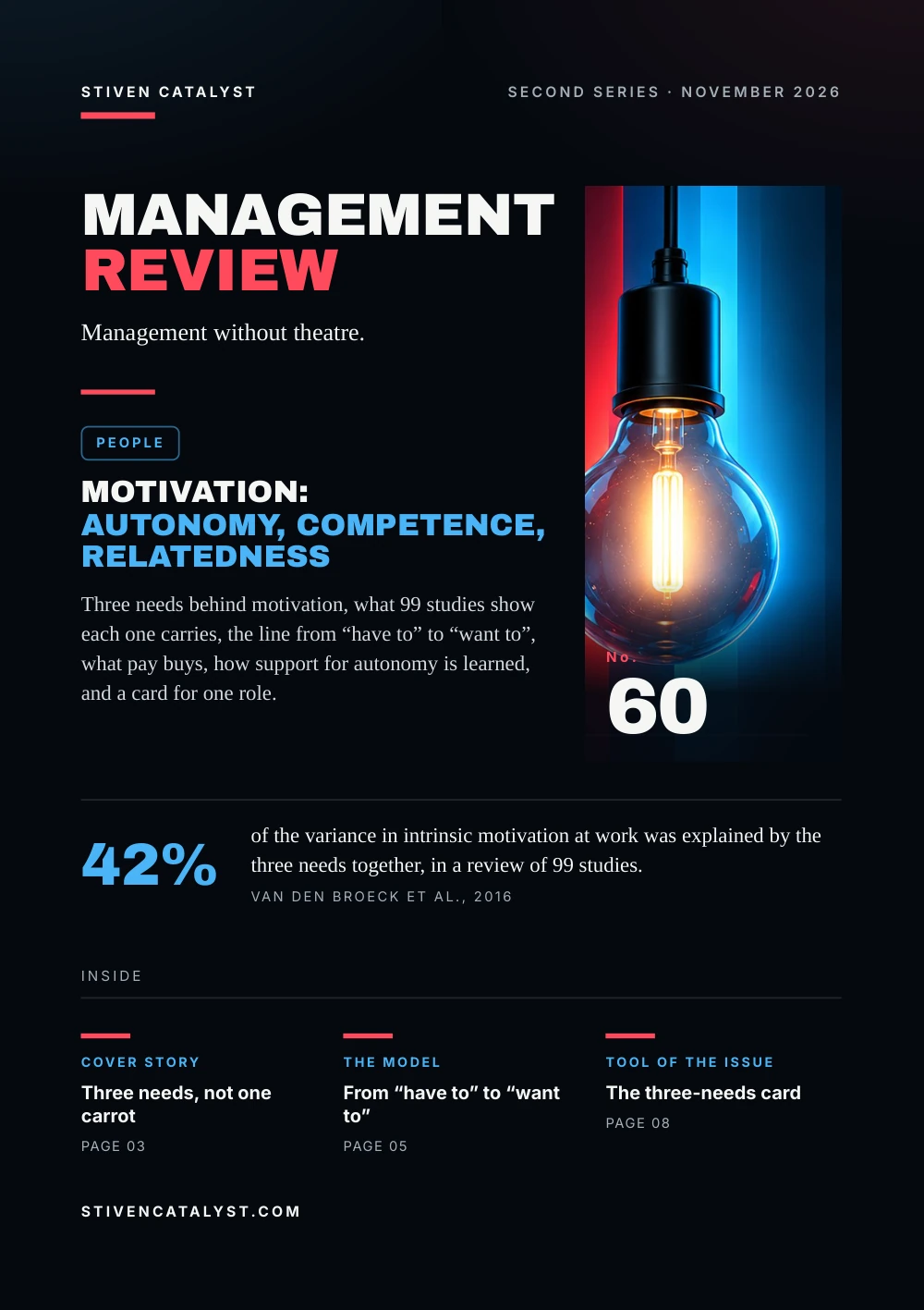 Motivation: au
t onomy, compe tence, relatedness October 2026 Richard Ryan and Edward Deci placed three needs at the centre of motivation, and Issue 60 begins with them. A review of 99 studies shows which need carries engagement and which carries performance. The issue then follows the line from “have to” to “want to”, the part a manager's support for autonomy plays along it, and what 40 years of research say about pay, intrinsic motivation and quality. It closes with how the style is measured and learned, and a card for checking one role against the three needs. -
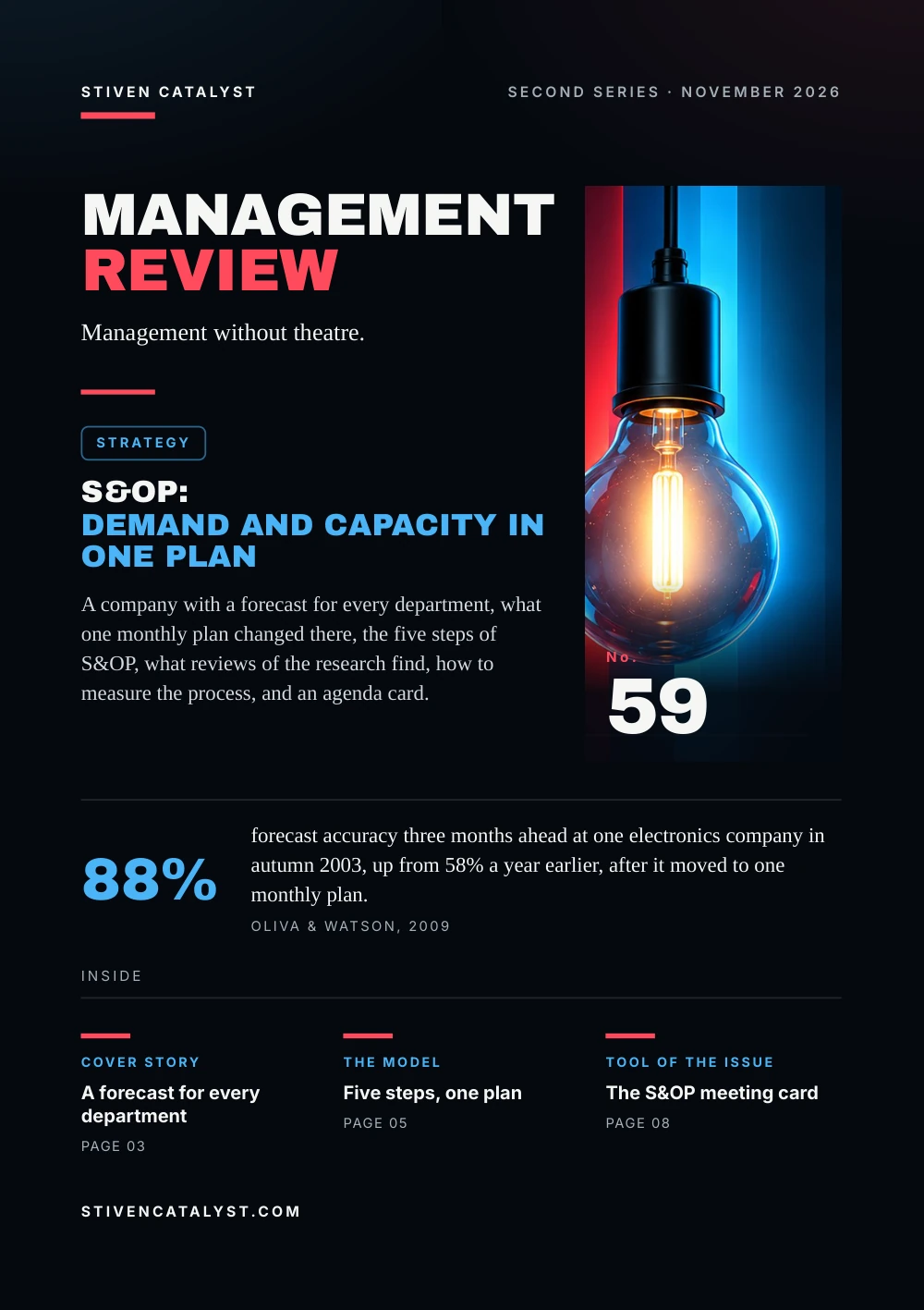 S&OP: demand and capaci
t y in one plan October 2026 At a consumer electronics company, sales, operations and finance each kept their own forecast; Issue 59 follows what a monthly consensus process changed there. It sets out the five steps of sales and operations planning and weighs what reviews of the research find about maturity and results. It then asks how the process itself can be measured, and closes with a card for the agenda of the monthly S&OP meeting. -
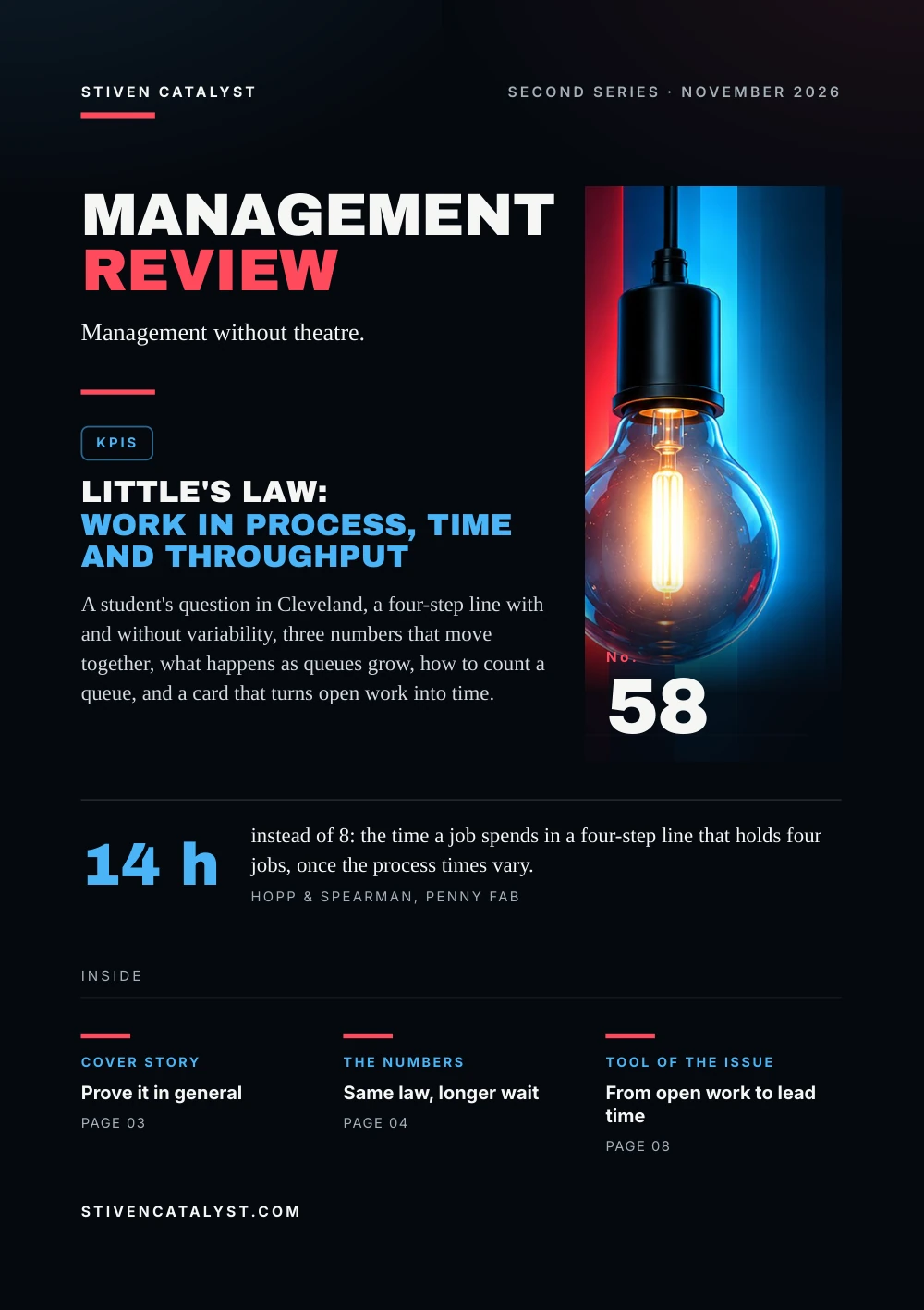 Li
t tle's law: work in process, time and throughput October 2026 Issue 58 opens with the student who asked John Little to prove a queuing formula in general. Wallace Hopp and Mark Spearman's four-step Penny Fab then runs with and without variability, and the three numbers of the law are read from a manager's side. Kanban teams, emergency departments and a server under load show the law in practice; a method for measuring a queue over a period and a card that turns a count of open work into a lead time close the issue. -
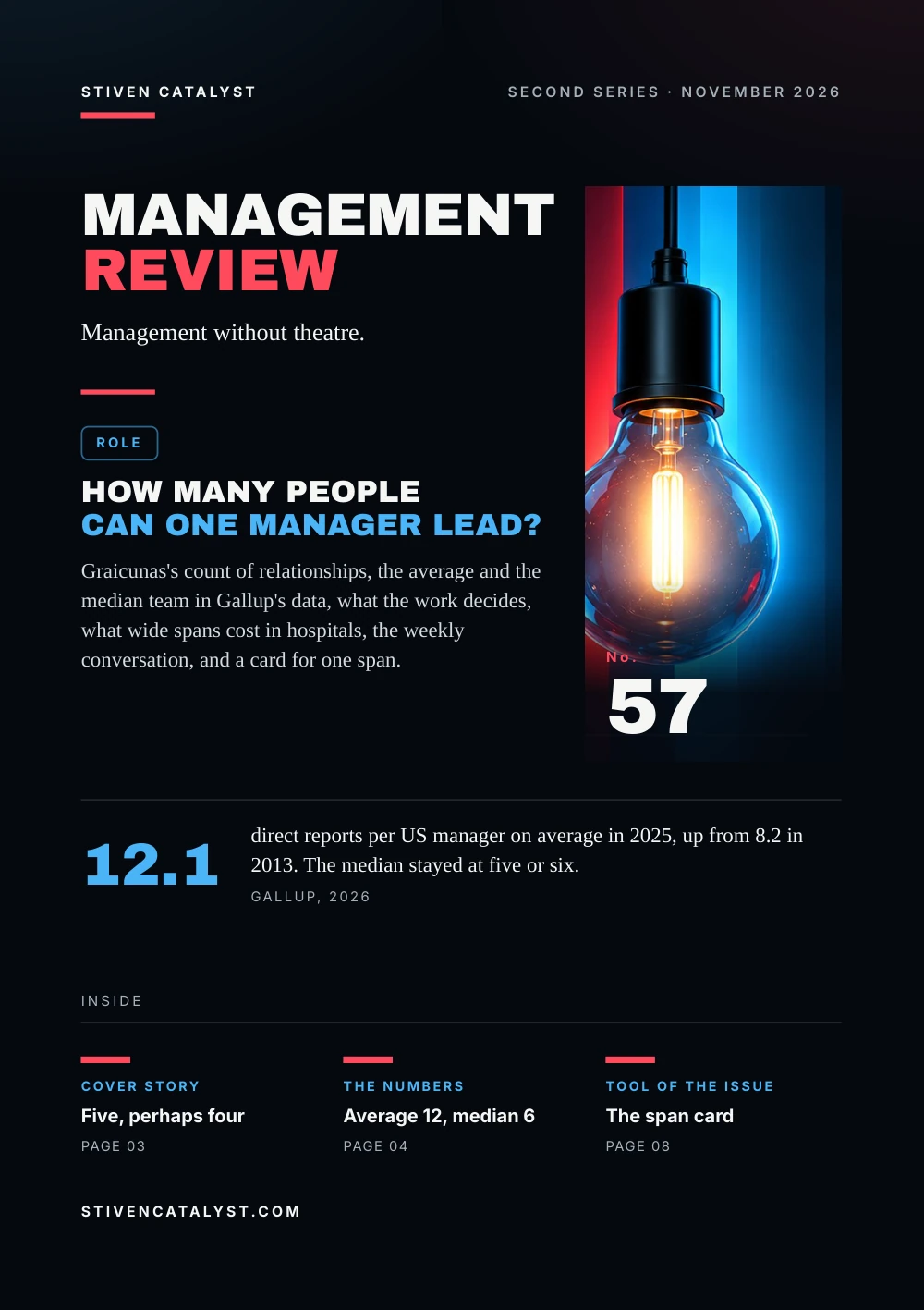 How many people can one manager lead?
October 2026
In 1933 V. A. Graicunas used a formula to show that a fifth subordinate more than doubles a manager's relationships. Issue 57 sets Gallup's rising average team against a median that has hardly moved, and follows Luther Gulick to the conclusion that the work decides the span. It looks at what wide spans cost nurse managers and their teams, shows that the weekly conversation matters more than team size, and ends with a card for checking one manager's span.
-
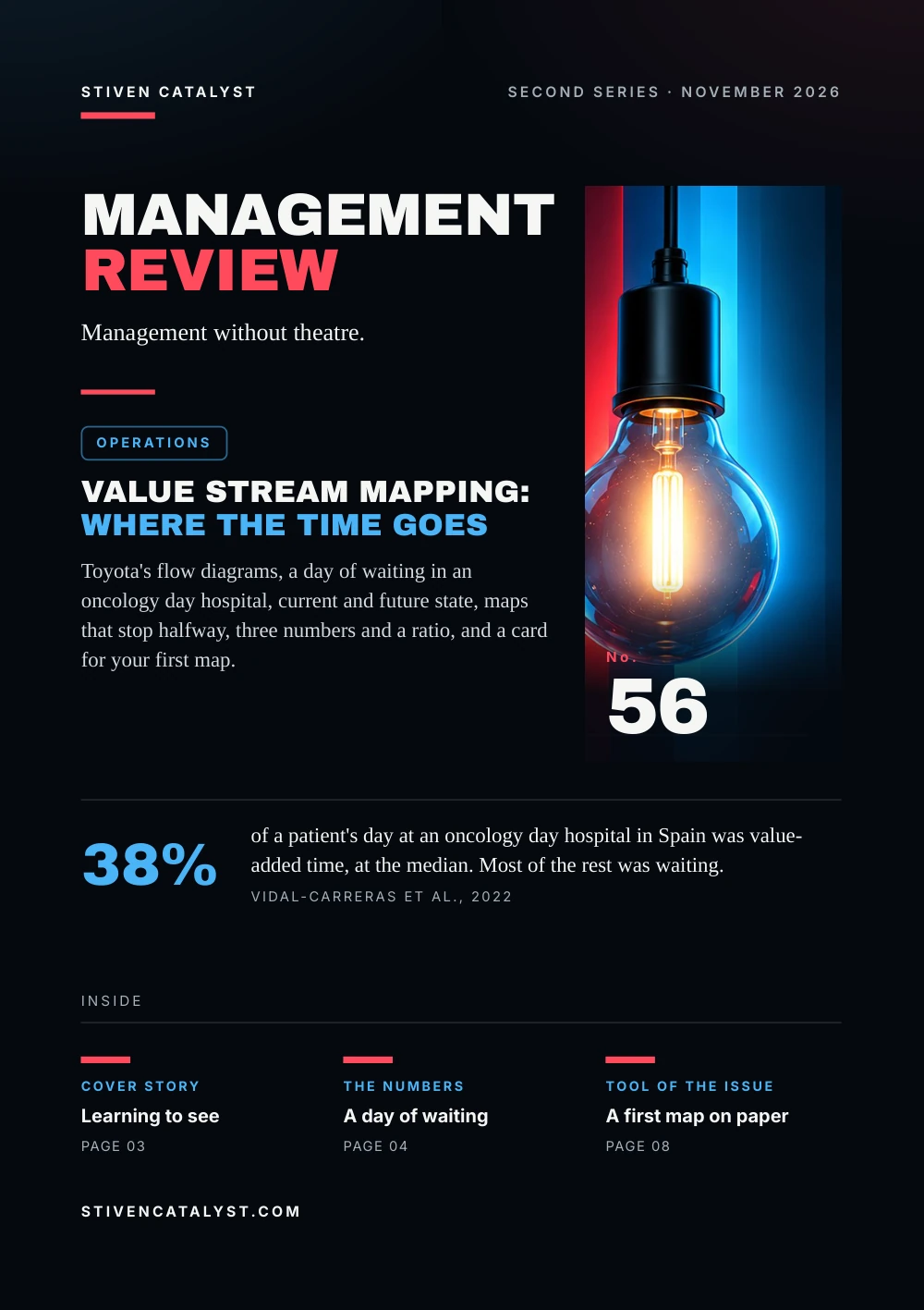 Value stream mapping: where the time goes
October 2026
Mike Rother and John Shook turned a Toyota diagram into value stream mapping; Issue 56 starts there. It follows a patient's day in a Spanish oncology day hospital, where the work took minutes and the waiting took hours, and walks through the steps from current to future state. It then asks why so many published maps stop at the current state, measures a flow with Karen Martin and Mike Osterling's three numbers and a ratio, and closes with a card for a first map on paper.
-
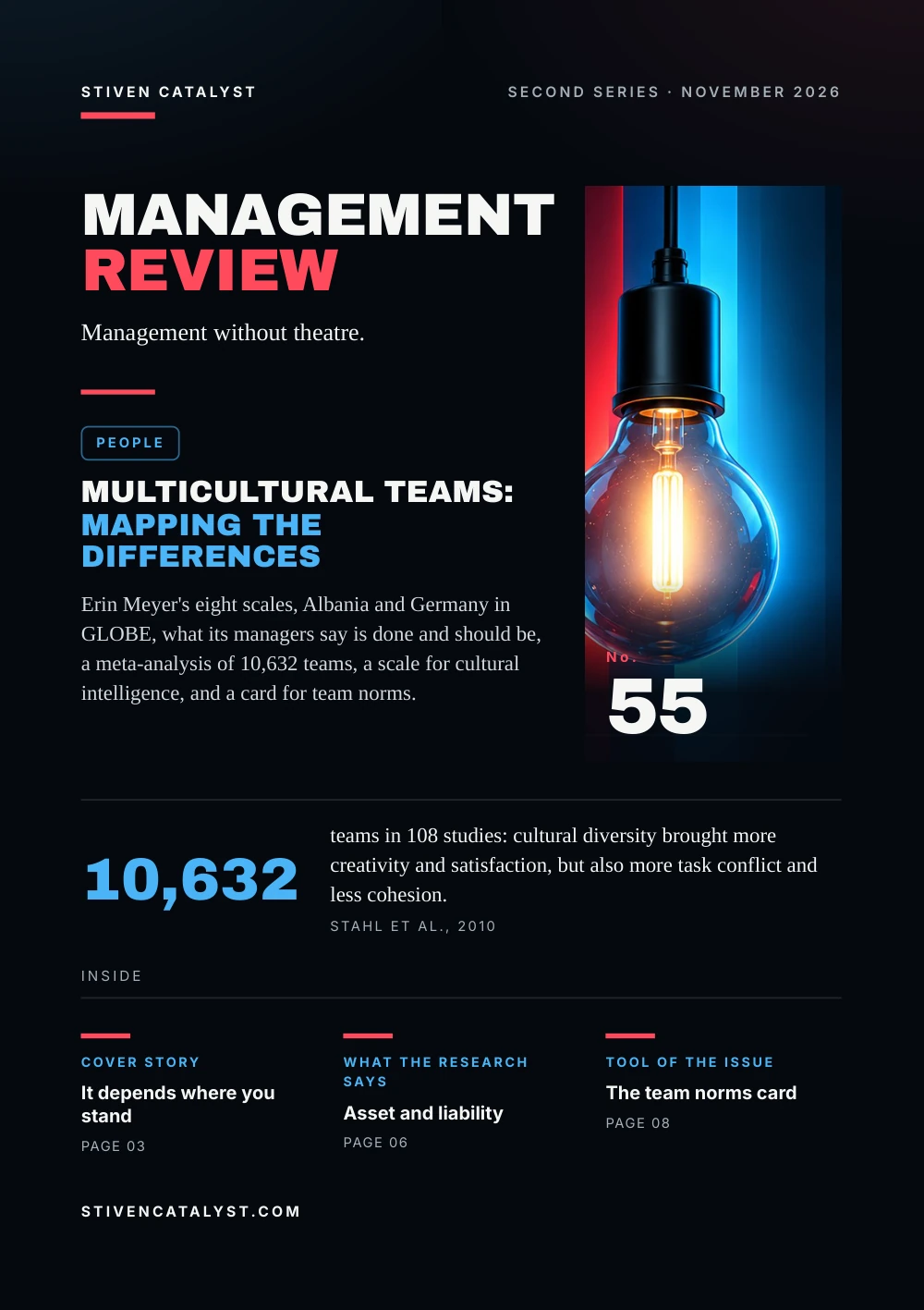 Multicultural teams: mapping the differences
October 2026
Erin Meyer's eight scales open Issue 55, with her warning that a culture's place on a scale means something only next to another. The GLOBE study then sets Albania beside Germany and separates what managers say is done from what they say should be done. A meta-analysis of 108 studies and 10,632 teams, a scale that measures a person rather than a country, and a card for agreeing how a mixed team works complete the issue.
-
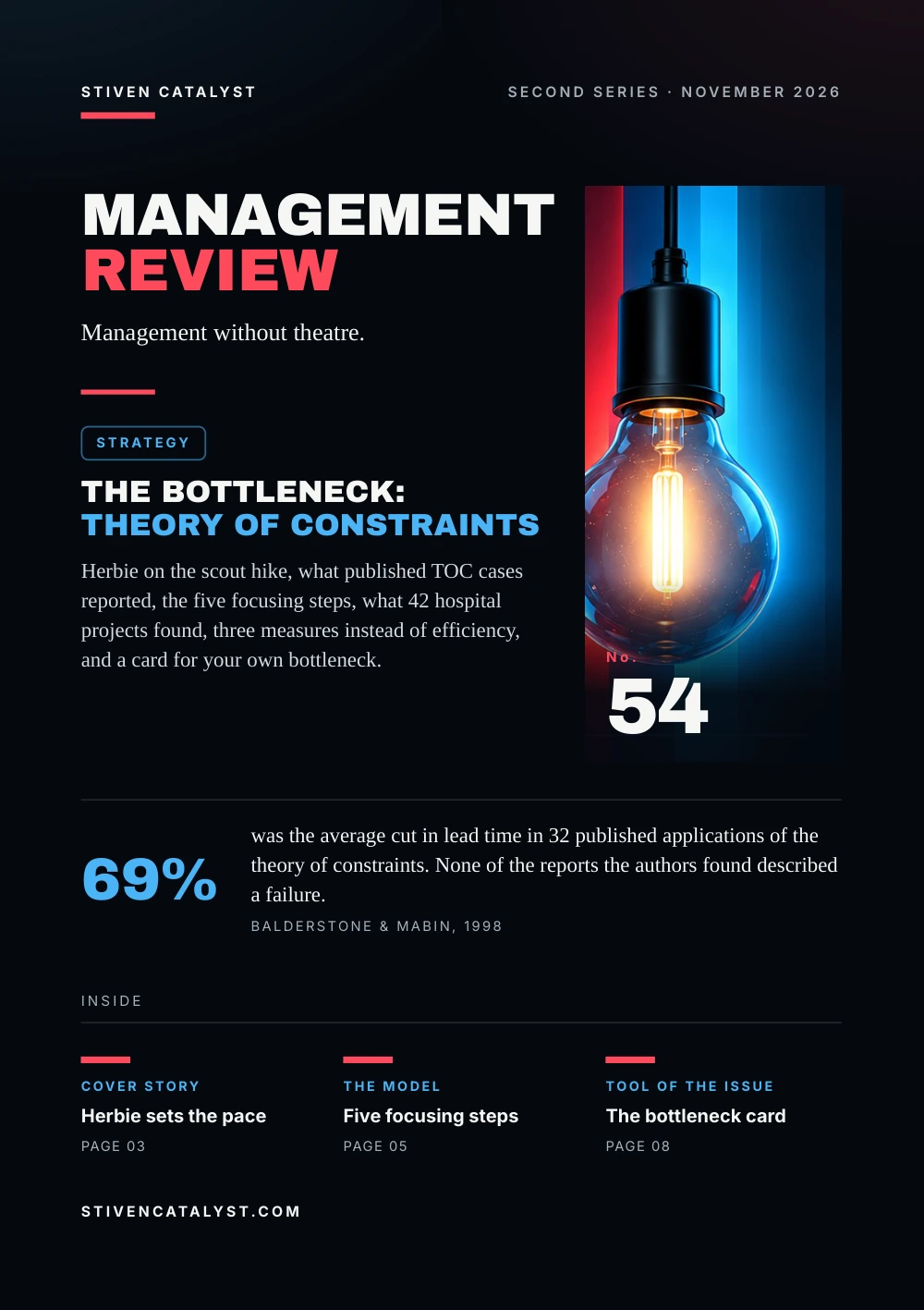 The bo
t tleneck: theory of constraints October 2026 In Eliyahu Goldratt's novel The Goal, the slowest boy on a scout hike sets the pace; Issue 54 starts with him. It looks at what published applications of the theory of constraints reported and what they leave out, and sets out the five focusing steps. Then come 42 projects in healthcare, one of them a queue that moved to the next ward, three measures in place of local efficiency, and a card for finding and working your own bottleneck. -
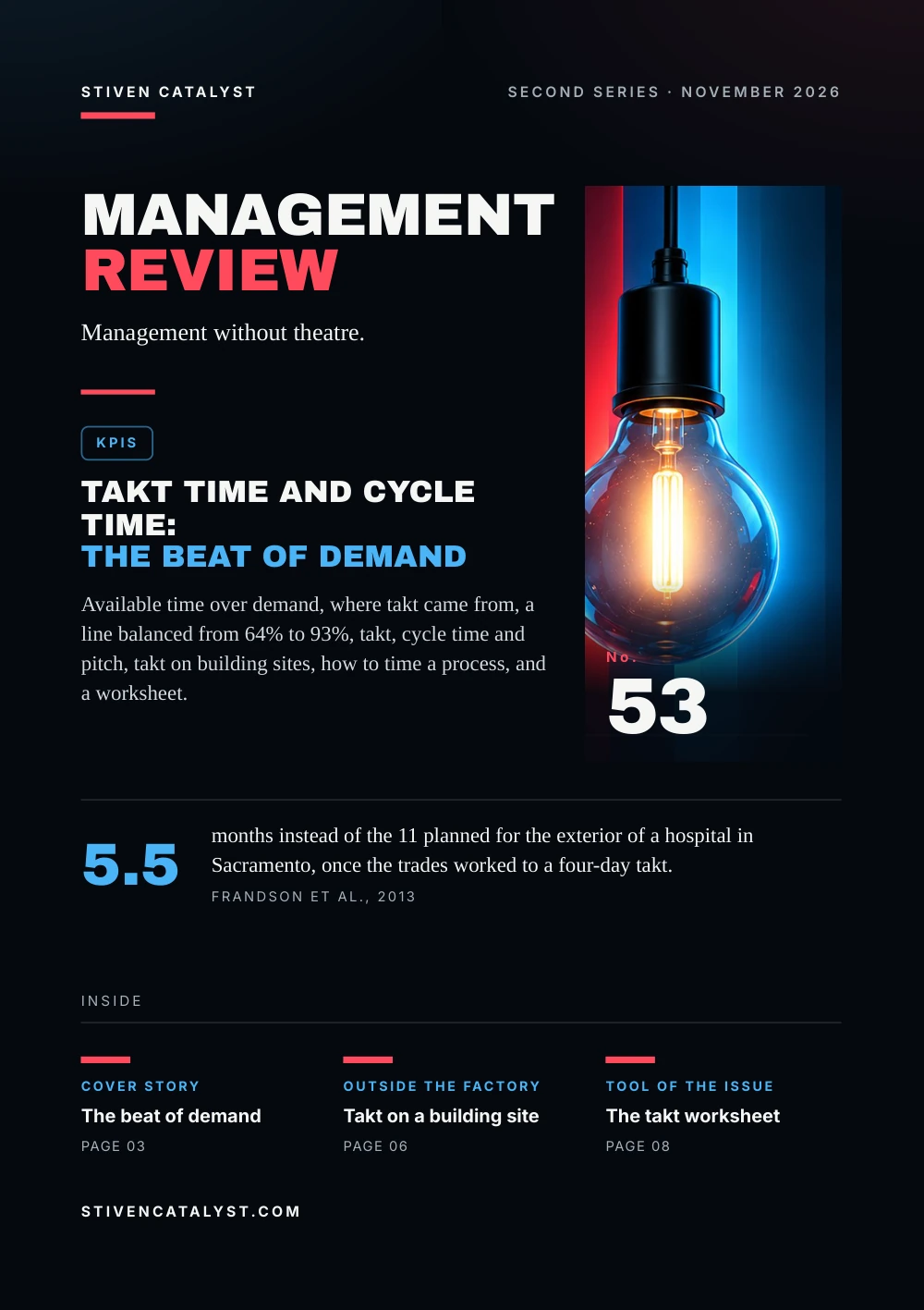 Takt time and cycle time: the beat of demand
October 2026
Issue 53 opens with the Lean Enterprise Institute's definition of takt time and traces its path from the arsenal of Venice and German aircraft plants to Toyota. On one line, eight unevenly loaded operators became two balanced lines; takt is then set against cycle time and pitch and carried to building sites in Sacramento and Helsinki. How to time a process before balancing it, and a takt worksheet, close the issue.
-
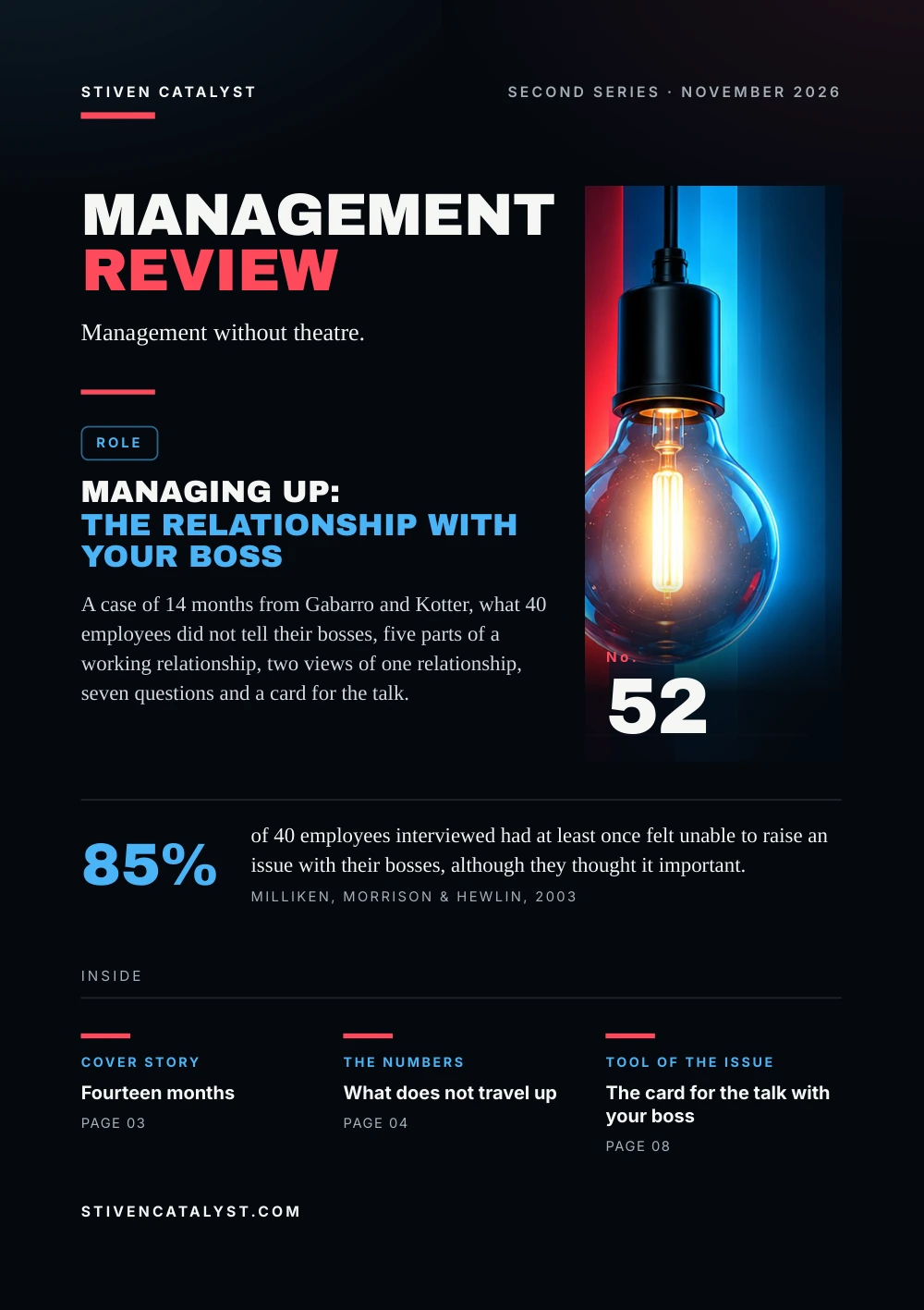 Managing up: the relationship with your boss
October 2026
A manager fired after 14 months under a difficult boss: the case John Gabarro and John Kotter told in 1980 opens Issue 52. Then come what 40 employees did not dare to raise with their bosses, and why, and the five parts of a working relationship with the boss. Leader–member exchange follows that relationship from strangers to partners, meta-analyses show that boss and employee rate it differently, and a card prepares your next conversation with your manager.
-
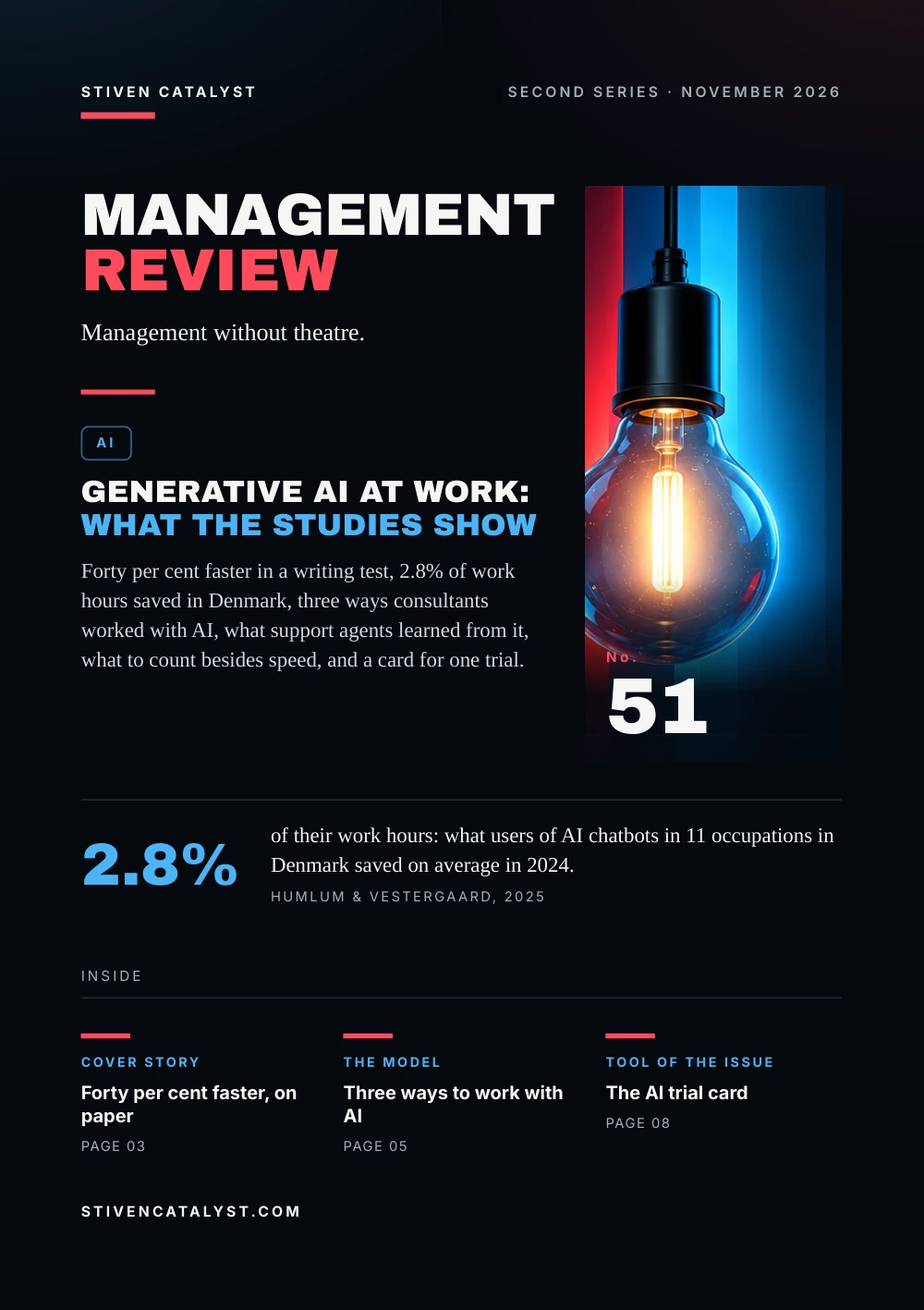 Generative AI at work: what the studies show
October 2026
Issue 51 reads the studies of generative AI at work side by side. In a writing experiment professionals finished 40% faster; in a Danish survey users saved 2.8% of their hours; 244 consultants worked with GPT-4 in three different ways. Then come what 5,179 support agents learned from an AI assistant and what students lost without one, five things to count besides speed, and a card for trying AI on one task.
-
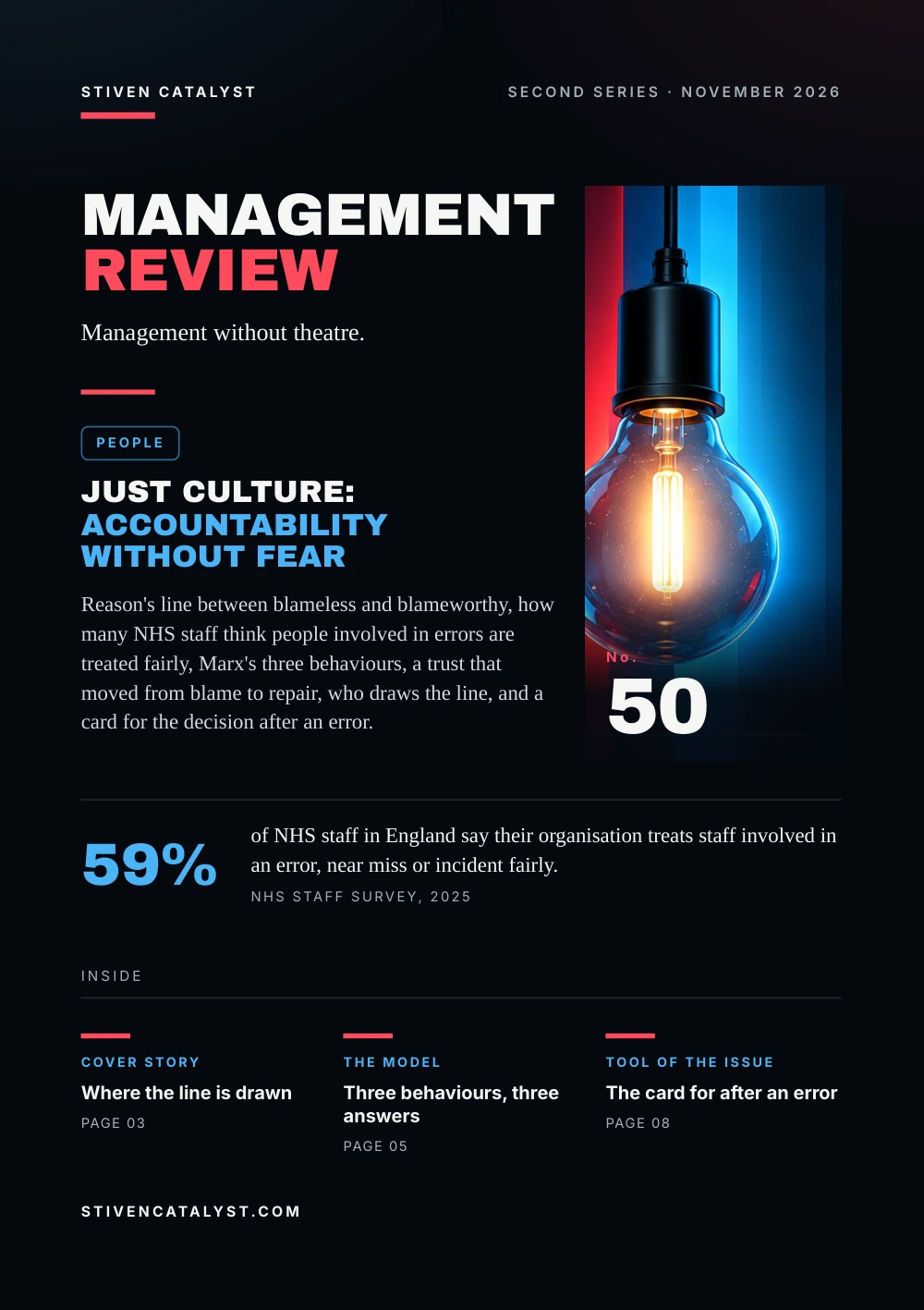 Just culture: accountabili
t y without fear October 2026 James Reason saw two ways of looking at human error and wanted a line drawn between blameless and blameworthy acts; Issue 50 starts with him. It asks how many NHS staff in England think people involved in errors are treated fairly, and sets out David Marx's human error, at-risk behaviour and recklessness. A mental health trust in Liverpool that swapped culpability for repair, Sidney Dekker's question of who gets to draw the line and a card for the decision after an error complete the issue. -
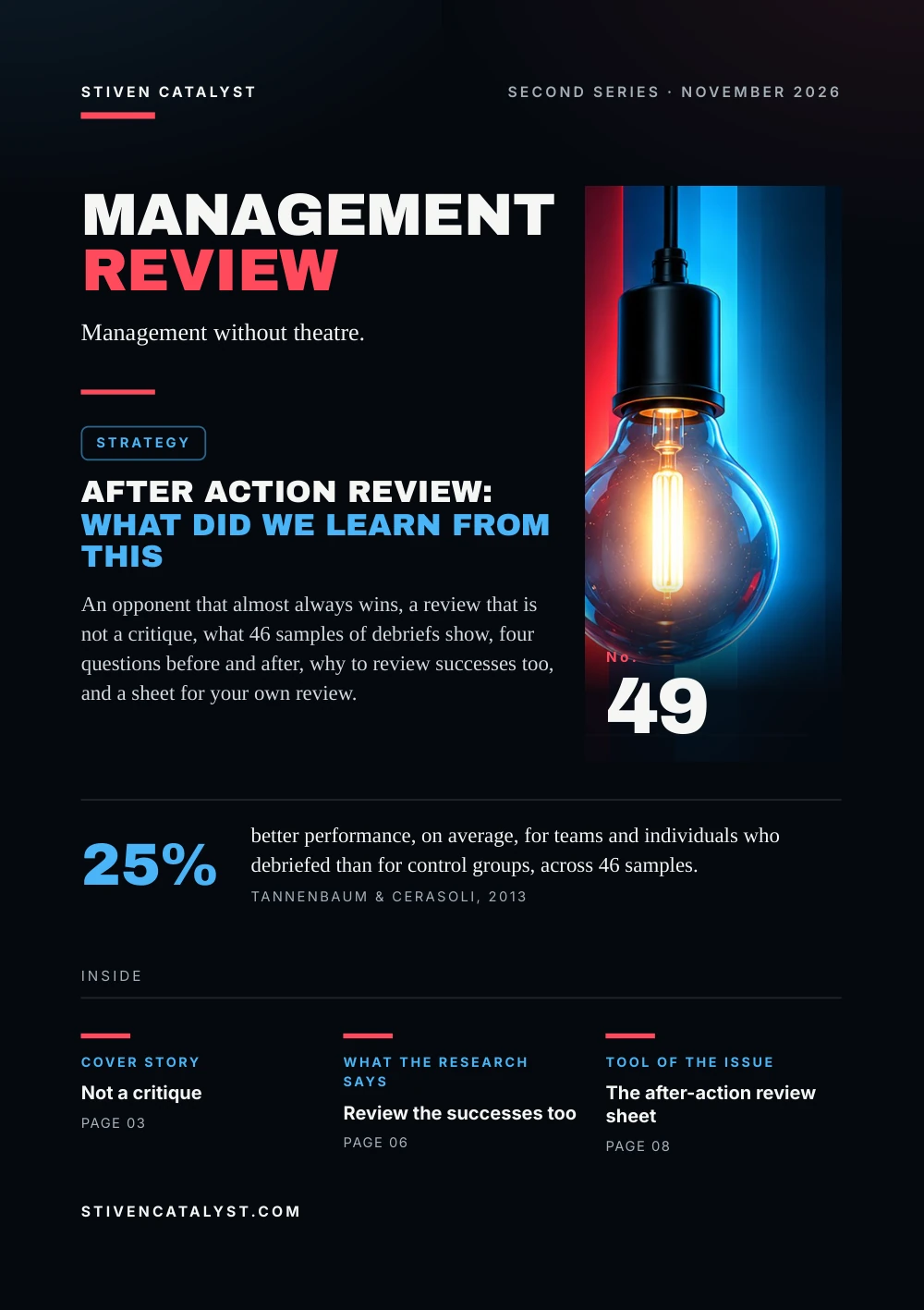 A
f ter Action Review: what did we learn from this October 2026 The US Army's Opposing Force almost always beats the brigades sent to train against it; Issue 49 starts there. It reads the Army's 1993 guide, which says an after-action review is not a critique, and checks what a meta-analysis of 46 samples found about debriefs. Then come the four questions before and after the action, soldiers who also reviewed their successes, the question of when a lesson counts as learned, and a sheet for your own review. -
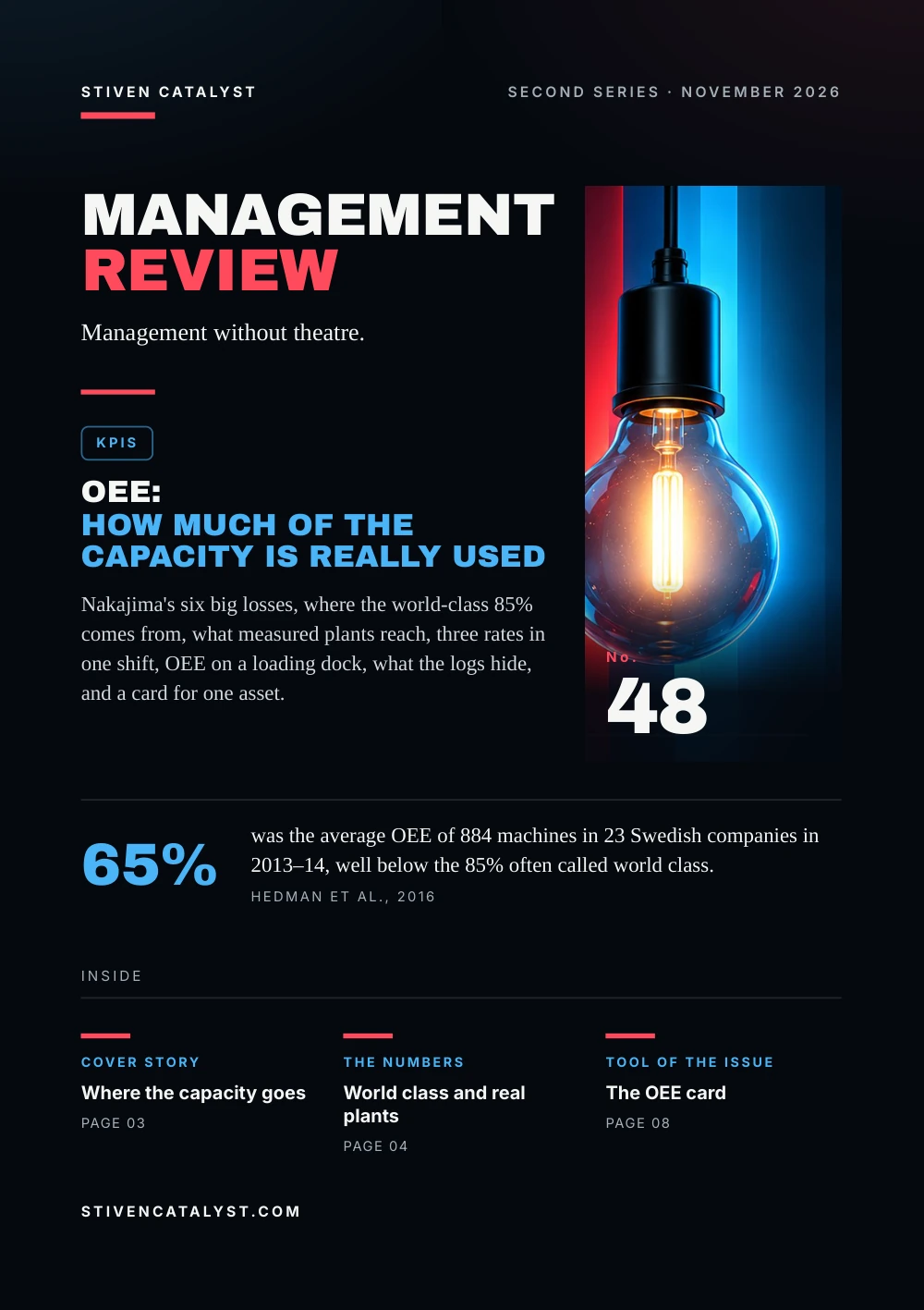 OEE: how much of the capaci
t y is really used October 2026 Issue 48 follows overall equipment effectiveness from Japan's maintenance prize and Seiichi Nakajima's TPM to the six big losses. It traces the world-class 85% back to a set of ideal conditions and sets it against what studies of real machines measured. One invented shift is worked through and the idea carried, with care, to vehicles and loading docks; after a look at what automatic logs can hide comes a card for one asset. -
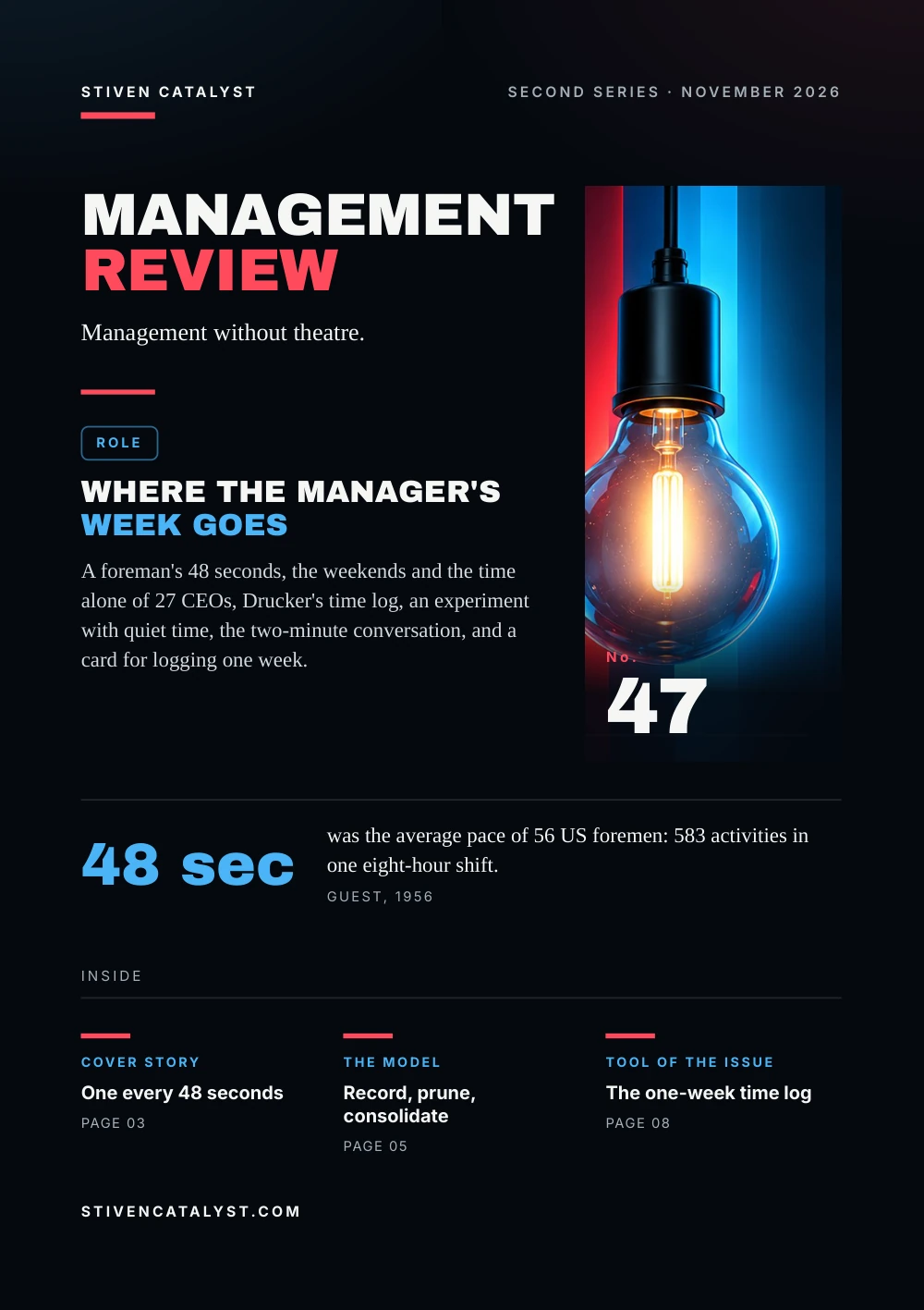 Where the manager's week goes
October 2026
Henry Mintzberg gathered the studies of managers at work, from a foreman with a new task every 48 seconds to managers who seldom had half an hour in one piece; Issue 47 starts with them. It follows 27 CEOs into their weekends and their time alone and sets out Peter Drucker's three steps for knowing your time. An experiment with quiet time, John Kotter's two-minute conversations and the way the large studies measured the week lead to a card for logging your own.
-
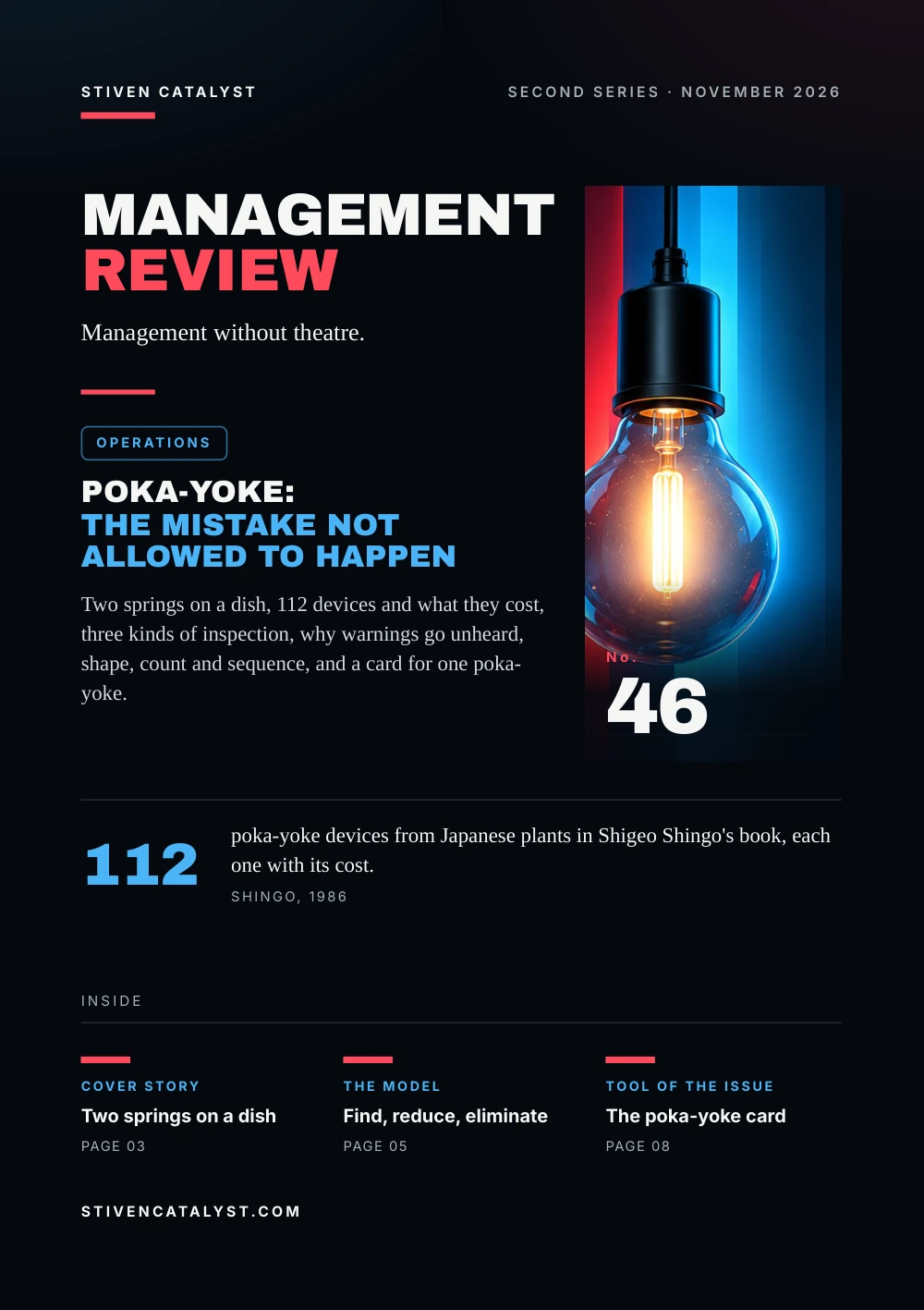 Poka-yoke: the mistake not allowed
t o happen October 2026 At a small Japanese plant in 1961, a switch kept missing its spring; Issue 46 starts there. It counts the 112 devices in Shigeo Shingo's Zero Quality Control and what they cost, and separates inspections that find, reduce and eliminate defects. Hospital alarms show why a warning is weaker than a stop; the three ways a device detects an error and a card for one poka-yoke close the issue. -
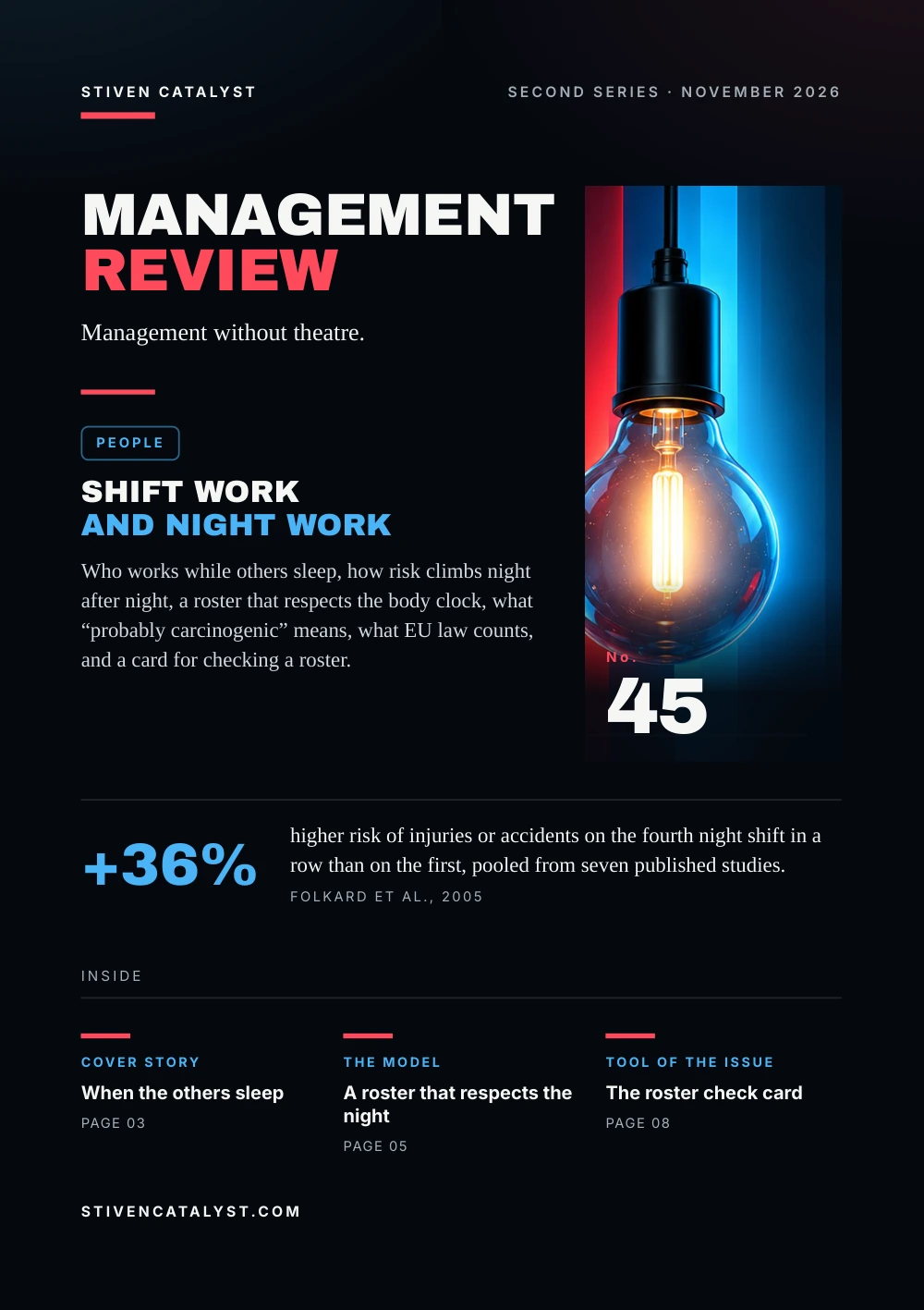 Shi
f t work and night work October 2026 One worker in five in Europe works shifts, and Issue 45 starts with them. It shows how the risk of incidents rises over successive night shifts, sets out the British safety regulator's advice on designing a roster, and admits how uncertain the evidence on the direction of rotation still is. It then explains what IARC means when it calls night shift work probably carcinogenic, lists what EU law requires for night workers and ends with a card for checking a roster. -
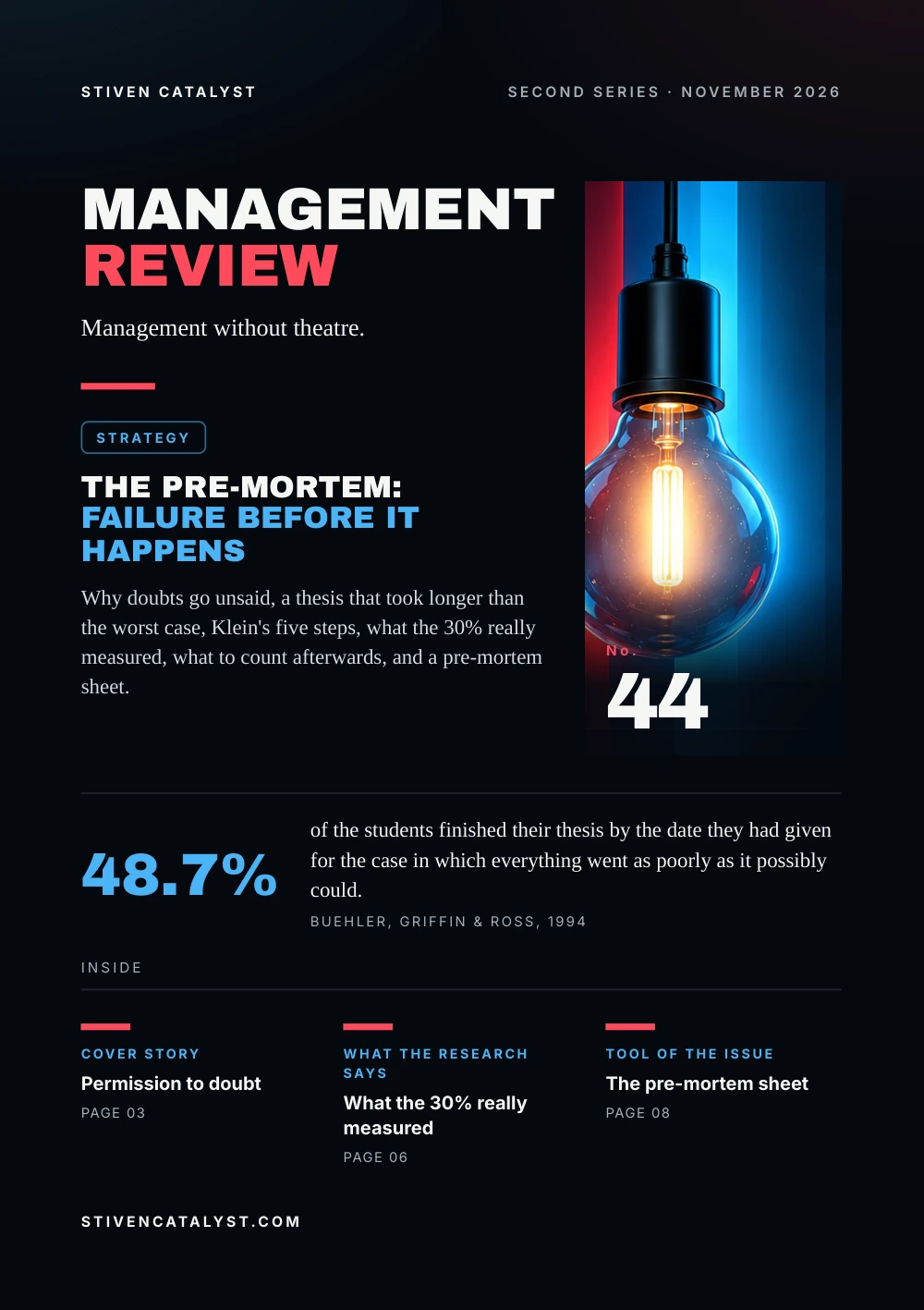 The pre-mo
r tem: failure before it happens October 2026 Once a plan seems settled, a team keeps its doubts to itself; Issue 44 starts there. It follows students whose thesis took longer than even their worst-case forecast and sets out Gary Klein's pre-mortem step by step. Then it checks what the often-quoted 30% actually measured, shows what to count after a session and ends with a sheet for your own pre-mortem. -
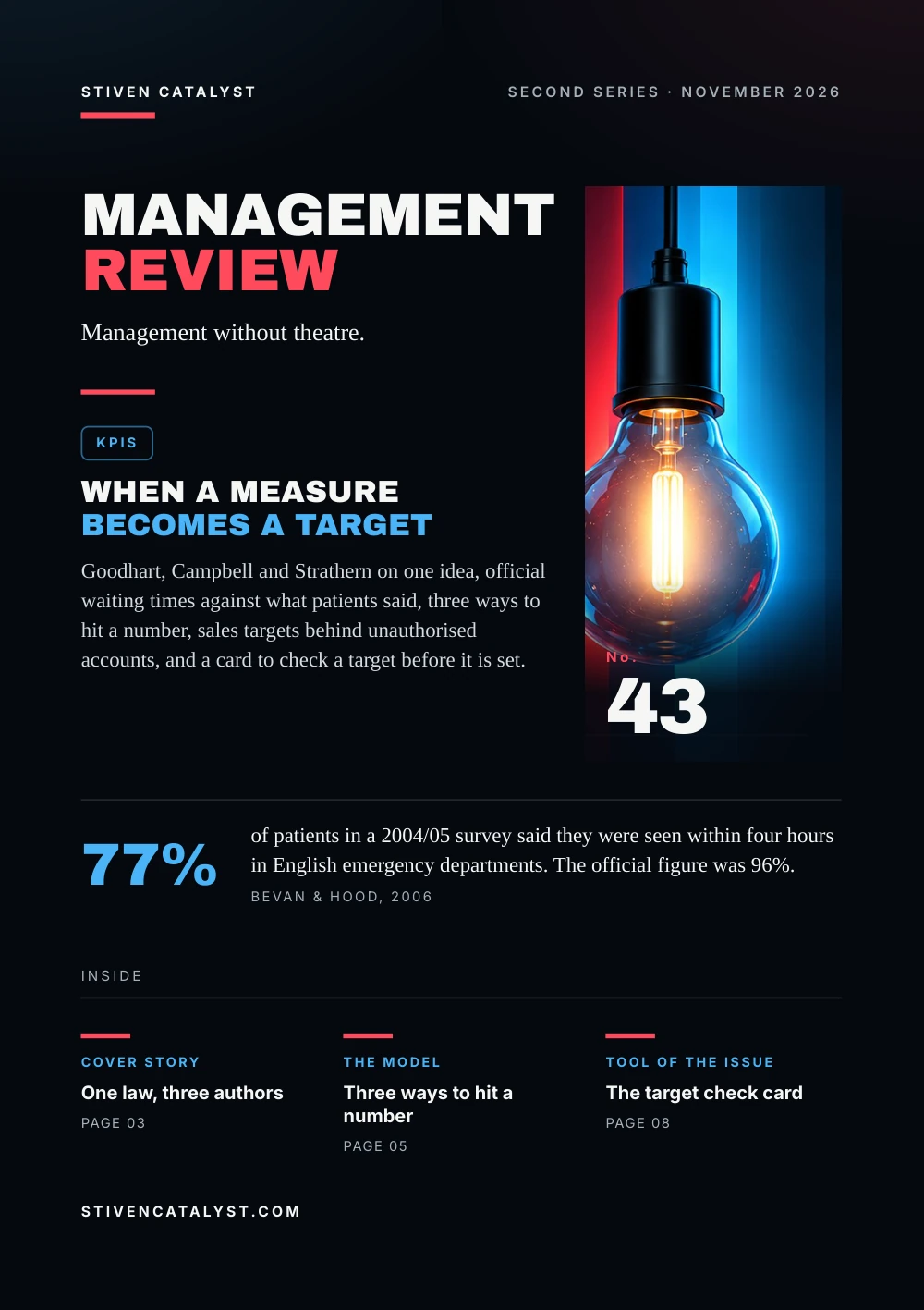 When a measure becomes a targ
e t October 2026 Issue 43 traces one idea from Charles Goodhart's monetary paper of 1975 through Donald Campbell to Marilyn Strathern. It sets the official waiting times of English emergency departments against what patients reported and names three ways a number gets hit without the work improving. Sales targets behind accounts customers had not authorised, Jerry Muller's metric fixation and a card to check a target before it is set complete the issue. -
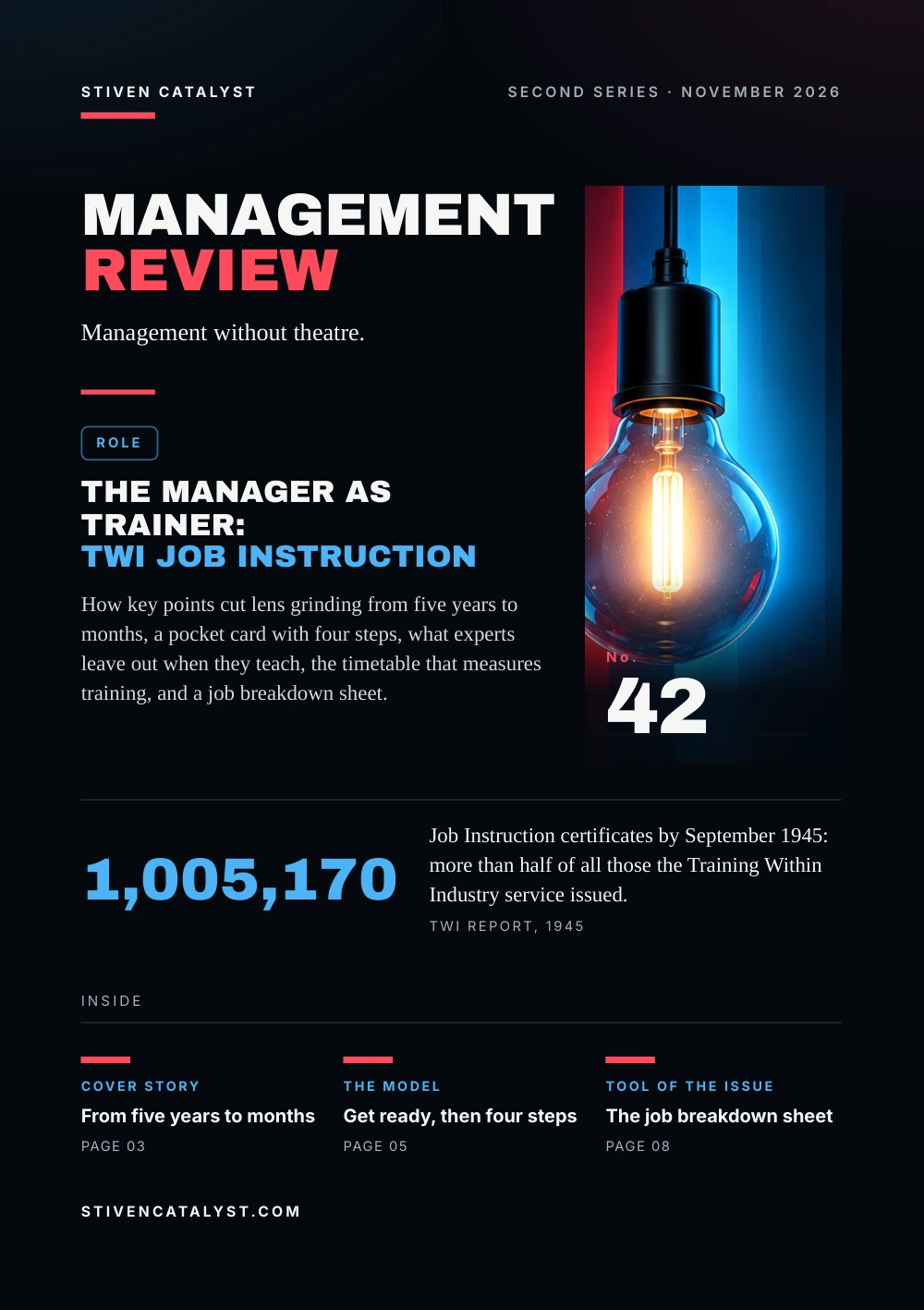 The manager as trainer: TWI Job Instruction
October 2026
In 1940 the United States needed lens grinders, and a handful of key points cut their training from years to months: Issue 42 begins there. It follows Job Instruction from Charles Allen's shipyards to more than a million certificates and sets out the pocket card with its four steps. Expert surgeons show how much is left out when a procedure is taught, TWI's timetable measures training, and a job breakdown sheet waits to be filled in.
-
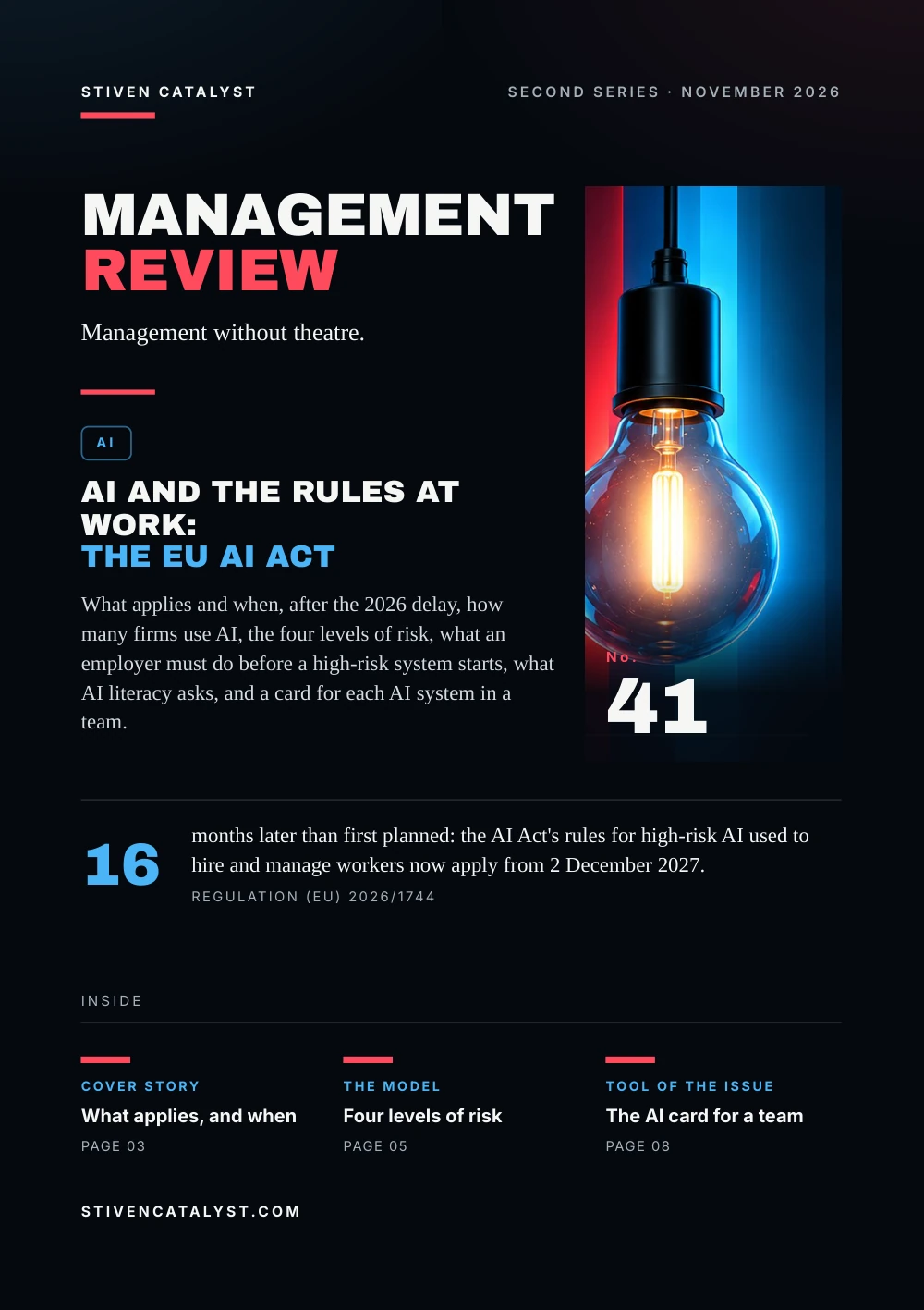 AI and the rules at work: the EU AI Act
October 2026
Issue 41 opens the second series with the EU's AI Act. It sets out what has applied since 2025, what the Digital Omnibus on AI postponed in 2026 and how many firms already use AI. Then come the four levels of risk, from emotion recognition at work, which is banned, to tools for hiring and performance; the employer's duties before a high-risk system starts; the duty of AI literacy; and a card for each AI system a team uses.
-
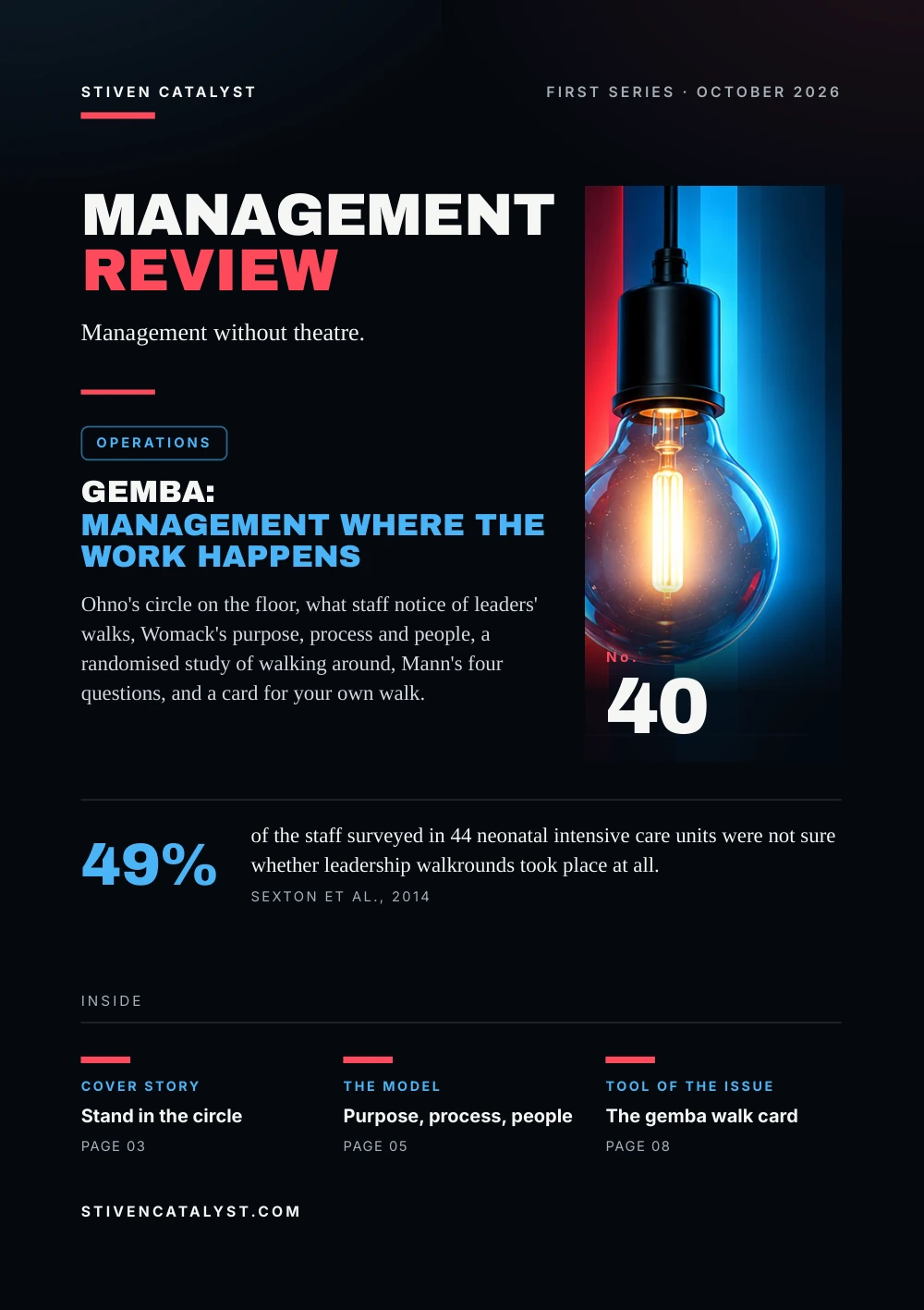 Gemba: management where the work happens
October 2026
Issue 40 opens inside the circle Taiichi Ohno drew on the shop floor. It asks how many frontline staff even notice their leaders' walks, follows Jim Womack along a value stream with purpose, process and people, and looks at a randomised study in which walking around made things worse. David Mann's four questions and a card for your own gemba walk close the issue.
-
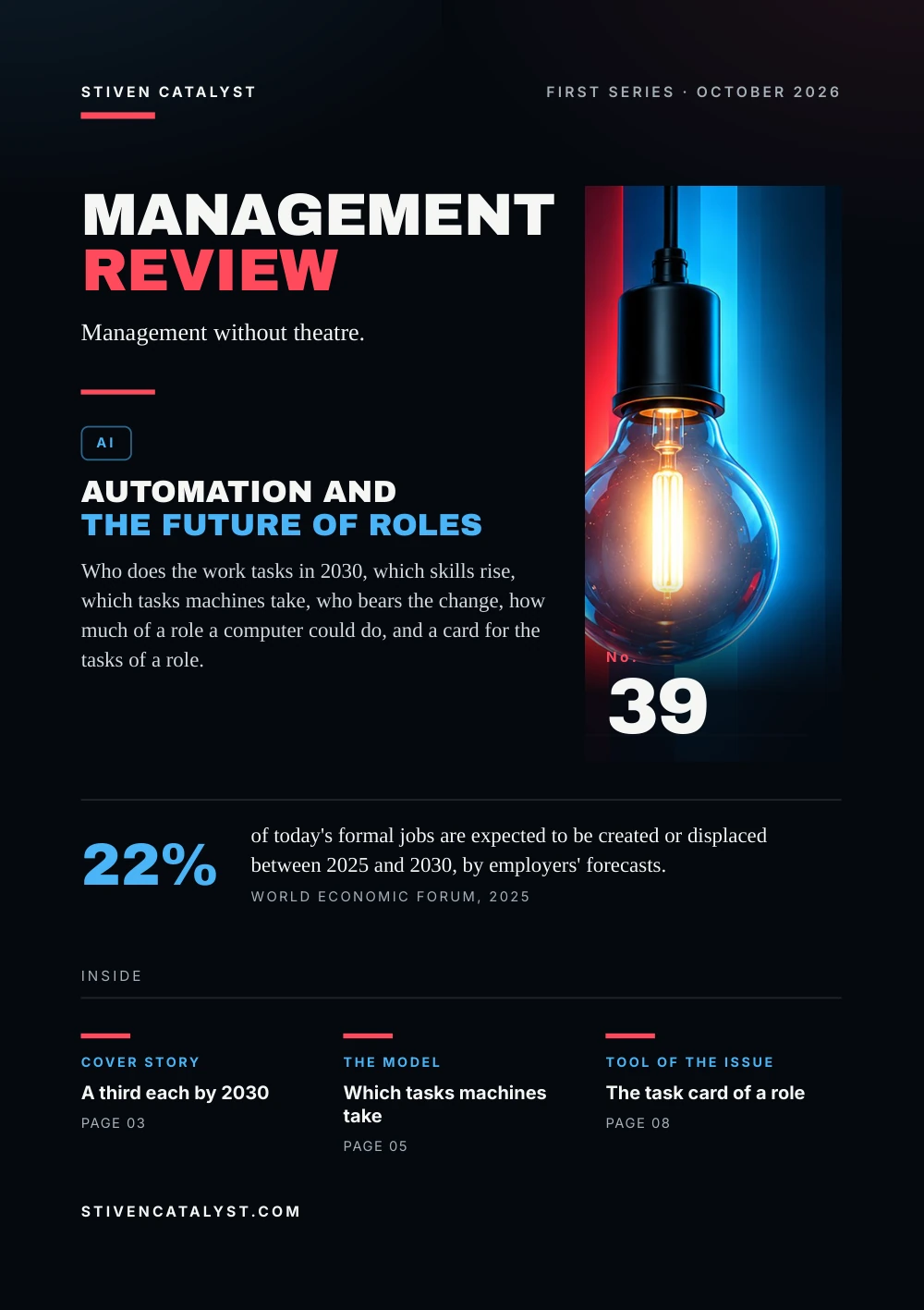 Au
t omation and the future of roles October 2026 Issue 39 opens with employers' forecast that by 2030 people, machines and both together will each do about a third of work tasks. It sets out the skills on the rise and sorts tasks into routine and non-routine. Then it asks who bore the change when robots and AI arrived and measures how much of an occupation a computer could do, before a card for the tasks of a role closes the issue. -
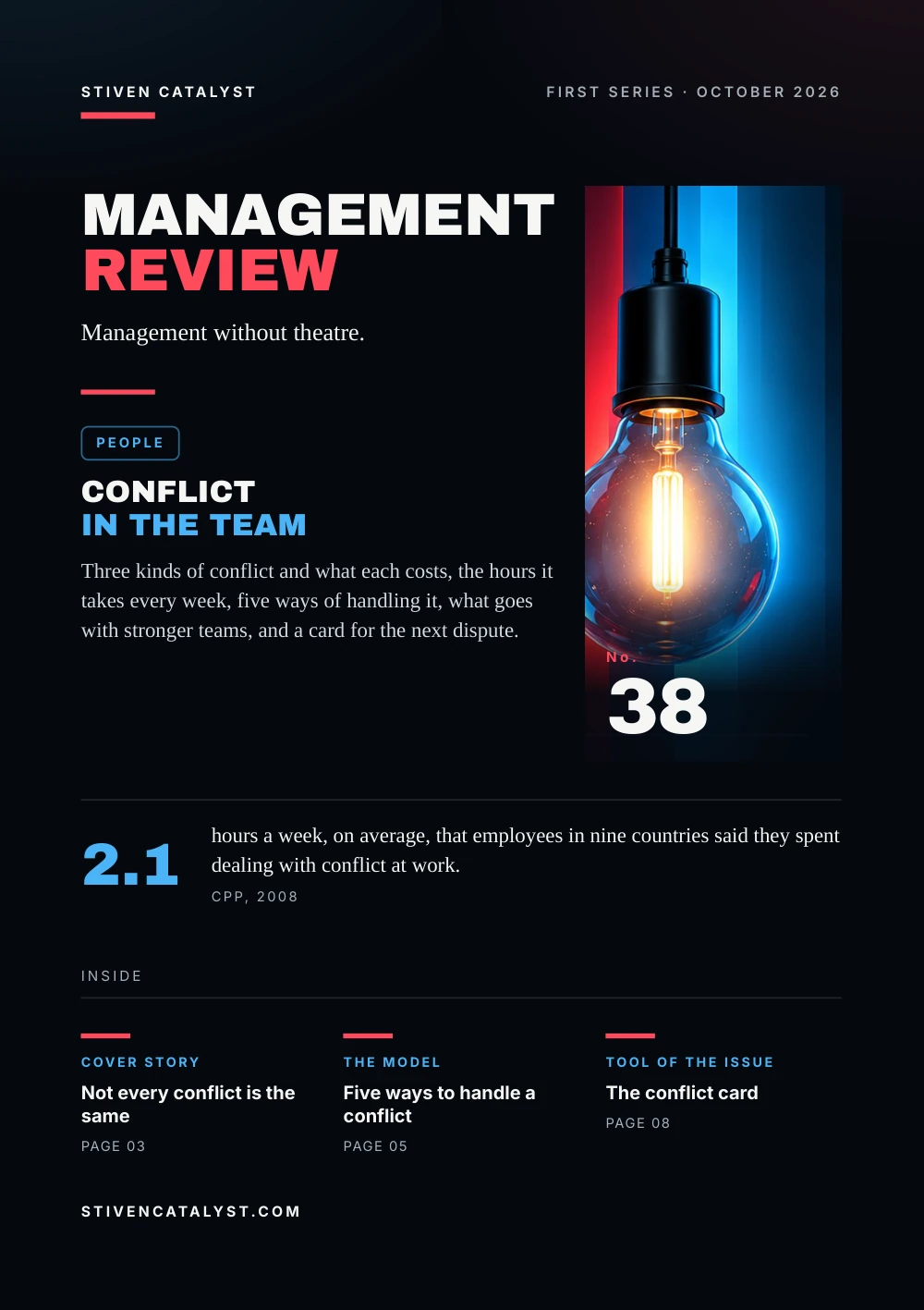 Conflict in the team
October 2026
Issue 38 opens with an old belief: disagreement about the work makes a team sharper, and only personal friction harms it. Two meta-analyses put it to the test, and a survey counts the hours a week that conflict takes in nine countries. After the five modes of Thomas and Kilmann and the ways of handling conflict that go with stronger teams, a card for the next dispute closes the issue.
-
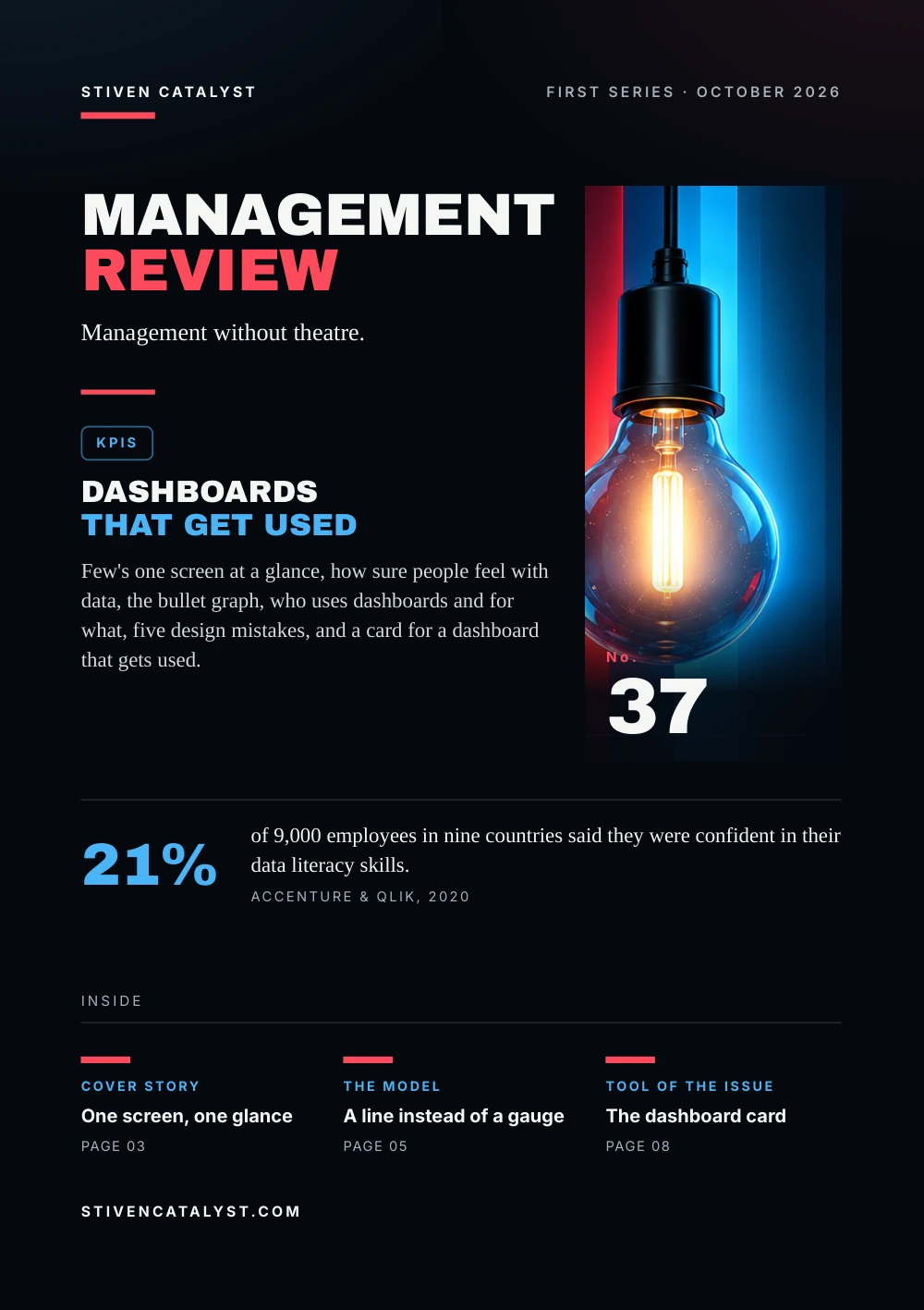 Dashboards that g
e t used October 2026 Issue 37 opens with Stephen Few's narrow definition of a dashboard: one screen, monitored at a glance. It asks how sure employees feel when they work with data and explains the bullet graph Few designed to replace the gauge. Who actually uses dashboards, and for what, comes next; a screen is checked against Few's common design mistakes, and a card for a dashboard that gets used closes the issue. -
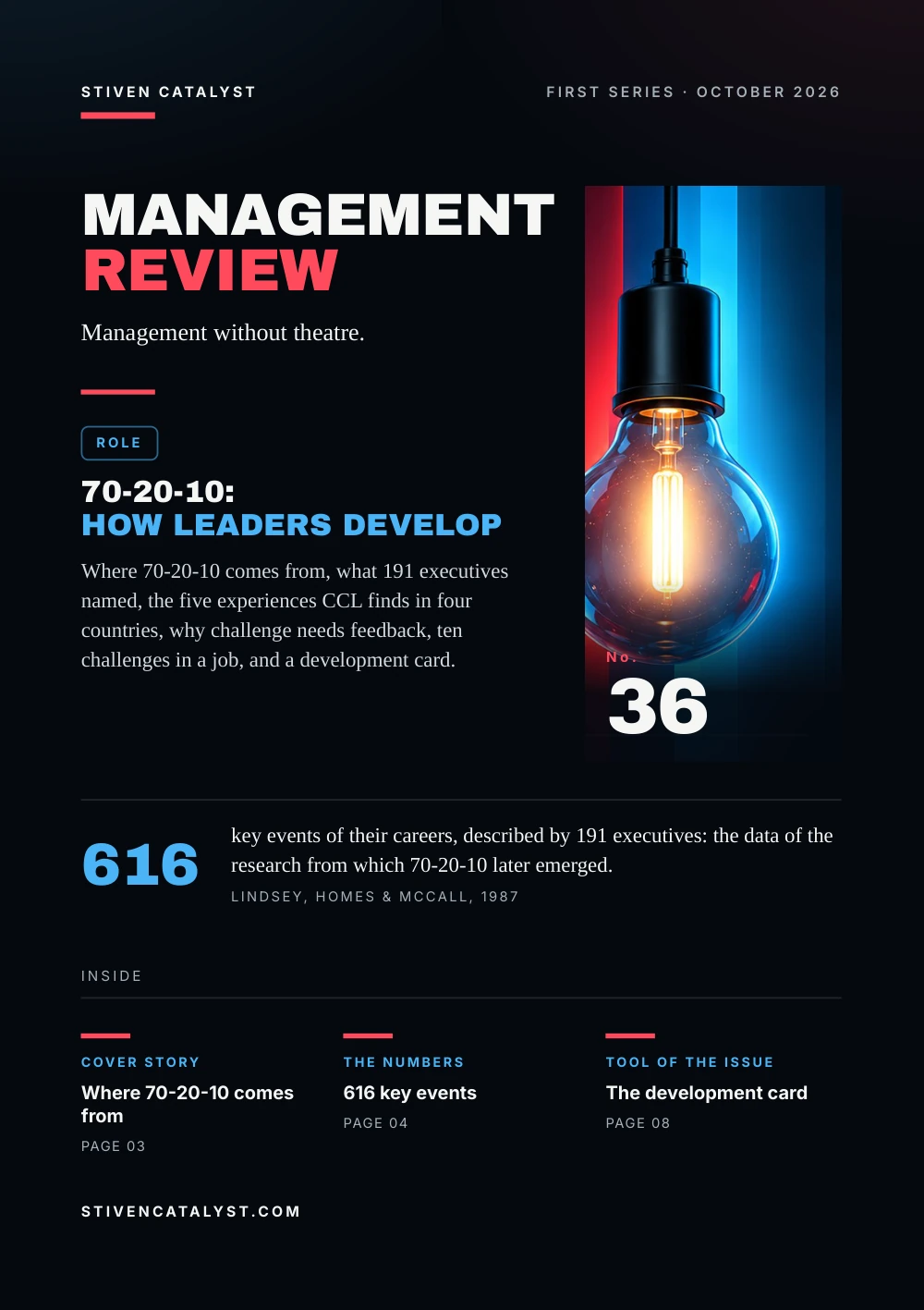 70-20-10: how leaders develop
October 2026
Issue 36 traces 70-20-10 to a sentence of 1996 and to the Center for Creative Leadership's research with 191 executives, then counts the 616 key events they named. It sets out the experiences CCL finds in four countries and weighs what studies find about challenge, feedback and the framework in practice. A card for developing one skill closes the issue.
-
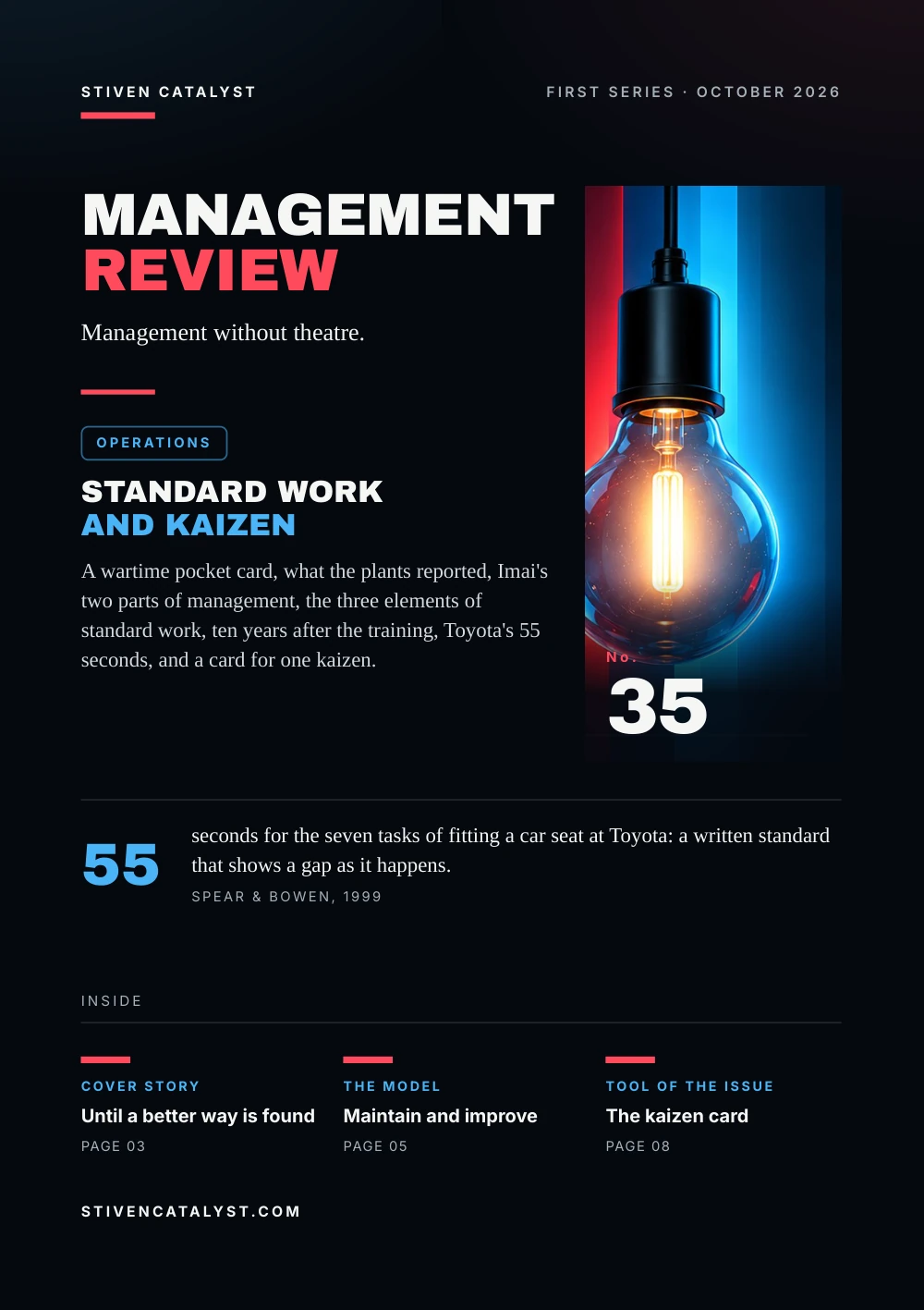 Standard work and kaizen
October 2026
Issue 35 opens with a Second World War pocket card that told supervisors to use a new method until a better way is found. It reads what plants reported to the Training Within Industry service, then sets out Masaaki Imai's two parts of management and the three elements of standard work. A study of 11,575 firms over ten years and Toyota's way of making a gap visible within seconds lead to the closing card for one kaizen.
-
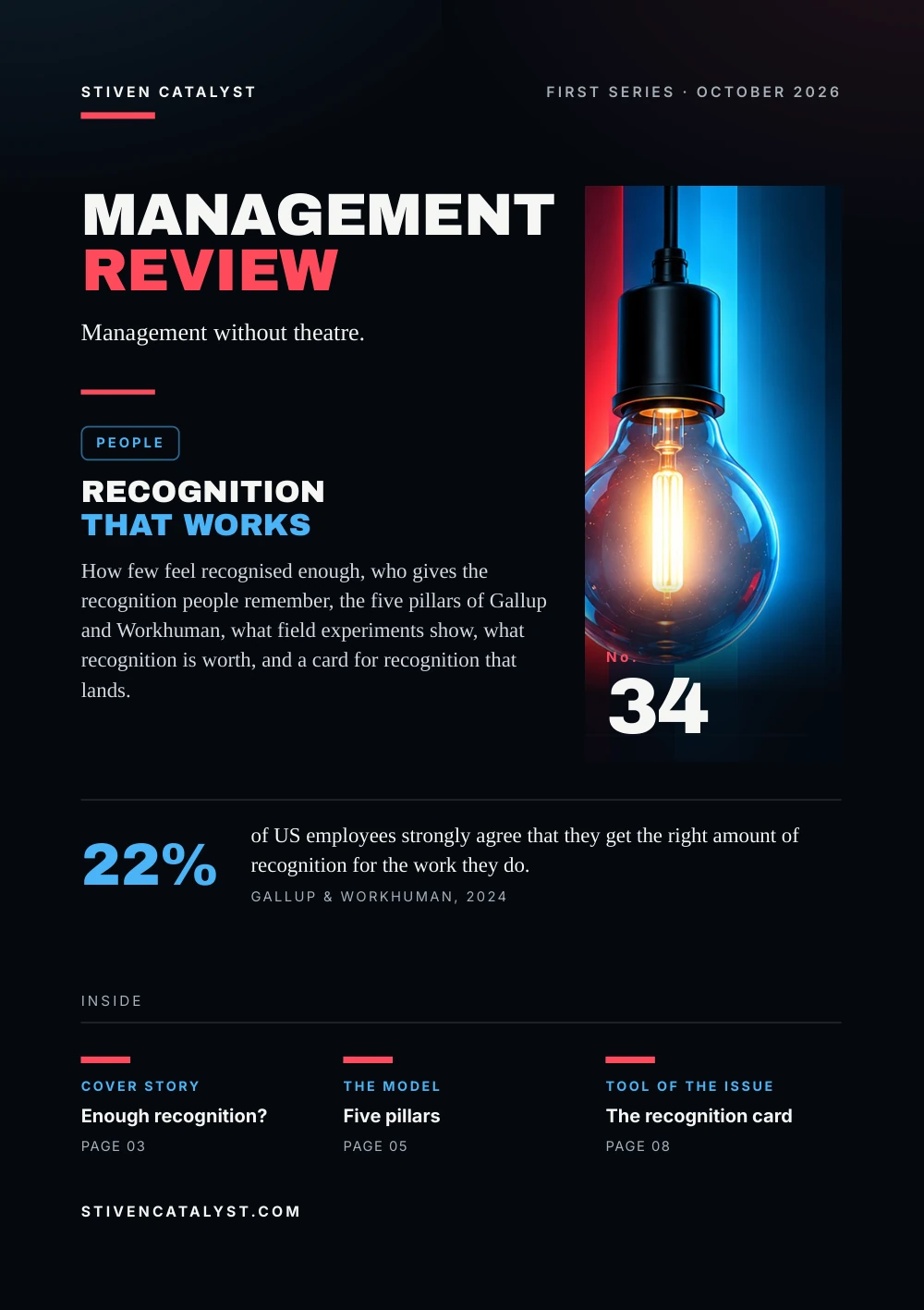 Recognition that works
October 2026
Issue 34 opens with the finding of Gallup and Workhuman that only 22% of US employees strongly agree they get the right amount of recognition. It asks who gives the recognition people remember and sets out the five pillars of recognition that works. Field experiments show a card that helped and an award that did harm; after Gallup's estimate of what recognition is worth, a card for recognition that lands closes the issue.
-
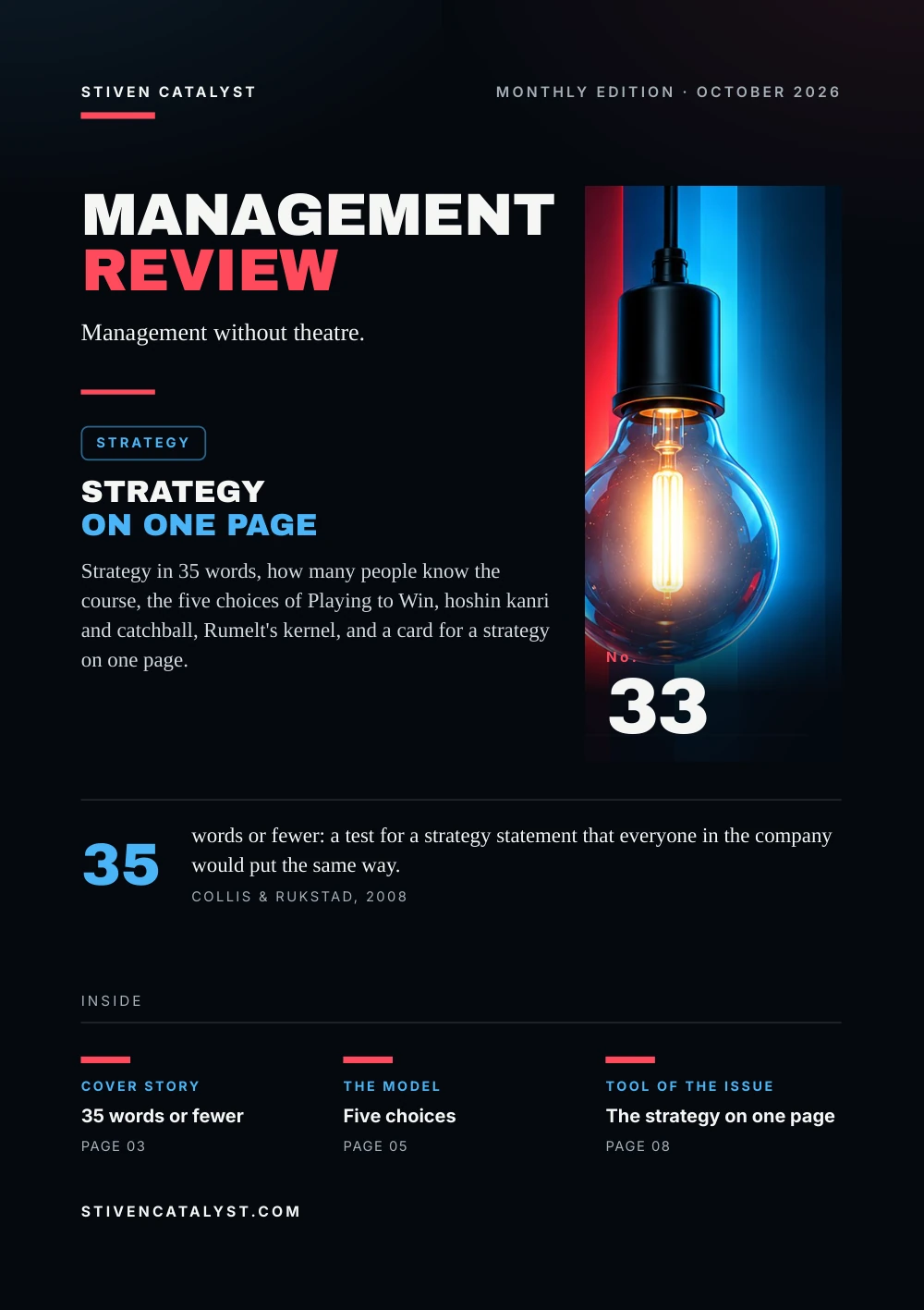 Strategy on one page
October 2026
Issue 33 opens with Collis and Rukstad's test: a strategy statement in 35 words or fewer. It asks how many employees know their company's course and sets out the five choices of Playing to Win. Hoshin kanri travels from Japan to the West, a plan meets Richard Rumelt's kernel, and a card for a strategy on one page closes the issue.
-
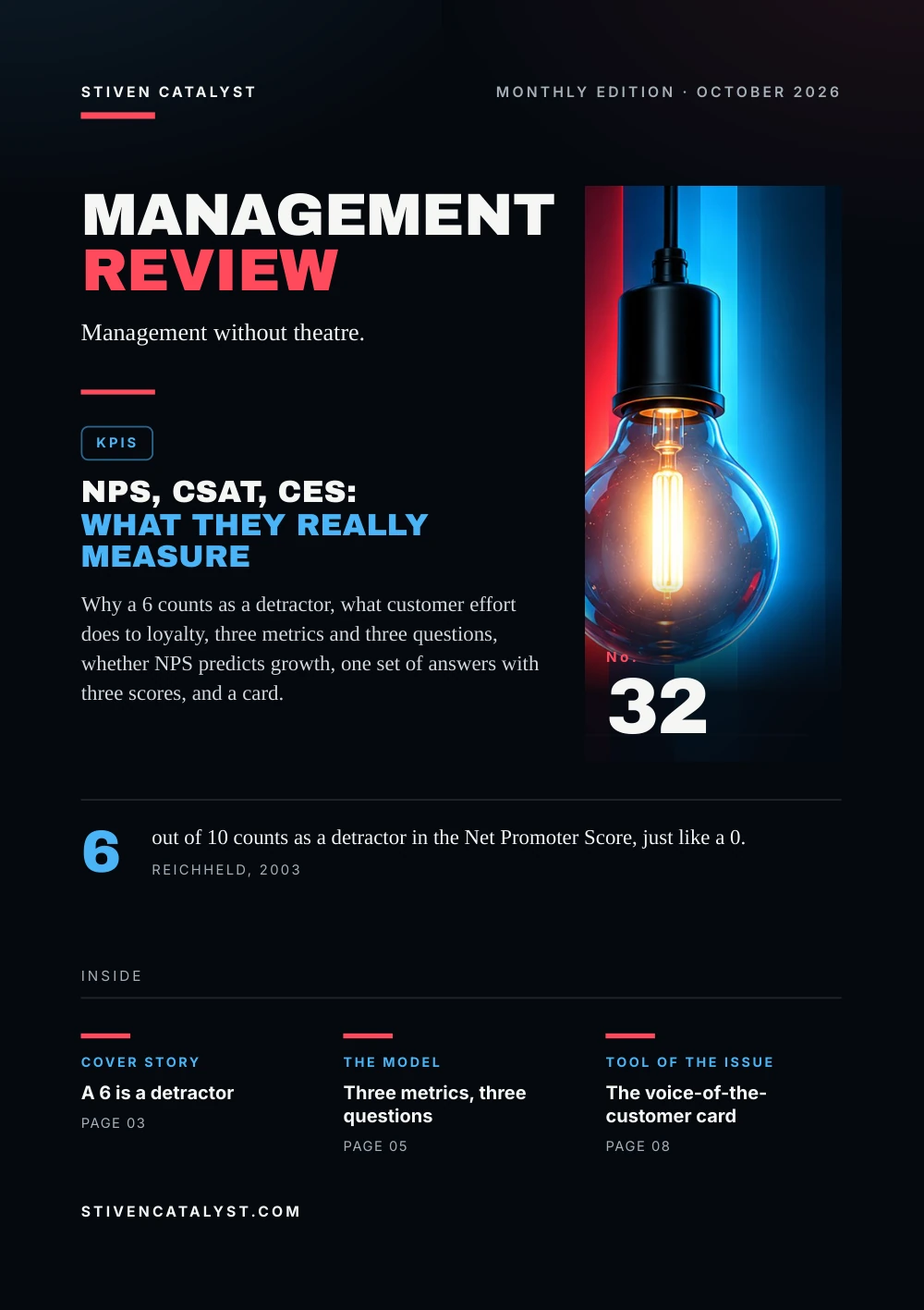 NPS, CSAT, CES: what th
e y really measure October 2026 Issue 32 opens with the Net Promoter question and the reason a 6 counts as a detractor. CEB's research on customer effort follows, then a comparison of the questions behind NPS, CSAT and CES and of the studies on which metric predicts growth and retention. One set of answers yields three scores, and a card for the voice of the customer closes the issue. -
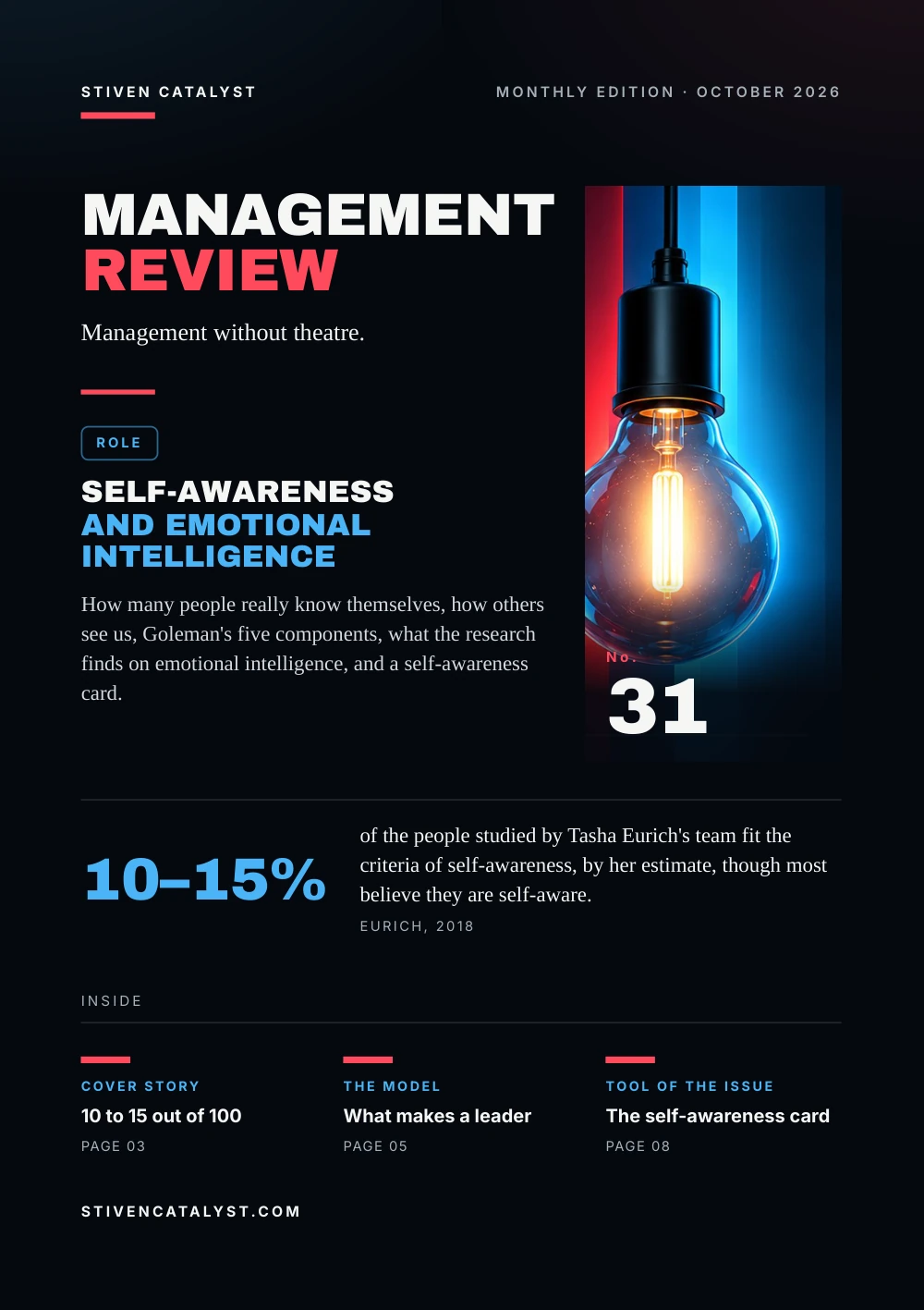 Self-awareness and emotional intelligence
October 2026
Issue 31 opens with Tasha Eurich's estimate that only 10–15% of people fit the criteria of self-awareness. It shows how little self-ratings agree with the ratings of others and sets out Daniel Goleman's five components, together with the claims made for them. After weighing what meta-analyses find about emotional intelligence, it closes with a card for seeing yourself as others do.
-
 The quali
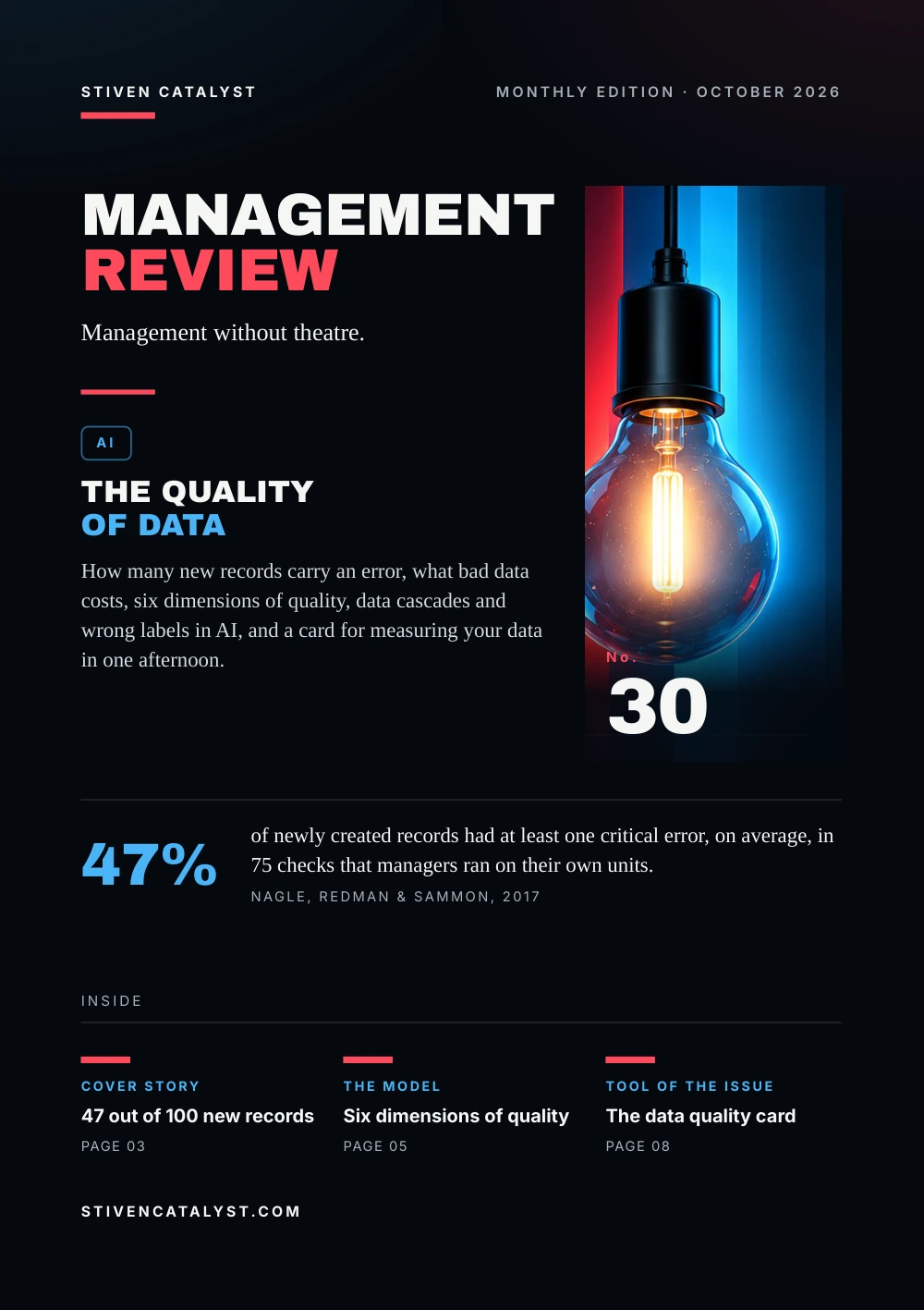
t y of data October 2026 Issue 30 opens with 75 managers who checked the newest records of their own units and found a critical error in 47% of them. It weighs what bad data costs and how little of that cost is measured, then sets out six dimensions of data quality. Data cascades and wrong labels in AI come next, and a card for measuring data in one afternoon closes the issue. -
 Burnout and workload
October 2026
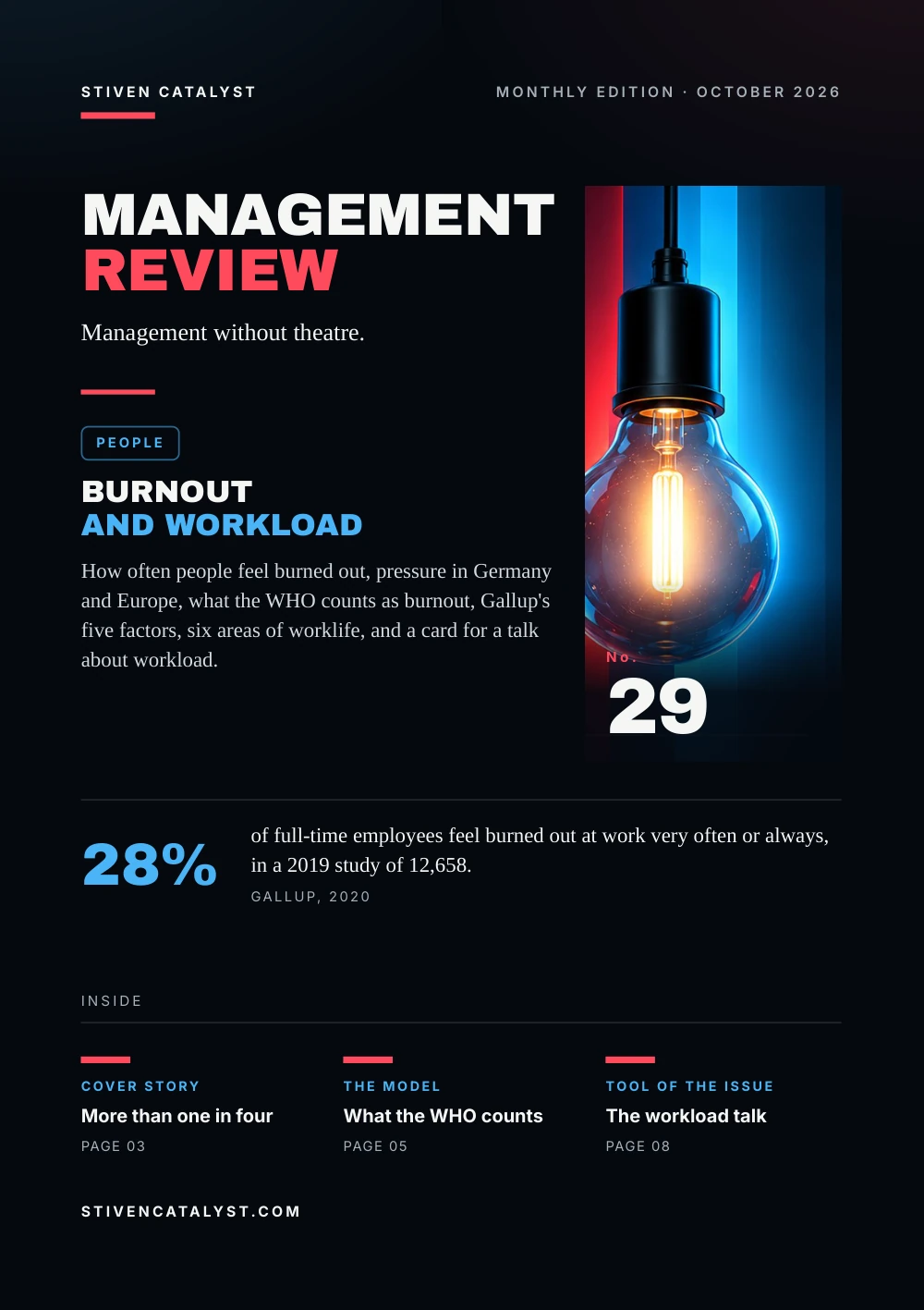
Issue 29 opens with Gallup's finding that 28% of full-time employees feel burned out very often or always. It follows deadline pressure in Germany and time pressure across Europe, then sets out what the WHO counts as burnout. Gallup's five linked factors and the six areas of worklife where job and person can clash lead to the closing card: a talk about workload.
-
 Operational risk: FMEA and the risk matrix
October 2026
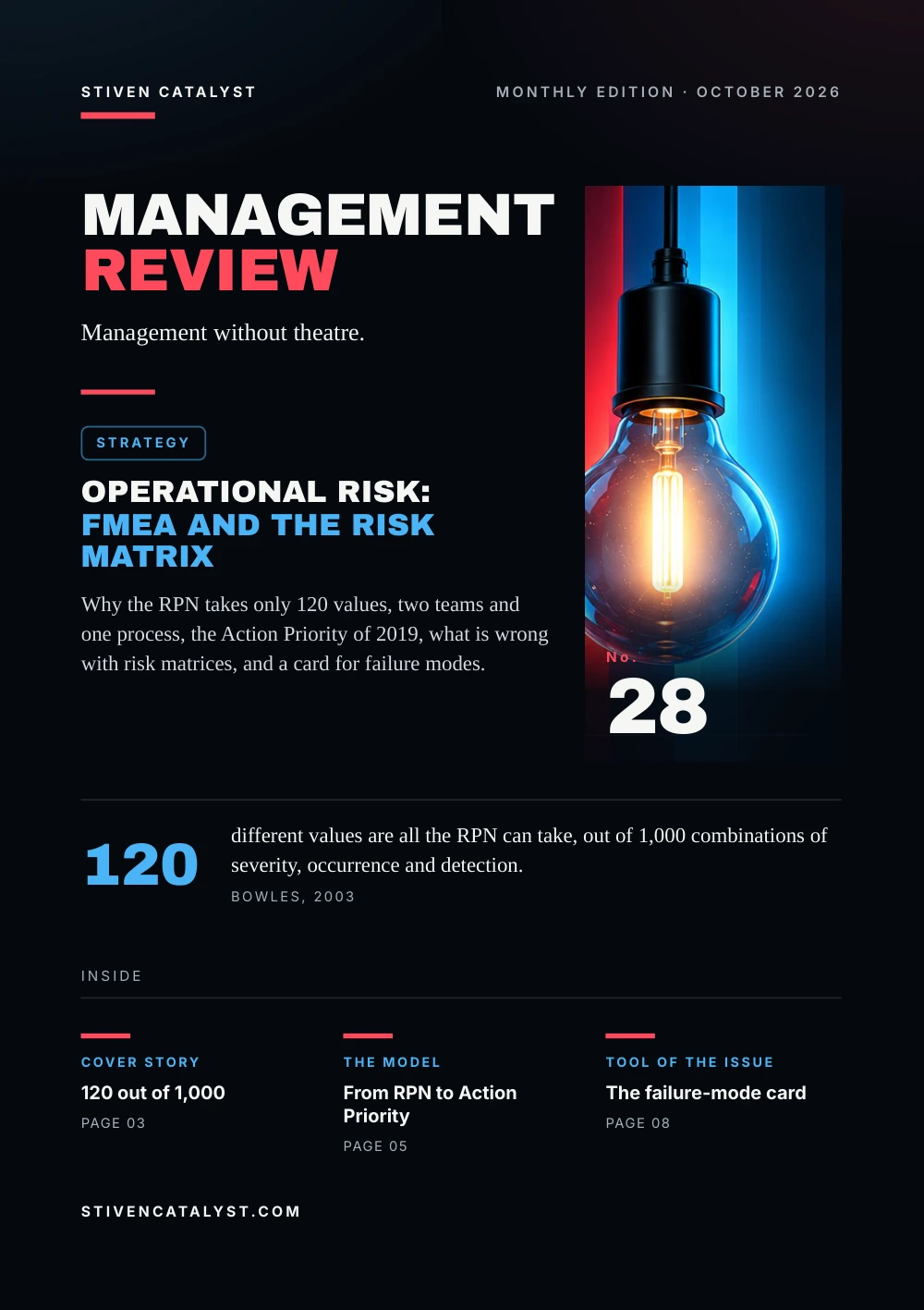
Issue 28 opens with a number that looks like a scale from 1 to 1,000 yet takes only 120 values. Two hospital teams then analyse the same process and find mostly different failures, and the 2019 FMEA handbook swaps the RPN for an Action Priority. After weighing the case against risk matrices, the issue closes with a card for failure modes.
-
 OTIF and the perfect order
October 2026
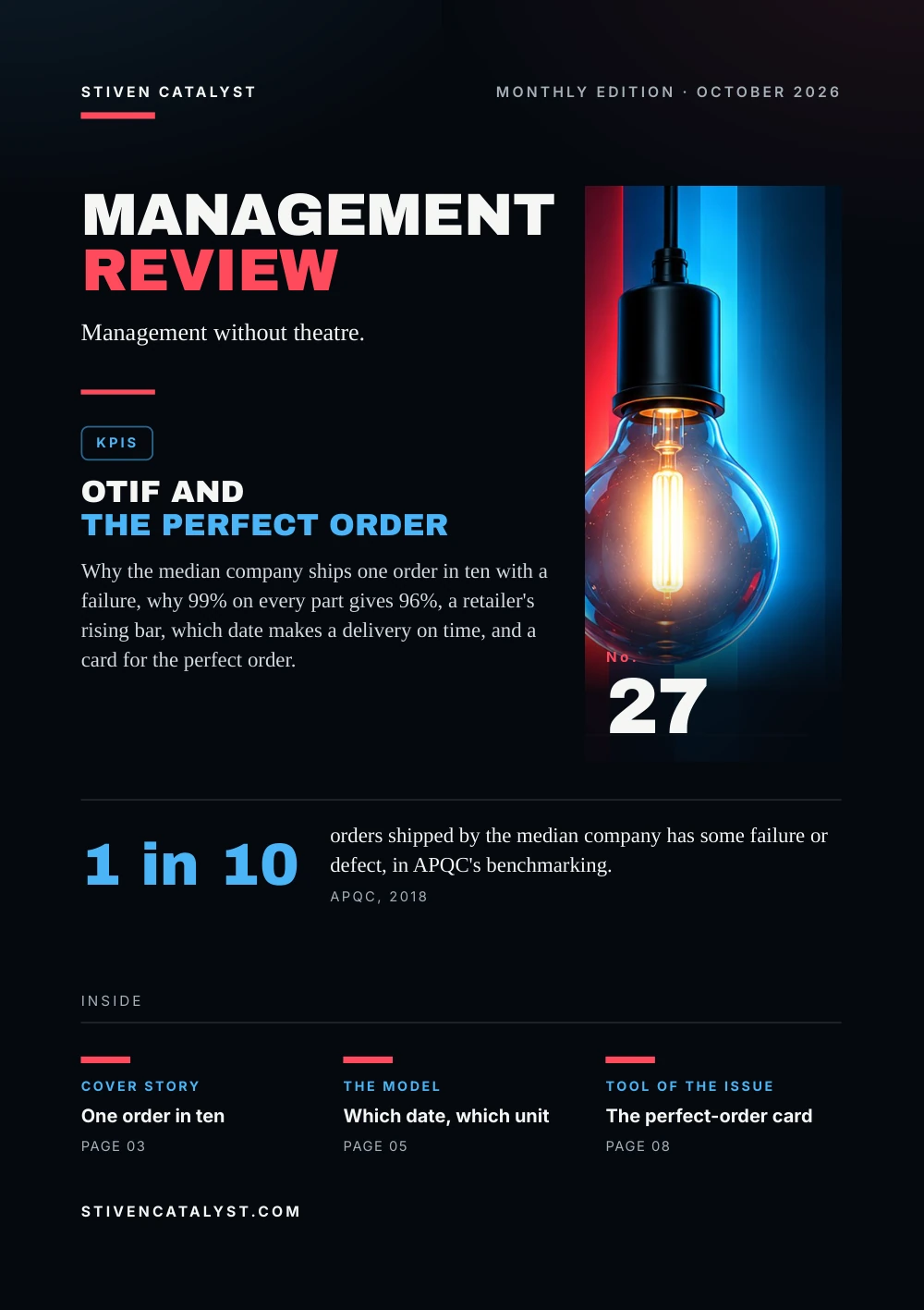
At the median company in APQC's benchmarking, one order in ten ships with some failure or defect, and 99% on each of four parts gives only 96%. Issue 27 follows the thresholds Walmart set for its suppliers and asks, with McKinsey, which date makes a delivery on time. It ends with a card for counting perfect orders.
-
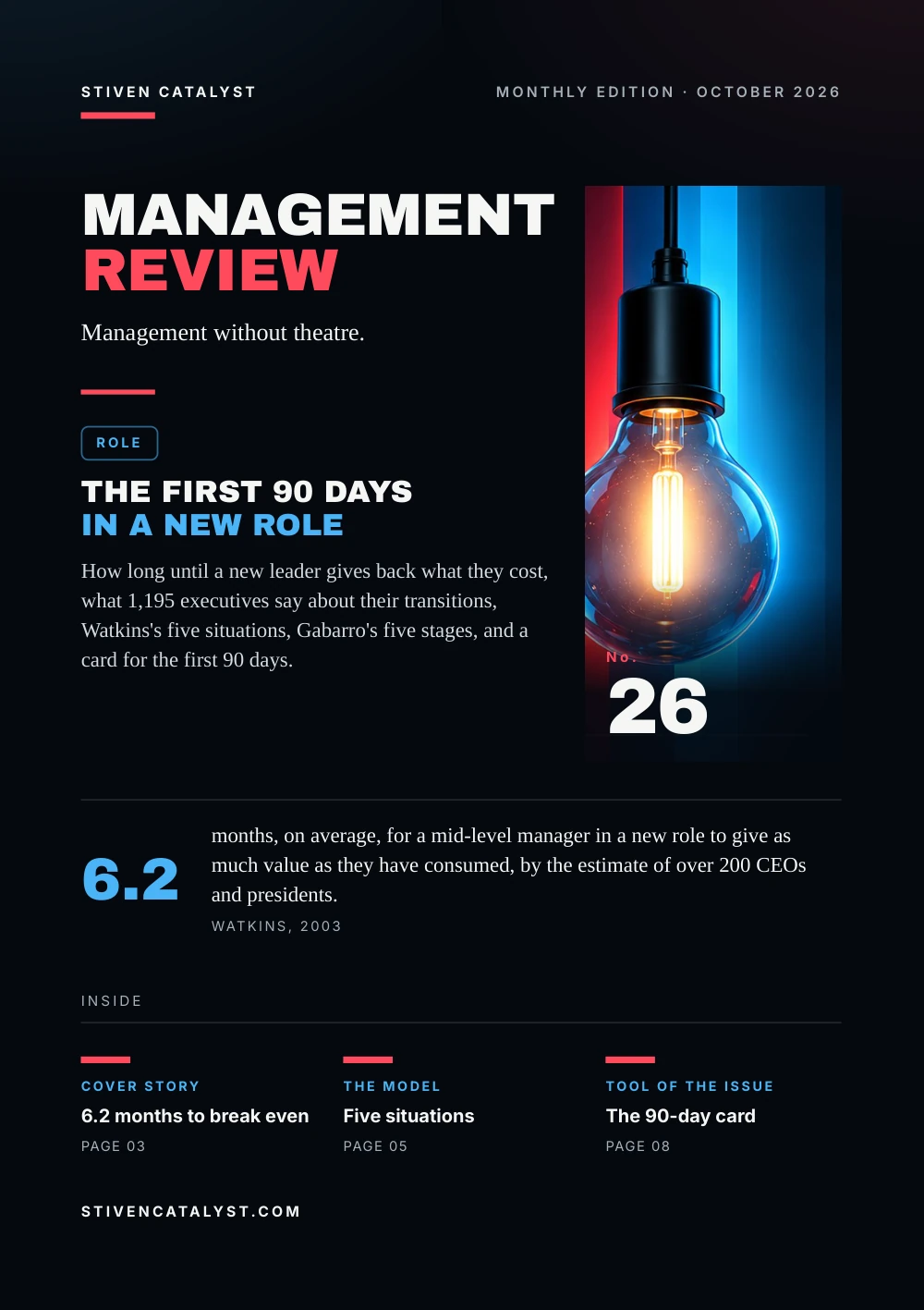 The first 90 days in a new role
October 2026
Over 200 CEOs and company presidents estimate that a mid-level manager in a new role needs 6.2 months to reach Michael Watkins's breakeven point. Issue 26 hears 1,195 executives on their transitions, sets out the five situations of Watkins's STARS model, and follows John Gabarro's five stages of taking charge and Matthew Bidwell's external hires. A card for the first 90 days closes it.
-
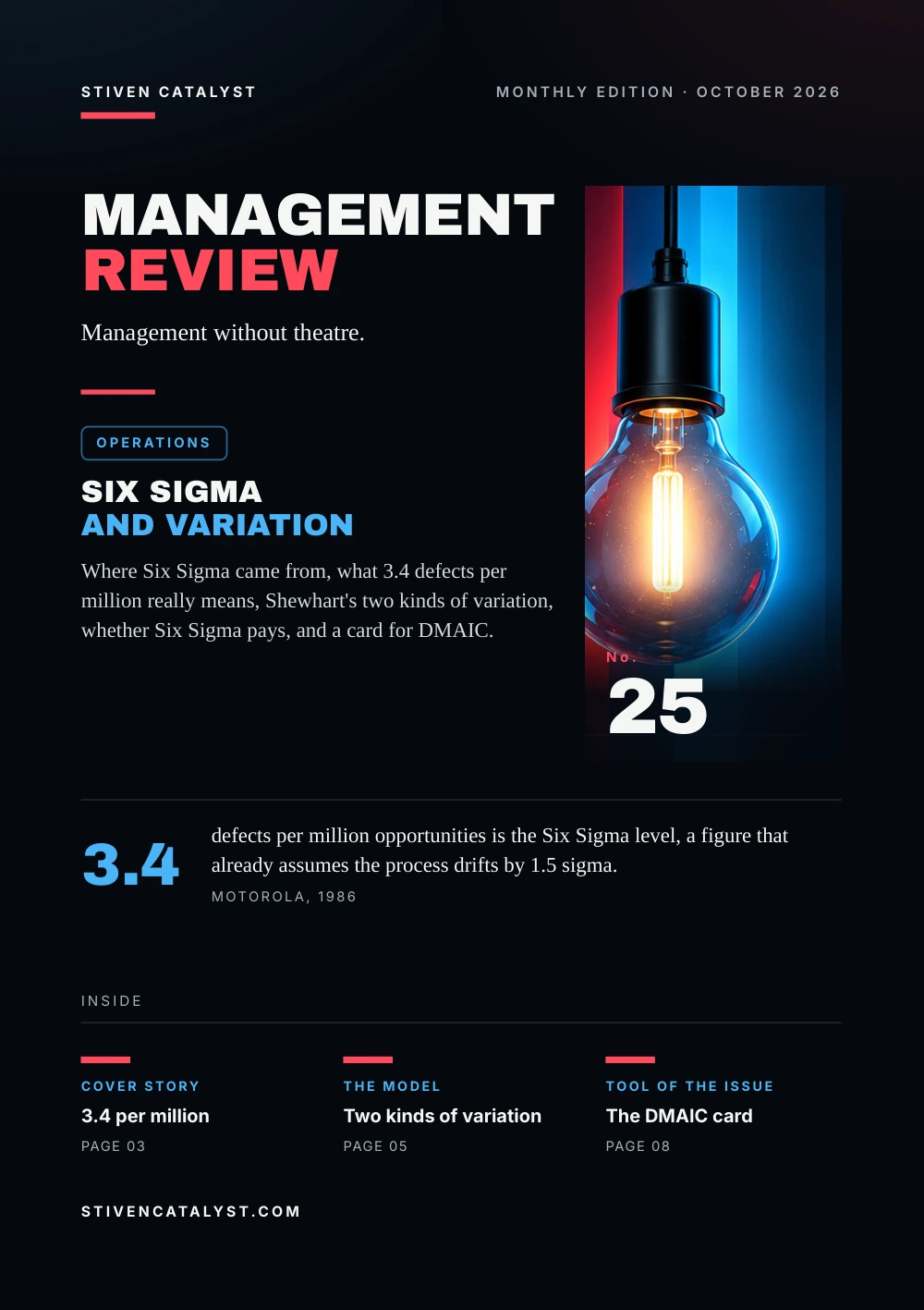 Six Sigma and variation
October 2026
Motorola dates Six Sigma to 1986, and its famous 3.4 defects per million opportunities rests on an assumption. Issue 25 shows how far apart three and six sigma lie, separates the two kinds of variation Walter Shewhart described in 1924, and weighs two studies of firms that adopted Six Sigma. It ends with a card for DMAIC.
-
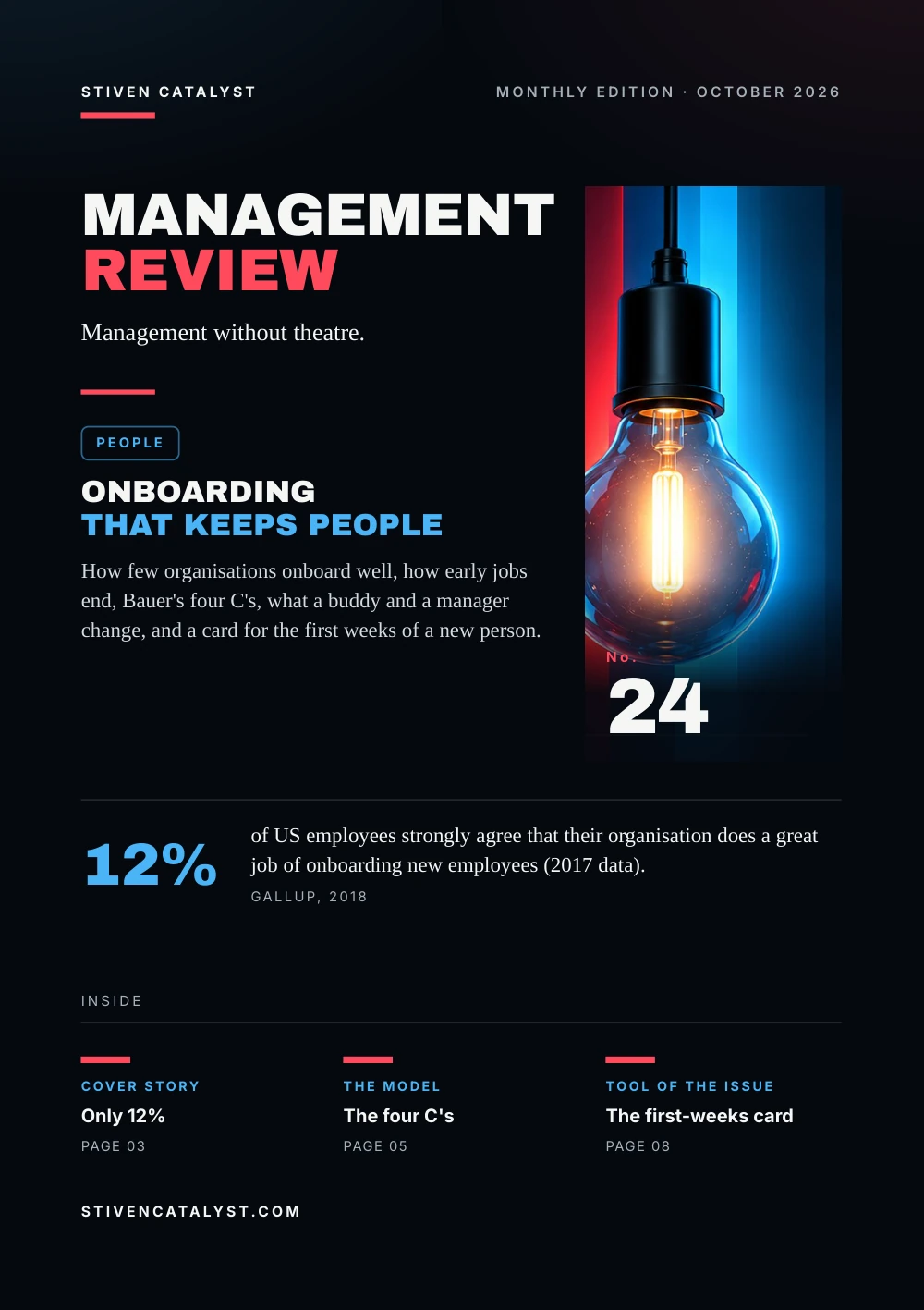 Onboarding that keeps people
October 2026
Only 12% of US employees think their organisation onboards new people well, and in a US generation followed since 1979 many jobs ended within the first year. Issue 24 sets out Talya Bauer's four C's and looks at what role clarity, confidence and a buddy change. It closes with a card for a new person's first weeks.
-
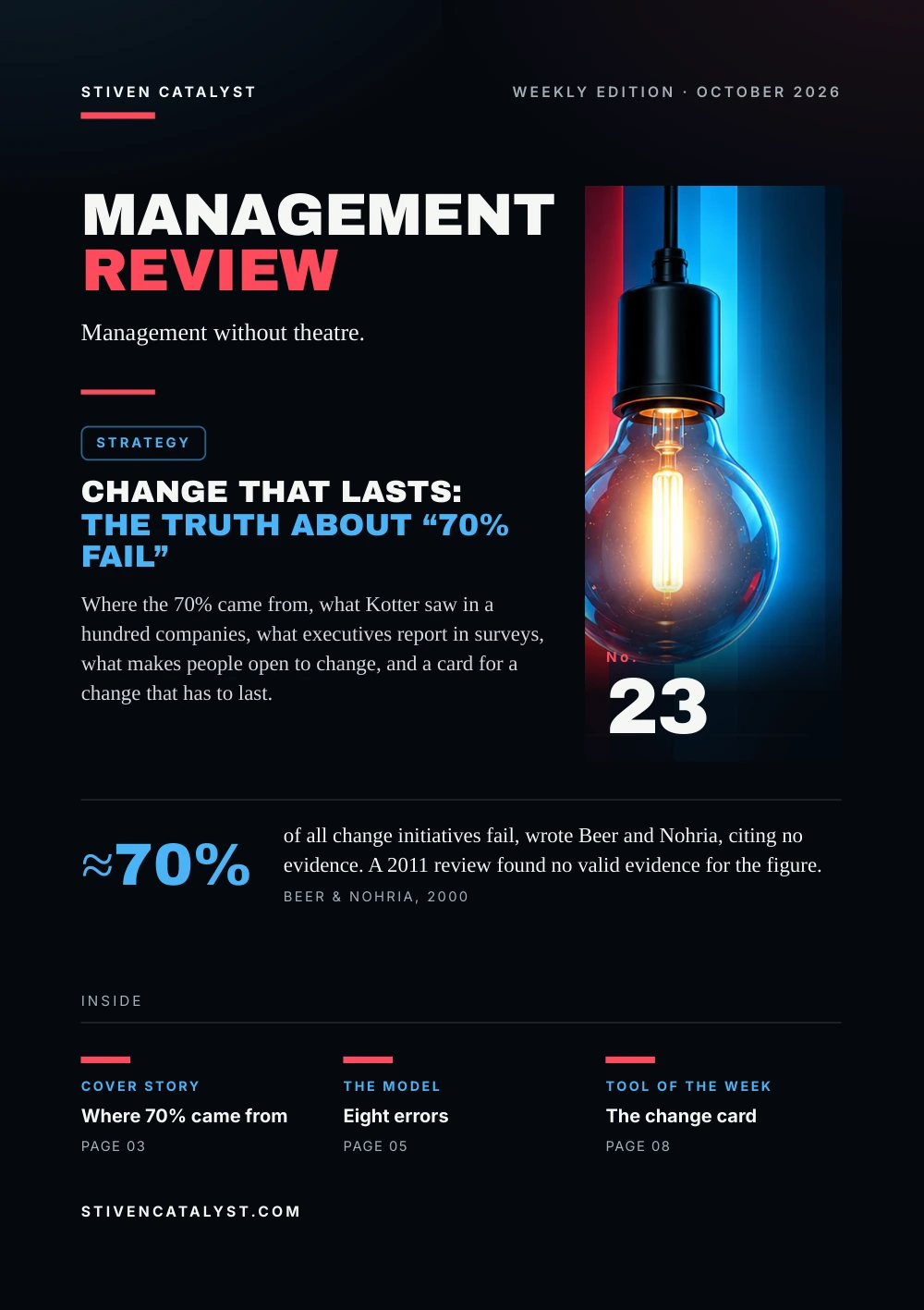 Change that lasts: the truth about “70% fail”
October 2026
The claim that 70% of change efforts fail began as an “unscientific estimate” in 1993, and a 2011 review found no evidence for it. Issue 23 goes through the eight errors John Kotter saw in more than a hundred companies, reads what executives report in McKinsey's surveys and looks at what makes people open to change. It ends with a card for a change that has to last.
-
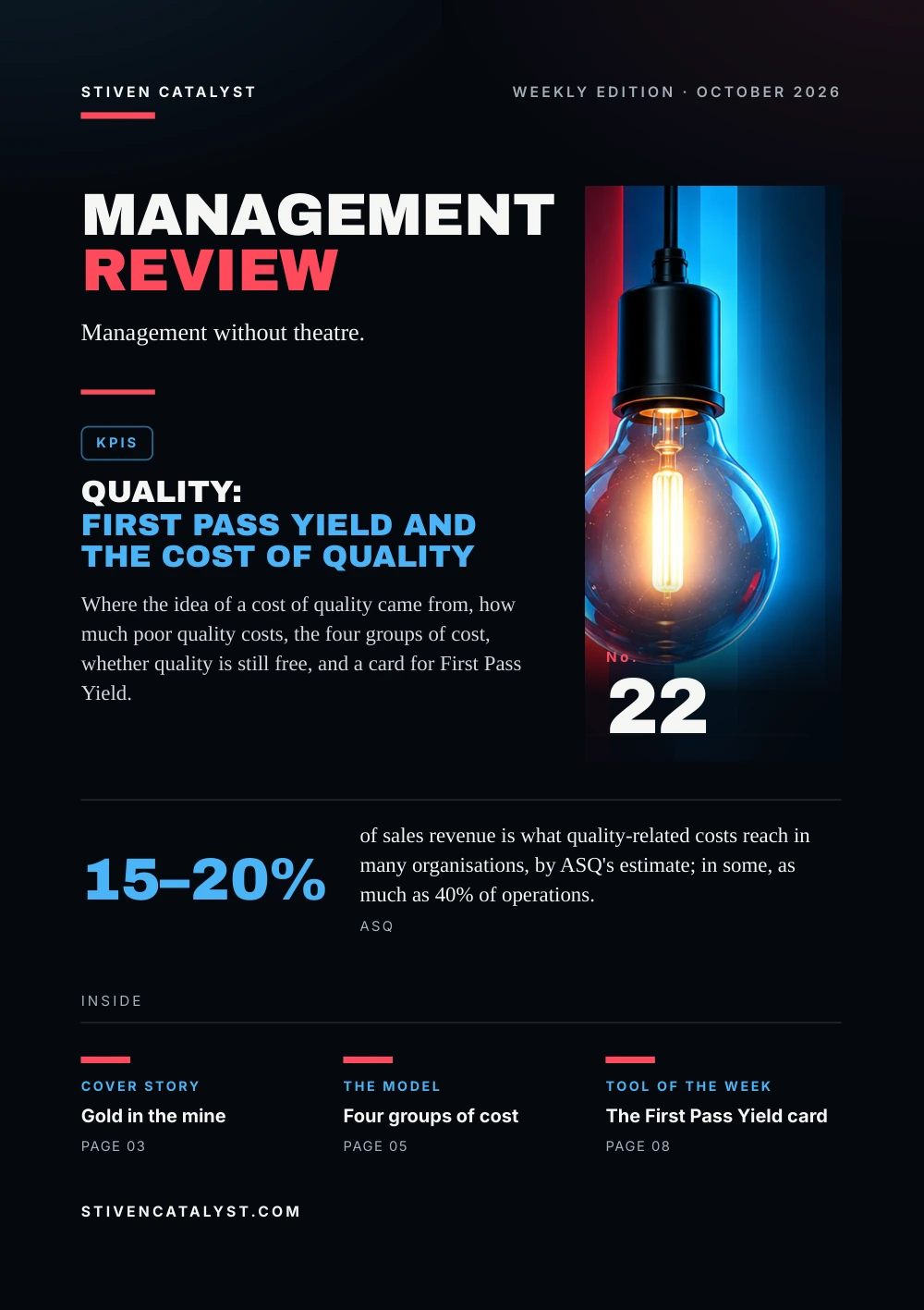 Quali
t y: First Pass Yield and the cost of qualit y October 2026 Joseph Juran's handbook of 1951 called the cost of failures gold in the mine; Philip Crosby's Quality Is Free came later. Issue 22 shows how far the reported cost can fall below the real one, sets out the four groups of cost, and asks whether quality is still free in modern manufacturing. A card for First Pass Yield closes it. -
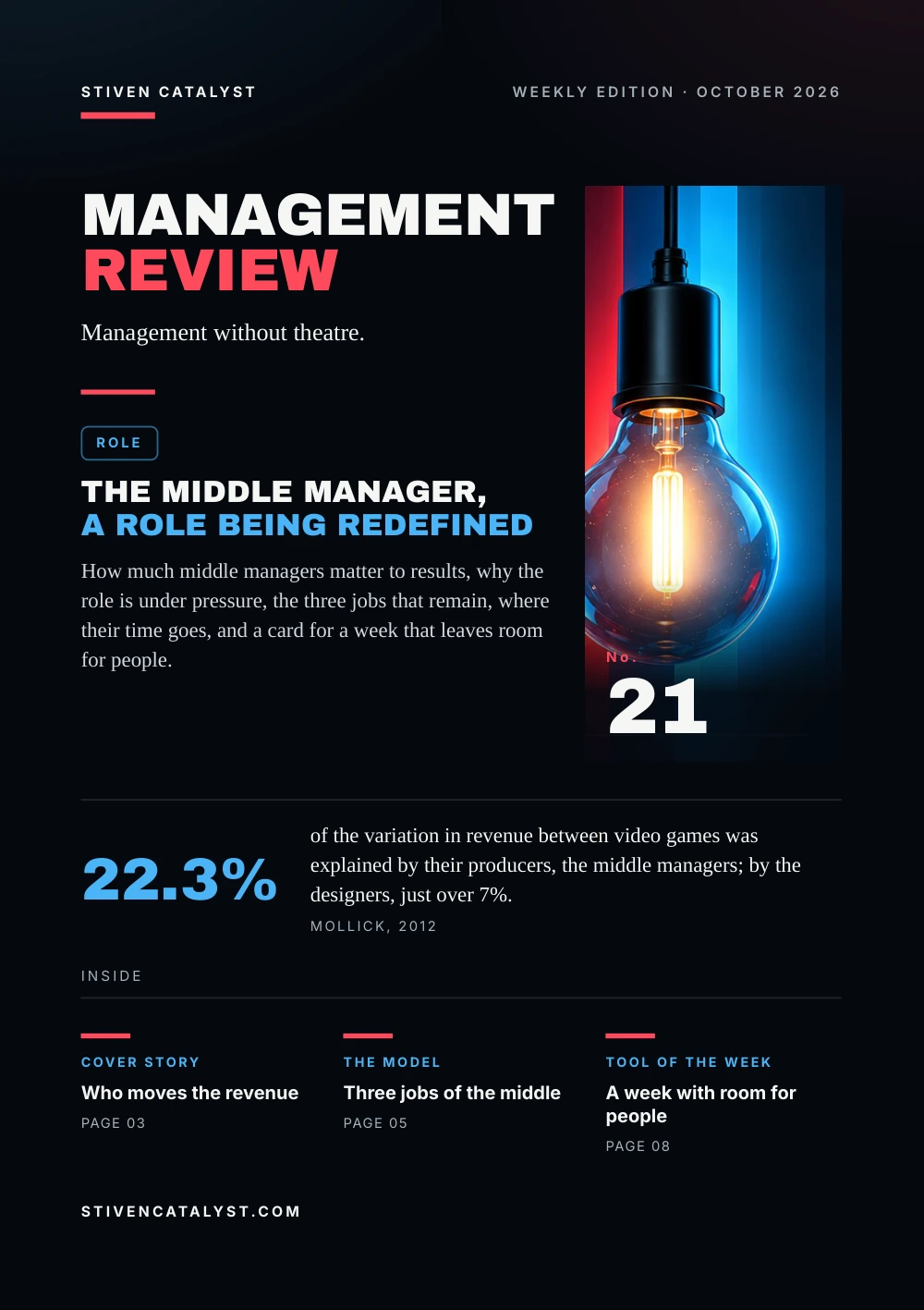 The middle manager, a role being redefined
October 2026
In the video game industry, producers, the middle managers, explained far more of the variation in revenue than designers did. Yet layoffs and a fall in job postings have put the role under pressure. Issue 21 sets out three jobs that remain for the middle, follows where its time goes, and ends with a card for a week that leaves room for people.
-
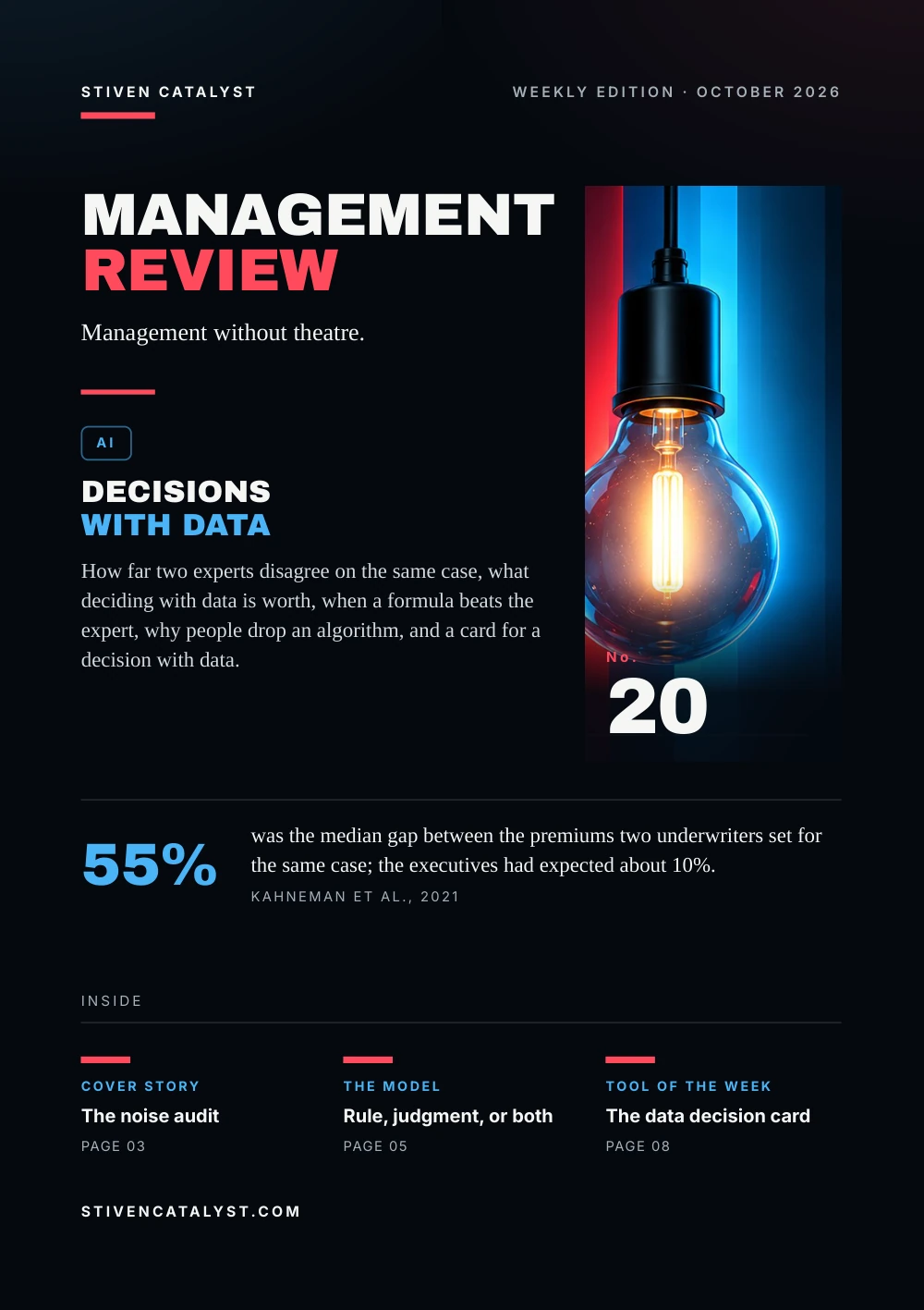 Decisions with data
October 2026
Two underwriters pricing the same case came out a median 55% apart. Issue 20 starts from that noise audit, looks at what deciding with data has been worth to firms and weighs formulas against experts. It shows why people drop an algorithm after one mistake, and what brings them back, before ending with a card for a decision with data.
-
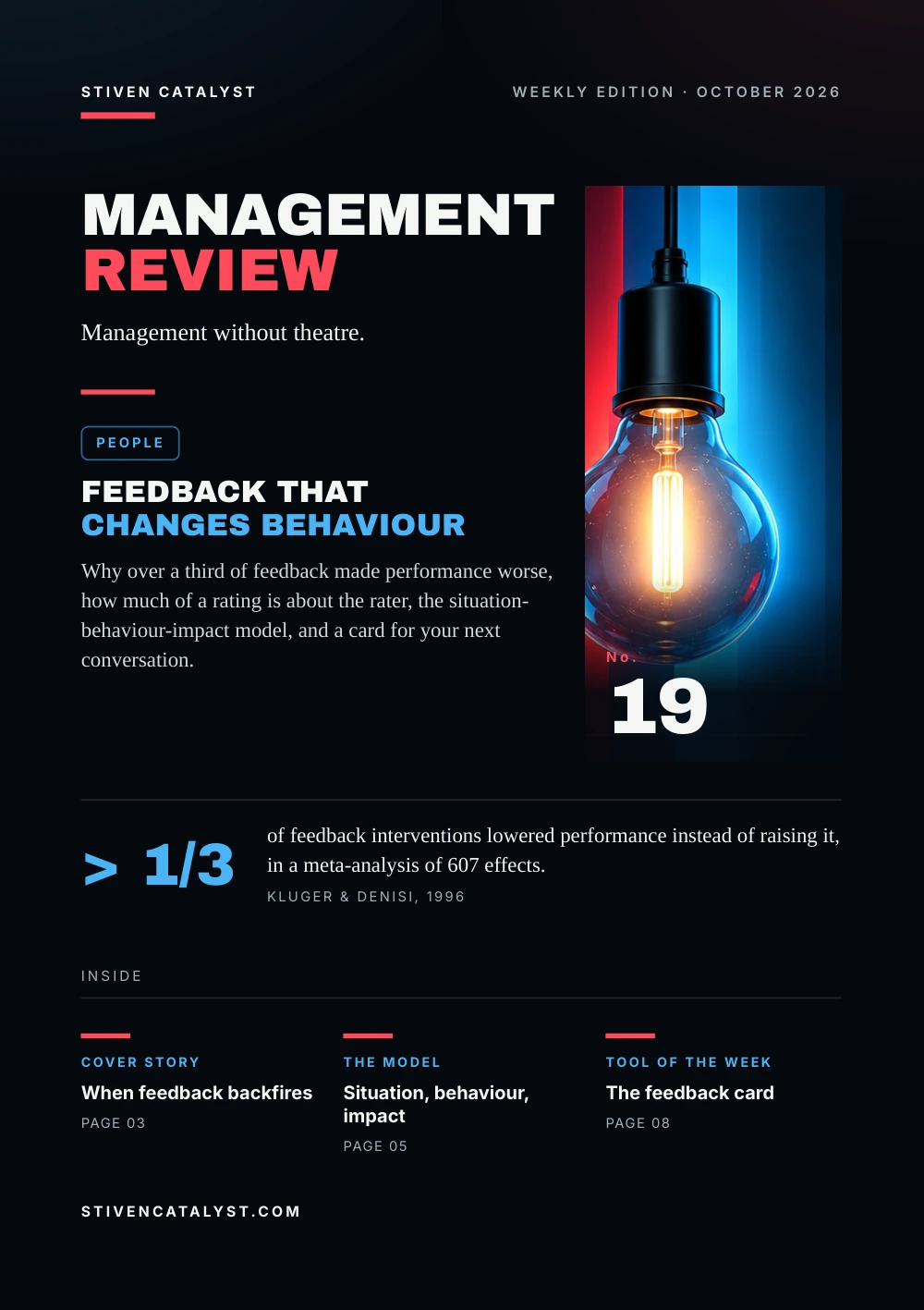 Feedback that changes behaviour
October 2026
In a meta-analysis of 607 effects, more than a third of feedback interventions lowered performance. Ratings, meanwhile, often say more about the rater than about the person rated. Issue 19 sets out the situation-behaviour-impact model, looks at what makes feedback useful, and ends with a card for your next conversation.
-
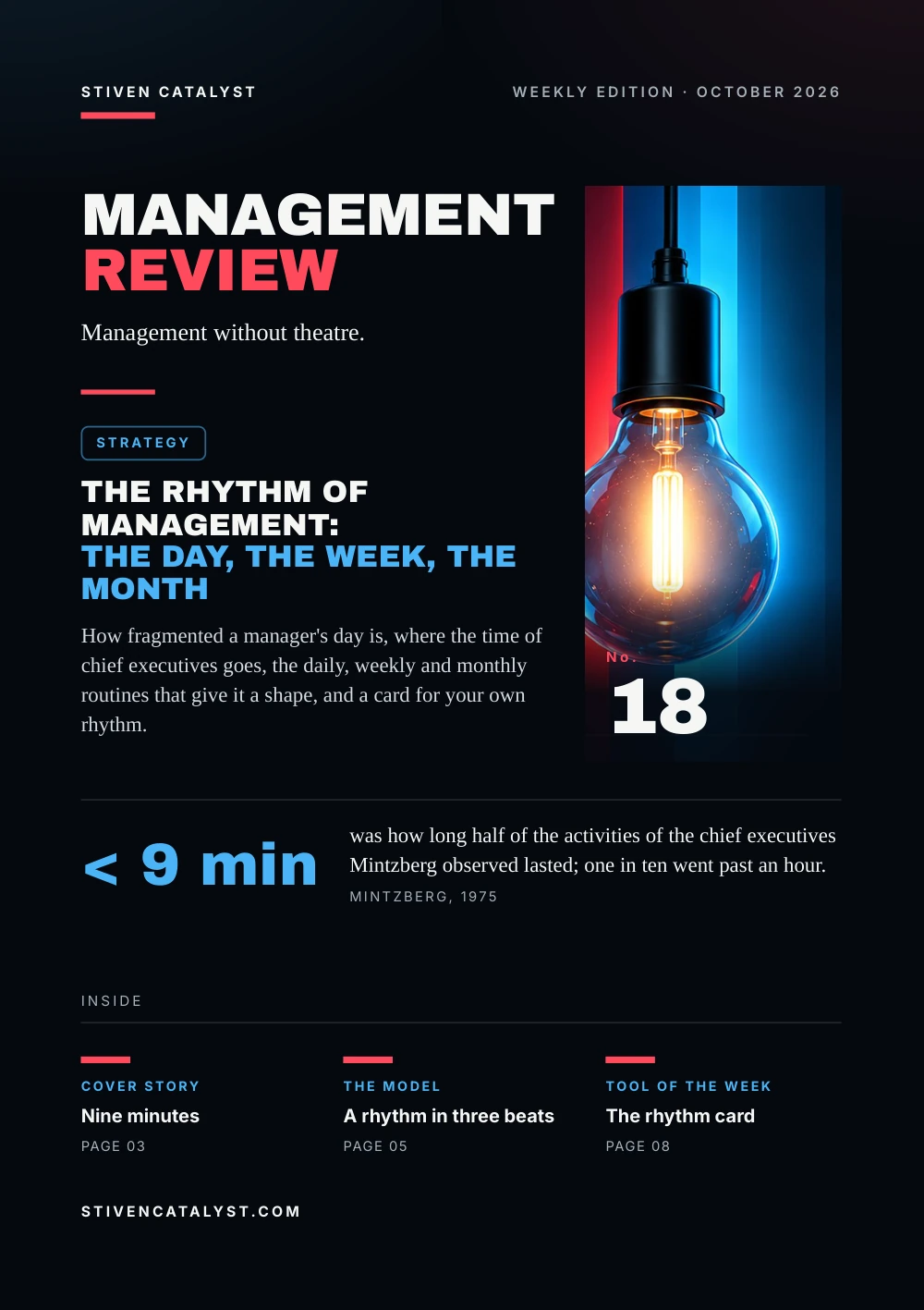 The rh
y thm of management: the day, the week, the month October 2026 Half of what the chief executives Henry Mintzberg watched lasted less than nine minutes; decades later, the time of 27 CEOs was logged across 60,000 hours. Issue 18 sets out the daily, weekly and monthly routines that Lean and Andy Grove propose and looks at what daily huddles showed in one hospital. A card for your own rhythm closes it. -
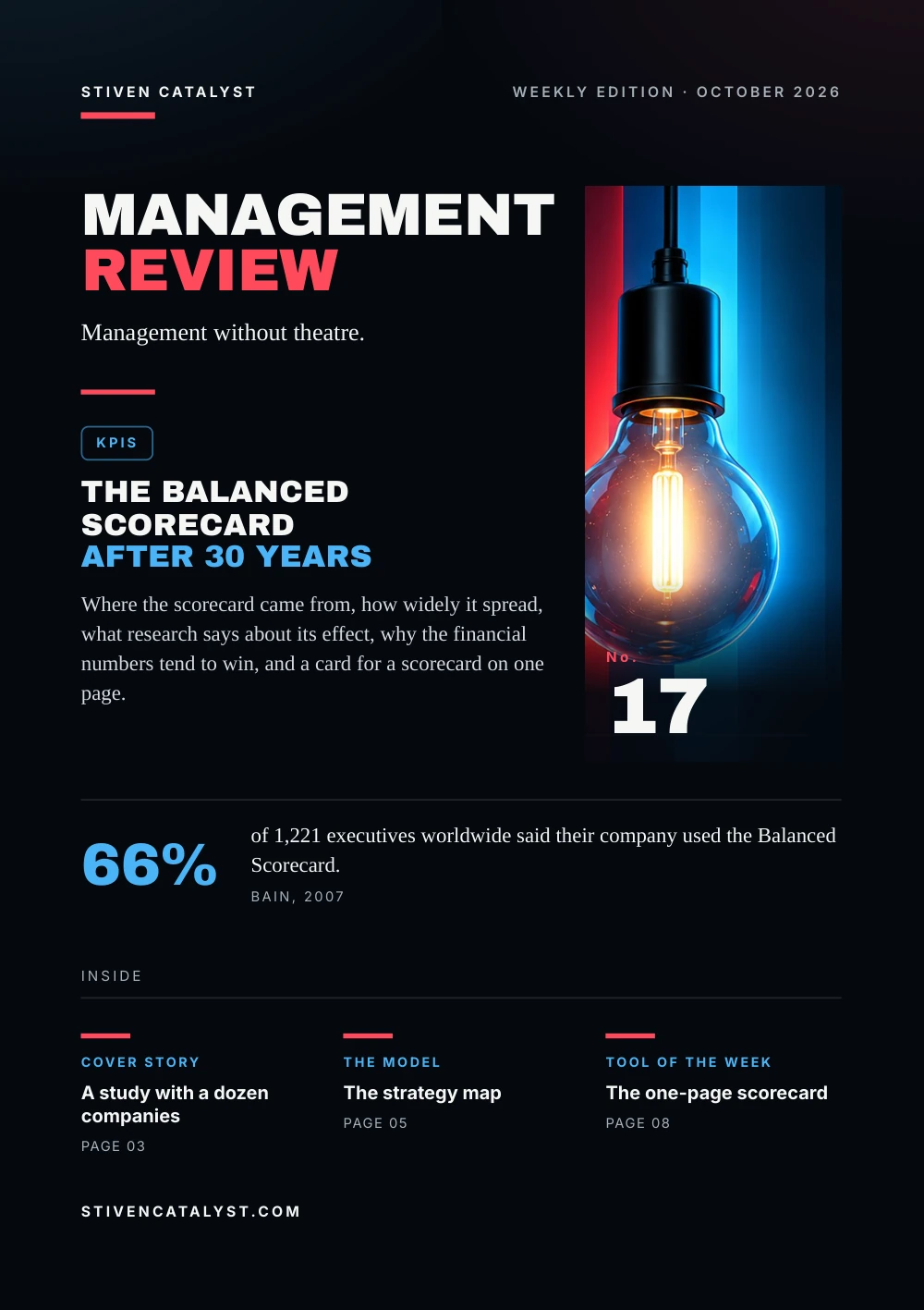 The Balanced Scorecard a
f ter 30 years October 2026 The Balanced Scorecard began in 1990, in a study with a dozen companies, and grew from a set of measures into a map of strategy. Issue 17 weighs three decades of research and shows why the financial numbers win when people judge. It closes with a card for a scorecard on one page. -
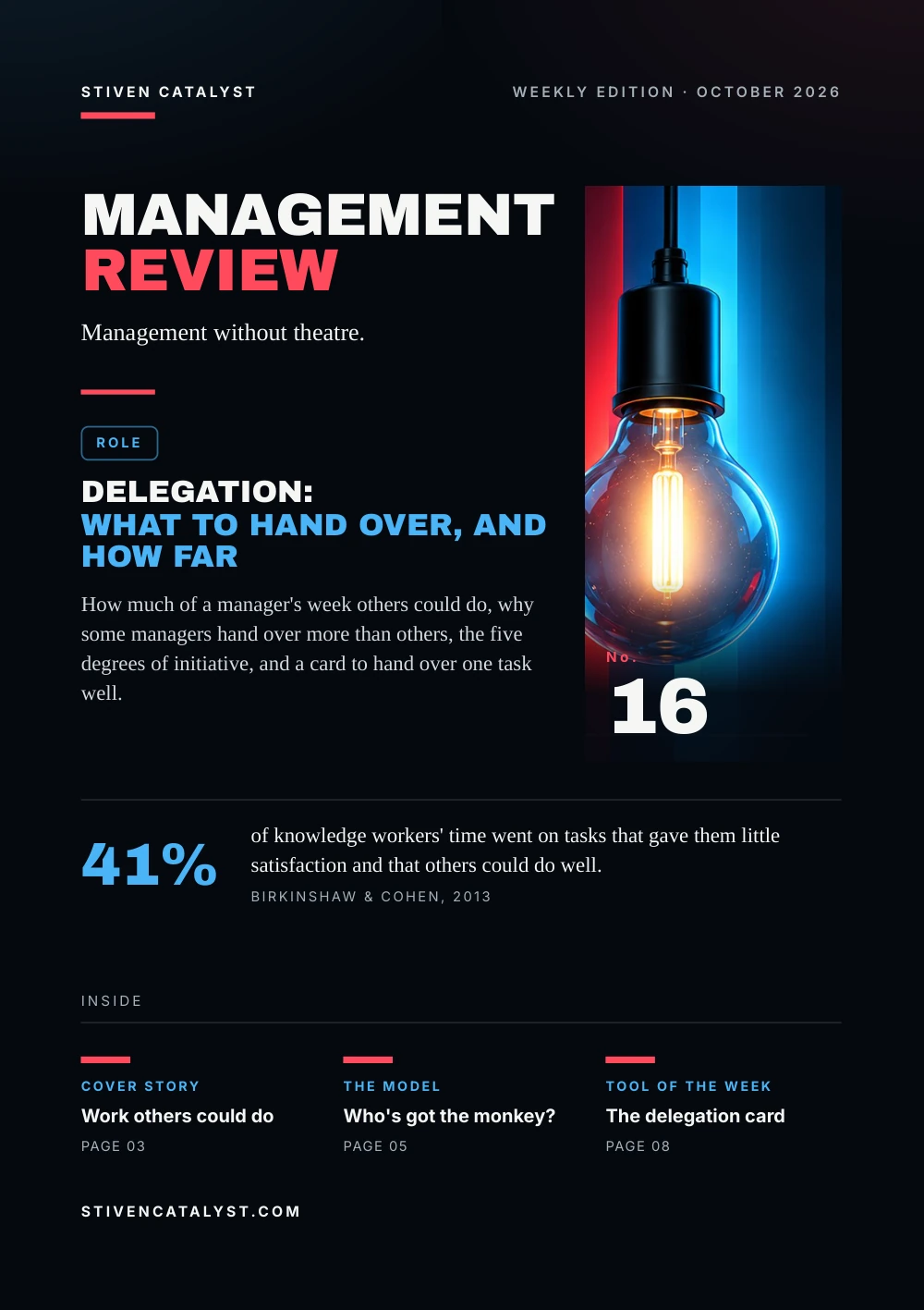 Delegation: what
t o hand over, and how far October 2026 Knowledge workers spend 41% of their time on work that others could do. Issue 16 looks at Gallup's study of fast-growing companies, follows a monkey that leaps from one back to another, and asks what decides whether a manager lets go. It ends with a card for handing over a single task. -
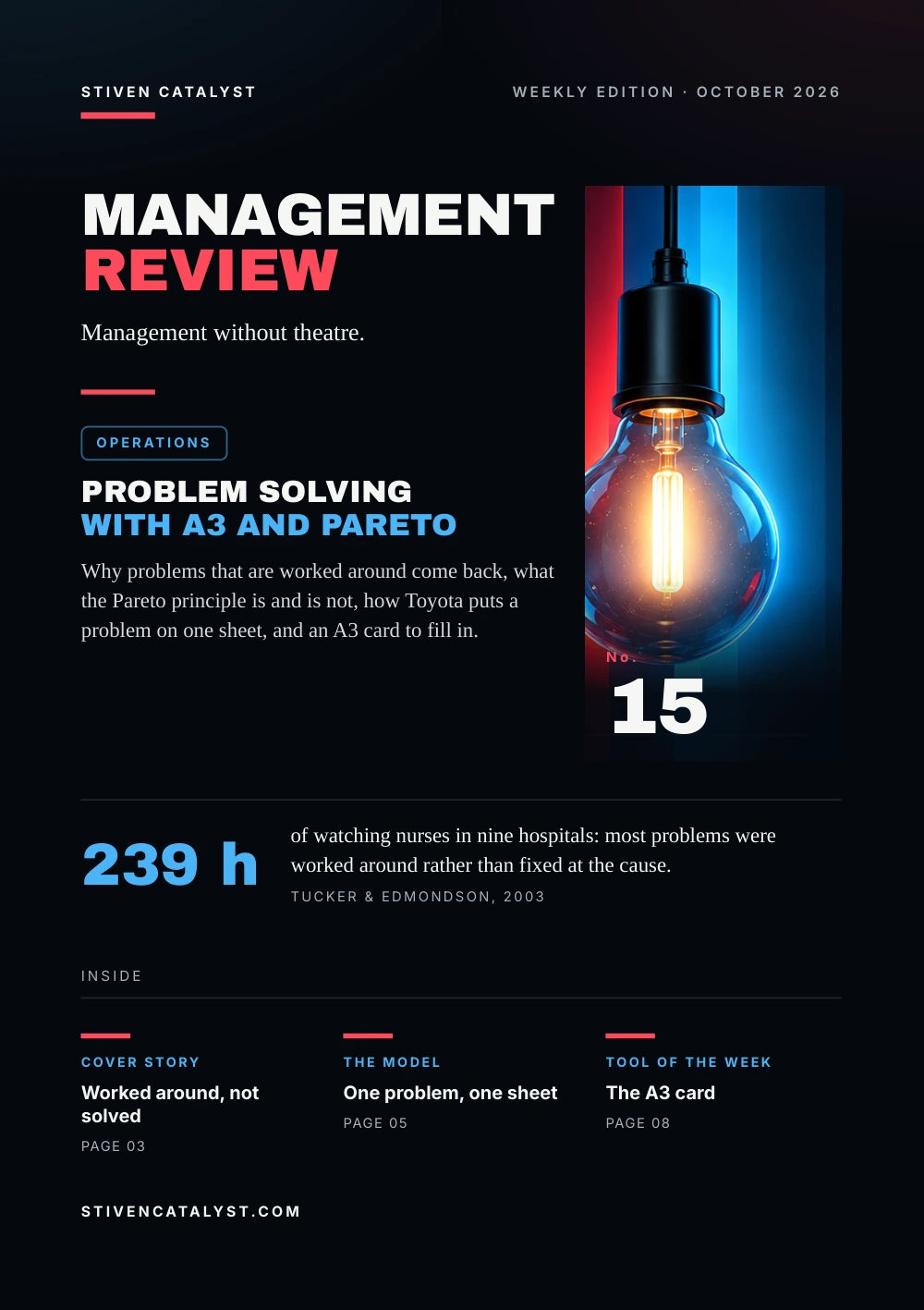 Problem solving with A3 and Par
e t o October 2026 Nurses in nine hospitals worked around most of the problems they met instead of fixing them. Joseph Juran named a principle after Pareto and later admitted the name was wrong, while Toyota learned to fit a whole problem on one sheet. Add a Pareto chart, drawn step by step, and Issue 15 closes with an A3 card. -
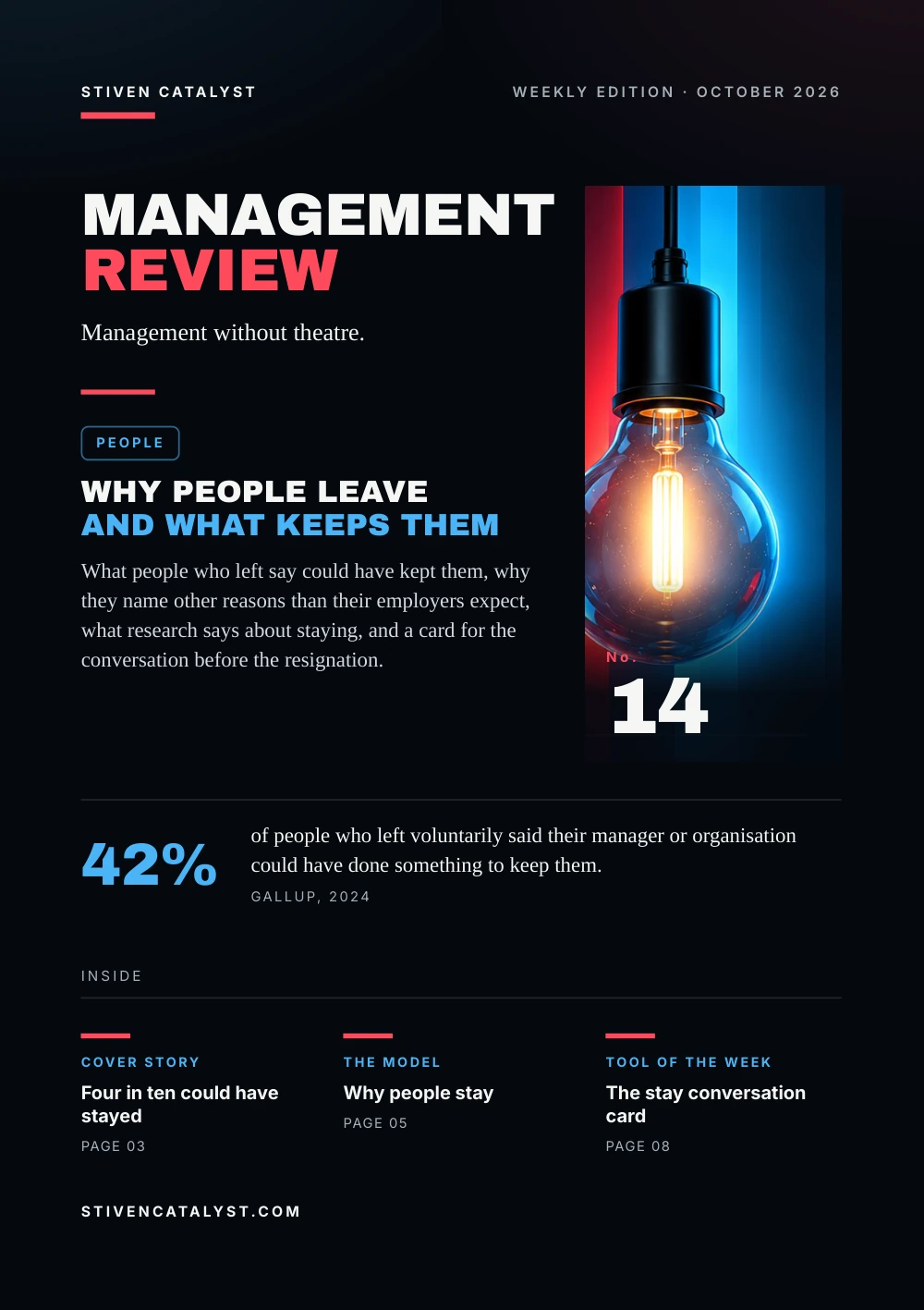 Why people leave and what keeps them
October 2026
Issue 14 starts with 717 people who left their jobs and the conversations that never happened. It sets what employers think against what leavers say, explains with the idea of job embeddedness why people stay, and counts what a departure costs. A card for the conversation before the resignation closes the issue.
-
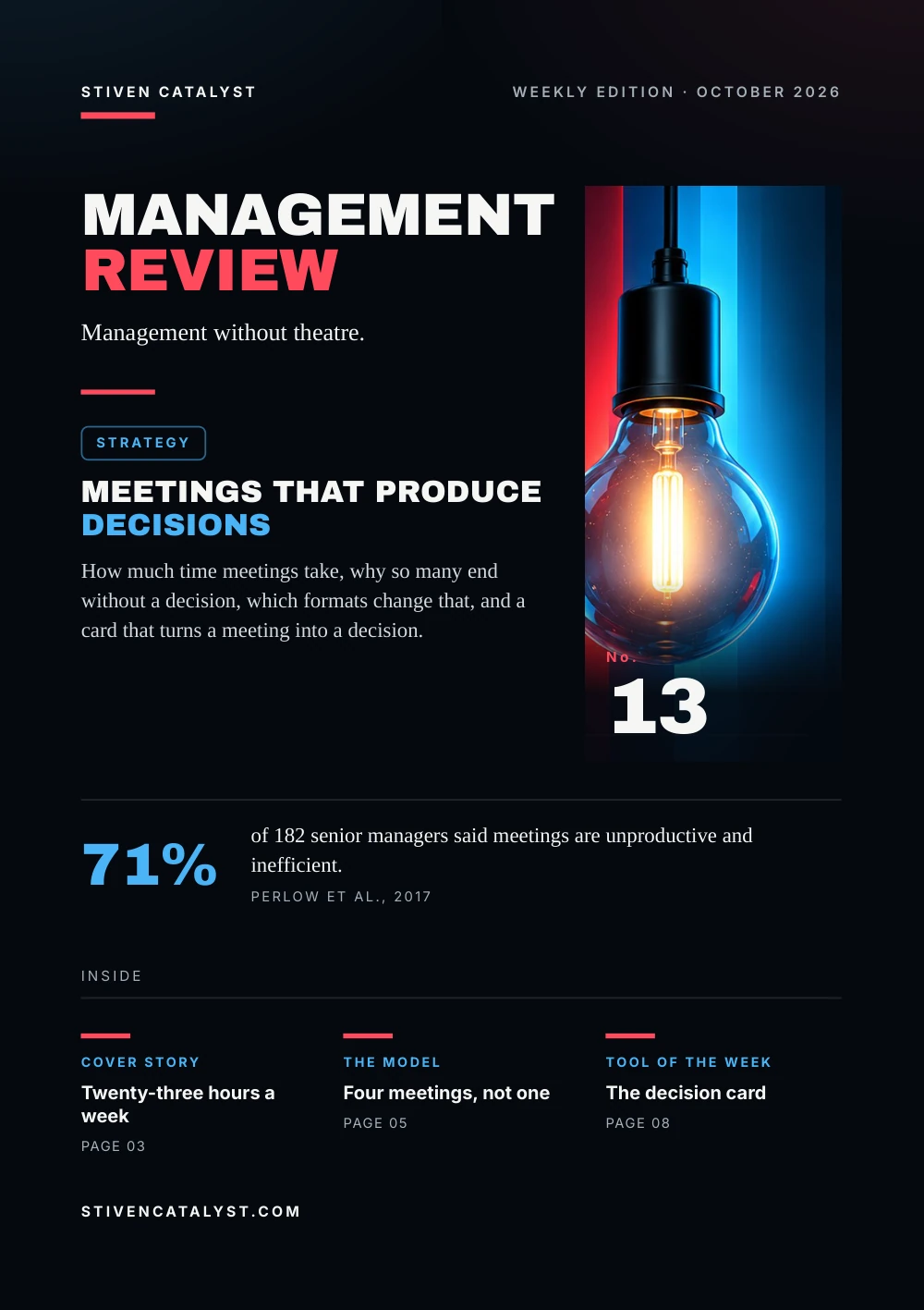 Me
e tings that produce decisions October 2026 Issue 13 counts what meetings cost, from 23 hours a week for executives to 300,000 hours for a single weekly meeting. It separates the four jobs a meeting can have and looks at two studies that change the format. A card for the meeting that has to decide closes the issue. -
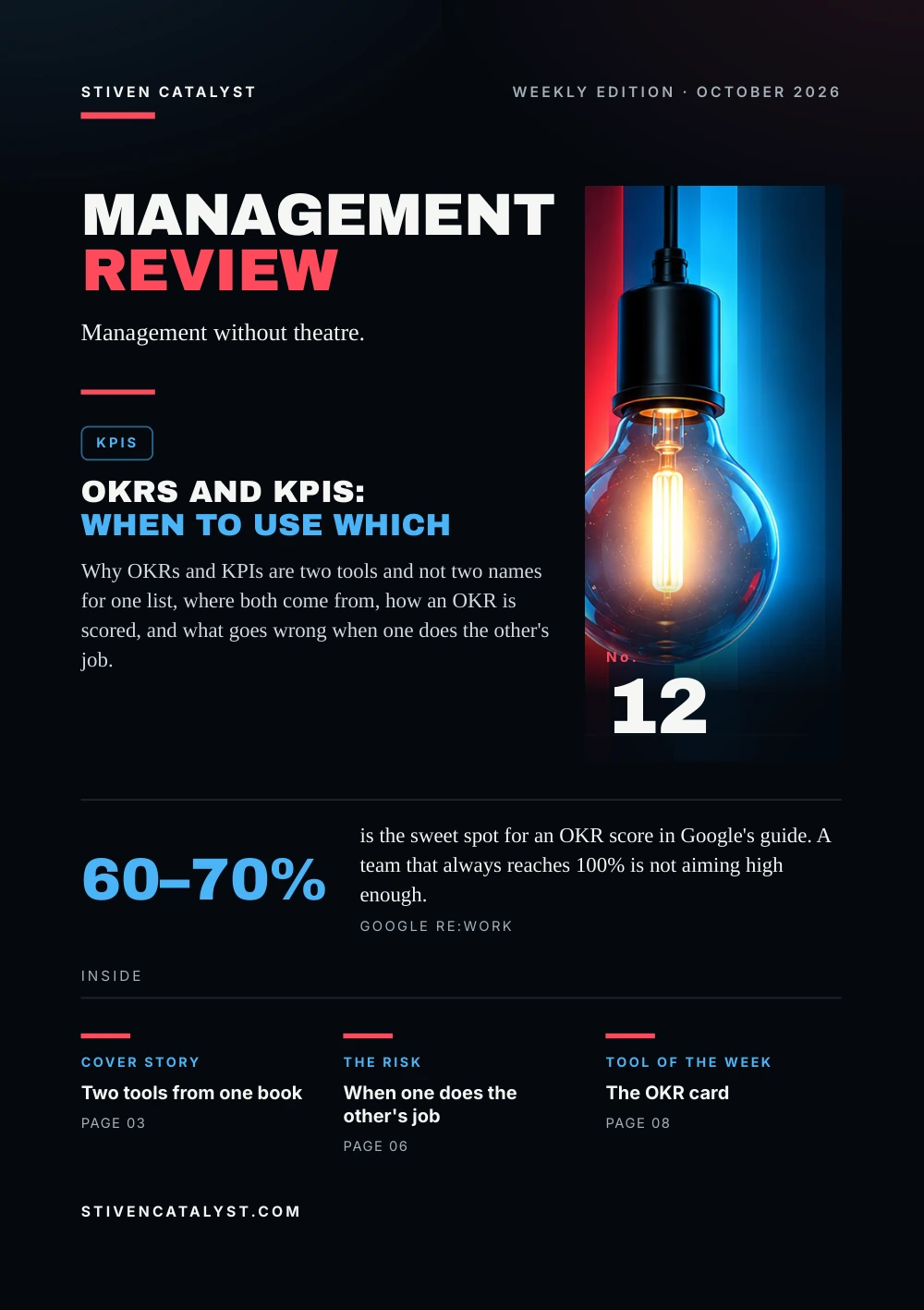 OKRs and KPIs: when
t o use which October 2026 Issue 12 goes back to the book in which both tools began and compares what each one is for. The research on OKRs turns out to be thin. The closing card keeps the KPIs in view while the team aims higher. -
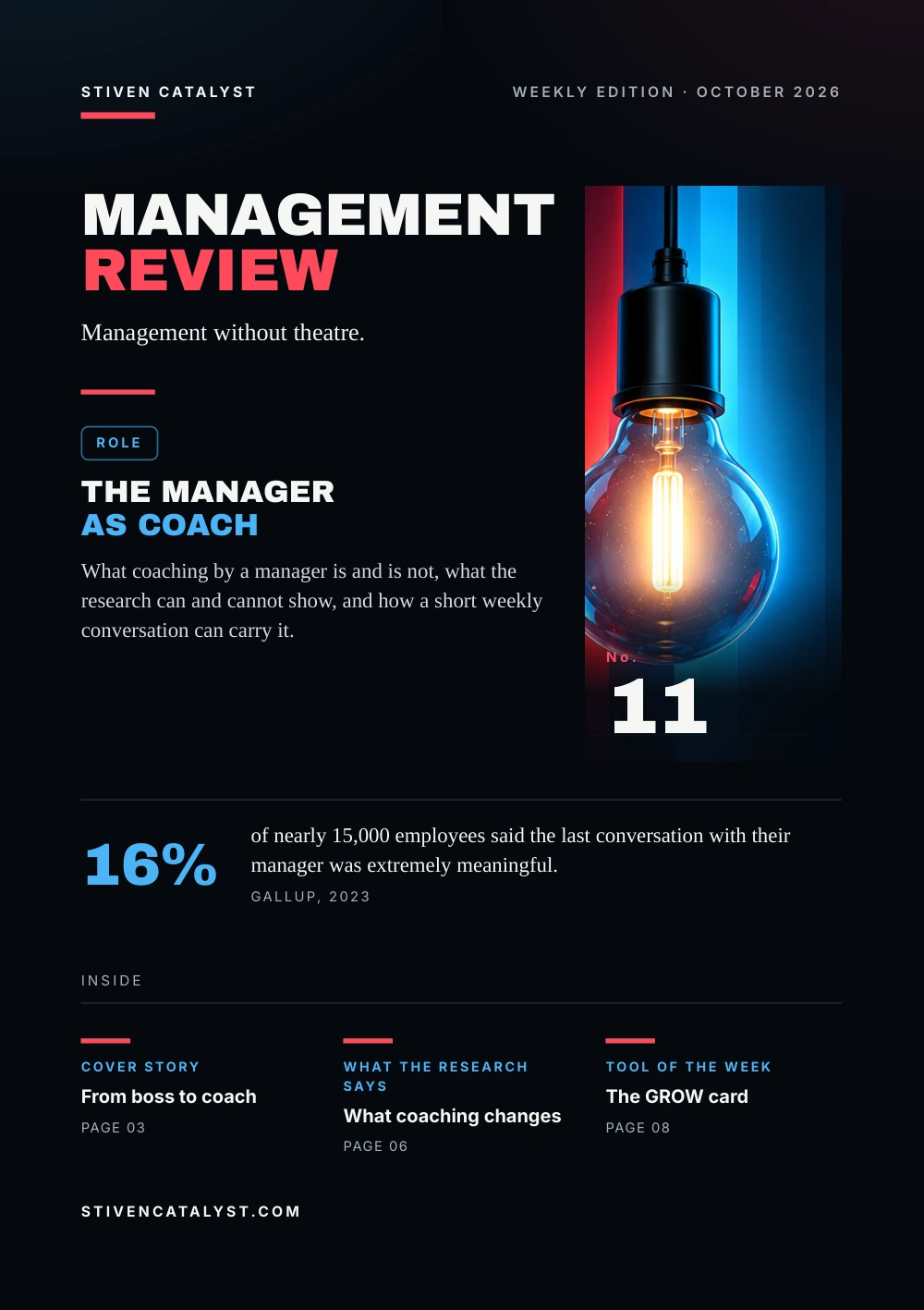 The manager as coach
October 2026
Issue 11 opens with the first behaviour on Google's list of its best managers. Gallup's data then show which conversations count, and the four GROW questions give them a shape. The issue ends with an honest look at what research can say about the manager who coaches.
-
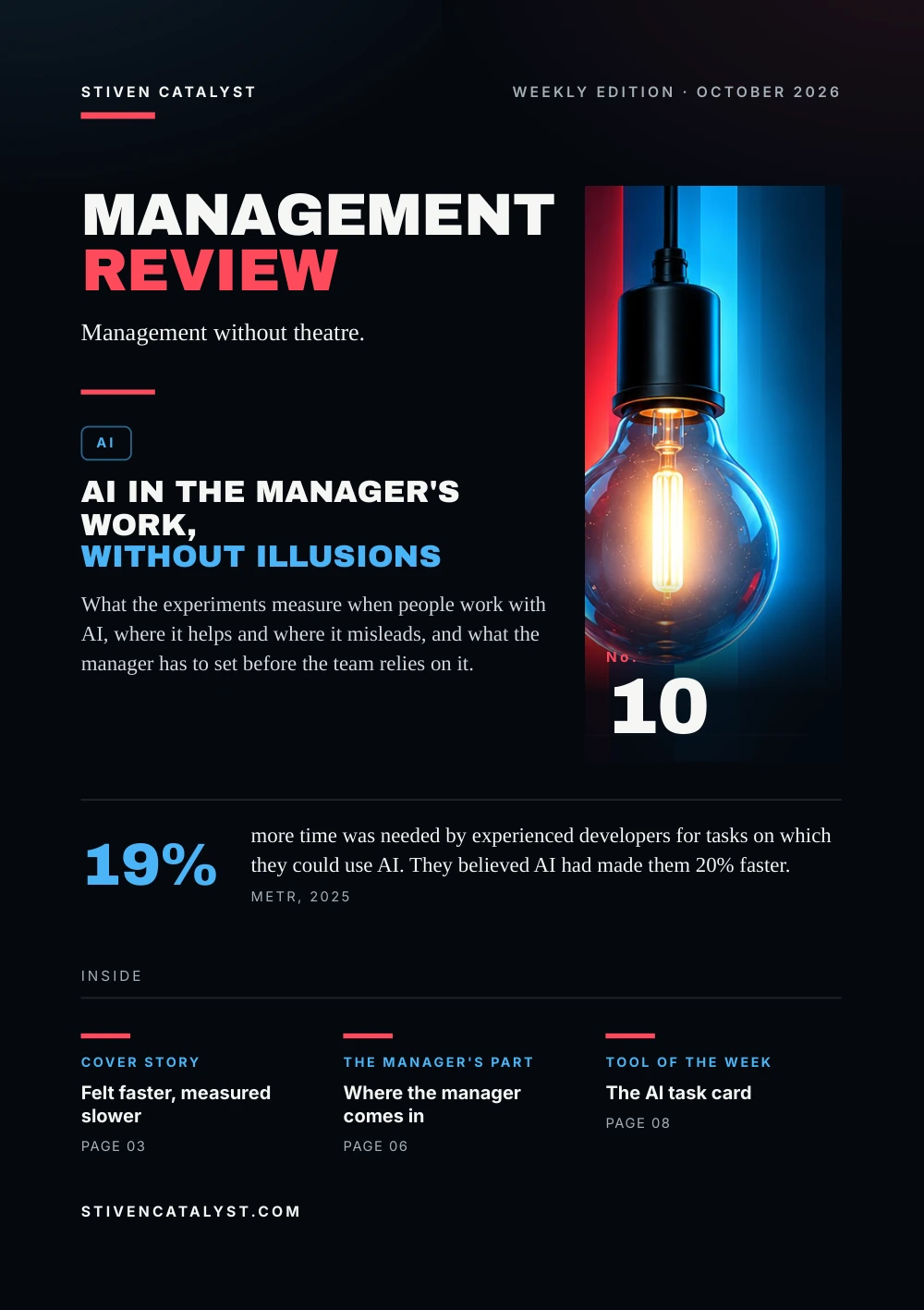 AI in the manager's work, without illusions
October 2026
In the experiment that opens Issue 10, people felt faster with AI and the clock measured them slower. The issue then follows AI use through Gallup's data and maps where AI helps and where it misleads. It ends with a card for every task you hand over to it.
-
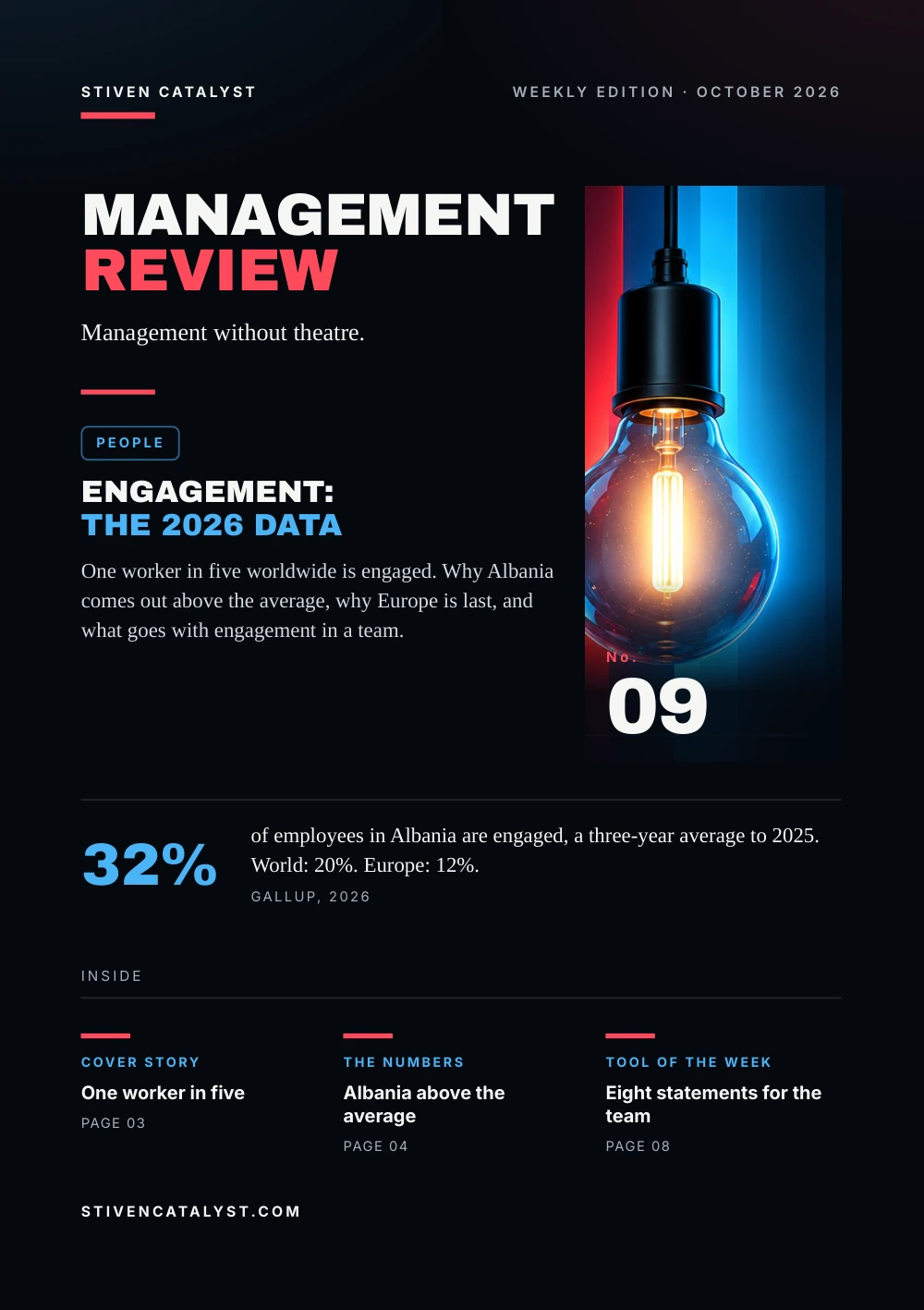 Engagement: the 2026 data
October 2026
Issue 9 reads Gallup's April 2026 report. Engagement fell worldwide for the second year in a row, Europe sits at the bottom and Albania well above both. Data from 183,806 work units show what goes with engaged teams.
-
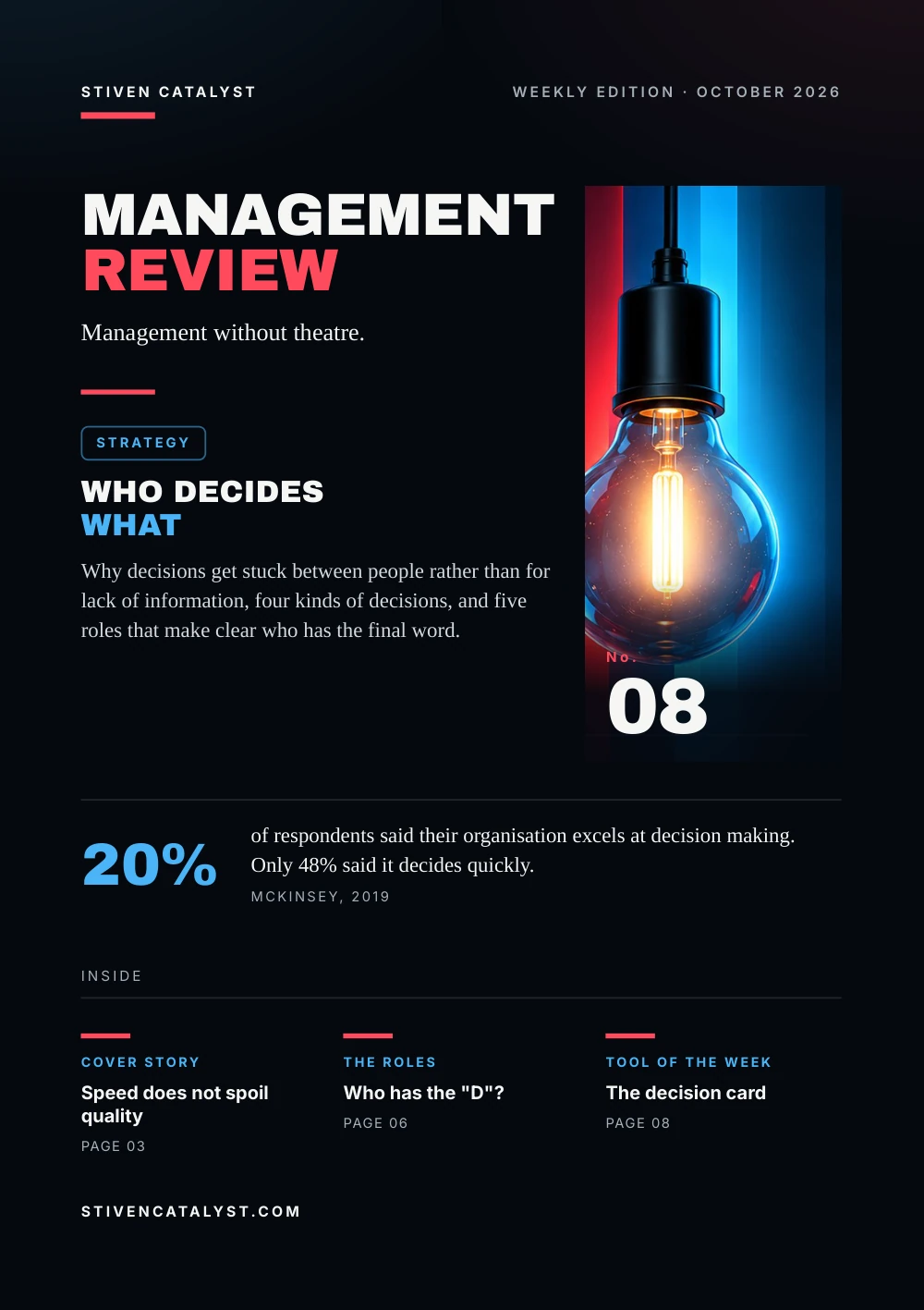 Who decides what
October 2026
Only one respondent in five rated their organisation's decisions excellent, in the survey that opens Issue 8. The issue shows why speed and quality go together and sorts decisions into four kinds. Every important decision then gets five roles.
-
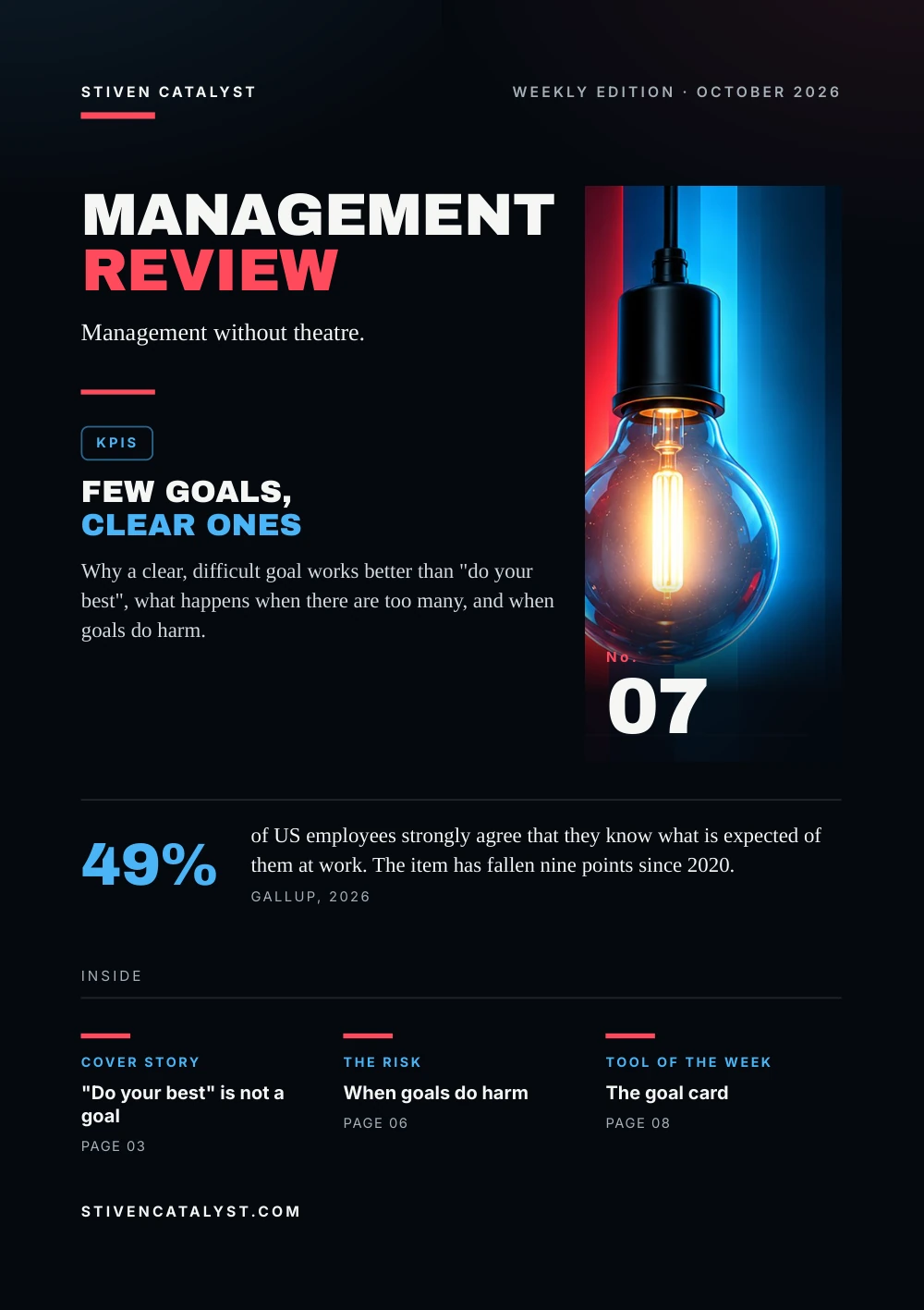 Few goals, clear ones
October 2026
Issue 7 draws on 35 years of research on goals and takes SMART apart letter by letter. It then turns to the side effects researchers warned about in 2009. The last step is to count how many goals your team really has.
-
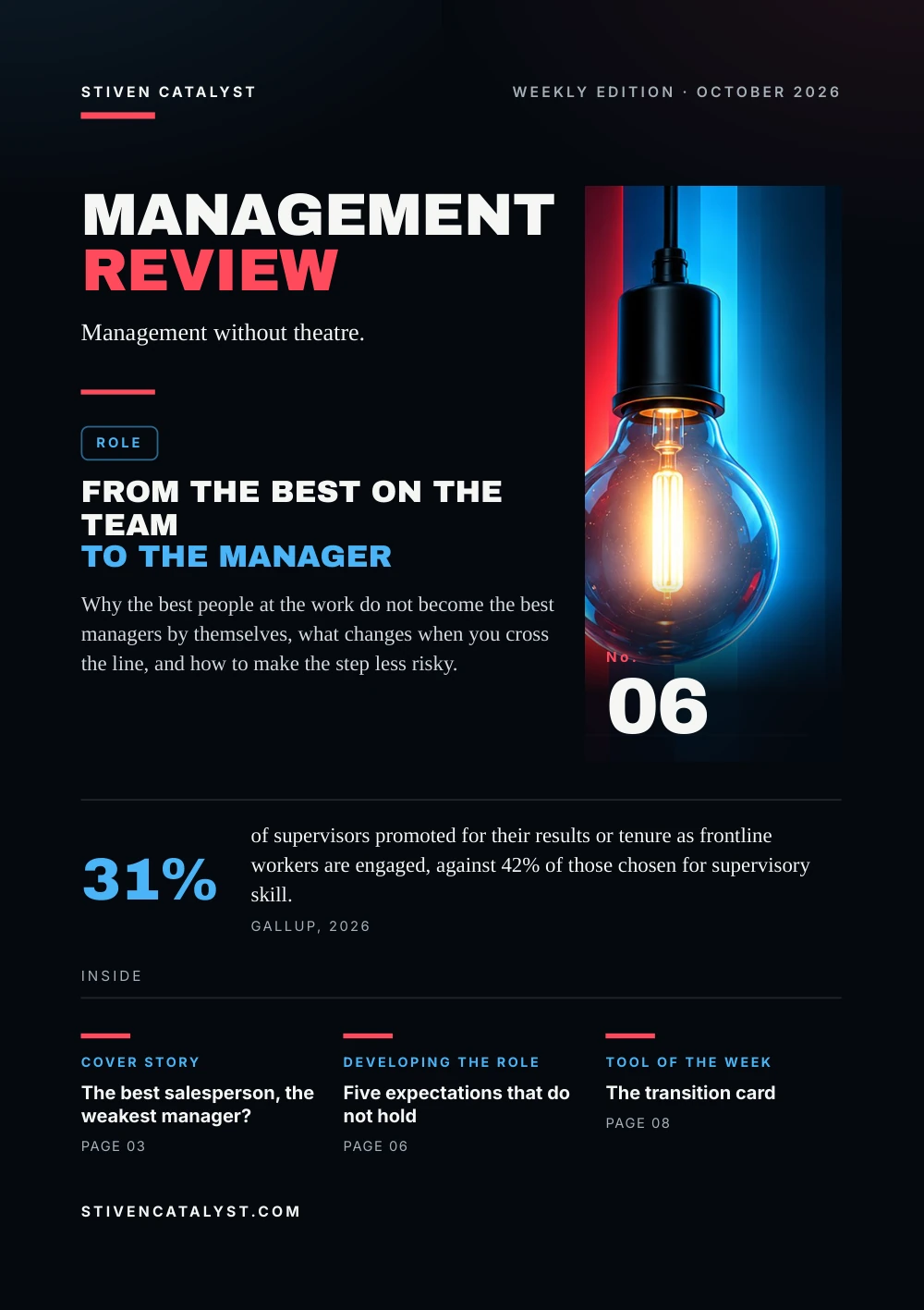 From the best on the team
t o the manager October 2026 Issue 6 follows the best person on the team into the manager's chair. The data on promoting top performers come first, then the shift in skills, time and values. Five expectations close the issue, none of which survives the first year. -
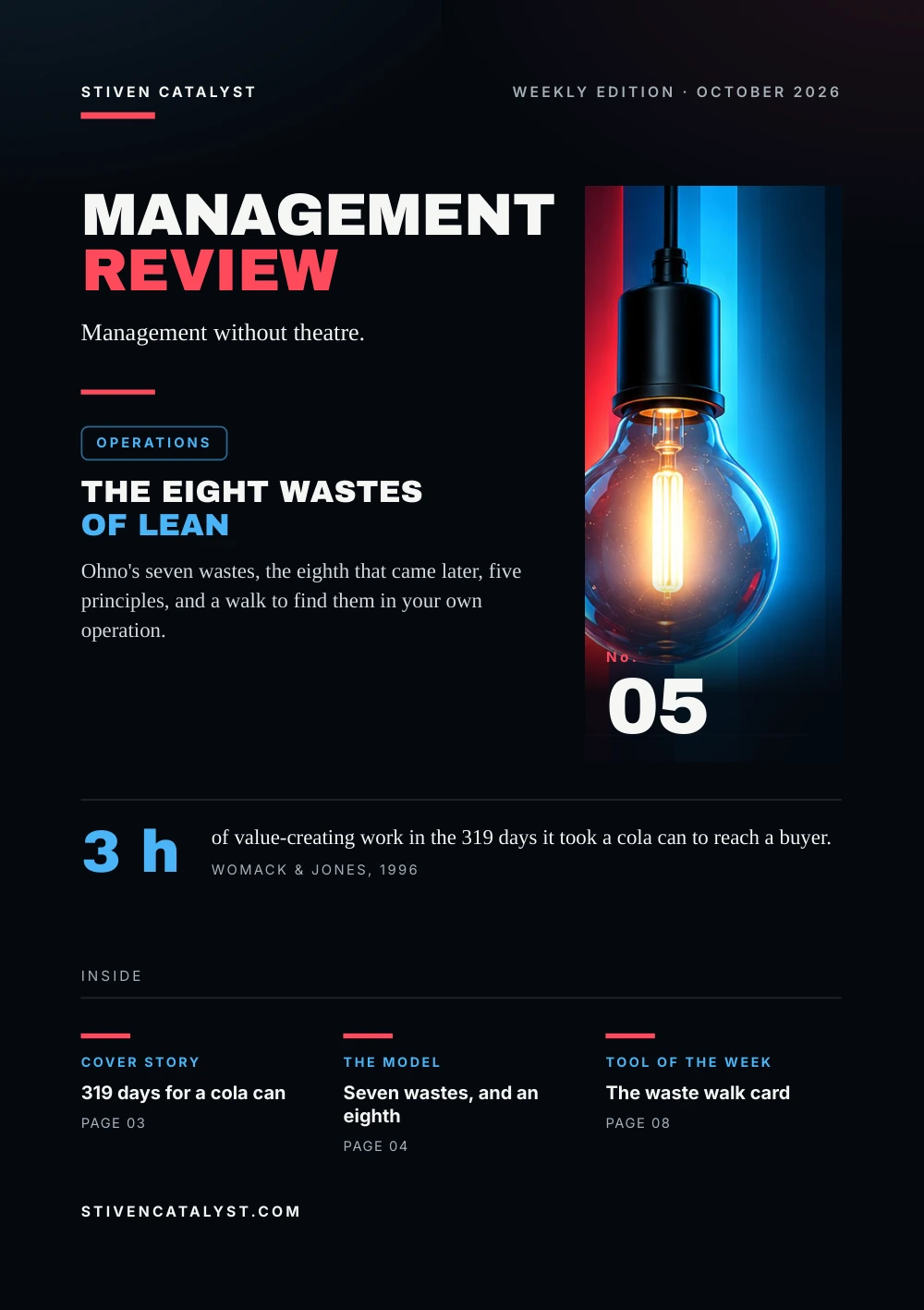 The eight wastes of Lean
October 2026
A cola can travels for 319 days and receives three hours of real work. Issue 5 starts from that gap, then names the seven wastes Taiichi Ohno described and the eighth added later. A card for walking through your own operation closes it.
-
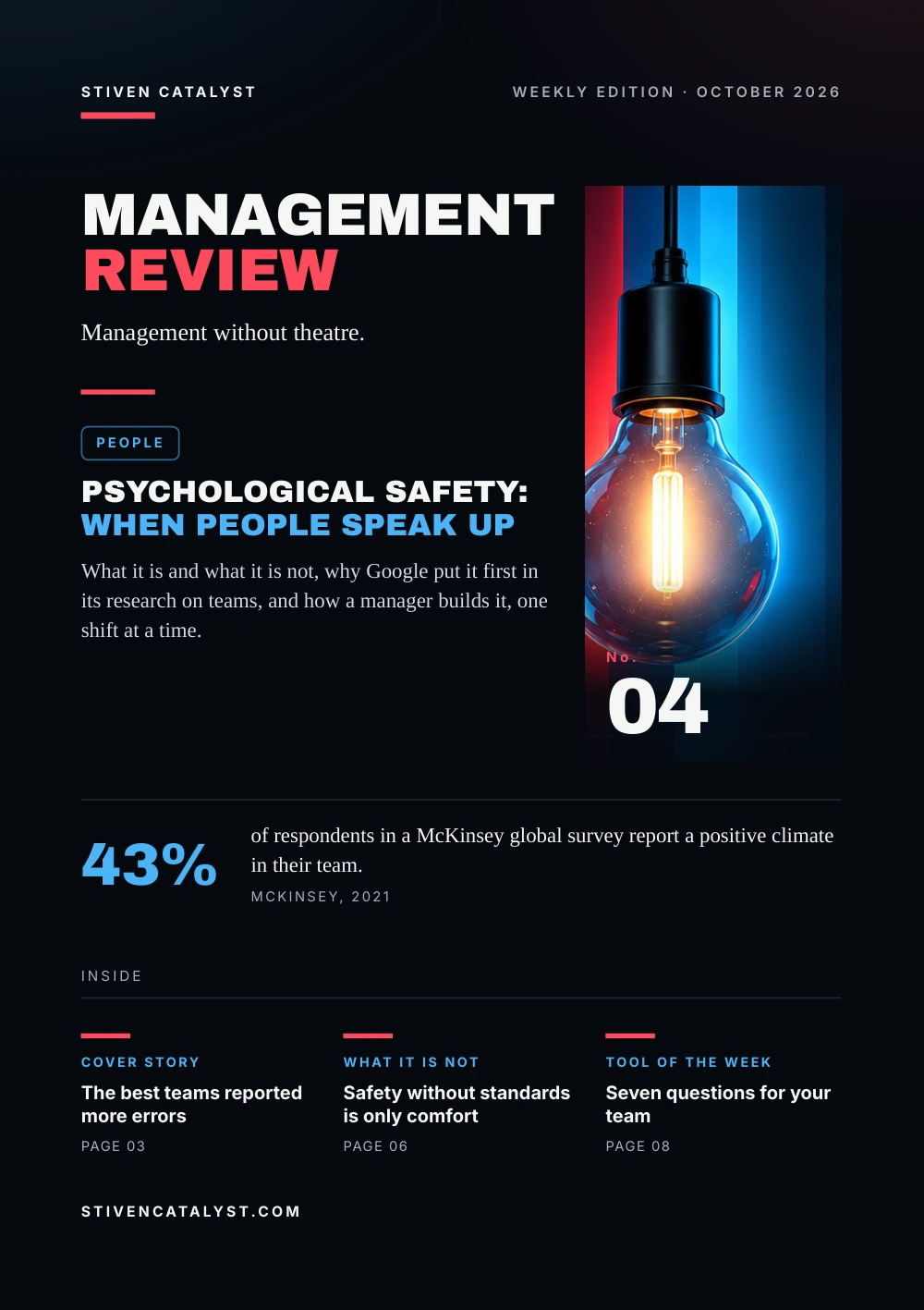 Psychological saf
e t y: when people speak up October 2026 Issue 4 opens on hospital wards where the best teams reported more errors. From there the idea leads to Google's study of 180 teams. The issue closes with seven questions a manager can put to the team on Monday. -
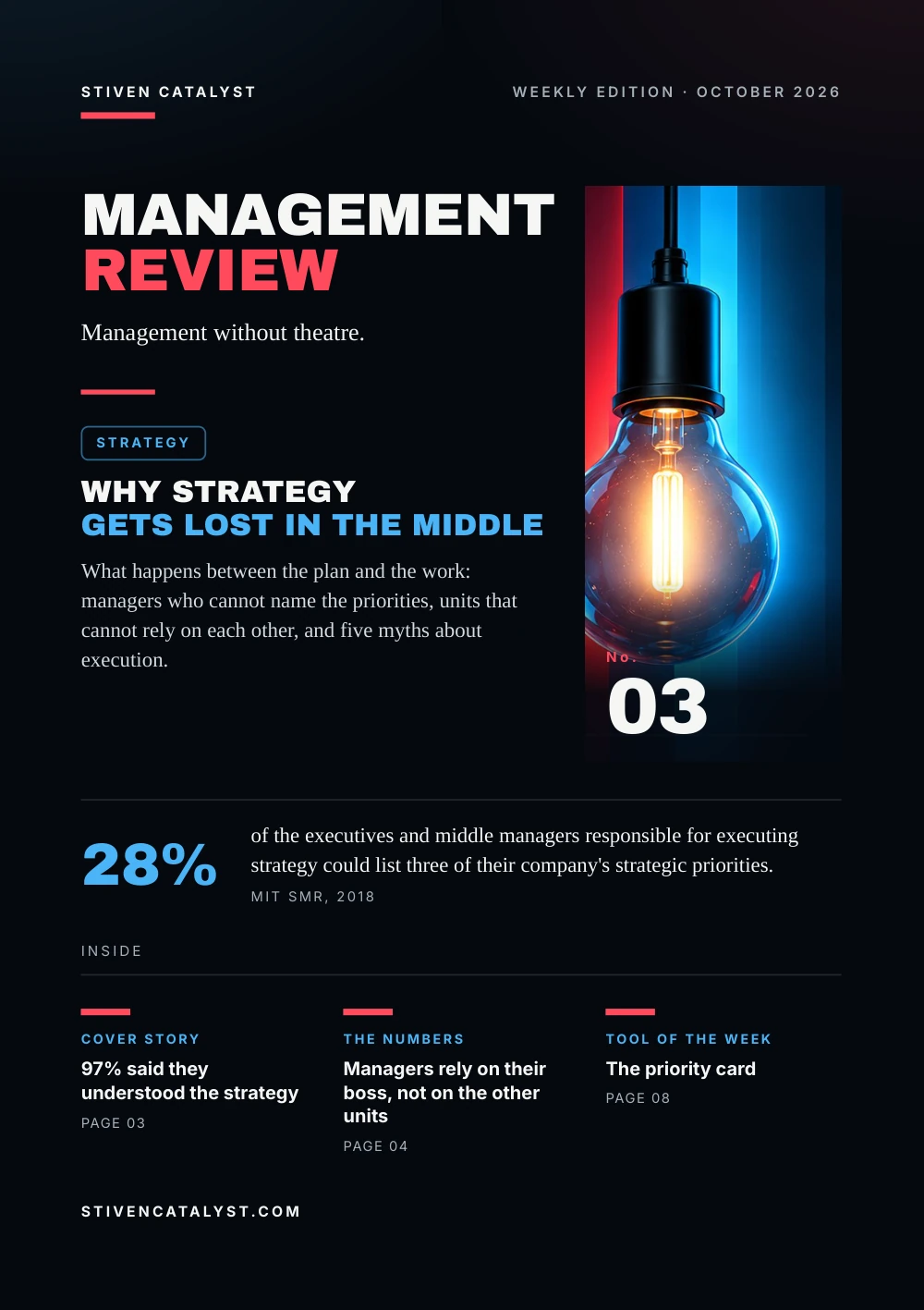 Why strategy g
e ts lost in the middle October 2026 Issue 3 follows a strategy from the top down to the work. In one company 97% of leaders said they understood it, yet most of them could not name its priorities. Whether it happens is decided further down, in the coordination between units. -
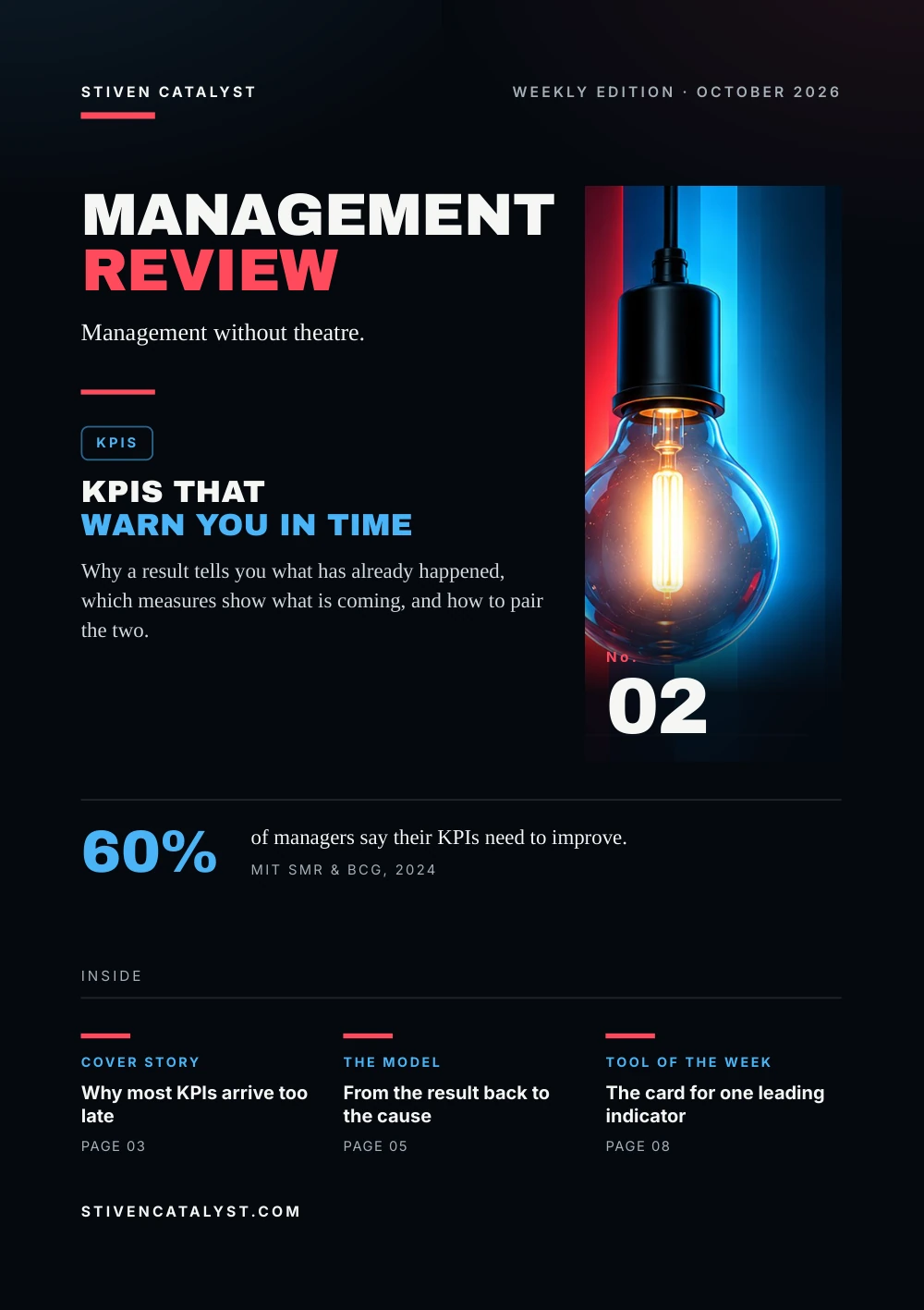 KPIs that warn you in time
October 2026
Most KPIs arrive after the damage is done. Issue 2 separates leading from lagging indicators and sets out what research says about KPIs today. It closes with a card for building one indicator that warns in time.
-
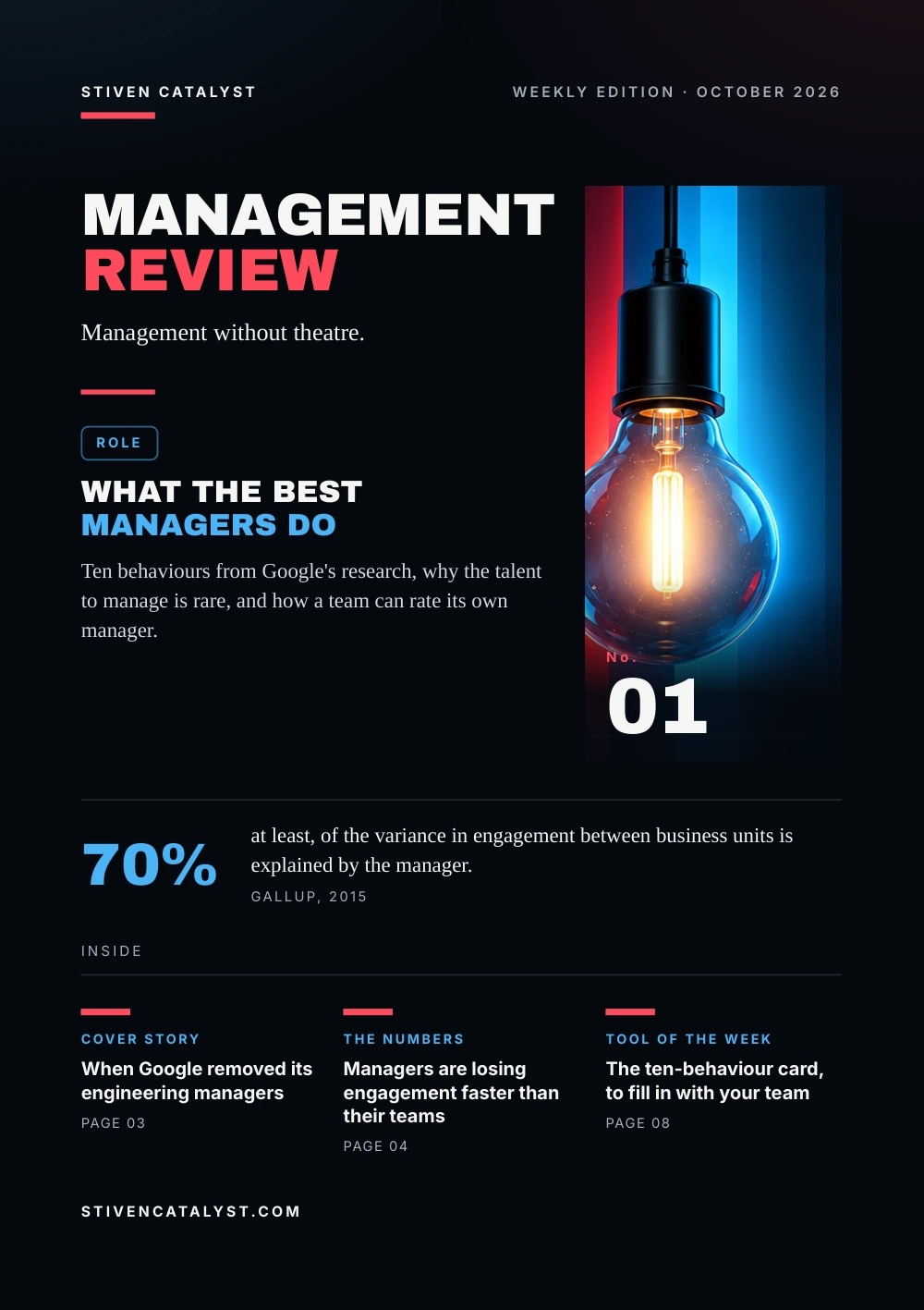 What the best managers do
October 2026
Issue 1 asks the most basic question of all: does the manager matter? Google's own data and Gallup's research on engagement and talent both answer it. A card closes the issue, for rating the ten behaviours together with your team.
No issue on this topic in this month.
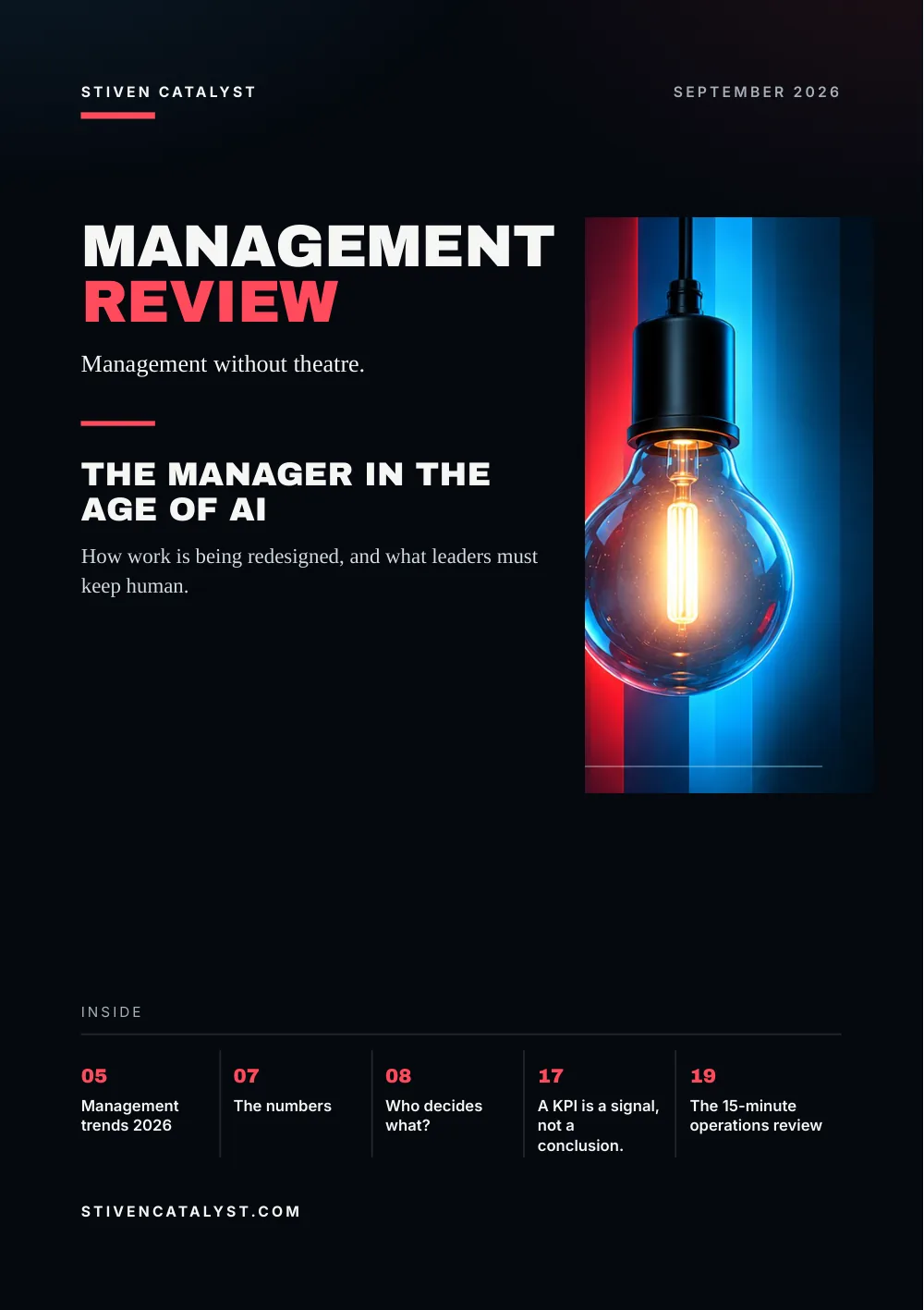
Management Review · Special edition · October 2026
The manager in the age of AI
Before the monthly edition, one special edition on the manager in the age of AI.
A one-off edition on the manager in the age of AI: the numbers from Microsoft, Deloitte, PwC, Gallup and Owl Labs, checked one by one, and the practice that turns them into work.
Open the editionCorrections
Every correction made after publication, the newest first: its date, the issue and what changed. Each is also on the issue's page and, for a correction to one issue, on the sources page of its PDF.
27 Oc
27 Oc
27 Oc
27 Oc
27 Oc
16 Oc
16 Oc
16 Oc
16 Oc
16 Oc
14 Oc
14 Oc
13 Oc
13 Oc
13 Oc
12 Oc
12 Oc
12 Oc
12 Oc
12 Oc
12 Oc
12 Oc
12 Oc
12 Oc
12 Oc
12 Oc
12 Oc