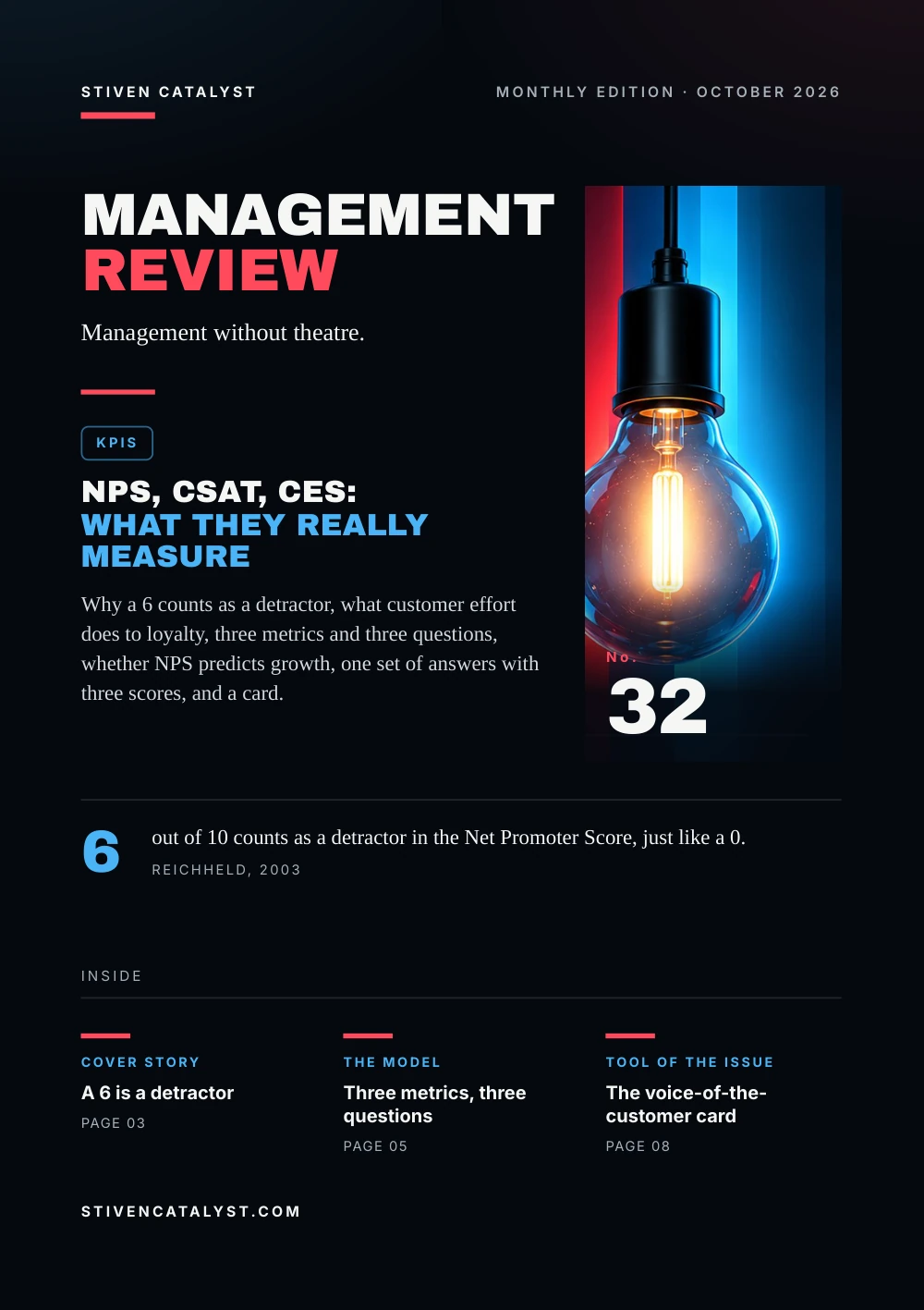
In Tasha Eurich's research most people believed they were self-aware, but only 10–15% fit her criteria. Ratings of the same people by peers and by bosses agree at 0.62; a person's own rating agrees with either at about 0.35. Daniel Goleman's five components of emotional intelligence came with bold claims. Meta-analyses find moderate links with performance, and much of what self-reported emotional intelligence predicts was already covered by personality and ability measures.
Management Review · Monthly edition · October 2026 · No. 31
Self-awareness and emotional intelligence
How many people really know themselves, how others see us, Goleman's five components, what the research finds on emotional intelligence, and a self-awareness card.
- No.
- 31
- Pages
- 10
- Sources
- 8
- Topics
- Role
Stiven CatalystMonthly edition · October 2026
ManagementReview
Management without theatre.
Role
Self-awarenessand emotional intelligence
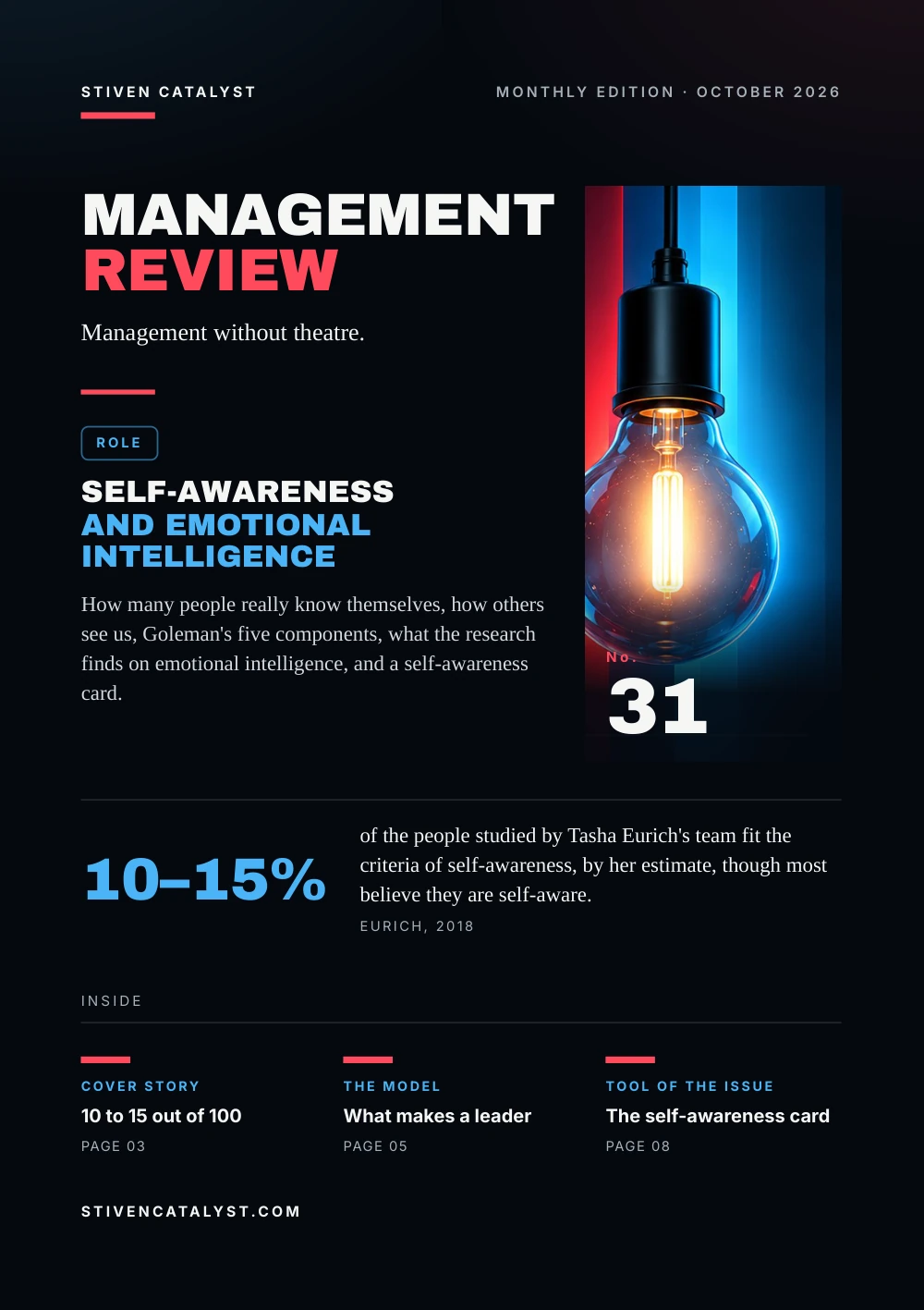
How many people really know themselves, how others see us, Goleman's five components, what the research finds on emotional intelligence, and a self-awareness card.

No.31
10–15%
of the people studied by Tasha Eurich's team fit the criteria of self-awareness, by her estimate, though most believe they are self-aware.Eurich, 2018
stivencatalyst.com
No. 31 · Role
In this issue
A manager watches the team every day, and the team watches the manager, often more clearly. This issue looks at what self-awareness and emotional intelligence are, what the research really shows, and how to learn how others see you.
- 03Cover story10 to 15 out of 100
- 04The numbersHow others see us
- 05The modelWhat makes a leader
- 06What the research saysTwo kinds of emotional intelligence
- 07How it is measuredSeeing yourself, being seen
- 08Tool of the issueThe self-awareness card
- 09SourcesSources and method
How to read this issue
Figure
Every figure has its source and year at the foot of its page.
Our reading
Where the editors interpret rather than the research, it says so.
Practice
The steps and the card are proposals to try, not research results.
Cover story
10 t o 15out of 100
Tasha Eurich's team ran ten investigations with nearly 5,000 participants and reviewed about 800 studies. Her conclusion in Harvard Business Review, 2018: most people believe they are self-aware, but only 10–15% of those studied fit the criteria.
10–15%of the people studied fit the criteria of self-awareness, by Eurich's estimate
19 of 20competencies in which higher-level leaders overrated themselves more than lower-level ones, in a study of over 3,600 leaders
Eurich explains it with experience and power: senior leaders have fewer people above them who give candid feedback, and the more power a leader holds, the less comfortable others feel offering criticism. The most effective leaders, she writes, counter this by seeking critical feedback often, from bosses, peers, staff and the board.
Our reading
Rank brings more information about the business and less about yourself. That gap has to be closed on purpose.
Source: Tasha Eurich, Harvard Business Review, 2018
The 10–15% is the author's estimate; her criteria and calculation are not published in the texts we saw, and the study of 3,600 leaders she cites is not named.
The numbers
How otherssee us
In 1988 Michael Harris and John Schaubroeck pooled studies of performance ratings. Peers and bosses agreed fairly well about the same people; the people's own ratings agreed far less with either.
Agreement between ratings of the same people's performance (correlation)
Link between a leader's EI and transformational leadership, by who rates them
Peter Harms and Marcus Credé found the second pattern in a 2010 meta-analysis. Different raters also agreed little with each other: 0.14 on leadership and 0.16 on emotional intelligence.
Sources: Michael M. Harris & John Schaubroeck, Personnel Psychology, 1988; Peter D. Harms & Marcus Credé, Journal of Leadership & Organizational Studies, 2010
Correlations from meta-analyses, not proof of cause. The 1988 figures concern performance ratings in general, not emotional intelligence.
The model
What makesa leader
In 1998 Daniel Goleman described emotional intelligence at work in five components. Self-awareness comes first: knowing your emotions, strengths, weaknesses, drives and values, and their effect on others.
Self-awareness
Realistic self-assessment, humour about oneself, a thirst for constructive criticism.
Self-regulation
Managing disruptive emotions and impulses: thinking before acting.
Motivation
Passion for the work beyond money or status, and persistence.
Empathy
Understanding the emotional makeup of others and treating them accordingly.
Social skill
Managing relationships, building networks, finding common ground.
His basis: competency models from 188 companies, some built from senior managers' judgments, some from criteria such as division profits. He wrote that emotional intelligence was twice as important as technical skills and IQ for jobs at all levels, and that for senior leaders nearly 90% of the difference in their profiles came from it. The article does not show how these ratios were calculated.
Our reading
The five components are a useful checklist. The ratios are a claim, not a finding.
Source: Daniel Goleman, Harvard Business Review, 1998
HBR is a magazine for practitioners, not a peer-reviewed journal. The 90% refers to differences between competency profiles, not to the share of performance that emotional intelligence explains.
More in the essayFrom Albania to Germany: what I have changed in the way I lead
What the research says
Two kinds ofemotional intelligence
In 2010 Dana Joseph and Daniel Newman showed that the label covers two different things: ability EI, measured with tests that have right answers, and mixed EI, measured mostly with self-report questionnaires that also take in personality, motivation and other competencies.
Ernest O'Boyle and colleagues found that all three kinds of EI measure correlate with job performance, at 0.24 to 0.30 after correction. For ability EI, Joseph and Newman found the link inconsistent: positive in jobs with much emotional labour, negative in jobs with little.
Self-reported, mixed EI and job performance (Joseph et al., 2015)
- 01
0.47
the earlier estimate, from 2010
- 02
0.29
the updated estimate, with performance rated by supervisors
- 03
−0.02
after controlling for ability EI, self-efficacy, self-rated performance, personality and general mental ability
Our reading
What self-report questionnaires predict, older measures mostly predicted already. What others can see a leader do is a better place to start.
Sources: Dana L. Joseph & Daniel A. Newman, Journal of Applied Psychology, 2010; Ernest H. O'Boyle Jr. et al., Journal of Organizational Behavior, 2011; Dana L. Joseph, Jing Jin, Daniel A. Newman & Ernest H. O'Boyle, Journal of Applied Psychology, 2015
Correlations, not proof of cause; 0.47 and 0.29 are correlations, −0.02 is a regression weight. The O'Boyle figures are confirmed through secondary sources only.
How it is measured
Seeing yourself,being seen
Eurich separates internal self-awareness, how clearly we see our own values, reactions and impact, from external self-awareness, how well we understand how others see us. By her account the two are unrelated, which gives four types.
Internal self-awarenessExternal self-awareness
Introspectors
Clear about who they are, but often surprised by how others react.
high internal · low externalAware
They see themselves clearly and understand their effect on others.
high internal · high externalSeekers
Not yet clear who they are or how others experience them.
low internal · low externalPleasers
Focused on what others expect, at times at the cost of their own needs and values.
low internal · high externalMeasuring it means comparing a self-rating with other people's ratings. John Fleenor and colleagues reviewed the research on this self–other agreement: studies measure it in different ways, so their findings conflict, including on whether leaders who over-rate themselves are less effective.
Sources: Tasha Eurich, Harvard Business Review, 2018; John W. Fleenor et al., The Leadership Quarterly, 2010
The four types are a description, not a measured split: how many people fall into each is not given.
Tool of the issue
The self-awarenesscard
Answer the questions yourself, then ask three people who see your work, a boss, a peer and someone in your team, the same ones. The gaps are the point.
01What I do welltwo or three things, in my words
02What they say I do wellthe same question, in their words
03What I could do bettermy view
04What they say I could do bettertheir view, without arguing back
05Where we differ mostone gap to look at
06One thing to trywhat, from when, and when I ask again
Source: Tasha Eurich, Harvard Business Review, 2018
A practice proposed by the editors, after Eurich (2018) on external self-awareness and critical feedback. It is not a test of emotional intelligence.
Sources and method
Every figurehas a source.
The figures in this issue come from the sources below. The year shows how recent each one is.
- What Self-Awareness Really Is (and How to Cultivate It)Tasha Eurich, Harvard Business Review, 2018https://hbr.org/2018/01/what-self-awareness-really-is-and-how-to-cultivate-it
- A meta-analysis of self-supervisor, self-peer, and peer-supervisor ratingsMichael M. Harris & John Schaubroeck, Personnel Psychology, 1988https://doi.org/10.1111/j.1744-6570.1988.tb00631.x
- Emotional intelligence and transformational and transactional leadership: A meta-analysisPeter D. Harms & Marcus Credé, Journal of Leadership & Organizational Studies, 2010https://doi.org/10.1177/1548051809350894
- What Makes a Leader?Daniel Goleman, Harvard Business Review, 1998https://hbr.org/2004/01/what-makes-a-leader
- Emotional intelligence: An integrative meta-analysis and cascading modelDana L. Joseph & Daniel A. Newman, Journal of Applied Psychology, 2010https://doi.org/10.1037/a0017286
- The relation between emotional intelligence and job performance: A meta-analysisErnest H. O'Boyle Jr. et al., Journal of Organizational Behavior, 2011
- Why does self-reported emotional intelligence predict job performance? A meta-analytic investigation of mixed EIDana L. Joseph, Jing Jin, Daniel A. Newman & Ernest H. O'Boyle, Journal of Applied Psychology, 2015
- Self–other rating agreement in leadership: A reviewJohn W. Fleenor et al., The Leadership Quarterly, 2010https://doi.org/10.1016/j.leaqua.2010.10.006
Editorial method
Each figure was checked for its year, its publisher and what exactly it measures. Where the publisher's page could not be opened, the figure was checked against independent summaries and is marked “via”. The editors' interpretation is marked “Our reading”. Figures that could not be confirmed are not in the issue.
ManagementReview
Management without theatre.
Every issue, one management question, checked against the best research.
All issues
stivencatalyst.com/magazine/management-review.html
Management Review · No. 31 · October 2026 · Stiven Catalyst
Click or swipe a page to turn it. The arrow keys work too.
Management Review · No. 31
The figures of the issue
The charts of the printed pages, with their sources.
Source: Michael M. Harris & John Schaubroeck, Personnel Psychology, 1988
Source: Peter D. Harms & Marcus Credé, Journal of Leadership & Organizational Studies, 2010
The whole text Read the issue as text For reading on a small screen, searching or a screen reader. The same words, without the page design.
In this issue
A manager watches the team every day, and the team watches the manager, often more clearly. This issue looks at what self-awareness and emotional intelligence are, what the research really shows, and how to learn how others see you.
In Tasha Eurich's research most people believed they were self-aware, but only 10–15% fit her criteria. Ratings of the same people by peers and by bosses agree at 0.62; a person's own rating agrees with either at about 0.35. Daniel Goleman's five components of emotional intelligence came with bold claims. Meta-analyses find moderate links with performance, and much of what self-reported emotional intelligence predicts was already covered by personality and ability measures.
Stiven Janaqi, Editor
Cover story
10 t o 15 out of 100
Tasha Eurich's team ran ten investigations with nearly 5,000 participants and reviewed about 800 studies. Her conclusion in Harvard Business Review, 2018: most people believe they are self-aware, but only 10–15% of those studied fit the criteria.
- 10–15% of the people studied fit the criteria of self-awareness, by Eurich's estimate
- 19 of 20 competencies in which higher-level leaders overrated themselves more than lower-level ones, in a study of over 3,600 leaders
Eurich explains it with experience and power: senior leaders have fewer people above them who give candid feedback, and the more power a leader holds, the less comfortable others feel offering criticism. The most effective leaders, she writes, counter this by seeking critical feedback often, from bosses, peers, staff and the board.
Our reading
Rank brings more information about the business and less about yourself. That gap has to be closed on purpose.
The 10–15% is the author's estimate; her criteria and calculation are not published in the texts we saw, and the study of 3,600 leaders she cites is not named.
Source: Tasha Eurich, Harvard Business Review, 2018
The numbers
How others see us
In 1988 Michael Harris and John Schaubroeck pooled studies of performance ratings. Peers and bosses agreed fairly well about the same people; the people's own ratings agreed far less with either.
Agreement between ratings of the same people's performance (correlation): Self and boss 0.35, Self and peers 0.36, Peers and boss 0.62.
Link between a leader's EI and transformational leadership, by who rates them: The same person rates both 0.59, Different people rate them 0.12.
Peter Harms and Marcus Credé found the second pattern in a 2010 meta-analysis. Different raters also agreed little with each other: 0.14 on leadership and 0.16 on emotional intelligence.
Correlations from meta-analyses, not proof of cause. The 1988 figures concern performance ratings in general, not emotional intelligence.
Sources: Michael M. Harris & John Schaubroeck, Personnel Psychology, 1988; Peter D. Harms & Marcus Credé, Journal of Leadership & Organizational Studies, 2010
The model
What makes a leader
In 1998 Daniel Goleman described emotional intelligence at work in five components. Self-awareness comes first: knowing your emotions, strengths, weaknesses, drives and values, and their effect on others.
- Self-awareness. Realistic self-assessment, humour about oneself, a thirst for constructive criticism.
- Self-regulation. Managing disruptive emotions and impulses: thinking before acting.
- Motivation. Passion for the work beyond money or status, and persistence.
- Empathy. Understanding the emotional makeup of others and treating them accordingly.
- Social skill. Managing relationships, building networks, finding common ground.
His basis: competency models from 188 companies, some built from senior managers' judgments, some from criteria such as division profits. He wrote that emotional intelligence was twice as important as technical skills and IQ for jobs at all levels, and that for senior leaders nearly 90% of the difference in their profiles came from it. The article does not show how these ratios were calculated.
Our reading
The five components are a useful checklist. The ratios are a claim, not a finding.
HBR is a magazine for practitioners, not a peer-reviewed journal. The 90% refers to differences between competency profiles, not to the share of performance that emotional intelligence explains.
Source: Daniel Goleman, Harvard Business Review, 1998
More in the essay: From Albania to Germany: what I have changed in the way I lead
What the research says
Two kinds of emotional intelligence
In 2010 Dana Joseph and Daniel Newman showed that the label covers two different things: ability EI, measured with tests that have right answers, and mixed EI, measured mostly with self-report questionnaires that also take in personality, motivation and other competencies.
Ernest O'Boyle and colleagues found that all three kinds of EI measure correlate with job performance, at 0.24 to 0.30 after correction. For ability EI, Joseph and Newman found the link inconsistent: positive in jobs with much emotional labour, negative in jobs with little.
Self-repor ted, mixed EI and job performance (Joseph e t al., 2015)
- 0.47. the earlier estimate, from 2010
- 0.29. the updated estimate, with performance rated by supervisors
- −0.02. after controlling for ability EI, self-efficacy, self-rated performance, personality and general mental ability
Our reading
What self-report questionnaires predict, older measures mostly predicted already. What others can see a leader do is a better place to start.
Correlations, not proof of cause; 0.47 and 0.29 are correlations, −0.02 is a regression weight. The O'Boyle figures are confirmed through secondary sources only.
Sources: Dana L. Joseph & Daniel A. Newman, Journal of Applied Psychology, 2010; Ernest H. O'Boyle Jr. et al., Journal of Organizational Behavior, 2011; Dana L. Joseph, Jing Jin, Daniel A. Newman & Ernest H. O'Boyle, Journal of Applied Psychology, 2015
How it is measured
Seeing yourself, being seen
Eurich separates internal self-awareness, how clearly we see our own values, reactions and impact, from external self-awareness, how well we understand how others see us. By her account the two are unrelated, which gives four types.
Internal self-awareness × External self-awareness:
- Introspec
t ors (high internal · low external). Clear about who they are, but often surprised by how others react. - Aware (high internal · high external). They see themselves clearly and understand their effect on others.
- Seekers (low internal · low external). Not yet clear who they are or how others experience them.
- Pleasers (low internal · high external). Focused on what others expect, at times at the cost of their own needs and values.
Measuring it means comparing a self-rating with other people's ratings. John Fleenor and colleagues reviewed the research on this self–other agreement: studies measure it in different ways, so their findings conflict, including on whether leaders who over-rate themselves are less effective.
The four types are a description, not a measured split: how many people fall into each is not given.
Sources: Tasha Eurich, Harvard Business Review, 2018; John W. Fleenor et al., The Leadership Quarterly, 2010
Tool of the issue
The self-awareness card
Answer the questions yourself, then ask three people who see your work, a boss, a peer and someone in your team, the same ones. The gaps are the point.
- What I do well two or three things, in my words
- What th
e y say I do well the same question, in their words - What I could do b
e t ter my view - What th
e y say I could do be t ter their view, without arguing back - Where we differ most one gap to look at
- One thing
t o try what, from when, and when I ask again
A practice proposed by the editors, after Eurich (2018) on external self-awareness and critical feedback. It is not a test of emotional intelligence.
Source: Tasha Eurich, Harvard Business Review, 2018
Sources and method
Every figure has a source.
The figures in this issue come from the sources below. The year shows how recent each one is.
- Tasha Eurich, Harvard Business Review, “What Self-Awareness Really Is (and How to Cultivate It)”, 2018. https://hbr.org/2018/01/what-self-awareness-really-is-and-how-to-cultivate-it
- Michael M. Harris & John Schaubroeck, Personnel Psychology, “A meta-analysis of self-supervisor, self-peer, and peer-supervisor ratings”, 1988. https://doi.org/10.1111/j.1744-6570.1988.tb00631.x
- Peter D. Harms & Marcus Credé, Journal of Leadership & Organizational Studies, “Emotional intelligence and transformational and transactional leadership: A meta-analysis”, 2010. https://doi.org/10.1177/1548051809350894
- Daniel Goleman, Harvard Business Review, “What Makes a Leader?”, 1998. https://hbr.org/2004/01/what-makes-a-leader
- Dana L. Joseph & Daniel A. Newman, Journal of Applied Psychology, “Emotional intelligence: An integrative meta-analysis and cascading model”, 2010. https://doi.org/10.1037/a0017286
- Ernest H. O'Boyle Jr. et al., Journal of Organizational Behavior, “The relation between emotional intelligence and job performance: A meta-analysis”, 2011.
- Dana L. Joseph, Jing Jin, Daniel A. Newman & Ernest H. O'Boyle, Journal of Applied Psychology, “Why does self-reported emotional intelligence predict job performance? A meta-analytic investigation of mixed EI”, 2015.
- John W. Fleenor et al., The Leadership Quarterly, “Self–other rating agreement in leadership: A review”, 2010. https://doi.org/10.1016/j.leaqua.2010.10.006
Edit orial me thod
Each figure was checked for its year, its publisher and what exactly it measures. Where the publisher's page could not be opened, the figure was checked against independent summaries and is marked “via”. The editors' interpretation is marked “Our reading”. Figures that could not be confirmed are not in the issue.
Management Review · Monthly edition