In 2022 the WHO estimated that 15% of working-age adults had a mental disorder in 2019, and that depression and anxiety cost about 12 billion working days a year. Its guidelines recommend changing the work to reduce psychosocial risks and, for the first time, training managers. The evidence for manager training is the strongest; for changing the work it is very uncertain, probably because such changes are hard to study. German law already asks employers to assess psychological strain. The issue describes evidence; it is not medical advice.
Management Review · Second series · November 2026 · No. 75
Mental health at work
What the WHO guidelines of 2022 put first, how many working-age adults live with a mental disorder, six places to act, how strong the evidence is, what German law asks, and a card for one strain.
- No.
- 75
- Pages
- 10
- Sources
- 6
- Topics
- People
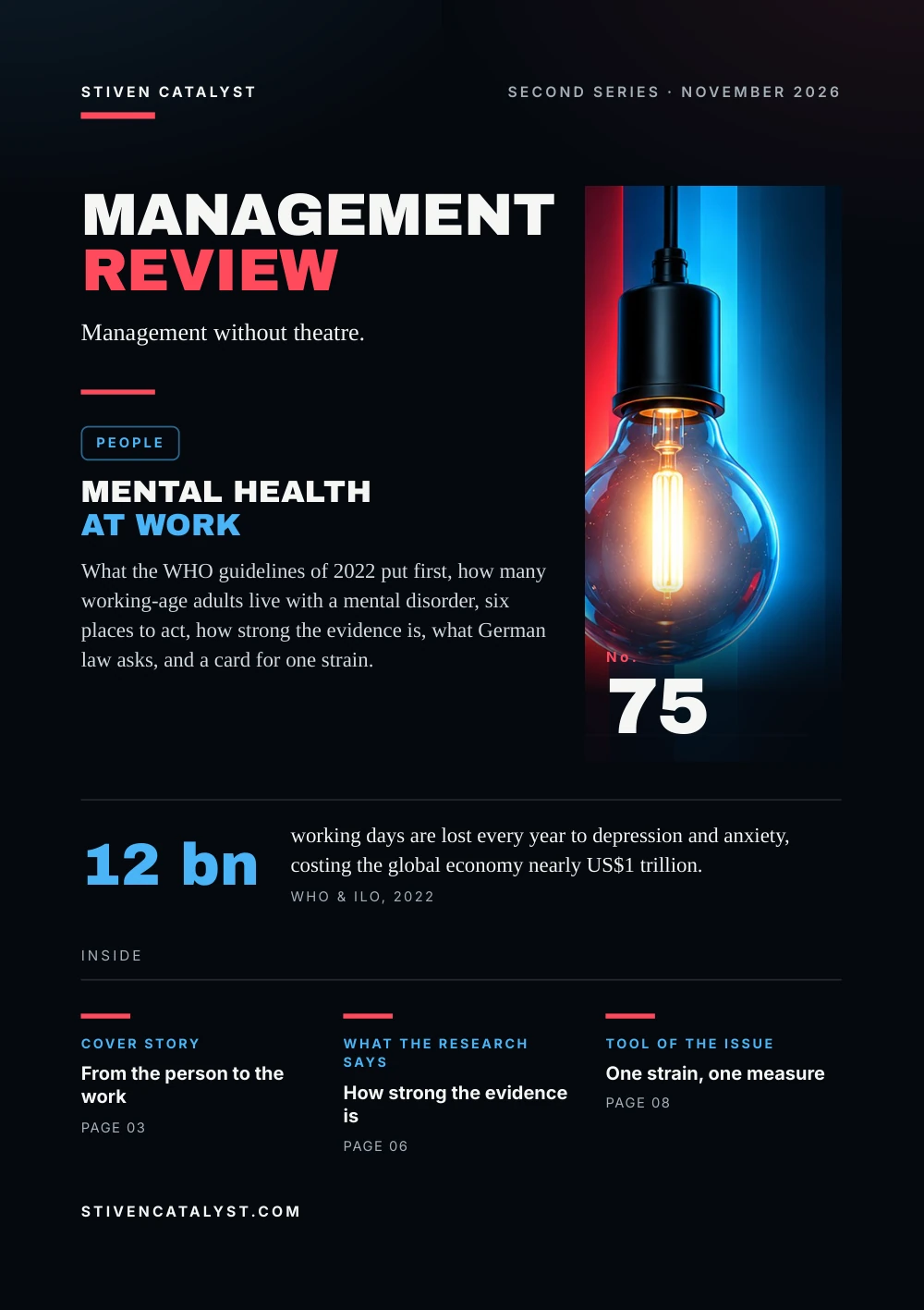
Stiven CatalystSecond series · November 2026
ManagementReview
Management without theatre.
People
Mental healthat work
What the WHO guidelines of 2022 put first, how many working-age adults live with a mental disorder, six places to act, how strong the evidence is, what German law asks, and a card for one strain.

No.75
12 bn
working days are lost every year to depression and anxiety, costing the global economy nearly US$1 trillion.WHO & ILO, 2022
stivencatalyst.com
No. 75 · People
In this issue
Mental health at work is often handled as a matter for the individual: an app, a course, a hotline. The WHO guidelines of 2022 start somewhere else, with workload, control and how people treat each other. This issue asks what that means for a manager.
- 03Cover storyFrom the person to the work
- 04The numbersThree in twenty
- 05The modelWhere to act
- 06What the research saysHow strong the evidence is
- 07How it is measuredWhat German law asks
- 08Tool of the issueOne strain, one measure
- 09SourcesSources and method
How to read this issue
Figure
Every figure has its source and year at the foot of its page.
Our reading
Where the editors interpret rather than the research, it says so.
Practice
The steps and the card are proposals to try, not research results.
Cover story
From the persont o the work
On 28 September 2022 the WHO published its guidelines on mental health at work, together with a policy brief written with the International Labour Organization. They begin with the conditions of work.
Risks at work the WHO names
- excessive workload or work pace, understaffing
- little control over job design or workload
- violence, harassment or bullying
- discrimination and exclusion
- job insecurity
The launch named what was new in them:
“For the first time WHO recommends manager training, to build their capacity to prevent stressful work environments and respond to workers in distress.”
Our reading
Workload, control and behaviour are decided at work, often by the manager. That is where the WHO starts.
Sources: World Health Organization, 2022; World Health Organization & International Labour Organization, 2022; World Health Organization, 2024
The list shortens the WHO fact sheet; translations are ours. Burnout is No. 29, psychological safety No. 4. This issue describes guidelines and evidence; it is not medical advice.
The numbers
Threein twent y
The WHO's World Mental Health Report of 2022 estimated that nearly a billion people lived with a mental disorder in 2019, and that close to 15% of the world's working population has one at any given time.
The working population worldwide, out of 20
- 3 in 20have a mental disorder (≈ 15%)
- 17 in 20the rest
≈ 12 bnworking days lost each year to depression and anxiety
≈ $1 tnthe yearly cost to the global economy
35%of countries reported national programmes to promote mental health at work
Our reading
In a team of twenty, three people living with a mental disorder is the average expectation, not a rare case.
Sources: World Health Organization, 2022; World Health Organization & International Labour Organization, 2022
Global estimates, not counts. A disorder is a diagnosis, not the stress of a hard week. Days, cost and the 35% are as the WHO and ILO gave them in 2022; the WHO's fact sheet of 2026 gives 16% for 2023.
The model
Wheret o act
The guidelines recommend action in these areas. They run from the work itself, through the people who lead it, to workers who live with a mental health condition.
Organisational interventions
reduce psychosocial risks such as bullying or low job control
Manager training
knowledge, attitudes and skills; not meant to turn managers into therapists
Worker training
mental health literacy and awareness
Individual interventions
psychosocial support or physical activity, as one part of a wider programme
Return to work
work-directed care, such as a phased return, with ongoing clinical care
Gaining employment
supported employment for people with severe conditions
Our reading
Help for the individual is on the list, but as one part. It does not replace changing the work that strains everyone.
Sources: World Health Organization, 2022; Aiysha Malik, José Luis Ayuso-Mateos, Gergő Baranyi, Corrado Barbui, Graham Thornicroft, Mark van Ommeren & Aemal Akhtar, World Psychiatry 22(2), 2023; World Health Organization, 2024
Rows shortened from the guidelines and Malik et al. (2023). The guidelines also recommend reasonable accommodations, such as flexible hours or extra time for tasks. On screening workers, the WHO made no recommendation.
More in the essayLeadership without a title
What the research says
How strongthe evidence is
With the GRADE method the WHO rates each recommendation twice: how strong it is, and how certain the evidence behind it is.
Manager training
strong recommendation, moderate certainty
Organisational interventions for all
“may be considered”: conditional, very low certainty
Mental health training for workers
conditional, very low certainty
Leadership-oriented training
no recommendation: no clear effect on health
Screening workers
no recommendation: unclear if benefits outweigh harms
Our reading
Weak evidence for changing the work is not proof that it fails. Such changes are hard to study, and the law does not wait for the trials.
Sources: World Health Organization, 2022; Aiysha Malik, José Luis Ayuso-Mateos, Gergő Baranyi, Corrado Barbui, Graham Thornicroft, Mark van Ommeren & Aemal Akhtar, World Psychiatry 22(2), 2023
Low certainty means more research could change the estimate. Malik et al. (2023) trace the weak evidence to how hard complex interventions are to evaluate. The grades are as printed in the guidelines.
How it is measured
What Germanlaw asks
Germany's Occupational Safety and Health Act (Arbeitsschutzgesetz) lists psychological strain at work among the sources of hazard for the employer's risk assessment (§ 5(3) no. 6). Read together, four steps:
Assess (§ 5)
which hazards come with the work, by type of activity; where conditions are alike, one assessment will do
Act at the source (§ 4)
design work to spare physical and mental health; individual measures come after the others
Check (§ 3)
whether the measures work, and adapt them when conditions change
Document (§ 6)
the result of the assessment, the measures and the result of their review
Our reading
The law and the WHO point the same way: the work first, the person after. A questionnaire is not yet an assessment; the measures and their review belong to it.
Source: Federal Republic of Germany, Bundesgesetzblatt I 1996 p. 1246, 2025
Our summary of §§ 3–6, not legal advice. The Act prescribes no method for the assessment. We did not check the law in Albania.
Tool of the issue
One strain,one measure
One card per task or team. It asks about the work, not about anyone's health: what strains, where it comes from, what changes at the source, and when you check. Five Whys helps with the third line.
01Task or teamwhere, which shift, how many people
02The strainload or pace, control, staffing, behaviour, insecurity: which, how often
03Where it comes fromask why until you reach something in the work
04Measure at the sourcewhat changes in the work, before training or individual help
05Who and by whenone owner, one date; ask the team what they would change
06Check and recorddid the strain go down; where it is written down
Sources: World Health Organization, 2022; Federal Republic of Germany, Bundesgesetzblatt I 1996 p. 1246, 2025
A practice proposed by the editors, after the WHO's order and §§ 3–6 of the Arbeitsschutzgesetz. It is not a diagnosis and replaces neither the formal risk assessment nor medical help.
Open the tool: 5 Whysstivencatalyst.com/tools/five-whys/
Sources and method
Every figurehas a source.
The figures in this issue come from the sources below. The year shows how recent each one is.
- WHO guidelines on mental health at workWorld Health Organization, 2022https://www.who.int/publications/i/item/9789240053052
- WHO and ILO call for new measures to tackle mental health issues at work (news release, 28 September 2022)World Health Organization & International Labour Organization, 2022https://www.who.int/news/item/28-09-2022-who-and-ilo-call-for-new-measures-to-tackle-mental-health-issues-at-work
- Mental health at work (fact sheet)World Health Organization, 2024https://www.who.int/news-room/fact-sheets/detail/mental-health-at-work
- World mental health report: Transforming mental health for allWorld Health Organization, 2022https://www.who.int/publications/i/item/9789240049338
- Mental health at work: WHO guidelinesAiysha Malik, José Luis Ayuso-Mateos, Gergő Baranyi, Corrado Barbui, Graham Thornicroft, Mark van Ommeren & Aemal Akhtar, World Psychiatry 22(2), 2023https://doi.org/10.1002/wps.21094
- Arbeitsschutzgesetz (Occupational Safety and Health Act), §§ 3–6, as last amended on 22 December 2025Federal Republic of Germany, Bundesgesetzblatt I 1996 p. 1246, 2025https://www.gesetze-im-internet.de/arbschg/
Editorial method
Each figure was checked for its year, its publisher and what exactly it measures. Where the publisher's page could not be opened, the figure was checked against independent summaries and is marked “via”. The editors' interpretation is marked “Our reading”. Figures that could not be confirmed are not in the issue.
ManagementReview
Management without theatre.
Every issue, one management question, checked against the best research.
All issues
stivencatalyst.com/magazine/management-review.html
Management Review · No. 75 · November 2026 · Stiven Catalyst
Click or swipe a page to turn it. The arrow keys work too.
Management Review · No. 75
The figures of the issue
The charts of the printed pages, with their sources.
- 3 in 20have a mental disorder (≈ 15%)
- 17 in 20the rest
- 3 in 20have a mental disorder (≈ 15%)
- 17 in 20the rest
Source: World Health Organization, 2022
The whole text Read the issue as text For reading on a small screen, searching or a screen reader. The same words, without the page design.
In this issue
Mental health at work is often handled as a matter for the individual: an app, a course, a hotline. The WHO guidelines of 2022 start somewhere else, with workload, control and how people treat each other. This issue asks what that means for a manager.
In 2022 the WHO estimated that 15% of working-age adults had a mental disorder in 2019, and that depression and anxiety cost about 12 billion working days a year. Its guidelines recommend changing the work to reduce psychosocial risks and, for the first time, training managers. The evidence for manager training is the strongest; for changing the work it is very uncertain, probably because such changes are hard to study. German law already asks employers to assess psychological strain. The issue describes evidence; it is not medical advice.
Stiven Janaqi, Editor
Cover story
From the person t o the work
On 28 September 2022 the WHO published its guidelines on mental health at work, together with a policy brief written with the International Labour Organization. They begin with the conditions of work.
Risks at work the WHO names
- excessive workload or work pace, understaffing
- little control over job design or workload
- violence, harassment or bullying
- discrimination and exclusion
- job insecurity
The launch named what was new in them:
For the first time WHO recommends manager training, to build their capacity to prevent stressful work environments and respond to workers in distress.
Our reading
Workload, control and behaviour are decided at work, often by the manager. That is where the WHO starts.
The list shortens the WHO fact sheet; translations are ours. Burnout is No. 29, psychological safety No. 4. This issue describes guidelines and evidence; it is not medical advice.
Sources: World Health Organization, 2022; World Health Organization & International Labour Organization, 2022; World Health Organization, 2024
The numbers
Three in twent y
The WHO's World Mental Health Report of 2022 estimated that nearly a billion people lived with a mental disorder in 2019, and that close to 15% of the world's working population has one at any given time.
The working population worldwide, out of 20: 3 in 20 have a mental disorder (≈ 15%), 17 in 20 the rest.
- ≈ 12 bn working days lost each year to depression and anxiety
- ≈ $1 tn the yearly cost to the global economy
- 35% of countries reported national programmes to promote mental health at work
Our reading
In a team of twenty, three people living with a mental disorder is the average expectation, not a rare case.
Global estimates, not counts. A disorder is a diagnosis, not the stress of a hard week. Days, cost and the 35% are as the WHO and ILO gave them in 2022; the WHO's fact sheet of 2026 gives 16% for 2023.
Sources: World Health Organization, 2022; World Health Organization & International Labour Organization, 2022
The model
Where t o act
The guidelines recommend action in these areas. They run from the work itself, through the people who lead it, to workers who live with a mental health condition.
- Organisational interventions. reduce psychosocial risks such as bullying or low job control
- Manager training. knowledge, attitudes and skills; not meant to turn managers into therapists
- Worker training. mental health literacy and awareness
- Individual interventions. psychosocial support or physical activity, as one part of a wider programme
- R
e turnt o work. work-directed care, such as a phased return, with ongoing clinical care - Gaining employment. supported employment for people with severe conditions
Our reading
Help for the individual is on the list, but as one part. It does not replace changing the work that strains everyone.
Rows shortened from the guidelines and Malik et al. (2023). The guidelines also recommend reasonable accommodations, such as flexible hours or extra time for tasks. On screening workers, the WHO made no recommendation.
Sources: World Health Organization, 2022; Aiysha Malik, José Luis Ayuso-Mateos, Gergő Baranyi, Corrado Barbui, Graham Thornicroft, Mark van Ommeren & Aemal Akhtar, World Psychiatry 22(2), 2023; World Health Organization, 2024
More in the essay: Leadership without a title
What the research says
How strong the evidence is
With the GRADE method the WHO rates each recommendation twice: how strong it is, and how certain the evidence behind it is.
- Manager training. strong recommendation, moderate certainty
- Organisational interventions for all. “may be considered”: conditional, very low certainty
- Mental health training for workers. conditional, very low certainty
- Leadership-oriented training. no recommendation: no clear effect on health
- Screening workers. no recommendation: unclear if benefits outweigh harms
Our reading
Weak evidence for changing the work is not proof that it fails. Such changes are hard to study, and the law does not wait for the trials.
Low certainty means more research could change the estimate. Malik et al. (2023) trace the weak evidence to how hard complex interventions are to evaluate. The grades are as printed in the guidelines.
Sources: World Health Organization, 2022; Aiysha Malik, José Luis Ayuso-Mateos, Gergő Baranyi, Corrado Barbui, Graham Thornicroft, Mark van Ommeren & Aemal Akhtar, World Psychiatry 22(2), 2023
How it is measured
What German law asks
Germany's Occupational Safety and Health Act (Arbeitsschutzgesetz) lists psychological strain at work among the sources of hazard for the employer's risk assessment (§ 5(3) no. 6). Read together, four steps:
- Assess (§ 5). which hazards come with the work, by type of activity; where conditions are alike, one assessment will do
- Act at the source (§ 4). design work to spare physical and mental health; individual measures come after the others
- Check (§ 3). whether the measures work, and adapt them when conditions change
- Document (§ 6). the result of the assessment, the measures and the result of their review
Our reading
The law and the WHO point the same way: the work first, the person after. A questionnaire is not yet an assessment; the measures and their review belong to it.
Our summary of §§ 3–6, not legal advice. The Act prescribes no method for the assessment. We did not check the law in Albania.
Source: Federal Republic of Germany, Bundesgesetzblatt I 1996 p. 1246, 2025
Tool of the issue
One strain, one measure
One card per task or team. It asks about the work, not about anyone's health: what strains, where it comes from, what changes at the source, and when you check. Five Whys helps with the third line.
- Task or team where, which shift, how many people
- The strain load or pace, control, staffing, behaviour, insecurity: which, how often
- Where it comes from ask why until you reach something in the work
- Measure at the source what changes in the work, before training or individual help
- Who and by when one owner, one date; ask the team what they would change
- Check and record did the strain go down; where it is written down
A practice proposed by the editors, after the WHO's order and §§ 3–6 of the Arbeitsschutzgesetz. It is not a diagnosis and replaces neither the formal risk assessment nor medical help.
Sources: World Health Organization, 2022; Federal Republic of Germany, Bundesgesetzblatt I 1996 p. 1246, 2025
Open the tool: 5 Whys
Sources and method
Every figure has a source.
The figures in this issue come from the sources below. The year shows how recent each one is.
- World Health Organization, “WHO guidelines on mental health at work”, 2022. https://www.who.int/publications/i/item/9789240053052
- World Health Organization & International Labour Organization, “WHO and ILO call for new measures to tackle mental health issues at work (news release, 28 September 2022)”, 2022. https://www.who.int/news/item/28-09-2022-who-and-ilo-call-for-new-measures-to-tackle-mental-health-issues-at-work
- World Health Organization, “Mental health at work (fact sheet)”, 2024. https://www.who.int/news-room/fact-sheets/detail/mental-health-at-work
- World Health Organization, “World mental health report: Transforming mental health for all”, 2022. https://www.who.int/publications/i/item/9789240049338
- Aiysha Malik, José Luis Ayuso-Mateos, Gergő Baranyi, Corrado Barbui, Graham Thornicroft, Mark van Ommeren & Aemal Akhtar, World Psychiatry 22(2), “Mental health at work: WHO guidelines”, 2023. https://doi.org/10.1002/wps.21094
- Federal Republic of Germany, Bundesgesetzblatt I 1996 p. 1246, “Arbeitsschutzgesetz (Occupational Safety and Health Act), §§ 3–6, as last amended on 22 December 2025”, 2025. https://www.gesetze-im-internet.de/arbschg/
Edit orial me thod
Each figure was checked for its year, its publisher and what exactly it measures. Where the publisher's page could not be opened, the figure was checked against independent summaries and is marked “via”. The editors' interpretation is marked “Our reading”. Figures that could not be confirmed are not in the issue.
Management Review · Monthly edition