Kathy Kram described what mentors give: career help, sponsorship among it, and personal support. In a Catalyst survey of more than 4,000 high potentials, more women than men had mentors, yet fewer of the mentored women were promoted. Two meta-analyses find mentoring linked with better careers, but with small effects on pay and promotion. People who found their mentors themselves did better than those who were assigned one, and in formal programmes a say in the process and good training made a difference.
Management Review · Second series · November 2026 · No. 72
Ment or and sponsor
Kram's two kinds of help, high potentials who were mentored but not promoted, what a sponsor does that a mentor does not, what the meta-analyses find, assigned or chosen mentors, and a card for one relationship.
- No.
- 72
- Pages
- 10
- Sources
- 7
- Topics
- Role
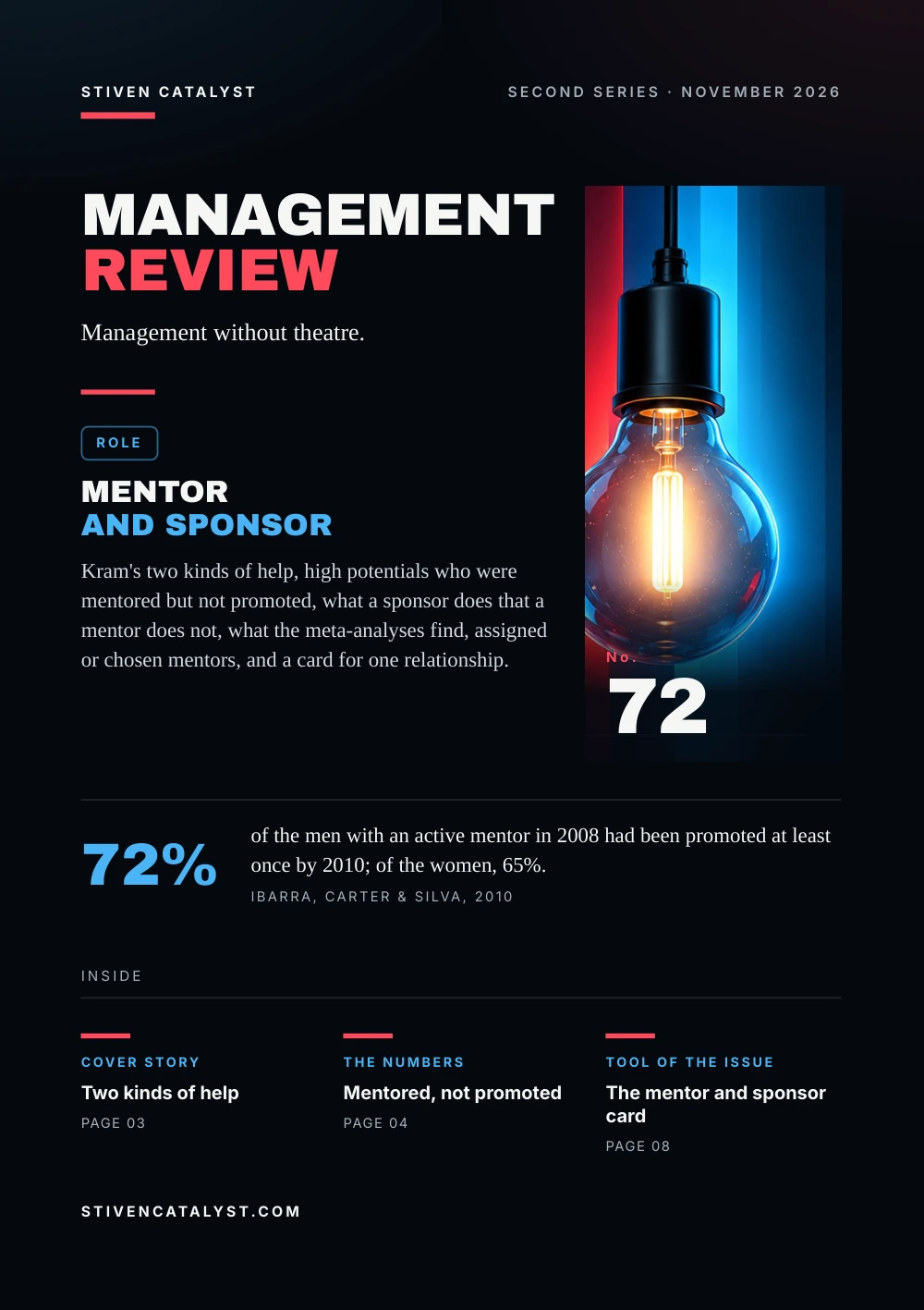
Stiven CatalystSecond series · November 2026
ManagementReview
Management without theatre.
Role
Mentorand sponsor
Kram's two kinds of help, high potentials who were mentored but not promoted, what a sponsor does that a mentor does not, what the meta-analyses find, assigned or chosen mentors, and a card for one relationship.

No.72
72%
of the men with an active mentor in 2008 had been promoted at least once by 2010; of the women, 65%.Ibarra, Carter & Silva, 2010
stivencatalyst.com
No. 72 · Role
In this issue
Most people who move up can name someone who helped them. Two kinds of help are often mixed up: a mentor talks with you about your work, a sponsor talks about you where decisions are made. This issue separates the two and asks what each is worth.
- 03Cover storyTwo kinds of help
- 04The numbersMentored, not promoted
- 05The modelMentor and sponsor
- 06What the research saysWhat mentoring is worth
- 07How it is measuredAssigned or chosen
- 08Tool of the issueThe mentor and sponsor card
- 09SourcesSources and method
How to read this issue
Figure
Every figure has its source and year at the foot of its page.
Our reading
Where the editors interpret rather than the research, it says so.
Practice
The steps and the card are proposals to try, not research results.
Cover story
Two kindsof help
Kathy Kram studied 18 pairs of junior and senior managers in mentoring relationships, and in Mentoring at Work (1985) she sorted what mentors do into two groups: help with the career, and help with the person.
Career functions
- Sponsorship
- Exposure and visibility
- Coaching
- Protection
- Challenging assignments
Psychosocial functions
- Role modelling
- Acceptance and confirmation
- Counselling
- Friendship
Twenty-five years later, Herminia Ibarra, Nancy Carter and Christine Silva met a senior marketing manager who had been matched with a high-level mentor and invited to a programme for high potentials:
“I'd been here for 12 years, and nothing happened. Now I am being mentored to death.”
Our reading
A mentor talks with you. A sponsor talks about you, in rooms you are not in.
Sources: Kathy E. Kram, Scott, Foresman, 1985 (via Kram & Isabella, 1985; Allen et al., 2004; Ibarra, Carter & Silva, 2010); Kathy E. Kram & Lynn A. Isabella, Academy of Management Journal 28(1), 1985; Herminia Ibarra, Nancy M. Carter & Christine Silva, Harvard Business Review, 2010 (via Full text in a reprint of the article hosted by BIO (bio.org))
The functions as Kram and Isabella list them (1985); the 18 pairs are Kram's earlier interview study. We could not see the book itself. The authors disguised the manager's name.
The numbers
Ment ored,not promoted
In 2008 Catalyst surveyed more than 4,000 high potentials who had graduated from top MBA programmes worldwide between 1996 and 2007. In 2010 it asked the same group about promotions since.
High potentials in the Catalyst surveys, 2008 and 2010
The women's mentors were less senior, even allowing for their lower starting posts, and the more senior the mentor, the faster the advancement. Both made as many lateral moves, but the men were promoted after them. By 2010 the men had 15% more promotions.
Our reading
More advice did not close the gap. What was missing was someone senior to vouch for them.
Source: Herminia Ibarra, Nancy M. Carter & Christine Silva, Harvard Business Review, 2010 (via Full text in a reprint of the article hosted by BIO (bio.org))
Self-reports; rows two and three cover those with an active mentor in 2008. A survey shows links, not causes; mentoring predicted promotion for the men, not for the women.
The model
Ment orand sponsor
Ibarra and her co-authors define sponsorship as a relationship in which the mentor goes beyond feedback and advice and uses influence with senior executives to advocate for the person. In Kram's terms it is one of five career functions; the authors found it was what the women lacked.
Mentors
- can sit at any level
- give support, feedback and advice
- serve as role models
- help read company politics
Sponsors
- are senior and have influence
- introduce you to other executives
- put your name forward for openings
- fight for your promotion
The four phases of a mentoring relationship (Kram)
- 01
Initiation
- 02
Cultivation
- 03
Separation
- 04
Redefinition
Our reading
A sponsor lends you a reputation. It is earned with what they have seen you do, not with a title you once held.
Sources: Herminia Ibarra, Nancy M. Carter & Christine Silva, Harvard Business Review, 2010 (via Full text in a reprint of the article hosted by BIO (bio.org)); Kathy E. Kram & Lynn A. Isabella, Academy of Management Journal 28(1), 1985
The two lists shorten the table in Ibarra et al. (2010). The phases follow Kram (1983) as Kram and Isabella summarise them: in cultivation the help is at its widest; after separation, much of it stops.
More in the essayStarting from zero after you have led people and a business
What the research says
What ment oringis wor th
Tammy Allen and colleagues pooled the studies on what mentoring brings the person mentored. The benefits held up, but effects on pay and promotion were small.
Correlation with each outcome, weighted mean r
In 2008 Lillian Eby and colleagues pooled 116 samples from youth, school and workplace mentoring: many outcomes were better, but the effects were generally small.
Our reading
Support makes people like their mentor. Pay and promotion move, a little, with the career help.
Sources: Tammy D. Allen, Lillian T. Eby, Mark L. Poteet, Elizabeth Lentz & Lizzette Lima, Journal of Applied Psychology 89(1), 2004; Lillian T. Eby, Tammy D. Allen, Sarah C. Evans, Thomas Ng & David L. DuBois, Journal of Vocational Behavior 72(2), 2008
r runs from 0 (no link) to 1; Eby et al. count 0.10 to 0.23 as small. Mostly surveys at one point in time: they show links, not causes.
How it is measured
Assignedor chosen
Belle Rose Ragins and John Cotton asked US engineers, social workers and journalists about their mentors and counted promotions over ten years. Of 1,162 respondents, 44% had an informal mentor, 9% a formal one and 47% none.
Promotions in ten years, on average (1999)
Only those with informal mentors were promoted significantly more, and earned more, than people without one; those with assigned mentors did not differ from them. In formal programmes, Allen, Eby and Lentz (2006) found two features linked with better mentoring: a say in the process, and training judged good.
Our reading
A programme can arrange the meeting. It cannot arrange the sponsor's interest in you; that has to be earned.
Sources: Belle Rose Ragins & John L. Cotton, Journal of Applied Psychology 84(4), 1999; Tammy D. Allen, Lillian T. Eby & Elizabeth Lentz, Journal of Applied Psychology 91(3), 2006 (via Abstract at USF Digital Commons)
A promotion counted with at least two of: a significant raise, wider responsibility, a higher level, eligibility for bonuses. The authors warn of selection: people who find mentors themselves may be stronger to begin with.
Tool of the issue
The ment or andsponsor card
One card per relationship. Write down which help you are asking for, advice or a word in the right room, and when you will check that it came. When a name is put forward, the CV has to be ready.
01The goalone: a skill, a role, a move within a year
02What the mentor givesadvice, feedback, an example: which, and on what
03What the sponsor riskswhose name, in front of whom, and what they have seen you do
04The next opportunitya role, a project or a meeting, and who decides it
05How oftenwhen you meet, and who asks for the meeting
06Review datewhat has opened, and whether to go on, change or end
Sources: Herminia Ibarra, Nancy M. Carter & Christine Silva, Harvard Business Review, 2010 (via Full text in a reprint of the article hosted by BIO (bio.org)); Kathy E. Kram & Lynn A. Isabella, Academy of Management Journal 28(1), 1985; Tammy D. Allen, Lillian T. Eby & Elizabeth Lentz, Journal of Applied Psychology 91(3), 2006 (via Abstract at USF Digital Commons)
A practice proposed by the editors, after the mentor and sponsor roles in Ibarra et al. (2010), Kram's phases and the say in the process that Allen, Eby and Lentz (2006) found mattered.
Open the tool: CV Builderstivencatalyst.com/tools/cv-builder/
Sources and method
Every figurehas a source.
The figures in this issue come from the sources below. The year shows how recent each one is.
- Mentoring at Work: Developmental Relationships in Organizational LifeKathy E. Kram, Scott, Foresman, 1985 · via Kram & Isabella, 1985; Allen et al., 2004; Ibarra, Carter & Silva, 2010
- Mentoring Alternatives: The Role of Peer Relationships in Career DevelopmentKathy E. Kram & Lynn A. Isabella, Academy of Management Journal 28(1), 1985https://doi.org/10.5465/256064
- Why Men Still Get More Promotions Than WomenHerminia Ibarra, Nancy M. Carter & Christine Silva, Harvard Business Review, 2010 · via Full text in a reprint of the article hosted by BIO (bio.org)https://hbr.org/2010/09/why-men-still-get-more-promotions-than-women
- Career Benefits Associated With Mentoring for Protégés: A Meta-AnalysisTammy D. Allen, Lillian T. Eby, Mark L. Poteet, Elizabeth Lentz & Lizzette Lima, Journal of Applied Psychology 89(1), 2004https://doi.org/10.1037/0021-9010.89.1.127
- Does Mentoring Matter? A Multidisciplinary Meta-Analysis Comparing Mentored and Non-Mentored IndividualsLillian T. Eby, Tammy D. Allen, Sarah C. Evans, Thomas Ng & David L. DuBois, Journal of Vocational Behavior 72(2), 2008https://doi.org/10.1016/j.jvb.2007.04.005
- Mentor Functions and Outcomes: A Comparison of Men and Women in Formal and Informal Mentoring RelationshipsBelle Rose Ragins & John L. Cotton, Journal of Applied Psychology 84(4), 1999https://doi.org/10.1037/0021-9010.84.4.529
- Mentorship Behaviors and Mentorship Quality Associated With Formal Mentoring Programs: Closing the Gap Between Research and PracticeTammy D. Allen, Lillian T. Eby & Elizabeth Lentz, Journal of Applied Psychology 91(3), 2006 · via Abstract at USF Digital Commonshttps://doi.org/10.1037/0021-9010.91.3.567
Editorial method
Each figure was checked for its year, its publisher and what exactly it measures. Where the publisher's page could not be opened, the figure was checked against independent summaries and is marked “via”. The editors' interpretation is marked “Our reading”. Figures that could not be confirmed are not in the issue.
ManagementReview
Management without theatre.
Every issue, one management question, checked against the best research.
All issues
stivencatalyst.com/magazine/management-review.html
Management Review · No. 72 · November 2026 · Stiven Catalyst
Click or swipe a page to turn it. The arrow keys work too.
Management Review · No. 72
The figures of the issue
The charts of the printed pages, with their sources.
Source: Herminia Ibarra, Nancy M. Carter & Christine Silva, Harvard Business Review, 2010 (via Full text in a reprint of the article hosted by BIO (bio.org))
Source: Tammy D. Allen, Lillian T. Eby, Mark L. Poteet, Elizabeth Lentz & Lizzette Lima, Journal of Applied Psychology 89(1), 2004
Source: Belle Rose Ragins & John L. Cotton, Journal of Applied Psychology 84(4), 1999
The whole text Read the issue as text For reading on a small screen, searching or a screen reader. The same words, without the page design.
In this issue
Most people who move up can name someone who helped them. Two kinds of help are often mixed up: a mentor talks with you about your work, a sponsor talks about you where decisions are made. This issue separates the two and asks what each is worth.
Kathy Kram described what mentors give: career help, sponsorship among it, and personal support. In a Catalyst survey of more than 4,000 high potentials, more women than men had mentors, yet fewer of the mentored women were promoted. Two meta-analyses find mentoring linked with better careers, but with small effects on pay and promotion. People who found their mentors themselves did better than those who were assigned one, and in formal programmes a say in the process and good training made a difference.
Stiven Janaqi, Editor
Cover story
Two kinds of help
Kathy Kram studied 18 pairs of junior and senior managers in mentoring relationships, and in Mentoring at Work (1985) she sorted what mentors do into two groups: help with the career, and help with the person.
Career functions
- Sponsorship
- Exposure and visibility
- Coaching
- Protection
- Challenging assignments
Psychosocial functions
- Role modelling
- Acceptance and confirmation
- Counselling
- Friendship
Twenty-five years later, Herminia Ibarra, Nancy Carter and Christine Silva met a senior marketing manager who had been matched with a high-level mentor and invited to a programme for high potentials:
I'd been here for 12 years, and nothing happened. Now I am being mentored to death.
Our reading
A mentor talks with you. A sponsor talks about you, in rooms you are not in.
The functions as Kram and Isabella list them (1985); the 18 pairs are Kram's earlier interview study. We could not see the book itself. The authors disguised the manager's name.
Sources: Kathy E. Kram, Scott, Foresman, 1985 (via Kram & Isabella, 1985; Allen et al., 2004; Ibarra, Carter & Silva, 2010); Kathy E. Kram & Lynn A. Isabella, Academy of Management Journal 28(1), 1985; Herminia Ibarra, Nancy M. Carter & Christine Silva, Harvard Business Review, 2010 (via Full text in a reprint of the article hosted by BIO (bio.org))
The numbers
Ment ored, not promoted
In 2008 Catalyst surveyed more than 4,000 high potentials who had graduated from top MBA programmes worldwide between 1996 and 2007. In 2010 it asked the same group about promotions since.
High potentials in the Catalyst surveys, 2008 and 2010: Had at least one mentor in their career: Men 76%, Women 83%; Mentor was the CEO or a senior executive: Men 78%, Women 69%; Mentored in 2008, promoted by 2010: Men 72%, Women 65%.
The women's mentors were less senior, even allowing for their lower starting posts, and the more senior the mentor, the faster the advancement. Both made as many lateral moves, but the men were promoted after them. By 2010 the men had 15% more promotions.
Our reading
More advice did not close the gap. What was missing was someone senior to vouch for them.
Self-reports; rows two and three cover those with an active mentor in 2008. A survey shows links, not causes; mentoring predicted promotion for the men, not for the women.
Source: Herminia Ibarra, Nancy M. Carter & Christine Silva, Harvard Business Review, 2010 (via Full text in a reprint of the article hosted by BIO (bio.org))
The model
Ment or and sponsor
Ibarra and her co-authors define sponsorship as a relationship in which the mentor goes beyond feedback and advice and uses influence with senior executives to advocate for the person. In Kram's terms it is one of five career functions; the authors found it was what the women lacked.
Ment ors
- can sit at any level
- give support, feedback and advice
- serve as role models
- help read company politics
Sponsors
- are senior and have influence
- introduce you to other executives
- put your name forward for openings
- fight for your promotion
The four phases of a ment oring relationship (Kram)
- Initiation.
- Cultivation.
- Separation.
- Redefinition.
Our reading
A sponsor lends you a reputation. It is earned with what they have seen you do, not with a title you once held.
The two lists shorten the table in Ibarra et al. (2010). The phases follow Kram (1983) as Kram and Isabella summarise them: in cultivation the help is at its widest; after separation, much of it stops.
Sources: Herminia Ibarra, Nancy M. Carter & Christine Silva, Harvard Business Review, 2010 (via Full text in a reprint of the article hosted by BIO (bio.org)); Kathy E. Kram & Lynn A. Isabella, Academy of Management Journal 28(1), 1985
More in the essay: Starting from zero after you have led people and a business
What the research says
What ment oring is wor th
Tammy Allen and colleagues pooled the studies on what mentoring brings the person mentored. The benefits held up, but effects on pay and promotion were small.
Correlation with each outcome, weighted mean r: Promotions: Career mentoring 0.10, Psychosocial 0.06; Pay: Career mentoring 0.08, Psychosocial 0.04; Career satisfaction: Career mentoring 0.29, Psychosocial 0.25; Satisfaction with the mentor: Career mentoring 0.37, Psychosocial 0.62.
In 2008 Lillian Eby and colleagues pooled 116 samples from youth, school and workplace mentoring: many outcomes were better, but the effects were generally small.
Our reading
Support makes people like their mentor. Pay and promotion move, a little, with the career help.
r runs from 0 (no link) to 1; Eby et al. count 0.10 to 0.23 as small. Mostly surveys at one point in time: they show links, not causes.
Sources: Tammy D. Allen, Lillian T. Eby, Mark L. Poteet, Elizabeth Lentz & Lizzette Lima, Journal of Applied Psychology 89(1), 2004; Lillian T. Eby, Tammy D. Allen, Sarah C. Evans, Thomas Ng & David L. DuBois, Journal of Vocational Behavior 72(2), 2008
How it is measured
Assigned or chosen
Belle Rose Ragins and John Cotton asked US engineers, social workers and journalists about their mentors and counted promotions over ten years. Of 1,162 respondents, 44% had an informal mentor, 9% a formal one and 47% none.
Promotions in ten years, on average (1999): No mentor 1.78, Assigned mentor 2.04, Self-found mentor 2.55.
Only those with informal mentors were promoted significantly more, and earned more, than people without one; those with assigned mentors did not differ from them. In formal programmes, Allen, Eby and Lentz (2006) found two features linked with better mentoring: a say in the process, and training judged good.
Our reading
A programme can arrange the meeting. It cannot arrange the sponsor's interest in you; that has to be earned.
A promotion counted with at least two of: a significant raise, wider responsibility, a higher level, eligibility for bonuses. The authors warn of selection: people who find mentors themselves may be stronger to begin with.
Sources: Belle Rose Ragins & John L. Cotton, Journal of Applied Psychology 84(4), 1999; Tammy D. Allen, Lillian T. Eby & Elizabeth Lentz, Journal of Applied Psychology 91(3), 2006 (via Abstract at USF Digital Commons)
Tool of the issue
The ment or and sponsor card
One card per relationship. Write down which help you are asking for, advice or a word in the right room, and when you will check that it came. When a name is put forward, the CV has to be ready.
- The goal one: a skill, a role, a move within a year
- What the men
t or gives advice, feedback, an example: which, and on what - What the sponsor risks whose name, in front of whom, and what they have seen you do
- The next oppo
r tunit y a role, a project or a meeting, and who decides it - How o
f ten when you meet, and who asks for the meeting - Review date what has opened, and whether to go on, change or end
A practice proposed by the editors, after the mentor and sponsor roles in Ibarra et al. (2010), Kram's phases and the say in the process that Allen, Eby and Lentz (2006) found mattered.
Sources: Herminia Ibarra, Nancy M. Carter & Christine Silva, Harvard Business Review, 2010 (via Full text in a reprint of the article hosted by BIO (bio.org)); Kathy E. Kram & Lynn A. Isabella, Academy of Management Journal 28(1), 1985; Tammy D. Allen, Lillian T. Eby & Elizabeth Lentz, Journal of Applied Psychology 91(3), 2006 (via Abstract at USF Digital Commons)
Open the tool: CV Builder
Sources and method
Every figure has a source.
The figures in this issue come from the sources below. The year shows how recent each one is.
- Kathy E. Kram, Scott, Foresman, “Mentoring at Work: Developmental Relationships in Organizational Life”, 1985 (via Kram & Isabella, 1985; Allen et al., 2004; Ibarra, Carter & Silva, 2010).
- Kathy E. Kram & Lynn A. Isabella, Academy of Management Journal 28(1), “Mentoring Alternatives: The Role of Peer Relationships in Career Development”, 1985. https://doi.org/10.5465/256064
- Herminia Ibarra, Nancy M. Carter & Christine Silva, Harvard Business Review, “Why Men Still Get More Promotions Than Women”, 2010 (via Full text in a reprint of the article hosted by BIO (bio.org)). https://hbr.org/2010/09/why-men-still-get-more-promotions-than-women
- Tammy D. Allen, Lillian T. Eby, Mark L. Poteet, Elizabeth Lentz & Lizzette Lima, Journal of Applied Psychology 89(1), “Career Benefits Associated With Mentoring for Protégés: A Meta-Analysis”, 2004. https://doi.org/10.1037/0021-9010.89.1.127
- Lillian T. Eby, Tammy D. Allen, Sarah C. Evans, Thomas Ng & David L. DuBois, Journal of Vocational Behavior 72(2), “Does Mentoring Matter? A Multidisciplinary Meta-Analysis Comparing Mentored and Non-Mentored Individuals”, 2008. https://doi.org/10.1016/j.jvb.2007.04.005
- Belle Rose Ragins & John L. Cotton, Journal of Applied Psychology 84(4), “Mentor Functions and Outcomes: A Comparison of Men and Women in Formal and Informal Mentoring Relationships”, 1999. https://doi.org/10.1037/0021-9010.84.4.529
- Tammy D. Allen, Lillian T. Eby & Elizabeth Lentz, Journal of Applied Psychology 91(3), “Mentorship Behaviors and Mentorship Quality Associated With Formal Mentoring Programs: Closing the Gap Between Research and Practice”, 2006 (via Abstract at USF Digital Commons). https://doi.org/10.1037/0021-9010.91.3.567
Edit orial me thod
Each figure was checked for its year, its publisher and what exactly it measures. Where the publisher's page could not be opened, the figure was checked against independent summaries and is marked “via”. The editors' interpretation is marked “Our reading”. Figures that could not be confirmed are not in the issue.
Management Review · Monthly edition