In 2001 Jason Colquitt showed that people tell apart four kinds of justice: of the outcome, of the process, of respect and of explanation. A meta-analysis of 183 studies found that the last two shape above all how people rate their boss. Gerald Leventhal named six rules for a fair process, and 45 samples show that process counts most when the outcome is bad. In four hospitals, nurses whose pay was cut slept better when their supervisors had been trained in fair treatment.
Management Review · Second series · November 2026 · No. 70
Organisational justice
Four kinds of fairness and how they were told apart, what 183 studies tie to the boss and to the organisation, Leventhal's six rules for a fair process, nurses who slept better when their supervisors were trained, twenty questions, and a card for one decision.
- No.
- 70
- Pages
- 10
- Sources
- 8
- Topics
- People
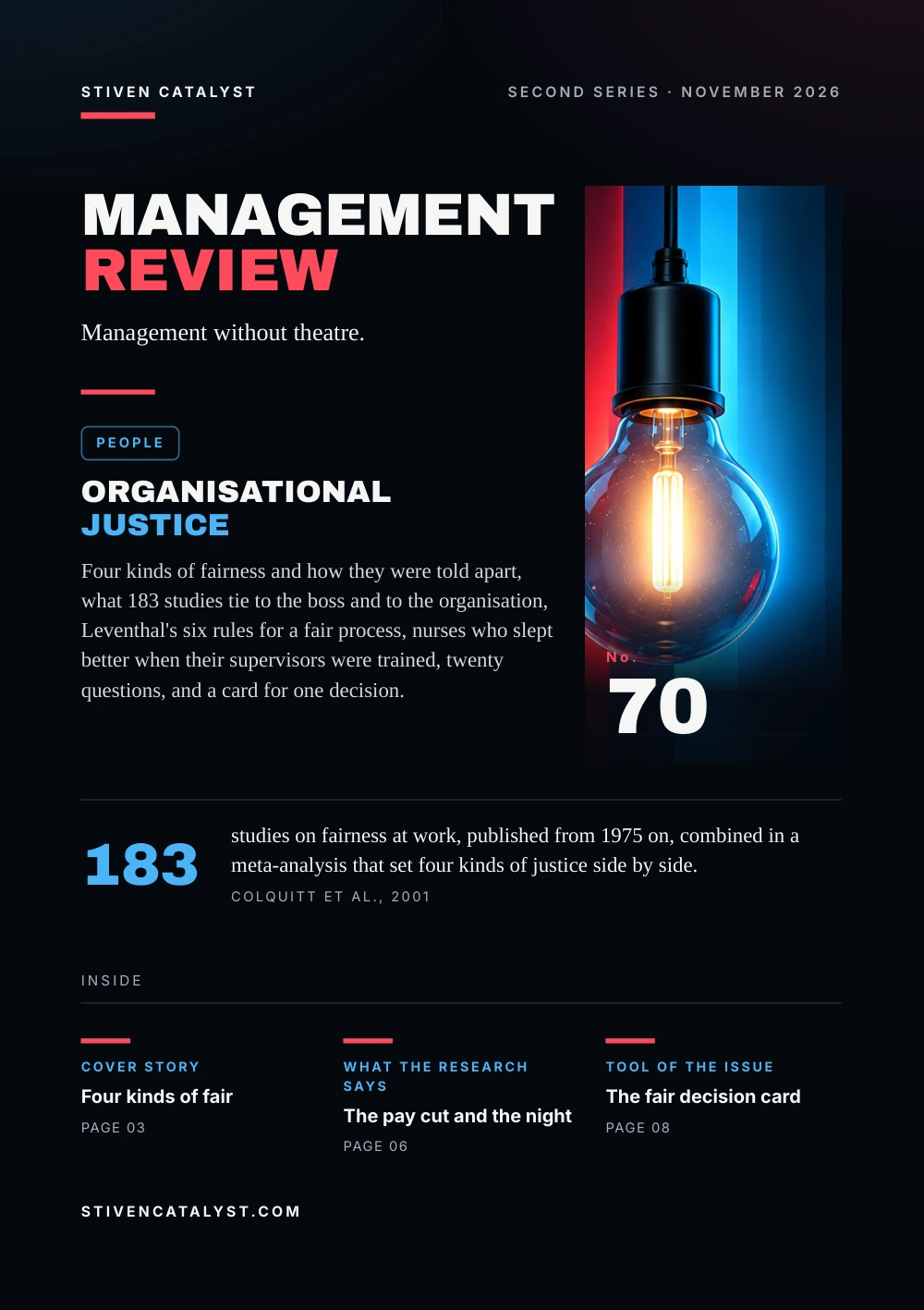
Stiven CatalystSecond series · November 2026
ManagementReview
Management without theatre.
People
Organisationaljustice
Four kinds of fairness and how they were told apart, what 183 studies tie to the boss and to the organisation, Leventhal's six rules for a fair process, nurses who slept better when their supervisors were trained, twenty questions, and a card for one decision.

No.70
183
studies on fairness at work, published from 1975 on, combined in a meta-analysis that set four kinds of justice side by side.Colquitt et al., 2001
stivencatalyst.com
No. 70 · People
In this issue
People judge more than what they get. They judge how it was decided, how they were treated and what they were told. This issue is about those four judgements, what research ties to them, and how a manager can check a decision against them before it is announced.
- 03Cover storyFour kinds of fair
- 04The numbersThe boss or the organisation
- 05The modelSix rules for a fair process
- 06What the research saysThe pay cut and the night
- 07How it is measuredTwenty questions
- 08Tool of the issueThe fair decision card
- 09SourcesSources and method
How to read this issue
Figure
Every figure has its source and year at the foot of its page.
Our reading
Where the editors interpret rather than the research, it says so.
Practice
The steps and the card are proposals to try, not research results.
Cover story
Four kindsof fair
In 2001 Jason Colquitt wrote questions for each kind of justice the research had described and tested them twice, with students at a university and with staff of a car parts maker. Four separate factors fitted the answers better than two or three broader ones.
01
Distributive: the outcome
Does what I get match what I put in? Adams, 1965
02
Procedural: the process
Was it decided by fair rules, with a voice? Thibaut & Walker, 1975; Leventhal, 1980
03
Interpersonal: respect
Was I treated with politeness, dignity and respect? Bies & Moag, 1986
04
Informational: explanation
Was I told why, candidly and in time? Greenberg, 1993
In 1990 Jerald Greenberg described the field as a literature “grown around attempts to describe and explain the role of fairness as a consideration in the workplace”. Bies and Moag had called the last two together interactional justice; Greenberg proposed splitting them, and Colquitt's data agreed.
Our reading
A decision can be fair in one way and unfair in three. People notice all four.
Sources: Jason A. Colquitt, Journal of Applied Psychology 86(3), 2001 (via Abstract at PubMed; items as reproduced by Díaz-Gracia et al., 2014); Jerald Greenberg, Journal of Management 16(2), 1990 (via Abstract; quoted in Colquitt et al., 2001); Jason A. Colquitt, Donald E. Conlon, Michael J. Wesson, Christopher O.L.H. Porter & K. Yee Ng, Journal of Applied Psychology 86(3), 2001
Justice here means perceived fairness, as the people affected judge it. The years name the works that introduced each idea, as cited by Colquitt et al. (2001); we have not read those works themselves.
The numbers
The boss orthe organisation
Jason Colquitt and four colleagues combined 183 studies from 1975 on. Bies and Moag had expected respect and explanation to shape how people see their boss, and process how they see the organisation. Corrected correlations:
Correlation with commitment to the organisation and with the rating of the boss, 2001
Respect and explanation went with the rating of the boss far more than with commitment. Among 6,442 British civil servants followed for 8.7 years, men reporting high justice at work had a lower risk of heart disease (hazard ratio 0.65).
Our reading
The organisation writes the procedure. The team judges the person who delivers it.
Sources: Jason A. Colquitt, Donald E. Conlon, Michael J. Wesson, Christopher O.L.H. Porter & K. Yee Ng, Journal of Applied Psychology 86(3), 2001; Mika Kivimäki, Jane E. Ferrie, Eric Brunner, Jenny Head, Martin J. Shipley, Jussi Vahtera & Michael G. Marmot, Archives of Internal Medicine 165(19), 2005 (via Abstract at PubMed)
Mostly self-reports, which can inflate the links. Respect and commitment: only two studies. The heart study shows a link, not a cause.
The model
Six rules fora fair process
Thibaut and Walker found in 1975 that people in disputes accept losing control over the decision as long as they keep control over the process: time to make their case. In 1980 Gerald Leventhal widened the idea into six rules a procedure should meet to be seen as fair.
01
Consistent
the same for everyone and over time
02
Free of bias
no one deciding has a stake in the result
03
Accurate
based on correct information
04
Correctable
a way to fix a wrong decision
05
Ethical
in line with standards of ethics
06
Representative
the views of those affected are heard
Joel Brockner and Batia Wiesenfeld reviewed 45 samples in 1996: the process mattered most to people's reactions when the outcome was poor or felt unfair, and the outcome mattered most when the process was poor.
Our reading
When you cannot give people the outcome they want, the process is what you still control.
Sources: Jason A. Colquitt, Donald E. Conlon, Michael J. Wesson, Christopher O.L.H. Porter & K. Yee Ng, Journal of Applied Psychology 86(3), 2001; Joel Brockner & Batia M. Wiesenfeld, Psychological Bulletin 120(2), 1996 (via Abstract at PubMed)
Thibaut and Walker studied legal disputes; Leventhal carried the idea into organisations. Both are summarised from Colquitt et al. (2001); the short labels of the rules are ours.
More in the essayLeading people without losing the person
What the research says
The pay cutand the night
Jerald Greenberg followed 467 nurses in four US hospitals of one group. At two, a new pay system cut pay by about 10%. At one hospital in each pair, supervisors had two four-hour sessions on fair treatment: dignity and respect, and full, accurate explanations.
PaySupervisors trained
Cut, no training
Insomnia fell only a little; six months on, still clearly above all others.
pay cut · not trainedCut, training
Insomnia fell steeply within four weeks; six months on, only slightly above no cut.
pay cut · trainedUnchanged
Less insomnia than with a cut.
pay unchanged · not trainedUnchanged
Less insomnia than with a cut.
pay unchanged · trainedAfter the cut, insomnia rose to about 6 on a 7-point scale, roughly double. The training was “nothing magical”, Greenberg said. A 2013 meta-analysis of 493 samples links justice to performance and helping, through trust and commitment.
Our reading
Fair treatment did not undo the cut. It changed how hard it hit.
Sources: Jerald Greenberg, Journal of Applied Psychology 91(1), 2006 (via Abstract at PubMed; Ohio State University news release, 2006); Jason A. Colquitt, Brent A. Scott, Jessica B. Rodell, David M. Long, Cindy P. Zapata, Donald E. Conlon & Michael J. Wesson, Journal of Applied Psychology 98(2), 2013 (via Abstract at PubMed)
Self-reported insomnia, and one hospital for each condition. The figures for the scale come from the university's 2006 news release; the abstract confirms the design and the direction.
How it is measured
Twent yquestions
Colquitt's measure asks about one outcome, the procedure behind it and the person who carried it out. Each of the 20 questions is answered from 1, “to a small extent”, to 5, “to a large extent”. It has since been tested in other languages, Spanish among them.
01
Outcome · 4 questions
Does it reflect the effort you put in? Is it justified, given your performance?
02
Process · 7 questions
Could you express your views? Were the procedures consistent? Could you appeal?
03
Respect · 4 questions
Were you treated with dignity? Did they refrain from improper remarks?
04
Explanation · 5 questions
Were they candid? Did they explain the procedures thoroughly? Did details come in time?
Hypothetical example, a team after a new holiday rota
- Outcome
- 3.4 of 5
- Process · respect
- 2.6 · 4.1
- Explanation
- 2.2 of 5
The team felt respected, but no one heard why the rota changed or how to object. The numbers are invented.
Sources: Jason A. Colquitt, Journal of Applied Psychology 86(3), 2001 (via Abstract at PubMed; items as reproduced by Díaz-Gracia et al., 2014); Liliana Díaz-Gracia, Claudio Barbaranelli & Bernardo Moreno-Jiménez, Psicothema 26(4), 2014
The questions are shortened from Colquitt (2001), as reproduced in the Spanish validation (2014); the translations are ours. Ask anonymously and read the four scores apart.
Tool of the issue
The fairdecision card
One decision that affects people: a rota, a bonus, a promotion, a new rule. Fill in the card before you announce it, and once more a week later, with what you heard back.
01The decisionwhat changes, for whom, from when
02Outcomewhich rule: contribution, equal shares or need; who gains, who loses
03Processwho was heard; same rule for all; facts checked; how to appeal
04Respectwho tells whom, where, in what words
05Explanationthe real reasons, candidly, before people hear it elsewhere
06A week laterwhat came back; what we corrected
Sources: Jason A. Colquitt, Journal of Applied Psychology 86(3), 2001 (via Abstract at PubMed; items as reproduced by Díaz-Gracia et al., 2014); Jason A. Colquitt, Donald E. Conlon, Michael J. Wesson, Christopher O.L.H. Porter & K. Yee Ng, Journal of Applied Psychology 86(3), 2001
A practice proposed by the editors, after Colquitt's four dimensions and Leventhal's rules. The KPI Diagnostic helps with a related question: whether a missed result comes from clarity, skill, capacity, process or ownership.
Open the tool: KPI Diagnosticstivencatalyst.com/tools/kpi-diagnostic/
Sources and method
Every figurehas a source.
The figures in this issue come from the sources below. The year shows how recent each one is.
- On the dimensionality of organizational justice: A construct validation of a measureJason A. Colquitt, Journal of Applied Psychology 86(3), 2001 · via Abstract at PubMed; items as reproduced by Díaz-Gracia et al., 2014https://doi.org/10.1037/0021-9010.86.3.386
- Organizational justice: Yesterday, today, and tomorrowJerald Greenberg, Journal of Management 16(2), 1990 · via Abstract; quoted in Colquitt et al., 2001https://doi.org/10.1177/014920639001600208
- Justice at the millennium: A meta-analytic review of 25 years of organizational justice researchJason A. Colquitt, Donald E. Conlon, Michael J. Wesson, Christopher O.L.H. Porter & K. Yee Ng, Journal of Applied Psychology 86(3), 2001https://doi.org/10.1037/0021-9010.86.3.425
- Justice at work and reduced risk of coronary heart disease among employees: The Whitehall II StudyMika Kivimäki, Jane E. Ferrie, Eric Brunner, Jenny Head, Martin J. Shipley, Jussi Vahtera & Michael G. Marmot, Archives of Internal Medicine 165(19), 2005 · via Abstract at PubMedhttps://doi.org/10.1001/archinte.165.19.2245
- An integrative framework for explaining reactions to decisions: Interactive effects of outcomes and proceduresJoel Brockner & Batia M. Wiesenfeld, Psychological Bulletin 120(2), 1996 · via Abstract at PubMedhttps://doi.org/10.1037/0033-2909.120.2.189
- Losing sleep over organizational injustice: Attenuating insomniac reactions to underpayment inequity with supervisory training in interactional justiceJerald Greenberg, Journal of Applied Psychology 91(1), 2006 · via Abstract at PubMed; Ohio State University news release, 2006https://doi.org/10.1037/0021-9010.91.1.58
- Justice at the millennium, a decade later: A meta-analytic test of social exchange and affect-based perspectivesJason A. Colquitt, Brent A. Scott, Jessica B. Rodell, David M. Long, Cindy P. Zapata, Donald E. Conlon & Michael J. Wesson, Journal of Applied Psychology 98(2), 2013 · via Abstract at PubMedhttps://doi.org/10.1037/a0031757
- Spanish version of Colquitt's Organizational Justice ScaleLiliana Díaz-Gracia, Claudio Barbaranelli & Bernardo Moreno-Jiménez, Psicothema 26(4), 2014https://doi.org/10.7334/psicothema2014.110
Editorial method
Each figure was checked for its year, its publisher and what exactly it measures. Where the publisher's page could not be opened, the figure was checked against independent summaries and is marked “via”. The editors' interpretation is marked “Our reading”. Figures that could not be confirmed are not in the issue.
ManagementReview
Management without theatre.
Every issue, one management question, checked against the best research.
All issues
stivencatalyst.com/magazine/management-review.html
Management Review · No. 70 · November 2026 · Stiven Catalyst
Click or swipe a page to turn it. The arrow keys work too.
Management Review · No. 70
The figures of the issue
The charts of the printed pages, with their sources.
Source: Jason A. Colquitt, Donald E. Conlon, Michael J. Wesson, Christopher O.L.H. Porter & K. Yee Ng, Journal of Applied Psychology 86(3), 2001
The whole text Read the issue as text For reading on a small screen, searching or a screen reader. The same words, without the page design.
In this issue
People judge more than what they get. They judge how it was decided, how they were treated and what they were told. This issue is about those four judgements, what research ties to them, and how a manager can check a decision against them before it is announced.
In 2001 Jason Colquitt showed that people tell apart four kinds of justice: of the outcome, of the process, of respect and of explanation. A meta-analysis of 183 studies found that the last two shape above all how people rate their boss. Gerald Leventhal named six rules for a fair process, and 45 samples show that process counts most when the outcome is bad. In four hospitals, nurses whose pay was cut slept better when their supervisors had been trained in fair treatment.
Stiven Janaqi, Editor
Cover story
Four kinds of fair
In 2001 Jason Colquitt wrote questions for each kind of justice the research had described and tested them twice, with students at a university and with staff of a car parts maker. Four separate factors fitted the answers better than two or three broader ones.
- Distributive: the ou
t come. Does what I get match what I put in? Adams, 1965 - Procedural: the process. Was it decided by fair rules, with a voice? Thibaut & Walker, 1975; Leventhal, 1980
- Interpersonal: respect. Was I treated with politeness, dignity and respect? Bies & Moag, 1986
- Informational: explanation. Was I told why, candidly and in time? Greenberg, 1993
In 1990 Jerald Greenberg described the field as a literature “grown around attempts to describe and explain the role of fairness as a consideration in the workplace”. Bies and Moag had called the last two together interactional justice; Greenberg proposed splitting them, and Colquitt's data agreed.
Our reading
A decision can be fair in one way and unfair in three. People notice all four.
Justice here means perceived fairness, as the people affected judge it. The years name the works that introduced each idea, as cited by Colquitt et al. (2001); we have not read those works themselves.
Sources: Jason A. Colquitt, Journal of Applied Psychology 86(3), 2001 (via Abstract at PubMed; items as reproduced by Díaz-Gracia et al., 2014); Jerald Greenberg, Journal of Management 16(2), 1990 (via Abstract; quoted in Colquitt et al., 2001); Jason A. Colquitt, Donald E. Conlon, Michael J. Wesson, Christopher O.L.H. Porter & K. Yee Ng, Journal of Applied Psychology 86(3), 2001
The numbers
The boss or the organisation
Jason Colquitt and four colleagues combined 183 studies from 1975 on. Bies and Moag had expected respect and explanation to shape how people see their boss, and process how they see the organisation. Corrected correlations:
Correlation with commitment to the organisation and with the rating of the boss, 2001: Process: Commitment 0.57, Rating of the boss 0.64; Outcome: Commitment 0.51, Rating of the boss 0.59; Respect: Commitment 0.19, Rating of the boss 0.62; Explanation: Commitment 0.29, Rating of the boss 0.65.
Respect and explanation went with the rating of the boss far more than with commitment. Among 6,442 British civil servants followed for 8.7 years, men reporting high justice at work had a lower risk of heart disease (hazard ratio 0.65).
Our reading
The organisation writes the procedure. The team judges the person who delivers it.
Mostly self-reports, which can inflate the links. Respect and commitment: only two studies. The heart study shows a link, not a cause.
Sources: Jason A. Colquitt, Donald E. Conlon, Michael J. Wesson, Christopher O.L.H. Porter & K. Yee Ng, Journal of Applied Psychology 86(3), 2001; Mika Kivimäki, Jane E. Ferrie, Eric Brunner, Jenny Head, Martin J. Shipley, Jussi Vahtera & Michael G. Marmot, Archives of Internal Medicine 165(19), 2005 (via Abstract at PubMed)
The model
Six rules for a fair process
Thibaut and Walker found in 1975 that people in disputes accept losing control over the decision as long as they keep control over the process: time to make their case. In 1980 Gerald Leventhal widened the idea into six rules a procedure should meet to be seen as fair.
- Consistent. the same for everyone and over time
- Free of bias. no one deciding has a stake in the result
- Accurate. based on correct information
- Correctable. a way to fix a wrong decision
E thical. in line with standards of ethics- Representative. the views of those affected are heard
Joel Brockner and Batia Wiesenfeld reviewed 45 samples in 1996: the process mattered most to people's reactions when the outcome was poor or felt unfair, and the outcome mattered most when the process was poor.
Our reading
When you cannot give people the outcome they want, the process is what you still control.
Thibaut and Walker studied legal disputes; Leventhal carried the idea into organisations. Both are summarised from Colquitt et al. (2001); the short labels of the rules are ours.
Sources: Jason A. Colquitt, Donald E. Conlon, Michael J. Wesson, Christopher O.L.H. Porter & K. Yee Ng, Journal of Applied Psychology 86(3), 2001; Joel Brockner & Batia M. Wiesenfeld, Psychological Bulletin 120(2), 1996 (via Abstract at PubMed)
More in the essay: Leading people without losing the person
What the research says
The pay cut and the night
Jerald Greenberg followed 467 nurses in four US hospitals of one group. At two, a new pay system cut pay by about 10%. At one hospital in each pair, supervisors had two four-hour sessions on fair treatment: dignity and respect, and full, accurate explanations.
Pay × Supervisors trained:
- Cut, no training (pay cut · not trained). Insomnia fell only a little; six months on, still clearly above all others.
- Cut, training (pay cut · trained). Insomnia fell steeply within four weeks; six months on, only slightly above no cut.
- Unchanged (pay unchanged · not trained). Less insomnia than with a cut.
- Unchanged (pay unchanged · trained). Less insomnia than with a cut.
After the cut, insomnia rose to about 6 on a 7-point scale, roughly double. The training was “nothing magical”, Greenberg said. A 2013 meta-analysis of 493 samples links justice to performance and helping, through trust and commitment.
Our reading
Fair treatment did not undo the cut. It changed how hard it hit.
Self-reported insomnia, and one hospital for each condition. The figures for the scale come from the university's 2006 news release; the abstract confirms the design and the direction.
Sources: Jerald Greenberg, Journal of Applied Psychology 91(1), 2006 (via Abstract at PubMed; Ohio State University news release, 2006); Jason A. Colquitt, Brent A. Scott, Jessica B. Rodell, David M. Long, Cindy P. Zapata, Donald E. Conlon & Michael J. Wesson, Journal of Applied Psychology 98(2), 2013 (via Abstract at PubMed)
How it is measured
Twent y questions
Colquitt's measure asks about one outcome, the procedure behind it and the person who carried it out. Each of the 20 questions is answered from 1, “to a small extent”, to 5, “to a large extent”. It has since been tested in other languages, Spanish among them.
- Ou
t come · 4 questions. Does it reflect the effort you put in? Is it justified, given your performance? - Process · 7 questions. Could you express your views? Were the procedures consistent? Could you appeal?
- Respect · 4 questions. Were you treated with dignity? Did they refrain from improper remarks?
- Explanation · 5 questions. Were they candid? Did they explain the procedures thoroughly? Did details come in time?
Hypothe tical example, a team af ter a new holiday rota
- Ou
t come: 3.4 of 5 - Process · respect: 2.6 · 4.1
- Explanation: 2.2 of 5
The team felt respected, but no one heard why the rota changed or how to object. The numbers are invented.
The questions are shortened from Colquitt (2001), as reproduced in the Spanish validation (2014); the translations are ours. Ask anonymously and read the four scores apart.
Sources: Jason A. Colquitt, Journal of Applied Psychology 86(3), 2001 (via Abstract at PubMed; items as reproduced by Díaz-Gracia et al., 2014); Liliana Díaz-Gracia, Claudio Barbaranelli & Bernardo Moreno-Jiménez, Psicothema 26(4), 2014
Tool of the issue
The fair decision card
One decision that affects people: a rota, a bonus, a promotion, a new rule. Fill in the card before you announce it, and once more a week later, with what you heard back.
- The decision what changes, for whom, from when
- Ou
t come which rule: contribution, equal shares or need; who gains, who loses - Process who was heard; same rule for all; facts checked; how to appeal
- Respect who tells whom, where, in what words
- Explanation the real reasons, candidly, before people hear it elsewhere
- A week later what came back; what we corrected
A practice proposed by the editors, after Colquitt's four dimensions and Leventhal's rules. The KPI Diagnostic helps with a related question: whether a missed result comes from clarity, skill, capacity, process or ownership.
Sources: Jason A. Colquitt, Journal of Applied Psychology 86(3), 2001 (via Abstract at PubMed; items as reproduced by Díaz-Gracia et al., 2014); Jason A. Colquitt, Donald E. Conlon, Michael J. Wesson, Christopher O.L.H. Porter & K. Yee Ng, Journal of Applied Psychology 86(3), 2001
Open the tool: KPI Diagnostic
Sources and method
Every figure has a source.
The figures in this issue come from the sources below. The year shows how recent each one is.
- Jason A. Colquitt, Journal of Applied Psychology 86(3), “On the dimensionality of organizational justice: A construct validation of a measure”, 2001 (via Abstract at PubMed; items as reproduced by Díaz-Gracia et al., 2014). https://doi.org/10.1037/0021-9010.86.3.386
- Jerald Greenberg, Journal of Management 16(2), “Organizational justice: Yesterday, today, and tomorrow”, 1990 (via Abstract; quoted in Colquitt et al., 2001). https://doi.org/10.1177/014920639001600208
- Jason A. Colquitt, Donald E. Conlon, Michael J. Wesson, Christopher O.L.H. Porter & K. Yee Ng, Journal of Applied Psychology 86(3), “Justice at the millennium: A meta-analytic review of 25 years of organizational justice research”, 2001. https://doi.org/10.1037/0021-9010.86.3.425
- Mika Kivimäki, Jane E. Ferrie, Eric Brunner, Jenny Head, Martin J. Shipley, Jussi Vahtera & Michael G. Marmot, Archives of Internal Medicine 165(19), “Justice at work and reduced risk of coronary heart disease among employees: The Whitehall II Study”, 2005 (via Abstract at PubMed). https://doi.org/10.1001/archinte.165.19.2245
- Joel Brockner & Batia M. Wiesenfeld, Psychological Bulletin 120(2), “An integrative framework for explaining reactions to decisions: Interactive effects of outcomes and procedures”, 1996 (via Abstract at PubMed). https://doi.org/10.1037/0033-2909.120.2.189
- Jerald Greenberg, Journal of Applied Psychology 91(1), “Losing sleep over organizational injustice: Attenuating insomniac reactions to underpayment inequity with supervisory training in interactional justice”, 2006 (via Abstract at PubMed; Ohio State University news release, 2006). https://doi.org/10.1037/0021-9010.91.1.58
- Jason A. Colquitt, Brent A. Scott, Jessica B. Rodell, David M. Long, Cindy P. Zapata, Donald E. Conlon & Michael J. Wesson, Journal of Applied Psychology 98(2), “Justice at the millennium, a decade later: A meta-analytic test of social exchange and affect-based perspectives”, 2013 (via Abstract at PubMed). https://doi.org/10.1037/a0031757
- Liliana Díaz-Gracia, Claudio Barbaranelli & Bernardo Moreno-Jiménez, Psicothema 26(4), “Spanish version of Colquitt's Organizational Justice Scale”, 2014. https://doi.org/10.7334/psicothema2014.110
Edit orial me thod
Each figure was checked for its year, its publisher and what exactly it measures. Where the publisher's page could not be opened, the figure was checked against independent summaries and is marked “via”. The editors' interpretation is marked “Our reading”. Figures that could not be confirmed are not in the issue.
Management Review · Monthly edition