In this issue
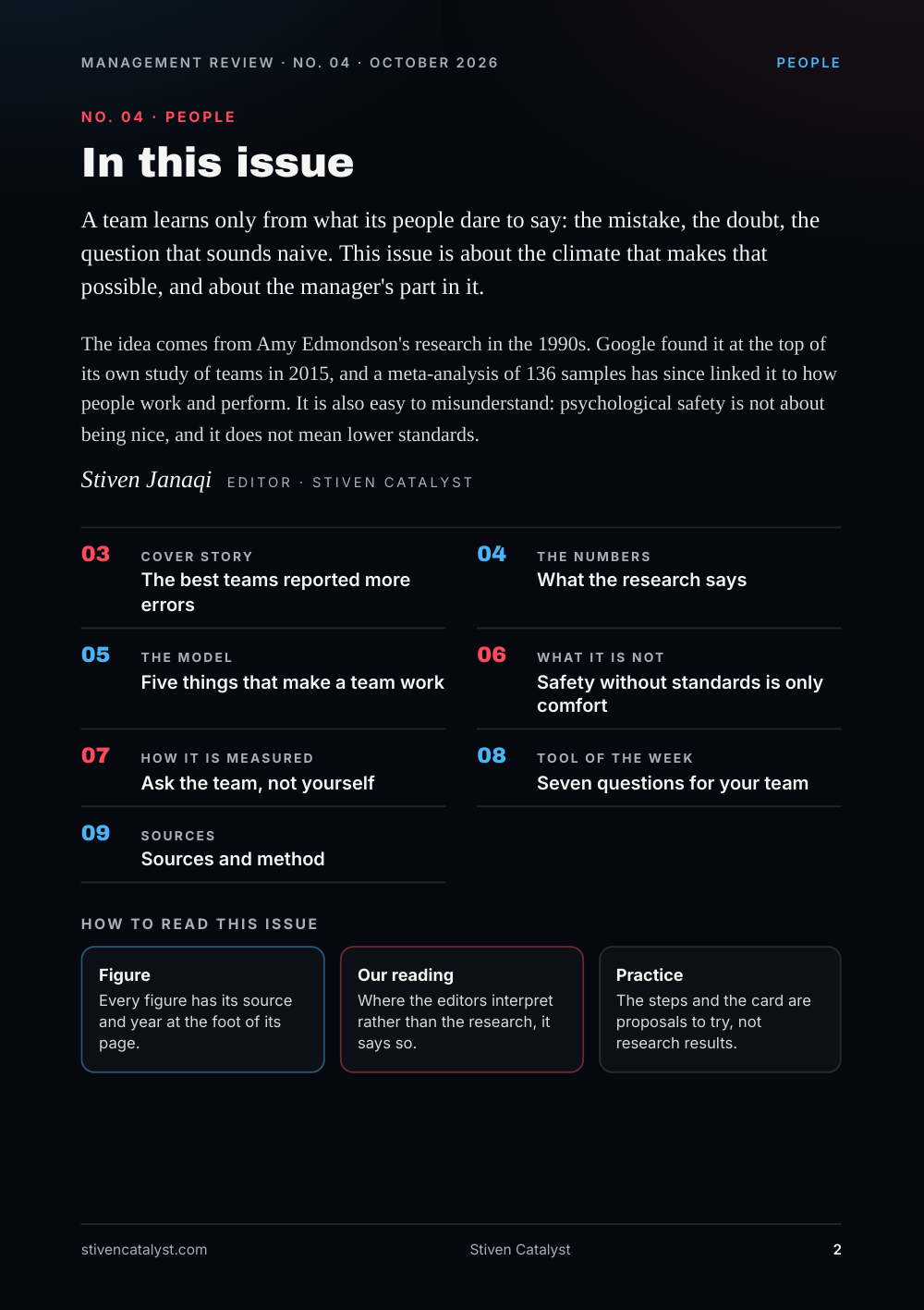
A team learns only from what its people dare to say: the mistake, the doubt, the question that sounds naive. This issue is about the climate that makes that possible, and about the manager's part in it.
The idea comes from Amy Edmondson's research in the 1990s. Google found it at the top of its own study of teams in 2015, and a meta-analysis of 136 samples has since linked it to how people work and perform. It is also easy to misunderstand: psychological safety is not about being nice, and it does not mean lower standards.
Stiven Janaqi, Editor
Cover story
The best teams repor ted more errors
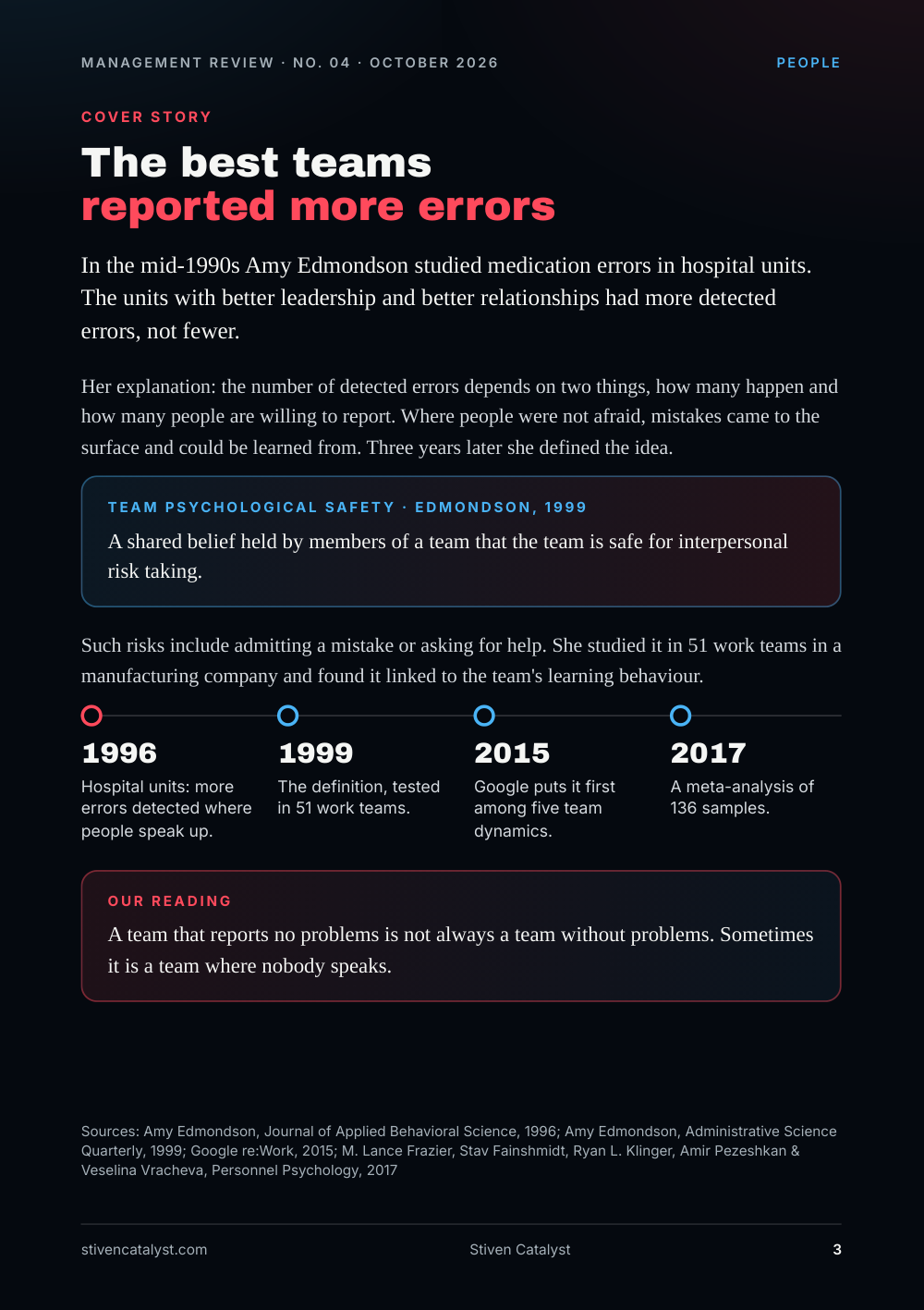
In the mid-1990s Amy Edmondson studied medication errors in hospital units. The units with better leadership and better relationships had more detected errors, not fewer.
Her explanation: the number of detected errors depends on two things, how many happen and how many people are willing to report. Where people were not afraid, mistakes came to the surface and could be learned from. Three years later she defined the idea.
Team psychological safe t y · Edmondson, 1999
A shared belief held by members of a team that the team is safe for interpersonal risk taking.
Such risks include admitting a mistake or asking for help. She studied it in 51 work teams in a manufacturing company and found it linked to the team's learning behaviour.
- 1996 Hospital units: more errors detected where people speak up.
- 1999 The definition, tested in 51 work teams.
- 2015 Google puts it first among five team dynamics.
- 2017 A meta-analysis of 136 samples.
Our reading
A team that reports no problems is not always a team without problems. Sometimes it is a team where nobody speaks.
Sources: Amy Edmondson, Journal of Applied Behavioral Science, 1996; Amy Edmondson, Administrative Science Quarterly, 1999; Google re:Work, 2015; M. Lance Frazier, Stav Fainshmidt, Ryan L. Klinger, Amir Pezeshkan & Veselina Vracheva, Personnel Psychology, 2017
The numbers
What the research says
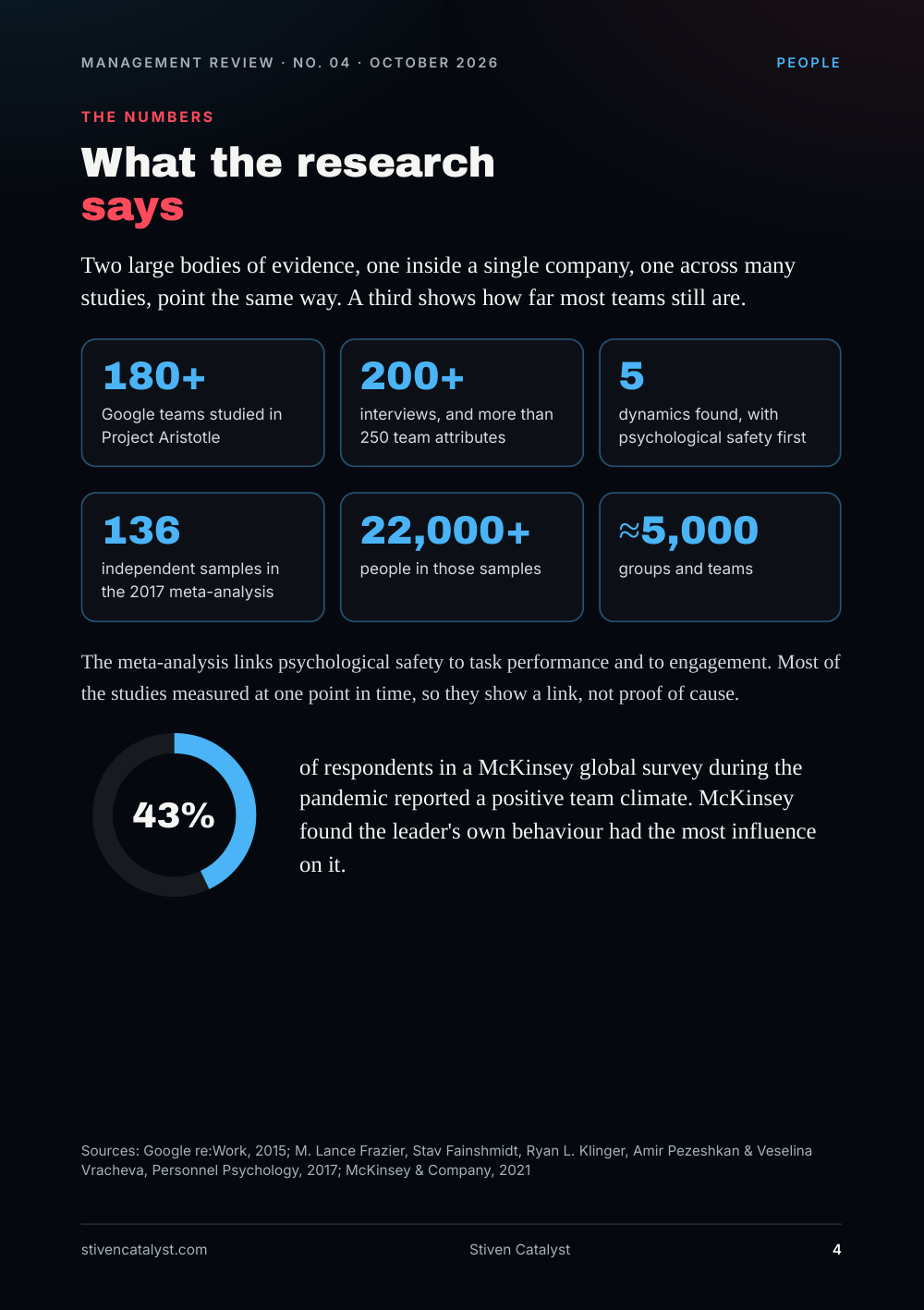
Two large bodies of evidence, one inside a single company, one across many studies, point the same way. A third shows how far most teams still are.
- 180+ Google teams studied in Project Aristotle
- 200+ interviews, and more than 250 team attributes
- 5 dynamics found, with psychological safety first
- 136 independent samples in the 2017 meta-analysis
- 22,000+ people in those samples
- ≈5,000 groups and teams
The meta-analysis links psychological safety to task performance and to engagement. Most of the studies measured at one point in time, so they show a link, not proof of cause.
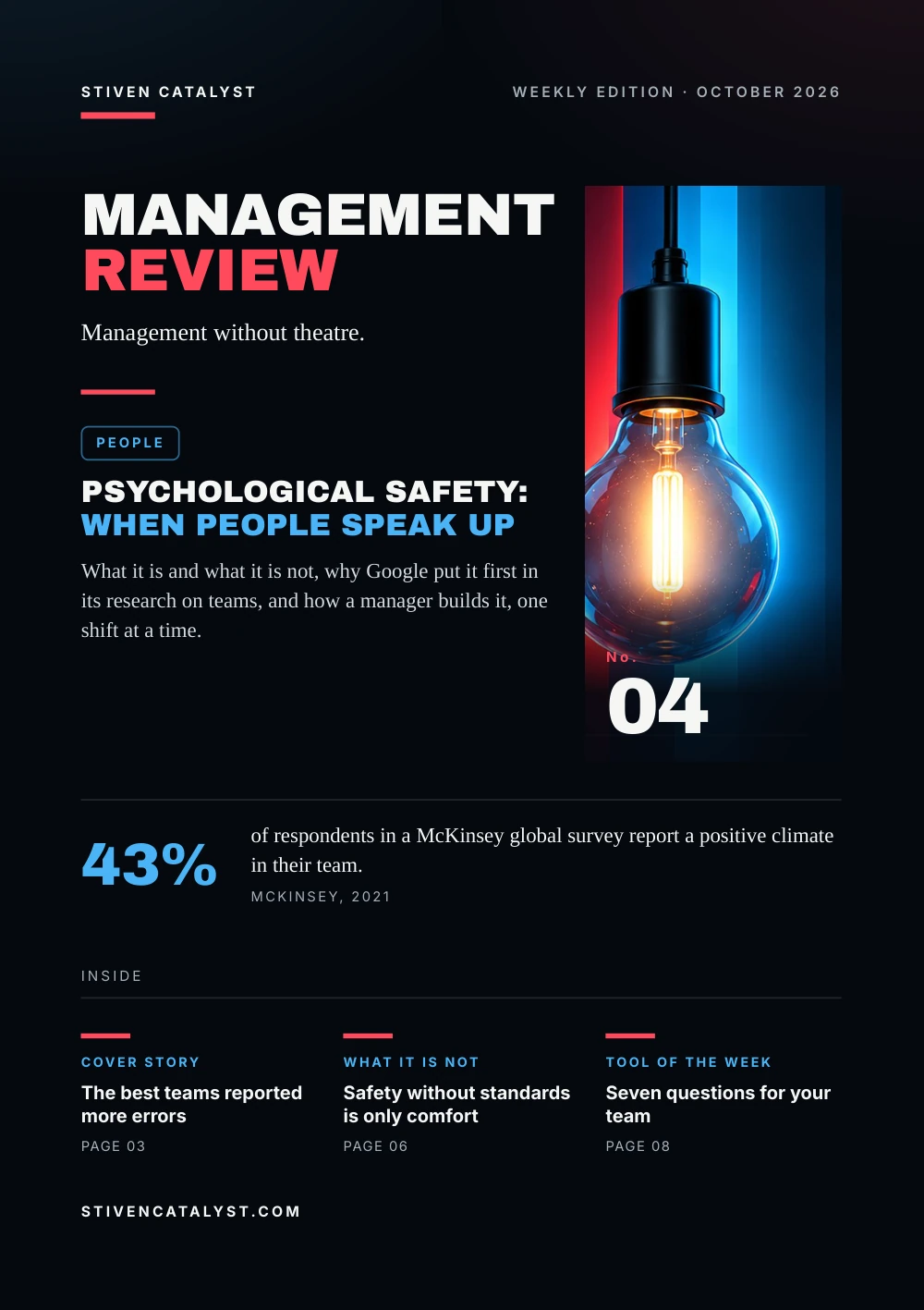
43% of respondents in a McKinsey global survey during the pandemic reported a positive team climate. McKinsey found the leader's own behaviour had the most influence on it.
Sources: Google re:Work, 2015; M. Lance Frazier, Stav Fainshmidt, Ryan L. Klinger, Amir Pezeshkan & Veselina Vracheva, Personnel Psychology, 2017; McKinsey & Company, 2021
The model
Five things that make a team work
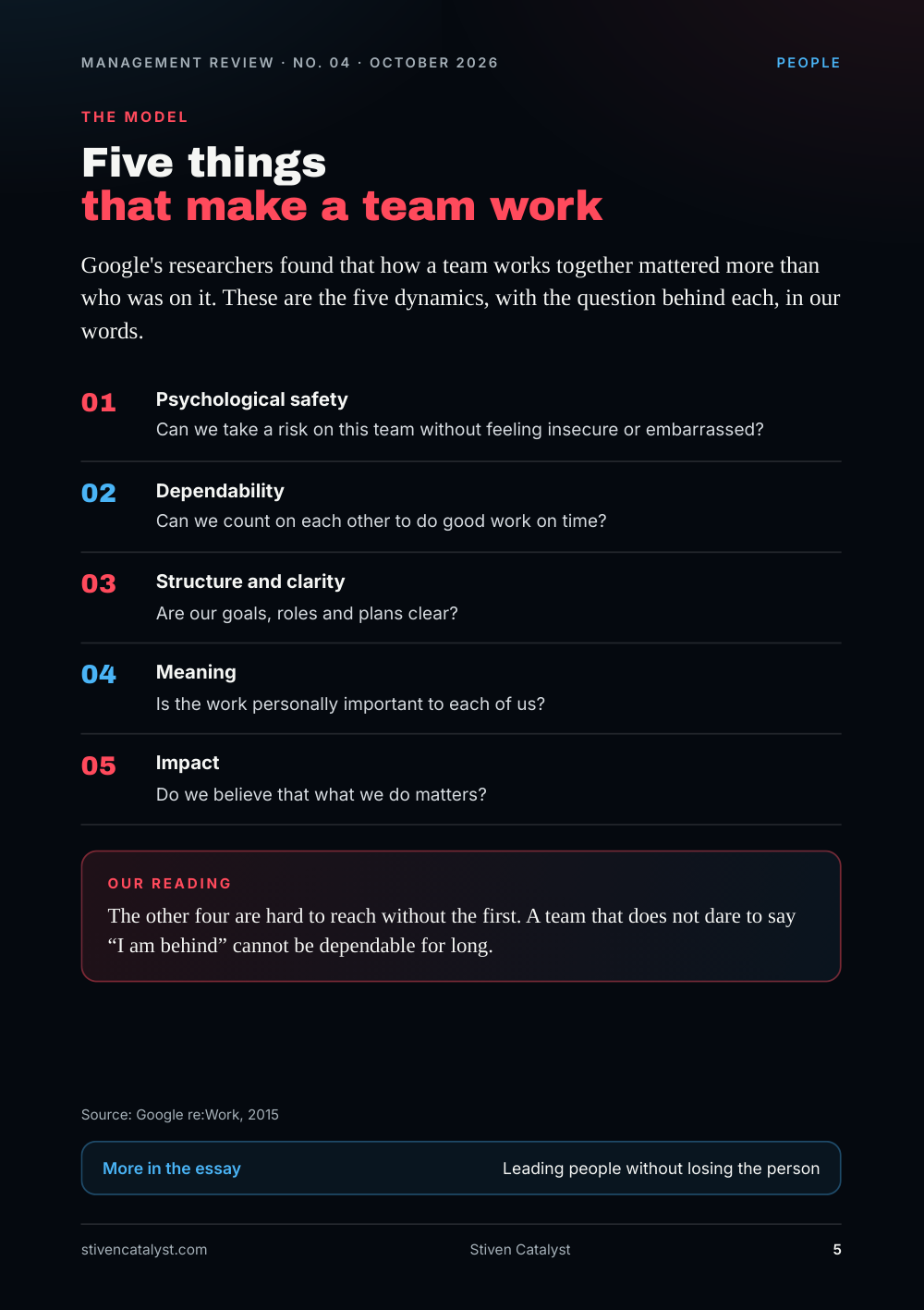
Google's researchers found that how a team works together mattered more than who was on it. These are the five dynamics, with the question behind each, in our words.
- Psychological saf
e t y. Can we take a risk on this team without feeling insecure or embarrassed? - Dependabili
t y. Can we count on each other to do good work on time? - Structure and clari
t y. Are our goals, roles and plans clear? - Meaning. Is the work personally important to each of us?
- Impact. Do we believe that what we do matters?
Our reading
The other four are hard to reach without the first. A team that does not dare to say “I am behind” cannot be dependable for long.
Source: Google re:Work, 2015
More in the essay: Leading people without losing the person
What it is not
Safe t y without standards is only comfor t
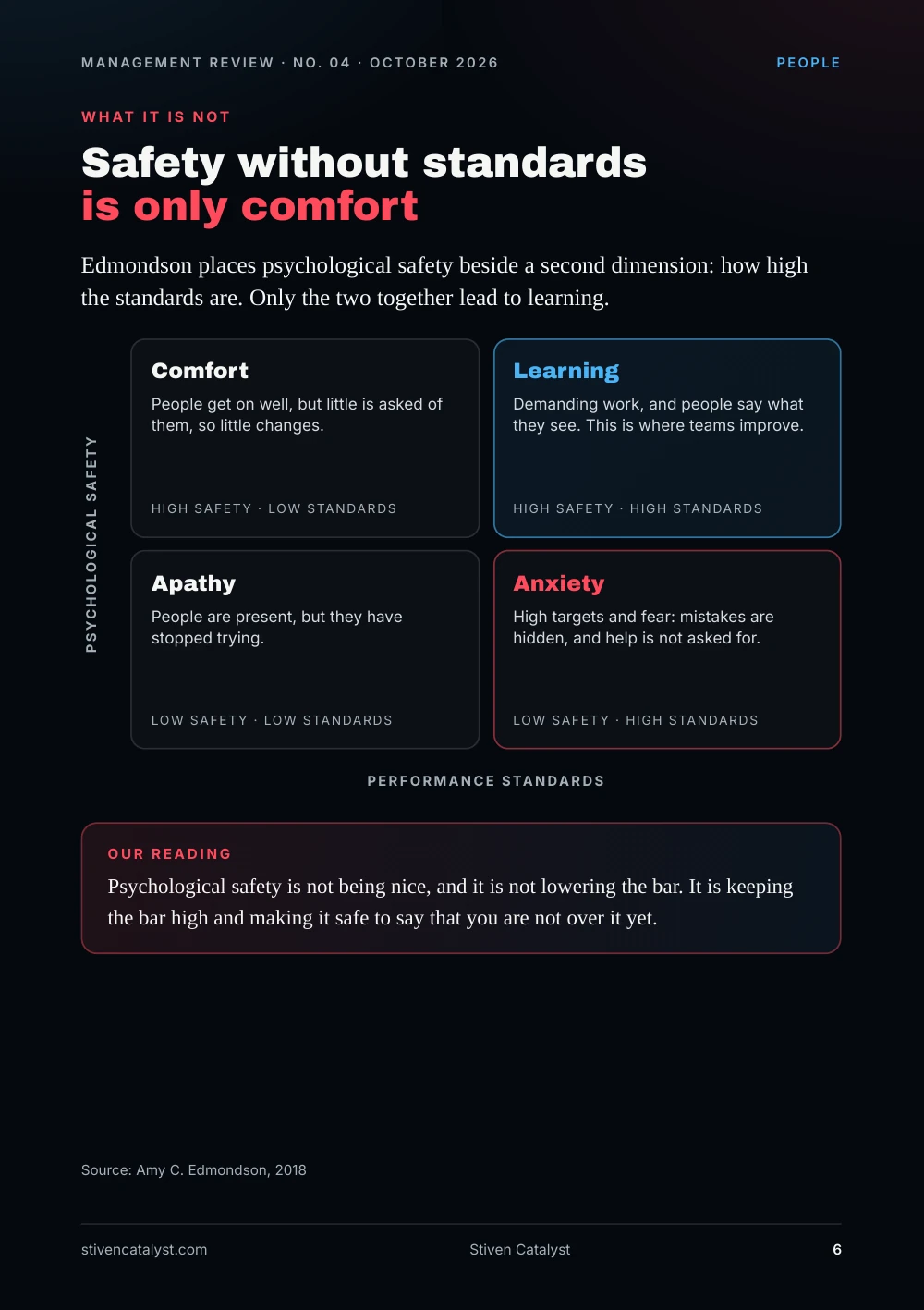
Edmondson places psychological safety beside a second dimension: how high the standards are. Only the two together lead to learning.
Psychological safety × Performance standards:
- Comfo
r t (high safety · low standards). People get on well, but little is asked of them, so little changes. - Learning (high safety · high standards). Demanding work, and people say what they see. This is where teams improve.
- Apathy (low safety · low standards). People are present, but they have stopped trying.
- Anxi
e t y (low safety · high standards). High targets and fear: mistakes are hidden, and help is not asked for.
Our reading
Psychological safety is not being nice, and it is not lowering the bar. It is keeping the bar high and making it safe to say that you are not over it yet.
Source: Amy C. Edmondson, 2018
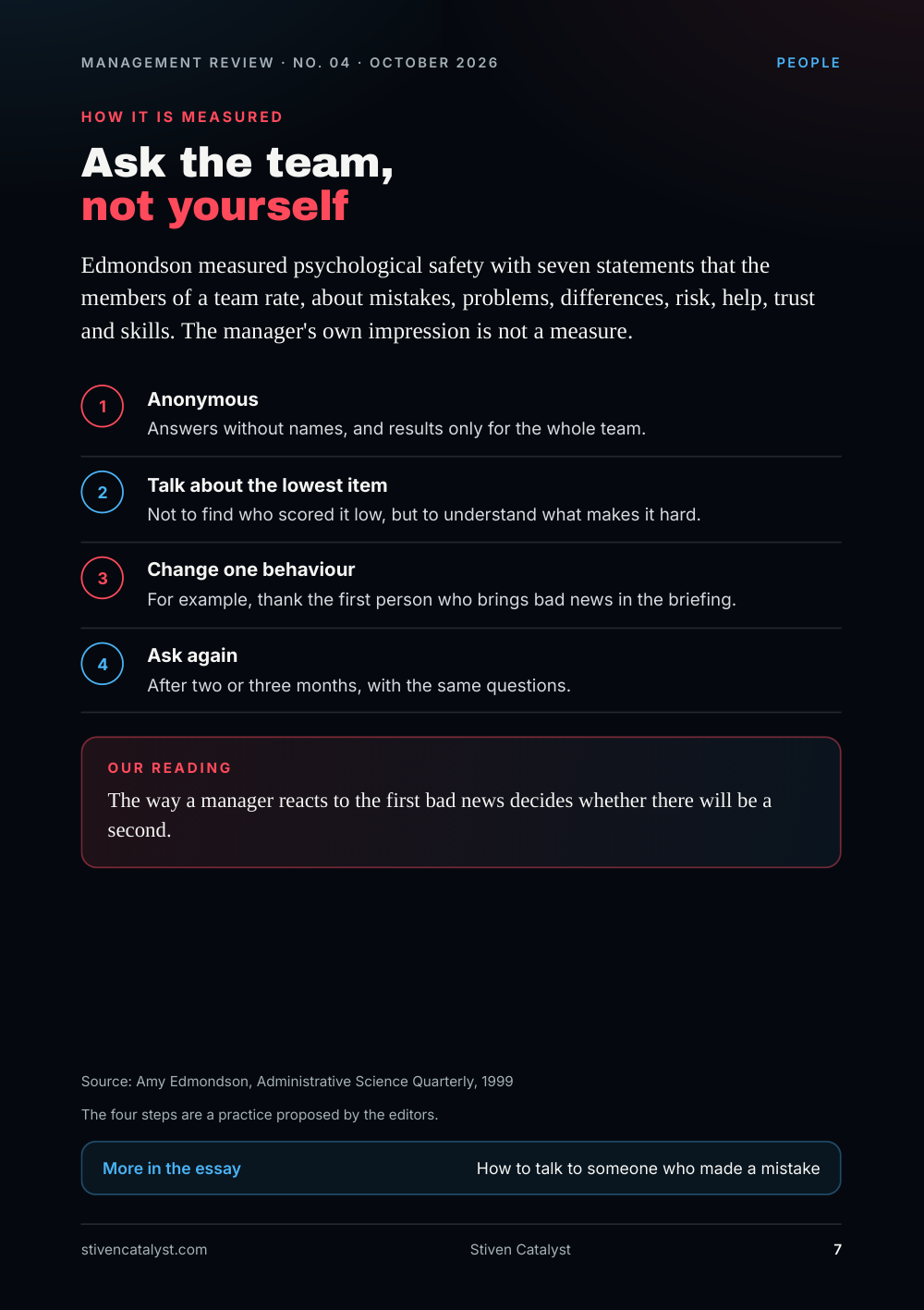
How it is measured
Ask the team, not yourself
Edmondson measured psychological safety with seven statements that the members of a team rate, about mistakes, problems, differences, risk, help, trust and skills. The manager's own impression is not a measure.
- Anonymous. Answers without names, and results only for the whole team.
- Talk about the lowest item. Not to find who scored it low, but to understand what makes it hard.
- Change one behaviour. For example, thank the first person who brings bad news in the briefing.
- Ask again. After two or three months, with the same questions.
Our reading
The way a manager reacts to the first bad news decides whether there will be a second.
The four steps are a practice proposed by the editors.
Source: Amy Edmondson, Administrative Science Quarterly, 1999
More in the essay: How to talk to someone who made a mistake
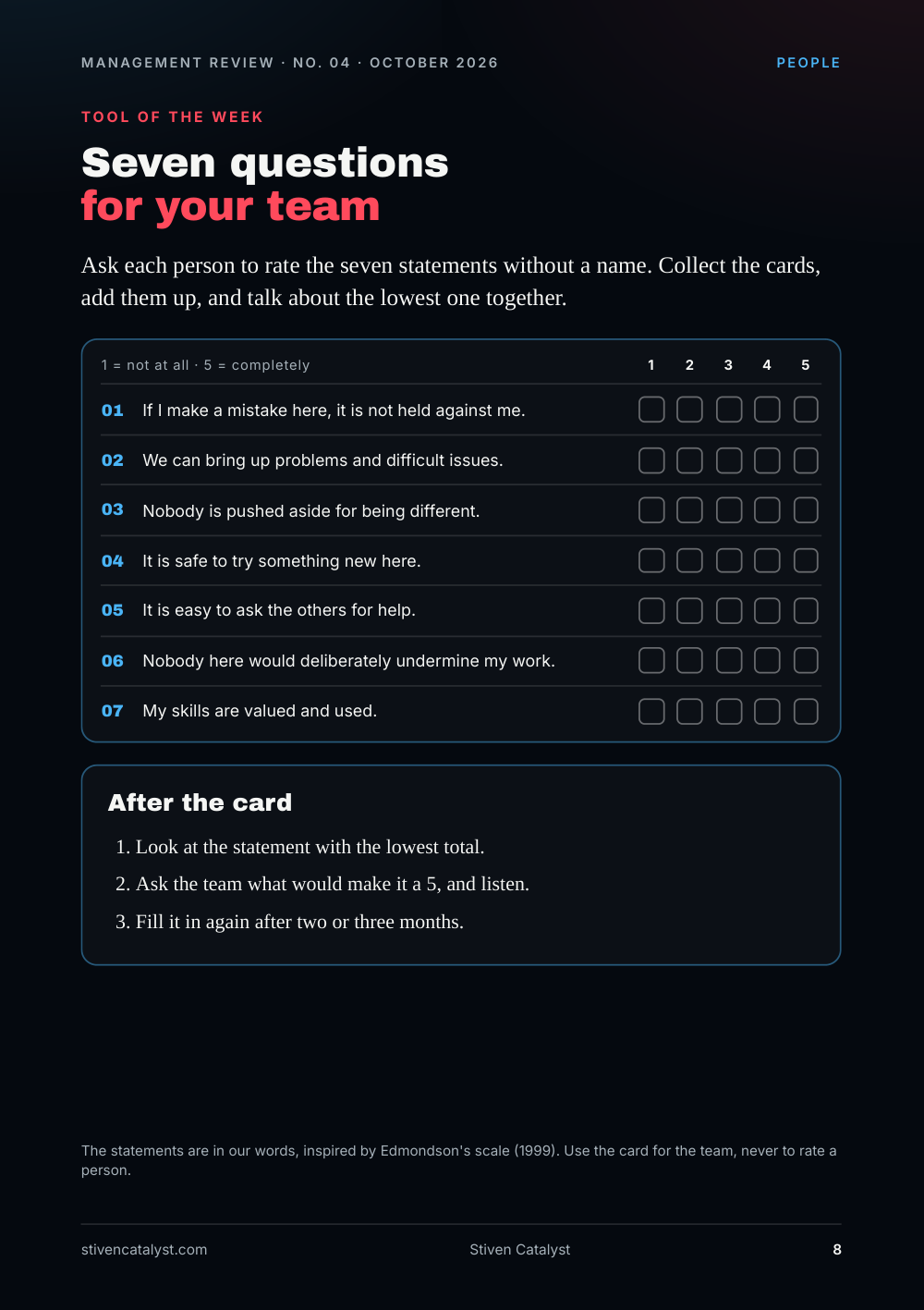
Tool of the week
Seven questions for your team
Ask each person to rate the seven statements without a name. Collect the cards, add them up, and talk about the lowest one together.
1 = not at all · 5 = completely
- If I make a mistake here, it is not held against me.
- We can bring up problems and difficult issues.
- Nobody is pushed aside for being different.
- It is safe to try something new here.
- It is easy to ask the others for help.
- Nobody here would deliberately undermine my work.
- My skills are valued and used.
Af ter the card
- Look at the statement with the lowest total.
- Ask the team what would make it a 5, and listen.
- Fill it in again after two or three months.
The statements are in our words, inspired by Edmondson's scale (1999). Use the card for the team, never to rate a person.
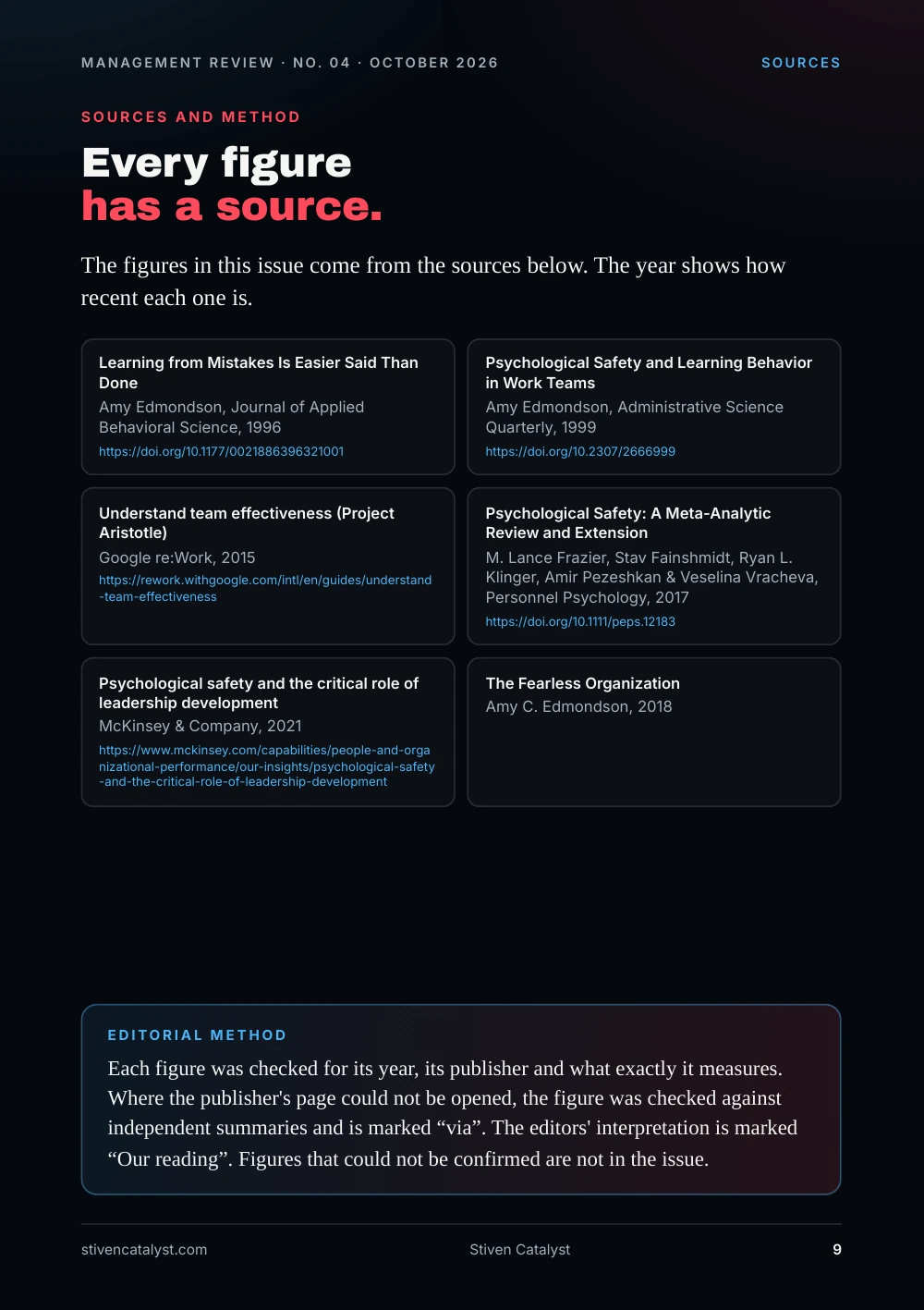
Sources and method
Every figure has a source.
The figures in this issue come from the sources below. The year shows how recent each one is.
- Amy Edmondson, Journal of Applied Behavioral Science, “Learning from Mistakes Is Easier Said Than Done”, 1996. https://doi.org/10.1177/0021886396321001
- Amy Edmondson, Administrative Science Quarterly, “Psychological Safety and Learning Behavior in Work Teams”, 1999. https://doi.org/10.2307/2666999
- Google re:Work, “Understand team effectiveness (Project Aristotle)”, 2015. https://rework.withgoogle.com/intl/en/guides/understand-team-effectiveness
- M. Lance Frazier, Stav Fainshmidt, Ryan L. Klinger, Amir Pezeshkan & Veselina Vracheva, Personnel Psychology, “Psychological Safety: A Meta-Analytic Review and Extension”, 2017. https://doi.org/10.1111/peps.12183
- McKinsey & Company, “Psychological safety and the critical role of leadership development”, 2021. https://www.mckinsey.com/capabilities/people-and-organizational-performance/our-insights/psychological-safety-and-the-critical-role-of-leadership-development
- Amy C. Edmondson, “The Fearless Organization”, 2018.
Edit orial me thod
Each figure was checked for its year, its publisher and what exactly it measures. Where the publisher's page could not be opened, the figure was checked against independent summaries and is marked “via”. The editors' interpretation is marked “Our reading”. Figures that could not be confirmed are not in the issue.