Adults imagining a problem at work expected a coworker to rate them less able if they asked for advice. Students paid for the impression they made asked less than half as often as students paid for their score. Yet the people asked rated askers as more capable, as long as the task was hard, the request came to them and they knew the subject. And strangers said yes far more often than askers predicted. Three conditions and a card close the issue.
Management Review · Third series · November 2026 · No. 91
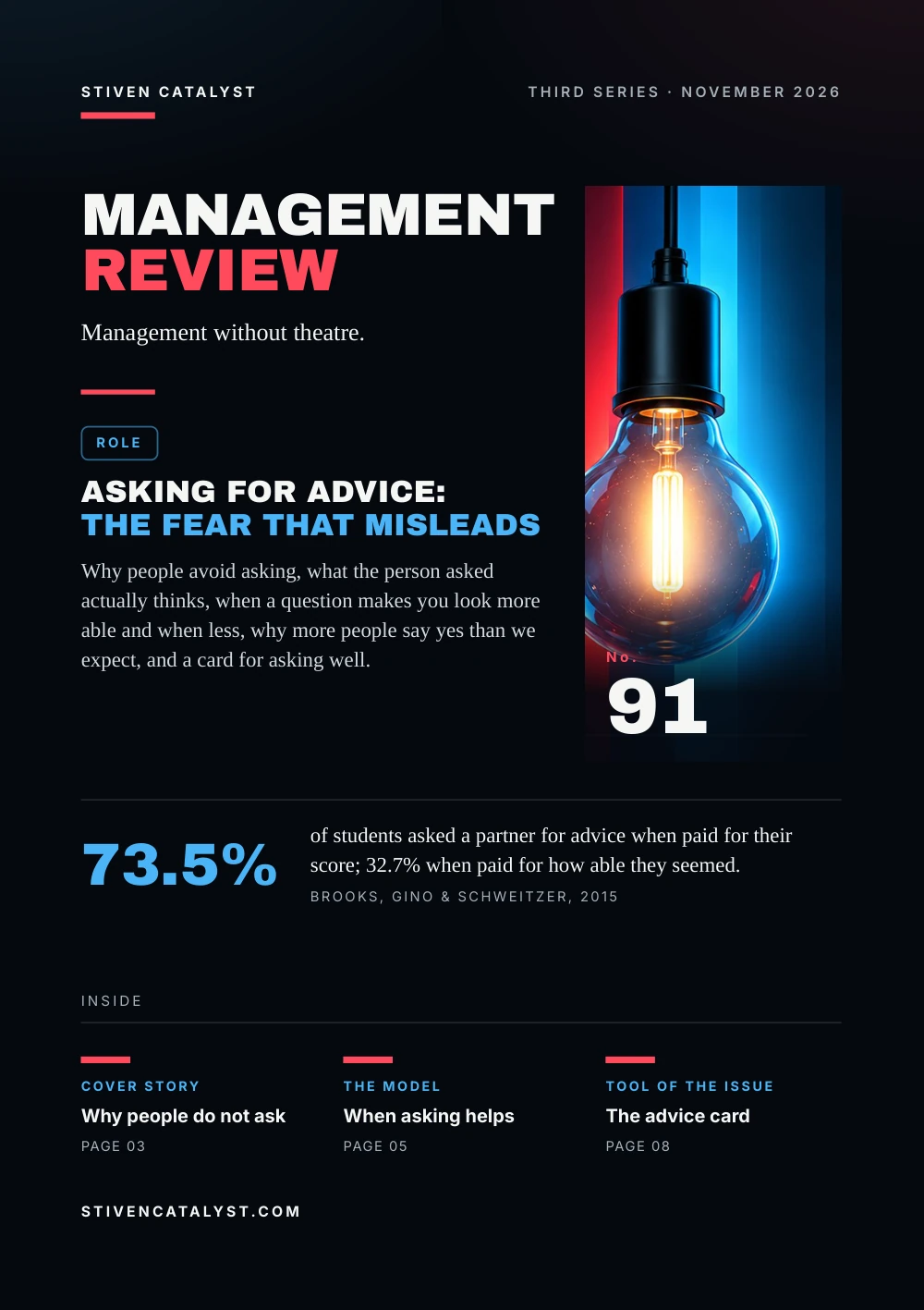
Asking for advice: the fear that misleads
Why people avoid asking, what the person asked actually thinks, when a question makes you look more able and when less, why more people say yes than we expect, and a card for asking well.
- No.
- 91
- Pages
- 10
- Sources
- 2
- Topics
- Role
- Online since
- 3 November 2026
Stiven CatalystThird series · November 2026
ManagementReview
Management without theatre.
Role
Asking for advice:the fear that misleads
Why people avoid asking, what the person asked actually thinks, when a question makes you look more able and when less, why more people say yes than we expect, and a card for asking well.

No.91
73.5%
of students asked a partner for advice when paid for their score; 32.7% when paid for how able they seemed.Brooks, Gino & Schweitzer, 2015
stivencatalyst.com
No. 91 · Role
In this issue
Many managers treat a question as an admission of a gap, and keep it to themselves. A team that never sees its manager ask learns that it should not ask either. This issue reads two research papers that tested the fear behind the silence: what people expect when they ask, and what the person asked actually thinks.
- 03Cover storyWhy people do not ask
- 04The numbersWhat the asked actually think
- 05The modelWhen asking helps
- 06What the research saysMore say yes than we expect
- 07How it is measuredAble, in whose eyes?
- 08Tool of the issueThe advice card
- 09SourcesSources and method
How to read this issue
Figure
Every figure has its source and year at the foot of its page.
Our reading
Where the editor interprets rather than the research, it says so.
Practice
The steps and the card are proposals to try, not research results.
Cover story
Why peopledo not ask
Alison Wood Brooks, Francesca Gino and Maurice Schweitzer began with the fear itself. They asked 302 adults to imagine a problem on an important project. Those who pictured asking a coworker for advice expected to be rated less capable: 4.50 against 5.69 on a scale of 1 to 7.
199 students before a hard puzzle: the message they chose to send (2015)
The partner had already done the puzzle. Students paid a dollar per right answer mostly asked for advice. Students paid by how able the partner would rate them mostly sent a friendly greeting instead.
Our reading
Worrying about looking able did not make anyone know more. It only made them ask less.
Source: Alison Wood Brooks, Francesca Gino & Maurice E. Schweitzer, Management Science 61(6), 2015
Pilot studies A and B of Brooks, Gino & Schweitzer (2015): A, adults online, a scenario; B, students in a laboratory, with a partner simulated by computer. The bars are shares of each payment group.
The numbers
What the askedactually think
In the next studies the authors turned to the person asked. After a task, a partner simulated by computer sent one short message. When it asked for advice, the person who received it rated the partner as more capable.
How capable the partner seemed, 1 to 7, by the message received (Study 2a, 2015)
3.62 vs 3.40competence of a partner who asked, and one who did not; 170 students (Study 1)
4.82 vs 4.49score out of 10 expected next round for the one who asked, and the one who did not (Study 2b)
Our reading
Asking did not make the partner seem warmer or more likeable. It made them seem more able.
Source: Alison Wood Brooks, Francesca Gino & Maurice E. Schweitzer, Management Science 61(6), 2015
Means of three statements such as “My partner is well qualified”, from 1 to 7. Study 2a: 191 students; the partner had scored 6 of 10 in the first round. Study 2b: 226 students; no effect on warmth or liking.
The model
When askinghelps
Asking did not help in every case. Three studies looked for the limits: how hard the task was, who was asked, and whether the person asked knew the subject.
The task is hard
Hard number grids: 3.57 against 3.28 for those not asked. Simple sums: no difference, and no harm (Study 3).
The request comes to you
Asked themselves: 4.83. Saw the partner ask someone else: 4.08. No request: 4.18 (Study 4).
You know the subject
Asked on their strongest subject, people rated the asker higher; on their weakest, lower (Study 5).
How capable the asker seemed, 1 to 7 (Study 5, 2015)
Our reading
A request for advice flatters the person asked. It works only if they believe they can answer it.
Source: Alison Wood Brooks, Francesca Gino & Maurice E. Schweitzer, Management Science 61(6), 2015
Means on the same scale. Study 3: 213 students; Study 4: 114 students and staff, where the asked person's own self-confidence carried part of the effect; Study 5: 250 adults online. Feedback on past work is in No. 19.
What the research says
More say yesthan we expect
A second fear stops the question: the answer will be no. In 2008 Francis Flynn and Vanessa Lake, now Bohns, had people predict how many strangers they would need to ask, then sent them out to ask.
Strangers approached to get the yeses needed (2008)
Charity volunteers expected to approach 210 people; they needed 122. Asking face to face took 2.3 people per yes, handing out a flyer 15.3. The askers' predictions followed the size of the favour, which made no difference to the answers.
Our reading
Saying no to someone's face is hard. That is why direct requests work, and why a request from a manager is rarely a free one.
Source: Francis J. Flynn & Vanessa K. B. Lake, Journal of Personality and Social Psychology 95(1), 2008
Means of people approached. Studies 1, 2 and 6: 42, 29 and 79 students asking strangers on a New York campus; Study 3: 127 charity volunteers, who also asked people they knew. Read in the authors' accepted version.
How it is measured
Able,in whose e yes?
In every study the person asked rated the asker on the same three statements, from 1, strongly disagree, to 7, strongly agree. Their average is the competence score in the charts of this issue.
Solves problems
“My partner is very capable of solving problems.”
Skills
“I feel very confident about my partner's skills.”
Qualified
“My partner is well qualified.”
What was tested
- Eight studies, 1,665 people
- Students, staff and adults online
- One typed message after one task
What was not
- Asking face to face
- Boss and team, power between them
- Asking again and again
Our reading
The evidence is clean but narrow. Whether it holds between a manager and a team has not been measured.
Source: Alison Wood Brooks, Francesca Gino & Maurice E. Schweitzer, Management Science 61(6), 2015
Statements adapted by the authors from Mayer and Davis (1999). The right-hand list follows the authors' own section on limits and further research. The total of participants is the editors' sum of the eight studies.
Tool of the issue
The advicecard
One card before a question that matters. The Skills Matrix shows who on the team is rated able to train others in a task: often the right person to ask.
01The questionone sentence; hard enough that a good answer changes what you do
02What I have triedwhat I know, what I did, where I am stuck
03Who knows thissomeone strong in exactly this, not only someone senior
04How I askdirectly, in my own words, and with room to say no
05What I will decidethe decision stays mine; by when
06Back to themwhat I did with the advice, and thanks
Sources: Alison Wood Brooks, Francesca Gino & Maurice E. Schweitzer, Management Science 61(6), 2015; Francis J. Flynn & Vanessa K. B. Lake, Journal of Personality and Social Psychology 95(1), 2008
The card is the editors' proposal, built on the three conditions and on the direct request; telling the advisor what you did is the editors' addition. The coach is in No. 11, self-awareness in No. 31, managing up in No. 52.
More in the essayWhen to solve it yourself and when to take it higher
Open the tool: Skills Matrixstivencatalyst.com/tools/skills-matrix/
Sources and method
Every figurehas a source.
The figures in this issue come from the sources below. The year shows how recent each one is.
- Smart People Ask for (My) Advice: Seeking Advice Boosts Perceptions of CompetenceAlison Wood Brooks, Francesca Gino & Maurice E. Schweitzer, Management Science 61(6), 2015https://doi.org/10.1287/mnsc.2014.2054
- If You Need Help, Just Ask: Underestimating Compliance With Direct Requests for HelpFrancis J. Flynn & Vanessa K. B. Lake, Journal of Personality and Social Psychology 95(1), 2008https://doi.org/10.1037/0022-3514.95.1.128
Editorial method
Each figure was checked for its year, its publisher and what it measures, in the full text where it could be opened. A source read only in a summary, an abstract or excerpts is marked “via”. A figure not confirmed in what was read is marked so on its page, or left out. The editor's interpretation is marked “Our reading”.
ManagementReview
Management without theatre.
Every issue, one management question, checked against the best research.
All issues
stivencatalyst.com/magazine/management-review.html
Management Review · No. 91 · November 2026 · Stiven Catalyst
Edited by Stiven Janaqi, who answers for it; “the editors” in this publication means him. Its texts, translations, layout and the checking of figures against their sources are done in working sessions with Claude, an AI model by Anthropic.
stivencatalyst.com/how-this-is-made.html
 Next issue
Sick leave: what the rate hides
Click or swipe a page to turn it. The arrow keys work too.
Management Review · No. 91
The figures of the issue
The charts of the printed pages, with their sources.
Pilot studies A and B of Brooks, Gino & Schweitzer (2015): A, adults online, a scenario; B, students in a laboratory, with a partner simulated by computer. The bars are shares of each payment group.
Source: Alison Wood Brooks, Francesca Gino & Maurice E. Schweitzer, Management Science 61(6), 2015
Means of three statements such as “My partner is well qualified”, from 1 to 7. Study 2a: 191 students; the partner had scored 6 of 10 in the first round. Study 2b: 226 students; no effect on warmth or liking.
Source: Alison Wood Brooks, Francesca Gino & Maurice E. Schweitzer, Management Science 61(6), 2015
Means on the same scale. Study 3: 213 students; Study 4: 114 students and staff, where the asked person's own self-confidence carried part of the effect; Study 5: 250 adults online. Feedback on past work is in No. 19.
Source: Alison Wood Brooks, Francesca Gino & Maurice E. Schweitzer, Management Science 61(6), 2015
Means of people approached. Studies 1, 2 and 6: 42, 29 and 79 students asking strangers on a New York campus; Study 3: 127 charity volunteers, who also asked people they knew. Read in the authors' accepted version.
Source: Francis J. Flynn & Vanessa K. B. Lake, Journal of Personality and Social Psychology 95(1), 2008
The whole text Read the issue as text For reading on a small screen, searching or a screen reader. The same words, without the page design.
In this issue
Many managers treat a question as an admission of a gap, and keep it to themselves. A team that never sees its manager ask learns that it should not ask either. This issue reads two research papers that tested the fear behind the silence: what people expect when they ask, and what the person asked actually thinks.
Adults imagining a problem at work expected a coworker to rate them less able if they asked for advice. Students paid for the impression they made asked less than half as often as students paid for their score. Yet the people asked rated askers as more capable, as long as the task was hard, the request came to them and they knew the subject. And strangers said yes far more often than askers predicted. Three conditions and a card close the issue.
Stiven Janaqi, Editor
Cover story
Why people do not ask
Alison Wood Brooks, Francesca Gino and Maurice Schweitzer began with the fear itself. They asked 302 adults to imagine a problem on an important project. Those who pictured asking a coworker for advice expected to be rated less capable: 4.50 against 5.69 on a scale of 1 to 7.
199 students before a hard puzzle: the message they chose to send (2015): “Can you give me any advice?”: Paid for the score 73.5%, Paid for the impression 32.7%; “I hope you did well”: Paid for the score 13.3%, Paid for the impression 49.5%; No message: Paid for the score 13.3%, Paid for the impression 17.8%.
The partner had already done the puzzle. Students paid a dollar per right answer mostly asked for advice. Students paid by how able the partner would rate them mostly sent a friendly greeting instead.
Our reading
Worrying about looking able did not make anyone know more. It only made them ask less.
Pilot studies A and B of Brooks, Gino & Schweitzer (2015): A, adults online, a scenario; B, students in a laboratory, with a partner simulated by computer. The bars are shares of each payment group.
Source: Alison Wood Brooks, Francesca Gino & Maurice E. Schweitzer, Management Science 61(6), 2015
The numbers
What the asked actually think
In the next studies the authors turned to the person asked. After a task, a partner simulated by computer sent one short message. When it asked for advice, the person who received it rated the partner as more capable.
How capable the partner seemed, 1 to 7, by the message received (Study 2a, 2015): Asked for advice 5.40, Greeting 4.67, Other question 4.47, “In this together” 4.34.
- 3.62 vs 3.40 competence of a partner who asked, and one who did not; 170 students (Study 1)
- 4.82 vs 4.49 score out of 10 expected next round for the one who asked, and the one who did not (Study 2b)
Our reading
Asking did not make the partner seem warmer or more likeable. It made them seem more able.
Means of three statements such as “My partner is well qualified”, from 1 to 7. Study 2a: 191 students; the partner had scored 6 of 10 in the first round. Study 2b: 226 students; no effect on warmth or liking.
Source: Alison Wood Brooks, Francesca Gino & Maurice E. Schweitzer, Management Science 61(6), 2015
The model
When asking helps
Asking did not help in every case. Three studies looked for the limits: how hard the task was, who was asked, and whether the person asked knew the subject.
- The task is hard. Hard number grids: 3.57 against 3.28 for those not asked. Simple sums: no difference, and no harm (Study 3).
- The request comes
t o you. Asked themselves: 4.83. Saw the partner ask someone else: 4.08. No request: 4.18 (Study 4). - You know the subject. Asked on their strongest subject, people rated the asker higher; on their weakest, lower (Study 5).
How capable the asker seemed, 1 to 7 (Study 5, 2015): Asked on a strength 5.32, Not asked 4.97, Asked on a weakness 4.53.
Our reading
A request for advice flatters the person asked. It works only if they believe they can answer it.
Means on the same scale. Study 3: 213 students; Study 4: 114 students and staff, where the asked person's own self-confidence carried part of the effect; Study 5: 250 adults online. Feedback on past work is in No. 19.
Source: Alison Wood Brooks, Francesca Gino & Maurice E. Schweitzer, Management Science 61(6), 2015
What the research says
More say yes than we expect
A second fear stops the question: the answer will be no. In 2008 Francis Flynn and Vanessa Lake, now Bohns, had people predict how many strangers they would need to ask, then sent them out to ask.
Strangers approached to get the yeses needed (2008): Fill in a questionnaire, 5 yeses: Predicted 20.5, Actually asked 10.5; Lend a phone for a call, 3 yeses: Predicted 10.1, Actually asked 6.2; Walk me to the gym, 1 yes: Predicted 7.2, Actually asked 2.3.
Charity volunteers expected to approach 210 people; they needed 122. Asking face to face took 2.3 people per yes, handing out a flyer 15.3. The askers' predictions followed the size of the favour, which made no difference to the answers.
Our reading
Saying no to someone's face is hard. That is why direct requests work, and why a request from a manager is rarely a free one.
Means of people approached. Studies 1, 2 and 6: 42, 29 and 79 students asking strangers on a New York campus; Study 3: 127 charity volunteers, who also asked people they knew. Read in the authors' accepted version.
Source: Francis J. Flynn & Vanessa K. B. Lake, Journal of Personality and Social Psychology 95(1), 2008
How it is measured
Able, in whose e yes?
In every study the person asked rated the asker on the same three statements, from 1, strongly disagree, to 7, strongly agree. Their average is the competence score in the charts of this issue.
- Solves problems. “My partner is very capable of solving problems.”
- Skills. “I feel very confident about my partner's skills.”
- Qualified. “My partner is well qualified.”
What was tested
- Eight studies, 1,665 people
- Students, staff and adults online
- One typed message after one task
What was not
- Asking face to face
- Boss and team, power between them
- Asking again and again
Our reading
The evidence is clean but narrow. Whether it holds between a manager and a team has not been measured.
Statements adapted by the authors from Mayer and Davis (1999). The right-hand list follows the authors' own section on limits and further research. The total of participants is the editors' sum of the eight studies.
Source: Alison Wood Brooks, Francesca Gino & Maurice E. Schweitzer, Management Science 61(6), 2015
Tool of the issue
The advice card
One card before a question that matters. The Skills Matrix shows who on the team is rated able to train others in a task: often the right person to ask.
- The question one sentence; hard enough that a good answer changes what you do
- What I have tried what I know, what I did, where I am stuck
- Who knows this someone strong in exactly this, not only someone senior
- How I ask directly, in my own words, and with room to say no
- What I will decide the decision stays mine; by when
- Back
t o them what I did with the advice, and thanks
The card is the editors' proposal, built on the three conditions and on the direct request; telling the advisor what you did is the editors' addition. The coach is in No. 11, self-awareness in No. 31, managing up in No. 52.
Sources: Alison Wood Brooks, Francesca Gino & Maurice E. Schweitzer, Management Science 61(6), 2015; Francis J. Flynn & Vanessa K. B. Lake, Journal of Personality and Social Psychology 95(1), 2008
More in the essay: When to solve it yourself and when to take it higher
Open the tool: Skills Matrix
Sources and method
Every figure has a source.
The figures in this issue come from the sources below. The year shows how recent each one is.
- Alison Wood Brooks, Francesca Gino & Maurice E. Schweitzer, Management Science 61(6), “Smart People Ask for (My) Advice: Seeking Advice Boosts Perceptions of Competence”, 2015. https://doi.org/10.1287/mnsc.2014.2054
- Francis J. Flynn & Vanessa K. B. Lake, Journal of Personality and Social Psychology 95(1), “If You Need Help, Just Ask: Underestimating Compliance With Direct Requests for Help”, 2008. https://doi.org/10.1037/0022-3514.95.1.128
Edit orial me thod
Each figure was checked for its year, its publisher and what it measures, in the full text where it could be opened. A source read only in a summary, an abstract or excerpts is marked “via”. A figure not confirmed in what was read is marked so on its page, or left out. The editor's interpretation is marked “Our reading”.
Edited by Stiven Janaqi, who answers for it; “the editors” in this publication means him. Its texts, translations, layout and the checking of figures against their sources are done in working sessions with Claude, an AI model by Anthropic. How this is made
Management Review · Monthly edition