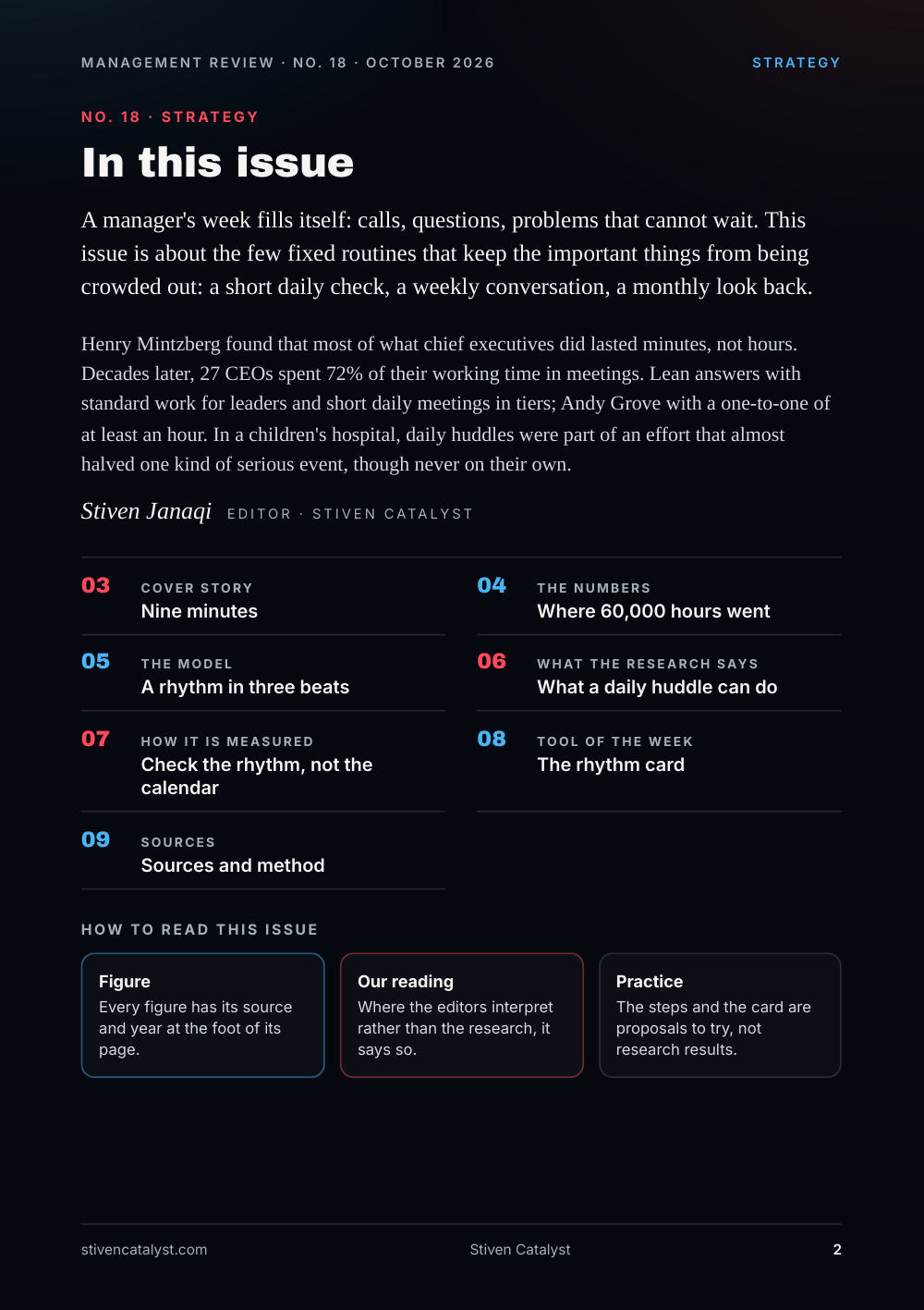
In this issue
A manager's week fills itself: calls, questions, problems that cannot wait. This issue is about the few fixed routines that keep the important things from being crowded out: a short daily check, a weekly conversation, a monthly look back.
Henry Mintzberg found that most of what chief executives did lasted minutes, not hours. Decades later, 27 CEOs spent 72% of their working time in meetings. Lean answers with standard work for leaders and short daily meetings in tiers; Andy Grove with a one-to-one of at least an hour. In a children's hospital, daily huddles were part of an effort that almost halved one kind of serious event, though never on their own.
Stiven Janaqi, Editor
Cover story
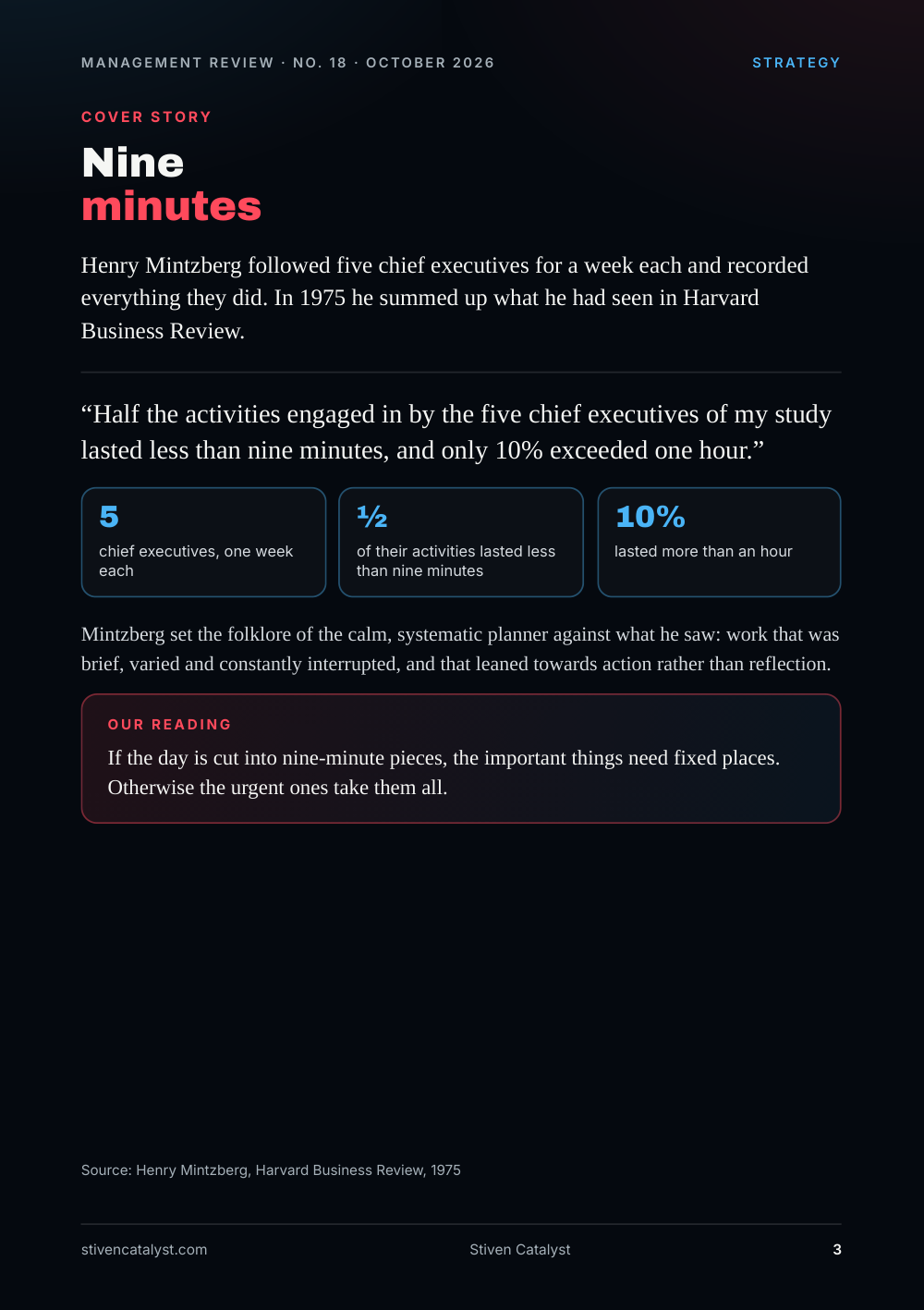
Nine minutes
Henry Mintzberg followed five chief executives for a week each and recorded everything they did. In 1975 he summed up what he had seen in Harvard Business Review.
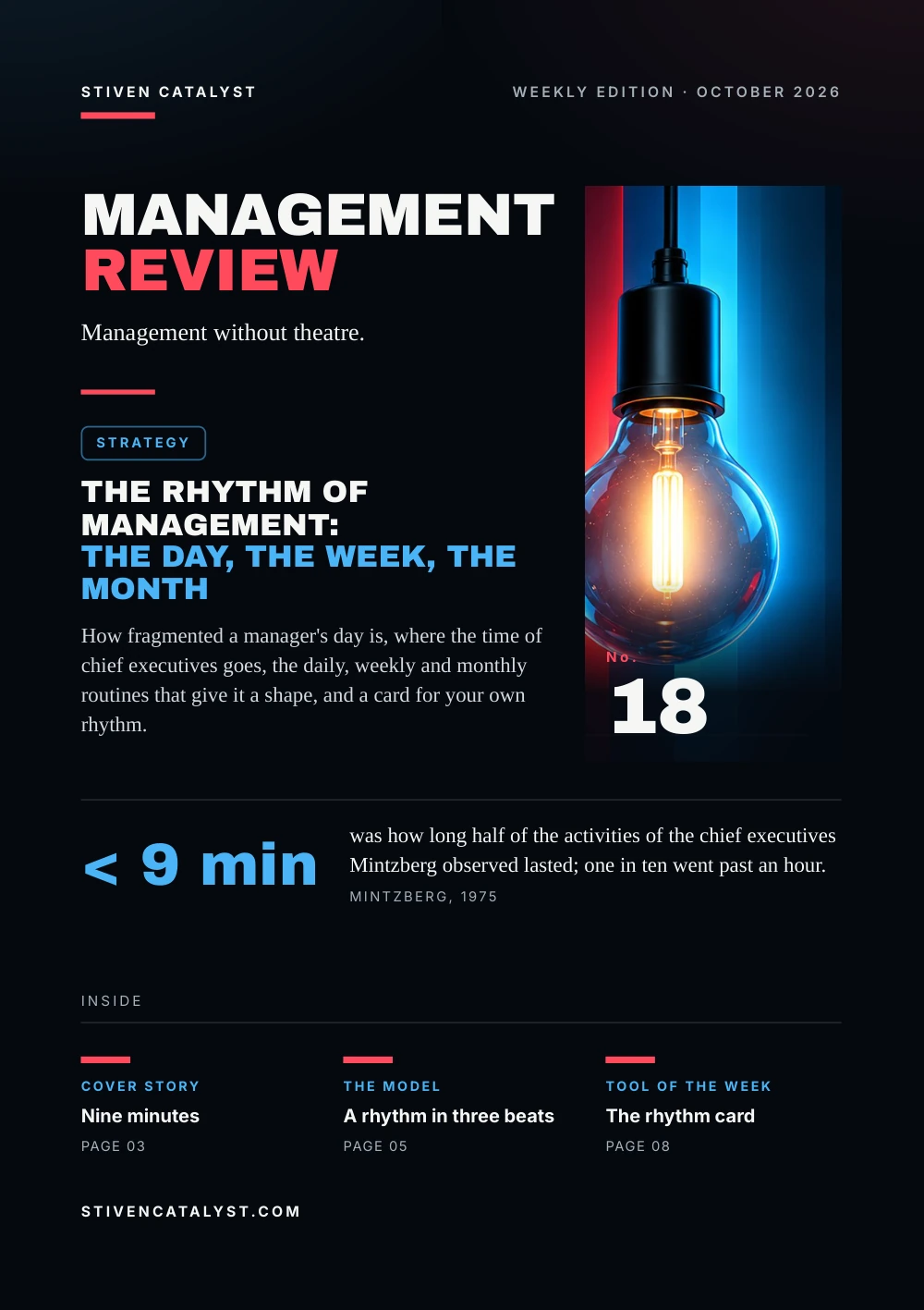
Half the activities engaged in by the five chief executives of my study lasted less than nine minutes, and only 10% exceeded one hour.
- 5 chief executives, one week each
- ½ of their activities lasted less than nine minutes
- 10% lasted more than an hour
Mintzberg set the folklore of the calm, systematic planner against what he saw: work that was brief, varied and constantly interrupted, and that leaned towards action rather than reflection.
Our reading
If the day is cut into nine-minute pieces, the important things need fixed places. Otherwise the urgent ones take them all.
Source: Henry Mintzberg, Harvard Business Review, 1975
The numbers
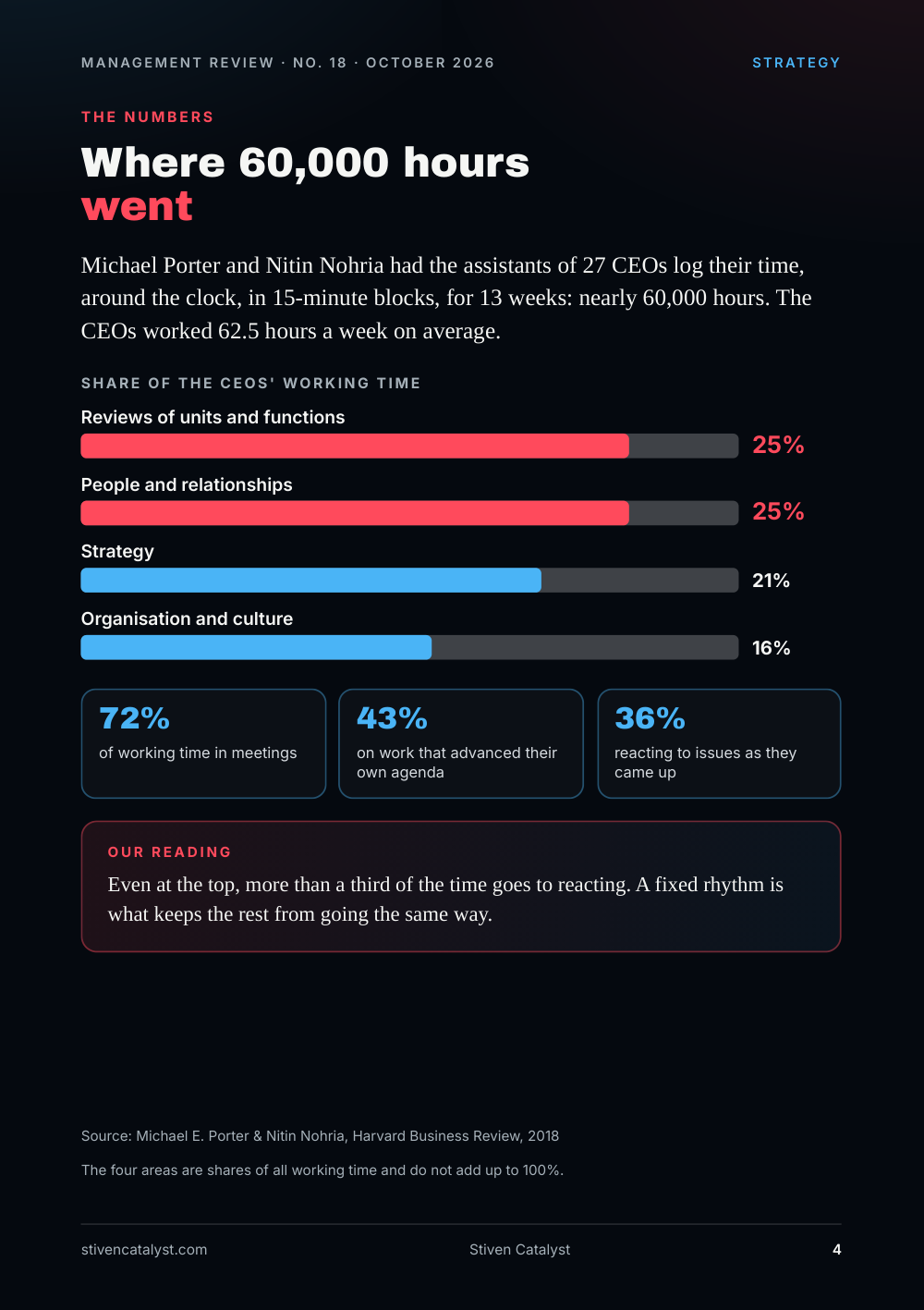
Where 60,000 hours went
Michael Porter and Nitin Nohria had the assistants of 27 CEOs log their time, around the clock, in 15-minute blocks, for 13 weeks: nearly 60,000 hours. The CEOs worked 62.5 hours a week on average.
Share of the CEOs' working time: Reviews of units and functions 25%, People and relationships 25%, Strategy 21%, Organisation and culture 16%.
- 72% of working time in meetings
- 43% on work that advanced their own agenda
- 36% reacting to issues as they came up
Our reading
Even at the top, more than a third of the time goes to reacting. A fixed rhythm is what keeps the rest from going the same way.
The four areas are shares of all working time and do not add up to 100%.
Source: Michael E. Porter & Nitin Nohria, Harvard Business Review, 2018
The model
A rhy thm in three beats
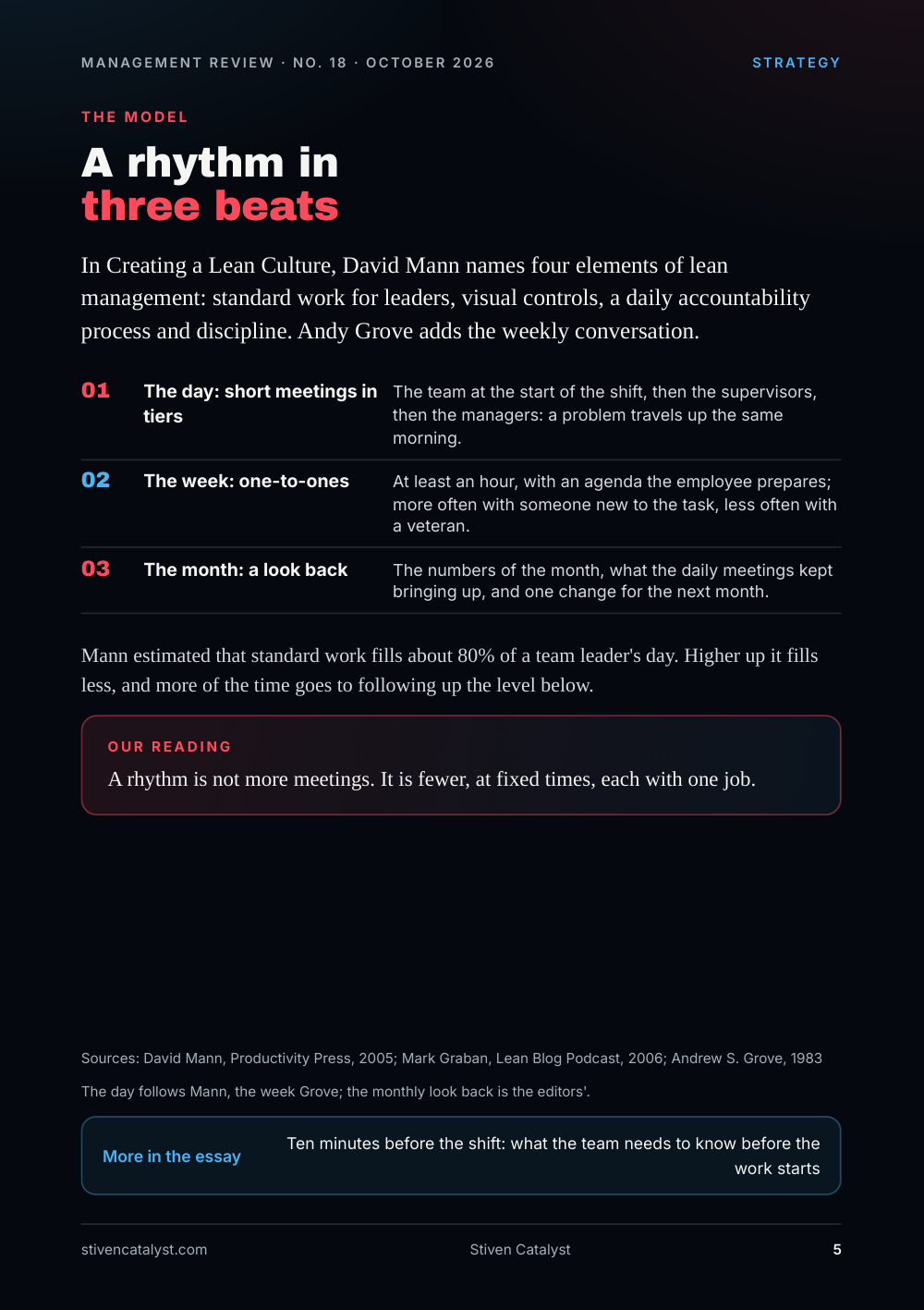
In Creating a Lean Culture, David Mann names four elements of lean management: standard work for leaders, visual controls, a daily accountability process and discipline. Andy Grove adds the weekly conversation.
- The day: sho
r t mee tings in tiers. The team at the start of the shift, then the supervisors, then the managers: a problem travels up the same morning. - The week: one-
t o-ones. At least an hour, with an agenda the employee prepares; more often with someone new to the task, less often with a veteran. - The month: a look back. The numbers of the month, what the daily meetings kept bringing up, and one change for the next month.
Mann estimated that standard work fills about 80% of a team leader's day. Higher up it fills less, and more of the time goes to following up the level below.
Our reading
A rhythm is not more meetings. It is fewer, at fixed times, each with one job.
The day follows Mann, the week Grove; the monthly look back is the editors'.
Sources: David Mann, Productivity Press, 2005; Mark Graban, Lean Blog Podcast, 2006; Andrew S. Grove, 1983
More in the essay: Ten minutes before the shift: what the team needs to know before the work starts
What the research says
What a daily huddle can do
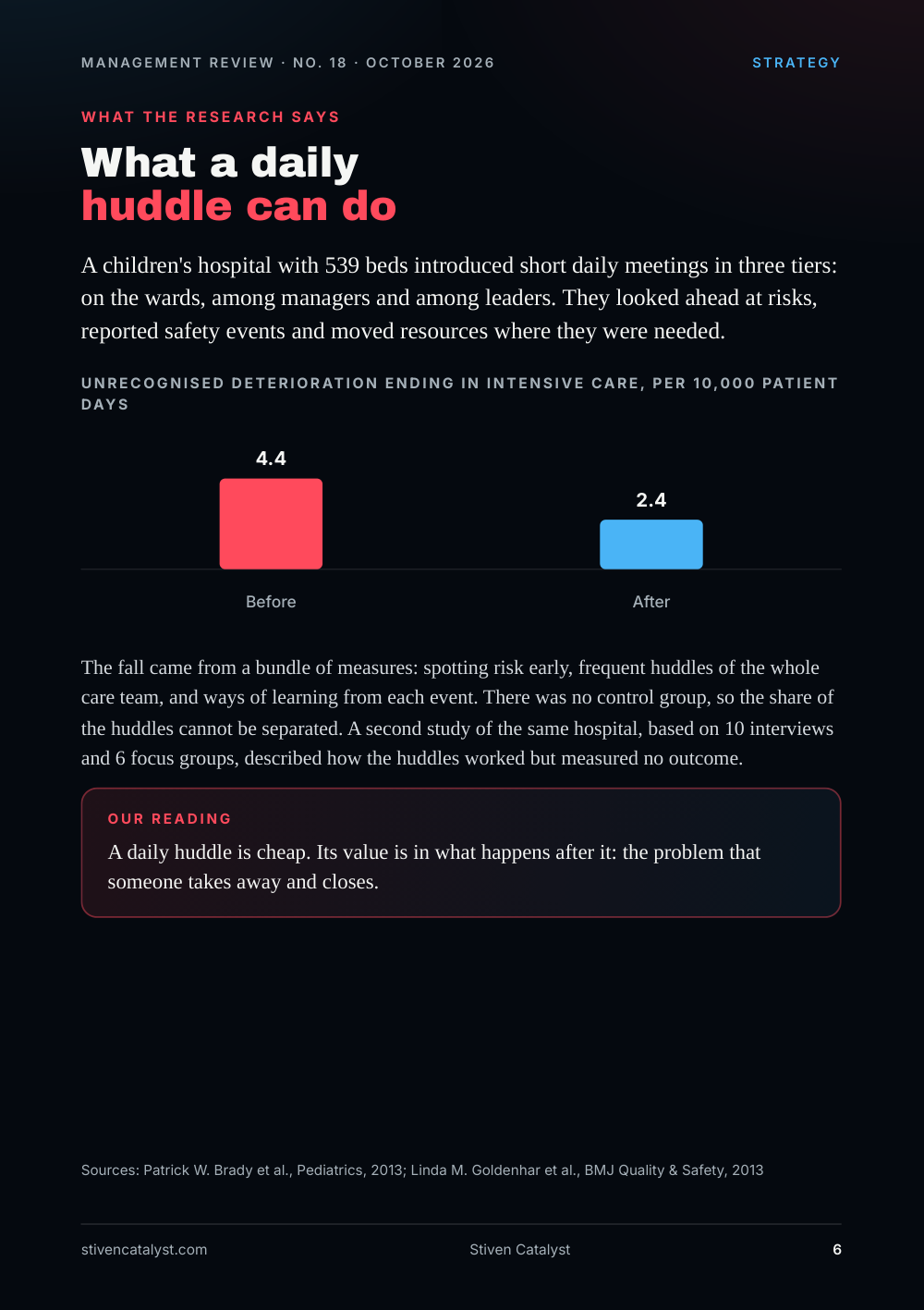
A children's hospital with 539 beds introduced short daily meetings in three tiers: on the wards, among managers and among leaders. They looked ahead at risks, reported safety events and moved resources where they were needed.
Unrecognised deterioration ending in intensive care, per 10,000 patient days: Before 4.4, After 2.4.
The fall came from a bundle of measures: spotting risk early, frequent huddles of the whole care team, and ways of learning from each event. There was no control group, so the share of the huddles cannot be separated. A second study of the same hospital, based on 10 interviews and 6 focus groups, described how the huddles worked but measured no outcome.
Our reading
A daily huddle is cheap. Its value is in what happens after it: the problem that someone takes away and closes.
Sources: Patrick W. Brady et al., Pediatrics, 2013; Linda M. Goldenhar et al., BMJ Quality & Safety, 2013
How it is measured
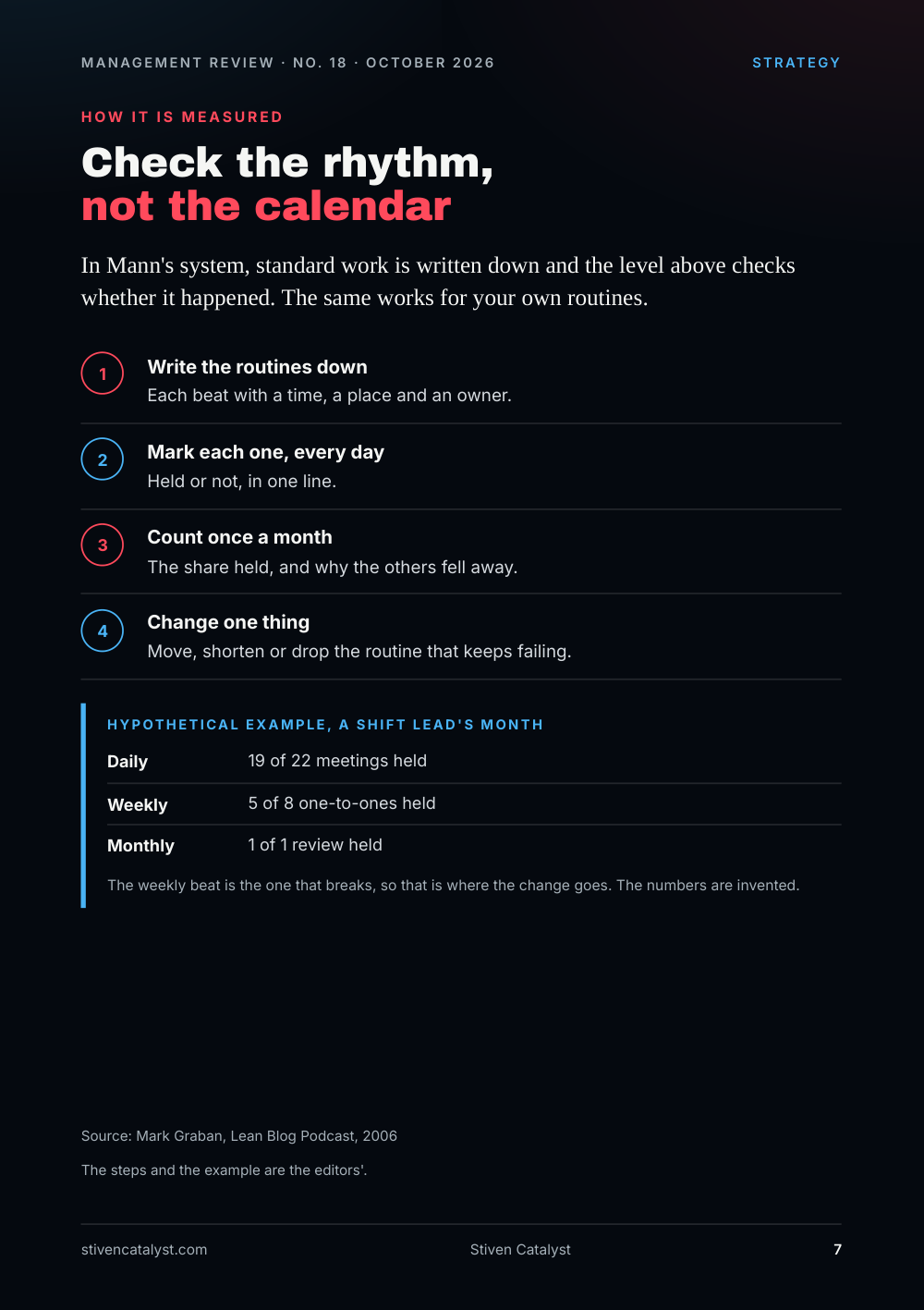
Check the rhy thm, not the calendar
In Mann's system, standard work is written down and the level above checks whether it happened. The same works for your own routines.
- Write the routines down. Each beat with a time, a place and an owner.
- Mark each one, every day. Held or not, in one line.
- Count once a month. The share held, and why the others fell away.
- Change one thing. Move, shorten or drop the routine that keeps failing.
Hypothe tical example, a shif t lead's month
- Daily: 19 of 22 meetings held
- Weekly: 5 of 8 one-to-ones held
- Monthly: 1 of 1 review held
The weekly beat is the one that breaks, so that is where the change goes. The numbers are invented.
The steps and the example are the editors'.
Source: Mark Graban, Lean Blog Podcast, 2006
Tool of the week
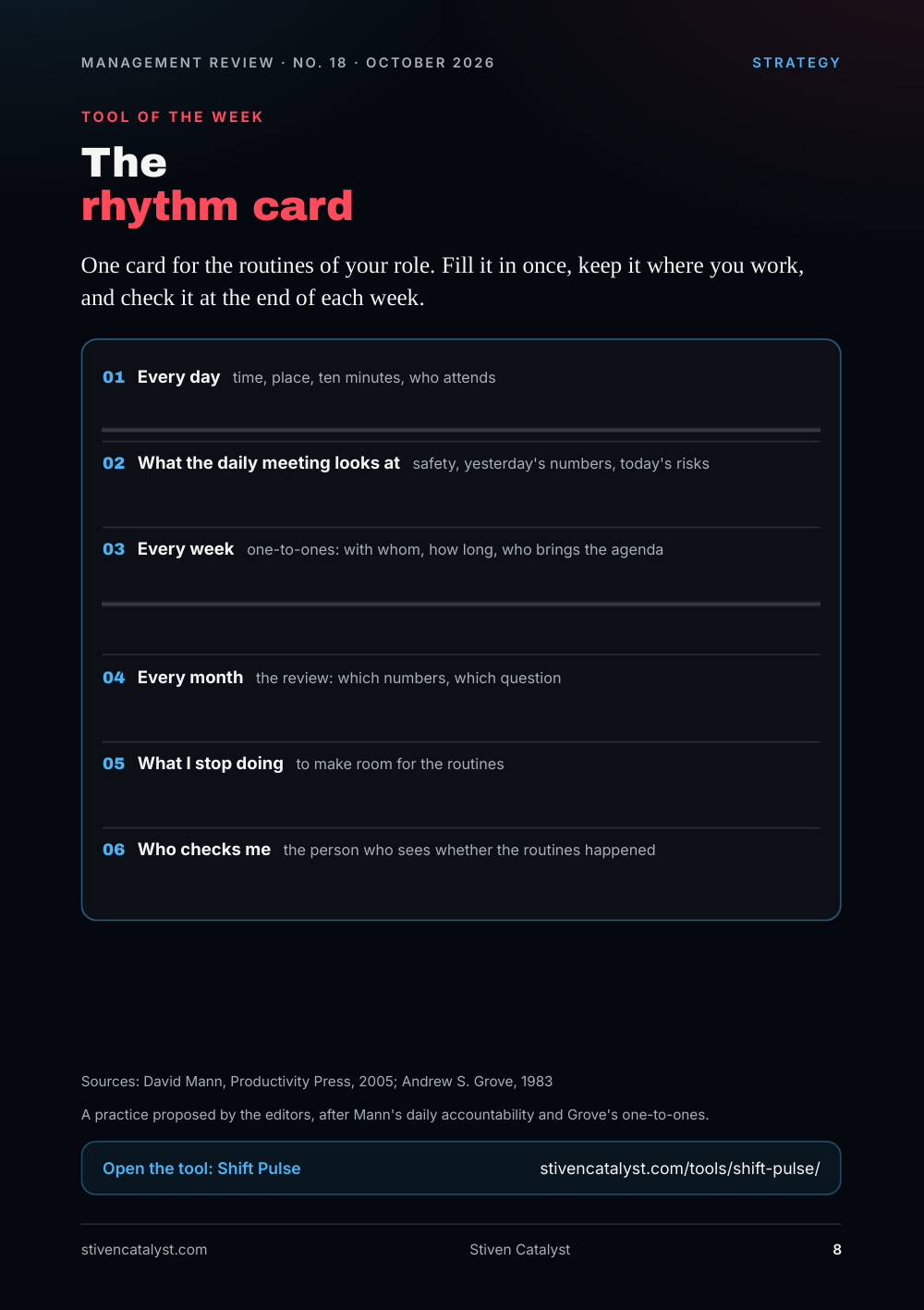
The rhy thm card
One card for the routines of your role. Fill it in once, keep it where you work, and check it at the end of each week.
- Every day time, place, ten minutes, who attends
- What the daily me
e ting looks at safety, yesterday's numbers, today's risks - Every week one-to-ones: with whom, how long, who brings the agenda
- Every month the review: which numbers, which question
- What I s
t op doing to make room for the routines - Who checks me the person who sees whether the routines happened
A practice proposed by the editors, after Mann's daily accountability and Grove's one-to-ones.
Sources: David Mann, Productivity Press, 2005; Andrew S. Grove, 1983
Open the tool: Shift Pulse
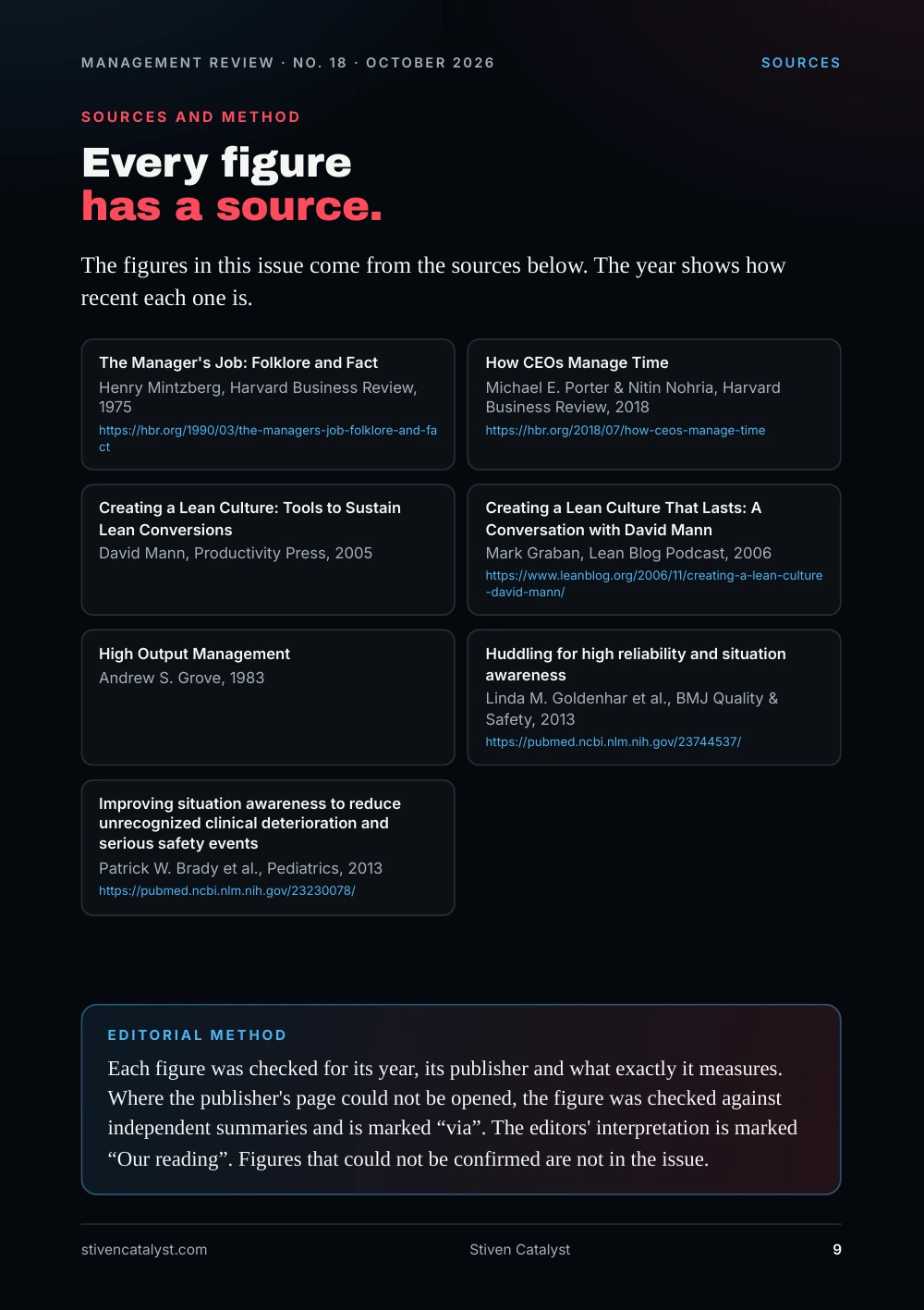
Sources and method
Every figure has a source.
The figures in this issue come from the sources below. The year shows how recent each one is.
- Henry Mintzberg, Harvard Business Review, “The Manager's Job: Folklore and Fact”, 1975. https://hbr.org/1990/03/the-managers-job-folklore-and-fact
- Michael E. Porter & Nitin Nohria, Harvard Business Review, “How CEOs Manage Time”, 2018. https://hbr.org/2018/07/how-ceos-manage-time
- David Mann, Productivity Press, “Creating a Lean Culture: Tools to Sustain Lean Conversions”, 2005.
- Mark Graban, Lean Blog Podcast, “Creating a Lean Culture That Lasts: A Conversation with David Mann”, 2006. https://www.leanblog.org/2006/11/creating-a-lean-culture-david-mann/
- Andrew S. Grove, “High Output Management”, 1983.
- Linda M. Goldenhar et al., BMJ Quality & Safety, “Huddling for high reliability and situation awareness”, 2013. https://pubmed.ncbi.nlm.nih.gov/23744537/
- Patrick W. Brady et al., Pediatrics, “Improving situation awareness to reduce unrecognized clinical deterioration and serious safety events”, 2013. https://pubmed.ncbi.nlm.nih.gov/23230078/
Edit orial me thod
Each figure was checked for its year, its publisher and what exactly it measures. Where the publisher's page could not be opened, the figure was checked against independent summaries and is marked “via”. The editors' interpretation is marked “Our reading”. Figures that could not be confirmed are not in the issue.