In this issue
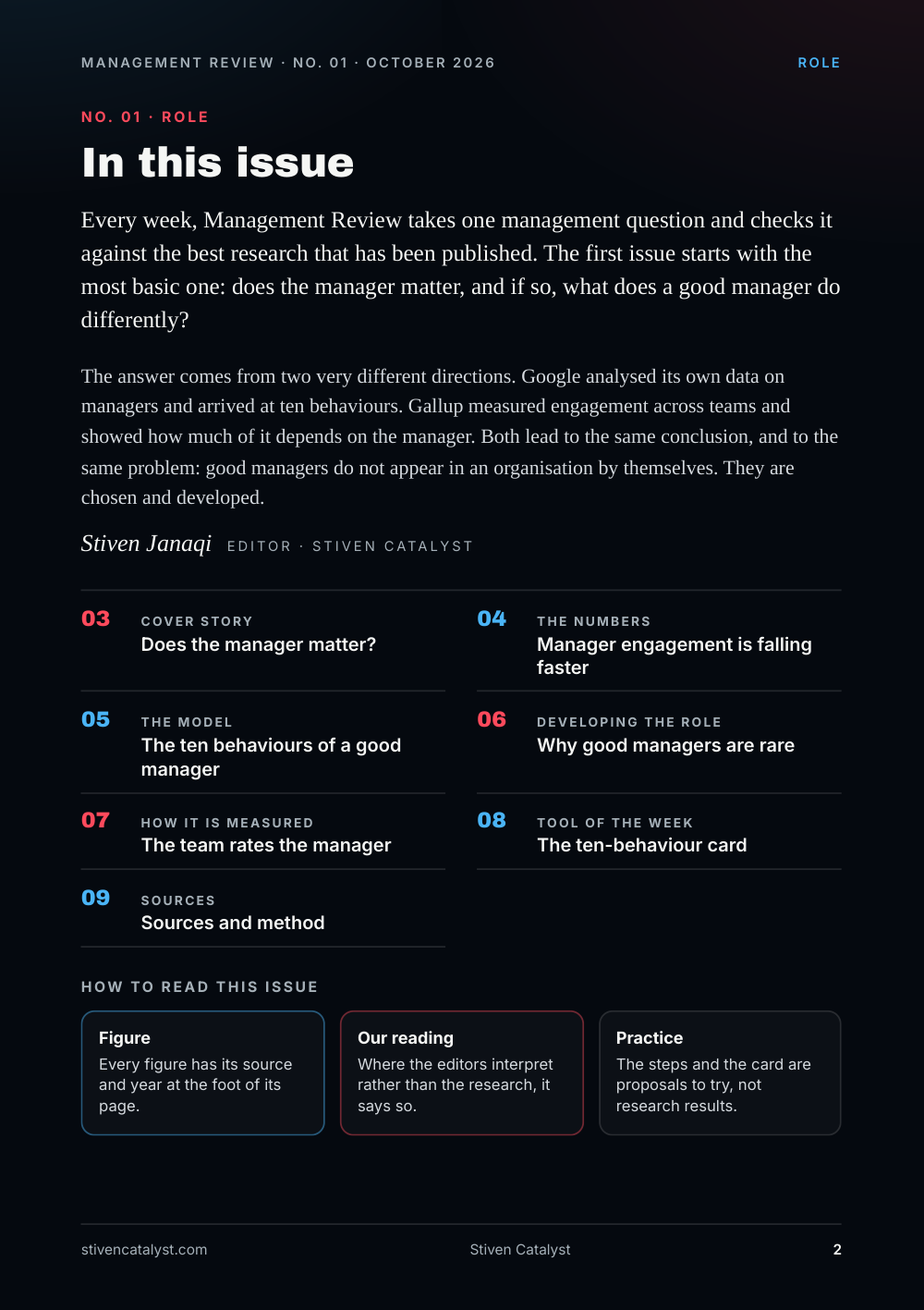
Every week, Management Review takes one management question and checks it against the best research that has been published. The first issue starts with the most basic one: does the manager matter, and if so, what does a good manager do differently?
The answer comes from two very different directions. Google analysed its own data on managers and arrived at ten behaviours. Gallup measured engagement across teams and showed how much of it depends on the manager. Both lead to the same conclusion, and to the same problem: good managers do not appear in an organisation by themselves. They are chosen and developed.
Stiven Janaqi, Editor
Cover story
Does the manager mat ter?
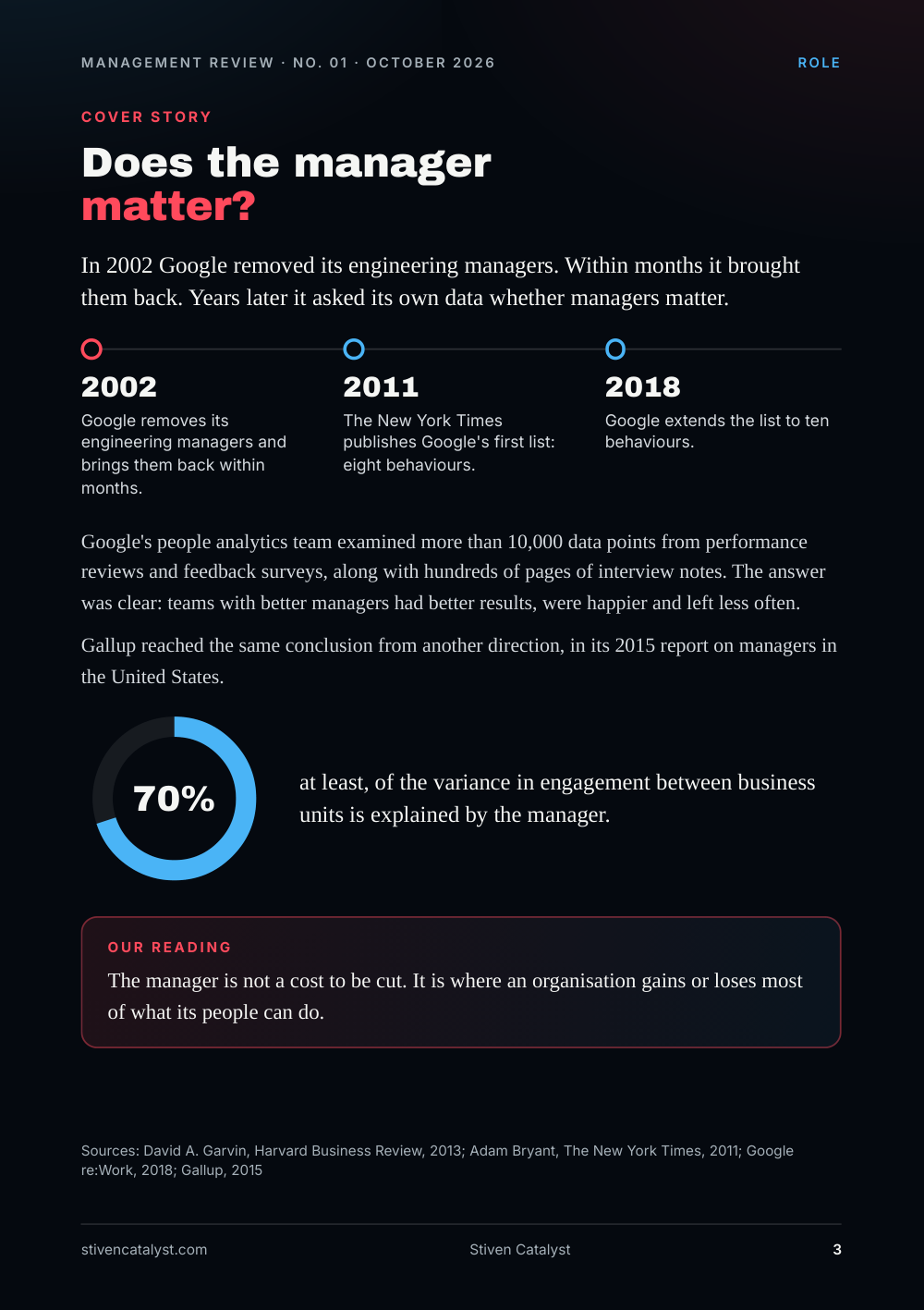
In 2002 Google removed its engineering managers. Within months it brought them back. Years later it asked its own data whether managers matter.
- 2002 Google removes its engineering managers and brings them back within months.
- 2011 The New York Times publishes Google's first list: eight behaviours.
- 2018 Google extends the list to ten behaviours.
Google's people analytics team examined more than 10,000 data points from performance reviews and feedback surveys, along with hundreds of pages of interview notes. The answer was clear: teams with better managers had better results, were happier and left less often.
Gallup reached the same conclusion from another direction, in its 2015 report on managers in the United States.
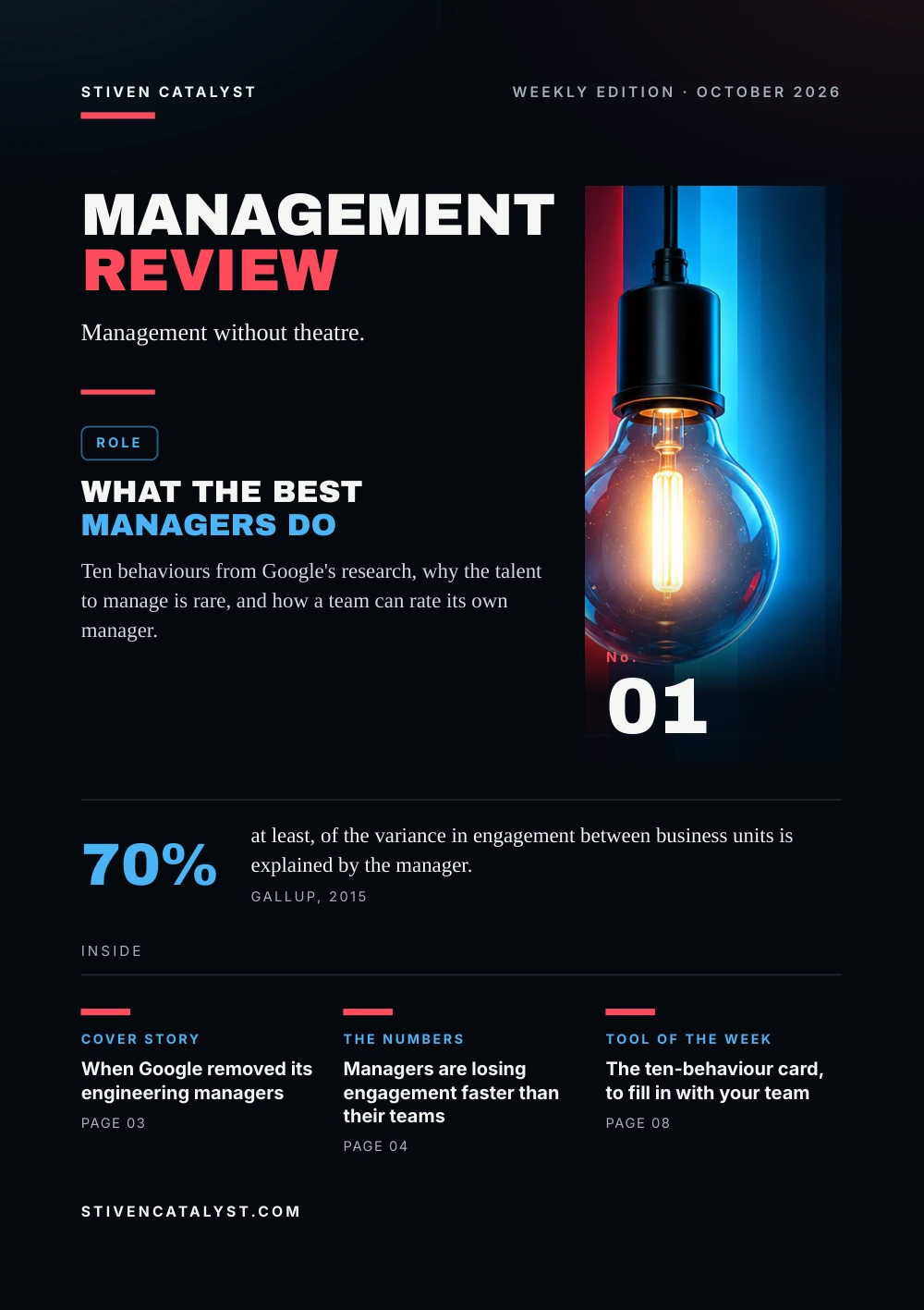
70% at least, of the variance in engagement between business units is explained by the manager.
Our reading
The manager is not a cost to be cut. It is where an organisation gains or loses most of what its people can do.
Sources: David A. Garvin, Harvard Business Review, 2013; Adam Bryant, The New York Times, 2011; Google re:Work, 2018; Gallup, 2015
The numbers
Manager engagement is falling faster
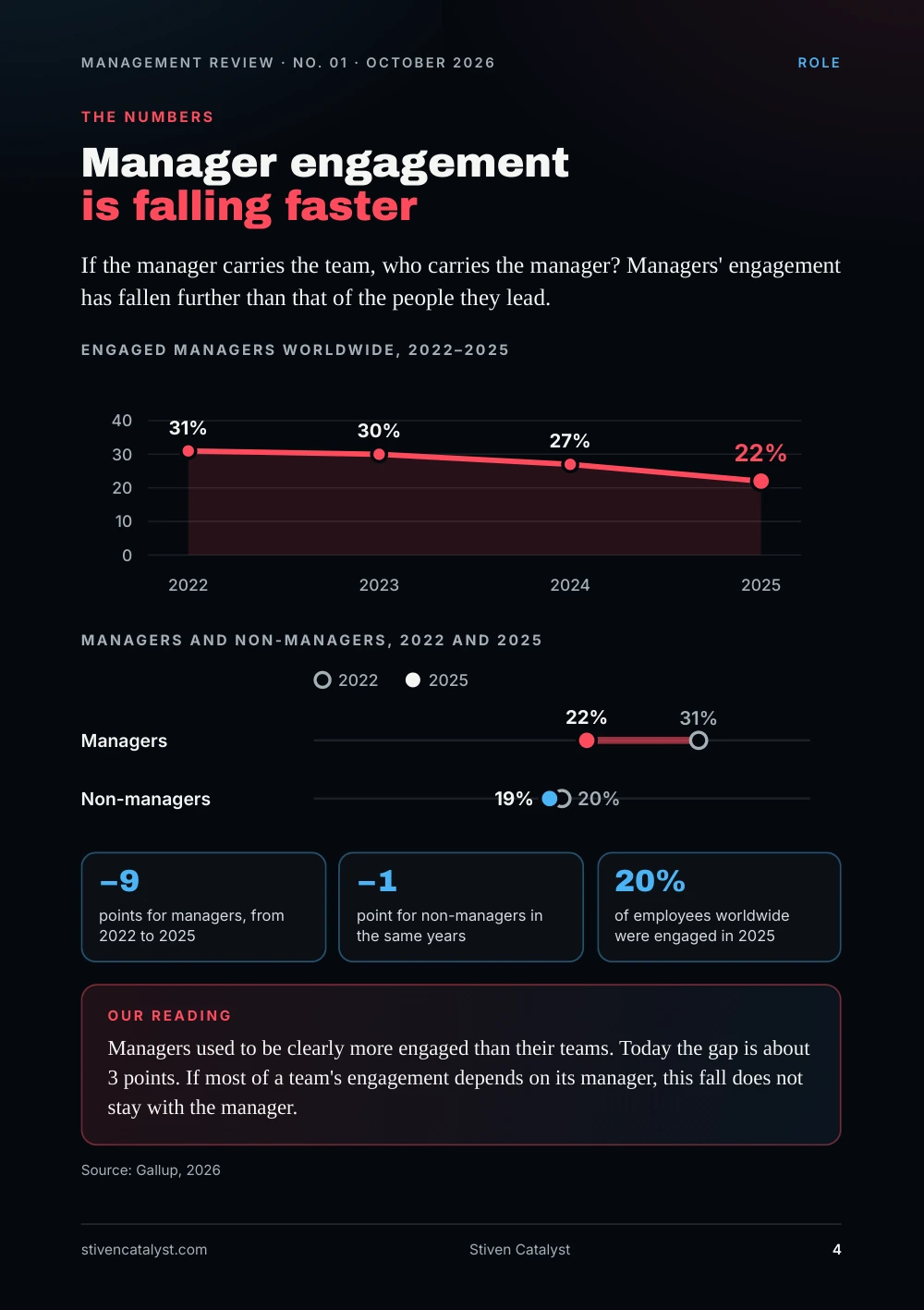
If the manager carries the team, who carries the manager? Managers' engagement has fallen further than that of the people they lead.
Engaged managers worldwide, 2022–2025: 2022 31%, 2023 30%, 2024 27%, 2025 22%.
Managers and non-managers, 2022 and 2025: Managers: 2022 31%, 2025 22%; Non-managers: 2022 20%, 2025 19%.
- −9 points for managers, from 2022 to 2025
- −1 point for non-managers in the same years
- 20% of employees worldwide were engaged in 2025
Our reading
Managers used to be clearly more engaged than their teams. Today the gap is about 3 points. If most of a team's engagement depends on its manager, this fall does not stay with the manager.
Source: Gallup, 2026
The model
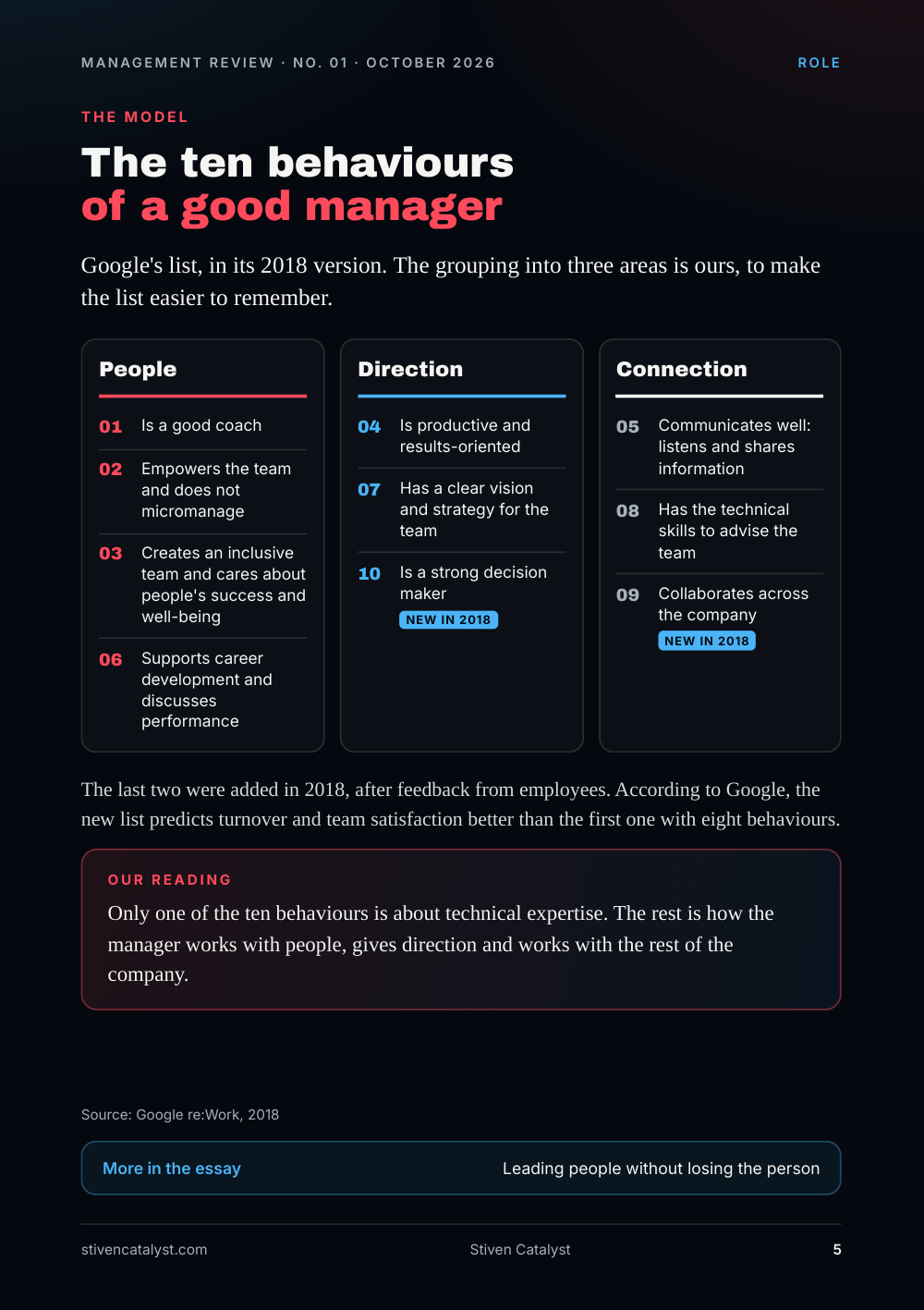
The ten behaviours of a good manager
Google's list, in its 2018 version. The grouping into three areas is ours, to make the list easier to remember.
People
- 01. Is a good coach
- 02. Empowers the team and does not micromanage
- 03. Creates an inclusive team and cares about people's success and well-being
- 06. Supports career development and discusses performance
Direction
- 04. Is productive and results-oriented
- 07. Has a clear vision and strategy for the team
- 10. Is a strong decision maker (New in 2018)
Connection
- 05. Communicates well: listens and shares information
- 08. Has the technical skills to advise the team
- 09. Collaborates across the company (New in 2018)
The last two were added in 2018, after feedback from employees. According to Google, the new list predicts turnover and team satisfaction better than the first one with eight behaviours.
Our reading
Only one of the ten behaviours is about technical expertise. The rest is how the manager works with people, gives direction and works with the rest of the company.
Source: Google re:Work, 2018
More in the essay: Leading people without losing the person
Developing the role
Why good managers are rare
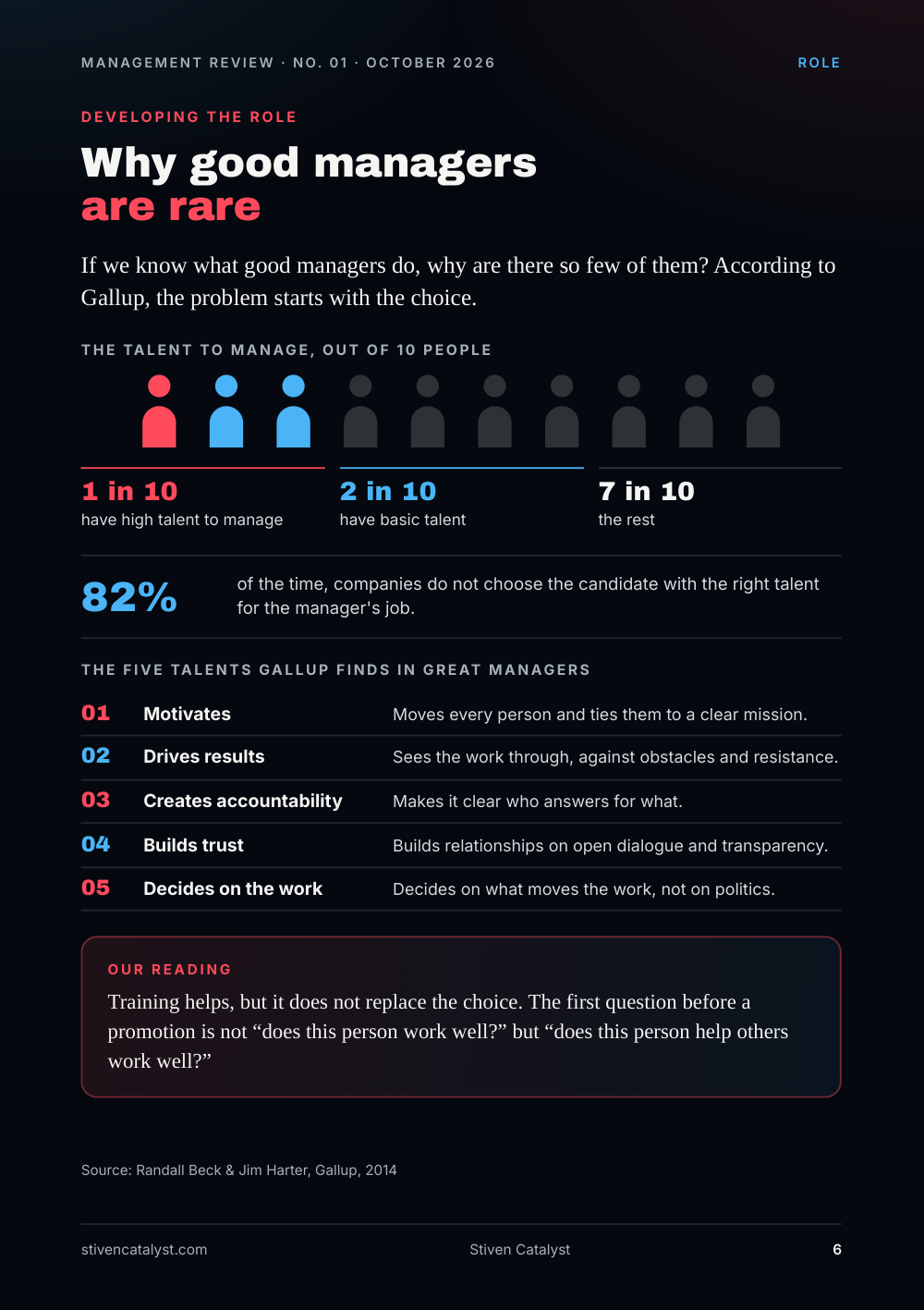
If we know what good managers do, why are there so few of them? According to Gallup, the problem starts with the choice.
The talent to manage, out of 10 people: 1 in 10 have high talent to manage, 2 in 10 have basic talent, 7 in 10 the rest.
82% of the time, companies do not choose the candidate with the right talent for the manager's job.
The five talents Gallup finds in great managers
- Motivates. Moves every person and ties them to a clear mission.
- Drives results. Sees the work through, against obstacles and resistance.
- Creates accountabili
t y. Makes it clear who answers for what. - Builds trust. Builds relationships on open dialogue and transparency.
- Decides on the work. Decides on what moves the work, not on politics.
Our reading
Training helps, but it does not replace the choice. The first question before a promotion is not “does this person work well?” but “does this person help others work well?”
Source: Randall Beck & Jim Harter, Gallup, 2014
How it is measured
The team rates the manager
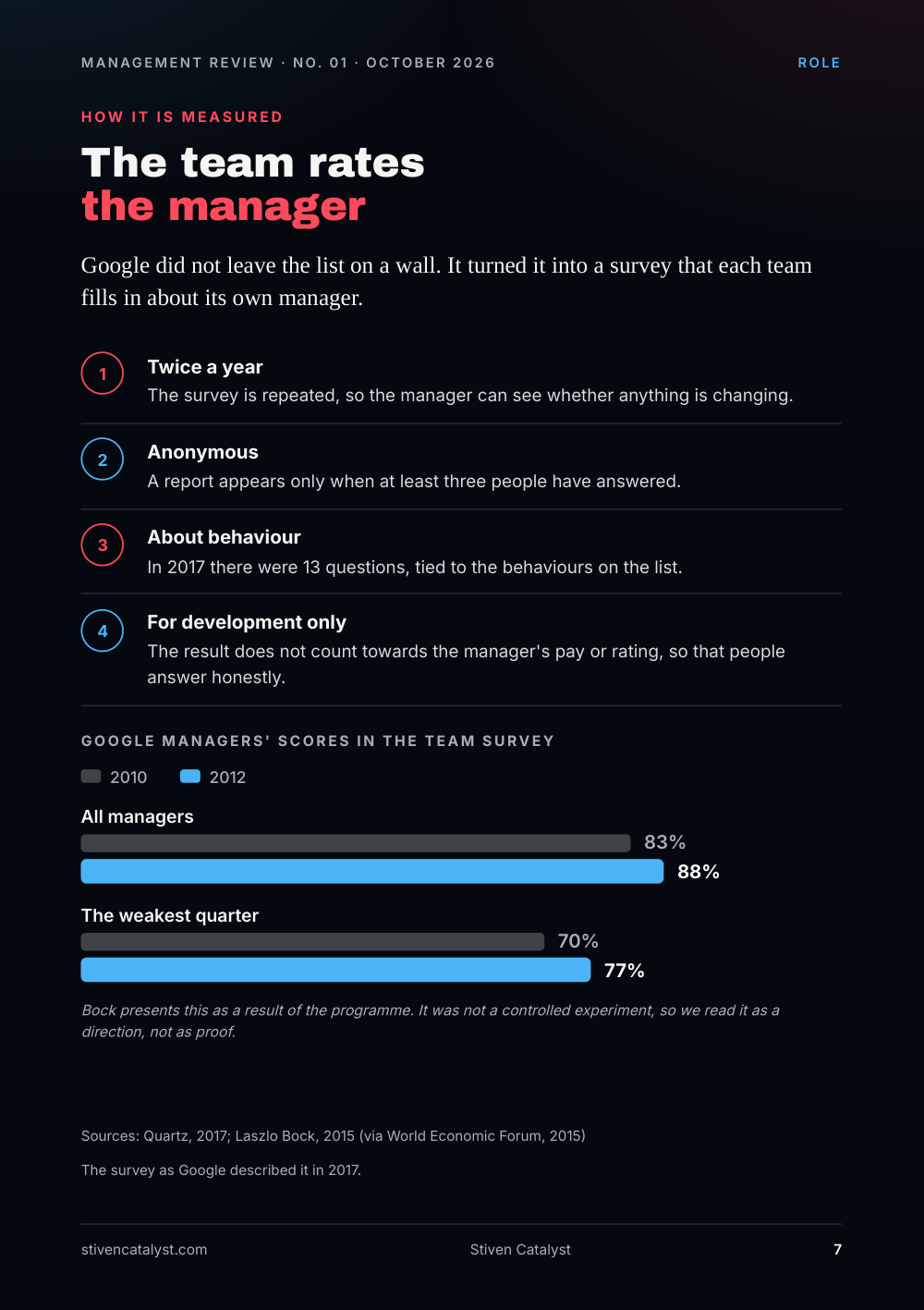
Google did not leave the list on a wall. It turned it into a survey that each team fills in about its own manager.
- Twice a year. The survey is repeated, so the manager can see whether anything is changing.
- Anonymous. A report appears only when at least three people have answered.
- About behaviour. In 2017 there were 13 questions, tied to the behaviours on the list.
- For development only. The result does not count towards the manager's pay or rating, so that people answer honestly.
Google managers' scores in the team survey: All managers: 2010 83%, 2012 88%; The weakest quarter: 2010 70%, 2012 77%.
Bock presents this as a result of the programme. It was not a controlled experiment, so we read it as a direction, not as proof.
The survey as Google described it in 2017.
Sources: Quartz, 2017; Laszlo Bock, 2015 (via World Economic Forum, 2015)
Tool of the week
The ten-behaviour card
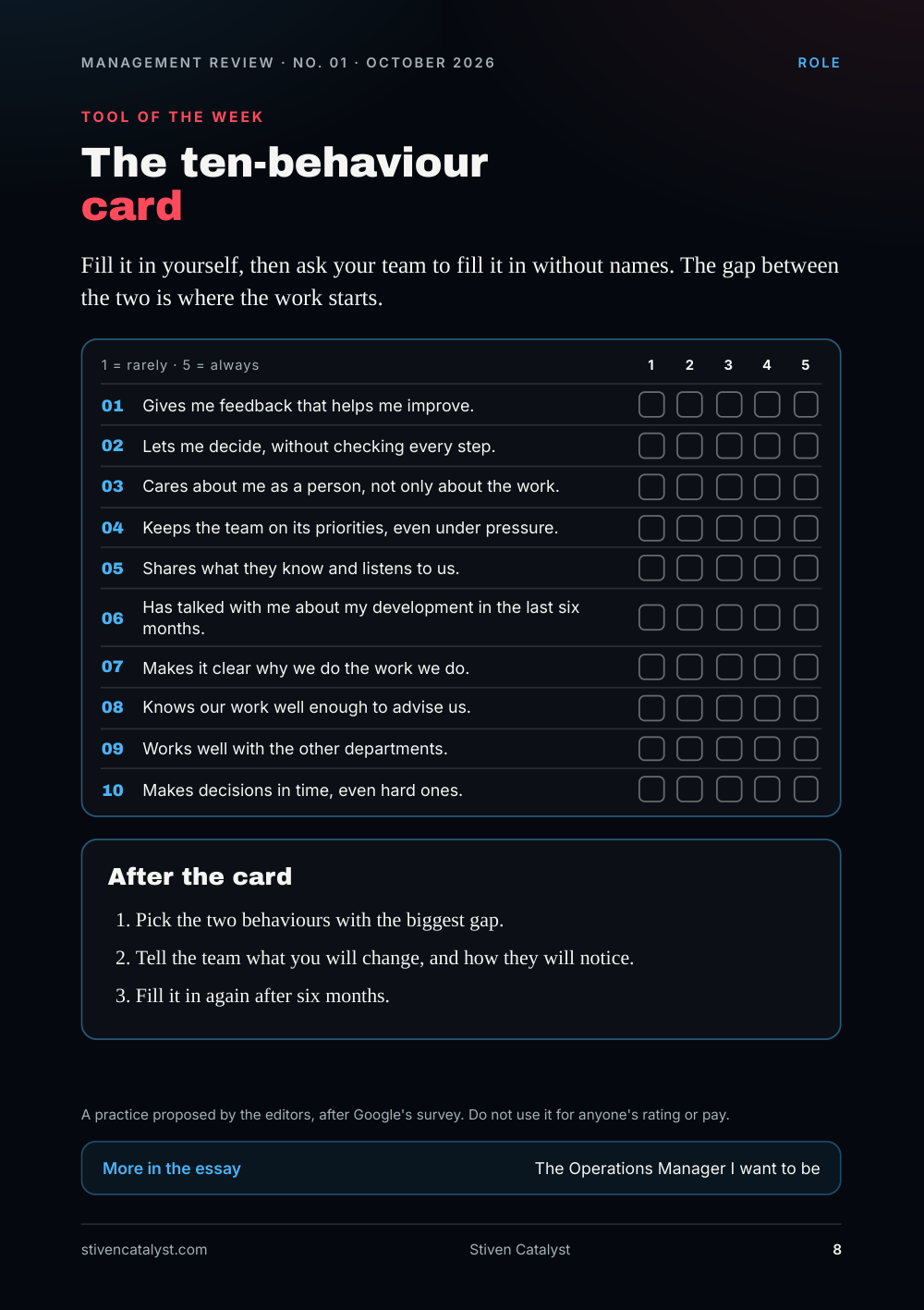
Fill it in yourself, then ask your team to fill it in without names. The gap between the two is where the work starts.
1 = rarely · 5 = always
- Gives me feedback that helps me improve.
- Lets me decide, without checking every step.
- Cares about me as a person, not only about the work.
- Keeps the team on its priorities, even under pressure.
- Shares what they know and listens to us.
- Has talked with me about my development in the last six months.
- Makes it clear why we do the work we do.
- Knows our work well enough to advise us.
- Works well with the other departments.
- Makes decisions in time, even hard ones.
Af ter the card
- Pick the two behaviours with the biggest gap.
- Tell the team what you will change, and how they will notice.
- Fill it in again after six months.
A practice proposed by the editors, after Google's survey. Do not use it for anyone's rating or pay.
More in the essay: The Operations Manager I want to be
Sources and method
Every figure has a source.
The figures in this issue come from the sources below. The year shows how recent each one is.
- Google re:Work, “Following the data: The research behind great managers”, 2018. https://rework.withgoogle.com/intl/en/guides/following-the-data-the-research-behind-great-managers
- David A. Garvin, Harvard Business Review, “How Google Sold Its Engineers on Management”, 2013. https://hbr.org/2013/12/how-google-sold-its-engineers-on-management
- Adam Bryant, The New York Times, “Google's Quest to Build a Better Boss”, 2011.
- Gallup, “State of the American Manager”, 2015. https://www.gallup.com/services/182138/state-american-manager.aspx
- Gallup, “State of the Global Workplace 2026”, 2026. https://www.gallup.com/workplace/349484/state-of-the-global-workplace.aspx
- Randall Beck & Jim Harter, Gallup, “Why Great Managers Are So Rare”, 2014. https://www.gallup.com/workplace/231593/why-great-managers-so-rare.aspx
- Quartz, “Manager feedback at Google: employees are asked 13 questions about their bosses”, 2017. https://qz.com/1058760/manager-feedback-at-google-employees-are-asked-13-questions-about-their-bosses-as-part-of-a-semi-annual-review-goog-googl
- Laszlo Bock, “Work Rules!”, 2015 (via World Economic Forum, 2015). https://www.weforum.org/stories/2015/04/the-9-habits-of-the-best-managers-according-to-googles-hr-boss/
Edit orial me thod
Each figure was checked for its year, its publisher and what exactly it measures. Where the publisher's page could not be opened, the figure was checked against independent summaries and is marked “via”. The editors' interpretation is marked “Our reading”. Figures that could not be confirmed are not in the issue.