In the Second World War, the US Training Within Industry service taught supervisors to teach a job the same way and to improve it, with four steps on a pocket card; Toyota later adopted the programmes. In 1986 Masaaki Imai brought the word kaizen to Western managers: improvement involving everyone, built on standards that are kept. A study of 11,575 firms found the wartime training still showing in sales and productivity ten years later, and at Toyota a seat is fitted in a written sequence timed in seconds.
Management Review · First series · October 2026 · No. 35
Standard work and kaizen
A wartime pocket card, what the plants reported, Imai's two parts of management, the three elements of standard work, ten years after the training, Toyota's 55 seconds, and a card for one kaizen.
- No.
- 35
- Pages
- 10
- Sources
- 7
- Topics
- Operations
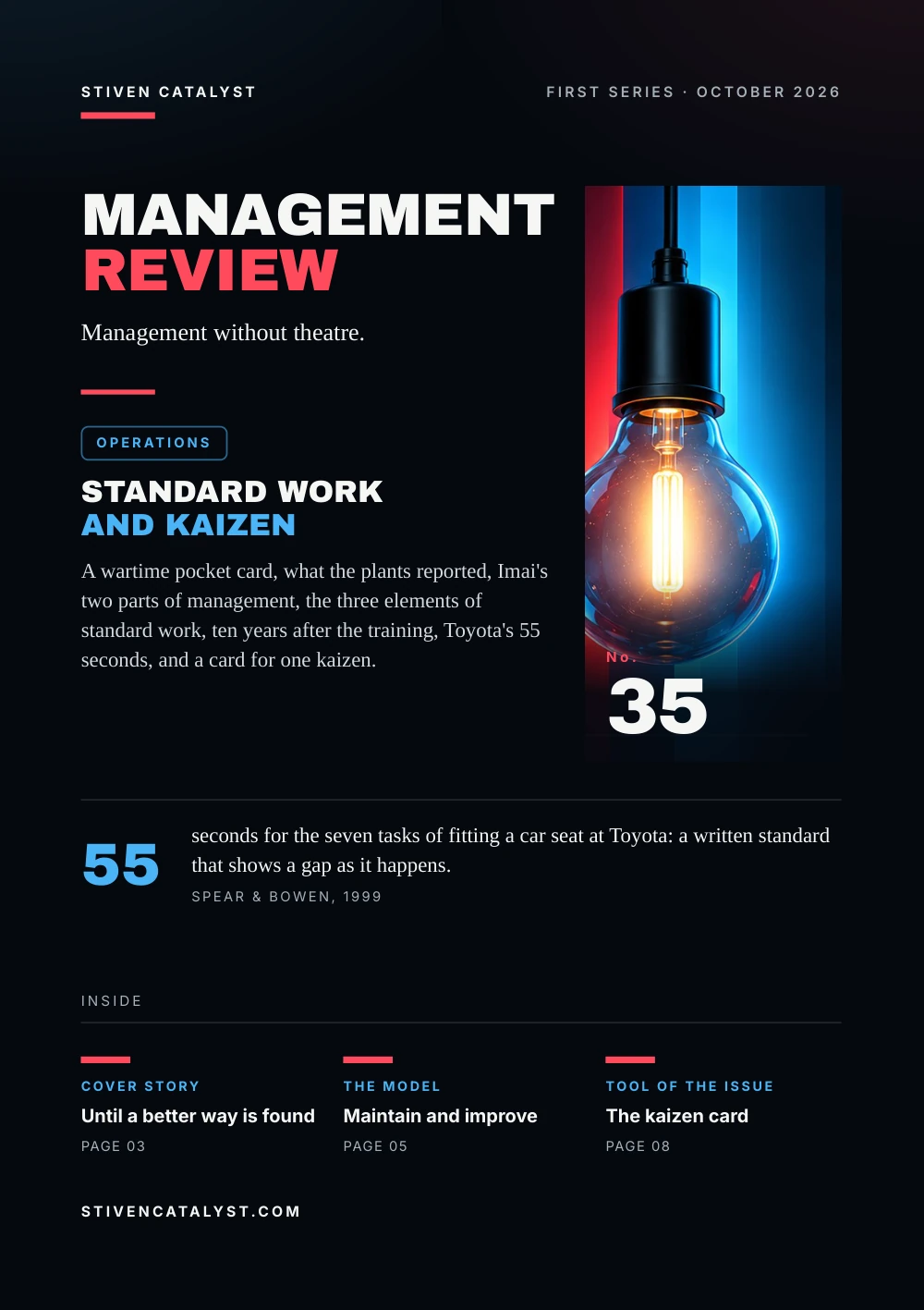
Stiven CatalystFirst series · October 2026
ManagementReview
Management without theatre.
Operations
Standard workand kaizen
A wartime pocket card, what the plants reported, Imai's two parts of management, the three elements of standard work, ten years after the training, Toyota's 55 seconds, and a card for one kaizen.

No.35
55
seconds for the seven tasks of fitting a car seat at Toyota: a written standard that shows a gap as it happens.Spear & Bowen, 1999
stivencatalyst.com
No. 35 · Operations
In this issue
A standard that nobody changes goes stale, and an improvement that nobody writes down is lost by the next shift. This issue is about the link between the two: the written best way to do a job today, and the habit of finding a better one.
- 03Cover storyUntil a better way is found
- 04The numbersWhat the plants reported
- 05The modelMaintain and improve
- 06What the research saysTen years after the training
- 07How it is measuredA gap you see in seconds
- 08Tool of the issueThe kaizen card
- 09SourcesSources and method
How to read this issue
Figure
Every figure has its source and year at the foot of its page.
Our reading
Where the editors interpret rather than the research, it says so.
Practice
The steps and the card are proposals to try, not research results.
Cover story
Until a be t terway is found
From 1940 to 1945, the US government's Training Within Industry service (TWI) trained supervisors in war plants. Each of its methods was so simple that it was printed on a pocket card.
01
Job Instruction
how to teach a job: important steps and key points, then show, try out, follow up
02
Job Methods
how to improve a job: break it down, question every detail, develop and apply the new method
03
Job Relations
how to handle a problem with people: get the facts, weigh and decide, act, check the results
The Job Methods card ends with one line: put the new method to work and use it until a better way is developed. By September 1945 TWI counted 1,750,650 certificates in 16,511 plants and unions. Toyota later adopted the programmes; Job Instruction is still the main training tool of its team leaders, says the Lean Enterprise Institute.
Our reading
Standard work and kaizen fit on one card: the new method becomes the standard, and the standard waits for the next better way.
Sources: War Manpower Commission, Bureau of Training, Training Within Industry Service, 1945; Lean Enterprise Institute, 2014
The counts are TWI's own. That Toyota adopted TWI comes from the Lean Enterprise Institute; the sources we checked do not give the year.
The numbers
What the plantsrepor ted
Asked by the US House of Representatives in 1943 for its results, TWI tabulated the voluntary reports of plants seven times. The last, September 1945:
Plants reporting a result of 25% or more, by kind of result, September 1945
In May 1943 most results were still under 25%. In one aircraft plant, a department where every supervisor held the Job Instruction certificate had a scrap cost of 15 cents per head; the plant average was 61.
Our reading
Plants chose whether to report, and TWI used the reports to back its budget requests. They show what managers saw; the comparison is on page 6.
Source: War Manpower Commission, Bureau of Training, Training Within Industry Service, 1945
Each share is of the plants that reported that kind of result; the report does not say how many plants each tabulation counted. The first one used more than 600 plant statements.
The model
Maintainand improve
In Kaizen (1986), Masaaki Imai defines kaizen as ongoing improvement involving everyone, managers and workers alike. In his account management has two parts: maintaining the current standards, through training and discipline, and improving them.
01
Takt time
the pace at which products must be made to meet customer demand
02
Work sequence
the order in which one operator does the tasks within the takt time
03
Standard inventory
the stock inside the process, including units in machines, that keeps it running smoothly
These are the three elements of standardized work for the Lean Enterprise Institute. Posted at the workstation, it is the baseline for the next kaizen. Its lexicon quotes Taiichi Ohno: there can be no kaizen without a standard.
The cycle, as the editors draw it
- 01
Standard
- 02
Train
- 03
See the gap
- 04
Improve
- 05
New standard
Our reading
A standard nobody follows is only a document. An improvement that never becomes the standard lasts as long as the person who made it.
Sources: Masaaki Imai, McGraw-Hill, 1986 (via Quality America, Kaizen); Lean Enterprise Institute, Lean Lexicon: Standardized Work, 2014; Lean Enterprise Institute, Lean Lexicon: Kaizen, 2014
Imai's definition and his two parts are confirmed in summaries of the book, not in the book itself.
More in the essayA good SOP is not a document
What the research says
Ten yearsaf ter the training
Nicola Bianchi and Michela Giorcelli collected data on all 11,575 US firms that applied to TWI. Money and trainers ran short: 48% received no training, and only 7% received all three modules.
Trained against untrained applicants, one and ten years after the training
Before the training, both groups followed the same trends. Sales of trained firms peaked in the eighth year, 21.7% above the others. Firms trained in Job Instruction began to set standard procedures for operations, and the gains held even as many top managers left after the war.
Our reading
The training lasted because it changed how the work was organised, not only what one manager knew.
Source: Nicola Bianchi & Michela Giorcelli, Journal of Political Economy, 2022 (via NBER Working Paper 28833, 2021)
A natural experiment, not a randomised trial. The figures are from the 2021 working paper; the article appeared in the Journal of Political Economy in 2022.
How it is measured
A gap you seein seconds
Steven Spear and Kent Bowen studied more than 40 plants over four years. Their first rule of the Toyota Production System: all work is highly specified as to content, sequence, timing and outcome.
At Toyota's plant in Georgetown, Kentucky, fitting the right-front seat of a Camry was designed as seven tasks in 55 seconds. A worker still on task 4 after 40 seconds, when it should end at 31, is behind; the floor of the zone is marked in tenths, so he and his team leader see it at once.
Not done as specified
Find the true skill of the person or capability of the machine; train or modify.
Done as specified, still defective
Change the design of the work: the standard itself was wrong.
Hypothetical example, a packing station
- Standard
- six steps in 90 seconds; the label is checked at step 5
- Observed
- step 5 skipped on 4 of 20 orders at the evening peak
- Response
- the scanner sits too far away: move it, test for a week, rewrite the standard
A gap in the standard, not in the person. The case is invented.
Source: Steven Spear & H. Kent Bowen, Harvard Business Review, 1999
The Camry example dates from 1999. The two responses follow Spear and Bowen; the packing example is the editors'.
Tool of the issue
The kaizencard
One card for one improvement to one standard. Fill it in where the work is done, with the people who do it; when the cause needs digging, the 5 Whys worksheet helps.
01The standardthe job, its important steps and key points, the date of the version
02Timewhat the standard allows, what it took today
03The gapwhat departed from the standard, where, how often
04Not followed, or wrong?train the person, or change the standard
05One small changewho tries it, until when, measured the same way as before
06New standardwritten, posted, taught with the four steps of Job Instruction
Sources: War Manpower Commission, Bureau of Training, Training Within Industry Service, 1945; Steven Spear & H. Kent Bowen, Harvard Business Review, 1999; Masaaki Imai, McGraw-Hill, 1986 (via Quality America, Kaizen)
A practice proposed by the editors, after TWI's Job Instruction and Job Methods cards (1945), Spear & Bowen (1999) and Imai (1986).
Open the tool: 5 Whysstivencatalyst.com/tools/five-whys/
Sources and method
Every figurehas a source.
The figures in this issue come from the sources below. The year shows how recent each one is.
- The Training Within Industry Report, 1940-1945War Manpower Commission, Bureau of Training, Training Within Industry Service, 1945https://www.govinfo.gov/content/pkg/GOVPUB-PR32_5200-00275cf1fd80a1d51995ae716fd38f34/html/GOVPUB-PR32_5200-00275cf1fd80a1d51995ae716fd38f34.htm
- Lean Lexicon: Training Within Industry (TWI)Lean Enterprise Institute, 2014https://www.lean.org/lexicon-terms/training-within-industry-twi/
- Kaizen: The Key to Japan's Competitive SuccessMasaaki Imai, McGraw-Hill, 1986 · via Quality America, Kaizenhttps://qualityamerica.com/LSS-Knowledge-Center/qualityimprovementtools/kaizen.php
- Lean Lexicon: Standardized WorkLean Enterprise Institute, 2014https://www.lean.org/lexicon-terms/standardized-work/
- Lean Lexicon: KaizenLean Enterprise Institute, 2014https://www.lean.org/lexicon-terms/kaizen/
- The Dynamics and Spillovers of Management Interventions: Evidence from the Training Within Industry ProgramNicola Bianchi & Michela Giorcelli, Journal of Political Economy, 2022 · via NBER Working Paper 28833, 2021https://www.nber.org/papers/w28833
- Decoding the DNA of the Toyota Production SystemSteven Spear & H. Kent Bowen, Harvard Business Review, 1999https://hbr.org/1999/09/decoding-the-dna-of-the-toyota-production-system
Editorial method
Each figure was checked for its year, its publisher and what exactly it measures. Where the publisher's page could not be opened, the figure was checked against independent summaries and is marked “via”. The editors' interpretation is marked “Our reading”. Figures that could not be confirmed are not in the issue.
ManagementReview
Management without theatre.
Every issue, one management question, checked against the best research.
All issues
stivencatalyst.com/magazine/management-review.html
Management Review · No. 35 · October 2026 · Stiven Catalyst
Click or swipe a page to turn it. The arrow keys work too.
Management Review · No. 35
The figures of the issue
The charts of the printed pages, with their sources.
Source: War Manpower Commission, Bureau of Training, Training Within Industry Service, 1945
Source: Nicola Bianchi & Michela Giorcelli, Journal of Political Economy, 2022 (via NBER Working Paper 28833, 2021)
The whole text Read the issue as text For reading on a small screen, searching or a screen reader. The same words, without the page design.
In this issue
A standard that nobody changes goes stale, and an improvement that nobody writes down is lost by the next shift. This issue is about the link between the two: the written best way to do a job today, and the habit of finding a better one.
In the Second World War, the US Training Within Industry service taught supervisors to teach a job the same way and to improve it, with four steps on a pocket card; Toyota later adopted the programmes. In 1986 Masaaki Imai brought the word kaizen to Western managers: improvement involving everyone, built on standards that are kept. A study of 11,575 firms found the wartime training still showing in sales and productivity ten years later, and at Toyota a seat is fitted in a written sequence timed in seconds.
Stiven Janaqi, Editor
Cover story
Until a be t ter way is found
From 1940 to 1945, the US government's Training Within Industry service (TWI) trained supervisors in war plants. Each of its methods was so simple that it was printed on a pocket card.
- Job Instruction. how to teach a job: important steps and key points, then show, try out, follow up
- Job M
e thods. how to improve a job: break it down, question every detail, develop and apply the new method - Job Relations. how to handle a problem with people: get the facts, weigh and decide, act, check the results
The Job Methods card ends with one line: put the new method to work and use it until a better way is developed. By September 1945 TWI counted 1,750,650 certificates in 16,511 plants and unions. Toyota later adopted the programmes; Job Instruction is still the main training tool of its team leaders, says the Lean Enterprise Institute.
Our reading
Standard work and kaizen fit on one card: the new method becomes the standard, and the standard waits for the next better way.
The counts are TWI's own. That Toyota adopted TWI comes from the Lean Enterprise Institute; the sources we checked do not give the year.
Sources: War Manpower Commission, Bureau of Training, Training Within Industry Service, 1945; Lean Enterprise Institute, 2014
The numbers
What the plants repor ted
Asked by the US House of Representatives in 1943 for its results, TWI tabulated the voluntary reports of plants seven times. The last, September 1945:
Plants reporting a result of 25% or more, by kind of result, September 1945: Training time reduced 100%, Grievances reduced 100%, Manpower saved 88%, Production increased 86%, Scrap loss reduced 55%.
In May 1943 most results were still under 25%. In one aircraft plant, a department where every supervisor held the Job Instruction certificate had a scrap cost of 15 cents per head; the plant average was 61.
Our reading
Plants chose whether to report, and TWI used the reports to back its budget requests. They show what managers saw; the comparison is on page 6.
Each share is of the plants that reported that kind of result; the report does not say how many plants each tabulation counted. The first one used more than 600 plant statements.
Source: War Manpower Commission, Bureau of Training, Training Within Industry Service, 1945
The model
Maintain and improve
In Kaizen (1986), Masaaki Imai defines kaizen as ongoing improvement involving everyone, managers and workers alike. In his account management has two parts: maintaining the current standards, through training and discipline, and improving them.
- Takt time. the pace at which products must be made to meet customer demand
- Work sequence. the order in which one operator does the tasks within the takt time
- Standard inven
t ory. the stock inside the process, including units in machines, that keeps it running smoothly
These are the three elements of standardized work for the Lean Enterprise Institute. Posted at the workstation, it is the baseline for the next kaizen. Its lexicon quotes Taiichi Ohno: there can be no kaizen without a standard.
The cycle, as the edit ors draw it
- Standard.
- Train.
- See the gap.
- Improve.
- New standard.
Our reading
A standard nobody follows is only a document. An improvement that never becomes the standard lasts as long as the person who made it.
Imai's definition and his two parts are confirmed in summaries of the book, not in the book itself.
Sources: Masaaki Imai, McGraw-Hill, 1986 (via Quality America, Kaizen); Lean Enterprise Institute, Lean Lexicon: Standardized Work, 2014; Lean Enterprise Institute, Lean Lexicon: Kaizen, 2014
More in the essay: A good SOP is not a document
What the research says
Ten years af ter the training
Nicola Bianchi and Michela Giorcelli collected data on all 11,575 US firms that applied to TWI. Money and trainers ran short: 48% received no training, and only 7% received all three modules.
Trained against untrained applicants, one and ten years after the training: Productivity: Year 1 6%, Year 10 27%; Sales: Year 1 5.3%, Year 10 16%.
Before the training, both groups followed the same trends. Sales of trained firms peaked in the eighth year, 21.7% above the others. Firms trained in Job Instruction began to set standard procedures for operations, and the gains held even as many top managers left after the war.
Our reading
The training lasted because it changed how the work was organised, not only what one manager knew.
A natural experiment, not a randomised trial. The figures are from the 2021 working paper; the article appeared in the Journal of Political Economy in 2022.
Source: Nicola Bianchi & Michela Giorcelli, Journal of Political Economy, 2022 (via NBER Working Paper 28833, 2021)
How it is measured
A gap you see in seconds
Steven Spear and Kent Bowen studied more than 40 plants over four years. Their first rule of the Toyota Production System: all work is highly specified as to content, sequence, timing and outcome.
At Toyota's plant in Georgetown, Kentucky, fitting the right-front seat of a Camry was designed as seven tasks in 55 seconds. A worker still on task 4 after 40 seconds, when it should end at 31, is behind; the floor of the zone is marked in tenths, so he and his team leader see it at once.
- Not done as specified. Find the true skill of the person or capability of the machine; train or modify.
- Done as specified, still defective. Change the design of the work: the standard itself was wrong.
Hypothe tical example, a packing station
- Standard: six steps in 90 seconds; the label is checked at step 5
- Observed: step 5 skipped on 4 of 20 orders at the evening peak
- Response: the scanner sits too far away: move it, test for a week, rewrite the standard
A gap in the standard, not in the person. The case is invented.
The Camry example dates from 1999. The two responses follow Spear and Bowen; the packing example is the editors'.
Source: Steven Spear & H. Kent Bowen, Harvard Business Review, 1999
Tool of the issue
The kaizen card
One card for one improvement to one standard. Fill it in where the work is done, with the people who do it; when the cause needs digging, the 5 Whys worksheet helps.
- The standard the job, its important steps and key points, the date of the version
- Time what the standard allows, what it took today
- The gap what departed from the standard, where, how often
- Not followed, or wrong? train the person, or change the standard
- One small change who tries it, until when, measured the same way as before
- New standard written, posted, taught with the four steps of Job Instruction
A practice proposed by the editors, after TWI's Job Instruction and Job Methods cards (1945), Spear & Bowen (1999) and Imai (1986).
Sources: War Manpower Commission, Bureau of Training, Training Within Industry Service, 1945; Steven Spear & H. Kent Bowen, Harvard Business Review, 1999; Masaaki Imai, McGraw-Hill, 1986 (via Quality America, Kaizen)
Open the tool: 5 Whys
Sources and method
Every figure has a source.
The figures in this issue come from the sources below. The year shows how recent each one is.
- War Manpower Commission, Bureau of Training, Training Within Industry Service, “The Training Within Industry Report, 1940-1945”, 1945. https://www.govinfo.gov/content/pkg/GOVPUB-PR32_5200-00275cf1fd80a1d51995ae716fd38f34/html/GOVPUB-PR32_5200-00275cf1fd80a1d51995ae716fd38f34.htm
- Lean Enterprise Institute, “Lean Lexicon: Training Within Industry (TWI)”, 2014. https://www.lean.org/lexicon-terms/training-within-industry-twi/
- Masaaki Imai, McGraw-Hill, “Kaizen: The Key to Japan's Competitive Success”, 1986 (via Quality America, Kaizen). https://qualityamerica.com/LSS-Knowledge-Center/qualityimprovementtools/kaizen.php
- Lean Enterprise Institute, “Lean Lexicon: Standardized Work”, 2014. https://www.lean.org/lexicon-terms/standardized-work/
- Lean Enterprise Institute, “Lean Lexicon: Kaizen”, 2014. https://www.lean.org/lexicon-terms/kaizen/
- Nicola Bianchi & Michela Giorcelli, Journal of Political Economy, “The Dynamics and Spillovers of Management Interventions: Evidence from the Training Within Industry Program”, 2022 (via NBER Working Paper 28833, 2021). https://www.nber.org/papers/w28833
- Steven Spear & H. Kent Bowen, Harvard Business Review, “Decoding the DNA of the Toyota Production System”, 1999. https://hbr.org/1999/09/decoding-the-dna-of-the-toyota-production-system
Edit orial me thod
Each figure was checked for its year, its publisher and what exactly it measures. Where the publisher's page could not be opened, the figure was checked against independent summaries and is marked “via”. The editors' interpretation is marked “Our reading”. Figures that could not be confirmed are not in the issue.
Management Review · Monthly edition