A fire lieutenant ordered his crew out moments before the floor collapsed, and at first could explain it only as ESP. In a study from 1985, experienced fireground commanders compared options in fewer than 12% of 156 decisions. Gary Klein's recognition-primed decision model shows what they did instead. Experiments show that stress makes choices riskier and the search for options shorter. Daniel Kahneman and Klein set out when such intuition deserves trust.
Management Review · Second series · November 2026 · No. 62
Decisions under pressure
A floor that was too quiet, 156 decisions on the fireground, recognise then simulate, what stress does to choices, when a gut feeling deserves trust, and a card for a fast decision.
- No.
- 62
- Pages
- 10
- Sources
- 7
- Topics
- Role
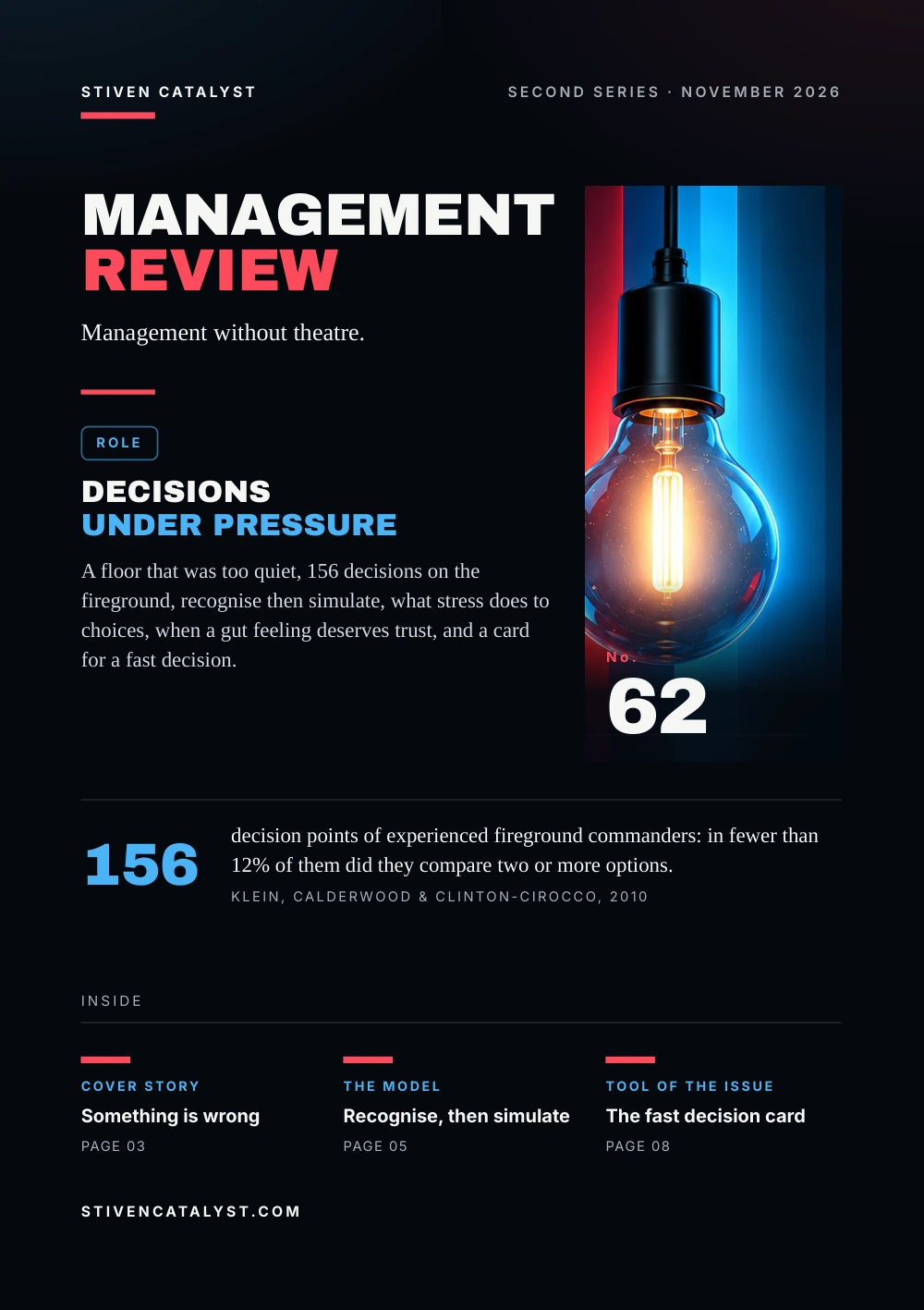
Stiven CatalystSecond series · November 2026
ManagementReview
Management without theatre.
Role
Decisionsunder pressure
A floor that was too quiet, 156 decisions on the fireground, recognise then simulate, what stress does to choices, when a gut feeling deserves trust, and a card for a fast decision.

No.62
156
decision points of experienced fireground commanders: in fewer than 12% of them did they compare two or more options.Klein, Calderwood & Clinton-Cirocco, 2010
stivencatalyst.com
No. 62 · Role
In this issue
Under pressure there is rarely time to list the options, weigh them and pick the best. Yet decisions still get made, and many of them are good. This issue asks how experienced people decide when time is short, what stress changes, and when a fast judgement can be trusted.
- 03Cover storySomething is wrong
- 04The numbersOne option, not two
- 05The modelRecognise, then simulate
- 06What the research saysWhat stress does to choices
- 07How it is measuredWhen the gut deserves trust
- 08Tool of the issueThe fast decision card
- 09SourcesSources and method
How to read this issue
Figure
Every figure has its source and year at the foot of its page.
Our reading
Where the editors interpret rather than the research, it says so.
Practice
The steps and the card are proposals to try, not research results.
Cover story
Some thingis wrong
A Cleveland fire commander told Gary Klein about a decision from his days as a lieutenant. The fire seemed to be in the kitchen of a one-storey house. Water hardly helped, and the crew pulled back into the living room. There he ordered everyone out. Moments later, the floor they had stood on collapsed.
The fire had been in the basement. Asked why he gave the order, he spoke of ESP. Klein went through the incident with him for two hours, and the reasons came out.
01
Water
A kitchen fire should die down under water. This one did not.
02
Heat
The room was hotter than a kitchen fire would make it.
03
Quiet
For that much heat, the fire was too quiet. The floor muffled it.
Our reading
He did not see more than his crew. He noticed sooner that what he saw did not match what he expected.
Source: Malcolm Gladwell, Little, Brown, 2005 (via Quoted in Fire Engineering, "Rapid Cognition: Think Fast!", 2011; Max Bazerman, Harvard Program on Negotiation, 2013)
From Klein's interviews, told after Malcolm Gladwell's retelling in Blink (2005) as retold by Fire Engineering and Max Bazerman; we could not see Klein's own account. The cues were reconstructed afterwards.
The numbers
One op tion,not two
In 1985 Gary Klein, Roberta Calderwood and Anne Clinton-Cirocco interviewed 26 experienced fireground commanders (23 years of experience on average) about 156 decision points in real incidents. They expected them to compare at least two options. They were wrong.
156 decision points of fireground commanders, study of 1985
Usually one option came to mind first, and it was enough. In 2021 Klein added that inexperienced decision makers use this approach less than half the time, and that people use it even when time is not short.
Our reading
Under pressure, experts do not choose faster among options. Mostly they never line options up at all.
Sources: Gary Klein, Roberta Calderwood & Anne Clinton-Cirocco, Journal of Cognitive Engineering and Decision Making 4(3), 2010 (via Abstract at SAGE); Gary Klein, Psychology Today, 2021
Done in 1985, republished with a postscript in 2010; the abstract gives the shares only as “over 80%” and “less than 12%”, and so does the chart. Interviews after the event: how commanders remembered deciding.
The model
Recognise,then simulate
From these interviews came the recognition-primed decision (RPD) model. Klein describes two processes: matching the situation to ones met before, which points to a workable action, then imagining how it would play out.
The RPD strategy, after Kahneman & Klein (2009)
- 01
Recognise
The situation matches a pattern; a plausible option comes first.
- 02
Simulate
Run the option forward in the mind: will it work here?
- 03
Act or adjust
If it works, act. If it has a flaw, change it.
- 04
Next option
If it cannot be fixed, take the next most plausible one and run it the same way.
With patterns from more than a decade of fires, the commanders could foresee how flames would spread and notice signs that a house was about to collapse. Klein calls recognition fast and intuitive, simulation slower and deliberate.
Our reading
The check is built in: the mental simulation. A fast decision is not thoughtless; the thinking goes into a single option.
Sources: Daniel Kahneman & Gary Klein, American Psychologist 64(6), 2009; Gary Klein, Psychology Today, 2021
Steps after Kahneman and Klein's description of the commanders, worded by the editors. The model describes experienced people; it does not promise that the first option is right.
What the research says
What stress doest o choices
Katrin Starcke and Matthias Brand pooled laboratory studies that induced stress before a decision: 32 datasets, 1,829 participants. Overall, decisions under stress were more disadvantageous, more reward-seeking and riskier than without it.
Effect of stress on decisions (d), 2016
The effect was clear where risk did harm and absent elsewhere. In an older experiment (1987), Giora Keinan gave 101 students decision problems with no time limit. Under stress, they more often offered a solution before considering all the alternatives, and scanned them less systematically; how they scanned was linked to getting the answers right.
Our reading
Stress does not only hurry a decision. Even without a deadline, it makes people stop looking sooner. With a trained eye that may be enough; without one, the first idea goes untested.
Sources: Katrin Starcke & Matthias Brand, Psychological Bulletin 142(9), 2016 (via Abstract at PubMed); Giora Keinan, Journal of Personality and Social Psychology 52(3), 1987 (via Abstract at PubMed)
d is an effect size; by the usual convention 0.2 is small. Laboratory studies with stress induced on purpose, not crews in the field. Keinan's study is from 1987.
How it is measured
When the gutdeserves trust
Daniel Kahneman spent much of his career finding intuition flawed in experiments; Klein, making the case for expert intuition. In 2009 they set out together when it can be trusted. Their answer looks at the situation, not at how sure one feels:
01
A regular environment
Stable links between visible cues and what follows: firefighting, medicine. Not the price of a single stock.
02
A chance to learn it
Prolonged practice and feedback that is rapid and unequivocal.
Confidence, they write, is no reliable sign that an intuition is valid, and expertise is fractionated: skilled in some tasks of a job, not in others. In 2010 Klein added: take the gut feeling as a data point, then check whether it makes sense here.
Hypothetical example, a shift lead's month
- Held
- 16 of 22 fast decisions went as expected
- Missed
- 6, of which 5 in situations rarely met before
The count shows where experience is real and where it only feels real. The numbers are invented.
Sources: Daniel Kahneman & Gary Klein, American Psychologist 64(6), 2009; Daniel Kahneman & Gary Klein, interviewed by Olivier Sibony & Dan Lovallo, McKinsey Quarterly, 2010
Conditions and examples from Kahneman & Klein (2009), Klein's words from McKinsey Quarterly (2010). Writing the expectation down first is the editors' way to get rapid feedback.
More in the essayWhen to solve it yourself and when to take it higher
Tool of the issue
The fastdecision card
One card, one decision. The first four lines before you act or right after, the last two when the pressure is off. An expectation that failed is the most useful line.
01What I seecues and facts, not interpretations
02What I expectwhat should happen next if I read it right
03What I will dothe first workable option, run through once in my head
04What would tell me I am wrongthe sign that makes me stop and look again
05What happenedas expected? if not, what did I miss
06Handed overwhat stays open, who owns it, who was told
Sources: Gary Klein, Psychology Today, 2021; Daniel Kahneman & Gary Klein, American Psychologist 64(6), 2009; Daniel Kahneman & Gary Klein, interviewed by Olivier Sibony & Dan Lovallo, McKinsey Quarterly, 2010
A practice proposed by the editors, after the RPD model, Kahneman and Klein's conditions and Klein's advice to treat a gut feeling as a data point. The handover tool keeps open items with an owner.
Open the tool: Shift Handoverstivencatalyst.com/tools/shift-handover/
Sources and method
Every figurehas a source.
The figures in this issue come from the sources below. The year shows how recent each one is.
- Blink: The Power of Thinking Without ThinkingMalcolm Gladwell, Little, Brown, 2005 · via Quoted in Fire Engineering, "Rapid Cognition: Think Fast!", 2011; Max Bazerman, Harvard Program on Negotiation, 2013
- Rapid Decision Making on the Fire Ground: The Original Study Plus a PostscriptGary Klein, Roberta Calderwood & Anne Clinton-Cirocco, Journal of Cognitive Engineering and Decision Making 4(3), 2010 · via Abstract at SAGEhttps://doi.org/10.1518/155534310X12844000801203
- The RPD Model: Criticisms and ConfusionsGary Klein, Psychology Today, 2021https://www.psychologytoday.com/us/blog/seeing-what-others-dont/202102/the-rpd-model-criticisms-and-confusions
- Conditions for intuitive expertise: A failure to disagreeDaniel Kahneman & Gary Klein, American Psychologist 64(6), 2009https://doi.org/10.1037/a0016755
- Effects of stress on decisions under uncertainty: A meta-analysisKatrin Starcke & Matthias Brand, Psychological Bulletin 142(9), 2016 · via Abstract at PubMedhttps://doi.org/10.1037/bul0000060
- Decision making under stress: Scanning of alternatives under controllable and uncontrollable threatsGiora Keinan, Journal of Personality and Social Psychology 52(3), 1987 · via Abstract at PubMedhttps://doi.org/10.1037/0022-3514.52.3.639
- Strategic decisions: When can you trust your gut?Daniel Kahneman & Gary Klein, interviewed by Olivier Sibony & Dan Lovallo, McKinsey Quarterly, 2010https://www.mckinsey.com/capabilities/strategy-and-corporate-finance/our-insights/strategic-decisions-when-can-you-trust-your-gut
Editorial method
Each figure was checked for its year, its publisher and what exactly it measures. Where the publisher's page could not be opened, the figure was checked against independent summaries and is marked “via”. The editors' interpretation is marked “Our reading”. Figures that could not be confirmed are not in the issue.
ManagementReview
Management without theatre.
Every issue, one management question, checked against the best research.
All issues
stivencatalyst.com/magazine/management-review.html
Management Review · No. 62 · November 2026 · Stiven Catalyst
Click or swipe a page to turn it. The arrow keys work too.
Management Review · No. 62
The figures of the issue
The charts of the printed pages, with their sources.
Source: Gary Klein, Roberta Calderwood & Anne Clinton-Cirocco, Journal of Cognitive Engineering and Decision Making 4(3), 2010 (via Abstract at SAGE)
Source: Katrin Starcke & Matthias Brand, Psychological Bulletin 142(9), 2016 (via Abstract at PubMed)
The whole text Read the issue as text For reading on a small screen, searching or a screen reader. The same words, without the page design.
In this issue
Under pressure there is rarely time to list the options, weigh them and pick the best. Yet decisions still get made, and many of them are good. This issue asks how experienced people decide when time is short, what stress changes, and when a fast judgement can be trusted.
A fire lieutenant ordered his crew out moments before the floor collapsed, and at first could explain it only as ESP. In a study from 1985, experienced fireground commanders compared options in fewer than 12% of 156 decisions. Gary Klein's recognition-primed decision model shows what they did instead. Experiments show that stress makes choices riskier and the search for options shorter. Daniel Kahneman and Klein set out when such intuition deserves trust.
Stiven Janaqi, Editor
Cover story
Some thing is wrong
A Cleveland fire commander told Gary Klein about a decision from his days as a lieutenant. The fire seemed to be in the kitchen of a one-storey house. Water hardly helped, and the crew pulled back into the living room. There he ordered everyone out. Moments later, the floor they had stood on collapsed.
The fire had been in the basement. Asked why he gave the order, he spoke of ESP. Klein went through the incident with him for two hours, and the reasons came out.
- Water. A kitchen fire should die down under water. This one did not.
- Heat. The room was hotter than a kitchen fire would make it.
- Qui
e t. For that much heat, the fire was too quiet. The floor muffled it.
Our reading
He did not see more than his crew. He noticed sooner that what he saw did not match what he expected.
From Klein's interviews, told after Malcolm Gladwell's retelling in Blink (2005) as retold by Fire Engineering and Max Bazerman; we could not see Klein's own account. The cues were reconstructed afterwards.
Source: Malcolm Gladwell, Little, Brown, 2005 (via Quoted in Fire Engineering, "Rapid Cognition: Think Fast!", 2011; Max Bazerman, Harvard Program on Negotiation, 2013)
The numbers
One op tion, not two
In 1985 Gary Klein, Roberta Calderwood and Anne Clinton-Cirocco interviewed 26 experienced fireground commanders (23 years of experience on average) about 156 decision points in real incidents. They expected them to compare at least two options. They were wrong.
156 decision points of fireground commanders, study of 1985: Recognised a typical situation and its usual action over 80%, Compared two or more options under 12%.
Usually one option came to mind first, and it was enough. In 2021 Klein added that inexperienced decision makers use this approach less than half the time, and that people use it even when time is not short.
Our reading
Under pressure, experts do not choose faster among options. Mostly they never line options up at all.
Done in 1985, republished with a postscript in 2010; the abstract gives the shares only as “over 80%” and “less than 12%”, and so does the chart. Interviews after the event: how commanders remembered deciding.
Sources: Gary Klein, Roberta Calderwood & Anne Clinton-Cirocco, Journal of Cognitive Engineering and Decision Making 4(3), 2010 (via Abstract at SAGE); Gary Klein, Psychology Today, 2021
The model
Recognise, then simulate
From these interviews came the recognition-primed decision (RPD) model. Klein describes two processes: matching the situation to ones met before, which points to a workable action, then imagining how it would play out.
The RPD strategy, af ter Kahneman & Klein (2009)
- Recognise. The situation matches a pattern; a plausible option comes first.
- Simulate. Run the option forward in the mind: will it work here?
- Act or adjust. If it works, act. If it has a flaw, change it.
- Next o
p tion. If it cannot be fixed, take the next most plausible one and run it the same way.
With patterns from more than a decade of fires, the commanders could foresee how flames would spread and notice signs that a house was about to collapse. Klein calls recognition fast and intuitive, simulation slower and deliberate.
Our reading
The check is built in: the mental simulation. A fast decision is not thoughtless; the thinking goes into a single option.
Steps after Kahneman and Klein's description of the commanders, worded by the editors. The model describes experienced people; it does not promise that the first option is right.
Sources: Daniel Kahneman & Gary Klein, American Psychologist 64(6), 2009; Gary Klein, Psychology Today, 2021
What the research says
What stress does t o choices
Katrin Starcke and Matthias Brand pooled laboratory studies that induced stress before a decision: 32 datasets, 1,829 participants. Overall, decisions under stress were more disadvantageous, more reward-seeking and riskier than without it.
Effect of stress on decisions (d), 2016: All 0.17, Risk costly 0.26, Other 0.01.
The effect was clear where risk did harm and absent elsewhere. In an older experiment (1987), Giora Keinan gave 101 students decision problems with no time limit. Under stress, they more often offered a solution before considering all the alternatives, and scanned them less systematically; how they scanned was linked to getting the answers right.
Our reading
Stress does not only hurry a decision. Even without a deadline, it makes people stop looking sooner. With a trained eye that may be enough; without one, the first idea goes untested.
d is an effect size; by the usual convention 0.2 is small. Laboratory studies with stress induced on purpose, not crews in the field. Keinan's study is from 1987.
Sources: Katrin Starcke & Matthias Brand, Psychological Bulletin 142(9), 2016 (via Abstract at PubMed); Giora Keinan, Journal of Personality and Social Psychology 52(3), 1987 (via Abstract at PubMed)
How it is measured
When the gut deserves trust
Daniel Kahneman spent much of his career finding intuition flawed in experiments; Klein, making the case for expert intuition. In 2009 they set out together when it can be trusted. Their answer looks at the situation, not at how sure one feels:
- A regular environment. Stable links between visible cues and what follows: firefighting, medicine. Not the price of a single stock.
- A chance
t o learn it. Prolonged practice and feedback that is rapid and unequivocal.
Confidence, they write, is no reliable sign that an intuition is valid, and expertise is fractionated: skilled in some tasks of a job, not in others. In 2010 Klein added: take the gut feeling as a data point, then check whether it makes sense here.
Hypothe tical example, a shif t lead's month
- Held: 16 of 22 fast decisions went as expected
- Missed: 6, of which 5 in situations rarely met before
The count shows where experience is real and where it only feels real. The numbers are invented.
Conditions and examples from Kahneman & Klein (2009), Klein's words from McKinsey Quarterly (2010). Writing the expectation down first is the editors' way to get rapid feedback.
Sources: Daniel Kahneman & Gary Klein, American Psychologist 64(6), 2009; Daniel Kahneman & Gary Klein, interviewed by Olivier Sibony & Dan Lovallo, McKinsey Quarterly, 2010
More in the essay: When to solve it yourself and when to take it higher
Tool of the issue
The fast decision card
One card, one decision. The first four lines before you act or right after, the last two when the pressure is off. An expectation that failed is the most useful line.
- What I see cues and facts, not interpretations
- What I expect what should happen next if I read it right
- What I will do the first workable option, run through once in my head
- What would tell me I am wrong the sign that makes me stop and look again
- What happened as expected? if not, what did I miss
- Handed over what stays open, who owns it, who was told
A practice proposed by the editors, after the RPD model, Kahneman and Klein's conditions and Klein's advice to treat a gut feeling as a data point. The handover tool keeps open items with an owner.
Sources: Gary Klein, Psychology Today, 2021; Daniel Kahneman & Gary Klein, American Psychologist 64(6), 2009; Daniel Kahneman & Gary Klein, interviewed by Olivier Sibony & Dan Lovallo, McKinsey Quarterly, 2010
Open the tool: Shift Handover
Sources and method
Every figure has a source.
The figures in this issue come from the sources below. The year shows how recent each one is.
- Malcolm Gladwell, Little, Brown, “Blink: The Power of Thinking Without Thinking”, 2005 (via Quoted in Fire Engineering, "Rapid Cognition: Think Fast!", 2011; Max Bazerman, Harvard Program on Negotiation, 2013).
- Gary Klein, Roberta Calderwood & Anne Clinton-Cirocco, Journal of Cognitive Engineering and Decision Making 4(3), “Rapid Decision Making on the Fire Ground: The Original Study Plus a Postscript”, 2010 (via Abstract at SAGE). https://doi.org/10.1518/155534310X12844000801203
- Gary Klein, Psychology Today, “The RPD Model: Criticisms and Confusions”, 2021. https://www.psychologytoday.com/us/blog/seeing-what-others-dont/202102/the-rpd-model-criticisms-and-confusions
- Daniel Kahneman & Gary Klein, American Psychologist 64(6), “Conditions for intuitive expertise: A failure to disagree”, 2009. https://doi.org/10.1037/a0016755
- Katrin Starcke & Matthias Brand, Psychological Bulletin 142(9), “Effects of stress on decisions under uncertainty: A meta-analysis”, 2016 (via Abstract at PubMed). https://doi.org/10.1037/bul0000060
- Giora Keinan, Journal of Personality and Social Psychology 52(3), “Decision making under stress: Scanning of alternatives under controllable and uncontrollable threats”, 1987 (via Abstract at PubMed). https://doi.org/10.1037/0022-3514.52.3.639
- Daniel Kahneman & Gary Klein, interviewed by Olivier Sibony & Dan Lovallo, McKinsey Quarterly, “Strategic decisions: When can you trust your gut?”, 2010. https://www.mckinsey.com/capabilities/strategy-and-corporate-finance/our-insights/strategic-decisions-when-can-you-trust-your-gut
Edit orial me thod
Each figure was checked for its year, its publisher and what exactly it measures. Where the publisher's page could not be opened, the figure was checked against independent summaries and is marked “via”. The editors' interpretation is marked “Our reading”. Figures that could not be confirmed are not in the issue.
Management Review · Monthly edition