Lord Cullen found that the night shift on Piper Alpha did not know a safety valve was missing, because the handover had not said so. In a refinery, none of fifteen observed handovers showed all the safe behaviours; after structured logs, 71% of those asked saw better logbooks. In nine hospitals, the I-PASS handover went with 23% fewer medical errors; in a later study of 32, complete spoken handovers rose from 20% to 66%. Six marks and a card close the issue.
Management Review · Third series · November 2026 · No. 90
The shif t handover: what ge ts lost
A valve that was not mentioned at Piper Alpha, fifteen handovers watched in a refinery, what a structured log changed, the I-PASS programme in 9 and then 32 hospitals, and a card for the handover.
- No.
- 90
- Pages
- 10
- Sources
- 5
- Topics
- Operations
- Online since
- 1 November 2026
Stiven CatalystThird series · November 2026
ManagementReview
Management without theatre.
Operations
The shift handover:what gets lost
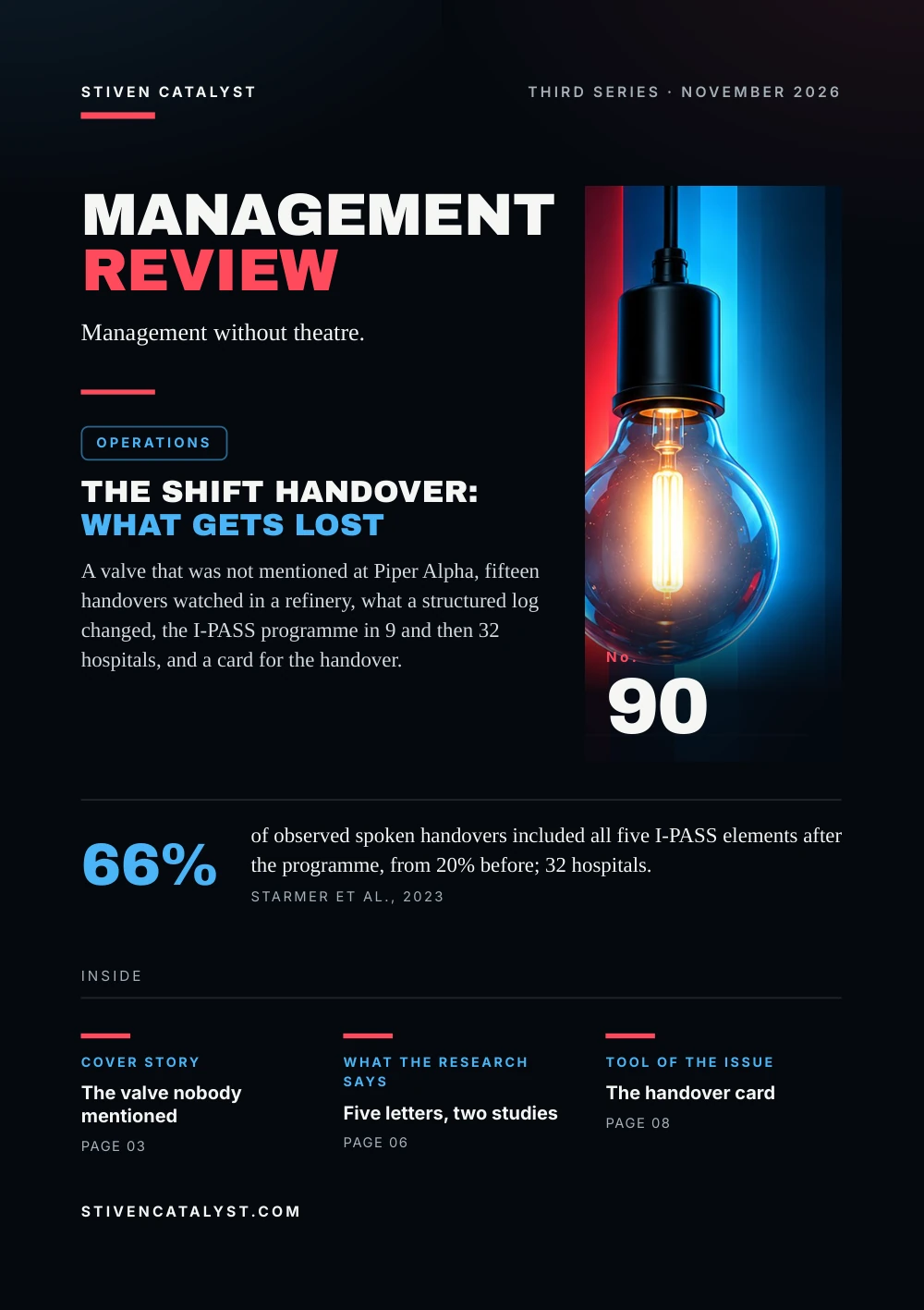
A valve that was not mentioned at Piper Alpha, fifteen handovers watched in a refinery, what a structured log changed, the I-PASS programme in 9 and then 32 hospitals, and a card for the handover.

No.90
66%
of observed spoken handovers included all five I-PASS elements after the programme, from 20% before; 32 hospitals.Starmer et al., 2023
stivencatalyst.com
No. 90 · Operations
In this issue
Two good shifts can still lose what lies between them. The handover is the few minutes in which one shift's knowledge becomes the next shift's work, or does not. This issue asks what gets lost there, and what changed where the handover was given a structure.
- 03Cover storyThe valve nobody mentioned
- 04The numbersFifteen handovers, one refinery
- 05The modelWhat the handover carries
- 06What the research saysFive letters, two studies
- 07How it is measuredWatch one handover
- 08Tool of the issueThe handover card
- 09SourcesSources and method
How to read this issue
Figure
Every figure has its source and year at the foot of its page.
Our reading
Where the editor interprets rather than the research, it says so.
Practice
The steps and the card are proposals to try, not research results.
Cover story
The valve nobodymentioned
On the evening of 6 July 1988 a pressure safety valve on the Piper Alpha platform was off for overhaul; a blank flange sat in its place. When a condensate pump tripped, the night shift set out to restart the other pump, the one under maintenance.
- 1987A fatal accident on the platform; the company pleads guilty, among other things, to poor communication from the day to the night shift.
- 19886 July, evening: handovers between operators and maintenance do not say that safety valve 504 is out.
- 21:45One condensate injection pump trips; the night shift turns to the other.
- 22:00First explosion. Of 226 men on the platform, 165 die; 61 survive.
Lord Cullen traced the night shift's ignorance to failures in passing on information at shift handover and in the permit to work. There were no written procedures for handovers, and maintenance was not always set out in the operators' logs.
Our reading
The warning came the year before, with a death and a guilty plea. The handover practice did not change.
Source: The Hon. Lord Cullen, Department of Energy, HMSO, 1990
From the Cullen report (1990), paragraphs 1.4–1.11, 11.13 and 11.16; times are the report's approximations. The causes were many; this page follows the handover. Witnesses told the inquiry handover practice had not changed after 1987.
The numbers
Fif teen handovers,one refinery
In 1994–95 the psychologist Ronald Lardner worked with a large UK oil refinery that had had no handover incident but saw room to improve. He watched fifteen operator handovers against a list of safe behaviours, then helped the staff design structured logs for about 55 posts.
0 / 15observed handovers had all the safe behaviours; only one receiver took notes
20%showed no sign of preparing; handovers lasted 1 to 11 minutes
38 staff asked about 3 months after the structured logs (1999)
Our reading
Every handover was face to face, and still none had everything. Talking is not yet a handover.
Source: Ronald Lardner, The Keil Centre, 1999
One refinery, one observed shift, opinions not error counts; the bars are shares of 38 people asked. The paper is dated 1999. Read in full on HSE's site.
The model
What the handovercarries
HSE describes an effective handover in three parts: the outgoing person prepares, both sides talk it through, and the incoming person cross-checks before taking over. Two structures fill the middle part: one from a refinery, one from hospitals.
Refinery log, always
- Safety
- Maintenance and technical problems
- Work outstanding
- Comments
- Signatures of the authors
I-PASS, hospitals
- Illness severity
- Patient summary
- Action list
- Situational awareness and contingency planning
- Synthesis by the receiver
Both lists put the critical point first, safety or illness severity, and keep what is still to be done apart from what happened. I-PASS ends with the receiver saying back what was understood: HSE's cross-check, made part of the handover itself.
Our reading
A list decides what is said every time, whoever is tired or new. The read-back shows whether it was heard.
Sources: Health and Safety Executive, 2024; Ronald Lardner, The Keil Centre, 1999; A. J. Starmer et al., Journal of Hospital Medicine 18(1), 2023
The refinery's five mandatory categories as Lardner lists them; posts added others where needed. I-PASS as Starmer et al. (2023) spell it. The comparison is the editors'.
What the research says
Five le t ters,two studies
In paediatric residency programmes at nine hospitals, a handover programme built on I-PASS went with medical errors falling from 24.5 to 18.8 per 100 admissions (2014). Amy Starmer and colleagues then took it to 32 hospitals, 12 of them community hospitals, with 18 months of coaching.
Observed handovers in 32 hospitals, before and after (2023)
Harm linked to handovers, as residents reported it, fell by 47% per person-year. In the nine hospitals, spoken handovers took 2.4 minutes per patient before and 2.5 after: the structure did not make them longer.
Our reading
The programme was more than a mnemonic: training, watching live handovers and coaching came with it.
Sources: A. J. Starmer et al., Journal of Hospital Medicine 18(1), 2023; A. J. Starmer et al., New England Journal of Medicine 371(19), 2014 (via the abstract at PubMed and Starmer et al. (2023))
Before-and-after comparisons; observers knew the phase, and harm was self-reported (58.6% answered). 2023 read in full; 2014 from its abstract, 10,740 admissions.
How it is measured
Wat ch onehandover
Both studies watched handovers rather than asking about them. A manager can do the same: sit in on one handover a week and mark what is there, without stepping in.
Prepared
notes or a log ready before the incoming person arrives
Face to face, no distractions
spoken and written together, away from other handovers
Safety stated first
equipment out of service, work in progress across the change
Open apart from done
each open item with a name and a time
Read back
the receiver sums up and asks; the giver corrects
High risk flagged
after a long absence, to someone new, in an upset
Our reading
Count the marks, not the minutes. A short handover that has all six beats a long one that has three.
Sources: Health and Safety Executive, 2024; Ronald Lardner, The Keil Centre, 1999; A. J. Starmer et al., Journal of Hospital Medicine 18(1), 2023
The marks draw on HSE's principles, Lardner's list of safe behaviours and I-PASS; the selection and the weekly sitting-in are the editors'. Fatigue at the end of a shift is in No. 89, rosters in No. 45.
Tool of the issue
The handovercard
One card per handover, written before the shift ends and read together face to face. The Shift Handover tool keeps the open items with an owner and carries the unresolved ones into the next shift.
01State nowhow serious things are: normal, watch, or upset
02Safety and work in progressequipment out of service, permits, jobs that cross the change
03Open itemseach with its state, an owner and a time; resolved ones apart
04If … thenwhat may happen on the next shift, and what to do if it does
05Receiver's read-backin the receiver's words; questions asked and answered
06Handed overtime and both names
Sources: Ronald Lardner, The Keil Centre, 1999; A. J. Starmer et al., Journal of Hospital Medicine 18(1), 2023; Health and Safety Executive, 2024
The card is the editors' proposal, built on the refinery log, I-PASS and HSE's principles; the essay linked below tells the author's own handover practice.
More in the essayWhy the shift handover is one of the most underrated processes
Open the tool: Shift Handoverstivencatalyst.com/tools/shift-handover/
Sources and method
Every figurehas a source.
The figures in this issue come from the sources below. The year shows how recent each one is.
- The Public Inquiry into the Piper Alpha Disaster (Cm 1310)The Hon. Lord Cullen, Department of Energy, HMSO, 1990https://www.hse.gov.uk/offshore/piper-alpha-disaster-public-inquiry.htm
- Shift handover (Human factors: common risks)Health and Safety Executive, 2024https://www.hse.gov.uk/humanfactors/topics/shift-handover.htm
- Safe communication at shift handover: setting and implementing standardsRonald Lardner, The Keil Centre, 1999https://www.hse.gov.uk/humanfactors/assets/docs/standards.pdf
- Changes in Medical Errors after Implementation of a Handoff ProgramA. J. Starmer et al., New England Journal of Medicine 371(19), 2014 · via the abstract at PubMed and Starmer et al. (2023)https://doi.org/10.1056/NEJMsa1405556
- Implementation of the I-PASS handoff program in diverse clinical environments: A multicenter prospective effectiveness implementation studyA. J. Starmer et al., Journal of Hospital Medicine 18(1), 2023https://pmc.ncbi.nlm.nih.gov/articles/PMC10964397/
Editorial method
Each figure was checked for its year, its publisher and what it measures, in the full text where it could be opened. A source read only in a summary, an abstract or excerpts is marked “via”. A figure not confirmed in what was read is marked so on its page, or left out. The editor's interpretation is marked “Our reading”.
ManagementReview
Management without theatre.
Every issue, one management question, checked against the best research.
All issues
stivencatalyst.com/magazine/management-review.html
Management Review · No. 90 · November 2026 · Stiven Catalyst
Edited by Stiven Janaqi, who answers for it; “the editors” in this publication means him. Its texts, translations, layout and the checking of figures against their sources are done in working sessions with Claude, an AI model by Anthropic.
stivencatalyst.com/how-this-is-made.html
 Next issue
Asking for advice: the fear that misleads
Click or swipe a page to turn it. The arrow keys work too.
Management Review · No. 90
The figures of the issue
The charts of the printed pages, with their sources.
One refinery, one observed shift, opinions not error counts; the bars are shares of 38 people asked. The paper is dated 1999. Read in full on HSE's site.
Source: Ronald Lardner, The Keil Centre, 1999
Before-and-after comparisons; observers knew the phase, and harm was self-reported (58.6% answered). 2023 read in full; 2014 from its abstract, 10,740 admissions.
Source: A. J. Starmer et al., Journal of Hospital Medicine 18(1), 2023
The whole text Read the issue as text For reading on a small screen, searching or a screen reader. The same words, without the page design.
In this issue
Two good shifts can still lose what lies between them. The handover is the few minutes in which one shift's knowledge becomes the next shift's work, or does not. This issue asks what gets lost there, and what changed where the handover was given a structure.
Lord Cullen found that the night shift on Piper Alpha did not know a safety valve was missing, because the handover had not said so. In a refinery, none of fifteen observed handovers showed all the safe behaviours; after structured logs, 71% of those asked saw better logbooks. In nine hospitals, the I-PASS handover went with 23% fewer medical errors; in a later study of 32, complete spoken handovers rose from 20% to 66%. Six marks and a card close the issue.
Stiven Janaqi, Editor
Cover story
The valve nobody mentioned
On the evening of 6 July 1988 a pressure safety valve on the Piper Alpha platform was off for overhaul; a blank flange sat in its place. When a condensate pump tripped, the night shift set out to restart the other pump, the one under maintenance.
- 1987 A fatal accident on the platform; the company pleads guilty, among other things, to poor communication from the day to the night shift.
- 1988 6 July, evening: handovers between operators and maintenance do not say that safety valve 504 is out.
- 21:45 One condensate injection pump trips; the night shift turns to the other.
- 22:00 First explosion. Of 226 men on the platform, 165 die; 61 survive.
Lord Cullen traced the night shift's ignorance to failures in passing on information at shift handover and in the permit to work. There were no written procedures for handovers, and maintenance was not always set out in the operators' logs.
Our reading
The warning came the year before, with a death and a guilty plea. The handover practice did not change.
From the Cullen report (1990), paragraphs 1.4–1.11, 11.13 and 11.16; times are the report's approximations. The causes were many; this page follows the handover. Witnesses told the inquiry handover practice had not changed after 1987.
Source: The Hon. Lord Cullen, Department of Energy, HMSO, 1990
The numbers
Fif teen handovers, one refinery
In 1994–95 the psychologist Ronald Lardner worked with a large UK oil refinery that had had no handover incident but saw room to improve. He watched fifteen operator handovers against a list of safe behaviours, then helped the staff design structured logs for about 55 posts.
- 0 / 15 observed handovers had all the safe behaviours; only one receiver took notes
- 20% showed no sign of preparing; handovers lasted 1 to 11 minutes
38 staff asked about 3 months after the structured logs (1999): There had been a need to improve 66%, Logbooks are filled in better 71%, Handovers are conducted better 66%.
Our reading
Every handover was face to face, and still none had everything. Talking is not yet a handover.
One refinery, one observed shift, opinions not error counts; the bars are shares of 38 people asked. The paper is dated 1999. Read in full on HSE's site.
Source: Ronald Lardner, The Keil Centre, 1999
The model
What the handover carries
HSE describes an effective handover in three parts: the outgoing person prepares, both sides talk it through, and the incoming person cross-checks before taking over. Two structures fill the middle part: one from a refinery, one from hospitals.
Refinery log, always
- Safety
- Maintenance and technical problems
- Work outstanding
- Comments
- Signatures of the authors
I-PASS, hospitals
- Illness severity
- Patient summary
- Action list
- Situational awareness and contingency planning
- Synthesis by the receiver
Both lists put the critical point first, safety or illness severity, and keep what is still to be done apart from what happened. I-PASS ends with the receiver saying back what was understood: HSE's cross-check, made part of the handover itself.
Our reading
A list decides what is said every time, whoever is tired or new. The read-back shows whether it was heard.
The refinery's five mandatory categories as Lardner lists them; posts added others where needed. I-PASS as Starmer et al. (2023) spell it. The comparison is the editors'.
Sources: Health and Safety Executive, 2024; Ronald Lardner, The Keil Centre, 1999; A. J. Starmer et al., Journal of Hospital Medicine 18(1), 2023
What the research says
Five le t ters, two studies
In paediatric residency programmes at nine hospitals, a handover programme built on I-PASS went with medical errors falling from 24.5 to 18.8 per 100 admissions (2014). Amy Starmer and colleagues then took it to 32 hospitals, 12 of them community hospitals, with 18 months of coaching.
Observed handovers in 32 hospitals, before and after (2023): Spoken, all five elements: Before 20%, After 66%; Written, all five elements: Before 10%, After 74%; Receiver's synthesis very good or better: Before 31%, After 83%.
Harm linked to handovers, as residents reported it, fell by 47% per person-year. In the nine hospitals, spoken handovers took 2.4 minutes per patient before and 2.5 after: the structure did not make them longer.
Our reading
The programme was more than a mnemonic: training, watching live handovers and coaching came with it.
Before-and-after comparisons; observers knew the phase, and harm was self-reported (58.6% answered). 2023 read in full; 2014 from its abstract, 10,740 admissions.
Sources: A. J. Starmer et al., Journal of Hospital Medicine 18(1), 2023; A. J. Starmer et al., New England Journal of Medicine 371(19), 2014 (via the abstract at PubMed and Starmer et al. (2023))
How it is measured
Wat ch one handover
Both studies watched handovers rather than asking about them. A manager can do the same: sit in on one handover a week and mark what is there, without stepping in.
- Prepared. notes or a log ready before the incoming person arrives
- Face
t o face, no distractions. spoken and written together, away from other handovers - Saf
e t y stated first. equipment out of service, work in progress across the change - Open apa
r t from done. each open item with a name and a time - Read back. the receiver sums up and asks; the giver corrects
- High risk flagged. after a long absence, to someone new, in an upset
Our reading
Count the marks, not the minutes. A short handover that has all six beats a long one that has three.
The marks draw on HSE's principles, Lardner's list of safe behaviours and I-PASS; the selection and the weekly sitting-in are the editors'. Fatigue at the end of a shift is in No. 89, rosters in No. 45.
Sources: Health and Safety Executive, 2024; Ronald Lardner, The Keil Centre, 1999; A. J. Starmer et al., Journal of Hospital Medicine 18(1), 2023
Tool of the issue
The handover card
One card per handover, written before the shift ends and read together face to face. The Shift Handover tool keeps the open items with an owner and carries the unresolved ones into the next shift.
- State now how serious things are: normal, watch, or upset
- Saf
e t y and work in progress equipment out of service, permits, jobs that cross the change - Open items each with its state, an owner and a time; resolved ones apart
- If … then what may happen on the next shift, and what to do if it does
- Receiver's read-back in the receiver's words; questions asked and answered
- Handed over time and both names
The card is the editors' proposal, built on the refinery log, I-PASS and HSE's principles; the essay linked below tells the author's own handover practice.
Sources: Ronald Lardner, The Keil Centre, 1999; A. J. Starmer et al., Journal of Hospital Medicine 18(1), 2023; Health and Safety Executive, 2024
More in the essay: Why the shift handover is one of the most underrated processes
Open the tool: Shift Handover
Sources and method
Every figure has a source.
The figures in this issue come from the sources below. The year shows how recent each one is.
- The Hon. Lord Cullen, Department of Energy, HMSO, “The Public Inquiry into the Piper Alpha Disaster (Cm 1310)”, 1990. https://www.hse.gov.uk/offshore/piper-alpha-disaster-public-inquiry.htm
- Health and Safety Executive, “Shift handover (Human factors: common risks)”, 2024. https://www.hse.gov.uk/humanfactors/topics/shift-handover.htm
- Ronald Lardner, The Keil Centre, “Safe communication at shift handover: setting and implementing standards”, 1999. https://www.hse.gov.uk/humanfactors/assets/docs/standards.pdf
- A. J. Starmer et al., New England Journal of Medicine 371(19), “Changes in Medical Errors after Implementation of a Handoff Program”, 2014 (via the abstract at PubMed and Starmer et al. (2023)). https://doi.org/10.1056/NEJMsa1405556
- A. J. Starmer et al., Journal of Hospital Medicine 18(1), “Implementation of the I-PASS handoff program in diverse clinical environments: A multicenter prospective effectiveness implementation study”, 2023. https://pmc.ncbi.nlm.nih.gov/articles/PMC10964397/
Edit orial me thod
Each figure was checked for its year, its publisher and what it measures, in the full text where it could be opened. A source read only in a summary, an abstract or excerpts is marked “via”. A figure not confirmed in what was read is marked so on its page, or left out. The editor's interpretation is marked “Our reading”.
Edited by Stiven Janaqi, who answers for it; “the editors” in this publication means him. Its texts, translations, layout and the checking of figures against their sources are done in working sessions with Claude, an AI model by Anthropic. How this is made
Management Review · Monthly edition