In this issue
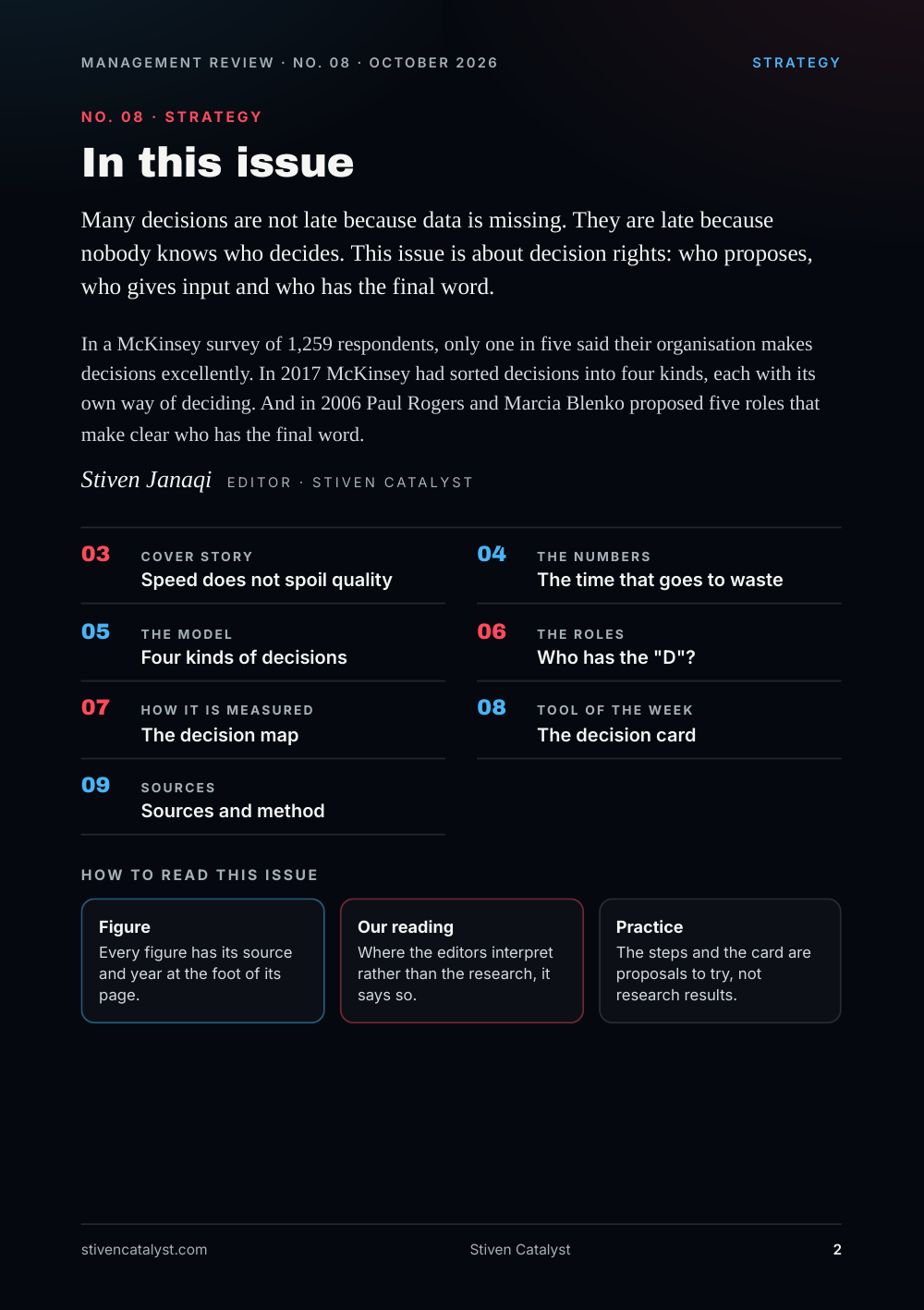
Many decisions are not late because data is missing. They are late because nobody knows who decides. This issue is about decision rights: who proposes, who gives input and who has the final word.
In a McKinsey survey of 1,259 respondents, only one in five said their organisation makes decisions excellently. In 2017 McKinsey had sorted decisions into four kinds, each with its own way of deciding. And in 2006 Paul Rogers and Marcia Blenko proposed five roles that make clear who has the final word.
Stiven Janaqi, Editor
Cover story
Speed does not spoil qualit y
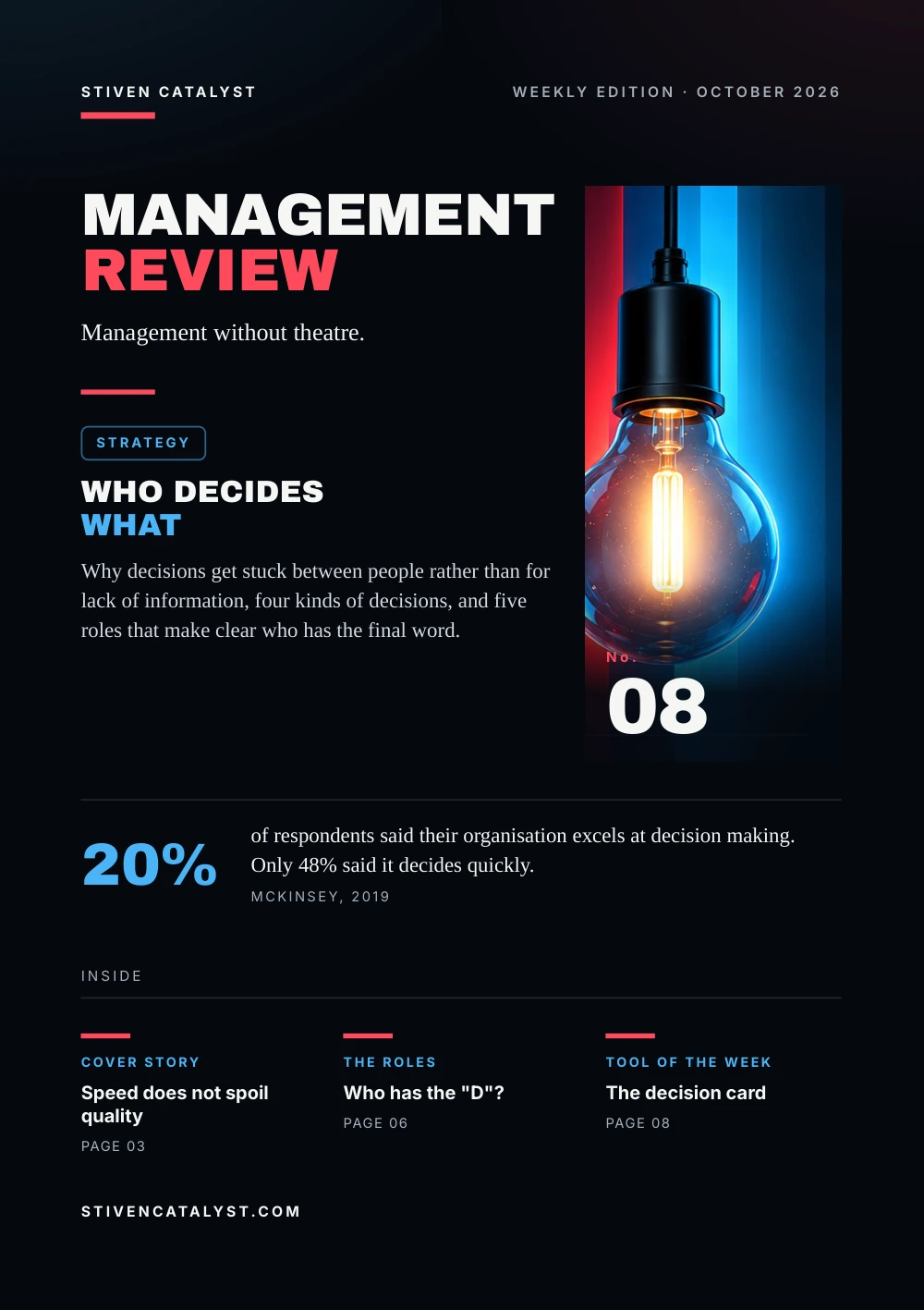
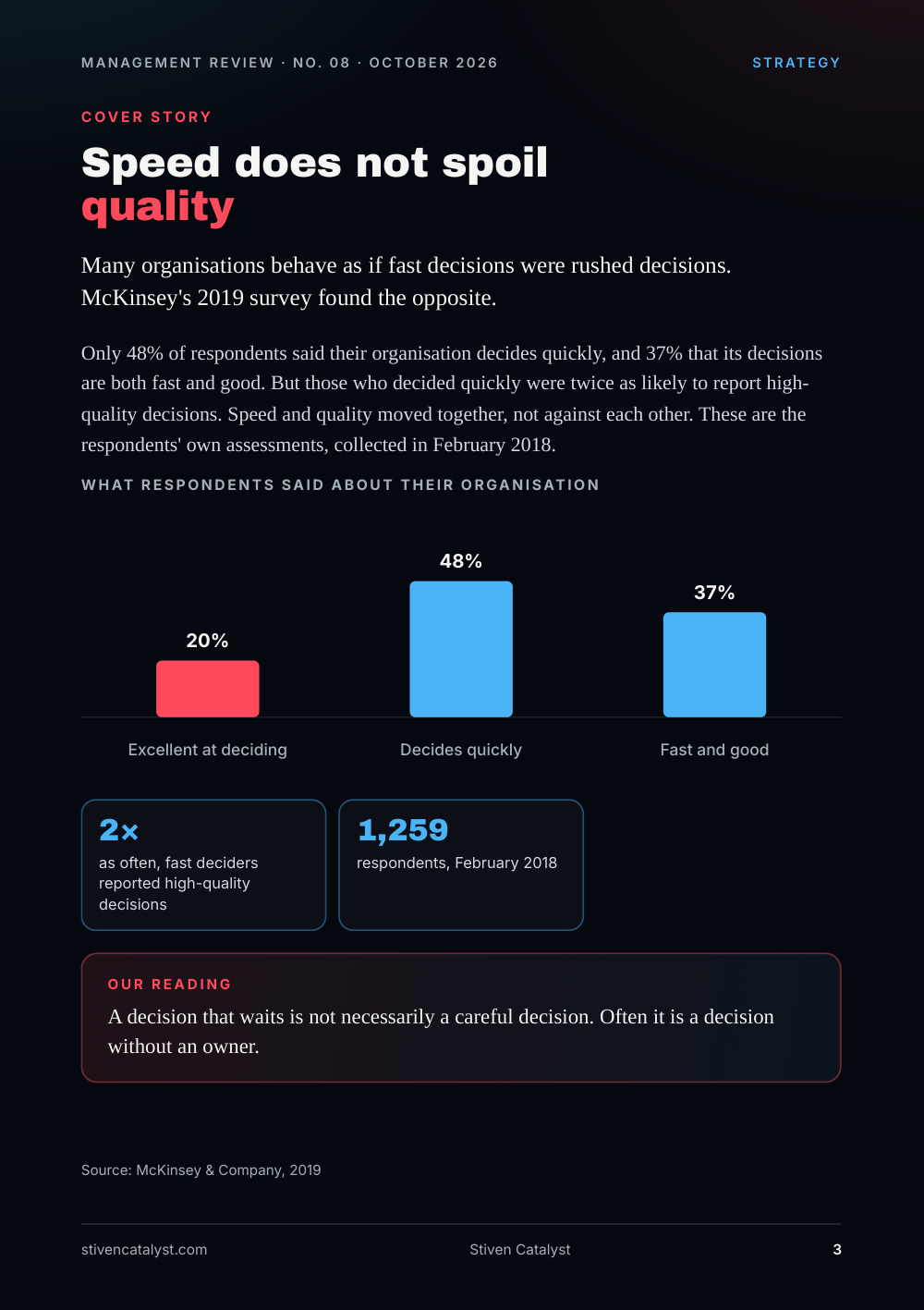
Many organisations behave as if fast decisions were rushed decisions. McKinsey's 2019 survey found the opposite.
Only 48% of respondents said their organisation decides quickly, and 37% that its decisions are both fast and good. But those who decided quickly were twice as likely to report high-quality decisions. Speed and quality moved together, not against each other. These are the respondents' own assessments, collected in February 2018.
What respondents said about their organisation: Excellent at deciding 20%, Decides quickly 48%, Fast and good 37%.
- 2× as often, fast deciders reported high-quality decisions
- 1,259 respondents, February 2018
Our reading
A decision that waits is not necessarily a careful decision. Often it is a decision without an owner.
Source: McKinsey & Company, 2019
The numbers
The time that goes t o waste
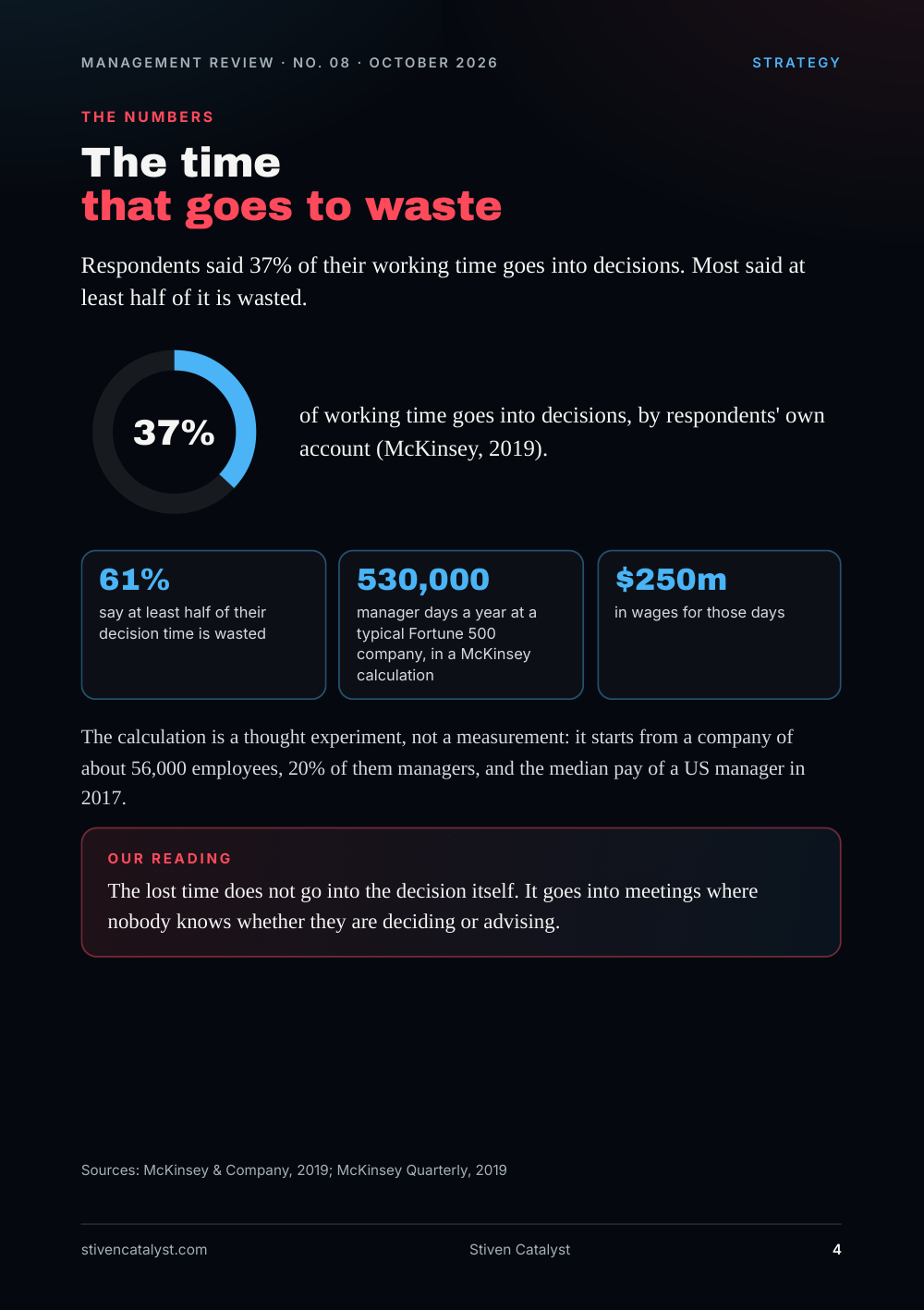
Respondents said 37% of their working time goes into decisions. Most said at least half of it is wasted.
37% of working time goes into decisions, by respondents' own account (McKinsey, 2019).
- 61% say at least half of their decision time is wasted
- 530,000 manager days a year at a typical Fortune 500 company, in a McKinsey calculation
- $250m in wages for those days
The calculation is a thought experiment, not a measurement: it starts from a company of about 56,000 employees, 20% of them managers, and the median pay of a US manager in 2017.
Our reading
The lost time does not go into the decision itself. It goes into meetings where nobody knows whether they are deciding or advising.
Sources: McKinsey & Company, 2019; McKinsey Quarterly, 2019
The model
Four kinds of decisions
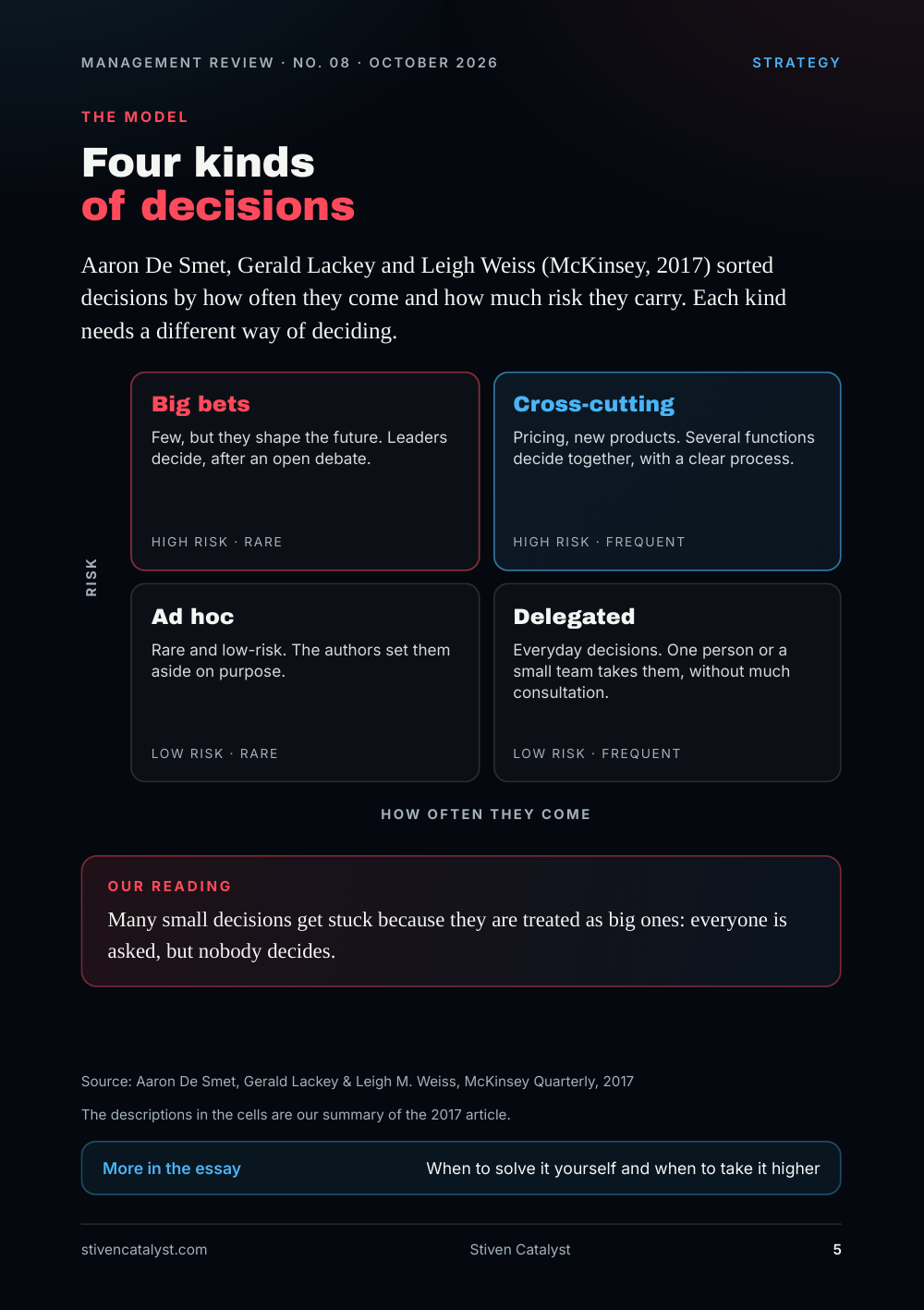
Aaron De Smet, Gerald Lackey and Leigh Weiss (McKinsey, 2017) sorted decisions by how often they come and how much risk they carry. Each kind needs a different way of deciding.
Risk × How often they come:
- Big b
e ts (High risk · rare). Few, but they shape the future. Leaders decide, after an open debate. - Cross-cu
t ting (High risk · frequent). Pricing, new products. Several functions decide together, with a clear process. - Ad hoc (Low risk · rare). Rare and low-risk. The authors set them aside on purpose.
- Delegated (Low risk · frequent). Everyday decisions. One person or a small team takes them, without much consultation.
Our reading
Many small decisions get stuck because they are treated as big ones: everyone is asked, but nobody decides.
The descriptions in the cells are our summary of the 2017 article.
Source: Aaron De Smet, Gerald Lackey & Leigh M. Weiss, McKinsey Quarterly, 2017
More in the essay: When to solve it yourself and when to take it higher
The roles
Who has the "D"?
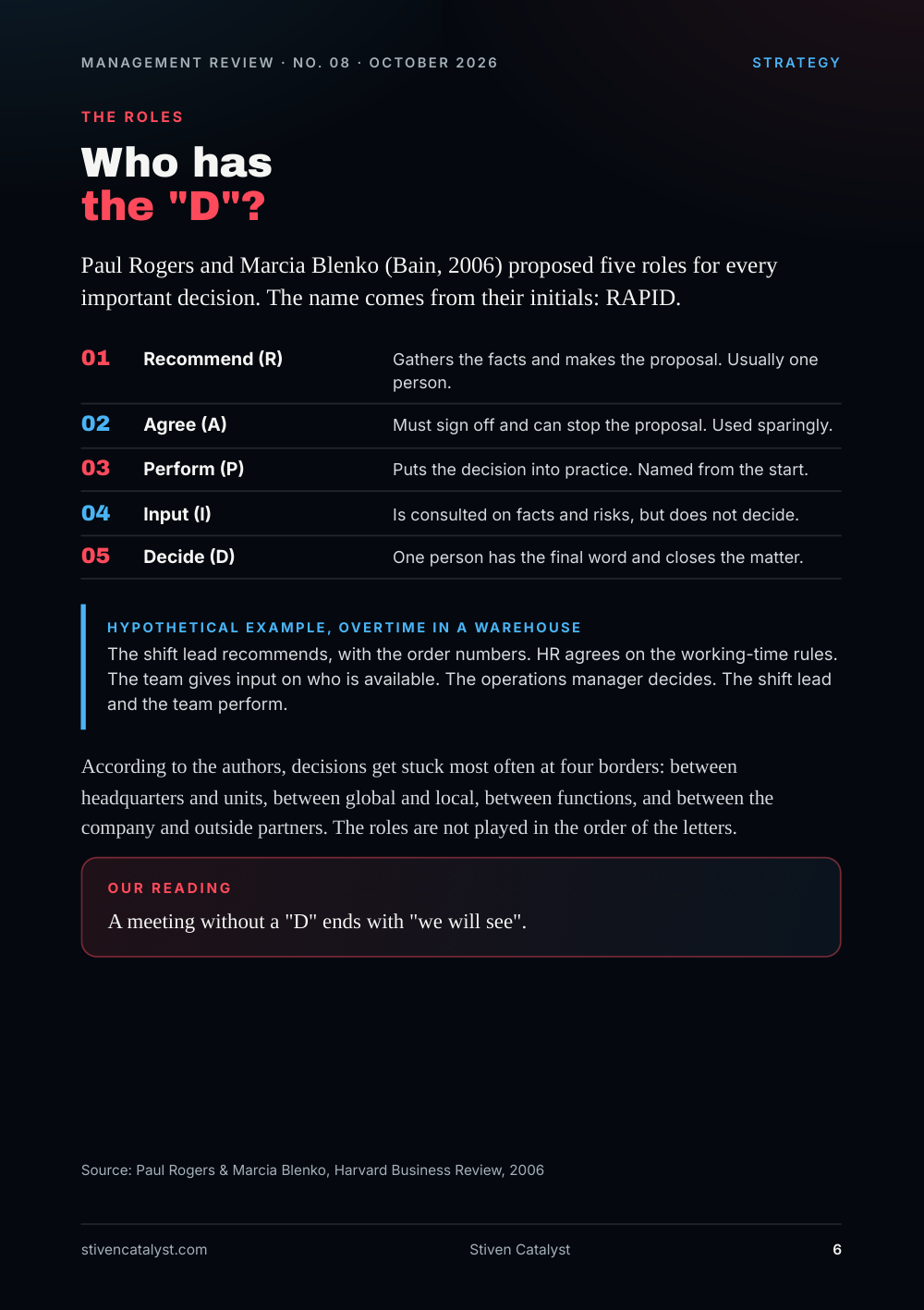
Paul Rogers and Marcia Blenko (Bain, 2006) proposed five roles for every important decision. The name comes from their initials: RAPID.
- Recommend (R). Gathers the facts and makes the proposal. Usually one person.
- Agree (A). Must sign off and can stop the proposal. Used sparingly.
- Perform (P). Puts the decision into practice. Named from the start.
- Input (I). Is consulted on facts and risks, but does not decide.
- Decide (D). One person has the final word and closes the matter.
Hypoth
According to the authors, decisions get stuck most often at four borders: between headquarters and units, between global and local, between functions, and between the company and outside partners. The roles are not played in the order of the letters.
Our reading
A meeting without a "D" ends with "we will see".
Source: Paul Rogers & Marcia Blenko, Harvard Business Review, 2006
How it is measured
The decision map
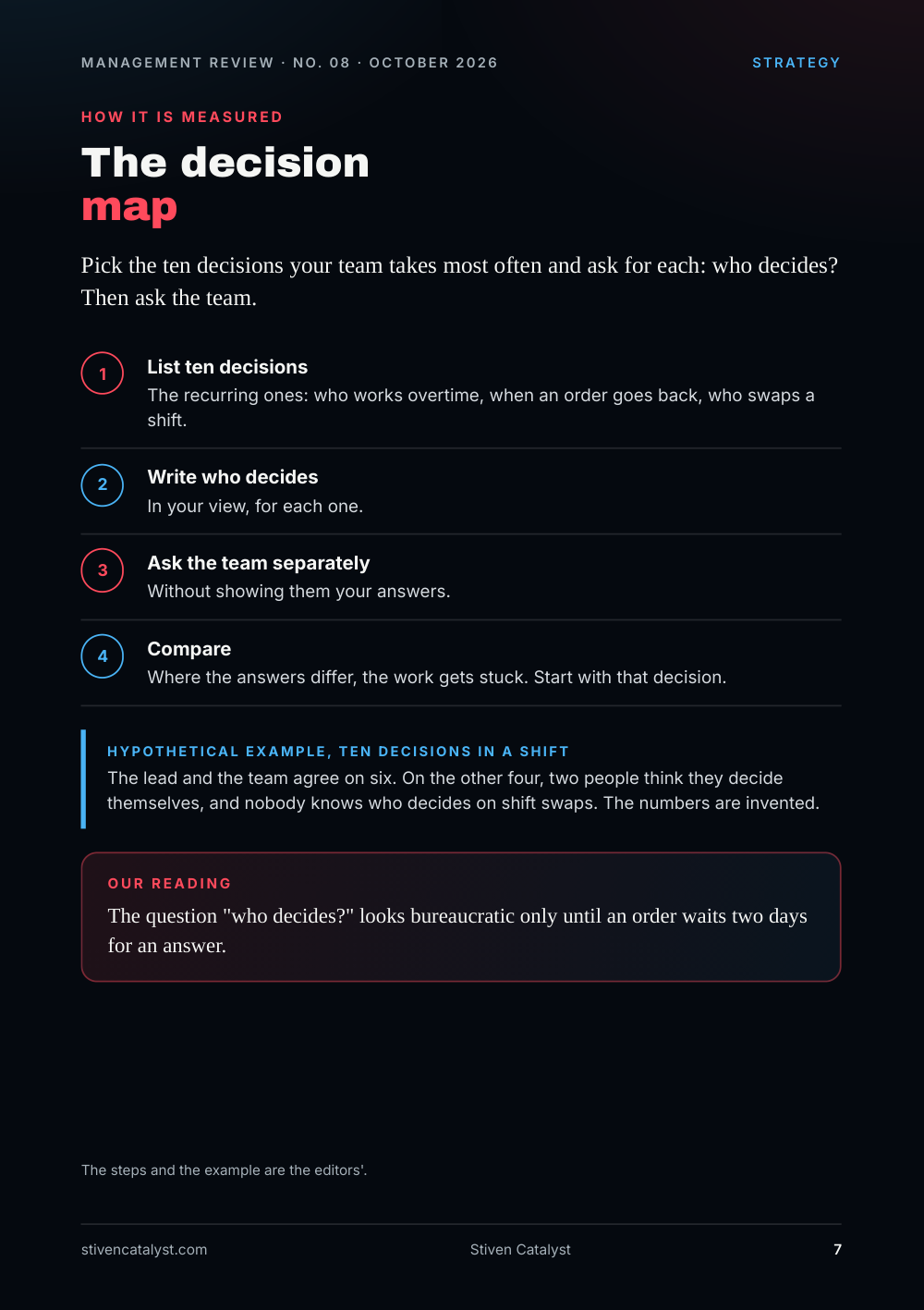
Pick the ten decisions your team takes most often and ask for each: who decides? Then ask the team.
- List ten decisions. The recurring ones: who works overtime, when an order goes back, who swaps a shift.
- Write who decides. In your view, for each one.
- Ask the team separately. Without showing them your answers.
- Compare. Where the answers differ, the work gets stuck. Start with that decision.
Hypoth
Our reading
The question "who decides?" looks bureaucratic only until an order waits two days for an answer.
The steps and the example are the editors'.
Tool of the week
The decision card
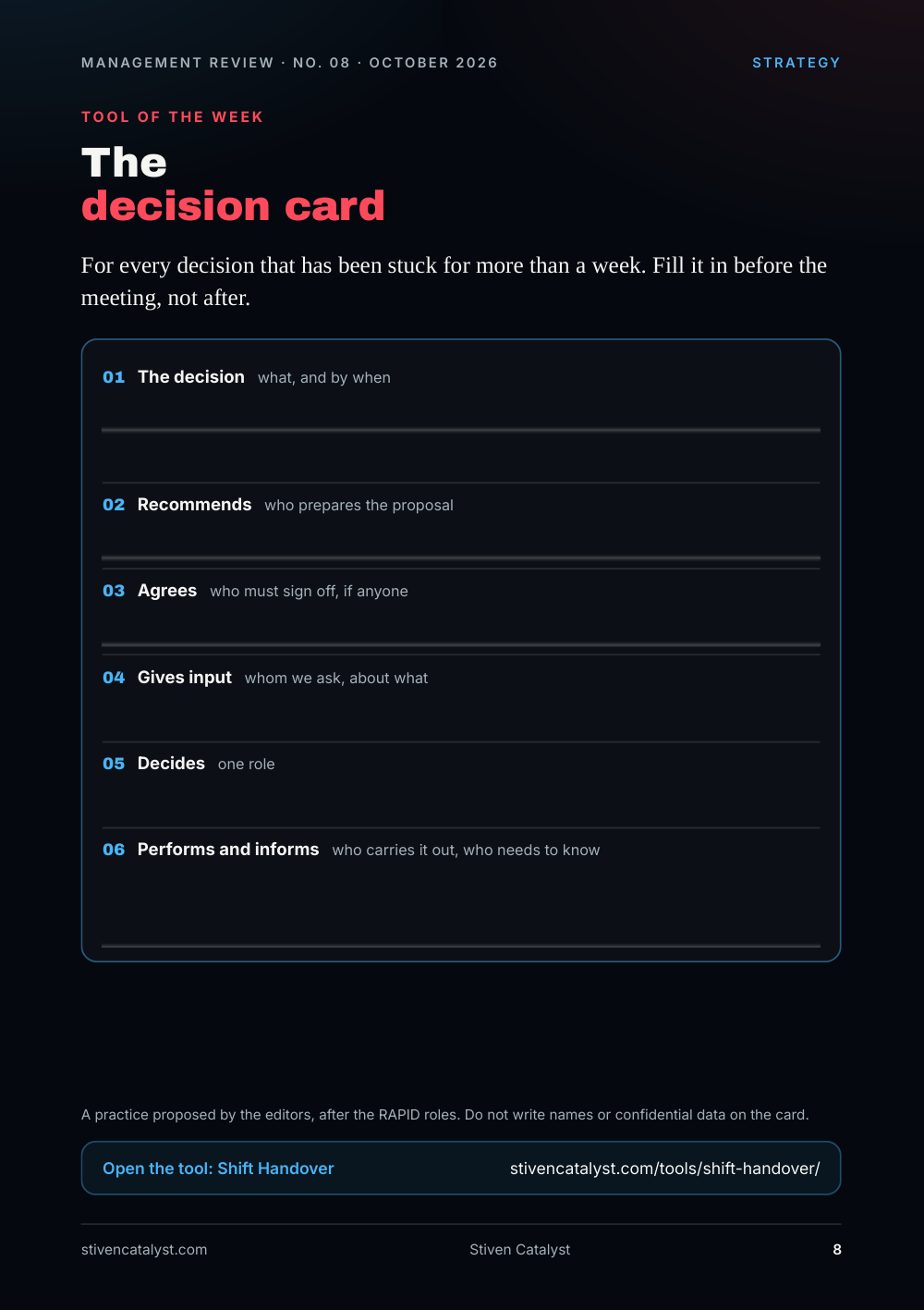
For every decision that has been stuck for more than a week. Fill it in before the meeting, not after.
- The decision what, and by when
- Recommends who prepares the proposal
- Agrees who must sign off, if anyone
- Gives input whom we ask, about what
- Decides one role
- Performs and informs who carries it out, who needs to know
A practice proposed by the editors, after the RAPID roles. Do not write names or confidential data on the card.
Open the tool: Shift Handover
Sources and method
Every figure has a source.
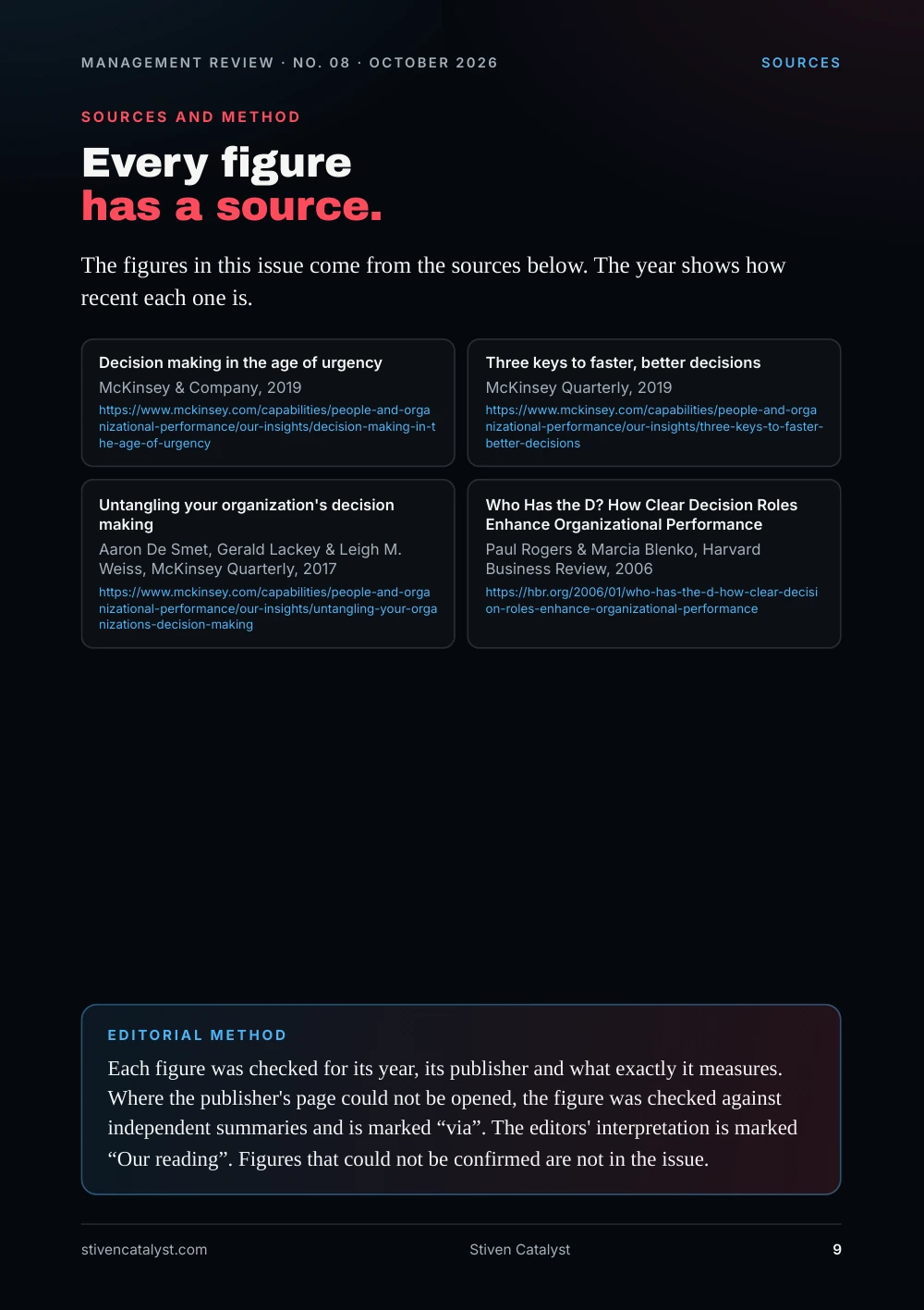
The figures in this issue come from the sources below. The year shows how recent each one is.
- McKinsey & Company, “Decision making in the age of urgency”, 2019. https://www.mckinsey.com/capabilities/people-and-organizational-performance/our-insights/decision-making-in-the-age-of-urgency
- McKinsey Quarterly, “Three keys to faster, better decisions”, 2019. https://www.mckinsey.com/capabilities/people-and-organizational-performance/our-insights/three-keys-to-faster-better-decisions
- Aaron De Smet, Gerald Lackey & Leigh M. Weiss, McKinsey Quarterly, “Untangling your organization's decision making”, 2017. https://www.mckinsey.com/capabilities/people-and-organizational-performance/our-insights/untangling-your-organizations-decision-making
- Paul Rogers & Marcia Blenko, Harvard Business Review, “Who Has the D? How Clear Decision Roles Enhance Organizational Performance”, 2006. https://hbr.org/2006/01/who-has-the-d-how-clear-decision-roles-enhance-organizational-performance
Edit orial me thod
Each figure was checked for its year, its publisher and what exactly it measures. Where the publisher's page could not be opened, the figure was checked against independent summaries and is marked “via”. The editors' interpretation is marked “Our reading”. Figures that could not be confirmed are not in the issue.