Noise kills sensory cells in the inner ear that do not grow back; prevention is the only option. In Germany, 9,819 cases of noise-induced hearing loss were recognised as an occupational disease in 2025, about four in ten of all recognitions. EU law sets steps at 80, 85 and 87 dB(A); Germany allows 85 at the ear. Below those levels noise still costs speech, attention and strain. How exposure is measured, and a card for the loud area, end the issue.
Management Review · Third series · November 2026 · No. 94
Noise at work: the ear and the quie ter costs
Hearing that does not come back, Germany's most recognised occupational disease, the steps at 80, 85 and 87 dB(A), what noise does to speech, attention and strain, how a shift's exposure is measured, and a card for the loud area.
- No.
- 94
- Pages
- 10
- Sources
- 4
- Topics
- People
- Online since
- 3 November 2026
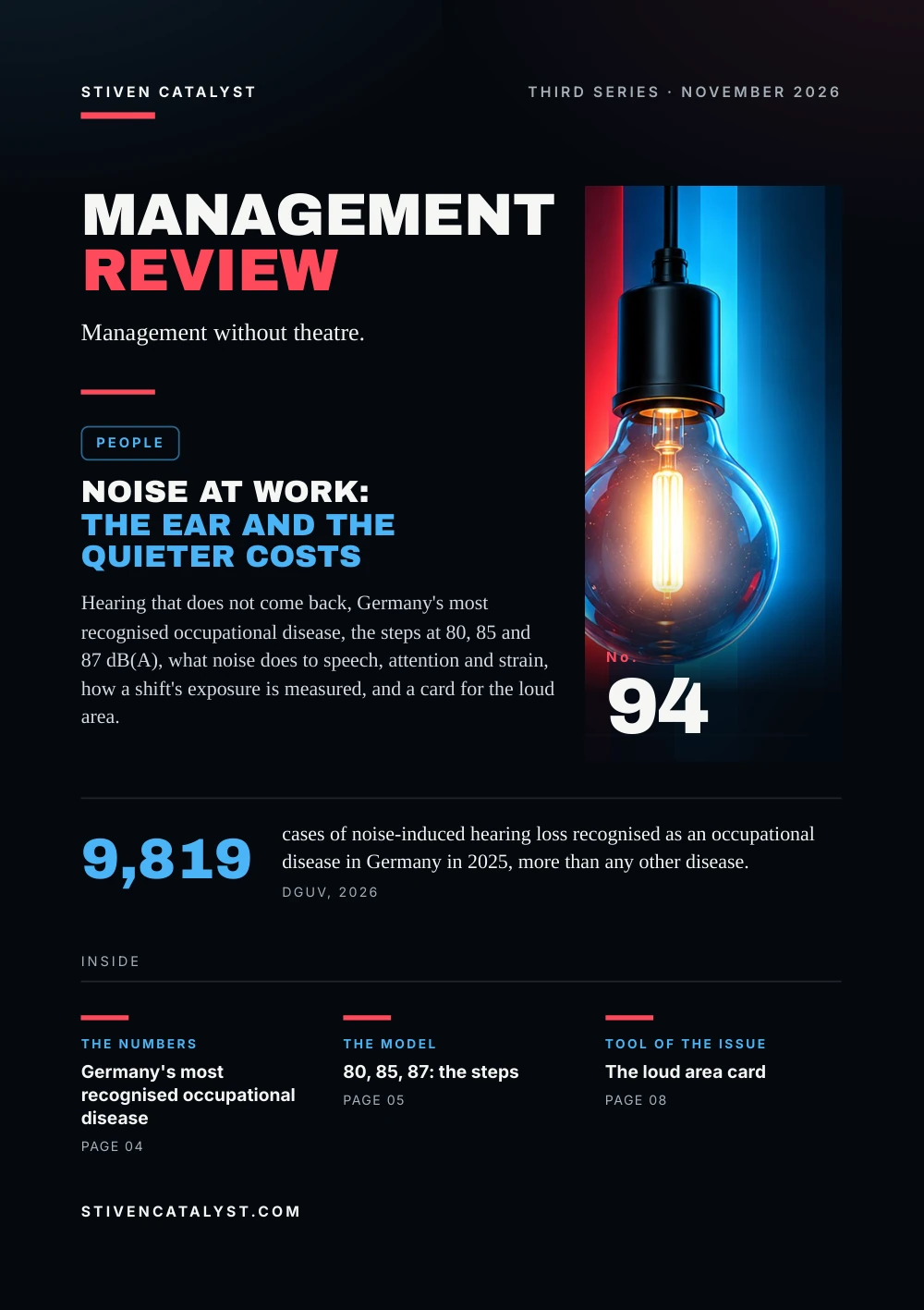
Stiven CatalystThird series · November 2026
ManagementReview
Management without theatre.
People
Noise at work:the ear and the quieter costs
Hearing that does not come back, Germany's most recognised occupational disease, the steps at 80, 85 and 87 dB(A), what noise does to speech, attention and strain, how a shift's exposure is measured, and a card for the loud area.
No.94
9,819
cases of noise-induced hearing loss recognised as an occupational disease in Germany in 2025, more than any other disease.DGUV, 2026
stivencatalyst.com
No. 94 · People
In this issue
In a warehouse, a kitchen or a laundry, noise is part of the work and rarely part of the plan. It does its damage without pain, and the damage stays. Managers decide which machine runs where, who works beside it and for how long. This issue asks what the evidence and the rules say about those decisions.
- 03Cover storyThe damage that does not heal
- 04The numbersThe most recognised occupational disease
- 05The model80, 85, 87: the steps
- 06What the research saysThe quieter costs
- 07How it is measuredAveraged over the shift
- 08Tool of the issueThe loud area card
- 09SourcesSources and method
How to read this issue
Figure
Every figure has its source and year at the foot of its page.
Our reading
Where the editor interprets rather than the research, it says so.
Practice
The steps and the card are proposals to try, not research results.
Cover story
The damagethat does not heal
Noise is the major preventable cause of hearing loss, wrote Mathias Basner and colleagues in The Lancet in 2014. It can come from one intense impulse, or from long, steady exposure above about 75 to 85 dB(A), as in industry.
The cells
Noise destroys the sensory hair cells of the inner ear. In mammals they do not regenerate: there is no remission.
The ringing
Tinnitus often follows exposure and can last; it can disturb sleep and make it hard to sustain attention.
Speech
Hearing loss that stops a person following speech in everyday situations has a severe social effect.
Attention and falls
It can lower attention to tasks; undiagnosed hearing loss is associated with accidents and falls.
Our reading
Noise hurts no one on the day. The loss shows years later, when nothing can be done but prevent more of it.
Source: Mathias Basner, Wolfgang Babisch, Adrian Davis, Mark Brink, Charlotte Clark, Sabine Janssen & Stephen Stansfeld, The Lancet 383(9925), 2014
From Basner et al. (2014), a review in The Lancet, read in full at PubMed Central; the levels are LA averages over time. The four groups are the editors' summary. Heat at work is in No. 84.
The numbers
The most recognisedoccupational disease
Germany's statutory accident insurers publish each year how many occupational diseases were reported, recognised and compensated with a pension. Noise-induced hearing loss is number 2301 on the list.
Noise-induced hearing loss recognised as an occupational disease, Germany
20,228suspected cases of noise-induced hearing loss reported in 2025
340new pensions for it in 2025, against 9,819 recognitions
Our reading
Each case counted here began years earlier, in a loud room where the exposure was not brought down.
Source: Deutsche Gesetzliche Unfallversicherung (DGUV), Zahlen und Fakten, 2026
DGUV tables, all statutory accident insurers, read in 2026. In 2024 and 2025 no disease had more recognitions; 9,819 of 24,340 in 2025 is about 40% (editors' arithmetic). Counts are cases, not a rate.
The model
80, 85, 87:the steps
Directive 2003/10/EC sets three values for the daily noise exposure, averaged over an eight-hour day. The two action values ignore hearing protectors; the limit counts what reaches the ear through them.
80 dB(A): lower action value
Hearing protectors made available; information and training; preventive hearing tests where the assessment shows a risk.
85 dB(A): upper action value
Protectors must be worn; the area is marked and access limited; a programme of technical and organisational measures; a right to a hearing check.
87 dB(A): limit at the ear
Never to be exceeded, even with protectors; if it is, act at once and find out why. Germany sets this value at 85 dB(A).
Our reading
The law ranks the answers: first the source, then technology, then work organisation, and only then the ear plug.
Sources: European Parliament and Council of the European Union, Official Journal L 42, 15.2.2003, 2003; Federal Government of Germany, BGBl. I 2007, p. 261, 2021
Directive 2003/10/EC, articles 3, 5–7 and 10, in our words; peak values 135, 137 and 140 dB(C). Germany: LärmVibrationsArbSchV §§ 6–8, the 85 dB(A) at the ear in § 8(2). Not legal advice.
What the research says
The quie tercosts
The Lancet review's evidence on noise beyond the ear comes mostly from homes, schools and hospitals: annoyance, disturbed sleep, raised blood pressure and stress hormones, and, among hospital staff, effects on work itself.
01
Words lost
Noise lowers speech intelligibility; in hospitals the misunderstandings that follow can lead to errors.
02
Strain
Staff report annoyance, irritation, fatigue and tension headaches; noise-induced stress is linked to burnout and lower performance.
03
The heart
Risk estimates for cardiovascular disease at ear-damaging work noise tend to be higher than for traffic noise at home.
The law names two of these costs. The employer must weigh noise that masks warning signals or other sounds needed to avoid accidents, and Germany adds tasks that demand high concentration and attention. Better acoustics, such as sound-absorbing ceilings, have been linked to staff performance and less strain.
Our reading
Below 80 dB(A) the ear may be safe and the shift still poorer: missed calls, repeated orders, a tired team.
Sources: Mathias Basner, Wolfgang Babisch, Adrian Davis, Mark Brink, Charlotte Clark, Sabine Janssen & Stephen Stansfeld, The Lancet 383(9925), 2014; European Parliament and Council of the European Union, Official Journal L 42, 15.2.2003, 2003; Federal Government of Germany, BGBl. I 2007, p. 261, 2021
Basner et al. (2014); the work effects are from hospital studies, not warehouses or kitchens, and are associations. Law: Directive 2003/10/EC art. 4(6)(e); LärmVibrationsArbSchV § 3(3). The callout is the editors' reading. Sleep and shift work are in No. 45.
How it is measured
Averaged overthe shif t
The daily exposure, LEX,8h, is a time-weighted average of all the noise at work over a nominal eight-hour day, impulses included; the peak is measured apart. Decibels add up in an unfamiliar way.
+3 dB
twice the sound energy: two identical machines instead of one
+10 dB
ten times the energy, heard as about twice as loud
Assess, then measure
measure where compliance cannot be judged safely; by a competent person; keep results 30 years
Example, invented by the editors
- Dish area, 4 h
- 88 dB(A)
- Rest of the shift
- quiet
- LEX,8h
- about 85 dB(A)
Half the shift at a level averages about 3 dB below it. Halving the time near the machine buys 3 dB; lowering the machine by 10 dB buys more.
Sources: European Parliament and Council of the European Union, Official Journal L 42, 15.2.2003, 2003; Federal Government of Germany, BGBl. I 2007, p. 261, 2021; Mathias Basner, Wolfgang Babisch, Adrian Davis, Mark Brink, Charlotte Clark, Sabine Janssen & Stephen Stansfeld, The Lancet 383(9925), 2014
Definitions from Directive 2003/10/EC art. 2 and 4 and LärmVibrationsArbSchV §§ 3–5; the 3 dB and 10 dB rules from Basner et al. (2014). The example and its arithmetic are the editors', with the rest of the shift taken as quiet.
Tool of the issue
The loudarea card
One card per loud area, filled in in the order the law sets: source first, ear last. The full assessment of each work area, with owners and checks, belongs in Risk Assessment.
01Area and levelsources, hours near them, LEX,8h and peak if measured; who measured, when
02At the sourcequieter equipment or method; maintenance of what rattles, leaks or bangs
03Technicalenclosures, screens, sound-absorbing surfaces, damping
04Organisationtime near the source, rotation, quiet breaks and rest room
05The earprotectors chosen and fitted, worn above 85; warning signals still heard; area marked
06Peoplebriefed in a language they understand; hearing checks offered; date of the next review
Sources: Federal Government of Germany, BGBl. I 2007, p. 261, 2021; European Parliament and Council of the European Union, Official Journal L 42, 15.2.2003, 2003; Mathias Basner, Wolfgang Babisch, Adrian Davis, Mark Brink, Charlotte Clark, Sabine Janssen & Stephen Stansfeld, The Lancet 383(9925), 2014
The card is the editors' proposal, not legal advice, built on the order in LärmVibrationsArbSchV § 7 and Directive 2003/10/EC art. 5, the duties in §§ 8 and 11, and Basner et al. (2014). The risk matrix is in No. 28.
Open the tool: Risk Assessmentstivencatalyst.com/tools/risk-assessment/
Sources and method
Every figurehas a source.
The figures in this issue come from the sources below. The year shows how recent each one is.
- Directive 2003/10/EC on the minimum health and safety requirements regarding the exposure of workers to the risks arising from physical agents (noise)European Parliament and Council of the European Union, Official Journal L 42, 15.2.2003, 2003https://www.legislation.gov.uk/eudr/2003/10/contents/adopted
- Lärm- und Vibrations-Arbeitsschutzverordnung (LärmVibrationsArbSchV), as amended 21 July 2021Federal Government of Germany, BGBl. I 2007, p. 261, 2021https://www.gesetze-im-internet.de/l_rmvibrationsarbschv/BJNR026110007.html
- Auditory and non-auditory effects of noise on healthMathias Basner, Wolfgang Babisch, Adrian Davis, Mark Brink, Charlotte Clark, Sabine Janssen & Stephen Stansfeld, The Lancet 383(9925), 2014https://pmc.ncbi.nlm.nih.gov/articles/PMC3988259/
- BK-Geschehen: Anzeigen auf Verdacht, anerkannte Berufskrankheiten und neue BK-Renten, 2023–2025Deutsche Gesetzliche Unfallversicherung (DGUV), Zahlen und Fakten, 2026https://www.dguv.de/de/zahlen-fakten/bk-geschehen/anerkannte-bken/index.jsp
Editorial method
Each figure was checked for its year, its publisher and what it measures, in the full text where it could be opened. A source read only in a summary, an abstract or excerpts is marked “via”. A figure not confirmed in what was read is marked so on its page, or left out. The editor's interpretation is marked “Our reading”.
ManagementReview
Management without theatre.
Every issue, one management question, checked against the best research.
All issues
stivencatalyst.com/magazine/management-review.html
Management Review · No. 94 · November 2026 · Stiven Catalyst
Edited by Stiven Janaqi, who answers for it; “the editors” in this publication means him. Its texts, translations, layout and the checking of figures against their sources are done in working sessions with Claude, an AI model by Anthropic.
stivencatalyst.com/how-this-is-made.html
 Next issue
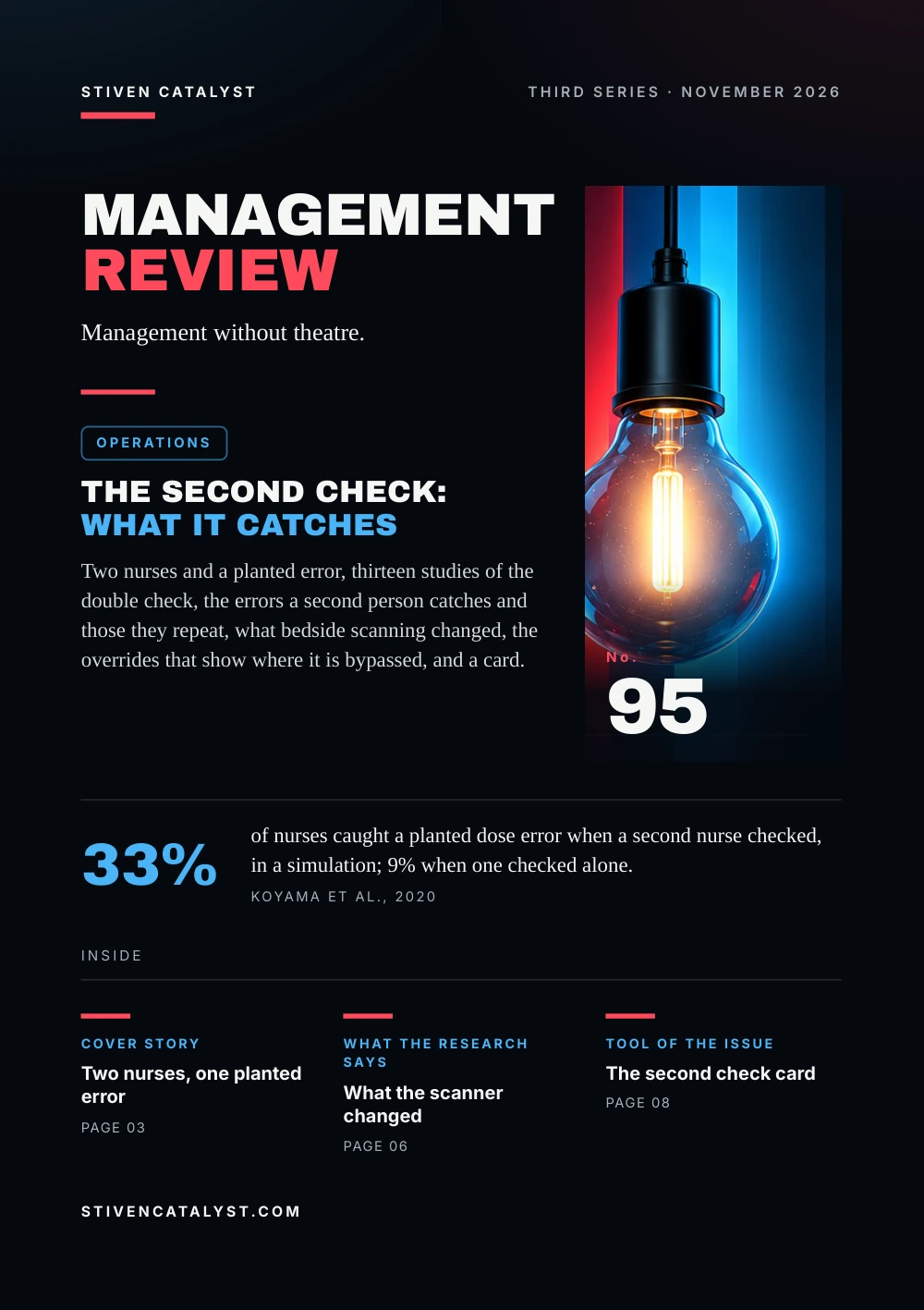
The second check: what it catches
Click or swipe a page to turn it. The arrow keys work too.
Management Review · No. 94
The figures of the issue
The charts of the printed pages, with their sources.
DGUV tables, all statutory accident insurers, read in 2026. In 2024 and 2025 no disease had more recognitions; 9,819 of 24,340 in 2025 is about 40% (editors' arithmetic). Counts are cases, not a rate.
Source: Deutsche Gesetzliche Unfallversicherung (DGUV), Zahlen und Fakten, 2026
The whole text Read the issue as text For reading on a small screen, searching or a screen reader. The same words, without the page design.
In this issue
In a warehouse, a kitchen or a laundry, noise is part of the work and rarely part of the plan. It does its damage without pain, and the damage stays. Managers decide which machine runs where, who works beside it and for how long. This issue asks what the evidence and the rules say about those decisions.
Noise kills sensory cells in the inner ear that do not grow back; prevention is the only option. In Germany, 9,819 cases of noise-induced hearing loss were recognised as an occupational disease in 2025, about four in ten of all recognitions. EU law sets steps at 80, 85 and 87 dB(A); Germany allows 85 at the ear. Below those levels noise still costs speech, attention and strain. How exposure is measured, and a card for the loud area, end the issue.
Stiven Janaqi, Editor
Cover story
The damage that does not heal
Noise is the major preventable cause of hearing loss, wrote Mathias Basner and colleagues in The Lancet in 2014. It can come from one intense impulse, or from long, steady exposure above about 75 to 85 dB(A), as in industry.
- The cells. Noise destroys the sensory hair cells of the inner ear. In mammals they do not regenerate: there is no remission.
- The ringing. Tinnitus often follows exposure and can last; it can disturb sleep and make it hard to sustain attention.
- Speech. Hearing loss that stops a person following speech in everyday situations has a severe social effect.
- A
t tention and falls. It can lower attention to tasks; undiagnosed hearing loss is associated with accidents and falls.
Our reading
Noise hurts no one on the day. The loss shows years later, when nothing can be done but prevent more of it.
From Basner et al. (2014), a review in The Lancet, read in full at PubMed Central; the levels are LA averages over time. The four groups are the editors' summary. Heat at work is in No. 84.
Source: Mathias Basner, Wolfgang Babisch, Adrian Davis, Mark Brink, Charlotte Clark, Sabine Janssen & Stephen Stansfeld, The Lancet 383(9925), 2014
The numbers
The most recognised occupational disease
Germany's statutory accident insurers publish each year how many occupational diseases were reported, recognised and compensated with a pension. Noise-induced hearing loss is number 2301 on the list.
Noise-induced hearing loss recognised as an occupational disease, Germany: 2023 7,609, 2024 8,897, 2025 9,819.
- 20,228 suspected cases of noise-induced hearing loss reported in 2025
- 340 new pensions for it in 2025, against 9,819 recognitions
Our reading
Each case counted here began years earlier, in a loud room where the exposure was not brought down.
DGUV tables, all statutory accident insurers, read in 2026. In 2024 and 2025 no disease had more recognitions; 9,819 of 24,340 in 2025 is about 40% (editors' arithmetic). Counts are cases, not a rate.
Source: Deutsche Gesetzliche Unfallversicherung (DGUV), Zahlen und Fakten, 2026
The model
80, 85, 87: the steps
Directive 2003/10/EC sets three values for the daily noise exposure, averaged over an eight-hour day. The two action values ignore hearing protectors; the limit counts what reaches the ear through them.
- 80 dB(A): lower action value. Hearing protectors made available; information and training; preventive hearing tests where the assessment shows a risk.
- 85 dB(A): upper action value. Protectors must be worn; the area is marked and access limited; a programme of technical and organisational measures; a right to a hearing check.
- 87 dB(A): limit at the ear. Never to be exceeded, even with protectors; if it is, act at once and find out why. Germany sets this value at 85 dB(A).
Our reading
The law ranks the answers: first the source, then technology, then work organisation, and only then the ear plug.
Directive 2003/10/EC, articles 3, 5–7 and 10, in our words; peak values 135, 137 and 140 dB(C). Germany: LärmVibrationsArbSchV §§ 6–8, the 85 dB(A) at the ear in § 8(2). Not legal advice.
Sources: European Parliament and Council of the European Union, Official Journal L 42, 15.2.2003, 2003; Federal Government of Germany, BGBl. I 2007, p. 261, 2021
What the research says
The quie ter costs
The Lancet review's evidence on noise beyond the ear comes mostly from homes, schools and hospitals: annoyance, disturbed sleep, raised blood pressure and stress hormones, and, among hospital staff, effects on work itself.
- Words lost. Noise lowers speech intelligibility; in hospitals the misunderstandings that follow can lead to errors.
- Strain. Staff report annoyance, irritation, fatigue and tension headaches; noise-induced stress is linked to burnout and lower performance.
- The hea
r t. Risk estimates for cardiovascular disease at ear-damaging work noise tend to be higher than for traffic noise at home.
The law names two of these costs. The employer must weigh noise that masks warning signals or other sounds needed to avoid accidents, and Germany adds tasks that demand high concentration and attention. Better acoustics, such as sound-absorbing ceilings, have been linked to staff performance and less strain.
Our reading
Below 80 dB(A) the ear may be safe and the shift still poorer: missed calls, repeated orders, a tired team.
Basner et al. (2014); the work effects are from hospital studies, not warehouses or kitchens, and are associations. Law: Directive 2003/10/EC art. 4(6)(e); LärmVibrationsArbSchV § 3(3). The callout is the editors' reading. Sleep and shift work are in No. 45.
Sources: Mathias Basner, Wolfgang Babisch, Adrian Davis, Mark Brink, Charlotte Clark, Sabine Janssen & Stephen Stansfeld, The Lancet 383(9925), 2014; European Parliament and Council of the European Union, Official Journal L 42, 15.2.2003, 2003; Federal Government of Germany, BGBl. I 2007, p. 261, 2021
How it is measured
Averaged over the shif t
The daily exposure, LEX,8h, is a time-weighted average of all the noise at work over a nominal eight-hour day, impulses included; the peak is measured apart. Decibels add up in an unfamiliar way.
- +3 dB. twice the sound energy: two identical machines instead of one
- +10 dB. ten times the energy, heard as about twice as loud
- Assess, then measure. measure where compliance cannot be judged safely; by a competent person; keep results 30 years
Example, invented by the edit ors
- Dish area, 4 h: 88 dB(A)
- Rest of the shi
f t: quiet - LEX,8h: about 85 dB(A)
Half the shift at a level averages about 3 dB below it. Halving the time near the machine buys 3 dB; lowering the machine by 10 dB buys more.
Definitions from Directive 2003/10/EC art. 2 and 4 and LärmVibrationsArbSchV §§ 3–5; the 3 dB and 10 dB rules from Basner et al. (2014). The example and its arithmetic are the editors', with the rest of the shift taken as quiet.
Sources: European Parliament and Council of the European Union, Official Journal L 42, 15.2.2003, 2003; Federal Government of Germany, BGBl. I 2007, p. 261, 2021; Mathias Basner, Wolfgang Babisch, Adrian Davis, Mark Brink, Charlotte Clark, Sabine Janssen & Stephen Stansfeld, The Lancet 383(9925), 2014
Tool of the issue
The loud area card
One card per loud area, filled in in the order the law sets: source first, ear last. The full assessment of each work area, with owners and checks, belongs in Risk Assessment.
- Area and level sources, hours near them, LEX,8h and peak if measured; who measured, when
- At the source quieter equipment or method; maintenance of what rattles, leaks or bangs
- Technical enclosures, screens, sound-absorbing surfaces, damping
- Organisation time near the source, rotation, quiet breaks and rest room
- The ear protectors chosen and fitted, worn above 85; warning signals still heard; area marked
- People briefed in a language they understand; hearing checks offered; date of the next review
The card is the editors' proposal, not legal advice, built on the order in LärmVibrationsArbSchV § 7 and Directive 2003/10/EC art. 5, the duties in §§ 8 and 11, and Basner et al. (2014). The risk matrix is in No. 28.
Sources: Federal Government of Germany, BGBl. I 2007, p. 261, 2021; European Parliament and Council of the European Union, Official Journal L 42, 15.2.2003, 2003; Mathias Basner, Wolfgang Babisch, Adrian Davis, Mark Brink, Charlotte Clark, Sabine Janssen & Stephen Stansfeld, The Lancet 383(9925), 2014
Open the tool: Risk Assessment
Sources and method
Every figure has a source.
The figures in this issue come from the sources below. The year shows how recent each one is.
- European Parliament and Council of the European Union, Official Journal L 42, 15.2.2003, “Directive 2003/10/EC on the minimum health and safety requirements regarding the exposure of workers to the risks arising from physical agents (noise)”, 2003. https://www.legislation.gov.uk/eudr/2003/10/contents/adopted
- Federal Government of Germany, BGBl. I 2007, p. 261, “Lärm- und Vibrations-Arbeitsschutzverordnung (LärmVibrationsArbSchV), as amended 21 July 2021”, 2021. https://www.gesetze-im-internet.de/l_rmvibrationsarbschv/BJNR026110007.html
- Mathias Basner, Wolfgang Babisch, Adrian Davis, Mark Brink, Charlotte Clark, Sabine Janssen & Stephen Stansfeld, The Lancet 383(9925), “Auditory and non-auditory effects of noise on health”, 2014. https://pmc.ncbi.nlm.nih.gov/articles/PMC3988259/
- Deutsche Gesetzliche Unfallversicherung (DGUV), Zahlen und Fakten, “BK-Geschehen: Anzeigen auf Verdacht, anerkannte Berufskrankheiten und neue BK-Renten, 2023–2025”, 2026. https://www.dguv.de/de/zahlen-fakten/bk-geschehen/anerkannte-bken/index.jsp
Edit orial me thod
Each figure was checked for its year, its publisher and what it measures, in the full text where it could be opened. A source read only in a summary, an abstract or excerpts is marked “via”. A figure not confirmed in what was read is marked so on its page, or left out. The editor's interpretation is marked “Our reading”.
Edited by Stiven Janaqi, who answers for it; “the editors” in this publication means him. Its texts, translations, layout and the checking of figures against their sources are done in working sessions with Claude, an AI model by Anthropic. How this is made
Management Review · Monthly edition