In this issue
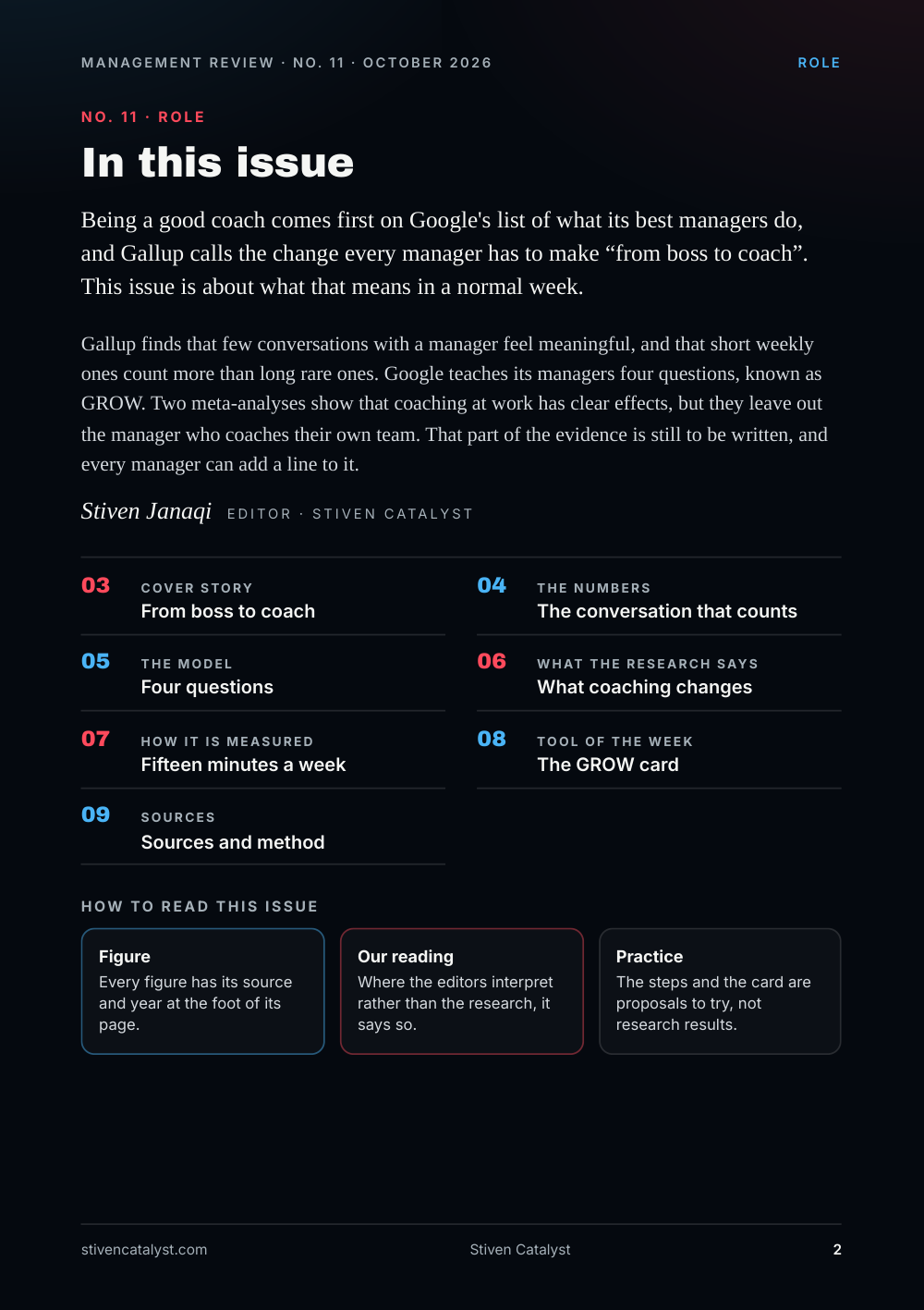
Being a good coach comes first on Google's list of what its best managers do, and Gallup calls the change every manager has to make “from boss to coach”. This issue is about what that means in a normal week.
Gallup finds that few conversations with a manager feel meaningful, and that short weekly ones count more than long rare ones. Google teaches its managers four questions, known as GROW. Two meta-analyses show that coaching at work has clear effects, but they leave out the manager who coaches their own team. That part of the evidence is still to be written, and every manager can add a line to it.
Stiven Janaqi, Editor
Cover story
From boss t o coach
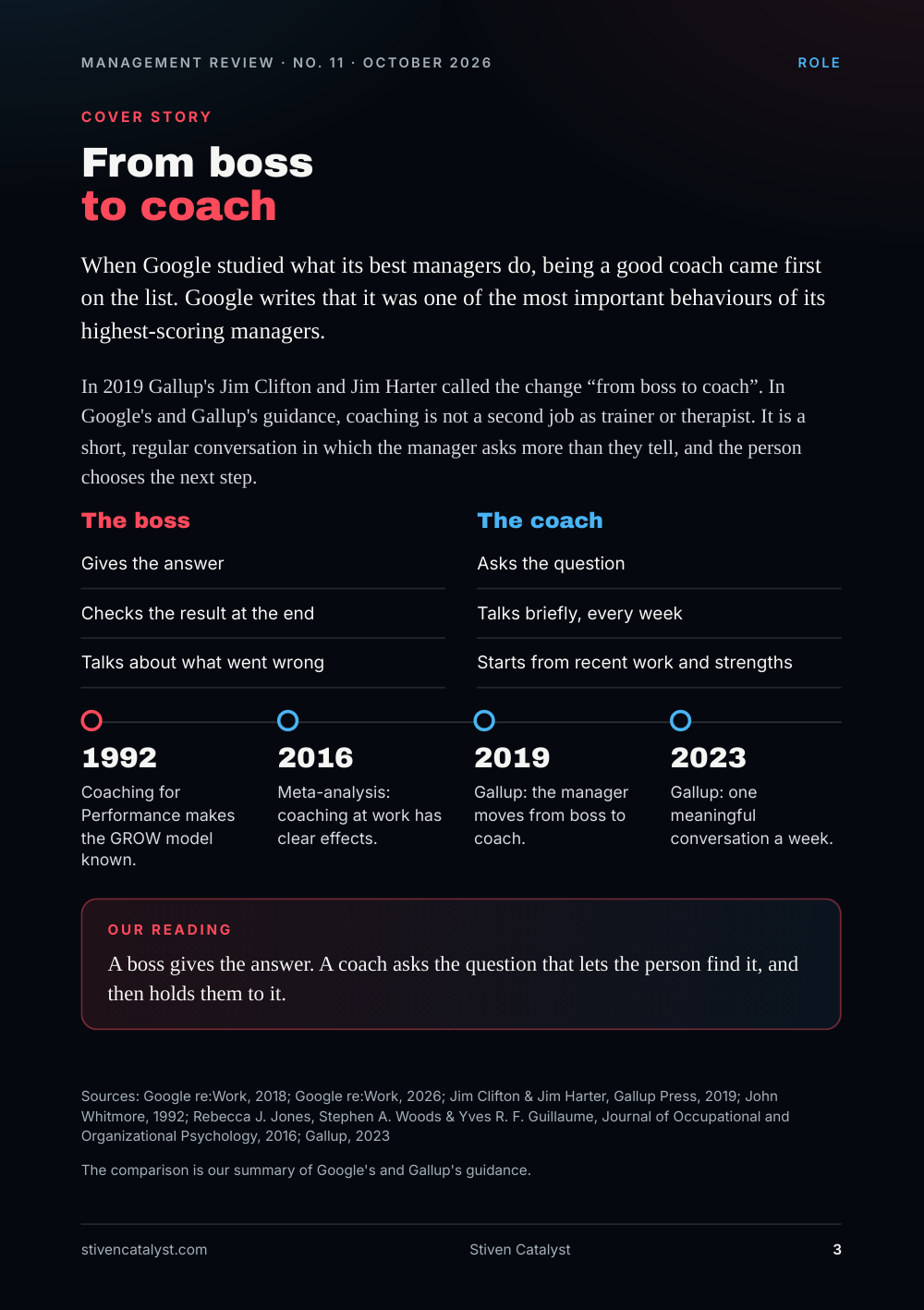
When Google studied what its best managers do, being a good coach came first on the list. Google writes that it was one of the most important behaviours of its highest-scoring managers.
In 2019 Gallup's Jim Clifton and Jim Harter called the change “from boss to coach”. In Google's and Gallup's guidance, coaching is not a second job as trainer or therapist. It is a short, regular conversation in which the manager asks more than they tell, and the person chooses the next step.
The boss
- Gives the answer
- Checks the result at the end
- Talks about what went wrong
The coach
- Asks the question
- Talks briefly, every week
- Starts from recent work and strengths
- 1992 Coaching for Performance makes the GROW model known.
- 2016 Meta-analysis: coaching at work has clear effects.
- 2019 Gallup: the manager moves from boss to coach.
- 2023 Gallup: one meaningful conversation a week.
Our reading
A boss gives the answer. A coach asks the question that lets the person find it, and then holds them to it.
The comparison is our summary of Google's and Gallup's guidance.
Sources: Google re:Work, 2018; Google re:Work, 2026; Jim Clifton & Jim Harter, Gallup Press, 2019; John Whitmore, 1992; Rebecca J. Jones, Stephen A. Woods & Yves R. F. Guillaume, Journal of Occupational and Organizational Psychology, 2016; Gallup, 2023
The numbers
The conversation that counts
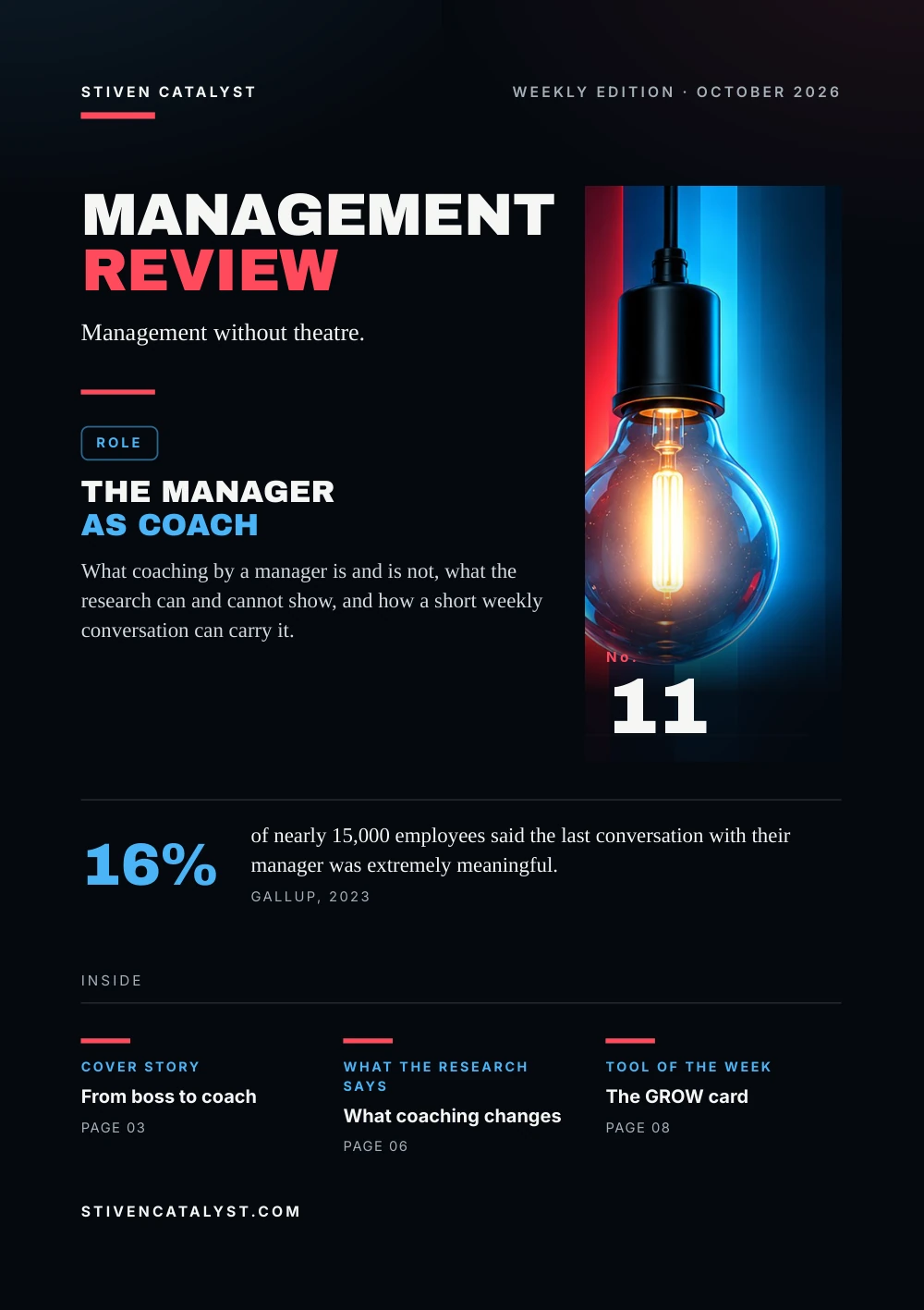
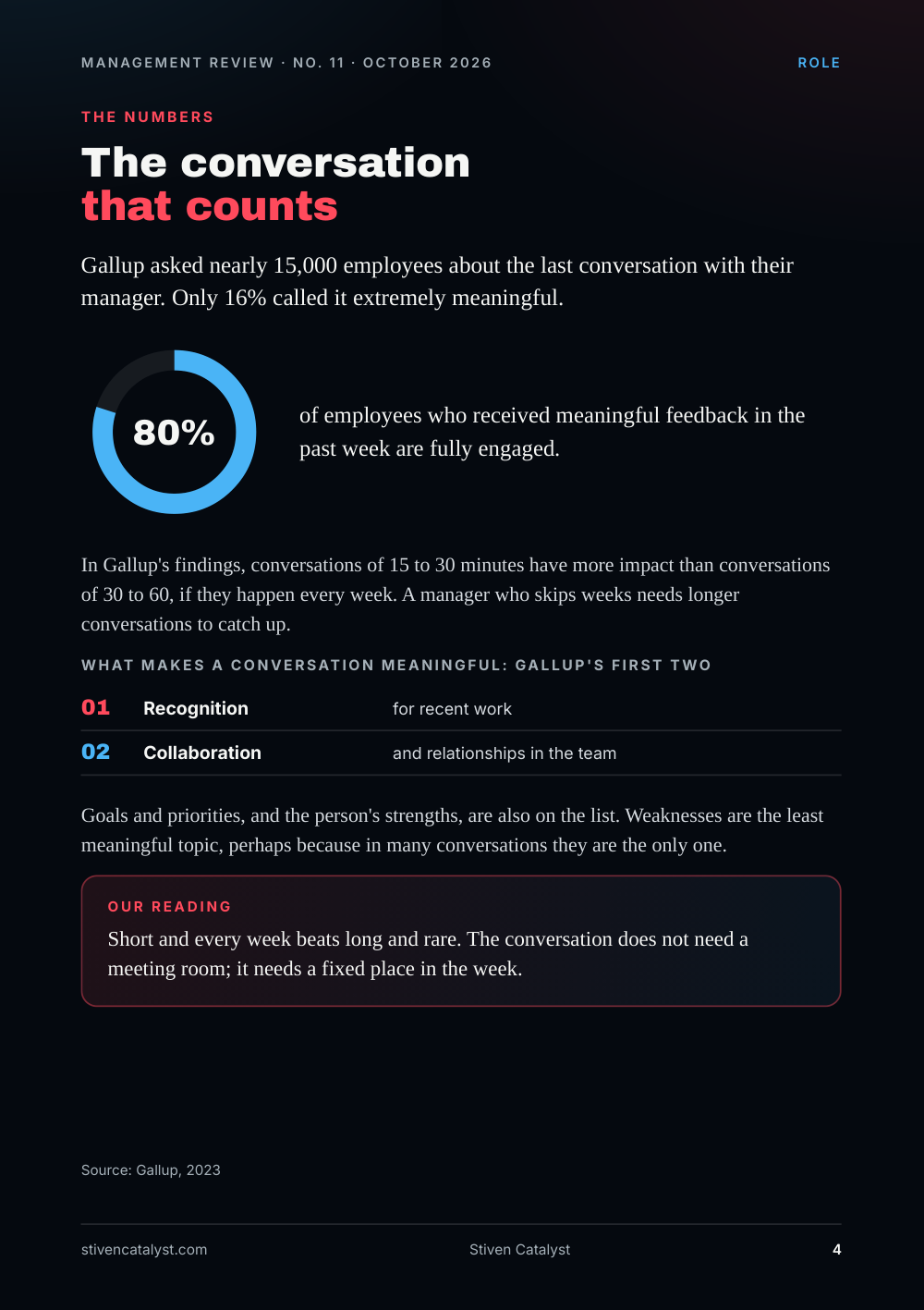
Gallup asked nearly 15,000 employees about the last conversation with their manager. Only 16% called it extremely meaningful.
80% of employees who received meaningful feedback in the past week are fully engaged.
In Gallup's findings, conversations of 15 to 30 minutes have more impact than conversations of 30 to 60, if they happen every week. A manager who skips weeks needs longer conversations to catch up.
What makes a conversation meaningful: Gallup's first two
- Recognition. for recent work
- Collaboration. and relationships in the team
Goals and priorities, and the person's strengths, are also on the list. Weaknesses are the least meaningful topic, perhaps because in many conversations they are the only one.
Our reading
Short and every week beats long and rare. The conversation does not need a meeting room; it needs a fixed place in the week.
Source: Gallup, 2023
The model
Four questions
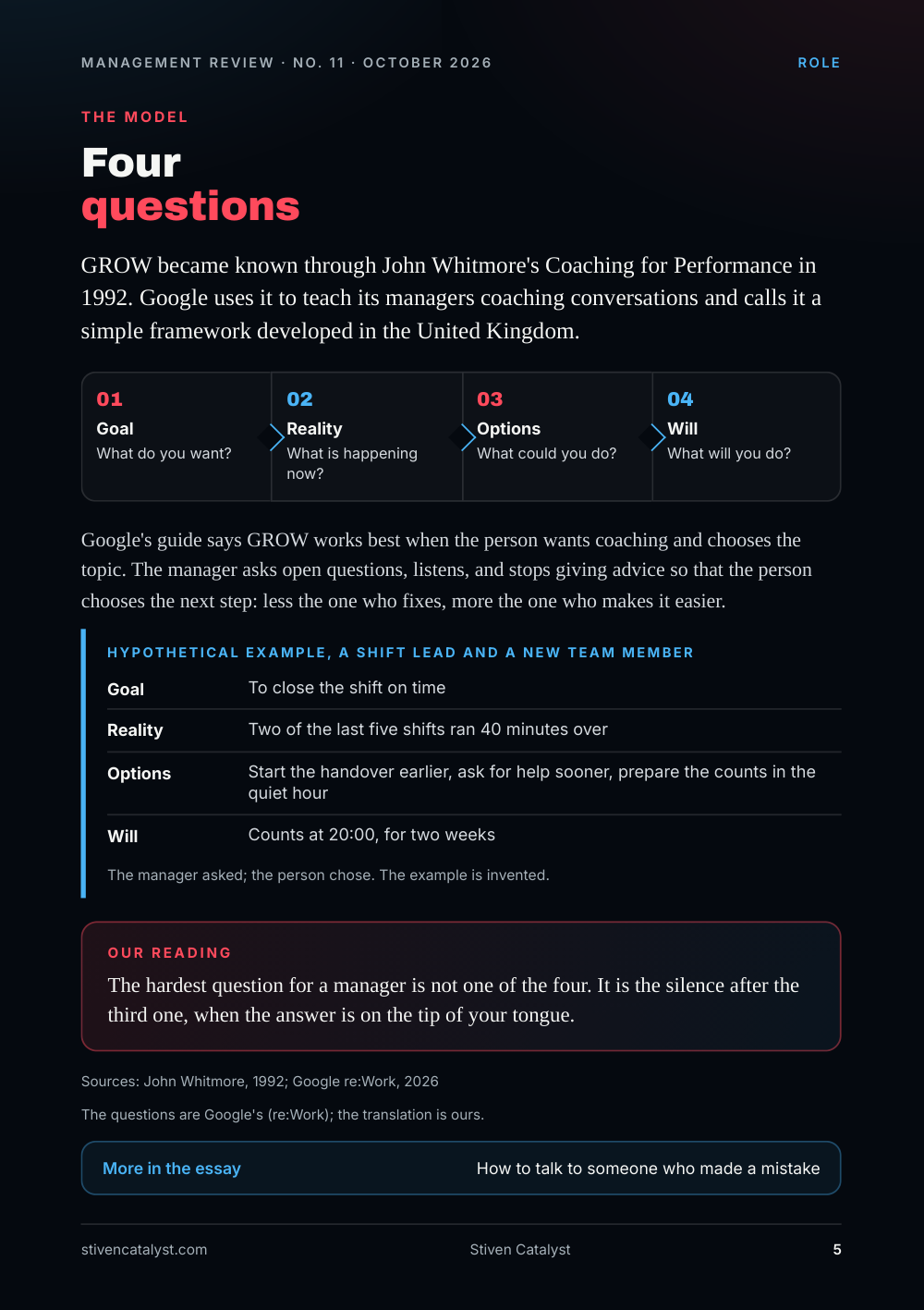
GROW became known through John Whitmore's Coaching for Performance in 1992. Google uses it to teach its managers coaching conversations and calls it a simple framework developed in the United Kingdom.
- Goal. What do you want?
- Reali
t y. What is happening now? - O
p tions. What could you do? - Will. What will you do?
Google's guide says GROW works best when the person wants coaching and chooses the topic. The manager asks open questions, listens, and stops giving advice so that the person chooses the next step: less the one who fixes, more the one who makes it easier.
Hypothe tical example, a shif t lead and a new team member
- Goal: To close the shift on time
- Reali
t y: Two of the last five shifts ran 40 minutes over - O
p tions: Start the handover earlier, ask for help sooner, prepare the counts in the quiet hour - Will: Counts at 20:00, for two weeks
The manager asked; the person chose. The example is invented.
Our reading
The hardest question for a manager is not one of the four. It is the silence after the third one, when the answer is on the tip of your tongue.
The questions are Google's (re:Work); the translation is ours.
Sources: John Whitmore, 1992; Google re:Work, 2026
More in the essay: How to talk to someone who made a mistake
What the research says
What coaching changes
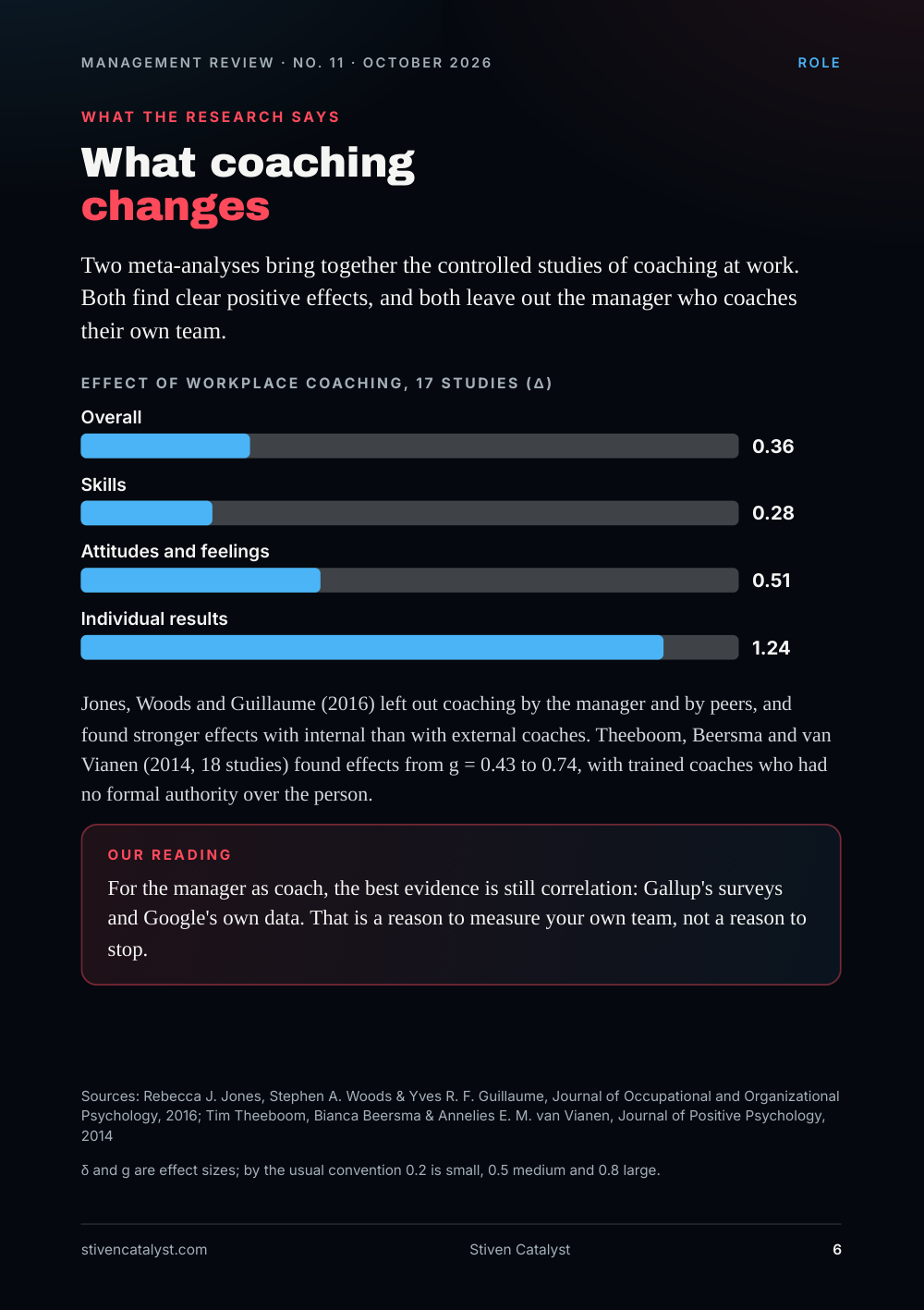
Two meta-analyses bring together the controlled studies of coaching at work. Both find clear positive effects, and both leave out the manager who coaches their own team.
Effect of workplace coaching, 17 studies (δ): Overall 0.36, Skills 0.28, Attitudes and feelings 0.51, Individual results 1.24.
Jones, Woods and Guillaume (2016) left out coaching by the manager and by peers, and found stronger effects with internal than with external coaches. Theeboom, Beersma and van Vianen (2014, 18 studies) found effects from g = 0.43 to 0.74, with trained coaches who had no formal authority over the person.
Our reading
For the manager as coach, the best evidence is still correlation: Gallup's surveys and Google's own data. That is a reason to measure your own team, not a reason to stop.
δ and g are effect sizes; by the usual convention 0.2 is small, 0.5 medium and 0.8 large.
Sources: Rebecca J. Jones, Stephen A. Woods & Yves R. F. Guillaume, Journal of Occupational and Organizational Psychology, 2016; Tim Theeboom, Bianca Beersma & Annelies E. M. van Vianen, Journal of Positive Psychology, 2014
How it is measured
Fif teen minutes a week
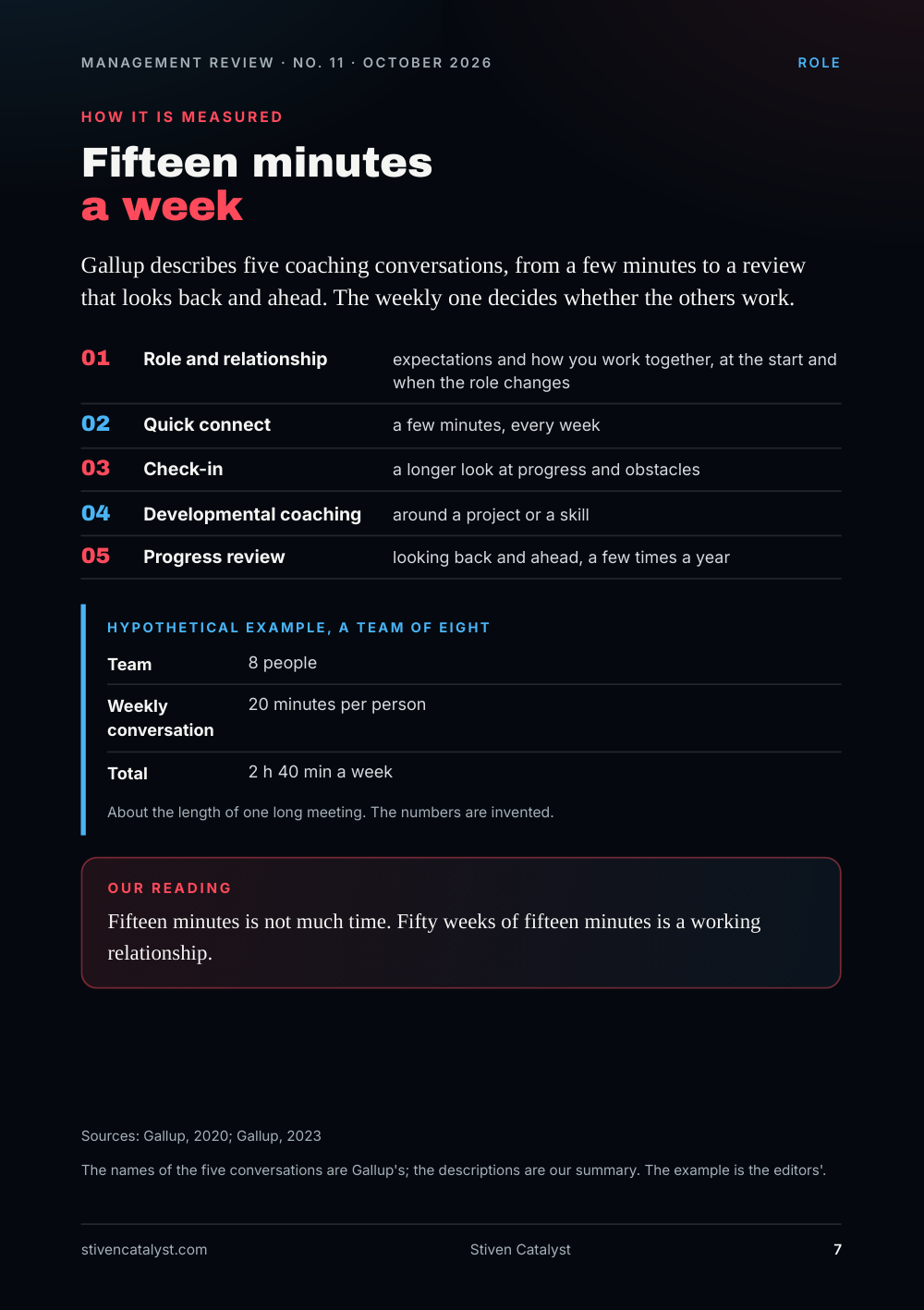
Gallup describes five coaching conversations, from a few minutes to a review that looks back and ahead. The weekly one decides whether the others work.
- Role and relationship. expectations and how you work together, at the start and when the role changes
- Quick connect. a few minutes, every week
- Check-in. a longer look at progress and obstacles
- Developmental coaching. around a project or a skill
- Progress review. looking back and ahead, a few times a year
Hypothe tical example, a team of eight
- Team: 8 people
- Weekly conversation: 20 minutes per person
T otal: 2 h 40 min a week
About the length of one long meeting. The numbers are invented.
Our reading
Fifteen minutes is not much time. Fifty weeks of fifteen minutes is a working relationship.
The names of the five conversations are Gallup's; the descriptions are our summary. The example is the editors'.
Sources: Gallup, 2020; Gallup, 2023
Tool of the week
The GROW card
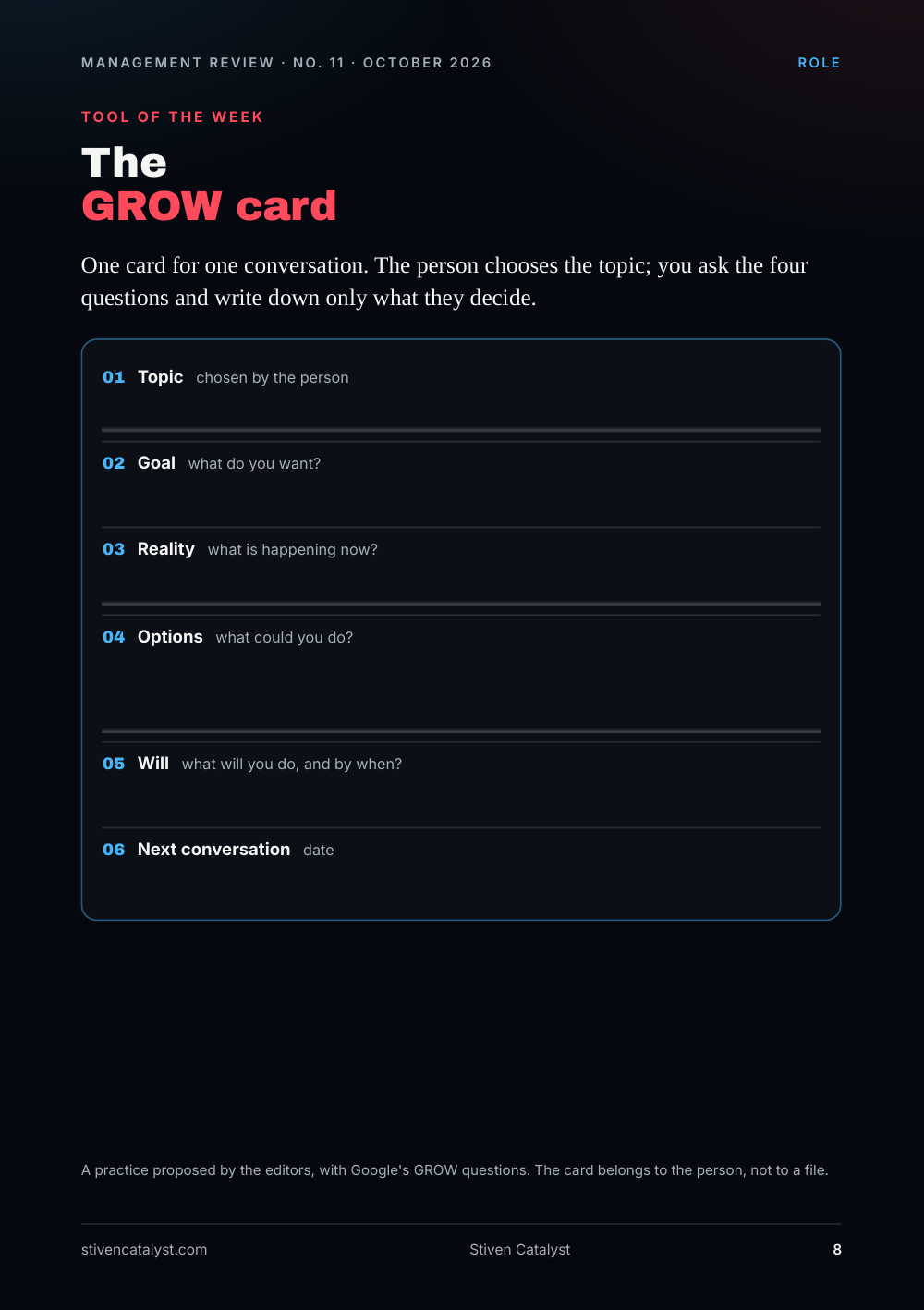
One card for one conversation. The person chooses the topic; you ask the four questions and write down only what they decide.
T opic chosen by the person- Goal what do you want?
- Reali
t y what is happening now? - O
p tions what could you do? - Will what will you do, and by when?
- Next conversation date
A practice proposed by the editors, with Google's GROW questions. The card belongs to the person, not to a file.
Sources and method
Every figure has a source.
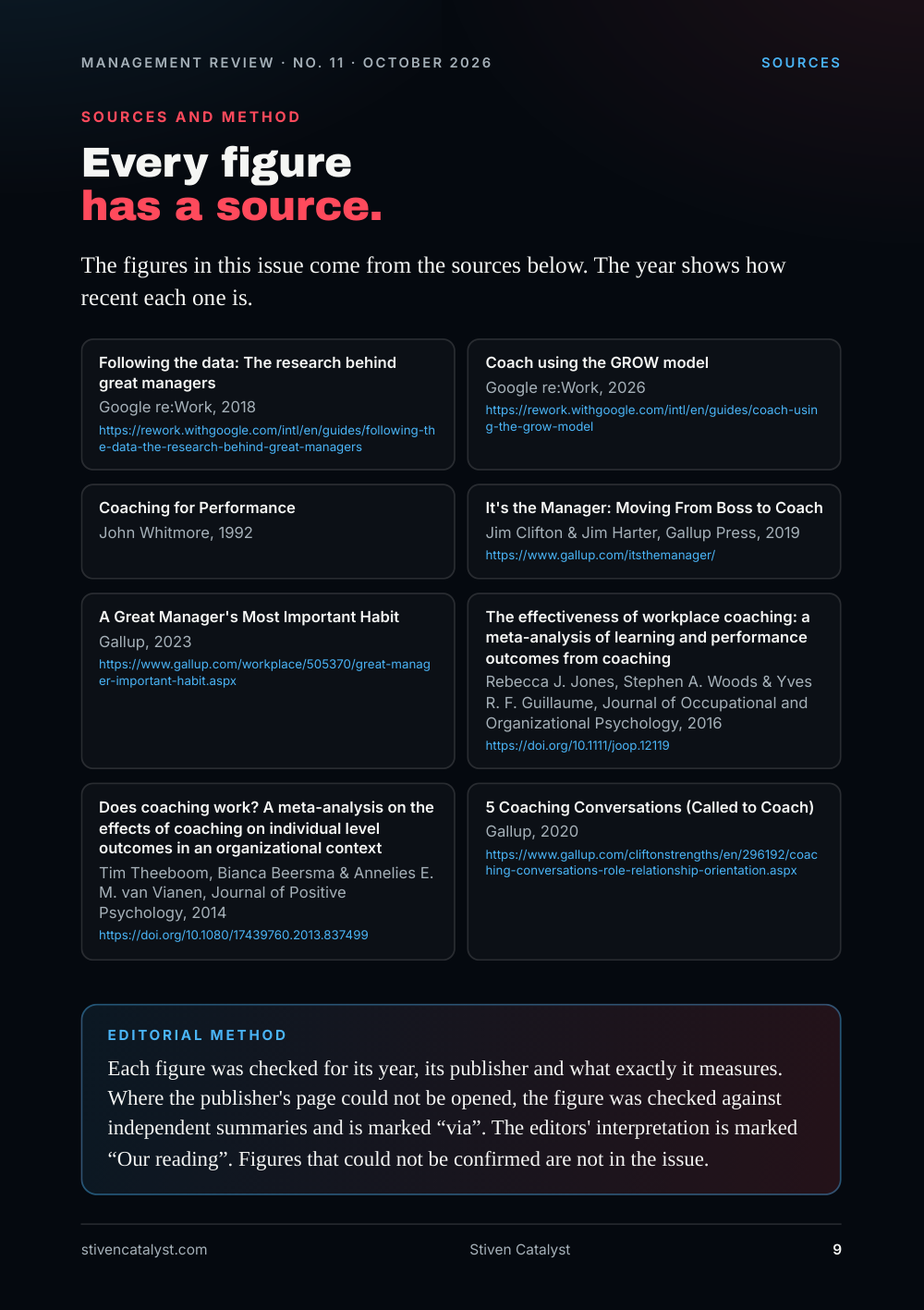
The figures in this issue come from the sources below. The year shows how recent each one is.
- Google re:Work, “Following the data: The research behind great managers”, 2018. https://rework.withgoogle.com/intl/en/guides/following-the-data-the-research-behind-great-managers
- Google re:Work, “Coach using the GROW model”, 2026. https://rework.withgoogle.com/intl/en/guides/coach-using-the-grow-model
- John Whitmore, “Coaching for Performance”, 1992.
- Jim Clifton & Jim Harter, Gallup Press, “It's the Manager: Moving From Boss to Coach”, 2019. https://www.gallup.com/itsthemanager/
- Gallup, “A Great Manager's Most Important Habit”, 2023. https://www.gallup.com/workplace/505370/great-manager-important-habit.aspx
- Rebecca J. Jones, Stephen A. Woods & Yves R. F. Guillaume, Journal of Occupational and Organizational Psychology, “The effectiveness of workplace coaching: a meta-analysis of learning and performance outcomes from coaching”, 2016. https://doi.org/10.1111/joop.12119
- Tim Theeboom, Bianca Beersma & Annelies E. M. van Vianen, Journal of Positive Psychology, “Does coaching work? A meta-analysis on the effects of coaching on individual level outcomes in an organizational context”, 2014. https://doi.org/10.1080/17439760.2013.837499
- Gallup, “5 Coaching Conversations (Called to Coach)”, 2020. https://www.gallup.com/cliftonstrengths/en/296192/coaching-conversations-role-relationship-orientation.aspx
Edit orial me thod
Each figure was checked for its year, its publisher and what exactly it measures. Where the publisher's page could not be opened, the figure was checked against independent summaries and is marked “via”. The editors' interpretation is marked “Our reading”. Figures that could not be confirmed are not in the issue.