In 2011 a study of 1,112 parole rulings found favourable decisions falling from about 65% to nearly zero within each session. A letter showed that prisoners without a lawyer usually came last; the authors replied that the pattern held. In 2016 a simulation showed that a rational judge who avoids starting long cases before a break produces much of the drop. Three explanations, one way to count your own decisions, and a card for the last hour close the issue.
Management Review · Third series · November 2026 · No. 107
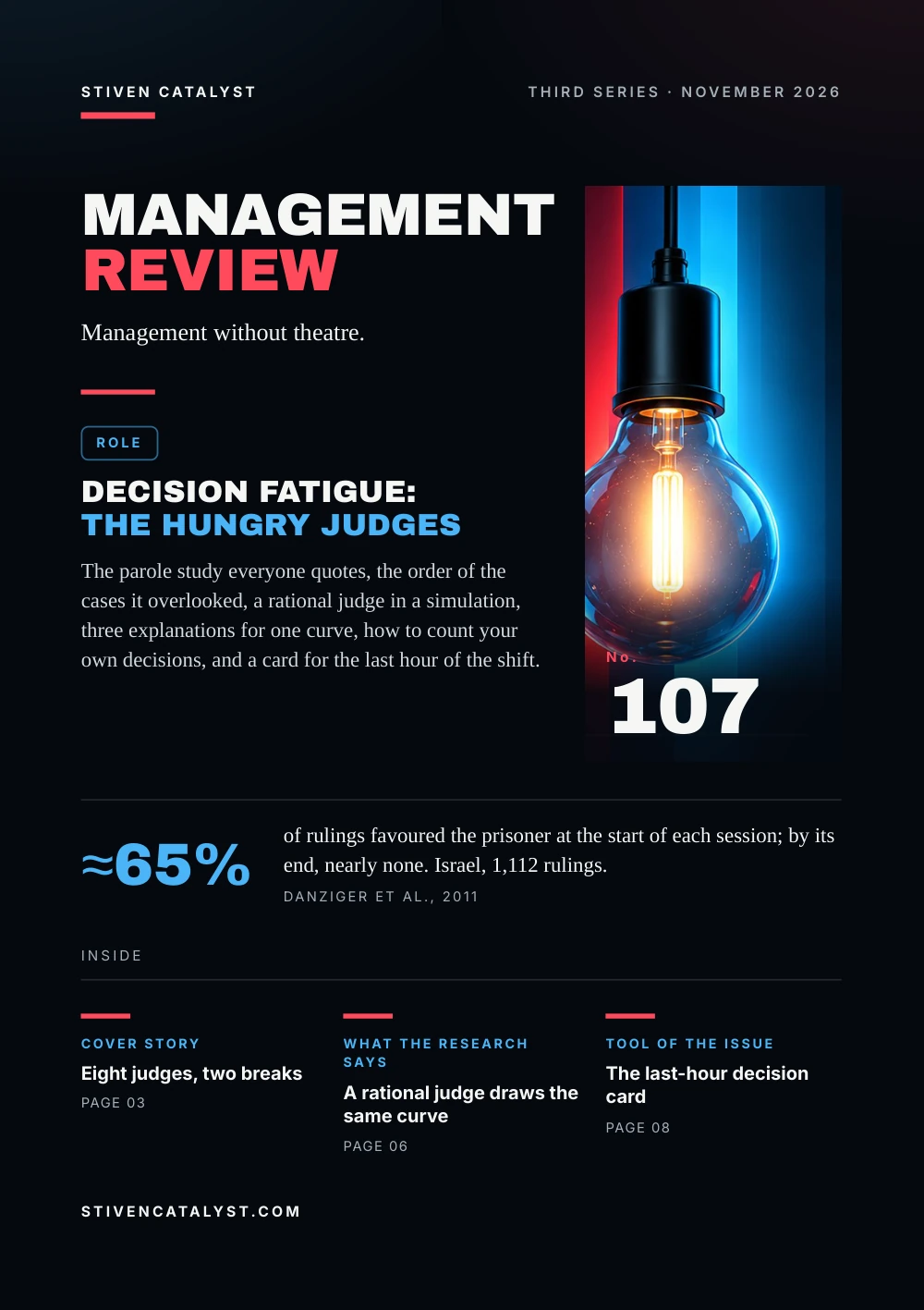
Decision fatigue: the hungry judges
The parole study everyone quotes, the order of the cases it overlooked, a rational judge in a simulation, three explanations for one curve, how to count your own decisions, and a card for the last hour of the shift.
- No.
- 107
- Pages
- 10
- Sources
- 4
- Topics
- Role
- Online since
- 7 November 2026
Stiven CatalystThird series · November 2026
ManagementReview
Management without theatre.
Role
Decision fatigue:the hungry judges
The parole study everyone quotes, the order of the cases it overlooked, a rational judge in a simulation, three explanations for one curve, how to count your own decisions, and a card for the last hour of the shift.

No.107
≈65%
of rulings favoured the prisoner at the start of each session; by its end, nearly none. Israel, 1,112 rulings.Danziger et al., 2011
stivencatalyst.com
No. 107 · Role
In this issue
Managers make their hardest calls late: the last request of the day, the complaint at the end of the night, the approval before handover. A famous study says that tired people then fall back on no. This issue asks how much of that claim survived its critics, and what a manager can still do with what survived.
- 03Cover storyEight judges, two breaks
- 04The numbersA yes takes longer
- 05The modelThree explanations for one curve
- 06What the research saysA rational judge draws the same curve
- 07How it is measuredBefore you blame fatigue, count
- 08Tool of the issueThe last-hour decision card
- 09SourcesSources and method
How to read this issue
Figure
Every figure has its source and year at the foot of its page.
Our reading
Where the editor interprets rather than the research, it says so.
Practice
The steps and the card are proposals to try, not research results.
Cover story
Eight judges,two breaks
Shai Danziger, Jonathan Levav and Liora Avnaim-Pesso coded 1,112 rulings by eight Israeli judges on two parole boards, over 50 days in ten months. A late-morning snack and lunch cut each day into three sessions. Within each, favourable rulings fell from about 65% to nearly zero, then jumped back after the break.
64.2%of requests were rejected; 48.4% of these rejections were deferrals to a later hearing
22.5years on the bench, the judges' average experience
The drop held after controls for the crime, months served, earlier prison terms, a rehabilitation programme, sex and nationality, and it held for every judge. The authors read it as depletion: after many rulings, a judge falls back on the status quo, which here means no.
Our reading
The surprise was never that judges are human. It was the size: from two in three to almost none, within one session.
Sources: Shai Danziger, Jonathan Levav & Liora Avnaim-Pesso, PNAS 108(17), 2011; Andreas Glöckner, Judgment and Decision Making 11(6), 2016
Danziger et al. (2011): 78.2% of the requests were for parole, the rest for changed terms. A deferral counts as a rejection. The curve is the paper's Figure 1 and is not redrawn: the data were never released. Noise between judges is in No. 20.
The numbers
A yes takeslonger
The paper itself held a detail that matters later. Granting a request took longer and needed more words than refusing it. The breaks were set by the judge, at times that varied from day to day.
7.37 : 5.21minutes per case, granted against refused
90 : 47words in the written verdict, granted against refused
- Session 1start of the day
- Snackstarts 9:49–10:27, after 7.8 cases on average; 38 min
- Session 211.4 cases on average
- Lunchstarts 12:46–14:10; 57 min on average
- Session 3afternoon
Source: Shai Danziger, Jonathan Levav & Liora Avnaim-Pesso, PNAS 108(17), 2011
Danziger et al. (2011), means over all rulings (89.61 and 47.36 words). The authors took the shorter refusals as a sign that no is the easier choice; Glöckner (2016) used the same two means for his simulation.
The model
Three explanationsfor one curve
Six months after the study, Keren Weinshall-Margel of the Israeli courts' research division and John Shapard wrote that the order of cases was not random. Within each session, prisoners without a lawyer usually went last; the board also tried to finish one prison's cases before a break.
01
Depletion
Many rulings tire the judge, who falls back on no; a meal restores. Danziger et al.
02
Order
The weaker cases, without counsel, come last in a session. Weinshall-Margel and Shapard
03
Time
Grants take longer, so they are the cases left for after the break. Glöckner
Share of requests granted, by legal counsel, the letter's data
The authors replied that the drop and the break stayed robust predictors once representation was added, and that lawyers took clients first come, first served, which rules out ordering by prison.
Sources: Keren Weinshall-Margel & John Shapard, PNAS 108(42), 2011 (via excerpts of the PubMed Central page, not the full text); Shai Danziger, Jonathan Levav & Liora Avnaim-Pesso, PNAS 108(42), 2011 (via excerpts of the PubMed Central page, not the full text); Andreas Glöckner, Judgment and Decision Making 11(6), 2016
Weinshall-Margel & Shapard (2011): the authors' data plus 12 hearing days of their own (227 decisions), same decision rules. The reply (2011) does not say how large the drop remains with counsel controlled, as Glöckner (2016) notes. Cards: the editors' summary.
What the research says
A rational judgedraws the same curve
In 2016 Andreas Glöckner simulated a judge without any bias: 10,000 cases in random order, 36% deserving a yes, grants taking 7.37 minutes and refusals 5.21 on average, as in the study. The judge only avoids starting a case that would run past the session's time limit.
Share of cases that still fit with 5 minutes left, simulation
So the last cases of a session are mostly quick refusals, and the long grants open the next one. The rational judge's curve fell from 36% towards zero. Cutting the last 5% of each session, as the study did, made the drop larger; with a slight link between rulings it gave a drop of about 15% even with no foresight.
Our reading
Glöckner does not say the judges were fine. He says the curve does not prove they were not.
Source: Andreas Glöckner, Judgment and Decision Making 11(6), 2016
Glöckner (2016), normal decision times, 60-minute limit. His caveats: the simulated start, about 45%, stays below the observed 65%, and time management explains a drop of only 15% to 45%. He calls the effect overestimated and does not rule it out.
How it is measured
Before you blamefatigue, count
Glöckner also points to the lab: a registered replication in 23 labs with 2,142 people found a depletion effect of d = 0.04, not different from zero. A manager who wants to know whether late decisions differ has to count them, and the critics show how not to.
Time and place in the queue
when it was decided, and how many decisions came before it that day
Who set the order
arrival, urgency, a person; the order is a cause until shown otherwise
Yes, no, and later
keep deferrals apart; counted as no, 67% for prisoners with counsel became 35%
How long it took
long cases get pushed to the next slot; that alone bends the curve
All of them
do not drop the last ones of a session; the simulation shows what that does
Sources: Andreas Glöckner, Judgment and Decision Making 11(6), 2016; Keren Weinshall-Margel & John Shapard, PNAS 108(42), 2011 (via excerpts of the PubMed Central page, not the full text)
The fields are the editors' proposal, built on the three papers' points of dispute. The replication (Hagger & Chatzisarantis, 2016) was not read; its result as Glöckner (2016) gives it. Hours awake and real fatigue are in No. 89.
Tool of the issue
The last-hourdecision card
What survives the critics is modest: a no is often the faster answer, and late in a session the quick answers pile up. For a decision that comes in the last hour and can wait, write down what happens if nobody decides, then hand it over instead of saying no by default.
01The decision, the timewhat is asked, by whom; how many decisions came before it today
02If nobody decidesthe default outcome; is it really neutral?
03Can it wait, can it be undonewhat waiting costs, and until when
04What a yes would needthe facts or the time missing now
05Handed over toname, by when; the person asking is told
Sources: Shai Danziger, Jonathan Levav & Liora Avnaim-Pesso, PNAS 108(17), 2011; Andreas Glöckner, Judgment and Decision Making 11(6), 2016
The card is the editors' proposal, not a tested method. It rests on the study's reading of no as the status quo and on the critics' point that long cases slip to the next slot. Defaults are in No. 93. The essay linked below gives the author's questions on reversibility and waiting.
More in the essayWhen to solve it yourself and when to take it higher
Open the tool: Shift Handoverstivencatalyst.com/tools/shift-handover/
Sources and method
Every figurehas a source.
The figures in this issue come from the sources below. The year shows how recent each one is.
- Extraneous factors in judicial decisionsShai Danziger, Jonathan Levav & Liora Avnaim-Pesso, PNAS 108(17), 2011https://doi.org/10.1073/pnas.1018033108
- Overlooked factors in the analysis of parole decisions (letter)Keren Weinshall-Margel & John Shapard, PNAS 108(42), 2011 · via excerpts of the PubMed Central page, not the full texthttps://doi.org/10.1073/pnas.1110910108
- Reply to Weinshall-Margel and Shapard: Extraneous factors in judicial decisions persistShai Danziger, Jonathan Levav & Liora Avnaim-Pesso, PNAS 108(42), 2011 · via excerpts of the PubMed Central page, not the full texthttps://doi.org/10.1073/pnas.1112190108
- The irrational hungry judge effect revisited: Simulations reveal that the magnitude of the effect is overestimatedAndreas Glöckner, Judgment and Decision Making 11(6), 2016https://journal.sjdm.org/16/16823/jdm16823.pdf
Editorial method
Each figure was checked for its year, its publisher and what it measures, in the full text where it could be opened. A source read only in a summary, an abstract or excerpts is marked “via”. A figure not confirmed in what was read is marked so on its page, or left out. The editor's interpretation is marked “Our reading”.
ManagementReview
Management without theatre.
Every issue, one management question, checked against the best research.
All issues
stivencatalyst.com/magazine/management-review.html
Management Review · No. 107 · November 2026 · Stiven Catalyst
Edited by Stiven Janaqi, who answers for it; “the editors” in this publication means him. Its texts, translations, layout and the checking of figures against their sources are done in working sessions with Claude, an AI model by Anthropic.
stivencatalyst.com/how-this-is-made.html
 Next issue
Online ratings: what a star is worth
Click or swipe a page to turn it. The arrow keys work too.
Management Review · No. 107
The figures of the issue
The charts of the printed pages, with their sources.
Weinshall-Margel & Shapard (2011): the authors' data plus 12 hearing days of their own (227 decisions), same decision rules. The reply (2011) does not say how large the drop remains with counsel controlled, as Glöckner (2016) notes. Cards: the editors' summary.
Source: Keren Weinshall-Margel & John Shapard, PNAS 108(42), 2011 (via excerpts of the PubMed Central page, not the full text)
Glöckner (2016), normal decision times, 60-minute limit. His caveats: the simulated start, about 45%, stays below the observed 65%, and time management explains a drop of only 15% to 45%. He calls the effect overestimated and does not rule it out.
Source: Andreas Glöckner, Judgment and Decision Making 11(6), 2016
The whole text Read the issue as text For reading on a small screen, searching or a screen reader. The same words, without the page design.
In this issue
Managers make their hardest calls late: the last request of the day, the complaint at the end of the night, the approval before handover. A famous study says that tired people then fall back on no. This issue asks how much of that claim survived its critics, and what a manager can still do with what survived.
In 2011 a study of 1,112 parole rulings found favourable decisions falling from about 65% to nearly zero within each session. A letter showed that prisoners without a lawyer usually came last; the authors replied that the pattern held. In 2016 a simulation showed that a rational judge who avoids starting long cases before a break produces much of the drop. Three explanations, one way to count your own decisions, and a card for the last hour close the issue.
Stiven Janaqi, Editor
Cover story
Eight judges, two breaks
Shai Danziger, Jonathan Levav and Liora Avnaim-Pesso coded 1,112 rulings by eight Israeli judges on two parole boards, over 50 days in ten months. A late-morning snack and lunch cut each day into three sessions. Within each, favourable rulings fell from about 65% to nearly zero, then jumped back after the break.
- 64.2% of requests were rejected; 48.4% of these rejections were deferrals to a later hearing
- 22.5 years on the bench, the judges' average experience
The drop held after controls for the crime, months served, earlier prison terms, a rehabilitation programme, sex and nationality, and it held for every judge. The authors read it as depletion: after many rulings, a judge falls back on the status quo, which here means no.
Our reading
The surprise was never that judges are human. It was the size: from two in three to almost none, within one session.
Danziger et al. (2011): 78.2% of the requests were for parole, the rest for changed terms. A deferral counts as a rejection. The curve is the paper's Figure 1 and is not redrawn: the data were never released. Noise between judges is in No. 20.
Sources: Shai Danziger, Jonathan Levav & Liora Avnaim-Pesso, PNAS 108(17), 2011; Andreas Glöckner, Judgment and Decision Making 11(6), 2016
The numbers
A yes takes longer
The paper itself held a detail that matters later. Granting a request took longer and needed more words than refusing it. The breaks were set by the judge, at times that varied from day to day.
- 7.37 : 5.21 minutes per case, granted against refused
- 90 : 47 words in the written verdict, granted against refused
- Session 1 start of the day
- Snack starts 9:49–10:27, after 7.8 cases on average; 38 min
- Session 2 11.4 cases on average
- Lunch starts 12:46–14:10; 57 min on average
- Session 3 afternoon
Danziger et al. (2011), means over all rulings (89.61 and 47.36 words). The authors took the shorter refusals as a sign that no is the easier choice; Glöckner (2016) used the same two means for his simulation.
Source: Shai Danziger, Jonathan Levav & Liora Avnaim-Pesso, PNAS 108(17), 2011
The model
Three explanations for one curve
Six months after the study, Keren Weinshall-Margel of the Israeli courts' research division and John Shapard wrote that the order of cases was not random. Within each session, prisoners without a lawyer usually went last; the board also tried to finish one prison's cases before a break.
- Depl
e tion. Many rulings tire the judge, who falls back on no; a meal restores. Danziger et al. - Order. The weaker cases, without counsel, come last in a session. Weinshall-Margel and Shapard
- Time. Grants take longer, so they are the cases left for after the break. Glöckner
Share of requests granted, by legal counsel, the letter's data: With counsel: Deferral counted as no 35%, Deferrals left out 67%; Without, about one case in three: Deferral counted as no 15%, Deferrals left out 39%.
The authors replied that the drop and the break stayed robust predictors once representation was added, and that lawyers took clients first come, first served, which rules out ordering by prison.
Weinshall-Margel & Shapard (2011): the authors' data plus 12 hearing days of their own (227 decisions), same decision rules. The reply (2011) does not say how large the drop remains with counsel controlled, as Glöckner (2016) notes. Cards: the editors' summary.
Sources: Keren Weinshall-Margel & John Shapard, PNAS 108(42), 2011 (via excerpts of the PubMed Central page, not the full text); Shai Danziger, Jonathan Levav & Liora Avnaim-Pesso, PNAS 108(42), 2011 (via excerpts of the PubMed Central page, not the full text); Andreas Glöckner, Judgment and Decision Making 11(6), 2016
What the research says
A rational judge draws the same curve
In 2016 Andreas Glöckner simulated a judge without any bias: 10,000 cases in random order, 36% deserving a yes, grants taking 7.37 minutes and refusals 5.21 on average, as in the study. The judge only avoids starting a case that would run past the session's time limit.
Share of cases that still fit with 5 minutes left, simulation: Cases that end in a refusal 46%, Cases that end in a grant 12%.
So the last cases of a session are mostly quick refusals, and the long grants open the next one. The rational judge's curve fell from 36% towards zero. Cutting the last 5% of each session, as the study did, made the drop larger; with a slight link between rulings it gave a drop of about 15% even with no foresight.
Our reading
Glöckner does not say the judges were fine. He says the curve does not prove they were not.
Glöckner (2016), normal decision times, 60-minute limit. His caveats: the simulated start, about 45%, stays below the observed 65%, and time management explains a drop of only 15% to 45%. He calls the effect overestimated and does not rule it out.
Source: Andreas Glöckner, Judgment and Decision Making 11(6), 2016
How it is measured
Before you blame fatigue, count
Glöckner also points to the lab: a registered replication in 23 labs with 2,142 people found a depletion effect of d = 0.04, not different from zero. A manager who wants to know whether late decisions differ has to count them, and the critics show how not to.
- Time and place in the queue. when it was decided, and how many decisions came before it that day
- Who s
e t the order. arrival, urgency, a person; the order is a cause until shown otherwise - Yes, no, and later. keep deferrals apart; counted as no, 67% for prisoners with counsel became 35%
- How long it
t ook. long cases get pushed to the next slot; that alone bends the curve - All of them. do not drop the last ones of a session; the simulation shows what that does
The fields are the editors' proposal, built on the three papers' points of dispute. The replication (Hagger & Chatzisarantis, 2016) was not read; its result as Glöckner (2016) gives it. Hours awake and real fatigue are in No. 89.
Sources: Andreas Glöckner, Judgment and Decision Making 11(6), 2016; Keren Weinshall-Margel & John Shapard, PNAS 108(42), 2011 (via excerpts of the PubMed Central page, not the full text)
Tool of the issue
The last-hour decision card
What survives the critics is modest: a no is often the faster answer, and late in a session the quick answers pile up. For a decision that comes in the last hour and can wait, write down what happens if nobody decides, then hand it over instead of saying no by default.
- The decision, the time what is asked, by whom; how many decisions came before it today
- If nobody decides the default outcome; is it really neutral?
- Can it wait, can it be undone what waiting costs, and until when
- What a yes would need the facts or the time missing now
- Handed over
t o name, by when; the person asking is told
The card is the editors' proposal, not a tested method. It rests on the study's reading of no as the status quo and on the critics' point that long cases slip to the next slot. Defaults are in No. 93. The essay linked below gives the author's questions on reversibility and waiting.
Sources: Shai Danziger, Jonathan Levav & Liora Avnaim-Pesso, PNAS 108(17), 2011; Andreas Glöckner, Judgment and Decision Making 11(6), 2016
More in the essay: When to solve it yourself and when to take it higher
Open the tool: Shift Handover
Sources and method
Every figure has a source.
The figures in this issue come from the sources below. The year shows how recent each one is.
- Shai Danziger, Jonathan Levav & Liora Avnaim-Pesso, PNAS 108(17), “Extraneous factors in judicial decisions”, 2011. https://doi.org/10.1073/pnas.1018033108
- Keren Weinshall-Margel & John Shapard, PNAS 108(42), “Overlooked factors in the analysis of parole decisions (letter)”, 2011 (via excerpts of the PubMed Central page, not the full text). https://doi.org/10.1073/pnas.1110910108
- Shai Danziger, Jonathan Levav & Liora Avnaim-Pesso, PNAS 108(42), “Reply to Weinshall-Margel and Shapard: Extraneous factors in judicial decisions persist”, 2011 (via excerpts of the PubMed Central page, not the full text). https://doi.org/10.1073/pnas.1112190108
- Andreas Glöckner, Judgment and Decision Making 11(6), “The irrational hungry judge effect revisited: Simulations reveal that the magnitude of the effect is overestimated”, 2016. https://journal.sjdm.org/16/16823/jdm16823.pdf
Edit orial me thod
Each figure was checked for its year, its publisher and what it measures, in the full text where it could be opened. A source read only in a summary, an abstract or excerpts is marked “via”. A figure not confirmed in what was read is marked so on its page, or left out. The editor's interpretation is marked “Our reading”.
Edited by Stiven Janaqi, who answers for it; “the editors” in this publication means him. Its texts, translations, layout and the checking of figures against their sources are done in working sessions with Claude, an AI model by Anthropic. How this is made
Management Review · Monthly edition