The ILO counts at least 2.41 billion workers, 71% of the working population, exposed to excessive heat; in 2020 nine in ten of those exposures happened outside heatwaves. Europe and Central Asia have the lowest share and the fastest rise. EU-OSHA names laundries, restaurant kitchens and warehouse workers among indoor groups at risk, and advises easing new workers in over days. Germany's workplace rule sets steps at 26, 30 and 35 °C. A card for the hot shift ends the issue.
Management Review · Third series · November 2026 · No. 84
Heat at work: not only in a heatwave
Warehouses, kitchens, vans and laundries, nine in ten exposures outside heatwaves, Europe's fast rise, the first days in the heat, Germany's steps at 26, 30 and 35 °C, and a card for the hot shift.
- No.
- 84
- Pages
- 10
- Sources
- 3
- Topics
- People
- Online since
- 1 November 2026
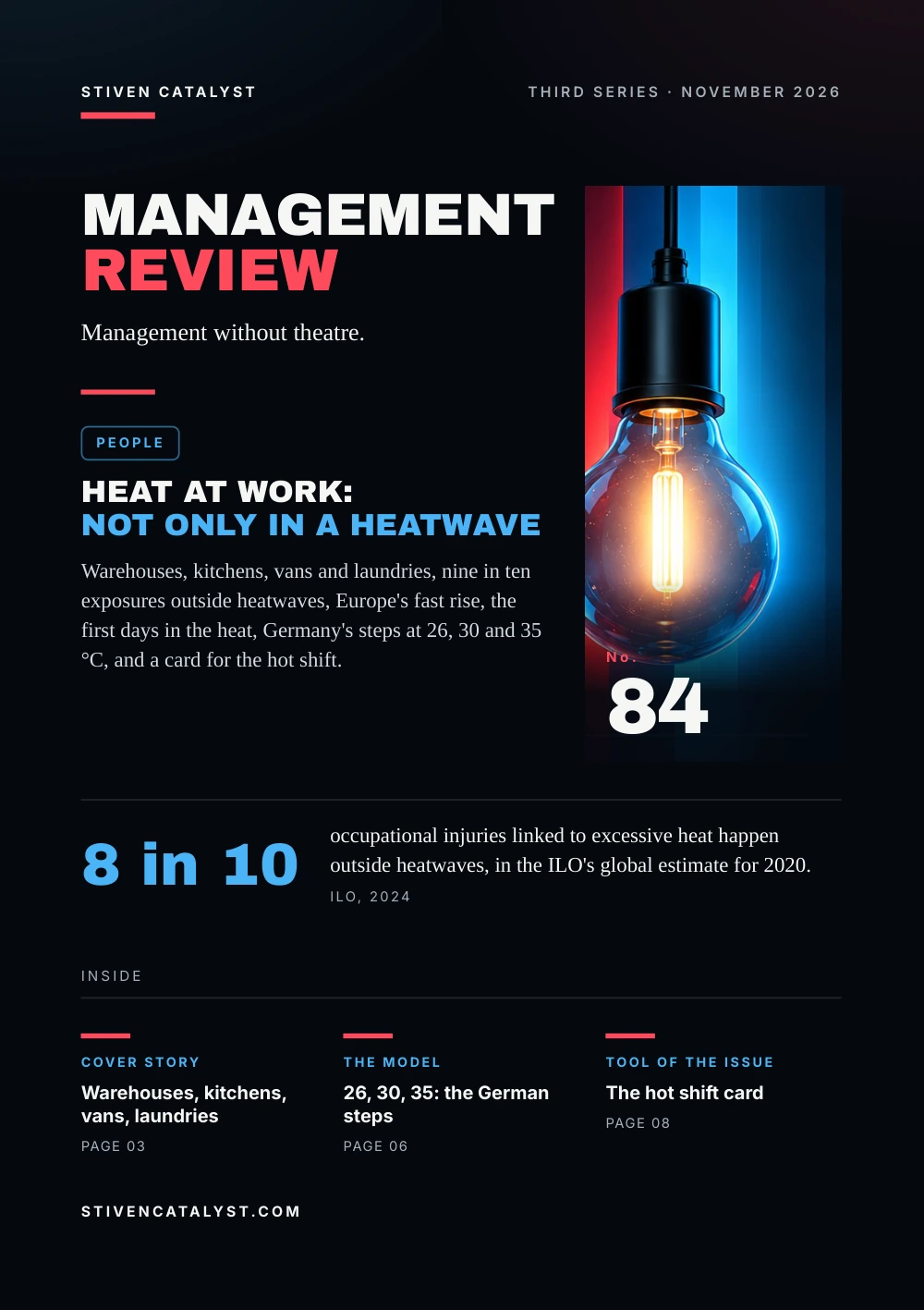
Stiven CatalystThird series · November 2026
ManagementReview
Management without theatre.
People
Heat at work:not only in a heatwave
Warehouses, kitchens, vans and laundries, nine in ten exposures outside heatwaves, Europe's fast rise, the first days in the heat, Germany's steps at 26, 30 and 35 °C, and a card for the hot shift.

No.84
8 in 10
occupational injuries linked to excessive heat happen outside heatwaves, in the ILO's global estimate for 2020.ILO, 2024
stivencatalyst.com
No. 84 · People
In this issue
Hotter summers reach work done indoors and in vans, not only on building sites. Managers of warehouses, kitchens, delivery rounds and laundries decide every hot day on water, breaks and pace. This issue asks what the evidence and the rules say about those decisions.
- 03Cover storyWarehouses, kitchens, vans, laundries
- 04The numbersNine in ten outside the heatwave
- 05What the research saysThe body and the first days
- 06The model26, 30, 35: the German steps
- 07How it is measuredMeasured where people work
- 08Tool of the issueThe hot shift card
- 09SourcesSources and method
How to read this issue
Figure
Every figure has its source and year at the foot of its page.
Our reading
Where the editor interprets rather than the research, it says so.
Practice
The steps and the card are proposals to try, not research results.
Cover story
Warehouses, kit chens,vans, laundries
Heat at work brings to mind a road crew at noon. EU-OSHA's guidance of 2023 also names work indoors: poorly cooled buildings, heavy physical work, and services such as laundries, restaurant kitchens and bakeries, as well as warehouse workers.
Warehouses
The ILO rates heavy handling and lifting as heavy work, 360–465 W of body heat; warehouse work is among its examples.
Kitchens
Restaurant work counts as moderate, 235–360 W; EU-OSHA lists restaurant kitchens and bakeries among indoor services at risk.
Delivery vans
Confined spaces that trap heat, often without air conditioning, parcels to carry, and few toilets on the route, which often means drinking too little.
Laundries
The ILO lists laundering among high-risk work. In hot, humid air sweat cools poorly; a worker there is more prone to losing fluid and salts.
Our reading
Indoors, much of the heat comes from the work itself: the body that lifts, the machine that runs, the air that does not move.
Sources: International Labour Organization (ILO), Geneva, 2024; European Agency for Safety and Health at Work (EU-OSHA), 2023
Watts are the body's heat output by work intensity, from the ILO's table based on ISO (2017). The vans follow the ILO's account of delivery workers; grouping the cases in four is the editors'.
The numbers
Nine in tenoutside the heatwave
The ILO's 2024 review starts from its estimate that 2.41 billion workers are exposed to excessive heat, and asks when it happens. In 2020, 231 million were exposed during a heatwave.
Workers exposed to excessive heat in 2020, out of 10
- 1 in 10during a heatwave
- 9 in 10outside heatwaves
29%of workers in Europe and Central Asia exposed, the lowest share of any region
+17.3%rise in exposure there from 2000 to 2020, the largest; worldwide +8.8%
Our reading
A heat plan that waits for the weather warning starts late. Most hot shifts never make the news.
Source: International Labour Organization (ILO), Geneva, 2024
ILO model estimates from climate and labour-force data, formal and informal work. For Europe's fast rise in heat-linked injuries the ILO suggests workforces largely not acclimatized. Read in the full text.
What the research says
The bodyand the first days
In heatstroke, EU-OSHA warns, body temperature can reach 40 °C or more within 10 to 15 minutes, and people are generally unable to notice their own symptoms. The body adapts to heat, but only over days.
Most of the usual time in the heat, worker with experience (2023)
New workers start at no more than 20% on day one and add at most 20% a day. Full acclimatisation takes six to seven days; tolerance falls even after a long weekend. A meta-analysis cited by the ILO found injury risk 1% higher per degree above reference values.
Our reading
In a hot week, the worker most at risk may be the new one, or the one back from leave.
Sources: European Agency for Safety and Health at Work (EU-OSHA), 2023; International Labour Organization (ILO), Geneva, 2024
EU-OSHA's recommended maximum share of usual time in the heat, a guide, not a measurement. The meta-analysis (22 studies, almost 22 million injuries) is as the ILO reports it; we did not read it.
The model
26, 30, 35:the German steps
Germany's workplace rule on room temperature, ASR A3.5, last amended in 2022, says the air in work rooms should not exceed 26 °C. When the outside air is above 26 °C and sun protection is in place, duties rise in steps.
Above 26 °C: should
Extra measures such as blinds kept shut, night cooling, flexitime, looser dress rules, fans; drinks should be provided. Heavy work, protective clothing or vulnerable staff call for a fresh assessment.
Above 30 °C: must
Effective measures under the risk assessment; technical and organisational ones come before personal ones. Drinks must be provided.
Above 35 °C: not a work room
Without measures as for heat work, such as air showers, cooling phases or heat-protective clothing, the room is not suitable for work while it lasts.
Our reading
At 30 °C “should” becomes “must”. A thermometer read only after complaints finds the step late.
Sources: Ausschuss für Arbeitsstätten; Federal Ministry of Labour (BMAS), GMBl 2010, p. 751, and 2022, p. 198, 2022; International Labour Organization (ILO), Geneva, 2024
ASR A3.5, sections 4.2 and 4.4, in our words; it applies in Germany. The ILO lists other limits, such as 27–31 °C by work intensity in Hungary and 28 °C in Latvia and Slovenia. The risk matrix is in No. 28.
How it is measured
Measured wherepeople work
ASR A3.5 says how: the air temperature, with a thermometer shielded from radiation and accurate to ±0.5 °C, read hourly where needed.
At the workplace
0.6 m above the floor for seated work, 1.1 m for standing work.
Outside
Hourly during working time, out of direct sun, about 4 m from the wall and 2 m high.
Humidity and radiant heat
Where they are high, they are judged too, alone or in a combined index; EU-OSHA names the WBGT.
Highest relative humidity when cooling adds moisture (2022)
Our reading
Cooling that adds moisture can trade one strain for another. The line marks where that trade stops.
Sources: Ausschuss für Arbeitsstätten; Federal Ministry of Labour (BMAS), GMBl 2010, p. 751, and 2022, p. 198, 2022; European Agency for Safety and Health at Work (EU-OSHA), 2023
The line is table 5 of ASR A3.5, the limit for cooling that raises humidity (about 11.5 g of water per kg of dry air); not a comfort range. Measuring rules from section 4.1.
Tool of the issue
The hotshif t card
One card per area and hot day, filled in before the shift and read out in the briefing, where today's risk is named. The full assessment of each work area belongs in Risk Assessment.
01Area and readingforecast outside, room reading at 1.1 m, time of reading
02Step and measuresabove 26, 30 or 35 °C; blinds, air, fans, cooler hours in place
03Waterwhere, how cool, who refills; one cup per person
04Pace and breaksheavy tasks moved to cooler hours, rotation, a cool place to rest, targets eased
05Who needs more carenew or returning staff, protective clothing, pregnancy, age, alone in a van
06Buddy and first aidwho watches whom, who is trained on this shift, call 112, how drivers check in
Sources: Ausschuss für Arbeitsstätten; Federal Ministry of Labour (BMAS), GMBl 2010, p. 751, and 2022, p. 198, 2022; European Agency for Safety and Health at Work (EU-OSHA), 2023; International Labour Organization (ILO), Geneva, 2024
This card is the editors' proposal, built on ASR A3.5, EU-OSHA (2023) and the ILO (2024). EU-OSHA warns that moving work into night hours brings risks of its own; night work is in No. 45, mental health in No. 75.
More in the essayTen minutes before the shift: what the team needs to know before the work starts
Open the tool: Risk Assessmentstivencatalyst.com/tools/risk-assessment/
Sources and method
Every figurehas a source.
The figures in this issue come from the sources below. The year shows how recent each one is.
- Heat at work: Implications for safety and health. A global review of the science, policy and practiceInternational Labour Organization (ILO), Geneva, 2024https://www.ilo.org/sites/default/files/2024-07/ILO_OSH_Heatstress-R16.pdf
- Heat at work – Guidance for workplacesEuropean Agency for Safety and Health at Work (EU-OSHA), 2023https://osha.europa.eu/en/publications/heat-work-guidance-workplaces
- Technische Regeln für Arbeitsstätten, ASR A3.5 „Raumtemperatur“ (2010, amended 2022)Ausschuss für Arbeitsstätten; Federal Ministry of Labour (BMAS), GMBl 2010, p. 751, and 2022, p. 198, 2022https://www.baua.de/DE/Angebote/Regelwerk/ASR/ASR-A3-5
Editorial method
Each figure was checked for its year, its publisher and what it measures, in the full text where it could be opened. A source read only in a summary, an abstract or excerpts is marked “via”. A figure not confirmed in what was read is marked so on its page, or left out. The editor's interpretation is marked “Our reading”.
ManagementReview
Management without theatre.
Every issue, one management question, checked against the best research.
All issues
stivencatalyst.com/magazine/management-review.html
Management Review · No. 84 · November 2026 · Stiven Catalyst
Edited by Stiven Janaqi, who answers for it; “the editors” in this publication means him. Its texts, translations, layout and the checking of figures against their sources are done in working sessions with Claude, an AI model by Anthropic.
stivencatalyst.com/how-this-is-made.html
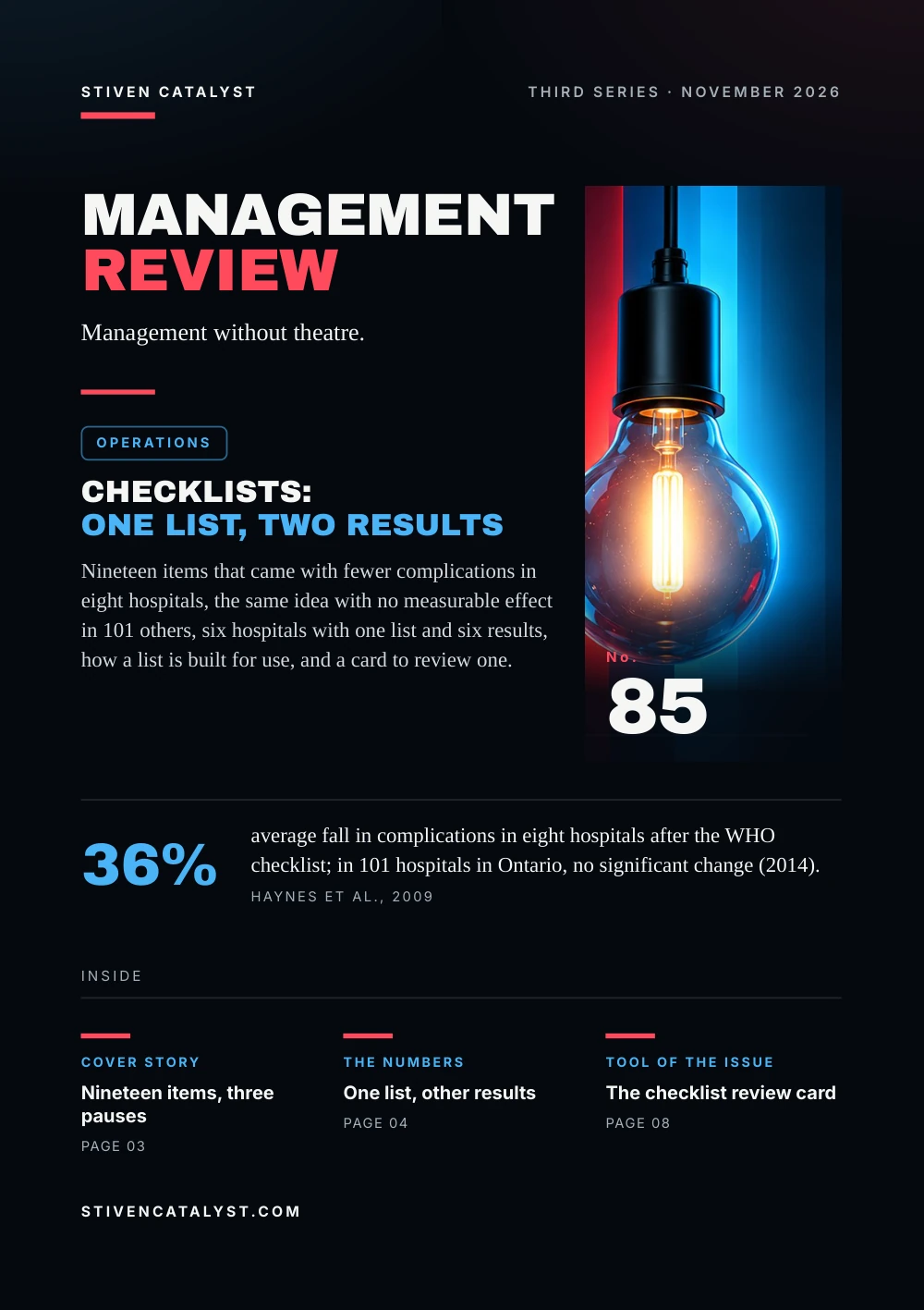 Next issue
Checklists: one list, two results
Click or swipe a page to turn it. The arrow keys work too.
Management Review · No. 84
The figures of the issue
The charts of the printed pages, with their sources.
- 1 in 10during a heatwave
- 9 in 10outside heatwaves
- 1 in 10during a heatwave
- 9 in 10outside heatwaves
ILO model estimates from climate and labour-force data, formal and informal work. For Europe's fast rise in heat-linked injuries the ILO suggests workforces largely not acclimatized. Read in the full text.
Source: International Labour Organization (ILO), Geneva, 2024
EU-OSHA's recommended maximum share of usual time in the heat, a guide, not a measurement. The meta-analysis (22 studies, almost 22 million injuries) is as the ILO reports it; we did not read it.
Source: European Agency for Safety and Health at Work (EU-OSHA), 2023
The line is table 5 of ASR A3.5, the limit for cooling that raises humidity (about 11.5 g of water per kg of dry air); not a comfort range. Measuring rules from section 4.1.
Source: Ausschuss für Arbeitsstätten; Federal Ministry of Labour (BMAS), GMBl 2010, p. 751, and 2022, p. 198, 2022
The whole text Read the issue as text For reading on a small screen, searching or a screen reader. The same words, without the page design.
In this issue
Hotter summers reach work done indoors and in vans, not only on building sites. Managers of warehouses, kitchens, delivery rounds and laundries decide every hot day on water, breaks and pace. This issue asks what the evidence and the rules say about those decisions.
The ILO counts at least 2.41 billion workers, 71% of the working population, exposed to excessive heat; in 2020 nine in ten of those exposures happened outside heatwaves. Europe and Central Asia have the lowest share and the fastest rise. EU-OSHA names laundries, restaurant kitchens and warehouse workers among indoor groups at risk, and advises easing new workers in over days. Germany's workplace rule sets steps at 26, 30 and 35 °C. A card for the hot shift ends the issue.
Stiven Janaqi, Editor
Cover story
Warehouses, kit chens, vans, laundries
Heat at work brings to mind a road crew at noon. EU-OSHA's guidance of 2023 also names work indoors: poorly cooled buildings, heavy physical work, and services such as laundries, restaurant kitchens and bakeries, as well as warehouse workers.
- Warehouses. The ILO rates heavy handling and lifting as heavy work, 360–465 W of body heat; warehouse work is among its examples.
- Ki
t chens. Restaurant work counts as moderate, 235–360 W; EU-OSHA lists restaurant kitchens and bakeries among indoor services at risk. - Delivery vans. Confined spaces that trap heat, often without air conditioning, parcels to carry, and few toilets on the route, which often means drinking too little.
- Laundries. The ILO lists laundering among high-risk work. In hot, humid air sweat cools poorly; a worker there is more prone to losing fluid and salts.
Our reading
Indoors, much of the heat comes from the work itself: the body that lifts, the machine that runs, the air that does not move.
Watts are the body's heat output by work intensity, from the ILO's table based on ISO (2017). The vans follow the ILO's account of delivery workers; grouping the cases in four is the editors'.
Sources: International Labour Organization (ILO), Geneva, 2024; European Agency for Safety and Health at Work (EU-OSHA), 2023
The numbers
Nine in ten outside the heatwave
The ILO's 2024 review starts from its estimate that 2.41 billion workers are exposed to excessive heat, and asks when it happens. In 2020, 231 million were exposed during a heatwave.
Workers exposed to excessive heat in 2020, out of 10: 1 in 10 during a heatwave, 9 in 10 outside heatwaves.
- 29% of workers in Europe and Central Asia exposed, the lowest share of any region
- +17.3% rise in exposure there from 2000 to 2020, the largest; worldwide +8.8%
Our reading
A heat plan that waits for the weather warning starts late. Most hot shifts never make the news.
ILO model estimates from climate and labour-force data, formal and informal work. For Europe's fast rise in heat-linked injuries the ILO suggests workforces largely not acclimatized. Read in the full text.
Source: International Labour Organization (ILO), Geneva, 2024
What the research says
The body and the first days
In heatstroke, EU-OSHA warns, body temperature can reach 40 °C or more within 10 to 15 minutes, and people are generally unable to notice their own symptoms. The body adapts to heat, but only over days.
Most of the usual time in the heat, worker with experience (2023): Day 1 50%, Day 2 60%, Day 3 80%, Day 4 100%.
New workers start at no more than 20% on day one and add at most 20% a day. Full acclimatisation takes six to seven days; tolerance falls even after a long weekend. A meta-analysis cited by the ILO found injury risk 1% higher per degree above reference values.
Our reading
In a hot week, the worker most at risk may be the new one, or the one back from leave.
EU-OSHA's recommended maximum share of usual time in the heat, a guide, not a measurement. The meta-analysis (22 studies, almost 22 million injuries) is as the ILO reports it; we did not read it.
Sources: European Agency for Safety and Health at Work (EU-OSHA), 2023; International Labour Organization (ILO), Geneva, 2024
The model
26, 30, 35: the German steps
Germany's workplace rule on room temperature, ASR A3.5, last amended in 2022, says the air in work rooms should not exceed 26 °C. When the outside air is above 26 °C and sun protection is in place, duties rise in steps.
- Above 26 °C: should. Extra measures such as blinds kept shut, night cooling, flexitime, looser dress rules, fans; drinks should be provided. Heavy work, protective clothing or vulnerable staff call for a fresh assessment.
- Above 30 °C: must. Effective measures under the risk assessment; technical and organisational ones come before personal ones. Drinks must be provided.
- Above 35 °C: not a work room. Without measures as for heat work, such as air showers, cooling phases or heat-protective clothing, the room is not suitable for work while it lasts.
Our reading
At 30 °C “should” becomes “must”. A thermometer read only after complaints finds the step late.
ASR A3.5, sections 4.2 and 4.4, in our words; it applies in Germany. The ILO lists other limits, such as 27–31 °C by work intensity in Hungary and 28 °C in Latvia and Slovenia. The risk matrix is in No. 28.
Sources: Ausschuss für Arbeitsstätten; Federal Ministry of Labour (BMAS), GMBl 2010, p. 751, and 2022, p. 198, 2022; International Labour Organization (ILO), Geneva, 2024
How it is measured
Measured where people work
ASR A3.5 says how: the air temperature, with a thermometer shielded from radiation and accurate to ±0.5 °C, read hourly where needed.
- At the workplace. 0.6 m above the floor for seated work, 1.1 m for standing work.
- Outside. Hourly during working time, out of direct sun, about 4 m from the wall and 2 m high.
- Humidi
t y and radiant heat. Where they are high, they are judged too, alone or in a combined index; EU-OSHA names the WBGT.
Highest relative humidity when cooling adds moisture (2022): 26 °C 55%, 28 °C 50%, 30 °C 44%, 32 °C 39%, 35 °C 33%.
Our reading
Cooling that adds moisture can trade one strain for another. The line marks where that trade stops.
The line is table 5 of ASR A3.5, the limit for cooling that raises humidity (about 11.5 g of water per kg of dry air); not a comfort range. Measuring rules from section 4.1.
Sources: Ausschuss für Arbeitsstätten; Federal Ministry of Labour (BMAS), GMBl 2010, p. 751, and 2022, p. 198, 2022; European Agency for Safety and Health at Work (EU-OSHA), 2023
Tool of the issue
The hot shif t card
One card per area and hot day, filled in before the shift and read out in the briefing, where today's risk is named. The full assessment of each work area belongs in Risk Assessment.
- Area and reading forecast outside, room reading at 1.1 m, time of reading
- Step and measures above 26, 30 or 35 °C; blinds, air, fans, cooler hours in place
- Water where, how cool, who refills; one cup per person
- Pace and breaks heavy tasks moved to cooler hours, rotation, a cool place to rest, targets eased
- Who needs more care new or returning staff, protective clothing, pregnancy, age, alone in a van
- Buddy and first aid who watches whom, who is trained on this shift, call 112, how drivers check in
This card is the editors' proposal, built on ASR A3.5, EU-OSHA (2023) and the ILO (2024). EU-OSHA warns that moving work into night hours brings risks of its own; night work is in No. 45, mental health in No. 75.
Sources: Ausschuss für Arbeitsstätten; Federal Ministry of Labour (BMAS), GMBl 2010, p. 751, and 2022, p. 198, 2022; European Agency for Safety and Health at Work (EU-OSHA), 2023; International Labour Organization (ILO), Geneva, 2024
More in the essay: Ten minutes before the shift: what the team needs to know before the work starts
Open the tool: Risk Assessment
Sources and method
Every figure has a source.
The figures in this issue come from the sources below. The year shows how recent each one is.
- International Labour Organization (ILO), Geneva, “Heat at work: Implications for safety and health. A global review of the science, policy and practice”, 2024. https://www.ilo.org/sites/default/files/2024-07/ILO_OSH_Heatstress-R16.pdf
- European Agency for Safety and Health at Work (EU-OSHA), “Heat at work – Guidance for workplaces”, 2023. https://osha.europa.eu/en/publications/heat-work-guidance-workplaces
- Ausschuss für Arbeitsstätten; Federal Ministry of Labour (BMAS), GMBl 2010, p. 751, and 2022, p. 198, “Technische Regeln für Arbeitsstätten, ASR A3.5 „Raumtemperatur“ (2010, amended 2022)”, 2022. https://www.baua.de/DE/Angebote/Regelwerk/ASR/ASR-A3-5
Edit orial me thod
Each figure was checked for its year, its publisher and what it measures, in the full text where it could be opened. A source read only in a summary, an abstract or excerpts is marked “via”. A figure not confirmed in what was read is marked so on its page, or left out. The editor's interpretation is marked “Our reading”.
Edited by Stiven Janaqi, who answers for it; “the editors” in this publication means him. Its texts, translations, layout and the checking of figures against their sources are done in working sessions with Claude, an AI model by Anthropic. How this is made
Management Review · Monthly edition