In this issue
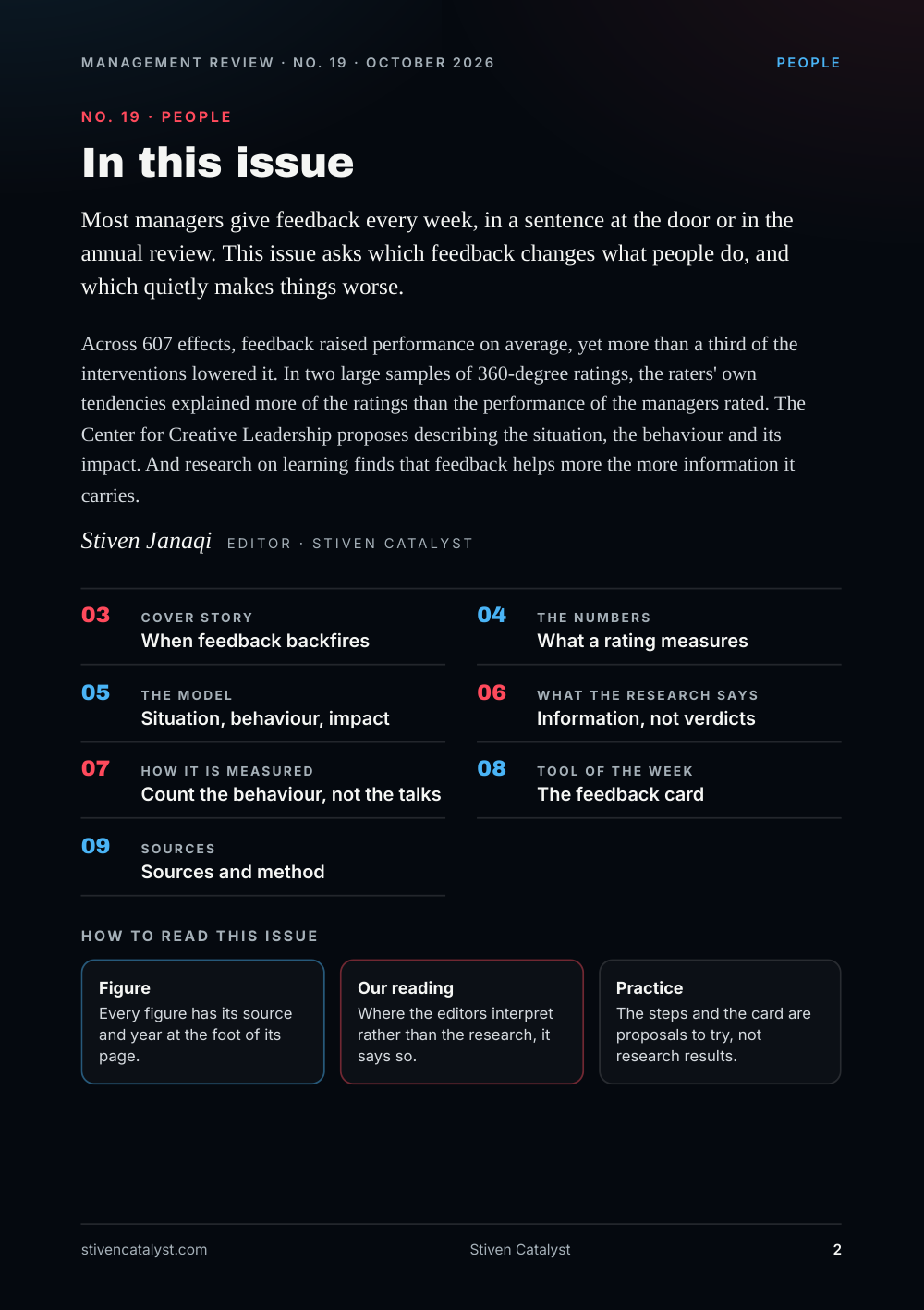
Most managers give feedback every week, in a sentence at the door or in the annual review. This issue asks which feedback changes what people do, and which quietly makes things worse.
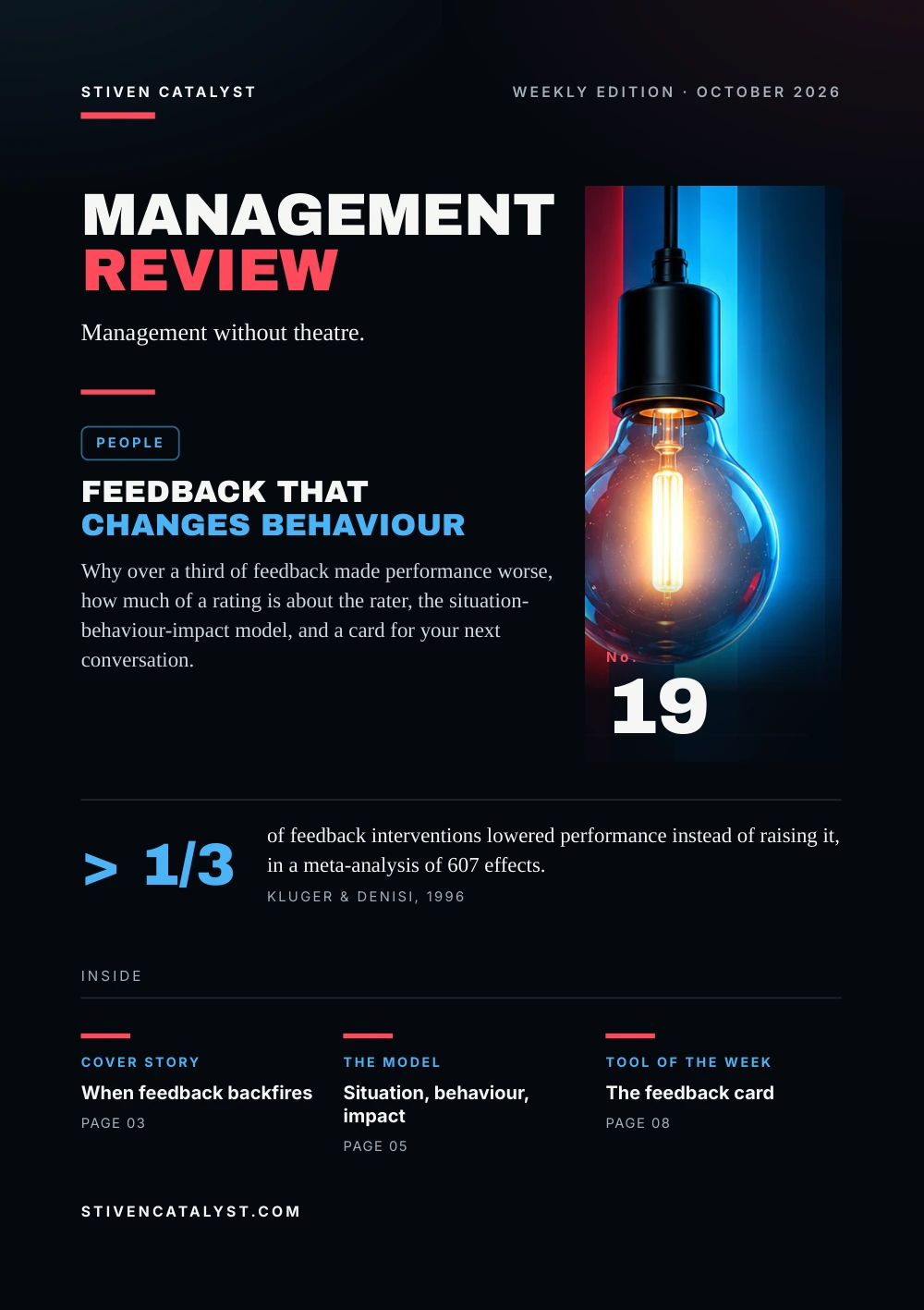
Across 607 effects, feedback raised performance on average, yet more than a third of the interventions lowered it. In two large samples of 360-degree ratings, the raters' own tendencies explained more of the ratings than the performance of the managers rated. The Center for Creative Leadership proposes describing the situation, the behaviour and its impact. And research on learning finds that feedback helps more the more information it carries.
Stiven Janaqi, Editor
Cover story
When feedback backfires
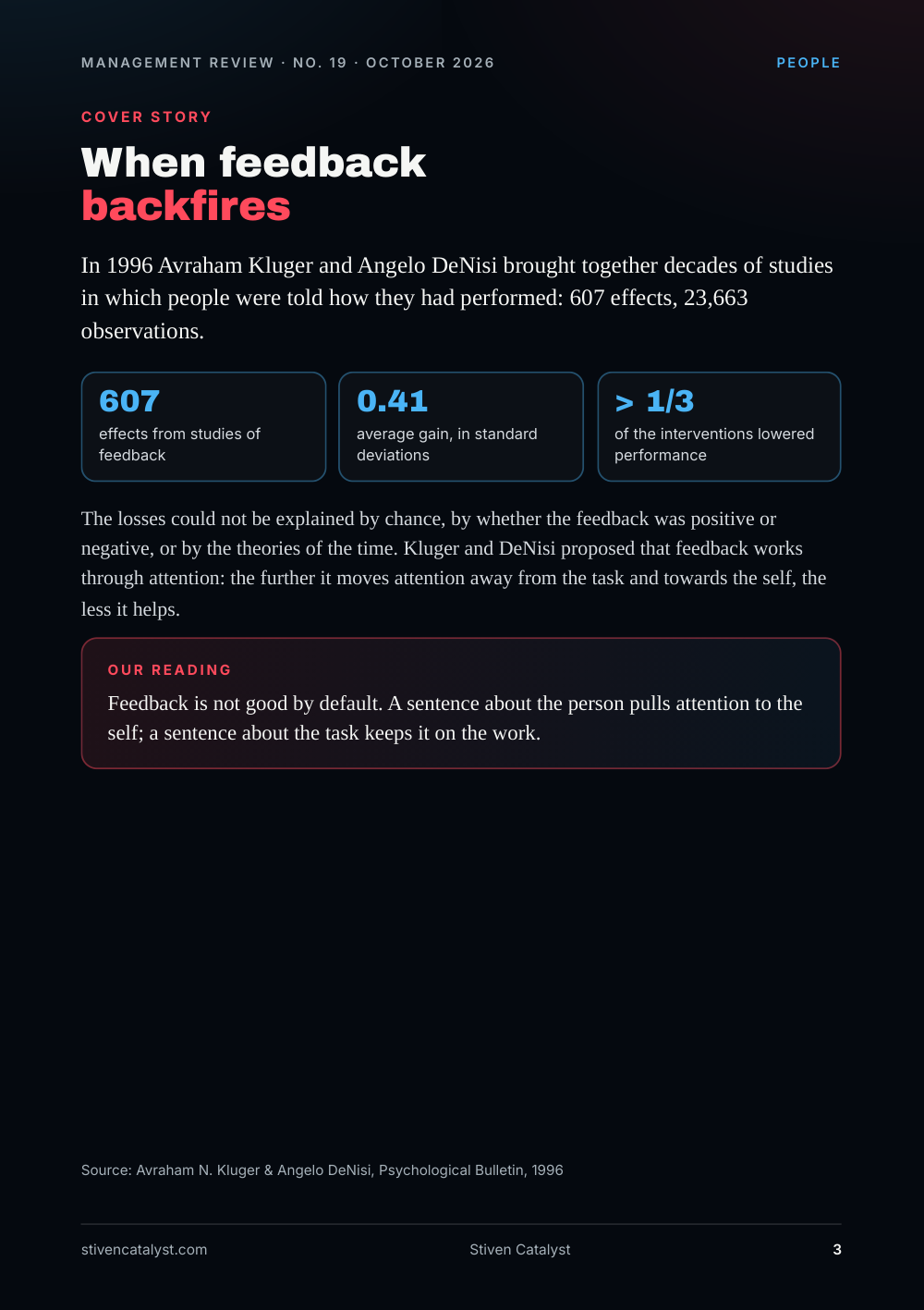
In 1996 Avraham Kluger and Angelo DeNisi brought together decades of studies in which people were told how they had performed: 607 effects, 23,663 observations.
- 607 effects from studies of feedback
- 0.41 average gain, in standard deviations
- > 1/3 of the interventions lowered performance
The losses could not be explained by chance, by whether the feedback was positive or negative, or by the theories of the time. Kluger and DeNisi proposed that feedback works through attention: the further it moves attention away from the task and towards the self, the less it helps.
Our reading
Feedback is not good by default. A sentence about the person pulls attention to the self; a sentence about the task keeps it on the work.
Source: Avraham N. Kluger & Angelo DeNisi, Psychological Bulletin, 1996
The numbers
What a rating measures
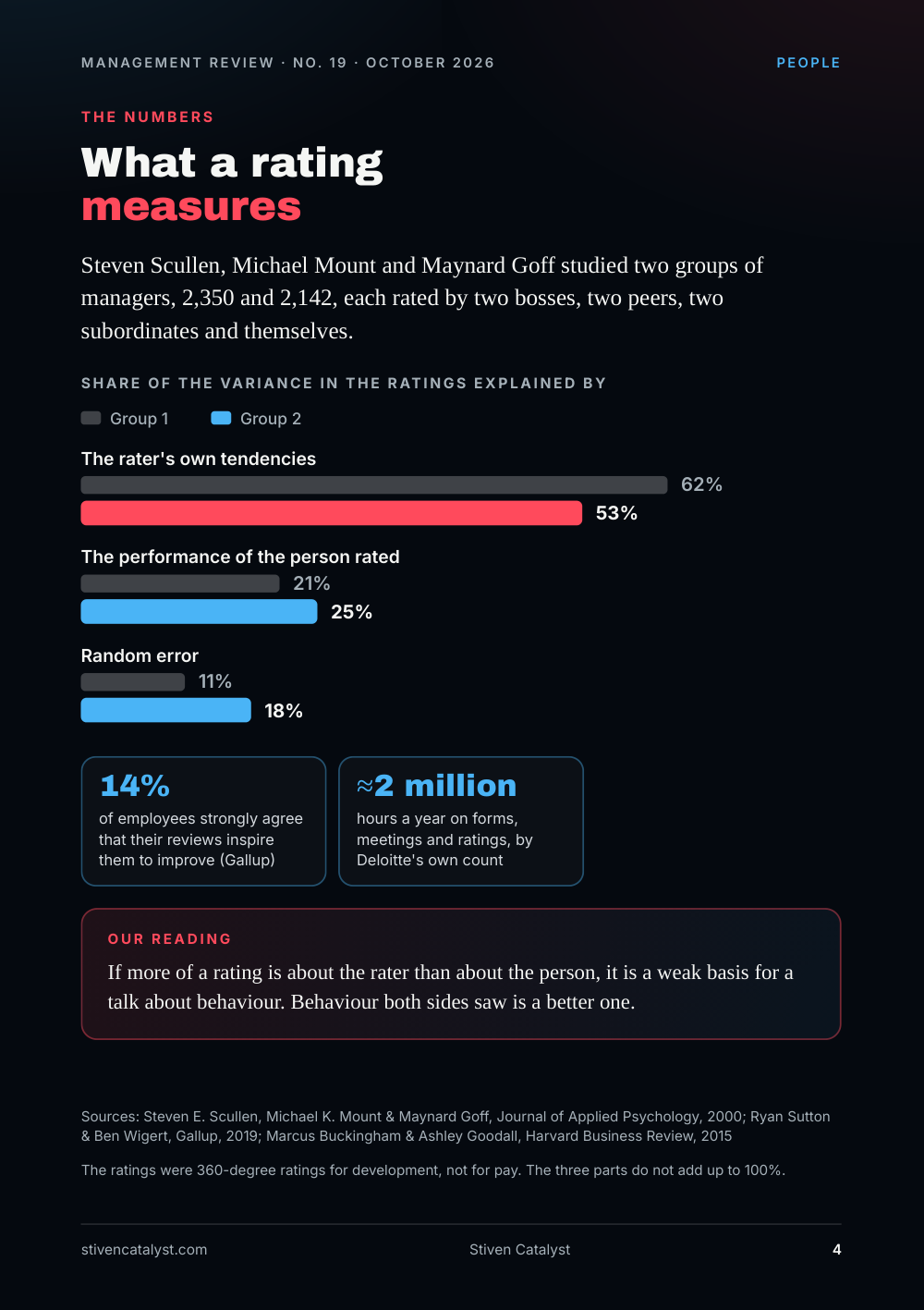
Steven Scullen, Michael Mount and Maynard Goff studied two groups of managers, 2,350 and 2,142, each rated by two bosses, two peers, two subordinates and themselves.
Share of the variance in the ratings explained by: The rater's own tendencies: Group 1 62%, Group 2 53%; The performance of the person rated: Group 1 21%, Group 2 25%; Random error: Group 1 11%, Group 2 18%.
- 14% of employees strongly agree that their reviews inspire them to improve (Gallup)
- ≈2 million hours a year on forms, meetings and ratings, by Deloitte's own count
Our reading
If more of a rating is about the rater than about the person, it is a weak basis for a talk about behaviour. Behaviour both sides saw is a better one.
The ratings were 360-degree ratings for development, not for pay. The three parts do not add up to 100%.
Sources: Steven E. Scullen, Michael K. Mount & Maynard Goff, Journal of Applied Psychology, 2000; Ryan Sutton & Ben Wigert, Gallup, 2019; Marcus Buckingham & Ashley Goodall, Harvard Business Review, 2015
The model
Situation, behaviour, impact
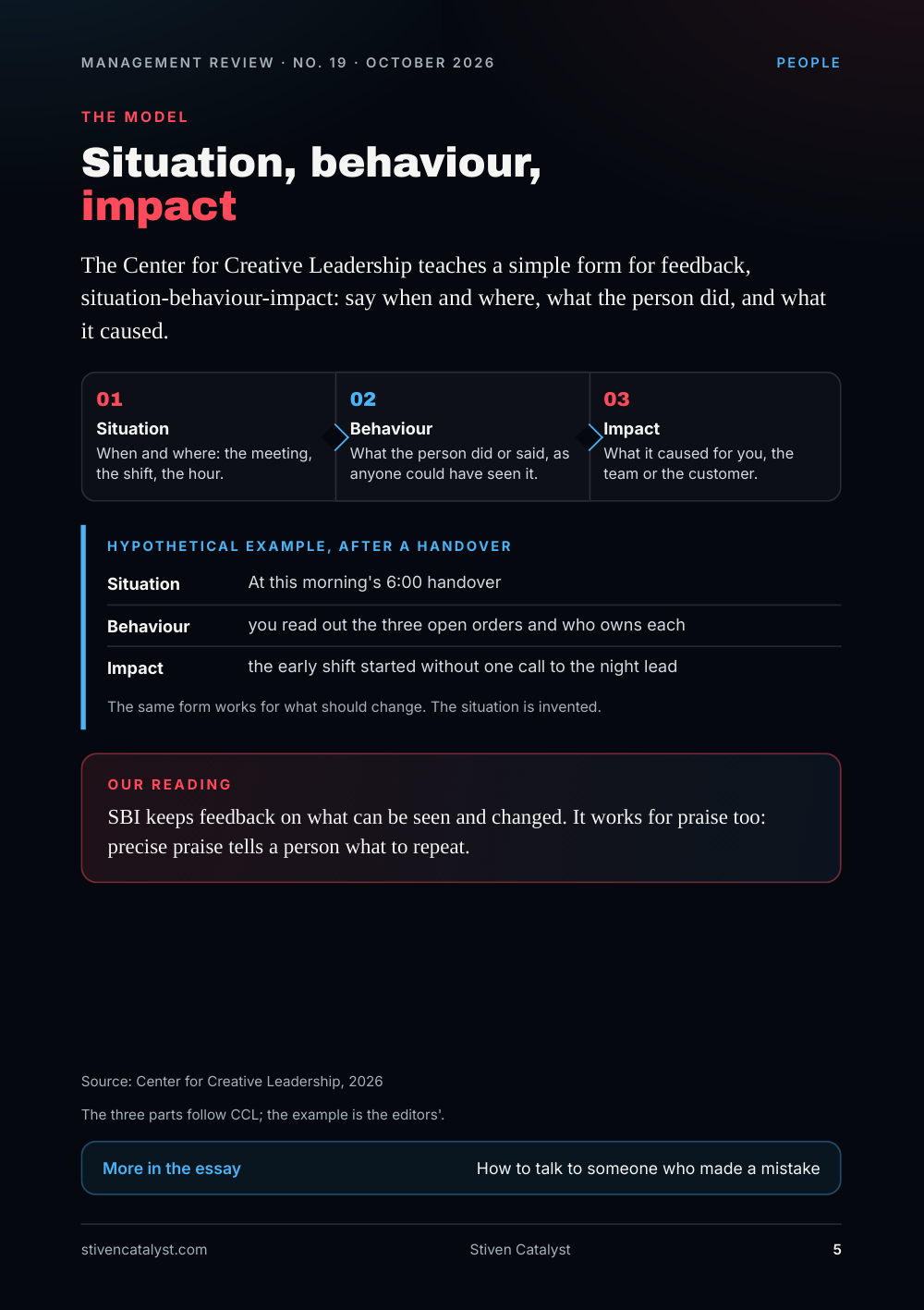
The Center for Creative Leadership teaches a simple form for feedback, situation-behaviour-impact: say when and where, what the person did, and what it caused.
- Situation. When and where: the meeting, the shift, the hour.
- Behaviour. What the person did or said, as anyone could have seen it.
- Impact. What it caused for you, the team or the customer.
Hypothe tical example, af ter a handover
- Situation: At this morning's 6:00 handover
- Behaviour: you read out the three open orders and who owns each
- Impact: the early shift started without one call to the night lead
The same form works for what should change. The situation is invented.
Our reading
SBI keeps feedback on what can be seen and changed. It works for praise too: precise praise tells a person what to repeat.
The three parts follow CCL; the example is the editors'.
Source: Center for Creative Leadership, 2026
More in the essay: How to talk to someone who made a mistake
What the research says
Information, not verdicts
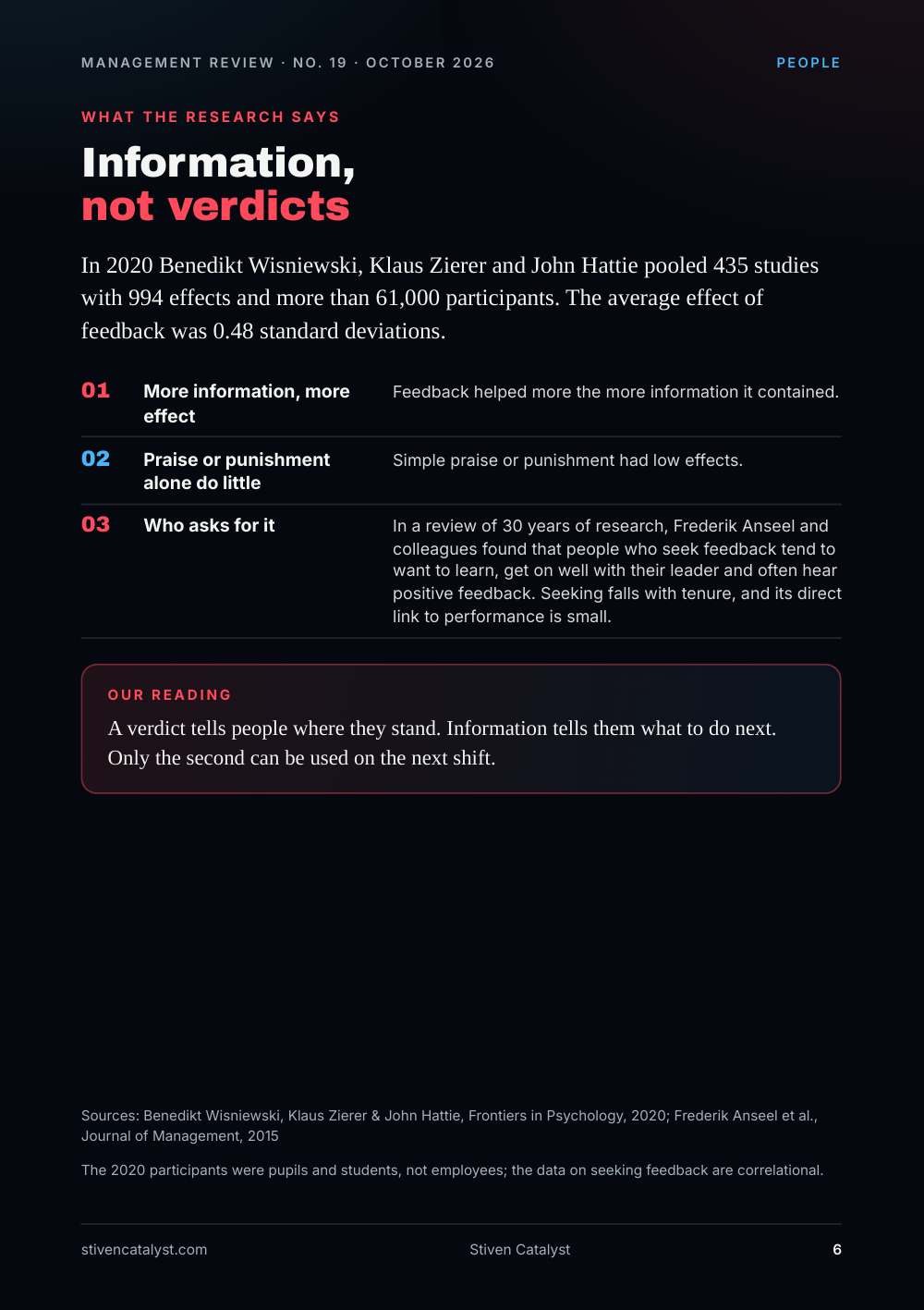
In 2020 Benedikt Wisniewski, Klaus Zierer and John Hattie pooled 435 studies with 994 effects and more than 61,000 participants. The average effect of feedback was 0.48 standard deviations.
- More information, more effect. Feedback helped more the more information it contained.
- Praise or punishment alone do li
t tle. Simple praise or punishment had low effects. - Who asks for it. In a review of 30 years of research, Frederik Anseel and colleagues found that people who seek feedback tend to want to learn, get on well with their leader and often hear positive feedback. Seeking falls with tenure, and its direct link to performance is small.
Our reading
A verdict tells people where they stand. Information tells them what to do next. Only the second can be used on the next shift.
The 2020 participants were pupils and students, not employees; the data on seeking feedback are correlational.
Sources: Benedikt Wisniewski, Klaus Zierer & John Hattie, Frontiers in Psychology, 2020; Frederik Anseel et al., Journal of Management, 2015
How it is measured
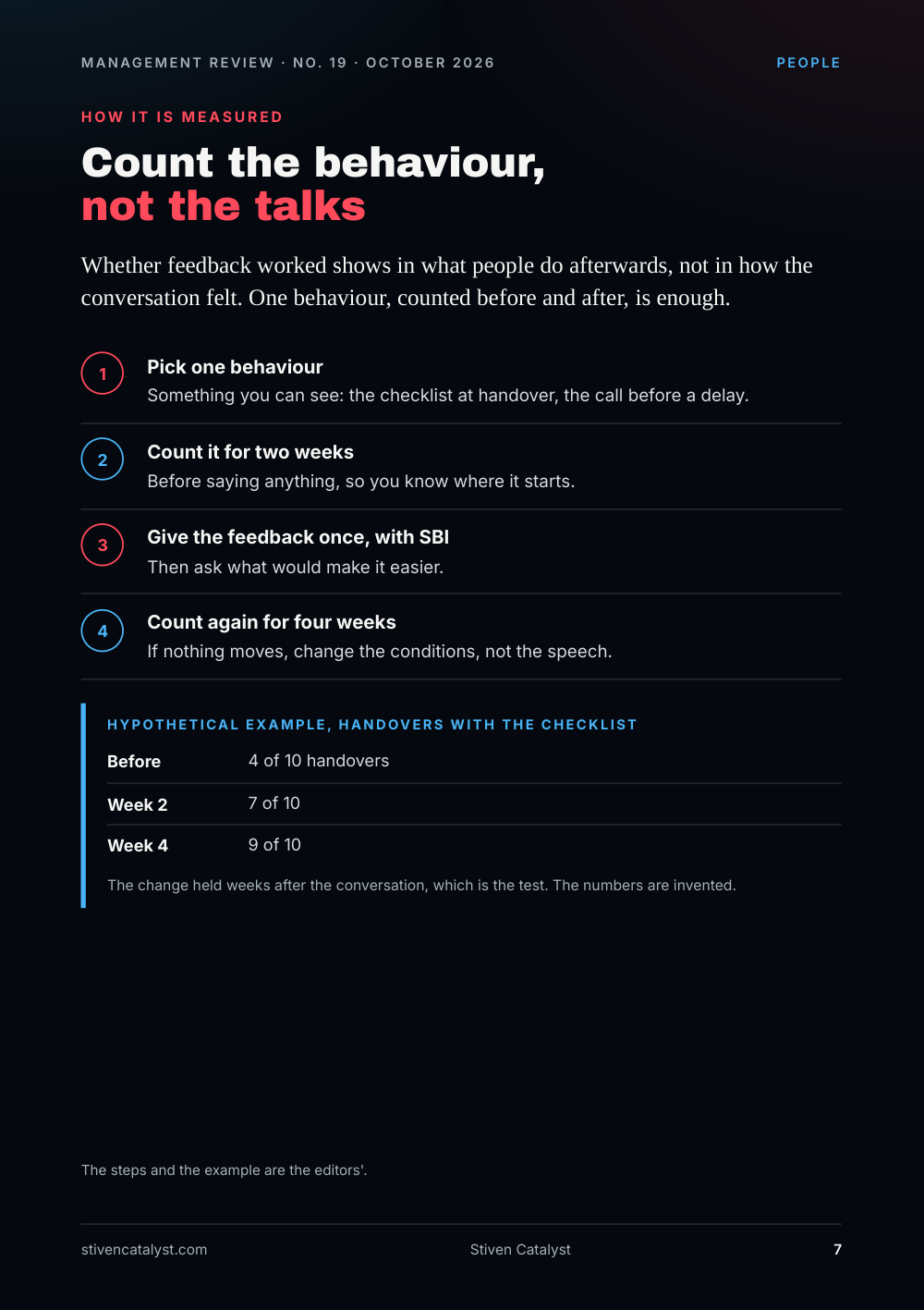
Count the behaviour, not the talks
Whether feedback worked shows in what people do afterwards, not in how the conversation felt. One behaviour, counted before and after, is enough.
- Pick one behaviour. Something you can see: the checklist at handover, the call before a delay.
- Count it for two weeks. Before saying anything, so you know where it starts.
- Give the feedback once, with SBI. Then ask what would make it easier.
- Count again for four weeks. If nothing moves, change the conditions, not the speech.
Hypothe tical example, handovers with the checklist
- Before: 4 of 10 handovers
- Week 2: 7 of 10
- Week 4: 9 of 10
The change held weeks after the conversation, which is the test. The numbers are invented.
The steps and the example are the editors'.
Tool of the week
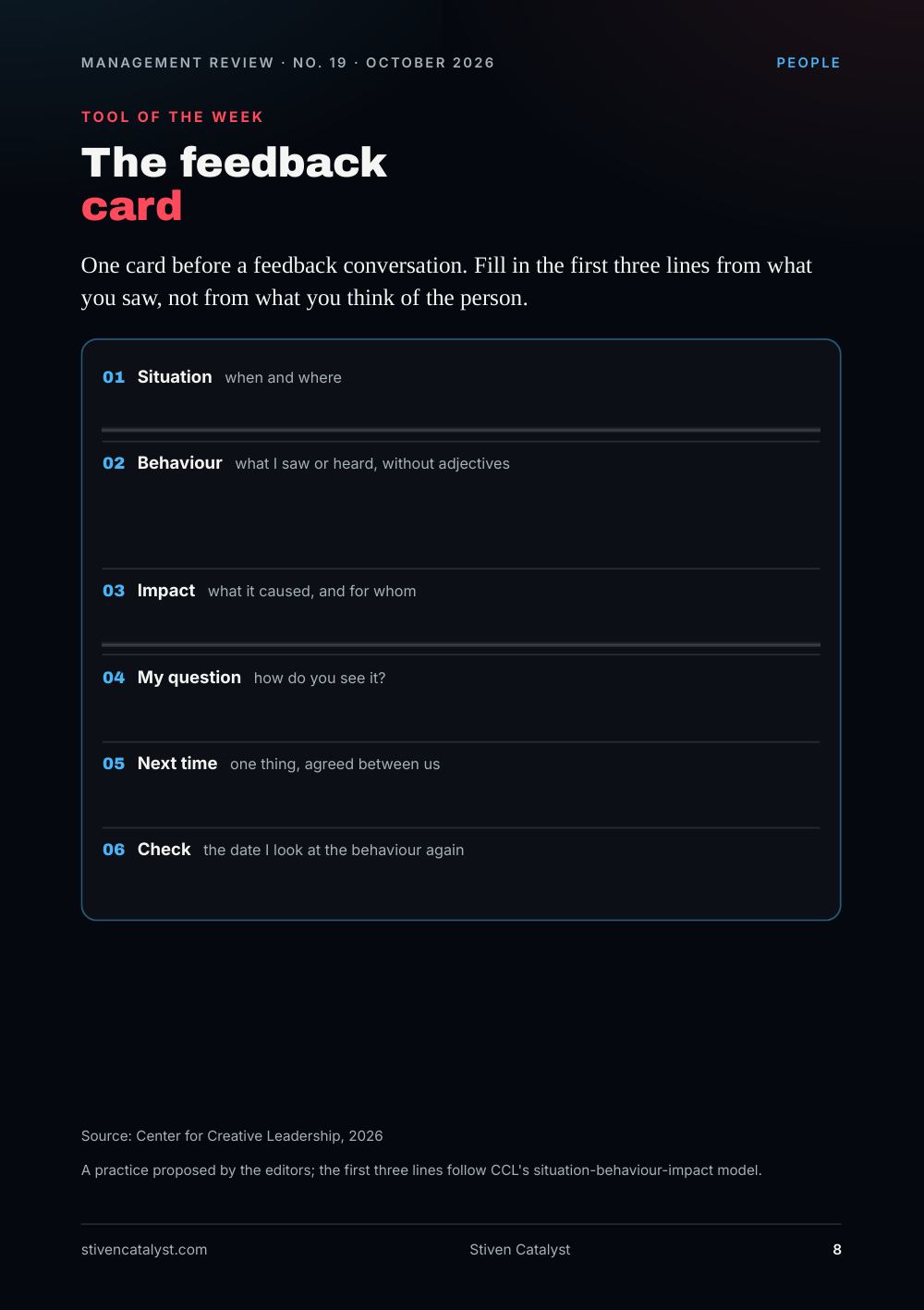
The feedback card
One card before a feedback conversation. Fill in the first three lines from what you saw, not from what you think of the person.
- Situation when and where
- Behaviour what I saw or heard, without adjectives
- Impact what it caused, and for whom
- My question how do you see it?
- Next time one thing, agreed between us
- Check the date I look at the behaviour again
A practice proposed by the editors; the first three lines follow CCL's situation-behaviour-impact model.
Source: Center for Creative Leadership, 2026
Sources and method
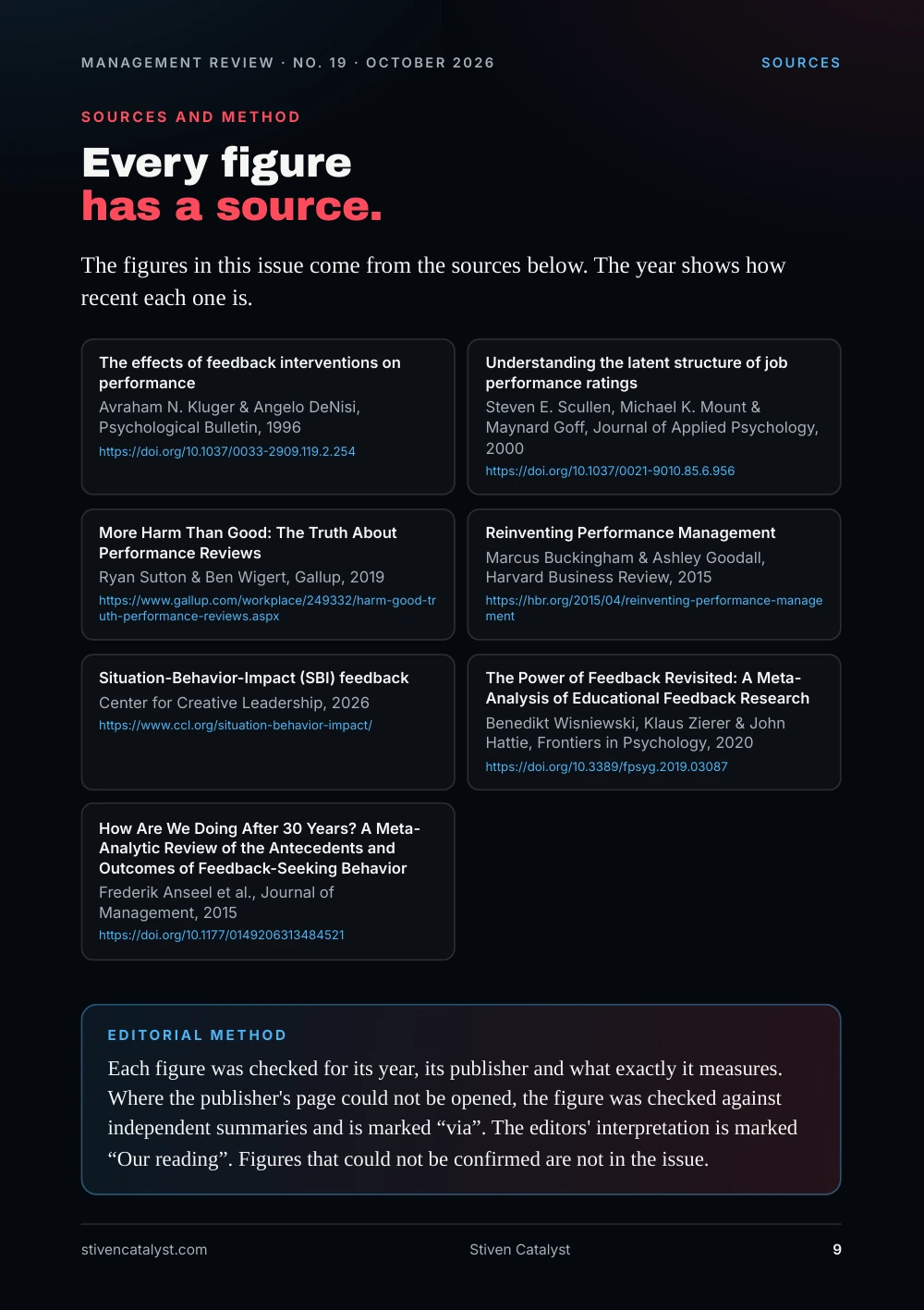
Every figure has a source.
The figures in this issue come from the sources below. The year shows how recent each one is.
- Avraham N. Kluger & Angelo DeNisi, Psychological Bulletin, “The effects of feedback interventions on performance”, 1996. https://doi.org/10.1037/0033-2909.119.2.254
- Steven E. Scullen, Michael K. Mount & Maynard Goff, Journal of Applied Psychology, “Understanding the latent structure of job performance ratings”, 2000. https://doi.org/10.1037/0021-9010.85.6.956
- Ryan Sutton & Ben Wigert, Gallup, “More Harm Than Good: The Truth About Performance Reviews”, 2019. https://www.gallup.com/workplace/249332/harm-good-truth-performance-reviews.aspx
- Marcus Buckingham & Ashley Goodall, Harvard Business Review, “Reinventing Performance Management”, 2015. https://hbr.org/2015/04/reinventing-performance-management
- Center for Creative Leadership, “Situation-Behavior-Impact (SBI) feedback”, 2026. https://www.ccl.org/situation-behavior-impact/
- Benedikt Wisniewski, Klaus Zierer & John Hattie, Frontiers in Psychology, “The Power of Feedback Revisited: A Meta-Analysis of Educational Feedback Research”, 2020. https://doi.org/10.3389/fpsyg.2019.03087
- Frederik Anseel et al., Journal of Management, “How Are We Doing After 30 Years? A Meta-Analytic Review of the Antecedents and Outcomes of Feedback-Seeking Behavior”, 2015. https://doi.org/10.1177/0149206313484521
Edit orial me thod
Each figure was checked for its year, its publisher and what exactly it measures. Where the publisher's page could not be opened, the figure was checked against independent summaries and is marked “via”. The editors' interpretation is marked “Our reading”. Figures that could not be confirmed are not in the issue.