In 1980 John Gabarro and John Kotter described managing the boss as working consciously with your superior for the best results for both and for the company, not as flattery. Of 40 employees interviewed in 2003, 34 had at least once felt unable to raise an important issue with their bosses. Leader–member exchange research describes how the relationship grows from strangers to partners. Meta-analyses find that boss and employee rate it only moderately alike. Seven questions make it measurable.
Management Review · Second series · November 2026 · No. 52
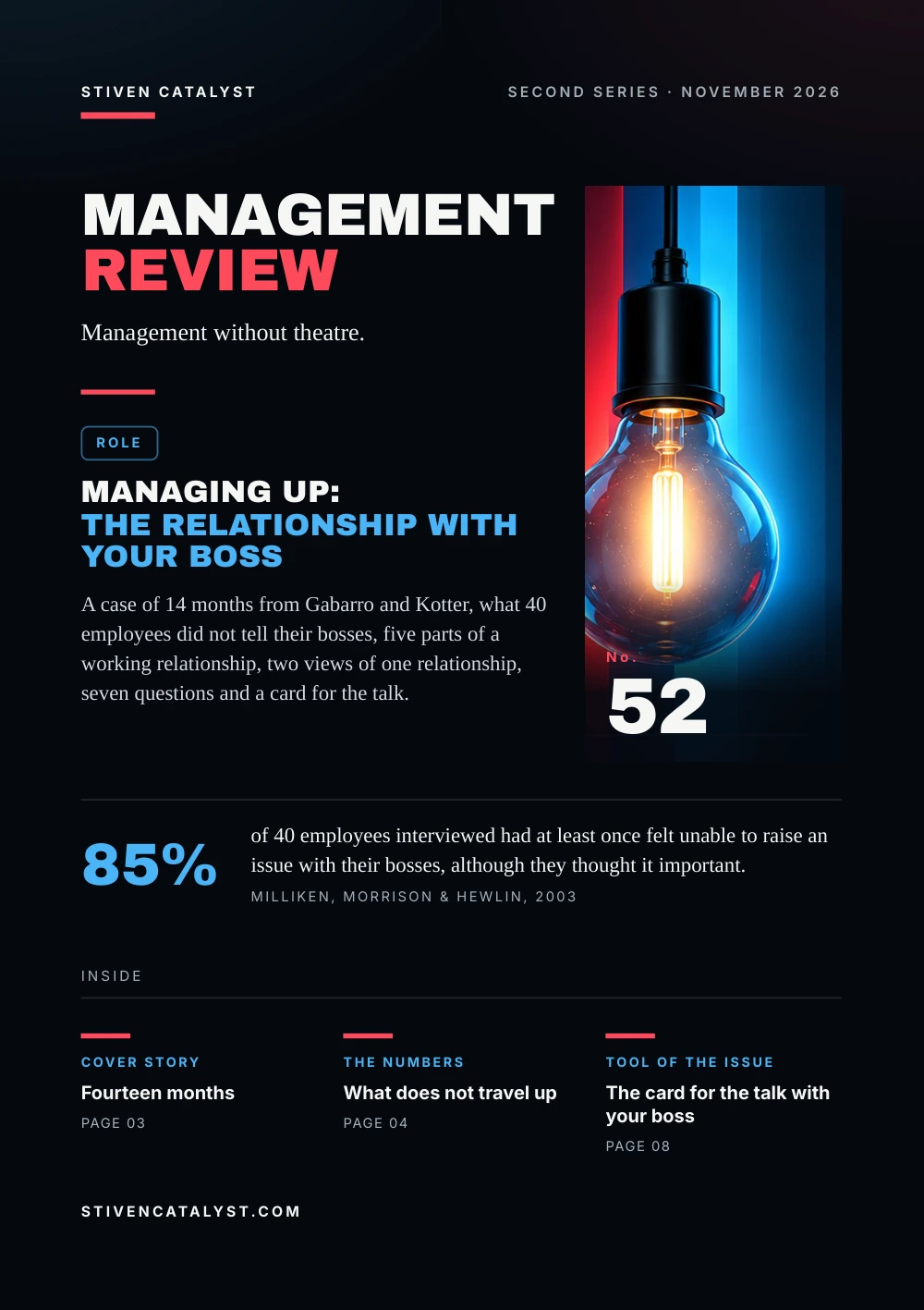
Managing up: the relationship with your boss
A case of 14 months from Gabarro and Kotter, what 40 employees did not tell their bosses, five parts of a working relationship, two views of one relationship, seven questions and a card for the talk.
- No.
- 52
- Pages
- 10
- Sources
- 6
- Topics
- Role
Stiven CatalystSecond series · November 2026
ManagementReview
Management without theatre.
Role
Managing up:the relationship with your boss
A case of 14 months from Gabarro and Kotter, what 40 employees did not tell their bosses, five parts of a working relationship, two views of one relationship, seven questions and a card for the talk.

No.52
85%
of 40 employees interviewed had at least once felt unable to raise an issue with their bosses, although they thought it important.Milliken, Morrison & Hewlin, 2003
stivencatalyst.com
No. 52 · Role
In this issue
Most of what is written for managers looks down, at the team. Yet every manager also has a boss, who sets priorities, opens doors and decides on resources. This issue looks up: at what the relationship with the boss needs, what gets in its way, and what a manager can do about it.
- 03Cover storyFourteen months
- 04The numbersWhat does not travel up
- 05The modelUnderstand, then build
- 06What the research saysTwo views of one relationship
- 07How it is measuredSeven questions, two answers
- 08Tool of the issueThe card for the talk with your boss
- 09SourcesSources and method
How to read this issue
Figure
Every figure has its source and year at the foot of its page.
Our reading
Where the editors interpret rather than the research, it says so.
Practice
The steps and the card are proposals to try, not research results.
Cover story
Four teenmonths
Gabarro and Kotter open with a case. Frank Gibbons, a manufacturing vice president, was strong on production and weak with people. Philip Bonnevie, who had always had good bosses, was promoted to report to him in 1975 and never thought that managing his boss was part of his job. Fourteen months later he was fired.
During a major product launch the two disagreed about what had been agreed: a new type of machinery, how much risk to take. A plant was built that could not make the product as planned. The company lost $2 million to $5 million, by the authors' account. Gibbons blamed Bonnevie, Bonnevie blamed Gibbons.
01
What the boss needs from you
cooperation, dependability and honesty
02
What you need from the boss
links to the rest of the company, priorities that fit, resources
Our reading
Gibbons's weakness was known to everyone. What was missing was a subordinate who took it into account.
Source: John J. Gabarro & John P. Kotter, Harvard Business Review, 1980 (via Best of HBR reprint, January 2005)
The case is told by Gabarro and Kotter (1980), from events of the 1970s; we know it only from their account. The two lists follow their article; the reading is the editors'.
The numbers
What does nottravel up
Frances Milliken, Elizabeth Morrison and Patricia Hewlin interviewed 40 people in full-time jobs. 34 of them (85%) had at least once felt unable to raise an issue with their bosses, although they thought it important. Only 51% generally felt comfortable speaking up.
Why they stayed silent (share of the 40 who named each reason), 2003
Held back most often: the competence or performance of a colleague or boss (37.5%), problems with processes (35%) and pay (27.5%).
Our reading
The news a boss needs most is often the news hardest to bring. Waiting to be asked is not enough.
Source: Frances J. Milliken, Elizabeth W. Morrison & Patricia F. Hewlin, Journal of Management Studies 40(6), 2003 (via Authors' manuscript)
Exploratory study: 40 interviews with full-time employees taking part-time MBA classes; the shares describe only this sample. Most named several reasons.
The model
Understand, thenbuild
Gabarro and Kotter's checklist has three parts: understand the boss, understand yourself, and build a relationship that fits both. A boss, they write, is a fallible human being with limited time and their own pressures.
Understand
- the boss's goals and pressures
- strengths, weaknesses, blind spots
- the boss's preferred way of working
- your own style and attitude to authority
Build
- compatible work styles
- expectations spelled out on both sides
- a flow of information, bad news included
- dependability and honesty
- selective use of the boss's time
Following Peter Drucker, they split bosses into readers and listeners. A listener is briefed in person, then gets a memo; a reader gets the memo first, then the talk.
Our reading
Managing up is not about pleasing the boss. It is about making sure the boss does not have to guess.
Source: John J. Gabarro & John P. Kotter, Harvard Business Review, 1980 (via Best of HBR reprint, January 2005)
Grouping after the authors' checklist, shortened by the editors. Readers and listeners come from Drucker, as quoted by Gabarro and Kotter.
More in the essayWhen to solve it yourself and when to take it higher
What the research says
Two views ofone relationship
Leader–member exchange (LMX) theory studies each boss–employee pair as a relationship of its own. In 1995 George Graen and Mary Uhl-Bien described how such a relationship can grow in three phases.
Leadership making, after Graen & Uhl-Bien (1995)
- 01
Strangers
formal, within the job description
- 02
Acquaintances
roles are tested, trust grows
- 03
Partners
mutual trust, respect and obligation
Charlotte Gerstner and David Day found the quality of this relationship linked to performance, satisfaction, commitment, role clarity and the intention to leave, but not to actual leaving. Leaders and members rated it only moderately alike. Hock-Peng Sin and colleagues confirmed this across 64 samples and 10,884 pairs (ρ = .37); agreement was higher in longer relationships and with more intense contact.
Our reading
You and your boss may be describing two different relationships. Only a conversation shows which one you have.
Sources: George B. Graen & Mary Uhl-Bien, The Leadership Quarterly 6(2), 1995 (via UF/IFAS Extension, Assessing the Relationship between Supervisors and Employees); Charlotte R. Gerstner & David V. Day, Journal of Applied Psychology 82(6), 1997; Hock-Peng Sin, Jennifer D. Nahrgang & Frederick P. Morgeson, Journal of Applied Psychology 94(4), 2009; James H. Dulebohn, William H. Bommer, Robert C. Liden, Robyn L. Brouer & Gerald R. Ferris, Journal of Management 38(6), 2012
Meta-analyses of correlations: they show associations, not causes. The phases are confirmed through independent summaries. James Dulebohn and colleagues (247 studies) found the leader's side explains the most; the employee's side counts too.
How it is measured
Seven questions,two answers
Graen and Uhl-Bien proposed seven questions, LMX-7, each answered on a five-point scale, so the total runs from 7 to 35. Gerstner and Day found it the soundest of the measures they compared. The questions ask, in short:
Where do I stand?
Do you know how satisfied the boss is with your work?
Understanding and potential
Does the boss understand your problems and see your potential?
Backing
Would the boss use their power to help you, even at a cost to themselves?
Trust and the whole
Would you defend the boss's decision in their absence? How effective is the relationship?
Hypothetical example, a shift leader and her manager
- Her score
- 22 of 35, lowest on “where do I stand?”
- His score
- 29 of 35
- Next step
- a monthly talk on what “good” means this quarter
The gap matters more than either number. The case and the numbers are invented.
Sources: George B. Graen & Mary Uhl-Bien, The Leadership Quarterly 6(2), 1995 (via UF/IFAS Extension, Assessing the Relationship between Supervisors and Employees); Charlotte R. Gerstner & David V. Day, Journal of Applied Psychology 82(6), 1997; Hock-Peng Sin, Jennifer D. Nahrgang & Frederick P. Morgeson, Journal of Applied Psychology 94(4), 2009
Questions paraphrased and grouped by the editors; the original wording was seen only in later reproductions. The boss can answer a matching version about the employee.
Tool of the issue
The card for the talkwith your boss
One card before each regular talk with your manager. Check the first two lines every quarter, the rest each time.
01Their goals and pressureswhat their own boss expects of them this quarter
02How they take informationreader or listener; how often, in what form
03What we expect of each othermy draft of their expectations, to check together
04News they need, including bad newswhat happened, what I have done, what I need decided
05Commitmentsonly dates I can keep; what slipped since last time
06What I will not ask forsmall things I can settle myself
Sources: John J. Gabarro & John P. Kotter, Harvard Business Review, 1980 (via Best of HBR reprint, January 2005); Frances J. Milliken, Elizabeth W. Morrison & Patricia F. Hewlin, Journal of Management Studies 40(6), 2003 (via Authors' manuscript)
A practice proposed by the editors, after Gabarro and Kotter's checklist and Milliken et al. on silence. The handover tool keeps open issues with an owner and a time.
Open the tool: Shift Handoverstivencatalyst.com/tools/shift-handover/
Sources and method
Every figurehas a source.
The figures in this issue come from the sources below. The year shows how recent each one is.
- Managing Your BossJohn J. Gabarro & John P. Kotter, Harvard Business Review, 1980 · via Best of HBR reprint, January 2005https://hbr.org/2005/01/managing-your-boss
- An Exploratory Study of Employee Silence: Issues that Employees Don't Communicate Upward and WhyFrances J. Milliken, Elizabeth W. Morrison & Patricia F. Hewlin, Journal of Management Studies 40(6), 2003 · via Authors' manuscripthttps://doi.org/10.1111/1467-6486.00387
- Relationship-based approach to leadership: Development of leader-member exchange (LMX) theory of leadership over 25 yearsGeorge B. Graen & Mary Uhl-Bien, The Leadership Quarterly 6(2), 1995 · via UF/IFAS Extension, Assessing the Relationship between Supervisors and Employeeshttps://digitalcommons.unl.edu/managementfacpub/57/
- Meta-analytic review of leader-member exchange theory: Correlates and construct issuesCharlotte R. Gerstner & David V. Day, Journal of Applied Psychology 82(6), 1997https://doi.org/10.1037/0021-9010.82.6.827
- Understanding why they don't see eye to eye: An examination of leader-member exchange (LMX) agreementHock-Peng Sin, Jennifer D. Nahrgang & Frederick P. Morgeson, Journal of Applied Psychology 94(4), 2009https://doi.org/10.1037/a0014827
- A Meta-Analysis of Antecedents and Consequences of Leader-Member ExchangeJames H. Dulebohn, William H. Bommer, Robert C. Liden, Robyn L. Brouer & Gerald R. Ferris, Journal of Management 38(6), 2012https://doi.org/10.1177/0149206311415280
Editorial method
Each figure was checked for its year, its publisher and what exactly it measures. Where the publisher's page could not be opened, the figure was checked against independent summaries and is marked “via”. The editors' interpretation is marked “Our reading”. Figures that could not be confirmed are not in the issue.
ManagementReview
Management without theatre.
Every issue, one management question, checked against the best research.
All issues
stivencatalyst.com/magazine/management-review.html
Management Review · No. 52 · November 2026 · Stiven Catalyst
Click or swipe a page to turn it. The arrow keys work too.
Management Review · No. 52
The figures of the issue
The charts of the printed pages, with their sources.
Source: Frances J. Milliken, Elizabeth W. Morrison & Patricia F. Hewlin, Journal of Management Studies 40(6), 2003 (via Authors' manuscript)
The whole text Read the issue as text For reading on a small screen, searching or a screen reader. The same words, without the page design.
In this issue
Most of what is written for managers looks down, at the team. Yet every manager also has a boss, who sets priorities, opens doors and decides on resources. This issue looks up: at what the relationship with the boss needs, what gets in its way, and what a manager can do about it.
In 1980 John Gabarro and John Kotter described managing the boss as working consciously with your superior for the best results for both and for the company, not as flattery. Of 40 employees interviewed in 2003, 34 had at least once felt unable to raise an important issue with their bosses. Leader–member exchange research describes how the relationship grows from strangers to partners. Meta-analyses find that boss and employee rate it only moderately alike. Seven questions make it measurable.
Stiven Janaqi, Editor
Cover story
Four teen months
Gabarro and Kotter open with a case. Frank Gibbons, a manufacturing vice president, was strong on production and weak with people. Philip Bonnevie, who had always had good bosses, was promoted to report to him in 1975 and never thought that managing his boss was part of his job. Fourteen months later he was fired.
During a major product launch the two disagreed about what had been agreed: a new type of machinery, how much risk to take. A plant was built that could not make the product as planned. The company lost $2 million to $5 million, by the authors' account. Gibbons blamed Bonnevie, Bonnevie blamed Gibbons.
- What the boss needs from you. cooperation, dependability and honesty
- What you need from the boss. links to the rest of the company, priorities that fit, resources
Our reading
Gibbons's weakness was known to everyone. What was missing was a subordinate who took it into account.
The case is told by Gabarro and Kotter (1980), from events of the 1970s; we know it only from their account. The two lists follow their article; the reading is the editors'.
Source: John J. Gabarro & John P. Kotter, Harvard Business Review, 1980 (via Best of HBR reprint, January 2005)
The numbers
What does not travel up
Frances Milliken, Elizabeth Morrison and Patricia Hewlin interviewed 40 people in full-time jobs. 34 of them (85%) had at least once felt unable to raise an issue with their bosses, although they thought it important. Only 51% generally felt comfortable speaking up.
Why they stayed silent (share of the 40 who named each reason), 2003: Being labelled or seen negatively 30%, Damaging a relationship 27.5%, It would change nothing 25%, Retaliation or punishment 22.5%, Harm to someone else 20%.
Held back most often: the competence or performance of a colleague or boss (37.5%), problems with processes (35%) and pay (27.5%).
Our reading
The news a boss needs most is often the news hardest to bring. Waiting to be asked is not enough.
Exploratory study: 40 interviews with full-time employees taking part-time MBA classes; the shares describe only this sample. Most named several reasons.
Source: Frances J. Milliken, Elizabeth W. Morrison & Patricia F. Hewlin, Journal of Management Studies 40(6), 2003 (via Authors' manuscript)
The model
Understand, then build
Gabarro and Kotter's checklist has three parts: understand the boss, understand yourself, and build a relationship that fits both. A boss, they write, is a fallible human being with limited time and their own pressures.
Understand
- the boss's goals and pressures
- strengths, weaknesses, blind spots
- the boss's preferred way of working
- your own style and attitude to authority
Build
- compatible work styles
- expectations spelled out on both sides
- a flow of information, bad news included
- dependability and honesty
- selective use of the boss's time
Following Peter Drucker, they split bosses into readers and listeners. A listener is briefed in person, then gets a memo; a reader gets the memo first, then the talk.
Our reading
Managing up is not about pleasing the boss. It is about making sure the boss does not have to guess.
Grouping after the authors' checklist, shortened by the editors. Readers and listeners come from Drucker, as quoted by Gabarro and Kotter.
Source: John J. Gabarro & John P. Kotter, Harvard Business Review, 1980 (via Best of HBR reprint, January 2005)
More in the essay: When to solve it yourself and when to take it higher
What the research says
Two views of one relationship
Leader–member exchange (LMX) theory studies each boss–employee pair as a relationship of its own. In 1995 George Graen and Mary Uhl-Bien described how such a relationship can grow in three phases.
Leadership making, af ter Graen & Uhl-Bien (1995)
- Strangers. formal, within the job description
- Acquaintances. roles are tested, trust grows
- Pa
r tners. mutual trust, respect and obligation
Charlotte Gerstner and David Day found the quality of this relationship linked to performance, satisfaction, commitment, role clarity and the intention to leave, but not to actual leaving. Leaders and members rated it only moderately alike. Hock-Peng Sin and colleagues confirmed this across 64 samples and 10,884 pairs (ρ = .37); agreement was higher in longer relationships and with more intense contact.
Our reading
You and your boss may be describing two different relationships. Only a conversation shows which one you have.
Meta-analyses of correlations: they show associations, not causes. The phases are confirmed through independent summaries. James Dulebohn and colleagues (247 studies) found the leader's side explains the most; the employee's side counts too.
Sources: George B. Graen & Mary Uhl-Bien, The Leadership Quarterly 6(2), 1995 (via UF/IFAS Extension, Assessing the Relationship between Supervisors and Employees); Charlotte R. Gerstner & David V. Day, Journal of Applied Psychology 82(6), 1997; Hock-Peng Sin, Jennifer D. Nahrgang & Frederick P. Morgeson, Journal of Applied Psychology 94(4), 2009; James H. Dulebohn, William H. Bommer, Robert C. Liden, Robyn L. Brouer & Gerald R. Ferris, Journal of Management 38(6), 2012
How it is measured
Seven questions, two answers
Graen and Uhl-Bien proposed seven questions, LMX-7, each answered on a five-point scale, so the total runs from 7 to 35. Gerstner and Day found it the soundest of the measures they compared. The questions ask, in short:
- Where do I stand?. Do you know how satisfied the boss is with your work?
- Understanding and potential. Does the boss understand your problems and see your potential?
- Backing. Would the boss use their power to help you, even at a cost to themselves?
- Trust and the whole. Would you defend the boss's decision in their absence? How effective is the relationship?
Hypothe tical example, a shif t leader and her manager
- Her score: 22 of 35, lowest on “where do I stand?”
- His score: 29 of 35
- Next step: a monthly talk on what “good” means this quarter
The gap matters more than either number. The case and the numbers are invented.
Questions paraphrased and grouped by the editors; the original wording was seen only in later reproductions. The boss can answer a matching version about the employee.
Sources: George B. Graen & Mary Uhl-Bien, The Leadership Quarterly 6(2), 1995 (via UF/IFAS Extension, Assessing the Relationship between Supervisors and Employees); Charlotte R. Gerstner & David V. Day, Journal of Applied Psychology 82(6), 1997; Hock-Peng Sin, Jennifer D. Nahrgang & Frederick P. Morgeson, Journal of Applied Psychology 94(4), 2009
Tool of the issue
The card for the talk with your boss
One card before each regular talk with your manager. Check the first two lines every quarter, the rest each time.
- Their goals and pressures what their own boss expects of them this quarter
- How th
e y take information reader or listener; how often, in what form - What we expect of each other my draft of their expectations, to check together
- News th
e y need, including bad news what happened, what I have done, what I need decided - Commitments only dates I can keep; what slipped since last time
- What I will not ask for small things I can settle myself
A practice proposed by the editors, after Gabarro and Kotter's checklist and Milliken et al. on silence. The handover tool keeps open issues with an owner and a time.
Sources: John J. Gabarro & John P. Kotter, Harvard Business Review, 1980 (via Best of HBR reprint, January 2005); Frances J. Milliken, Elizabeth W. Morrison & Patricia F. Hewlin, Journal of Management Studies 40(6), 2003 (via Authors' manuscript)
Open the tool: Shift Handover
Sources and method
Every figure has a source.
The figures in this issue come from the sources below. The year shows how recent each one is.
- John J. Gabarro & John P. Kotter, Harvard Business Review, “Managing Your Boss”, 1980 (via Best of HBR reprint, January 2005). https://hbr.org/2005/01/managing-your-boss
- Frances J. Milliken, Elizabeth W. Morrison & Patricia F. Hewlin, Journal of Management Studies 40(6), “An Exploratory Study of Employee Silence: Issues that Employees Don't Communicate Upward and Why”, 2003 (via Authors' manuscript). https://doi.org/10.1111/1467-6486.00387
- George B. Graen & Mary Uhl-Bien, The Leadership Quarterly 6(2), “Relationship-based approach to leadership: Development of leader-member exchange (LMX) theory of leadership over 25 years”, 1995 (via UF/IFAS Extension, Assessing the Relationship between Supervisors and Employees). https://digitalcommons.unl.edu/managementfacpub/57/
- Charlotte R. Gerstner & David V. Day, Journal of Applied Psychology 82(6), “Meta-analytic review of leader-member exchange theory: Correlates and construct issues”, 1997. https://doi.org/10.1037/0021-9010.82.6.827
- Hock-Peng Sin, Jennifer D. Nahrgang & Frederick P. Morgeson, Journal of Applied Psychology 94(4), “Understanding why they don't see eye to eye: An examination of leader-member exchange (LMX) agreement”, 2009. https://doi.org/10.1037/a0014827
- James H. Dulebohn, William H. Bommer, Robert C. Liden, Robyn L. Brouer & Gerald R. Ferris, Journal of Management 38(6), “A Meta-Analysis of Antecedents and Consequences of Leader-Member Exchange”, 2012. https://doi.org/10.1177/0149206311415280
Edit orial me thod
Each figure was checked for its year, its publisher and what exactly it measures. Where the publisher's page could not be opened, the figure was checked against independent summaries and is marked “via”. The editors' interpretation is marked “Our reading”. Figures that could not be confirmed are not in the issue.
Management Review · Monthly edition