In 1961 Shigeo Shingo watched a worker leave a spring out of a switch and solved it with a small dish. His book of 1986 describes 112 such devices; more than half cost $100 or less, in 1986 dollars. Shingo separates inspections that find defects, reduce them and eliminate them, and he prefers a device that stops the work to one that only warns. Hospital alarms show why: in 98 events reported to the Joint Commission, the factor named most often among those listed was an alarm turned off.
Management Review · Second series · November 2026 · No. 46
Poka-yoke: the mistake not allowed t o happen
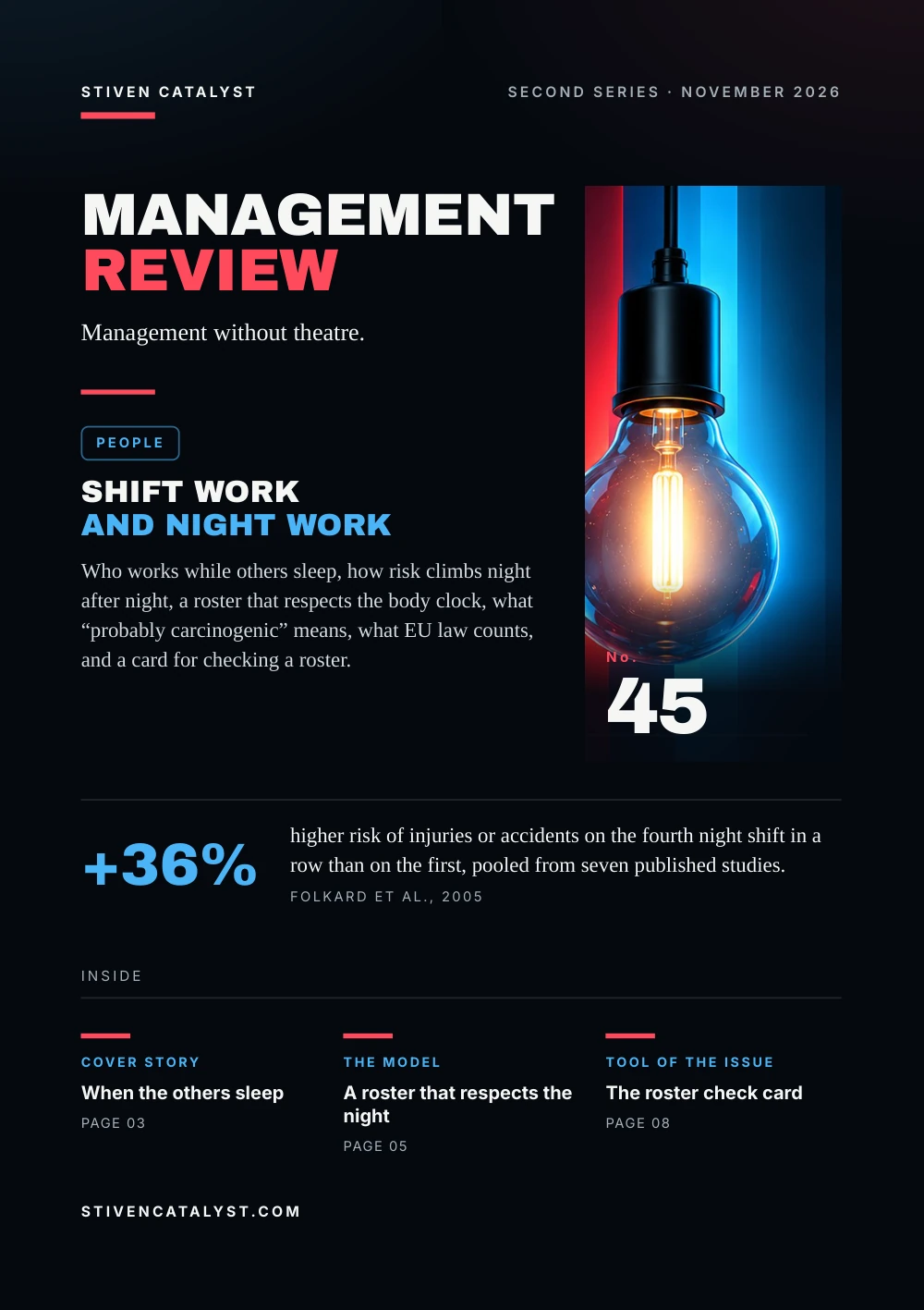
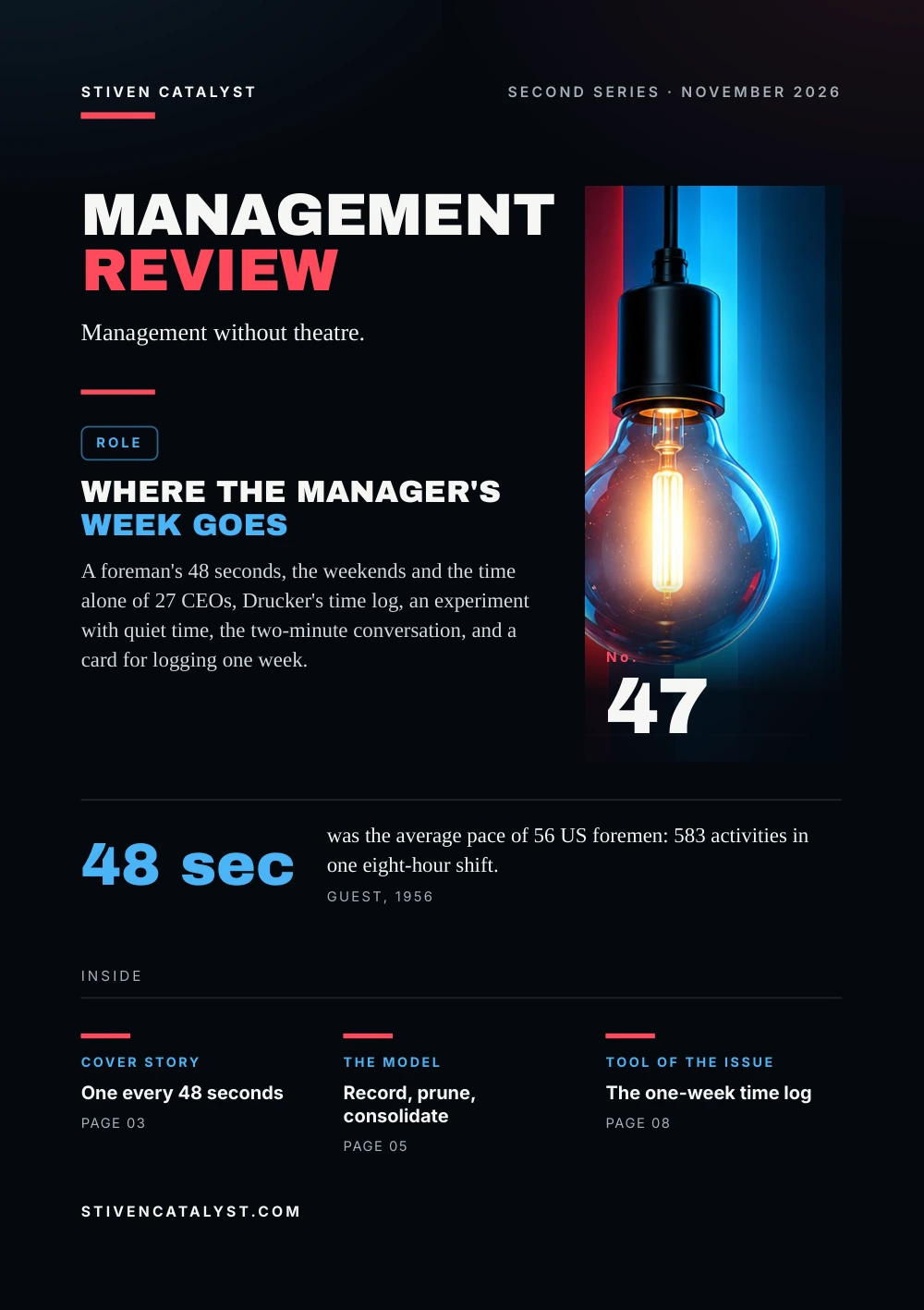
Two springs on a dish, 112 devices and what they cost, three kinds of inspection, why warnings go unheard, shape, count and sequence, and a card for one poka-yoke.
- No.
- 46
- Pages
- 10
- Sources
- 6
- Topics
- Operations
Stiven CatalystSecond series · November 2026
ManagementReview
Management without theatre.
Operations
Poka-yoke:the mistake not allowed to happen
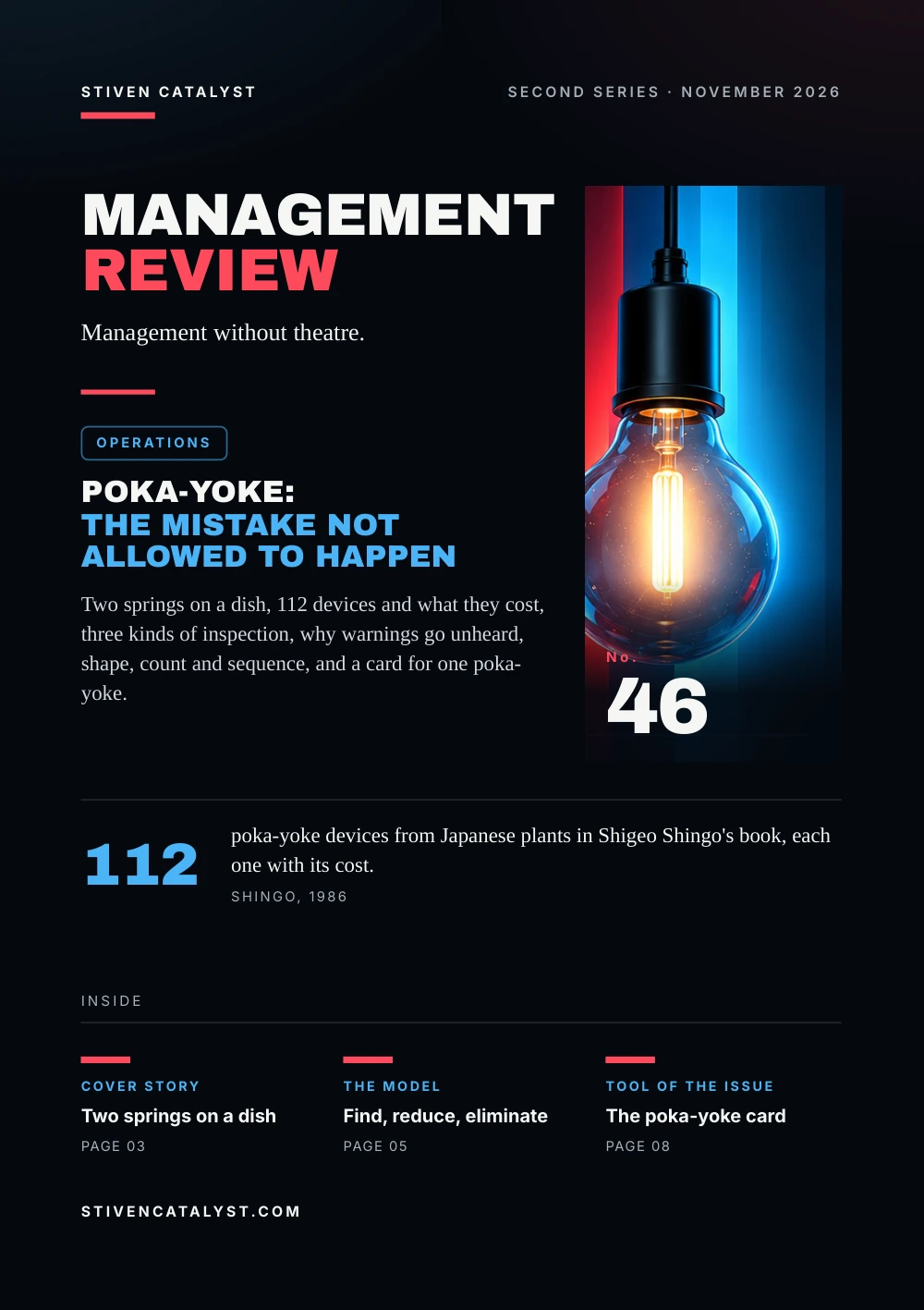
Two springs on a dish, 112 devices and what they cost, three kinds of inspection, why warnings go unheard, shape, count and sequence, and a card for one poka-yoke.

No.46
112
poka-yoke devices from Japanese plants in Shigeo Shingo's book, each one with its cost.Shingo, 1986
stivencatalyst.com
No. 46 · Operations
In this issue
Telling people to be more careful works for a while. This issue is about the other way: building the check into the work, so that a slip is caught before it becomes a defect, or cannot be made at all.
- 03Cover storyTwo springs on a dish
- 04The numbers112 devices, most of them cheap
- 05The modelFind, reduce, eliminate
- 06What the research saysWhen the warning goes unheard
- 07How it is measuredShape, count, sequence
- 08Tool of the issueThe poka-yoke card
- 09SourcesSources and method
How to read this issue
Figure
Every figure has its source and year at the foot of its page.
Our reading
Where the editors interpret rather than the research, it says so.
Practice
The steps and the card are proposals to try, not research results.
Cover story
Two springson a dish
In 1961 Shigeo Shingo visited Yamada Electric in Nagoya. The plant made a simple switch with two buttons for its parent company, Matsushita Electric, with a small spring under each button. Now and then a worker left a spring out, and each time Yamada had to send an inspector to Kyushu to check every switch delivered.
Telling workers to be careful helped for a while, then it happened again. On the floor Shingo saw a worker skip a spring, and asked the department chief:
“What does it mean for a human being to 'forget' something?”
The answer was a dish. At the start, the worker took two springs from a box of hundreds and put them on it; a spring left on the dish showed that one had been left out. No more springs went missing, Shingo writes. Around 1963 he renamed such devices: “foolproofing” made a worker cry, so he chose poka-yoke, proofing against inadvertent mistakes.
Our reading
The dish does not ask anyone to remember better. It shows the forgetting before the switch leaves the bench.
Source: Shigeo Shingo, translated by Andrew P. Dillon, Productivity Press, 1986
Shingo's own account, in Zero Quality Control (Japanese 1985, English 1986); we found no independent record. It is the first device he describes, not the first ever: foolproofing for safety came earlier.
The numbers
112 devices,most of them cheap
Shingo's book ends with 112 poka-yoke examples from Japanese plants, each with its cost. In 2007 John Grout sorted the costs in a report for the US Agency for Healthcare Research and Quality:
Shingo's examples by cost, in US dollars of 1986
83 of 112stop the work when an error occurs; the other 29 only warn
3.5% → 0.01%defect rate at Arakawa Auto Body within two years, mainly through poka-yoke
Our reading
When a device costs less than the hour spent arguing about it, the question is no longer money. It is whether anyone goes looking for the error.
Sources: John Grout, Agency for Healthcare Research and Quality, 2007; Shigeo Shingo, translated by Andrew P. Dillon, Productivity Press, 1986
Shares of the examples, as tabulated by Grout; the median is about $100. The count of 83 is the sum of Shingo's own grouping. Arakawa is his account, with no year given.
The model
Find, reduce,eliminate
Shingo sorts inspections by what they do to defects. Errors, he argues, cannot be removed from human work. But an error becomes a defect only if nothing happens at the stage where it is made.
01
Judgment inspection
sorts finished products into good and bad: it protects the customer, but does not lower the defect rate
02
Informative inspection
uses the defects found to correct the process: statistical control, checks at the next step, self-checks
03
Source inspection
checks the conditions that give rise to defects and acts at the error, before it becomes a defect
At Matsushita's Moriguchi television plant in 1963, statistical control had cut a 15% defect rate to 6.5%, where it stuck. Three months after checks at the next step began, it was 0.65%. Around 1967 Shingo arrived at source inspection. His Zero QC adds: check every item, not a sample, and act at once.
Our reading
A defect found at the end is a report on yesterday. An error caught at the source is a defect that never existed.
Source: Shigeo Shingo, translated by Andrew P. Dillon, Productivity Press, 1986
The three inspections and the Moriguchi rates are Shingo's account (1986). The reading is the editors'.
What the research says
When the warninggoes unheard
Shingo ranks devices that stop the work above those that only light a lamp or sound a buzzer: a warning works only if someone notices. In 2013 the Joint Commission counted 98 alarm-related events reported to it from 2009 to mid-2012; 80 ended in death.
Contributing factors in the 98 events, number of events
The alert estimates that 85 to 99% of alarm signals need no clinical action; a 2013 review puts false alarms at 72 to 99%. In 2026 the Institute for Safe Medication Practices ranked forcing functions highest, warnings and checklists in the middle, and reminders to “be more careful” among the lowest.
Our reading
An alarm that sounds all day becomes noise. Before adding one, ask whether the step could be stopped.
Sources: Shigeo Shingo, translated by Andrew P. Dillon, Productivity Press, 1986; The Joint Commission, 2013; Sue Sendelbach & Marjorie Funk, AACN Advanced Critical Care, 2013 (via PubMed abstract); Institute for Safe Medication Practices, ISMP Medication Safety Alert! Acute Care 31(1), 2026
Reporting is voluntary and covers a small share of events; one event can have several factors. The counts show kinds of failure, not frequency.
How it is measured
Shape, count,sequence
Shingo names three ways for a device to detect an error. Then it either stops the work, the stronger response, or warns with a light or a sound.
Contact
checks shape or size: the part fits the guide or touches the sensor, or it does not
Fixed value
checks that a step was repeated the set number of times, like six nuts welded on one part
Motion step
checks that the standard motions were done, in their order
Hypothetical example, a loading ramp for home deliveries
- Fixed value
- bags scanned against the order; the trolley is not released until the count matches
- Test
- once a shift, a trolley with one bag missing: does the block hold?
A device nobody tests can fail unseen. The case is invented.
Sources: Shigeo Shingo, translated by Andrew P. Dillon, Productivity Press, 1986; Lean Enterprise Institute, 2014; John Grout, Agency for Healthcare Research and Quality, 2007
The three methods and the six nuts are Shingo's. The Lean Enterprise Institute calls the stopping kind shutdown devices, the most powerful. Grout's advice: mistake-proof the mistake-proofing.
More in the essayWhere part of the order goes missing
Tool of the issue
The poka-yokecard
One card for one recurring error. Start where the error is made, not where the defect is found, and ask what in the work makes the slip possible before you ask for more attention. Incomplete Control shows where orders go out short.
01The errorwhat is left out, swapped or done backwards; how often
02Where it startsthe step where it is made, not where it is found
03Inspection todayjudgment, informative or at the source
04Methodcontact, fixed value or motion step
05Stop or warnif it only warns: who reacts, and how fast
06Test and ownerhow often the device is tested, by whom, what happens when it fails
Sources: Shigeo Shingo, translated by Andrew P. Dillon, Productivity Press, 1986; John Grout, Agency for Healthcare Research and Quality, 2007
A practice proposed by the editors, after Shingo (1986) and Grout (2007).
Open the tool: Incomplete Controlstivencatalyst.com/tools/incomplete-control/
Sources and method
Every figurehas a source.
The figures in this issue come from the sources below. The year shows how recent each one is.
- Zero Quality Control: Source Inspection and the Poka-yoke SystemShigeo Shingo, translated by Andrew P. Dillon, Productivity Press, 1986https://www.routledge.com/Zero-Quality-Control-Source-Inspection-and-the-Poka-yoke-System/Shingo/p/book/9780915299072
- Mistake-Proofing the Design of Health Care Processes (AHRQ Publication No. 07-0020)John Grout, Agency for Healthcare Research and Quality, 2007https://www.govinfo.gov/content/pkg/GOVPUB-HE20_6500-PURL-gpo3107/pdf/GOVPUB-HE20_6500-PURL-gpo3107.pdf
- Lean Lexicon: Poka-yokeLean Enterprise Institute, 2014https://www.lean.org/lexicon-terms/poka-yoke/
- Sentinel Event Alert, Issue 50: Medical device alarm safety in hospitalsThe Joint Commission, 2013https://digitalassets.jointcommission.org/api/public/content/f65e5c9df2b94000a99445e0a7877007
- Alarm fatigue: a patient safety concernSue Sendelbach & Marjorie Funk, AACN Advanced Critical Care, 2013 · via PubMed abstracthttps://doi.org/10.1097/NCI.0b013e3182a903f9
- Implement High-Leverage and Layered Risk-Reduction Strategies Using ISMP's Hierarchy of EffectivenessInstitute for Safe Medication Practices, ISMP Medication Safety Alert! Acute Care 31(1), 2026https://home.ecri.org/blogs/ismp-alerts-and-articles-library/implement-high-leverage-and-layered-risk-reduction-strategies-using-ismp-s-hierarchy-of-effectiveness
Editorial method
Each figure was checked for its year, its publisher and what exactly it measures. Where the publisher's page could not be opened, the figure was checked against independent summaries and is marked “via”. The editors' interpretation is marked “Our reading”. Figures that could not be confirmed are not in the issue.
ManagementReview
Management without theatre.
Every issue, one management question, checked against the best research.
All issues
stivencatalyst.com/magazine/management-review.html
Management Review · No. 46 · November 2026 · Stiven Catalyst
Click or swipe a page to turn it. The arrow keys work too.
Management Review · No. 46
The figures of the issue
The charts of the printed pages, with their sources.
Source: John Grout, Agency for Healthcare Research and Quality, 2007
Source: The Joint Commission, 2013
The whole text Read the issue as text For reading on a small screen, searching or a screen reader. The same words, without the page design.
In this issue
Telling people to be more careful works for a while. This issue is about the other way: building the check into the work, so that a slip is caught before it becomes a defect, or cannot be made at all.
In 1961 Shigeo Shingo watched a worker leave a spring out of a switch and solved it with a small dish. His book of 1986 describes 112 such devices; more than half cost $100 or less, in 1986 dollars. Shingo separates inspections that find defects, reduce them and eliminate them, and he prefers a device that stops the work to one that only warns. Hospital alarms show why: in 98 events reported to the Joint Commission, the factor named most often among those listed was an alarm turned off.
Stiven Janaqi, Editor
Cover story
Two springs on a dish
In 1961 Shigeo Shingo visited Yamada Electric in Nagoya. The plant made a simple switch with two buttons for its parent company, Matsushita Electric, with a small spring under each button. Now and then a worker left a spring out, and each time Yamada had to send an inspector to Kyushu to check every switch delivered.
Telling workers to be careful helped for a while, then it happened again. On the floor Shingo saw a worker skip a spring, and asked the department chief:
What does it mean for a human being to 'forget' something?
The answer was a dish. At the start, the worker took two springs from a box of hundreds and put them on it; a spring left on the dish showed that one had been left out. No more springs went missing, Shingo writes. Around 1963 he renamed such devices: “foolproofing” made a worker cry, so he chose poka-yoke, proofing against inadvertent mistakes.
Our reading
The dish does not ask anyone to remember better. It shows the forgetting before the switch leaves the bench.
Shingo's own account, in Zero Quality Control (Japanese 1985, English 1986); we found no independent record. It is the first device he describes, not the first ever: foolproofing for safety came earlier.
Source: Shigeo Shingo, translated by Andrew P. Dillon, Productivity Press, 1986
The numbers
112 devices, most of them cheap
Shingo's book ends with 112 poka-yoke examples from Japanese plants, each with its cost. In 2007 John Grout sorted the costs in a report for the US Agency for Healthcare Research and Quality:
Shingo's examples by cost, in US dollars of 1986: < $25 25.5%, $25–100 29.1%, $100–250 23.6%, $250–1000 13.6%, > $1000 8.2%.
- 83 of 112 stop the work when an error occurs; the other 29 only warn
- 3.5% → 0.01% defect rate at Arakawa Auto Body within two years, mainly through poka-yoke
Our reading
When a device costs less than the hour spent arguing about it, the question is no longer money. It is whether anyone goes looking for the error.
Shares of the examples, as tabulated by Grout; the median is about $100. The count of 83 is the sum of Shingo's own grouping. Arakawa is his account, with no year given.
Sources: John Grout, Agency for Healthcare Research and Quality, 2007; Shigeo Shingo, translated by Andrew P. Dillon, Productivity Press, 1986
The model
Find, reduce, eliminate
Shingo sorts inspections by what they do to defects. Errors, he argues, cannot be removed from human work. But an error becomes a defect only if nothing happens at the stage where it is made.
- Judgment inspection. sorts finished products into good and bad: it protects the customer, but does not lower the defect rate
- Informative inspection. uses the defects found to correct the process: statistical control, checks at the next step, self-checks
- Source inspection. checks the conditions that give rise to defects and acts at the error, before it becomes a defect
At Matsushita's Moriguchi television plant in 1963, statistical control had cut a 15% defect rate to 6.5%, where it stuck. Three months after checks at the next step began, it was 0.65%. Around 1967 Shingo arrived at source inspection. His Zero QC adds: check every item, not a sample, and act at once.
Our reading
A defect found at the end is a report on yesterday. An error caught at the source is a defect that never existed.
The three inspections and the Moriguchi rates are Shingo's account (1986). The reading is the editors'.
Source: Shigeo Shingo, translated by Andrew P. Dillon, Productivity Press, 1986
What the research says
When the warning goes unheard
Shingo ranks devices that stop the work above those that only light a lamp or sound a buzzer: a warning works only if someone notices. In 2013 the Joint Commission counted 98 alarm-related events reported to it from 2009 to mid-2012; 80 ended in death.
Contributing factors in the 98 events, number of events: Alarm turned off inappropriately 36, Alarm system absent or inadequate 30, Not audible in all areas 25, Improper alarm settings 21.
The alert estimates that 85 to 99% of alarm signals need no clinical action; a 2013 review puts false alarms at 72 to 99%. In 2026 the Institute for Safe Medication Practices ranked forcing functions highest, warnings and checklists in the middle, and reminders to “be more careful” among the lowest.
Our reading
An alarm that sounds all day becomes noise. Before adding one, ask whether the step could be stopped.
Reporting is voluntary and covers a small share of events; one event can have several factors. The counts show kinds of failure, not frequency.
Sources: Shigeo Shingo, translated by Andrew P. Dillon, Productivity Press, 1986; The Joint Commission, 2013; Sue Sendelbach & Marjorie Funk, AACN Advanced Critical Care, 2013 (via PubMed abstract); Institute for Safe Medication Practices, ISMP Medication Safety Alert! Acute Care 31(1), 2026
How it is measured
Shape, count, sequence
Shingo names three ways for a device to detect an error. Then it either stops the work, the stronger response, or warns with a light or a sound.
- Contact. checks shape or size: the part fits the guide or touches the sensor, or it does not
- Fixed value. checks that a step was repeated the set number of times, like six nuts welded on one part
- Motion step. checks that the standard motions were done, in their order
Hypothe tical example, a loading ramp for home deliveries
- Fixed value: bags scanned against the order; the trolley is not released until the count matches
- Test: once a shift, a trolley with one bag missing: does the block hold?
A device nobody tests can fail unseen. The case is invented.
The three methods and the six nuts are Shingo's. The Lean Enterprise Institute calls the stopping kind shutdown devices, the most powerful. Grout's advice: mistake-proof the mistake-proofing.
Sources: Shigeo Shingo, translated by Andrew P. Dillon, Productivity Press, 1986; Lean Enterprise Institute, 2014; John Grout, Agency for Healthcare Research and Quality, 2007
More in the essay: Where part of the order goes missing
Tool of the issue
The poka-yoke card
One card for one recurring error. Start where the error is made, not where the defect is found, and ask what in the work makes the slip possible before you ask for more attention. Incomplete Control shows where orders go out short.
- The error what is left out, swapped or done backwards; how often
- Where it sta
r ts the step where it is made, not where it is found - Inspection
t oday judgment, informative or at the source - M
e thod contact, fixed value or motion step - S
t op or warn if it only warns: who reacts, and how fast - Test and owner how often the device is tested, by whom, what happens when it fails
A practice proposed by the editors, after Shingo (1986) and Grout (2007).
Sources: Shigeo Shingo, translated by Andrew P. Dillon, Productivity Press, 1986; John Grout, Agency for Healthcare Research and Quality, 2007
Open the tool: Incomplete Control
Sources and method
Every figure has a source.
The figures in this issue come from the sources below. The year shows how recent each one is.
- Shigeo Shingo, translated by Andrew P. Dillon, Productivity Press, “Zero Quality Control: Source Inspection and the Poka-yoke System”, 1986. https://www.routledge.com/Zero-Quality-Control-Source-Inspection-and-the-Poka-yoke-System/Shingo/p/book/9780915299072
- John Grout, Agency for Healthcare Research and Quality, “Mistake-Proofing the Design of Health Care Processes (AHRQ Publication No. 07-0020)”, 2007. https://www.govinfo.gov/content/pkg/GOVPUB-HE20_6500-PURL-gpo3107/pdf/GOVPUB-HE20_6500-PURL-gpo3107.pdf
- Lean Enterprise Institute, “Lean Lexicon: Poka-yoke”, 2014. https://www.lean.org/lexicon-terms/poka-yoke/
- The Joint Commission, “Sentinel Event Alert, Issue 50: Medical device alarm safety in hospitals”, 2013. https://digitalassets.jointcommission.org/api/public/content/f65e5c9df2b94000a99445e0a7877007
- Sue Sendelbach & Marjorie Funk, AACN Advanced Critical Care, “Alarm fatigue: a patient safety concern”, 2013 (via PubMed abstract). https://doi.org/10.1097/NCI.0b013e3182a903f9
- Institute for Safe Medication Practices, ISMP Medication Safety Alert! Acute Care 31(1), “Implement High-Leverage and Layered Risk-Reduction Strategies Using ISMP's Hierarchy of Effectiveness”, 2026. https://home.ecri.org/blogs/ismp-alerts-and-articles-library/implement-high-leverage-and-layered-risk-reduction-strategies-using-ismp-s-hierarchy-of-effectiveness
Edit orial me thod
Each figure was checked for its year, its publisher and what exactly it measures. Where the publisher's page could not be opened, the figure was checked against independent summaries and is marked “via”. The editors' interpretation is marked “Our reading”. Figures that could not be confirmed are not in the issue.
Management Review · Monthly edition