For the friends of the years when our greatest wealth was time; for those who left, for those who stayed, and for Durrës, which in its own way did both.
A NOTE ON THE NARRATIVE
The dialogues and some scene details are literary reconstructions of the memories recounted, not transcripts. The station scene in Germany is a literary imagining of longing, not a confirmed episode. No names or biographies of friends have been added.
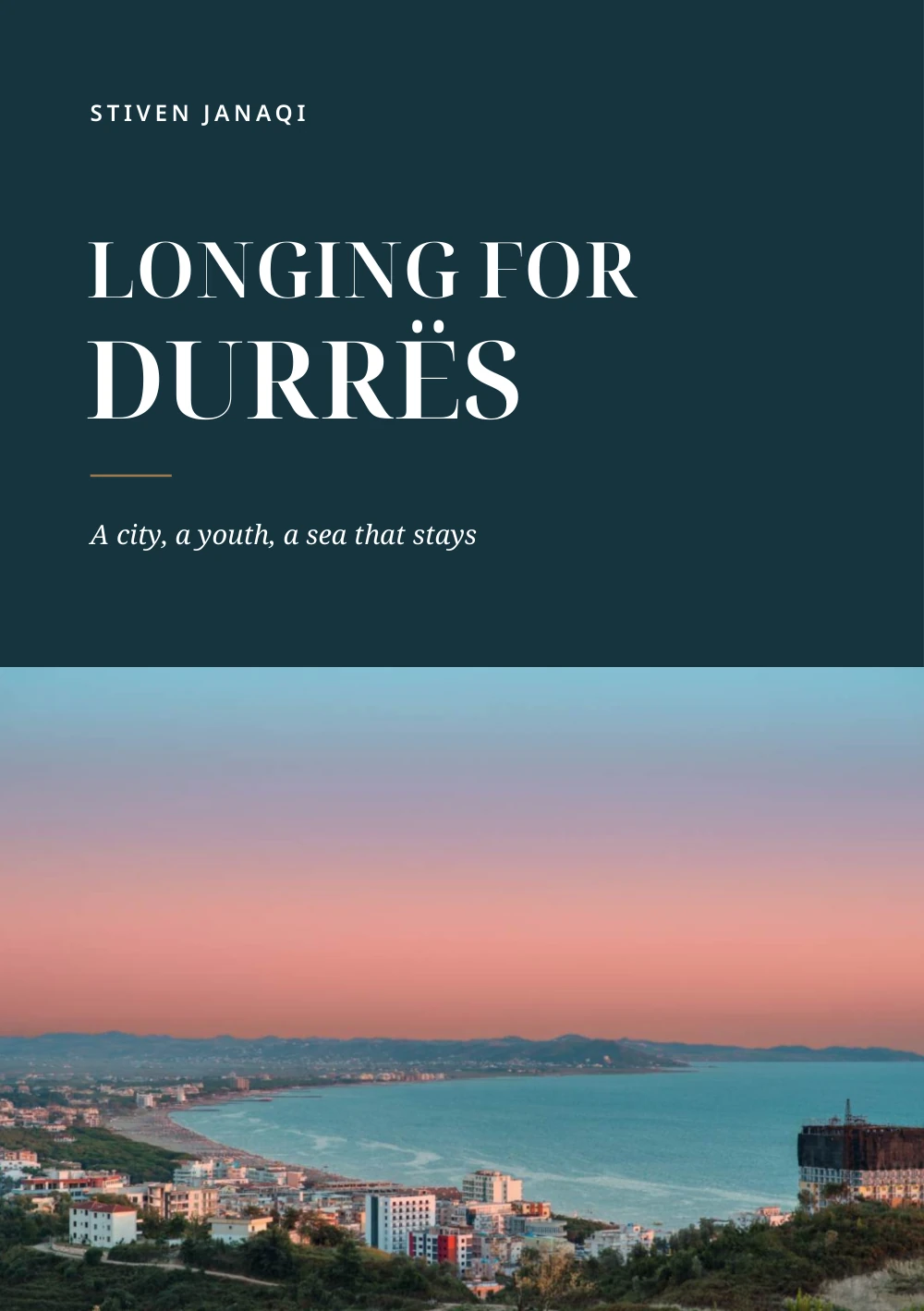
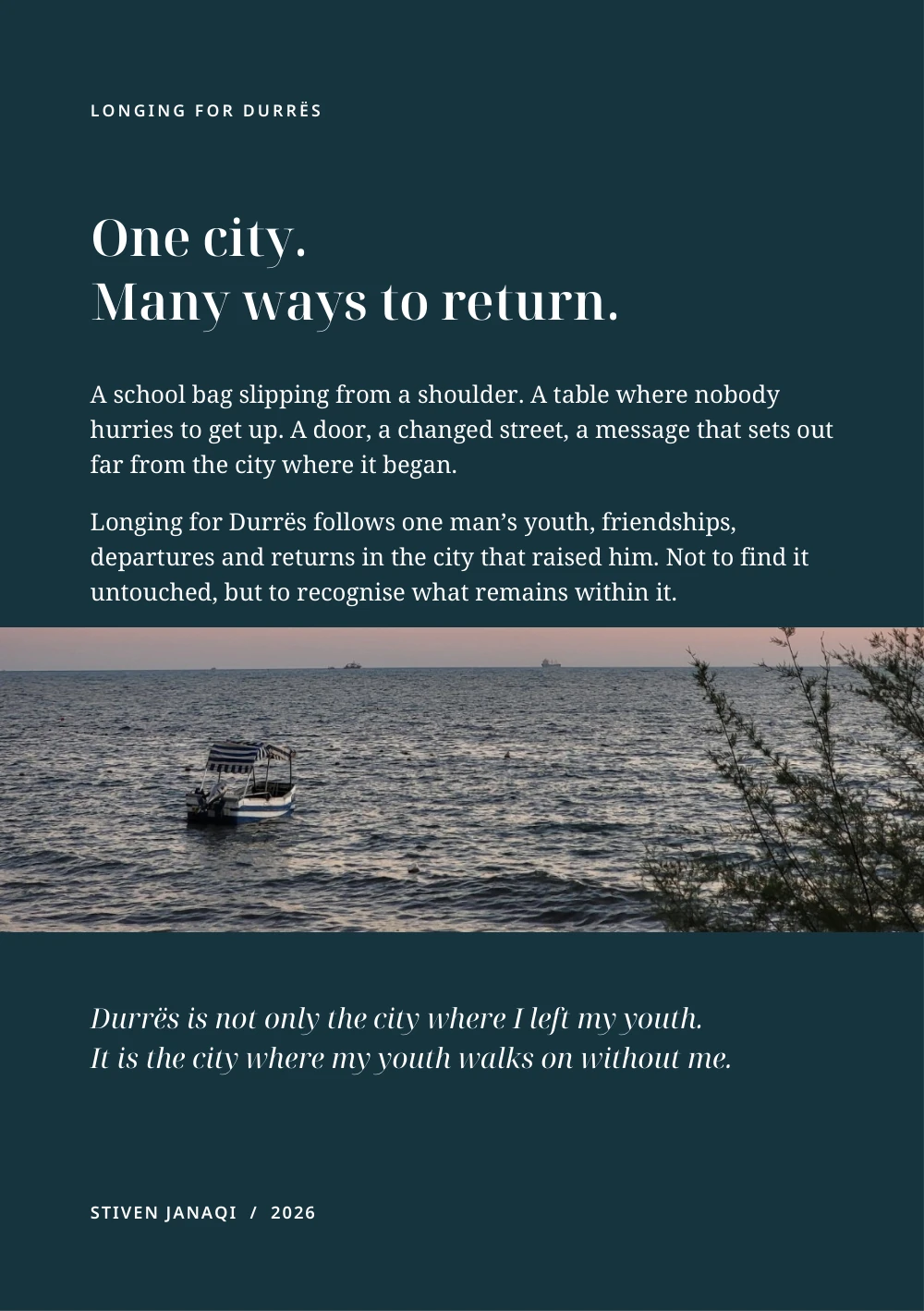
The photographs in this edition accompany the narrative; they do not necessarily show the place or time of the scene.
2026 / Third version, revised / Translated from the Albanian with AI assistance, revised by the author
PROLOGUE
The Second Cit y
I don’t know when Durrës began to turn into a memory. When I was small, it wasn’t a city. It was simply the way the world around me was built: a street that took you somewhere, the noise of the stairs in the apartment block, the salt air that came in without knocking and the voices that rose from below. The sea was somewhere near, even when you couldn’t see it.
Children don’t live in cities. They live in short distances. From home to school, from school to friends, from a corner where you waited for someone to another where going home could be put off a little longer. We measured how far we could walk before hunger caught up with us, how late we could get back without hearing the usual question. Sometimes the conversation had run out, but we kept walking. Nobody wanted to be the first to say he had to go.
Today, when I think about it, I realise that first city no longer exists in that form. Some streets are still there and some buildings still keep their windows, but I no longer know how to walk them with the impatience of a boy who has left his school bag at home and is taking the stairs two at a time. What is missing among them is the time when everything seemed set to last.
I’m not writing to bring it back. I want to stop at the things I used to run past.
Two Cities, One Memory
When I come back now, it feels as if there are two cities in Durrës at once. One is the city I see: denser, noisier, with new facades, building sites and cars looking for space. The other walks beside me unseen. It is the city of school, of friends, of afternoons when evening came late and we believed life too would come just as slowly.
The two overlap. On a present-day corner I look for an old trace and, without realising it, slow down in front of a place other people pass without turning their heads. They have things to do; I am trying to remember which way a friend used to come from. Sometimes all that comes back is the way he raised his hand, not his whole face.
I don’t always know whether I miss the place or the age I was when I was there. Memory gives the city the face we once had, and then convinces us that it is the city that has changed most. But there are changes longing can’t invent: a passage blocked off, a different shop, a name you no longer find over the door.
I have learned streets in other cities; I have made a life that doesn’t belong to this place alone. Even so, one old sentence is enough to sit me down again at a table where we used to laugh. For a few moments I even know where to rest my elbow.
This book follows those small returns. Not everything has stayed clear. Some places I remember in detail; of some days, all I have left is someone’s voice.
CHAPTER I
The Stree ts Before We Had Wat ches
Before we had watches on our wrists, we had the light. We knew how late it was from the way the sun fell on the blocks, from the shadows lengthening on the pavement, from the grown-ups’ voices that began calling names from the balconies.
The streets of childhood weren’t beautiful in the sense I give the word today. They were simply ours. A crooked tree, the entrance to a block, a kerb we sat on: each one mattered without needing a story.
Back then Durrës seemed endless to me. After one bend came another, and a reason not to go home yet could always be found. Home was close. That let us feel far away.
CHILDHOOD
At the Foot of the Block
In memory, my childhood is full of sounds. Gates shutting, keys clattering, bikes going past, voices that swell in the afternoon and thin out once it gets dark. From one window came the smell of lunch; from another, a television left on loud. When a name was called from above, even those of us with other names stopped for a moment.
Home wasn’t only inside the walls. It began at the door and stretched to the street. Some days you only had to go down to find someone. Other times we went out and no one had come. We waited in the same spot, shifting dust with the toe of a shoe, watching the doorways. Then one would appear, and waiting was no longer called waiting.
Thinking of those years, I am struck by how little we needed. Not because things were easy. Families had their worries; the grown-ups talked about money, work, prices, people who had left. The talk reached us through the open kitchen door. We caught the odd word and left the rest there. In the street, they were waiting for us.
I thought the grown-ups knew what they were doing. Later I learned they were improvising too, but back then my sense of safety had the shape of a light that would be on when I got back.
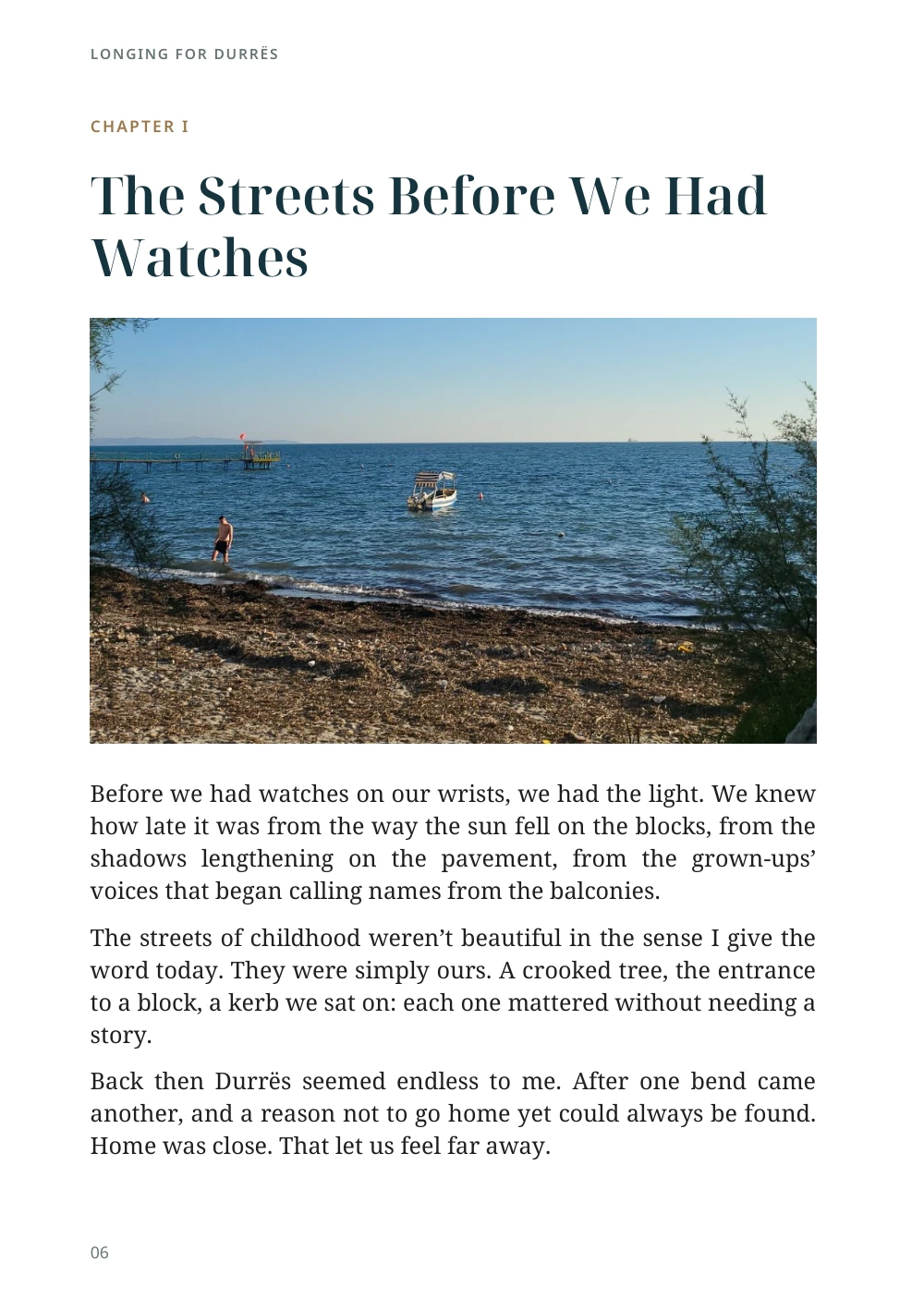
The sea was part of that safety too. I knew where it was. The air changed as I came near and the streets gradually opened out, until there were no more blocks ahead. I took that space as mine by right, like the yard. It never occurred to me that one day I would look for it in photographs.
The Things We Didn’t Phot ograph
Childhood knows nothing of nostalgia. It believes that whatever exists today will still be there tomorrow. So it doesn’t look closely at the entrance to the block, doesn’t photograph the school bag flung in a corner, and doesn’t imagine that one day the neighbourhood vendor’s voice may no longer be heard.
Nor did I keep them on purpose. They came back later, in pieces: a light over the stairs, sand left in a shoe, one hand feeling for the key while the other holds the bag. Sometimes I remember my tired legs and not where we had been.
Maps hold the monuments; details hold the person.
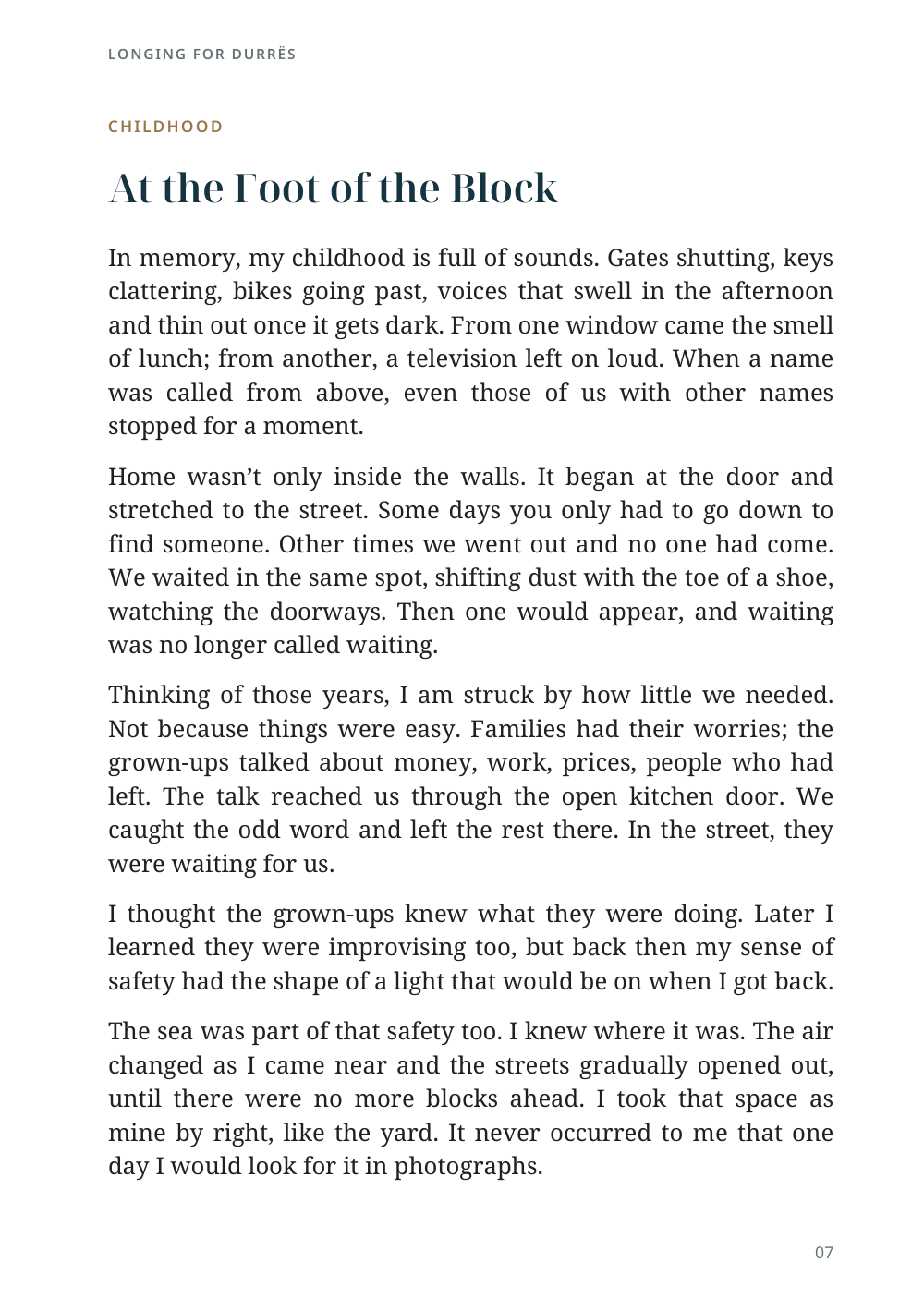
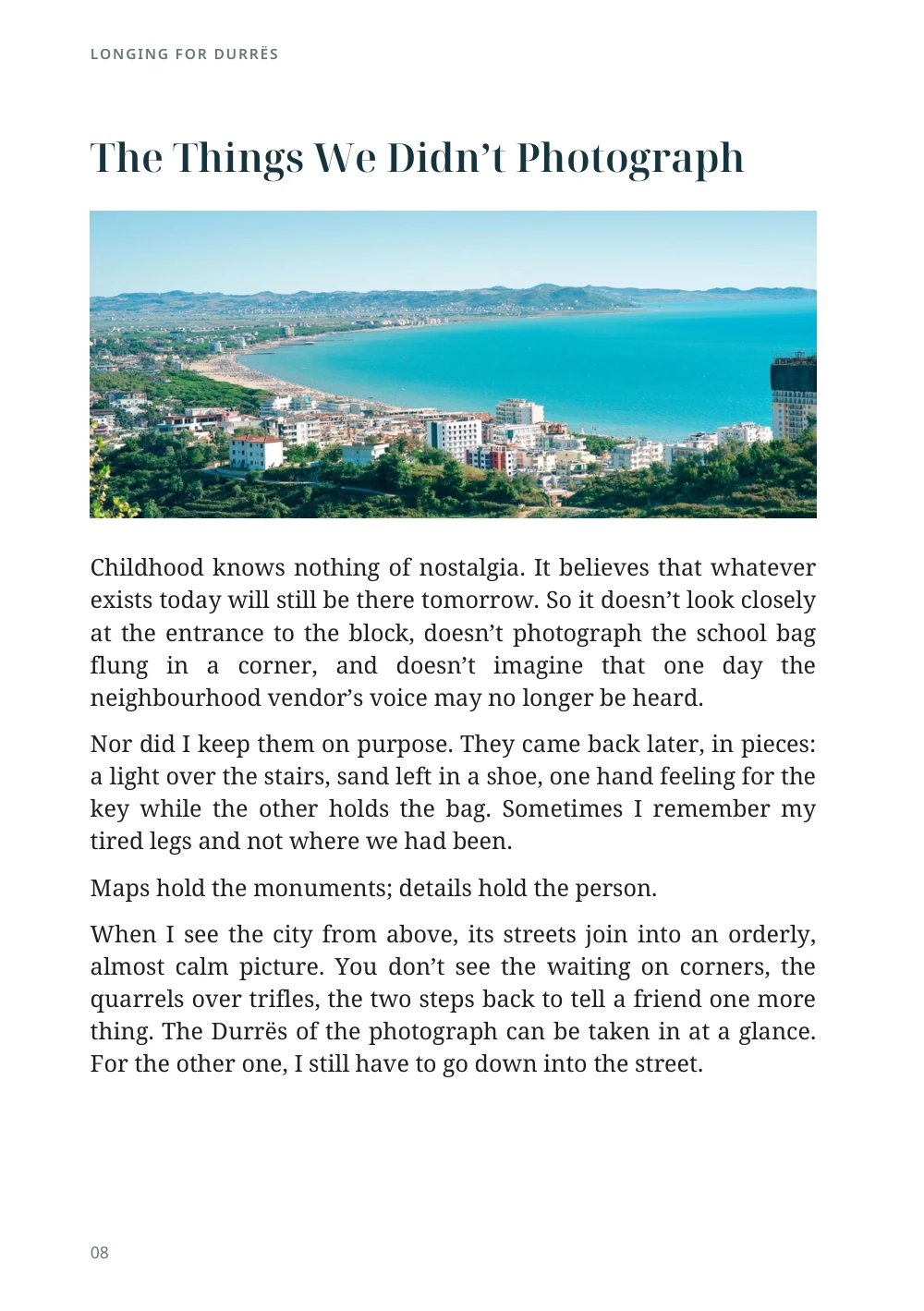
When I see the city from above, its streets join into an orderly, almost calm picture. You don’t see the waiting on corners, the quarrels over trifles, the two steps back to tell a friend one more thing. The Durrës of the photograph can be taken in at a glance. For the other one, I still have to go down into the street.
The Sea Ahead of Us
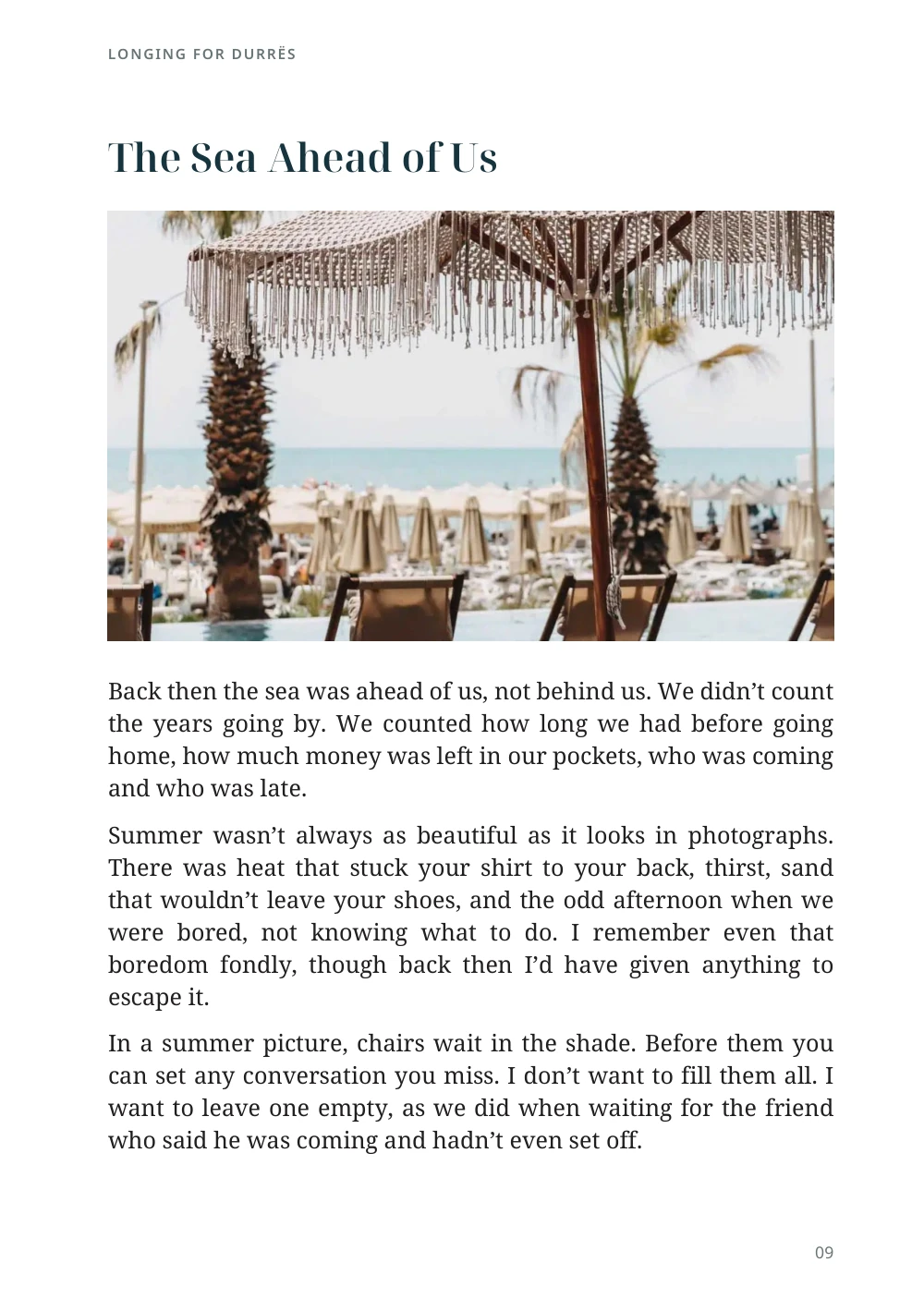
Back then the sea was ahead of us, not behind us. We didn’t count the years going by. We counted how long we had before going home, how much money was left in our pockets, who was coming and who was late.
Summer wasn’t always as beautiful as it looks in photographs. There was heat that stuck your shirt to your back, thirst, sand that wouldn’t leave your shoes, and the odd afternoon when we were bored, not knowing what to do. I remember even that boredom fondly, though back then I’d have given anything to escape it.
In a summer picture, chairs wait in the shade. Before them you can set any conversation you miss. I don’t want to fill them all. I want to leave one empty, as we did when waiting for the friend who said he was coming and hadn’t even set off.
CHAPTER II
When School Ended, the Cit y Began
The nine-year school gave the city a different map. There was the way to lessons, the way home and, above all, the little detours we made so that the way home would last longer. An unnecessary turn could give us another quarter of an hour together.
At the end of class, bags were shut before the last sentence was quite over. In the corridor the noise rose at once. We came out in a rush that didn’t stop us standing around outside the school for a long time afterwards, waiting for a latecomer. One hand held a bag strap, the other waved at him to hurry. Once he came, nobody hurried any more.
That was where friendship began to be about more than proximity. We weren’t together just because we lived nearby. We chose each other. We shared embarrassment, ambition, the fear of looking ridiculous and the wish to seem a bit more grown-up than we were. A bad mark could be survived; being seen to blush was harder.
A joke that had started at break would carry on into the street. To get it, you had to have been there, to have heard the tone, seen the face. We couldn’t tell it properly to anyone else, and we liked that: it was something of ours.
When the last bell rang, lessons ended. The city began.
Walking as a Way of Being T oge ther
There is an age when walking is the best form of conversation. Your bag is heavy, but you don’t go home. Even the one who complains it’s a long way comes anyway.
The one ahead turned and walked backwards. His bag strap was slipping and he hitched it up with a shoulder, still talking.
— Don’t act like you know where we’re going.
— I know, man.
— So where?
— Just walk. Why the rush?
— I’m not rushing. I’m hungry.
— We worked that out in second period.
We laughed. The hungry one overtook us, as if to show that if it were up to him we would have been there long ago. We followed him without deciding anything.
On those walks we talked about who had said what, who liked whom and who had promised to study and hadn’t opened a book. When the pavement narrowed we went in single file; a sentence passed from one to the next and the last asked for it again. A car would drown us out. Then we began again from the start, though the joke had lost half its charm.
From those afternoons I have kept the laughing faces, not necessarily the words. Memory makes its own choices. It erases the reason for the laughter and keeps the laughter itself.
Where our ways parted, we waited for the other to finish. Our bags already hung from one shoulder.
The First Split in the Map
The last years of the nine-year school brought a feeling we couldn’t name. Everyone was talking about secondary school, about the directions we would take, the places we would go. The grown-ups said it as a practical matter. For us it was the first split in the map.
Until then we had thought friendship was enough to keep people on the same road. Now the question of where each of us would enrol came into the conversation and didn’t let us joke for long. One had made up his mind; another said he didn’t know yet and asked the first again, as if the answer might have changed since the day before.
Nobody made a speech. There was no day when we said that from tomorrow everything would change. First someone was missing one afternoon. Then someone else had new friends. The talk that had gone on every day grew rarer and, when we did meet, we had to explain to each other names that until yesterday had not been part of our lives.
Still, for a few minutes everything fell back into place. A way of talking was enough, that shrug we knew so well, and the old road opened up again.
By the end of those years, Durrës seemed bigger. We would move through parts of it that hadn’t been ours before, towards corridors where we’d have to introduce ourselves afresh. It drew me and frightened me at once. I didn’t want to stay who I had been, but nor did I want to lose the people who knew me without my having to explain myself.
CHAPTER III
Gjergj Kastrioti Skënderbeu
My first year at Gjergj Kastrioti Skënderbeu was my way into a larger world. The same city, but a different crowd. Corridors where I didn’t know every face, voices that no longer belonged only to the neighbourhood or the old class, people who came with other ways of talking and laughing.
At that age every beginning feels like an exam, even when nobody is asking you anything. Where to sit, who to be with, how much to talk. I kept my bag close even when there was no reason to. I watched where the others had sat down and tried not to look as if that was exactly what I was doing.
The nine-year school had left me a ready-made place among people. Here nobody yet knew how I reacted to a joke, what made me uncomfortable, whether my silence was shyness or indifference. I misjudged them too. A few faces that had seemed cold to me began to feel close the moment I heard them laugh.
Little by little, I learned the voices. I came to know the footsteps of the one who rushed in, the chair someone always dragged back hard, the moment in class when a joke started before anyone had said it. School began to feel ordinary.
I didn’t notice the day I stopped thinking about where to sit. I simply walked in and went to my seat.
A New Social World
In class, people began to take shape. Not as names in the register, but as presences you could tell apart without turning your head. One talked while tapping his pen on the desk. Another looked up from his notebook only when he heard something he couldn’t let pass unchallenged.
— I know what I’ll do, said the one with the pen.
— Finished your homework?
— I mean life, man. I’m going to be rich.
— But how?
— I haven’t sorted that out yet.
The one with the notebook didn’t laugh at once. He shut the cover, rested his elbows on it and asked what he could do well enough to get paid. The other looked at him a moment, then pointed the pen at him:
— I won’t take you as a partner. You’ve spoiled it already.
This time he laughed too. The talk moved on to the cars we would buy, though none of us was bothering about how the money would be made. In the end the pen ran out and its owner asked to borrow another.
Today I can smile at our certainty, but I don’t want to judge it from afar. We needed to say the future out loud, to hear it come out of our mouths, even when we knew nothing of the road there.
Later, the one who argued with you might be the only one who waited for you after school. That confused the quick lines we had drawn between people.
The Cit y as a Second Classroom
After school, Durrës became a second classroom. There we learned how to be with different people, how to cover a disappointment with a joke, how to tell when someone wasn’t all right even when he said he was. We didn’t always manage. Sometimes we laughed just where we should have kept quiet.
The walking went on. The talk left school and entered life with no visible border: from an exam to work, from work to money, then on to the word “abroad”. That word named no particular country. It was where our wishes hadn’t yet met obstacles.
— I’m leaving, someone would say.
— Where to?
— I’ll find somewhere. Why, what would I do here?
Another argued that something could be done here too. We asked what, and he got cross, because he hadn’t started the talk to be held to account. Further on, he was the one complaining about the city. We didn’t let him off his contradiction. “But you just defended it!” He waved us off and walked ahead.
We wanted this place to give us more. We didn’t yet know what it would mean to live somewhere else, but we talked as if the hardest part were choosing where.
Today I hear those talks differently. Back then they were rehearsals without consequence. You could leave for one country at the start of the street and decide to stay by its end. Then came the hour to go back, and each went to his own home, in the same city.
CHAPTER IV
“Hen1” and the Hours Nobody Counted
At the crêperie we knew as “Hen1”, what we ordered was often just a pretext for the table to keep us a bit longer. In our conversations the name served as a meeting point: there was no need to give directions or explain what we would do there.
From those hours I have kept the movement around the table. A chair was pulled further out to make room for the latecomer; bags passed from side to side, and the talk broke off to tell him what he’d missed. He wanted to hear it from the start. We all began at once and you couldn’t make out a word.
Then came the usual things: the smell of warm batter, paper being unfolded, a corner of napkin crumpled between fingers. We talked with our mouths full, objected without waiting for the end, and forgot the question because someone had slipped in another story. Outside, people went by; now and then one of us looked up and the talk took a new turn.
The places of youth aren’t measured in architecture. More than how a wall looked, I remember how close we sat and how little it bothered us to have no particular plan for the evening.
“Five more minutes,” whoever had to leave would say. We didn’t count them. When at last he got up, he had to come back for something he’d forgotten, and ended up standing beside us again.
The Luxury of Shared Time
At the table, each of us brought his own version of the future. One wanted money, one a job he liked, one just for nobody to tell him what to do. That last wish appealed to everyone, until it came to deciding where we would go after the crêperie. Then everyone wanted to decide for the others.
— When we’re thirty, we’ll come back here.
— You, thirty? Come on.
— Why, what’s wrong with me?
— You’ve been saying “I’m off” for ten minutes. By then you might have got up.
He grabbed his jacket as if to prove it. Someone made room for him to get past, but another asked what we would order when we were rich, and the jacket stayed on his knees. The suggestions began. One promised he would pay for everyone; we reminded him at once that he had no intention of doing the same that evening.
Thirty seemed a faraway place. We could fill it with whatever we liked, because it hadn’t yet come to ask anything of us.
Today a get-together has to find room between work shifts, family, distance and the tiredness you don’t foresee when you say you’re free on Saturday. The conversation sets out to pick a day and ends with “we’ll talk”, not because we don’t want to meet, but because each of us is trying to open up an hour inside his own life.
At “Hen1” that hour was there without our asking. We could stay even when we had nothing left to say.
Before We Scat tered
A joke had gone a little further than it should have. The one who usually laughed first sat this time with his eyes on the paper crumpled in his hand. We talked on, relieved he wasn’t objecting.
Someone tried to put him back at the centre of the jokes. Another touched his arm.
— Leave it now.
— But what did I say?
— He heard it once. Come on, finish that.
There was no great silence. A chair scraped and the talk moved elsewhere. The one who had withdrawn stayed that way a little longer; then he said something small, a correction that didn’t matter, and we answered with more eagerness than the sentence called for.
I don’t know how often we caught these moments in time. Our friendship had egos in it too, comparisons and pride. When I say I remember those years with longing, I don’t want to erase the days when one of us went home quieter than he had come.
But we often found a simple way to get close again. A seat saved, a phone call for no reason, a question about homework. Not everything was resolved; some things were just covered over. I understand that better now.
When I think of us, I don’t see us at the end of our roads. I see us before we scattered, still able to say “tomorrow” to each other without opening a calendar. Even when we were angry, we knew where we would find each other.
A Door
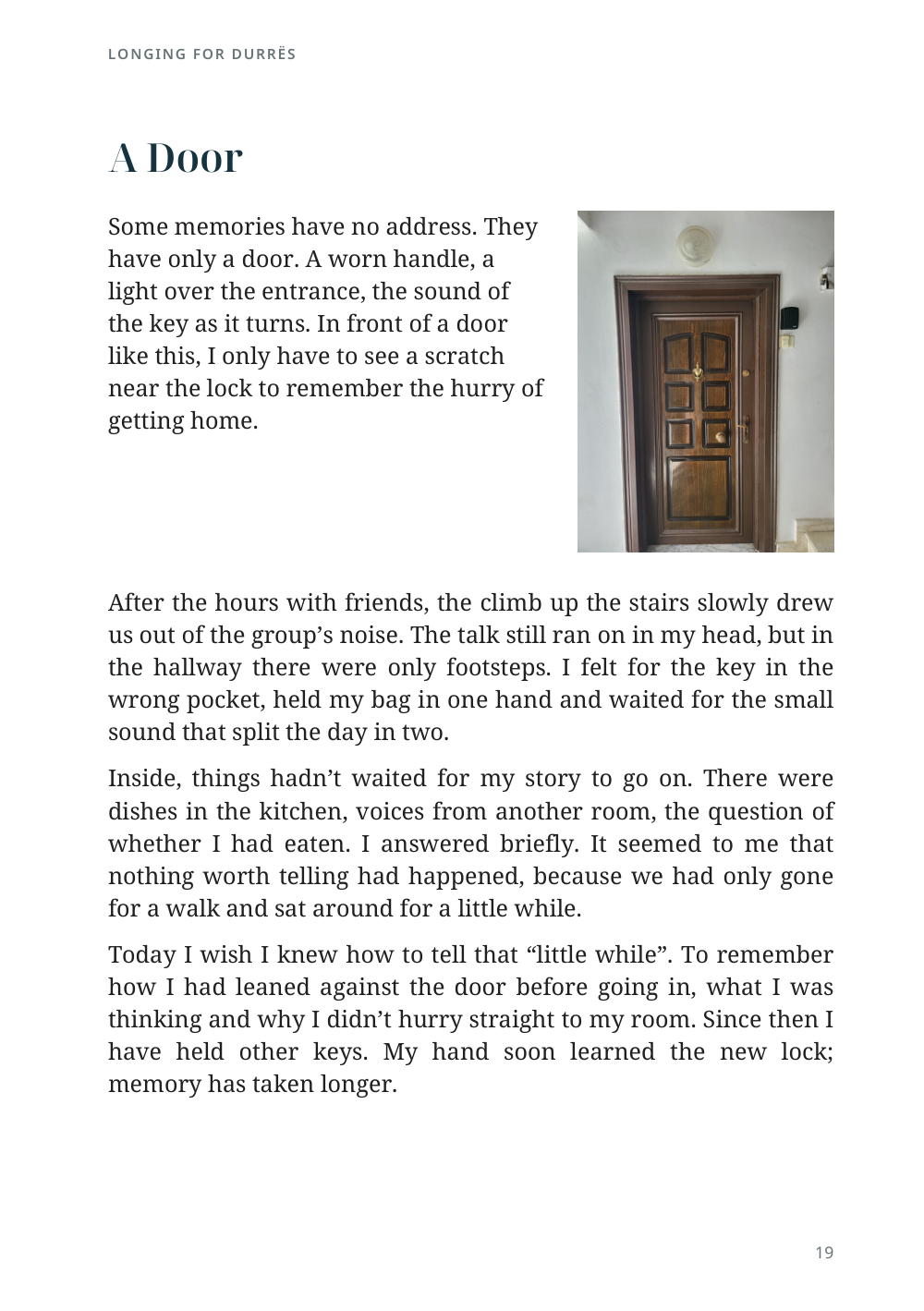
Some memories have no address. They have only a door. A worn handle, a light over the entrance, the sound of the key as it turns. In front of a door like this, I only have to see a scratch near the lock to remember the hurry of getting home.
After the hours with friends, the climb up the stairs slowly drew us out of the group’s noise. The talk still ran on in my head, but in the hallway there were only footsteps. I felt for the key in the wrong pocket, held my bag in one hand and waited for the small sound that split the day in two.
Inside, things hadn’t waited for my story to go on. There were dishes in the kitchen, voices from another room, the question of whether I had eaten. I answered briefly. It seemed to me that nothing worth telling had happened, because we had only gone for a walk and sat around for a little while.
Today I wish I knew how to tell that “little while”. To remember how I had leaned against the door before going in, what I was thinking and why I didn’t hurry straight to my room. Since then I have held other keys. My hand soon learned the new lock; memory has taken longer.
CHAPTER V
The Cit y Being Built over Our Memory
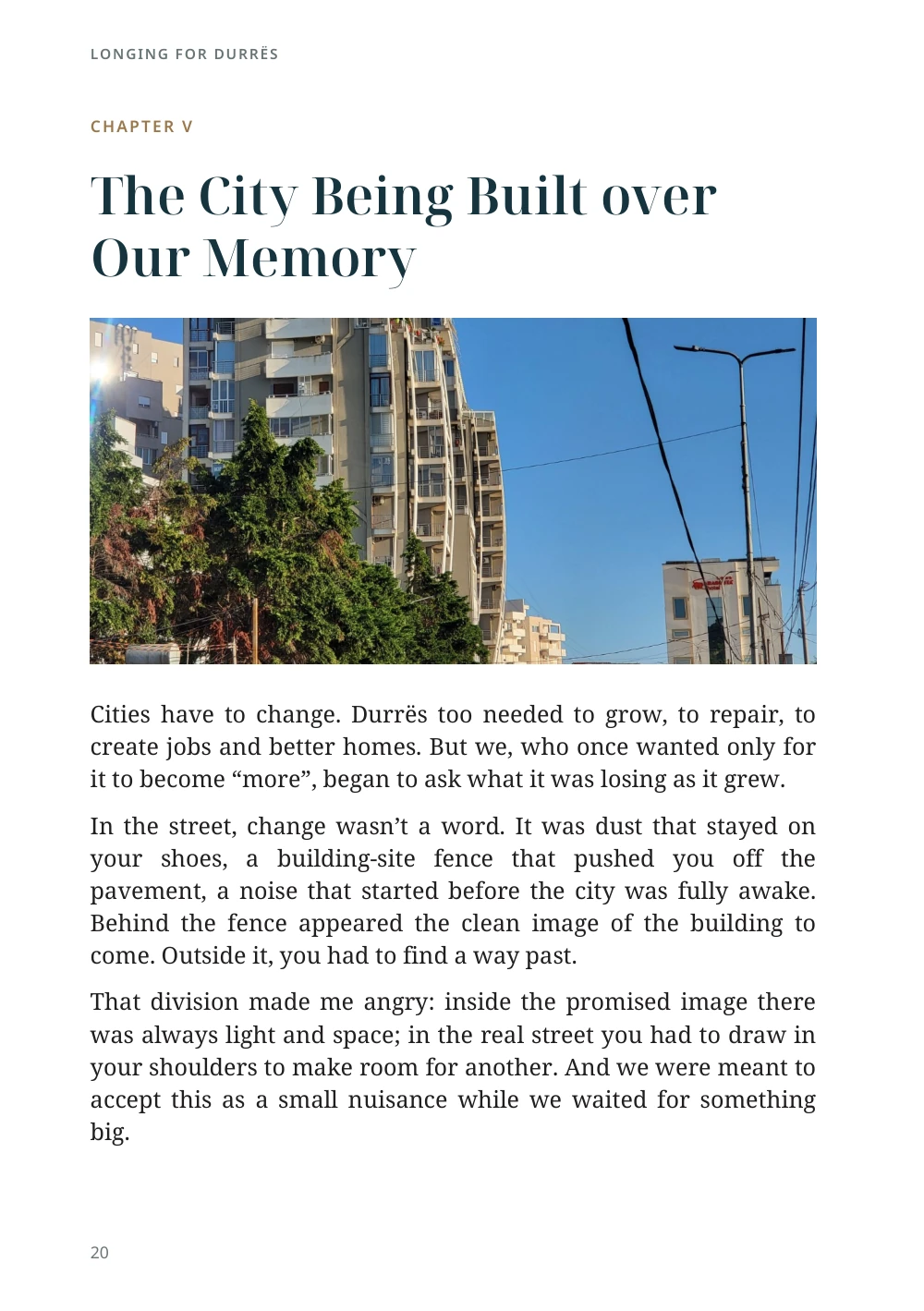
Cities have to change. Durrës too needed to grow, to repair, to create jobs and better homes. But we, who once wanted only for it to become “more”, began to ask what it was losing as it grew.
In the street, change wasn’t a word. It was dust that stayed on your shoes, a building-site fence that pushed you off the pavement, a noise that started before the city was fully awake. Behind the fence appeared the clean image of the building to come. Outside it, you had to find a way past.
That division made me angry: inside the promised image there was always light and space; in the real street you had to draw in your shoulders to make room for another. And we were meant to accept this as a small nuisance while we waited for something big.
When a Landmark Is Lost
There is an urban pain that comes not from ruins but from their absence. You pass a place and know that something was there, but you can no longer rebuild it accurately in your mind. A courtyard, a facade, a low space now replaced by storeys. Memory tells you: it was here. Your eyes reply: now it is this.
For a moment I am ashamed that I don’t remember enough. Then I get angry. Why should I be the archive of a stretch of street? Why should everything that couldn’t protect itself with a plaque survive only if we keep it in our heads?
I have nothing against a new home. I don’t want anyone living with damp so that my memory can find the facade as it left it. But that reasoning can’t apply to every loss. A pavement taken over doesn’t improve the life of whoever walks on it; a window facing only a wall gets no more light because the wall is new.
It is precisely in these spaces, treated as if they belong to no one until someone takes them, that I feel the thirst for profit. To someone selling, an empty space can be a lost opportunity. For us it was the place where we stopped without buying anything. In the end, we are left to walk on.
A city isn’t measured only by how much it builds. It is measured too by what it chooses not to touch. I didn’t think of this when I was young. Now it comes to mind whenever I search for a corner with my eyes and realise that even directions like “where it used to be” are becoming hard to follow.
Big Words and Small Sums
As the city rose upwards, not everyone rose with it. We understood this best at the table, when a plan just announced with enthusiasm began to break down into expenses. How much it cost, how much could be saved, what had to be kept for next month.
In a conversation like that, the question about a job didn’t end with its name. You had to ask about the hours, the pay, the journey there. The one who’d mentioned it tried to show its good side. The others did sums out loud until they saw they were shrinking his joy, and started saying that, anyway, it was a start.
We used that word often: start. As if the hard part were always temporary, as if we only had to hold out a little longer and the road would open by itself.
On television there were big words: development, opportunity, the future. In our talk there were wages, rent, work, leaving. Between these two languages lay a space where each had to find his own way. The promises tired me before they were even over, not because I didn’t want to believe them, but because I always had to return to the same sum.
We weren’t experts in economics. We were young people learning that some dreams cost more than we could pay. The next day, the city opened again. Someone raised a shutter, someone waited for the bus to work, and a postponed plan was still a plan. That wasn’t nothing, but it wasn’t everything we had asked for.
When the Cit y Becomes a Stranger
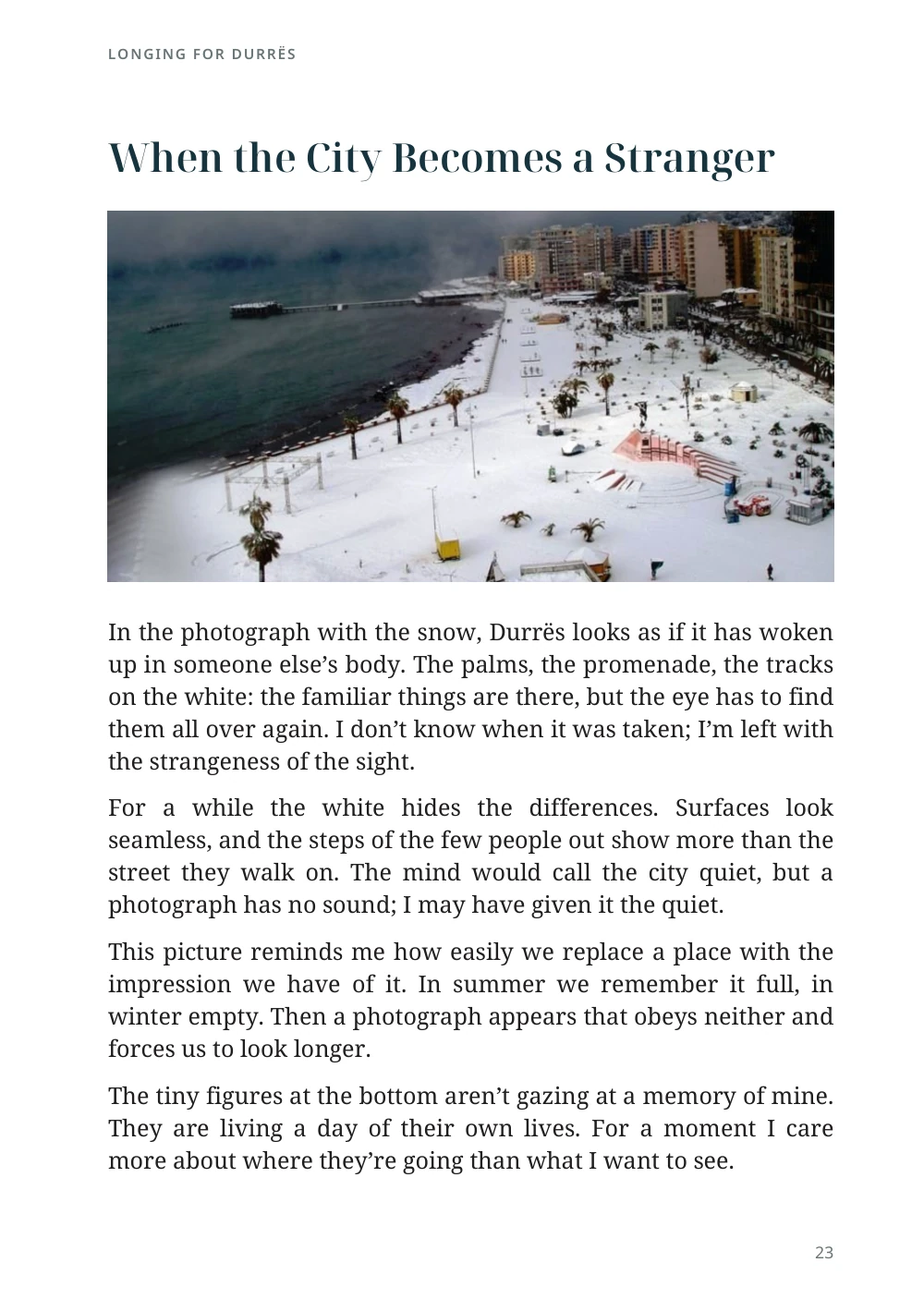
In the photograph with the snow, Durrës looks as if it has woken up in someone else’s body. The palms, the promenade, the tracks on the white: the familiar things are there, but the eye has to find them all over again. I don’t know when it was taken; I’m left with the strangeness of the sight.
For a while the white hides the differences. Surfaces look seamless, and the steps of the few people out show more than the street they walk on. The mind would call the city quiet, but a photograph has no sound; I may have given it the quiet.
This picture reminds me how easily we replace a place with the impression we have of it. In summer we remember it full, in winter empty. Then a photograph appears that obeys neither and forces us to look longer.
The tiny figures at the bottom aren’t gazing at a memory of mine. They are living a day of their own lives. For a moment I care more about where they’re going than what I want to see.
CHAPTER VI
Depar tures
At first, departures were sentences. “I’m thinking of leaving.” “I’ve got a chance abroad.” “I’ll give it a go.” They were said in the middle of another conversation, as you’d say you had something on next week. Then someone asked when, and the talk stopped there.
With no date yet, we could carry on the evening almost as before. Once a date was named, we began counting without showing it. How many more times would we meet before then? Did the last day fall at a time we could all make?
Nobody said: I’m leaving the life we have had together. People left for work, for study, for better wages, to test themselves. Our questions were about the papers and the journey. We didn’t know what to ask about the afternoons that would stay here.
The absence didn’t show straight away. For a while you kept meaning to call him for a coffee, and only when you picked up the phone did you remember he was no longer near. A number with another code made tangible what the word “abroad” had kept so vague.
Then I too came to know life away from Durrës. I saw how little room the word “work” takes in a conversation and how much it can hide: tiredness, fear, small successes, another language. “I’m fine,” you say. It’s even true. It just isn’t the whole story.
On the Other Side of the Morning
To explain longing, I think of an ordinary morning in Germany. Not a big event: a station, the light over the departures board, coats buttoned to the top. An announcement comes over the loudspeaker. People move to where the doors will open.
I know the way. I’m not lost, nor waiting for someone to save me from this life. I’ve learned the language of everyday things, the timetables, how a job should be done. It is precisely inside this earned security that something small can displace me.
A passenger hitches his bag up with a shoulder. The movement is familiar. For a moment I no longer see his coat but a school-bag strap slipping and the friend walking backwards, telling us not to rush. A smile comes by itself. The man in front of me hasn’t said a word.
The train comes; the doors open, I get on with the rest. My phone is in my hand. I could write to someone, but the message I have in mind isn’t a question. It is only: “I remembered something.”
Here I have people, obligations, a daily life I have built. Longing doesn’t deny them. It doesn’t tell me everything would be better if I were somewhere else. It just reminds me how easy it once was to call a name in the street and see the head I expected turn.
In the glass I see my face as it is now. Buildings pass before it while I am still searching for the words of a message begun many years ago.
Staying Is a Choice T oo
Not everyone left. Some stayed because they wanted to, some because life tied them there. Even an answer that seems simple can hold within it a family, a job, an obligation not spoken of at the table.
Over the years, dreams began to be put off. “Next year.” “When I’m a bit more settled.” “When I’m in a better position.” Those of us who lived far away used these sentences too. Only the obstacles had other names. That should have made us more careful with the advice we gave each other.
A friendship at a distance isn’t always lost for lack of love. It is lost, too, through the small things we no longer see. The other has a new colleague, a daily worry, a joy he has shared with someone nearby. You learn the outcome, but you weren’t there while he was waiting.
When we met, we sometimes went straight to the past. There we didn’t have to introduce anyone. A name was enough and the conversation opened up. But the life of today sat beside us and needed patience to be told. We also had to learn to hear stories we had no part in.
Those who stayed hadn’t kept our places empty. They had gone on living. I grasped this with my head before I could accept it without a small sting. I wanted to find them well, but part of me also wanted them to have waited for me.
I have had to let go of this silent unfairness. Only then could a return become a meeting, and not an inspection of what I had left behind.
CHAPTER VII
Re turns
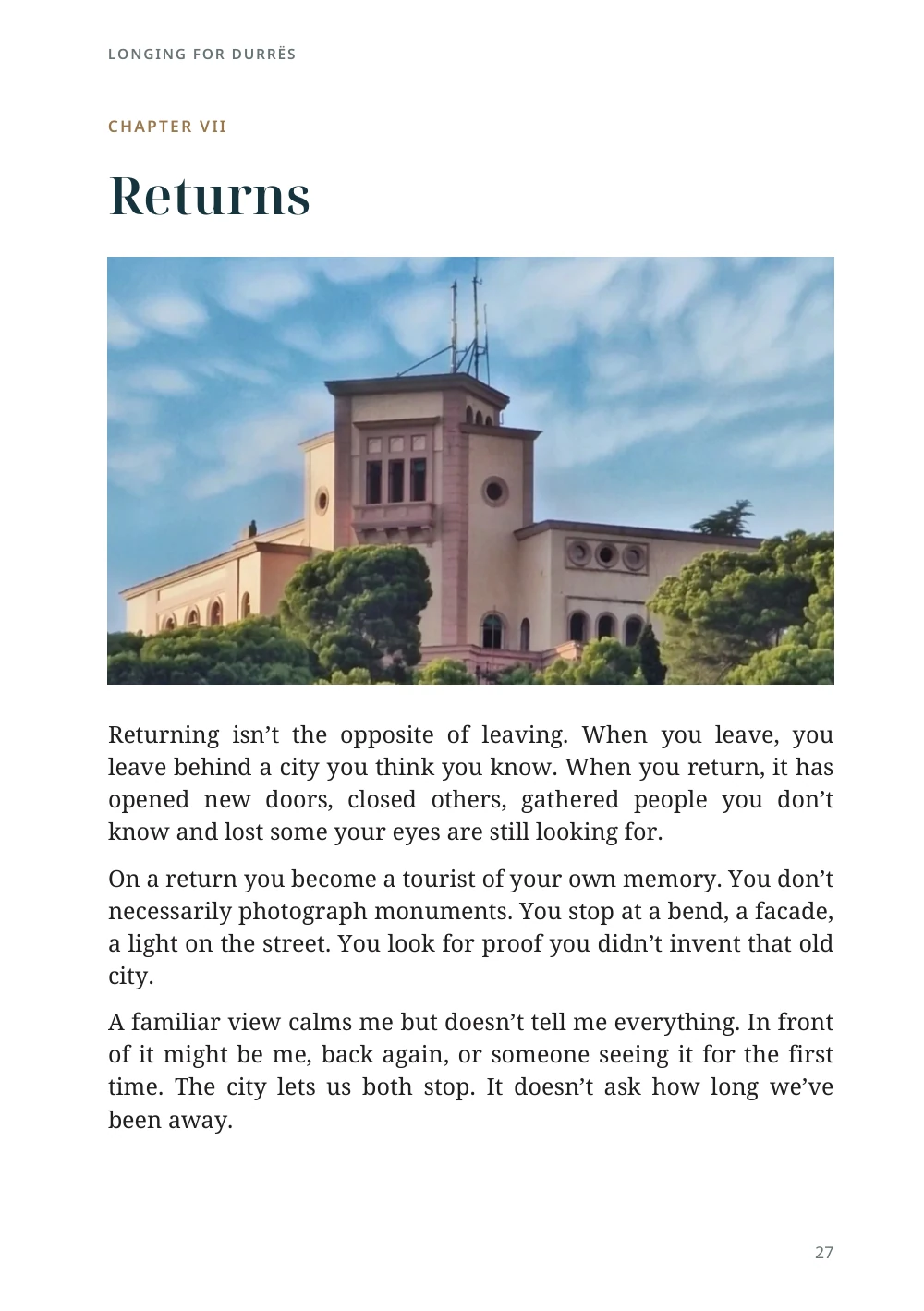
Returning isn’t the opposite of leaving. When you leave, you leave behind a city you think you know. When you return, it has opened new doors, closed others, gathered people you don’t know and lost some your eyes are still looking for.
On a return you become a tourist of your own memory. You don’t necessarily photograph monuments. You stop at a bend, a facade, a light on the street. You look for proof you didn’t invent that old city.
A familiar view calms me but doesn’t tell me everything. In front of it might be me, back again, or someone seeing it for the first time. The city lets us both stop. It doesn’t ask how long we’ve been away.
Two Versions of Myself on the Same Stree t
There are streets I walk more slowly now. The grown man sees the traffic, the facades, the changes. The boy I was looks for his friends, the school timetable, some reason not to go home yet. Now and then one of them keeps the other from seeing clearly.
Memory isn’t an accurate map. It has stretched some distances and shortened others. A building seems smaller than I remembered. The walk that used to take us an afternoon is soon over when I do it alone. It wasn’t its length that held us up.
Near a school, the noise of break time still has that sudden burst. I know none of the faces. A group stops at the gate, one turns back to wait for someone, the others complain but don’t leave. For a moment I want to see them as we were. Then someone laughs quite differently and the comparison falls apart.
It does me good that it falls apart. They aren’t there to act out my youth. They have their own conversations, jokes I don’t get, a city still widening out in front of them. What I call a changed place may be, for them, the first place.
I walk on without trying to find myself in each of them. I pass an entrance I have no business going into and a shop I never knew. My stops no longer belong to a shared map. And yet, when someone asks me which way to go, my hand rises to point before I have thought of the answer.
T o Love It without Idealising It
I love Durrës, but love doesn’t make it innocent. There are things that make me angry, and I don’t want to hide them behind a pretty photograph. Even so, anger doesn’t give me the right to call the life that people go on living here lost.
When I was young, I wanted to leave because I wanted more. Today I can admit I have found important things far away and that something is still missing, without turning one into an accusation against the other. I needn’t choose Durrës against every city I have lived in.
There are places more orderly, calmer for my everyday life. But here a street can remind me how I used to stand, what I did with my hands when I didn’t know what to say, how I tried to look confident in front of people who wanted the same thing.
They weren’t all happy days. We waited, we got fed up, we wanted to be someone else. Memory tends to leave these things out and keep only the laughter. I have to stop it now and then. Otherwise I wouldn’t be writing about the city I grew up in, but about the one I would have liked to have had.
What I have here isn’t all visible. It is time spent in places that may serve other people today. I can’t ask them to keep every chair for me. I can sit down somewhere, listen to what is being said around me and give the city the chance to tell me something I don’t know.
A Place at the Table
On a return, a get-together starts with practical things. Where are you, how long are you staying, when do you have to go. Phones go down on the table and the talk begins carefully, trying to sum up whole months without tiring the other.
Then an old expression comes up. Someone says it in the same tone, and for a few moments we don’t need to explain anything. Our bodies lean in over the table by themselves. We talk at the same time, correct each other over a detail nobody can prove, and laugh more than the story deserves.
— Is that how you remember it?
— Well, how was it?
— Forget it, you always end up looking good.
One of us checks his watch. This time we don’t say “five more minutes” with the old certainty. We know there may be someone waiting for him, a job that can’t be put off, a part of his day we don’t know. He stays a bit longer, but now it feels like time he is giving us, not something that is simply ours.
When we get up, the talk goes on standing. We have to step aside to let someone by. For a moment we are back where our ways parted after school, not wanting to go before the other finishes his sentence. Only the bags are gone.
We haven’t gone back to what we were. We have managed to be together as we are now. That is less easy, but it is not a small thing.
I stay a moment more on the pavement. Chairs scrape behind me. Then I take the street that brings me out to the water.
EPILOGUE
In the End, the Sea Stays
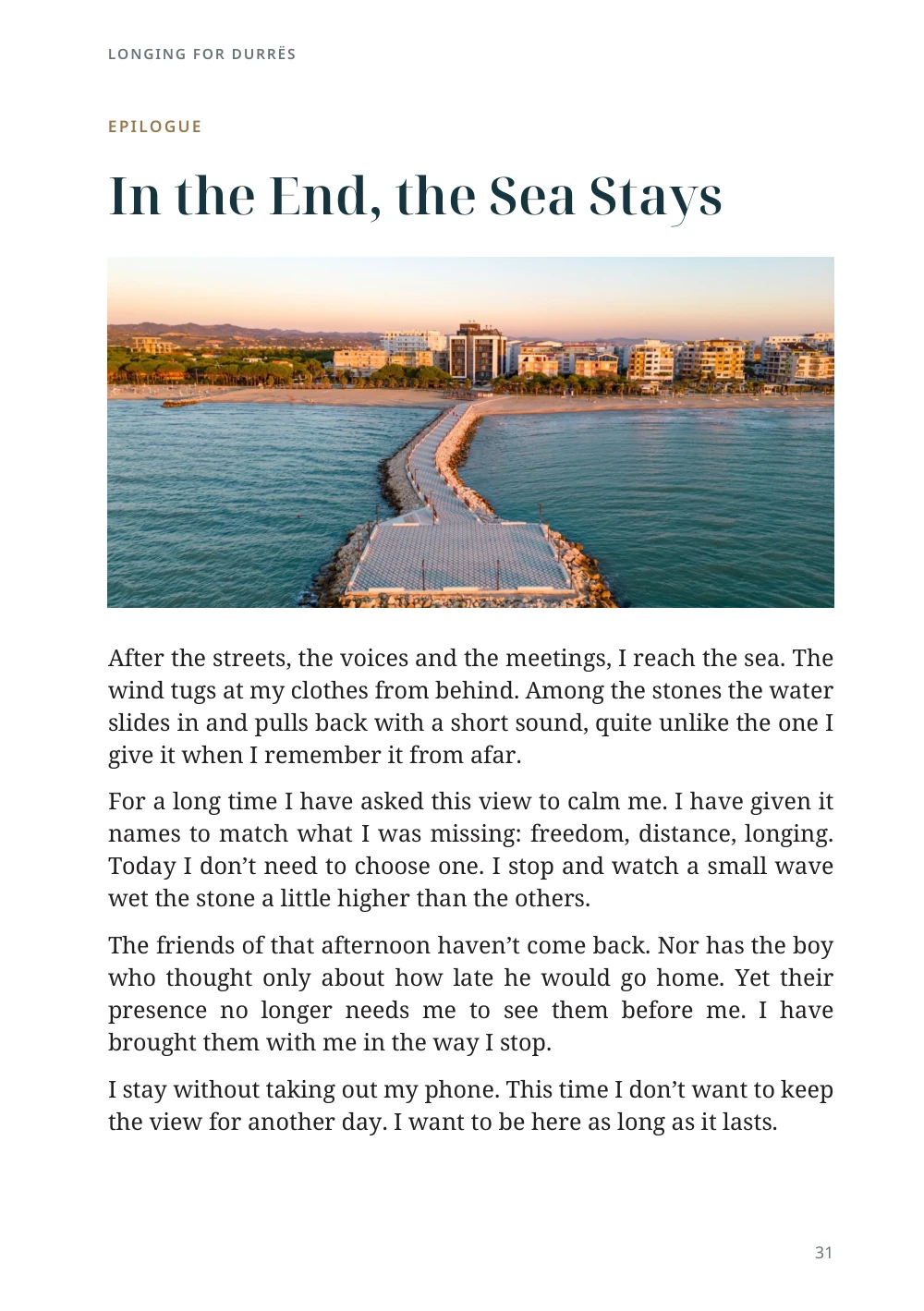
After the streets, the voices and the meetings, I reach the sea. The wind tugs at my clothes from behind. Among the stones the water slides in and pulls back with a short sound, quite unlike the one I give it when I remember it from afar.
For a long time I have asked this view to calm me. I have given it names to match what I was missing: freedom, distance, longing. Today I don’t need to choose one. I stop and watch a small wave wet the stone a little higher than the others.
The friends of that afternoon haven’t come back. Nor has the boy who thought only about how late he would go home. Yet their presence no longer needs me to see them before me. I have brought them with me in the way I stop.
I stay without taking out my phone. This time I don’t want to keep the view for another day. I want to be here as long as it lasts.
The Cit y within Us
When I think of Durrës, fragments come to me: a school corridor loud with break time, a bag slipping off a shoulder, the table at “Hen1”, the question from inside whether I’ve eaten. They make no orderly picture. In places memory halts; elsewhere it passes whole years showing me nothing.
I have wanted to approach them without embellishing them till they ring false. The city of my youth had hardships, families counting their money, young people who couldn’t see where they would end up. There were days, too, when I couldn’t bear how near everything was and wanted to go as far as possible. That impatience was mine too.
Today I don’t ask the city to give me back my youth. Nor do I ask it to stop for those not here. Somewhere another group is waiting for a friend running late. A chair is pulled out to make room for him. It is beautiful, this life that doesn’t need us to go on, even when accepting it hurts a little.
From the shore I turn my head towards the buildings. I can’t see all the streets I have walked, but I know they’re there and that soon I’ll step back into their noise. I have a life to go on with, not just a past to search for.
I take with me what I can: a voice, a movement of a hand, a little of this evening’s light. The rest I leave in the street.
Durrës is not only the city where I left my youth. It is the city where my youth walks on without me.