Shif t Pulse
Damage, incomplete orders, late routes, safety, OEE, open actions and the handover in one picture, by day or week. Trend charts, flags for what is off, and a summary to copy or print.
Open Shift PulseFree · Private · No sign-up
Small, practical tools built from the essays. They run in your browser, and nothing you type leaves your device, except a company website you give the CV Builder to find its logo.
59 tools
No tool matches these words. Try one word of the name, or a topic such as hotel, safety or quality, or clear the search to see every role.
Pulse · One shift
You run the floor for one shift: people, damage, incomplete orders, delays, and a clean handover at the end.
Open the planet: routine, learning, next orbitDamage, incomplete orders, late routes, safety, OEE, open actions and the handover in one picture, by day or week. Trend charts, flags for what is off, and a summary to copy or print.
Open Shift PulseLog damaged units by stage and cause. See the damage rate, DPMO and sigma level, the few causes behind most of it, and where to start.
Open the damage logLog orders that left without every item or parcel. See the incomplete rate, DPMO and sigma level, the causes behind most misses, and where they start.
Open the order logLog planned and actual route times. See the on-time rate, how much delay starts at the dock and how much on the road, and the reasons and hours behind it.
Open the route logLog the no-shows, declined cards, posting errors and open balances the night audit finds. See the exception rate, DPMO and sigma level, the causes behind most of them, and where in the stay they start.
Open the audit logNumbers, open issues with an owner and a time, heads-up and safety in one handover. Open issues carry over to the next shift by themselves.
Start a handoverOne list for every countermeasure, finding and signal from the other tools: owner, due date, status and how it is verified. Overdue first, a weekly review in ten minutes, calendar and Excel export.
Open the listSafety, Quality, Delivery, Cost and People as five month calendars of green, amber and red days, filled from your logs. Open actions, carried handover issues and a ten-minute huddle agenda to read out or print.
Open the boardWalk one area and score each S from 0 to 4, in 5S, 6S or 8S, with checklists for warehouse, hotel and delivery station. A radar against the last walk, the trend and a league table by area, findings straight into actions and a red tag register.
Start the auditEvery accident, near miss and unsafe condition on the green cross of the month, with days since the last accident, LTIFR, TRIR and the Bird pyramid. The cause to tackle first, open actions and a talk for today's briefing.
Open the crossThe register of found items from hand-in to return, police, charity or the bin, with a tag number, the safe and a photo for each. Keep-until dates, the items due for a decision, where most things are left, a reply to the guest and a tag label.
Open the registerThe live room board of the shift: every room by floor with its housekeeping code (VD, VC, VI, OCC, OD, DO, CO, OOO, OOS), DND, VIP and arrival flags and its attendant. It shows the next room to clean, the rooms ready for today's arrivals, the out-of-order share and the minutes from check-out to clean and from clean to inspected.
Open the room boardThe complaint and service-recovery log of the front office: LEARN, the action, the compensation in euros, the time to resolve and the call back. Complaints per 100 occupied room nights, the share resolved within target, repeat rooms, the Pareto of the categories and a reply to the guest.
Open the logThe paper of the team board in one print, from what the tools hold in this browser: open actions by owner, the week's maintenance work list and 5S audits, a card per leader, the Safety Cross and Daily Board of the month, and the attendant and section sheets of a hotel.
Print the packWeigh and log food waste, expired and damaged goods, scrap and linen with the reason and where it went. Kg and euro lost per day, grams per cover, the Pareto of categories and reasons, and the weeks against a reduction target.
Open the logLog every call for help on the floor, live with a running clock or after the fact. Time to respond and to solve against your targets, who to call now for an open call, the Pareto of reasons and stopped minutes, and the hours when calls pile up.
Open the logZenith · One area, week by week
You lead the shift leads. You read an area's numbers week by week and decide where the next hour of attention goes.
Open the planet: routine, learning, next orbitPerfect Delivery per order, on time, incomplete, damage, cold chain, loading and departures, partner and driver scorecards, route risk, root-cause Pareto, actions and a weekly review. A deep dive on one failure: where it concentrates, the evidence rows and an investigation that becomes a verified action. Reads your Excel workbook.
Open the control towerA number turned red. Ten statements show which cause your answers point to, clarity, skill, capacity, process design or ownership, as a hypothesis to check on the floor, with first moves.
Start the diagnosticWhich few causes make most of your delays, errors, idle time or complaints? Templates for delivery, warehouse and hotel, CSV and Excel import, a checked chart.
Find the vital fewOne problem on one sheet, the Toyota way: the facts and the number, the target and its date, the root cause, countermeasures with an owner each, and the follow-up. An eight-point check, print on A3 or A4, Word.
Start an A3Every improvement idea of the team on one board, from Idea through Plan, Do and Check to Adopted, with an effort and impact matrix that shows the quick wins. Adoption rate, days to adopted, savings per month and year, and the idea of the month.
Open the boardRate each person on each task from 0 to 4 in an ILU grid, with templates for warehouse, hotel front office and delivery station. Cover against target, single points of failure, cover per shift and a training plan that pairs a level 4 with a trainee, straight into actions.
Build the matrixLog each shift of a machine with its stops, pieces and rejects. Availability, performance, quality and OEE, the six big losses day by day, and the one to attack first.
Measure OEEEach night's rooms sold, revenue, no-shows, rooms out of order and complaints, pasted from the PMS. Occupancy, ADR and RevPAR against budget, the month's forecast, the weekday pattern, the revenue that leaked and a morning report to copy.
Open the KPIsLayered process audits by team lead, area manager and site lead, with yes or no checks on the standard for warehouse, hotel and delivery station, and a waste walk that counts the 8 wastes, Mura and Muri. Compliance per week and layer, where the no answers sit, which layer is late, and findings straight into actions.
Start the walkThe weekly or monthly report for your manager, written from the data of the other tools: safety, quality, delivery, OEE, 5S, hotel, Kaizen and actions, each against the period before and its target. What got better, what got worse, the biggest risk, one decision and three priorities. Text, A4 or Word.
Write the reportCheck a cleaned room before it is released: pass, fail or n.a. by zone, critical items that fail the room on their own, a photo of the fault. Re-cleans go back to the attendant, maintenance to the Action Tracker; the first-time pass rate per attendant, floor and room type shows where to coach.
Inspect a roomPlan the preventive maintenance and statutory checks of every asset by date or operating hours, log what was done, postponed or broke down, and see what is overdue, the PM compliance, MTBF and MTTR, and the work list of the week.
Plan maintenanceEvery tool in this browser read in one ranked morning list: control chart signals (p, c, u and I-MR with the run and trend rules), missed targets, overdue actions, maintenance, red tags and ideas, and safety on top.
Read the signalsThe executive housekeeper's staffing plan: departures, stay-overs, linen changes, VIP rooms, deep cleans and public areas become workload minutes (or credits) and the attendants needed against those scheduled, with hours, labour cost and minutes per occupied room. Sections balanced by minutes on as few floors as possible, printed per attendant or set into Room Status, and the week from the forecast.
Plan the housekeeping teamEach leader's routine as a standard, from the team leader's huddle to the site manager's Gemba walk, checked off every day: done, or missed with a reason. The next level up reviews the adherence each week, sees the share of the day in standard work against the guide for the level, and sends a task missed three times in two weeks to the Action Tracker.
Write the standardTurn the volume forecast and the rate of each process into the heads every shift needs, with breaks, utilisation and absence, and see the gap against the planned team, the bottleneck and how to close it with overtime, agency or qualified people from another process.
Plan the shiftsThe documented risk assessment of each work area: hazards from the eleven hazard-factor groups, likelihood × severity on a 5 × 5 matrix, measures in the STOP order with owners and their effectiveness check, the residual risk and the review date, set against the events of the Safety Cross.
Assess the risksMeter readings for electricity, gas, water, district heat or oil turned into use, cost and CO₂ for any period, kWh per occupied room night or per order, each meter against its own baseline, and a signal when a week drifts above it.
Read the metersLumen · The whole system
You look at the whole system: find where a problem really sits, prove it with data, and change the process so it stays fixed.
Open the planet: routine, learning, next orbitTurn defects into a sigma level, combine on time, undamaged and complete into perfect delivery, and see whether a bad day is a signal or noise.
Open the calculatorMove from a symptom to a root cause you can change, then agree one countermeasure, one owner and one check. Print it or save it as PDF.
Open the worksheetPut the effect at the head and collect causes with the team on the 6M, 4P or hotel bones, each with its why. Votes and likely causes rank them, the likely ones become actions to verify, and the top one goes to 5 Whys or the causes to Pareto.
Draw the fishboneWrite down how each process step can fail, rate severity, occurrence and detection, and get the RPN and the AIAG-VDA action priority. A heat map, the top ten risks and the actions with owners until the re-rating shows the risk is gone.
Open the sheetPaste measurements and get the right control chart (I-MR, Xbar-R/S, np, c, u) with Nelson rules and before/after phases, Cpk, chi-square, regression and a Gage R&R or attribute agreement study. Every number in plain words.
Open the labTime each element over five cycles with a stopwatch, space bar as the lap key. Get the standard time per station, takt from demand, a Yamazumi against it and the first element to move.
Start a studyMap one flow from supplier to customer with the pieces waiting between the steps. Get the lead-time ladder, PCE, takt and the bottleneck, then draw the future state and send its kaizen bursts to the Action Tracker.
Map a streamOne job as a TWI breakdown: major steps, key points marked Safety, Quality, Technique or Cost, and a reason for each, with the time per step against the takt. Versions with change notes, print on A4, Word.
Write a standardDraw the walking paths of one job over the floor plan, tap by tap, in metres. Get the metres and minutes walked per shift, the stop visited most and the longest repeated leg, then compare the layout after the change.
Draw the walksEvery DMAIC project on one page: phase, status, the next tollgate and its checklist, days in the phase, sigma before and after, and savings planned against realised. Each project keeps its charter, SIPOC, CTQ tree, RACI, Kano, RTY, COPQ and control plan.
Open the portfolioClassify every SKU by annual consumption value and by how steady its demand is, and get the nine-cell matrix with its policies, the cycle counts per week, safety stock and reorder points at your service level, and the SKUs for the golden zone.
Classify the stockTime one changeover element by element, split it into internal and external work, convert and streamline by Shingo's steps, and see the minutes and euros freed and the new changeover standard.
Study a changeoverThe Global 8D for a problem a customer saw, D0 to D8: containment within a day, 5W2H and IS / IS NOT, the root cause and the escape point both verified, corrective actions validated with data. Days open and to containment against targets, every action to the tracker, print and Word.
Open an 8DThe site's strategy on one X-matrix: breakthrough and annual objectives, improvement priorities, metrics and their owners, with the gaps listed. Catchball notes per priority, a bowling chart month by month, and a countermeasure when a metric misses twice in a row.
Open the X-matrixThe sites you look after side by side, each read from its read-only team code without joining: damage and incomplete rates, routes on time, OEE, 5S, safety, actions, maintenance and the hotel rates, best and worst named, ranked by a rule you can see.
Compare the sitesPlan, run and follow up a rapid improvement event: the charter with goals in numbers, preparation counted back from the first day, the standard 3–5 day agenda, ideas by waste on an effort and impact matrix, goals before and after, and the 30-day follow-up list. Report-out in A4 and Word.
Plan an eventList what prevention, appraisal, internal and external failure cost, as hours, counts or amounts for any period, and get the cost of quality a month and a year, the cost of poor quality as a share of revenue, the largest items and what a cut in failure would save.
Put a number on poor qualityTurn a batched schedule into a levelled mix: takt, pitch, load and EPEI, the day's heijunka box with clock times, and the changeovers it costs against the finished stock it saves.
Level the mixWork out how many kanban cards each supermarket or two-bin loop needs, by Toyota's formula or a statistical safety stock, see the cards to add or take out and the stock value at maximum, and print the cards eight to an A4 sheet.
Size the loopsEvery mistake-proofing device in one register: the error it prevents, Shingo's method, control or warning, prevention or detection. Test each on schedule with a deliberate error; see what is overdue or failed, verification compliance, effectiveness per device and a checklist to print.
Open the registerScore how mature an area's lean system is in ten dimensions, from 5S to kaizen, with up to five assessors: the spread shows where they disagree, the radar the change since last quarter, and the three weakest dimensions link to the tools that close them.
Assess an areaDMAIC in five steps on one warehouse case, with the tool to use at each step, three questions per step, the eight wastes and a project charter.
Start the courseAtlas · Every orbit
Carry your experience into the next role: a designed CV, an ATS CV and a matching cover letter.
Open the planet: routine, learning, next orbitA designer-quality CV on live A4 pages: photo, key figures, and company logos found from a website. In English, German or Albanian, saved as PDF.
Build your CVDrop in the CV you have, as PDF or Word. Get a clean one-column version that application software reads, matched to the job ad, as PDF, Word or text.
Convert your CVThe letter in the same design as your CV, with your details taken from it and a first draft from a few answers. PDF or Word.
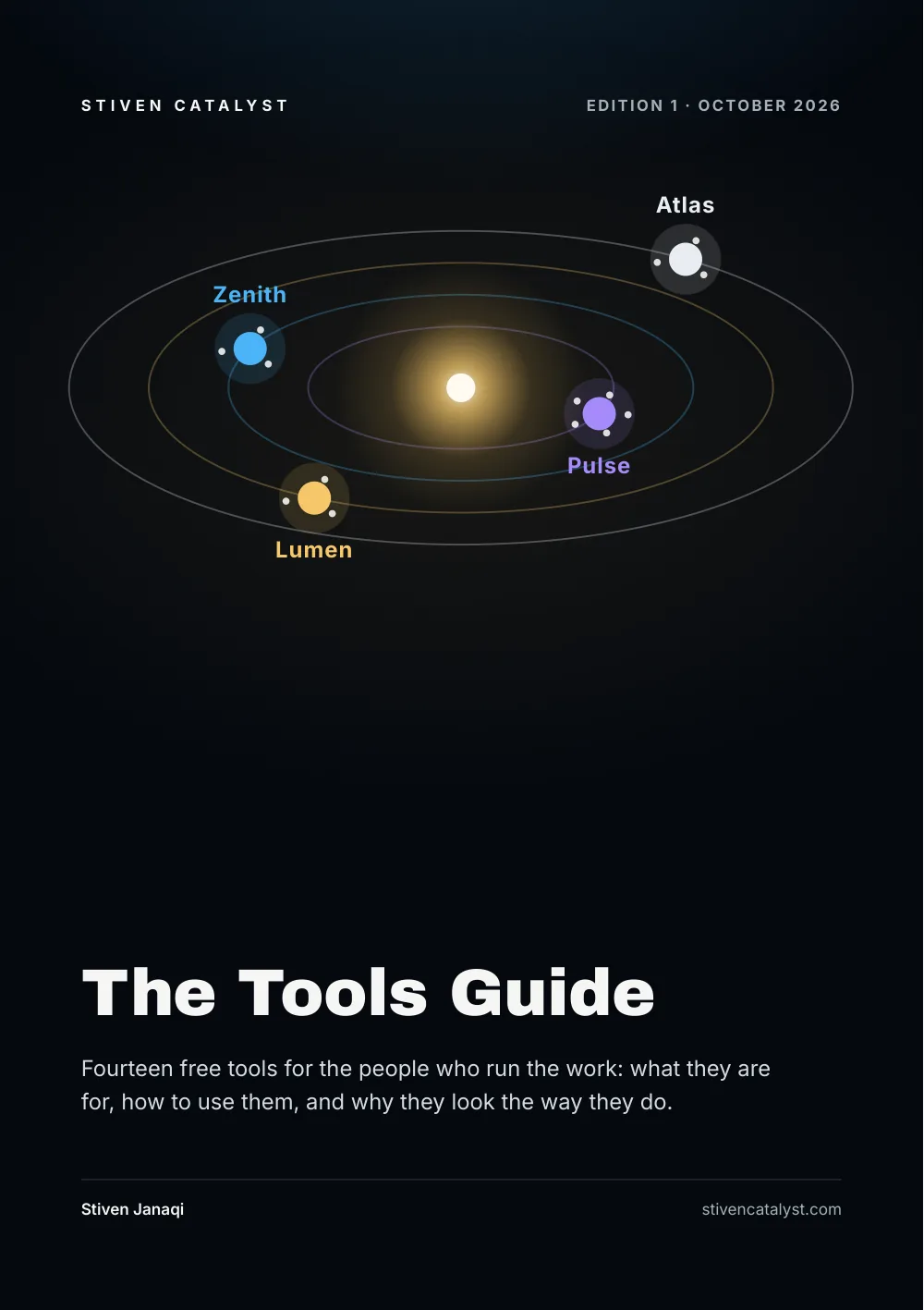
Write your letterThe guide · Edition 8
Why the tools are a solar system, what each family is for, and how to use every tool, step by step. Leaf through it page by page, or download the PDF.
Open the guideYour work
Every tool keeps your work only in this browser. Save it as one file to keep a copy, to carry on from another phone or computer, or to hand it to a colleague. Nothing is uploaded.
The file holds the tools' photos too, up to 20 MB of them; restore points stay on this device.
Then clear old entries in these tools to make room: the file keeps them, and opens on any device.
Works offline too: once a tool has been opened on this device, it and the other tools of its role open without a connection.
Share the tools you choose with your team: every device keeps working without a connection and syncs when it can. The work is encrypted on this device with a key made from the team code, so the server cannot read it.
Your team code
On another device, open this box and scan the code or type the six words under “Join a team”. Give it only to your team: whoever has it can read and change the shared work; for someone who should only look, make a read-only code instead. Write it down; it is not shown again.
Read-only: this device takes the team's work and sends nothing, so it can neither change nor delete the team's copy. Changes made here to the shared tools are not sent, and the next sync replaces them with the team's copy.
For someone who should see the team's work but not change it, such as a manager or a screen on the wall. It cannot change or delete anything.
When someone leaves the team: the work moves to a new code and the old copy is deleted. Every other device then joins again with the new code, and the old read-only codes stop working.
Read-only code
On the other device, open this box and scan the code or paste it under “Join a team”. Whoever has it can read the shared work, so give it only to people who may see it. It stops working when the team changes its code.
The team changed the work of this tool. Reload the page to see it.
Shared computer
One browser for the whole desk? Lock the tools with a PIN: your work and the restore points are encrypted on this device, the tools open empty, and the PIN brings everything back. Team sync pauses while locked. Nothing is uploaded.