Linda Treviño and colleagues found two pillars behind that reputation: the moral person and the moral manager. Crossed, they give four reputations, and only one is ethical leadership. In 195 departments the ethics of top management reached employees through their supervisors. Ethical leadership overlaps strongly with transformational leadership, yet still predicts behaviour beyond it. The ten-item scale shows what employees look at.
Management Review · Second series · November 2026 · No. 78
The e thical leader
A good person is not yet an ethical leader, how ethics flows from the top to the front line, four reputations, the overlap with transformational leadership, the ten questions of the scale, and a card for one decision.
- No.
- 78
- Pages
- 10
- Sources
- 6
- Topics
- Role
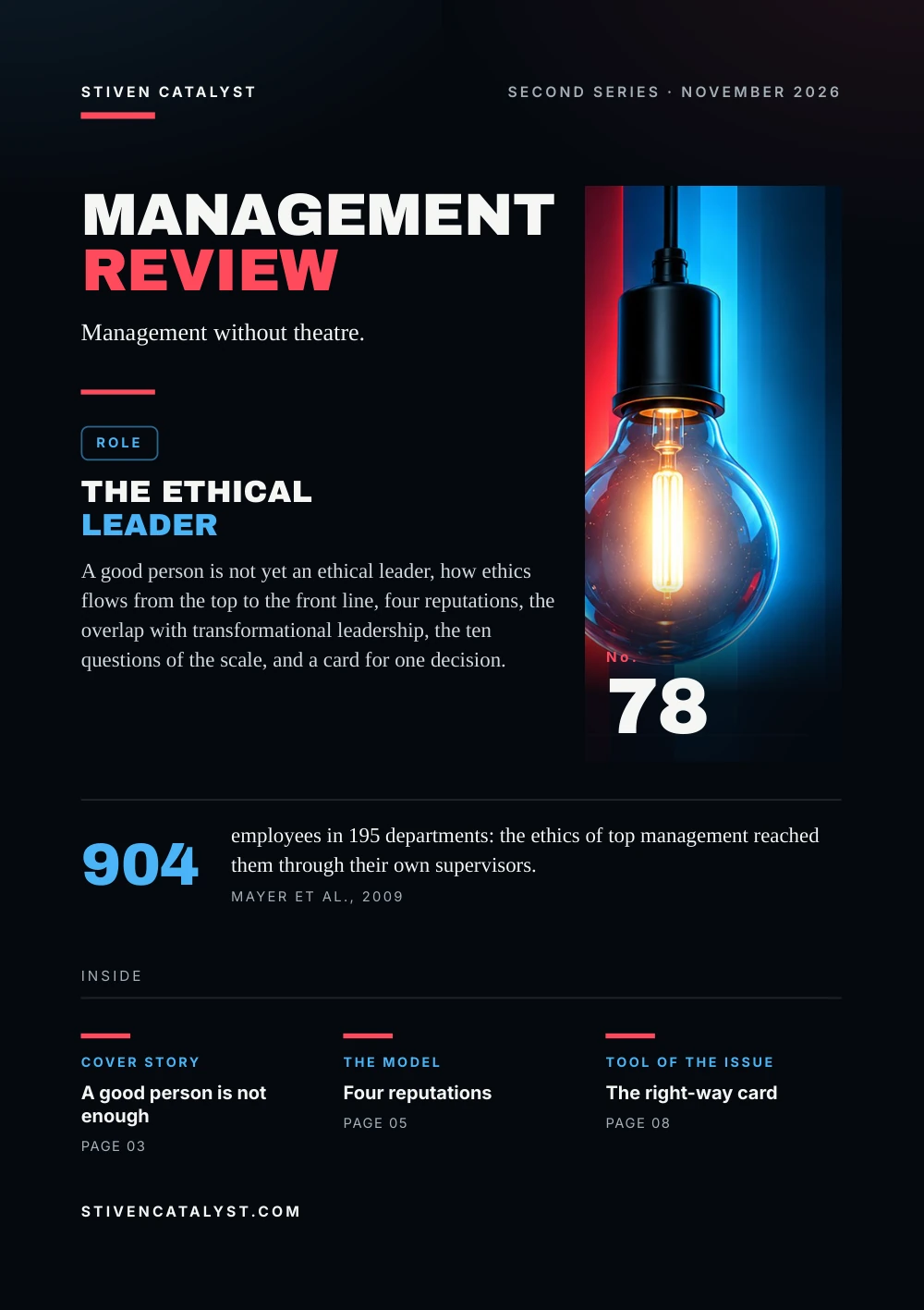
Stiven CatalystSecond series · November 2026
ManagementReview
Management without theatre.
Role
The ethicalleader
A good person is not yet an ethical leader, how ethics flows from the top to the front line, four reputations, the overlap with transformational leadership, the ten questions of the scale, and a card for one decision.

No.78
904
employees in 195 departments: the ethics of top management reached them through their own supervisors.Mayer et al., 2009
stivencatalyst.com
No. 78 · Role
In this issue
Most managers think of themselves as decent people. The research on ethical leadership asks a harder question: does the team know it, and does the way the team is led show it? A reputation for ethics is built in front of others, or not at all.
- 03Cover storyA good person is not enough
- 04The numbersHow low it flows
- 05The modelFour reputations
- 06What the research saysEthical, or simply a good leader?
- 07How it is measuredTen questions for the team
- 08Tool of the issueThe right-way card
- 09SourcesSources and method
How to read this issue
Figure
Every figure has its source and year at the foot of its page.
Our reading
Where the editors interpret rather than the research, it says so.
Practice
The steps and the card are proposals to try, not research results.
Cover story
A good personis not enough
Linda Treviño, Laura Hartman and Michael Brown interviewed senior executives and corporate ethics officers about what makes an executive known as an ethical leader (2000). The answer was a reputation that rests on two pillars.
Moral person
- Traits: honesty, integrity, trustworthiness
- Behaviours others can see
- How decisions are made
Moral manager
- Role modelling, in view of others
- Rewards and discipline
- Communicating about ethics and values
The first pillar is about who you are, the second about what you make of the team. A leader can be honest in private and still leave employees unsure what is expected of them, because ethics is never part of how the work is led.
Our reading
The team cannot see your conscience. It sees what you reward, what you correct and what you talk about.
Source: Linda K. Treviño, Laura P. Hartman & Michael Brown, California Management Review 42(4), 2000 (via Abstract and summaries)
The pillars as the article's abstract and later summaries give them; we could not see the article, nor how many people were interviewed.
The numbers
How lowit flows
David Mayer and colleagues asked whether ethical leadership at the top reaches the people who do the work, or stops at the level below (2009).
904employees surveyed
195managers, in 195 departments
The trickle-down the study tested
- 01
Top management
its ethical leadership
- 02
Supervisor
their ethical leadership
- 03
The group
less deviance, more helping
Ethical leadership at both levels went with less deviance in the group, such as breaking rules or harming colleagues, and with more voluntary help. The effect of the top ran through the supervisors.
Our reading
The front line reads the company's values from the person it reports to.
Source: David M. Mayer, Maribeth Kuenzi, Rebecca Greenbaum et al., Organizational Behavior and Human Decision Processes 108(1), 2009 (via Abstract)
Survey data at the level of groups: links, not causes. The examples of deviance are ours. We read the abstract and summaries, not the article.
The model
Fourreputations
Treviño and her co-authors set the ethical leader against three alternatives: the unethical leader, the hypocritical leader, who in their words talks the talk but doesn't walk the walk, and the ethically neutral leader.
Moral managerMoral person
Hypocritical
Speaks of values that their own conduct does not follow.
strong manager · weak personEthical
Lives the values and makes them part of how the team is led.
strong manager · strong personUnethical
Seen to act wrongly, and leaves ethics out of the team.
weak manager · weak personEthically neutral
May be decent, but ethics is not on the agenda, so employees cannot tell.
weak manager · person unclearOur reading
Silence is not neutral for long. Where nobody talks about how results are reached, the number is heard as the only rule.
Source: Linda K. Treviño, Laura P. Hartman & Michael Brown, California Management Review 42(4), 2000 (via Abstract and summaries)
The four types follow the article's abstract and summaries; placing them on two axes and the short texts in the cells are the editors'.
More in the essayLeading people without losing the person
What the research says
E thical, or simplya good leader?
Julia Hoch and colleagues pooled the studies on the newer leadership styles and asked how far each overlaps with transformational leadership, the style that inspires and sets an example (2018).
Correlation with transformational leadership, corrected ρ
For most outcomes ethical leadership added little beyond transformational leadership. Thomas Ng and Daniel Feldman (101 samples, 29,620 people, 2015) found it still predicted performance, helping and counterproductive behaviour, if weakly in some cases; trust in the leader carried the link to attitudes and performance.
Our reading
Inspiring and ethical are not the same thing. In the surveys they are mostly found in the same leaders.
Sources: Julia E. Hoch, William H. Bommer, James H. Dulebohn et al., Journal of Management 44(2), 2018 (via Abstract; ρ from later reviews); Thomas W. H. Ng & Daniel C. Feldman, Journal of Applied Psychology 100(3), 2015 (via Abstract); Akanksha Bedi, Can M. Alpaslan & Sandy Green, Journal of Business Ethics 139(3), 2016 (via Abstract)
The scale runs from 0 to 1; ρ from Hoch et al. as later reviews report them. Bedi et al. (2016) link it with fair treatment by the leader (see No. 70); links were stronger in the public sector.
How it is measured
Ten questionsfor the team
Michael Brown, Linda Treviño and David Harrison define ethical leadership as acting rightly oneself and promoting it in others through two-way communication, reinforcement and decisions (2005). Over seven studies they built a ten-item scale that employees fill in about their supervisor.
How they act
- lives ethically in private too
- can be trusted
- decides fairly, in balance
- has employees' interests in mind
- listens to employees
What they promote
- talks about ethics and values
- sets an example of the right way
- judges success also by how it was reached
- asks: what is the right thing to do?
- disciplines breaches of ethics
The ten items formed a single factor. In the original studies the scale predicted job satisfaction, dedication and willingness to report problems to management.
Our reading
A boss can score well in the first column and stay silent in the second. That is the neutral leader of page 5.
Source: Michael E. Brown, Linda K. Treviño & David A. Harrison, Organizational Behavior and Human Decision Processes 97(2), 2005 (via Abstract; the items from later studies)
Items shortened and translated by us, from later studies that reproduce them; the two columns follow the two parts of the definition and are the editors' sorting.
Tool of the issue
The right-waycard
One card per decision that tests the standard: a target under pressure, a shortcut, a complaint. Before pushing harder on a number, check how it is being reached.
01The decisionwhat it is, and who it affects
02The right thing to dothe question asked aloud, and the answer
03How the result is reachedwhat would make the wrong way faster
04Who was heardthe people who do the work, before deciding
05What the team was toldthe standard and the reason, in one sentence
06What was rewarded or correctedand whether the same would hold for anyone
Sources: Linda K. Treviño, Laura P. Hartman & Michael Brown, California Management Review 42(4), 2000 (via Abstract and summaries); Michael E. Brown, Linda K. Treviño & David A. Harrison, Organizational Behavior and Human Decision Processes 97(2), 2005 (via Abstract; the items from later studies)
A practice proposed by the editors, after the moral manager pillar of Treviño et al. (2000) and the items of the scale by Brown et al. (2005).
Open the tool: KPI Diagnosticstivencatalyst.com/tools/kpi-diagnostic/
Sources and method
Every figurehas a source.
The figures in this issue come from the sources below. The year shows how recent each one is.
- Moral Person and Moral Manager: How Executives Develop a Reputation for Ethical LeadershipLinda K. Treviño, Laura P. Hartman & Michael Brown, California Management Review 42(4), 2000 · via Abstract and summarieshttps://doi.org/10.2307/41166057
- How Low Does Ethical Leadership Flow? Test of a Trickle-Down ModelDavid M. Mayer, Maribeth Kuenzi, Rebecca Greenbaum et al., Organizational Behavior and Human Decision Processes 108(1), 2009 · via Abstracthttps://doi.org/10.1016/j.obhdp.2008.04.002
- Do Ethical, Authentic, and Servant Leadership Explain Variance Above and Beyond Transformational Leadership? A Meta-AnalysisJulia E. Hoch, William H. Bommer, James H. Dulebohn et al., Journal of Management 44(2), 2018 · via Abstract; ρ from later reviewshttps://doi.org/10.1177/0149206316665461
- Ethical Leadership: Meta-Analytic Evidence of Criterion-Related and Incremental ValidityThomas W. H. Ng & Daniel C. Feldman, Journal of Applied Psychology 100(3), 2015 · via Abstracthttps://doi.org/10.1037/a0038246
- A Meta-analytic Review of Ethical Leadership Outcomes and ModeratorsAkanksha Bedi, Can M. Alpaslan & Sandy Green, Journal of Business Ethics 139(3), 2016 · via Abstracthttps://doi.org/10.1007/s10551-015-2625-1
- Ethical Leadership: A Social Learning Perspective for Construct Development and TestingMichael E. Brown, Linda K. Treviño & David A. Harrison, Organizational Behavior and Human Decision Processes 97(2), 2005 · via Abstract; the items from later studieshttps://doi.org/10.1016/j.obhdp.2005.03.002
Editorial method
Each figure was checked for its year, its publisher and what exactly it measures. Where the publisher's page could not be opened, the figure was checked against independent summaries and is marked “via”. The editors' interpretation is marked “Our reading”. Figures that could not be confirmed are not in the issue.
ManagementReview
Management without theatre.
Every issue, one management question, checked against the best research.
All issues
stivencatalyst.com/magazine/management-review.html
Management Review · No. 78 · November 2026 · Stiven Catalyst
Click or swipe a page to turn it. The arrow keys work too.
Management Review · No. 78
The figures of the issue
The charts of the printed pages, with their sources.
Source: Julia E. Hoch, William H. Bommer, James H. Dulebohn et al., Journal of Management 44(2), 2018 (via Abstract; ρ from later reviews)
The whole text Read the issue as text For reading on a small screen, searching or a screen reader. The same words, without the page design.
In this issue
Most managers think of themselves as decent people. The research on ethical leadership asks a harder question: does the team know it, and does the way the team is led show it? A reputation for ethics is built in front of others, or not at all.
Linda Treviño and colleagues found two pillars behind that reputation: the moral person and the moral manager. Crossed, they give four reputations, and only one is ethical leadership. In 195 departments the ethics of top management reached employees through their supervisors. Ethical leadership overlaps strongly with transformational leadership, yet still predicts behaviour beyond it. The ten-item scale shows what employees look at.
Stiven Janaqi, Editor
Cover story
A good person is not enough
Linda Treviño, Laura Hartman and Michael Brown interviewed senior executives and corporate ethics officers about what makes an executive known as an ethical leader (2000). The answer was a reputation that rests on two pillars.
Moral person
- Traits: honesty, integrity, trustworthiness
- Behaviours others can see
- How decisions are made
Moral manager
- Role modelling, in view of others
- Rewards and discipline
- Communicating about ethics and values
The first pillar is about who you are, the second about what you make of the team. A leader can be honest in private and still leave employees unsure what is expected of them, because ethics is never part of how the work is led.
Our reading
The team cannot see your conscience. It sees what you reward, what you correct and what you talk about.
The pillars as the article's abstract and later summaries give them; we could not see the article, nor how many people were interviewed.
Source: Linda K. Treviño, Laura P. Hartman & Michael Brown, California Management Review 42(4), 2000 (via Abstract and summaries)
The numbers
How low it flows
David Mayer and colleagues asked whether ethical leadership at the top reaches the people who do the work, or stops at the level below (2009).
- 904 employees surveyed
- 195 managers, in 195 departments
The trickle-down the study tested
T op management. its ethical leadership- Supervisor. their ethical leadership
- The group. less deviance, more helping
Ethical leadership at both levels went with less deviance in the group, such as breaking rules or harming colleagues, and with more voluntary help. The effect of the top ran through the supervisors.
Our reading
The front line reads the company's values from the person it reports to.
Survey data at the level of groups: links, not causes. The examples of deviance are ours. We read the abstract and summaries, not the article.
Source: David M. Mayer, Maribeth Kuenzi, Rebecca Greenbaum et al., Organizational Behavior and Human Decision Processes 108(1), 2009 (via Abstract)
The model
Four reputations
Treviño and her co-authors set the ethical leader against three alternatives: the unethical leader, the hypocritical leader, who in their words talks the talk but doesn't walk the walk, and the ethically neutral leader.
Moral manager × Moral person:
- Hypocritical (strong manager · weak person). Speaks of values that their own conduct does not follow.
E thical (strong manager · strong person). Lives the values and makes them part of how the team is led.- Un
e thical (weak manager · weak person). Seen to act wrongly, and leaves ethics out of the team. E thically neutral (weak manager · person unclear). May be decent, but ethics is not on the agenda, so employees cannot tell.
Our reading
Silence is not neutral for long. Where nobody talks about how results are reached, the number is heard as the only rule.
The four types follow the article's abstract and summaries; placing them on two axes and the short texts in the cells are the editors'.
Source: Linda K. Treviño, Laura P. Hartman & Michael Brown, California Management Review 42(4), 2000 (via Abstract and summaries)
More in the essay: Leading people without losing the person
What the research says
E thical, or simply a good leader?
Julia Hoch and colleagues pooled the studies on the newer leadership styles and asked how far each overlaps with transformational leadership, the style that inspires and sets an example (2018).
Correlation with transformational leadership, corrected ρ: Authentic leadership 0.75, Ethical leadership 0.70, Servant leadership 0.52.
For most outcomes ethical leadership added little beyond transformational leadership. Thomas Ng and Daniel Feldman (101 samples, 29,620 people, 2015) found it still predicted performance, helping and counterproductive behaviour, if weakly in some cases; trust in the leader carried the link to attitudes and performance.
Our reading
Inspiring and ethical are not the same thing. In the surveys they are mostly found in the same leaders.
The scale runs from 0 to 1; ρ from Hoch et al. as later reviews report them. Bedi et al. (2016) link it with fair treatment by the leader (see No. 70); links were stronger in the public sector.
Sources: Julia E. Hoch, William H. Bommer, James H. Dulebohn et al., Journal of Management 44(2), 2018 (via Abstract; ρ from later reviews); Thomas W. H. Ng & Daniel C. Feldman, Journal of Applied Psychology 100(3), 2015 (via Abstract); Akanksha Bedi, Can M. Alpaslan & Sandy Green, Journal of Business Ethics 139(3), 2016 (via Abstract)
How it is measured
Ten questions for the team
Michael Brown, Linda Treviño and David Harrison define ethical leadership as acting rightly oneself and promoting it in others through two-way communication, reinforcement and decisions (2005). Over seven studies they built a ten-item scale that employees fill in about their supervisor.
How the y act
- lives ethically in private too
- can be trusted
- decides fairly, in balance
- has employees' interests in mind
- listens to employees
What the y promote
- talks about ethics and values
- sets an example of the right way
- judges success also by how it was reached
- asks: what is the right thing to do?
- disciplines breaches of ethics
The ten items formed a single factor. In the original studies the scale predicted job satisfaction, dedication and willingness to report problems to management.
Our reading
A boss can score well in the first column and stay silent in the second. That is the neutral leader of page 5.
Items shortened and translated by us, from later studies that reproduce them; the two columns follow the two parts of the definition and are the editors' sorting.
Source: Michael E. Brown, Linda K. Treviño & David A. Harrison, Organizational Behavior and Human Decision Processes 97(2), 2005 (via Abstract; the items from later studies)
Tool of the issue
The right-way card
One card per decision that tests the standard: a target under pressure, a shortcut, a complaint. Before pushing harder on a number, check how it is being reached.
- The decision what it is, and who it affects
- The right thing
t o do the question asked aloud, and the answer - How the result is reached what would make the wrong way faster
- Who was heard the people who do the work, before deciding
- What the team was
t old the standard and the reason, in one sentence - What was rewarded or corrected and whether the same would hold for anyone
A practice proposed by the editors, after the moral manager pillar of Treviño et al. (2000) and the items of the scale by Brown et al. (2005).
Sources: Linda K. Treviño, Laura P. Hartman & Michael Brown, California Management Review 42(4), 2000 (via Abstract and summaries); Michael E. Brown, Linda K. Treviño & David A. Harrison, Organizational Behavior and Human Decision Processes 97(2), 2005 (via Abstract; the items from later studies)
Open the tool: KPI Diagnostic
Sources and method
Every figure has a source.
The figures in this issue come from the sources below. The year shows how recent each one is.
- Linda K. Treviño, Laura P. Hartman & Michael Brown, California Management Review 42(4), “Moral Person and Moral Manager: How Executives Develop a Reputation for Ethical Leadership”, 2000 (via Abstract and summaries). https://doi.org/10.2307/41166057
- David M. Mayer, Maribeth Kuenzi, Rebecca Greenbaum et al., Organizational Behavior and Human Decision Processes 108(1), “How Low Does Ethical Leadership Flow? Test of a Trickle-Down Model”, 2009 (via Abstract). https://doi.org/10.1016/j.obhdp.2008.04.002
- Julia E. Hoch, William H. Bommer, James H. Dulebohn et al., Journal of Management 44(2), “Do Ethical, Authentic, and Servant Leadership Explain Variance Above and Beyond Transformational Leadership? A Meta-Analysis”, 2018 (via Abstract; ρ from later reviews). https://doi.org/10.1177/0149206316665461
- Thomas W. H. Ng & Daniel C. Feldman, Journal of Applied Psychology 100(3), “Ethical Leadership: Meta-Analytic Evidence of Criterion-Related and Incremental Validity”, 2015 (via Abstract). https://doi.org/10.1037/a0038246
- Akanksha Bedi, Can M. Alpaslan & Sandy Green, Journal of Business Ethics 139(3), “A Meta-analytic Review of Ethical Leadership Outcomes and Moderators”, 2016 (via Abstract). https://doi.org/10.1007/s10551-015-2625-1
- Michael E. Brown, Linda K. Treviño & David A. Harrison, Organizational Behavior and Human Decision Processes 97(2), “Ethical Leadership: A Social Learning Perspective for Construct Development and Testing”, 2005 (via Abstract; the items from later studies). https://doi.org/10.1016/j.obhdp.2005.03.002
Edit orial me thod
Each figure was checked for its year, its publisher and what exactly it measures. Where the publisher's page could not be opened, the figure was checked against independent summaries and is marked “via”. The editors' interpretation is marked “Our reading”. Figures that could not be confirmed are not in the issue.
Management Review · Monthly edition