In this issue
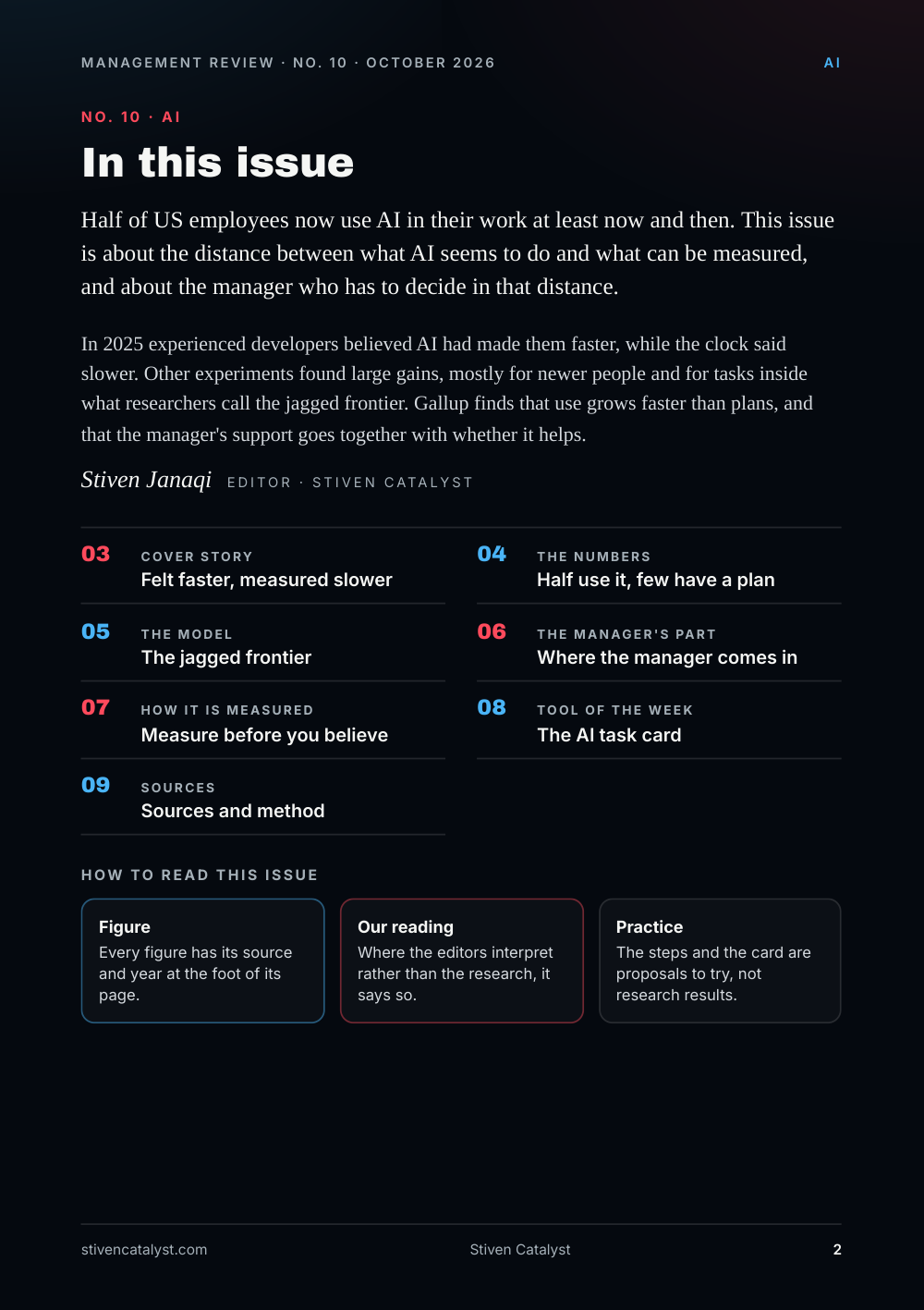
Half of US employees now use AI in their work at least now and then. This issue is about the distance between what AI seems to do and what can be measured, and about the manager who has to decide in that distance.
In 2025 experienced developers believed AI had made them faster, while the clock said slower. Other experiments found large gains, mostly for newer people and for tasks inside what researchers call the jagged frontier. Gallup finds that use grows faster than plans, and that the manager's support goes together with whether it helps.
Stiven Janaqi, Editor
Cover story
Felt faster, measured slower
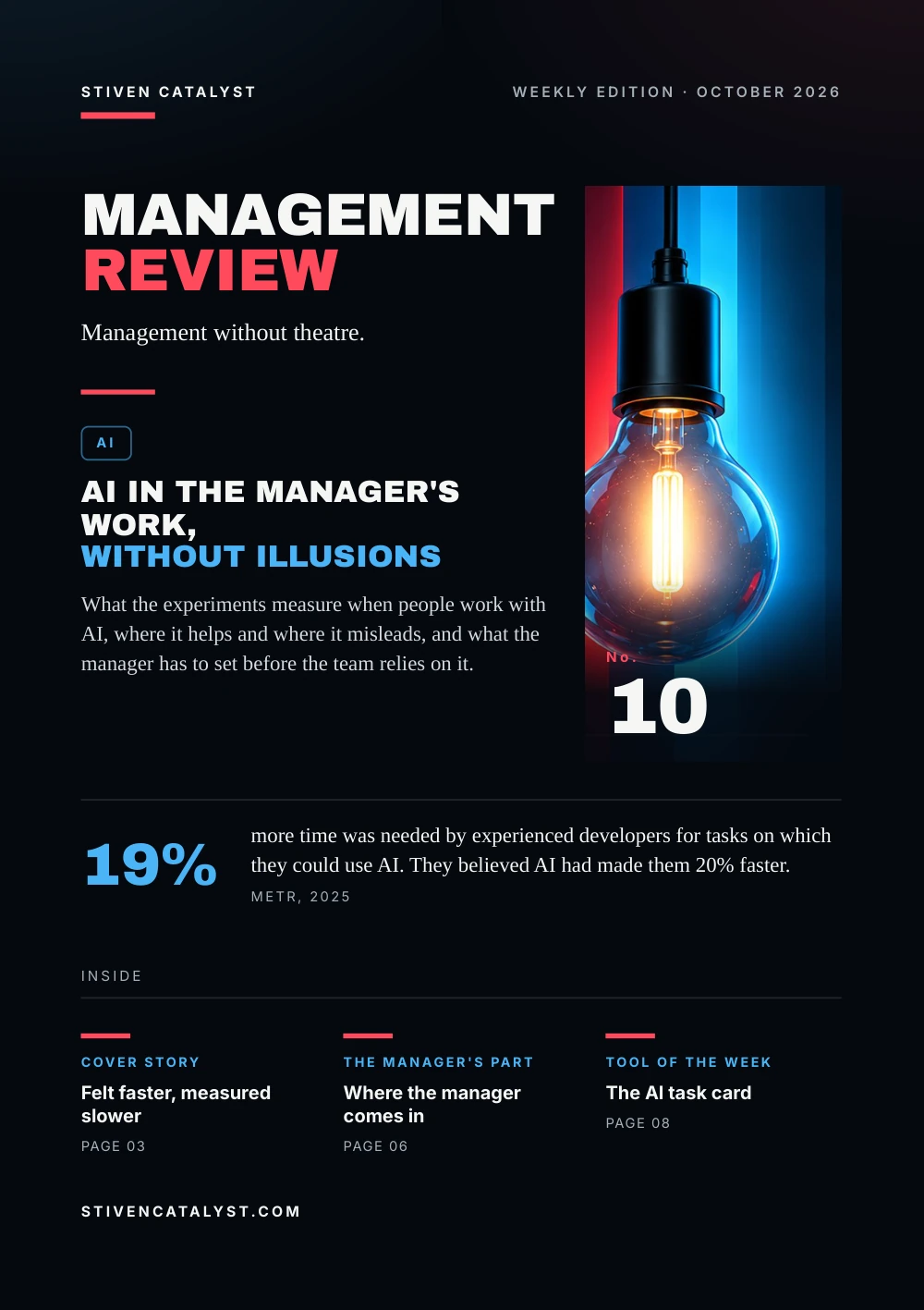
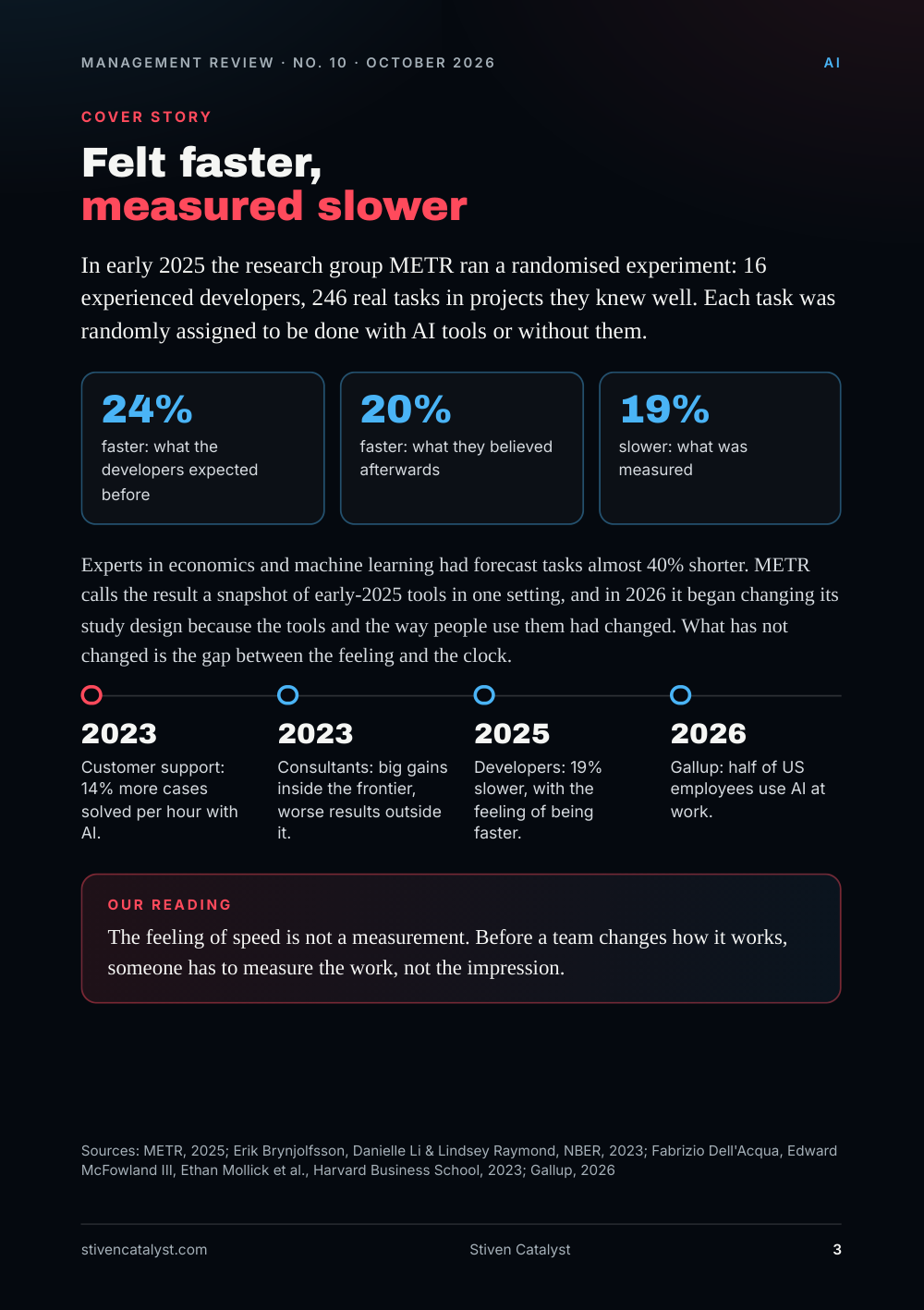
In early 2025 the research group METR ran a randomised experiment: 16 experienced developers, 246 real tasks in projects they knew well. Each task was randomly assigned to be done with AI tools or without them.
- 24% faster: what the developers expected before
- 20% faster: what they believed afterwards
- 19% slower: what was measured
Experts in economics and machine learning had forecast tasks almost 40% shorter. METR calls the result a snapshot of early-2025 tools in one setting, and in 2026 it began changing its study design because the tools and the way people use them had changed. What has not changed is the gap between the feeling and the clock.
- 2023 Customer support: 14% more cases solved per hour with AI.
- 2023 Consultants: big gains inside the frontier, worse results outside it.
- 2025 Developers: 19% slower, with the feeling of being faster.
- 2026 Gallup: half of US employees use AI at work.
Our reading
The feeling of speed is not a measurement. Before a team changes how it works, someone has to measure the work, not the impression.
Sources: METR, 2025; Erik Brynjolfsson, Danielle Li & Lindsey Raymond, NBER, 2023; Fabrizio Dell'Acqua, Edward McFowland III, Ethan Mollick et al., Harvard Business School, 2023; Gallup, 2026
The numbers
Half use it, few have a plan
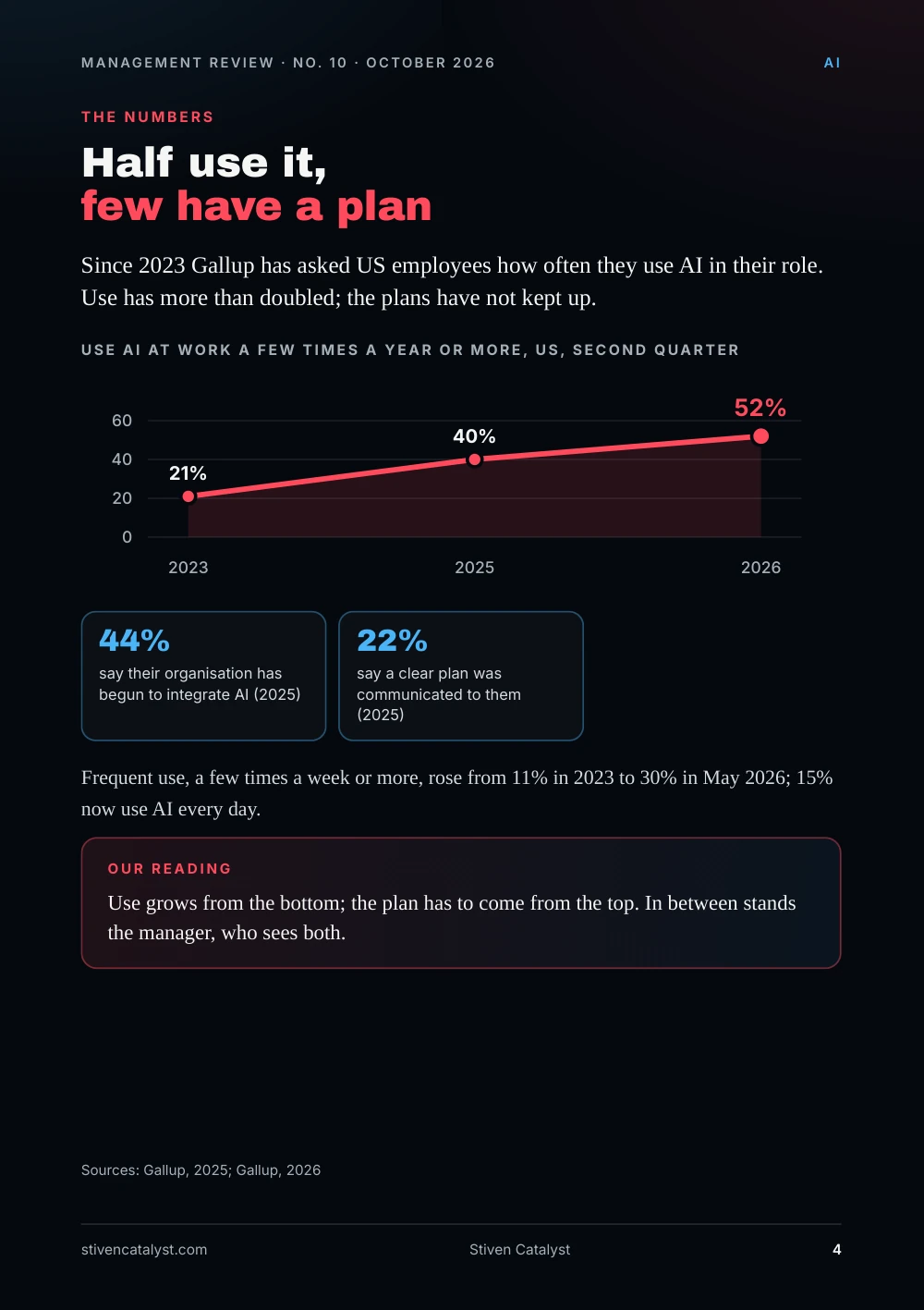
Since 2023 Gallup has asked US employees how often they use AI in their role. Use has more than doubled; the plans have not kept up.
Use AI at work a few times a year or more, US, second quarter: 2023 21%, 2025 40%, 2026 52%.
- 44% say their organisation has begun to integrate AI (2025)
- 22% say a clear plan was communicated to them (2025)
Frequent use, a few times a week or more, rose from 11% in 2023 to 30% in May 2026; 15% now use AI every day.
Our reading
Use grows from the bottom; the plan has to come from the top. In between stands the manager, who sees both.
Sources: Gallup, 2025; Gallup, 2026
The model
The jagged frontier
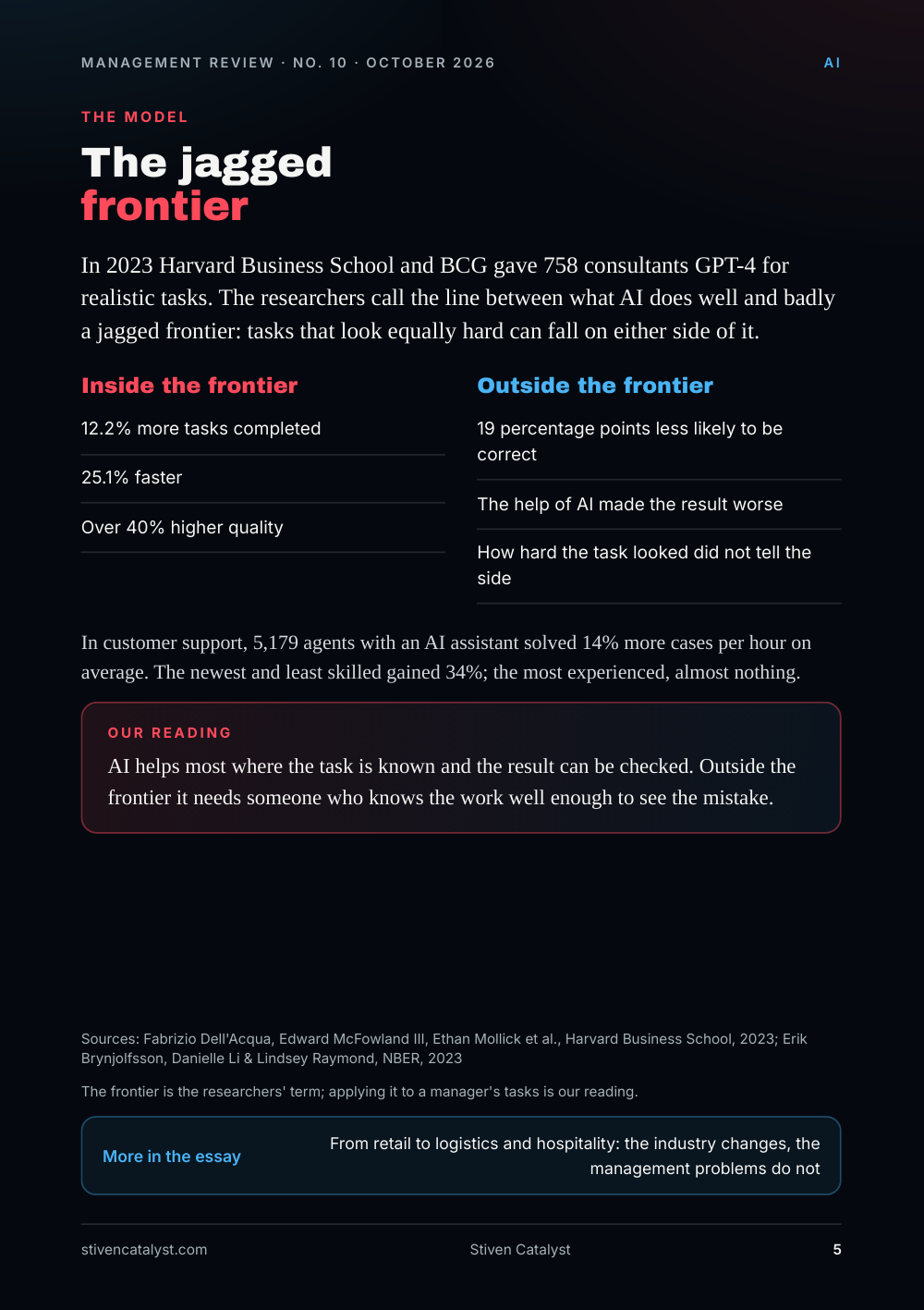
In 2023 Harvard Business School and BCG gave 758 consultants GPT-4 for realistic tasks. The researchers call the line between what AI does well and badly a jagged frontier: tasks that look equally hard can fall on either side of it.
Inside the frontier
- 12.2% more tasks completed
- 25.1% faster
- Over 40% higher quality
Outside the frontier
- 19 percentage points less likely to be correct
- The help of AI made the result worse
- How hard the task looked did not tell the side
In customer support, 5,179 agents with an AI assistant solved 14% more cases per hour on average. The newest and least skilled gained 34%; the most experienced, almost nothing.
Our reading
AI helps most where the task is known and the result can be checked. Outside the frontier it needs someone who knows the work well enough to see the mistake.
The frontier is the researchers' term; applying it to a manager's tasks is our reading.
Sources: Fabrizio Dell'Acqua, Edward McFowland III, Ethan Mollick et al., Harvard Business School, 2023; Erik Brynjolfsson, Danielle Li & Lindsey Raymond, NBER, 2023
More in the essay: From retail to logistics and hospitality: the industry changes, the management problems do not
The manager's part
Where the manager comes in
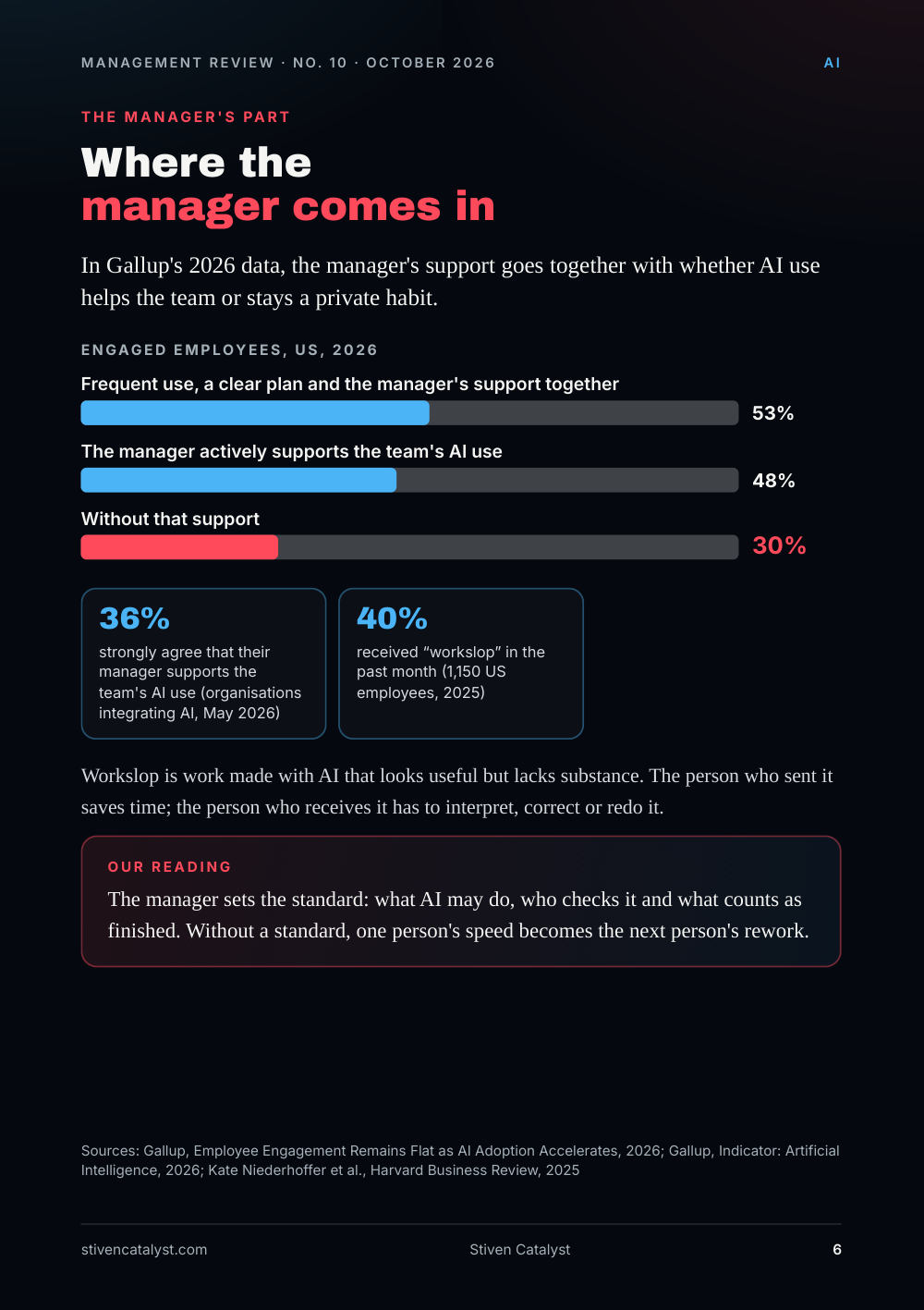
In Gallup's 2026 data, the manager's support goes together with whether AI use helps the team or stays a private habit.
Engaged employees, US, 2026: Frequent use, a clear plan and the manager's support together 53%, The manager actively supports the team's AI use 48%, Without that support 30%.
- 36% strongly agree that their manager supports the team's AI use (organisations integrating AI, May 2026)
- 40% received “workslop” in the past month (1,150 US employees, 2025)
Workslop is work made with AI that looks useful but lacks substance. The person who sent it saves time; the person who receives it has to interpret, correct or redo it.
Our reading
The manager sets the standard: what AI may do, who checks it and what counts as finished. Without a standard, one person's speed becomes the next person's rework.
Sources: Gallup, Employee Engagement Remains Flat as AI Adoption Accelerates, 2026; Gallup, Indicator: Artificial Intelligence, 2026; Kate Niederhoffer et al., Harvard Business Review, 2025
How it is measured
Measure before you believe
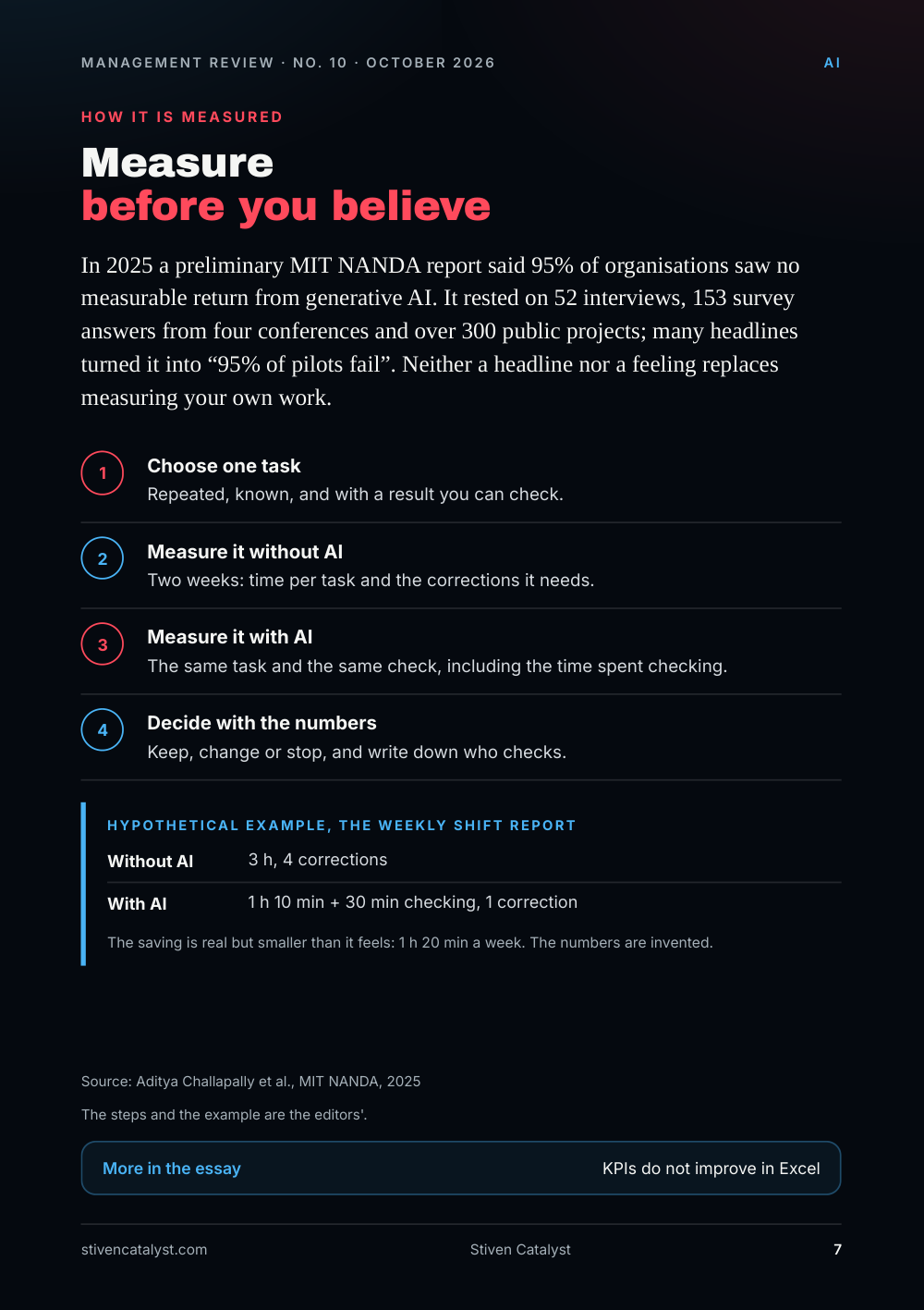
In 2025 a preliminary MIT NANDA report said 95% of organisations saw no measurable return from generative AI. It rested on 52 interviews, 153 survey answers from four conferences and over 300 public projects; many headlines turned it into “95% of pilots fail”. Neither a headline nor a feeling replaces measuring your own work.
- Choose one task. Repeated, known, and with a result you can check.
- Measure it without AI. Two weeks: time per task and the corrections it needs.
- Measure it with AI. The same task and the same check, including the time spent checking.
- Decide with the numbers. Keep, change or stop, and write down who checks.
Hypothe tical example, the weekly shif t repor t
- Without AI: 3 h, 4 corrections
- With AI: 1 h 10 min + 30 min checking, 1 correction
The saving is real but smaller than it feels: 1 h 20 min a week. The numbers are invented.
The steps and the example are the editors'.
Source: Aditya Challapally et al., MIT NANDA, 2025
More in the essay: KPIs do not improve in Excel
Tool of the week
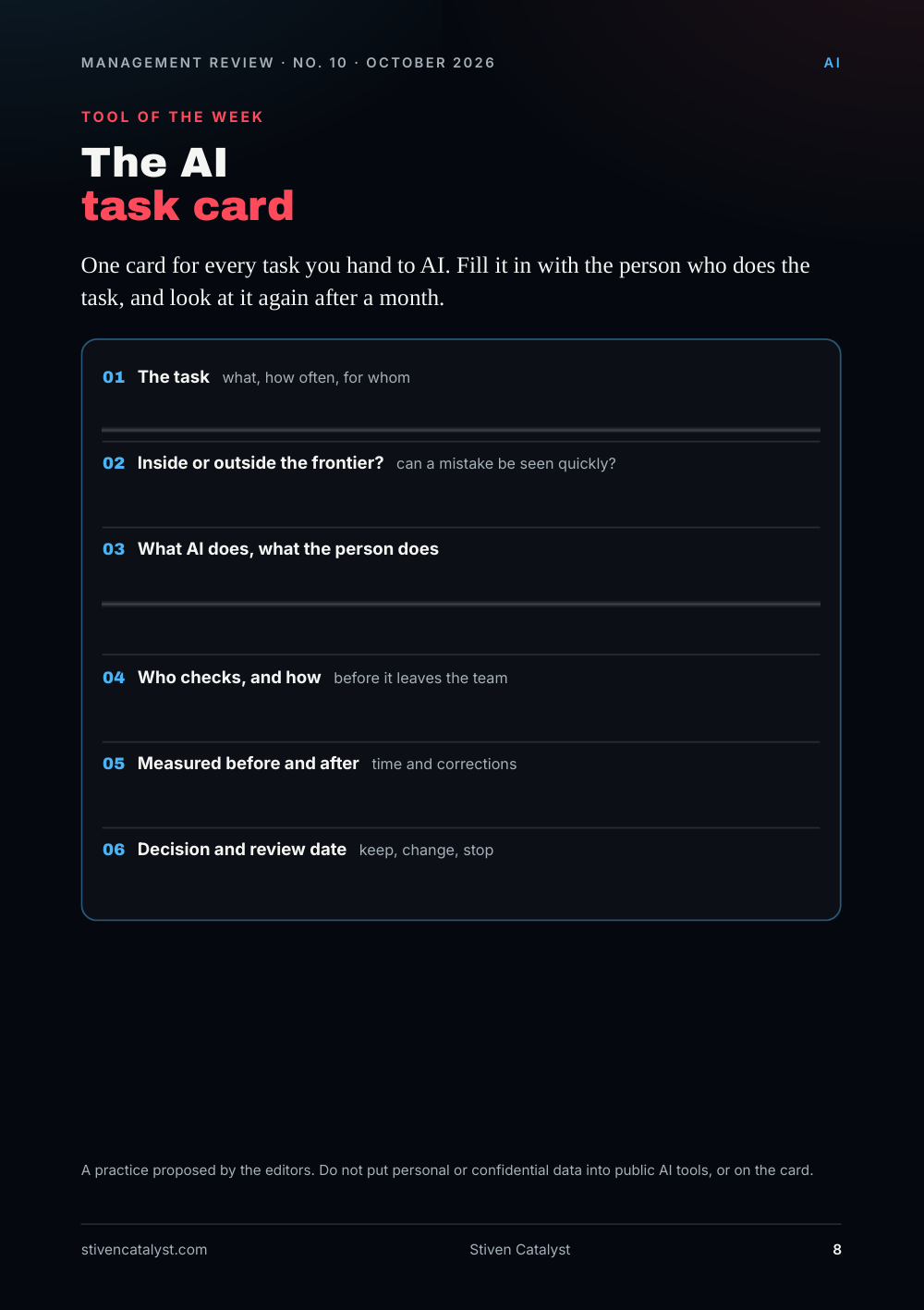
The AI task card
One card for every task you hand to AI. Fill it in with the person who does the task, and look at it again after a month.
- The task what, how often, for whom
- Inside or outside the frontier? can a mistake be seen quickly?
- What AI does, what the person does
- Who checks, and how before it leaves the team
- Measured before and a
f ter time and corrections - Decision and review date keep, change, stop
A practice proposed by the editors. Do not put personal or confidential data into public AI tools, or on the card.
Sources and method
Every figure has a source.
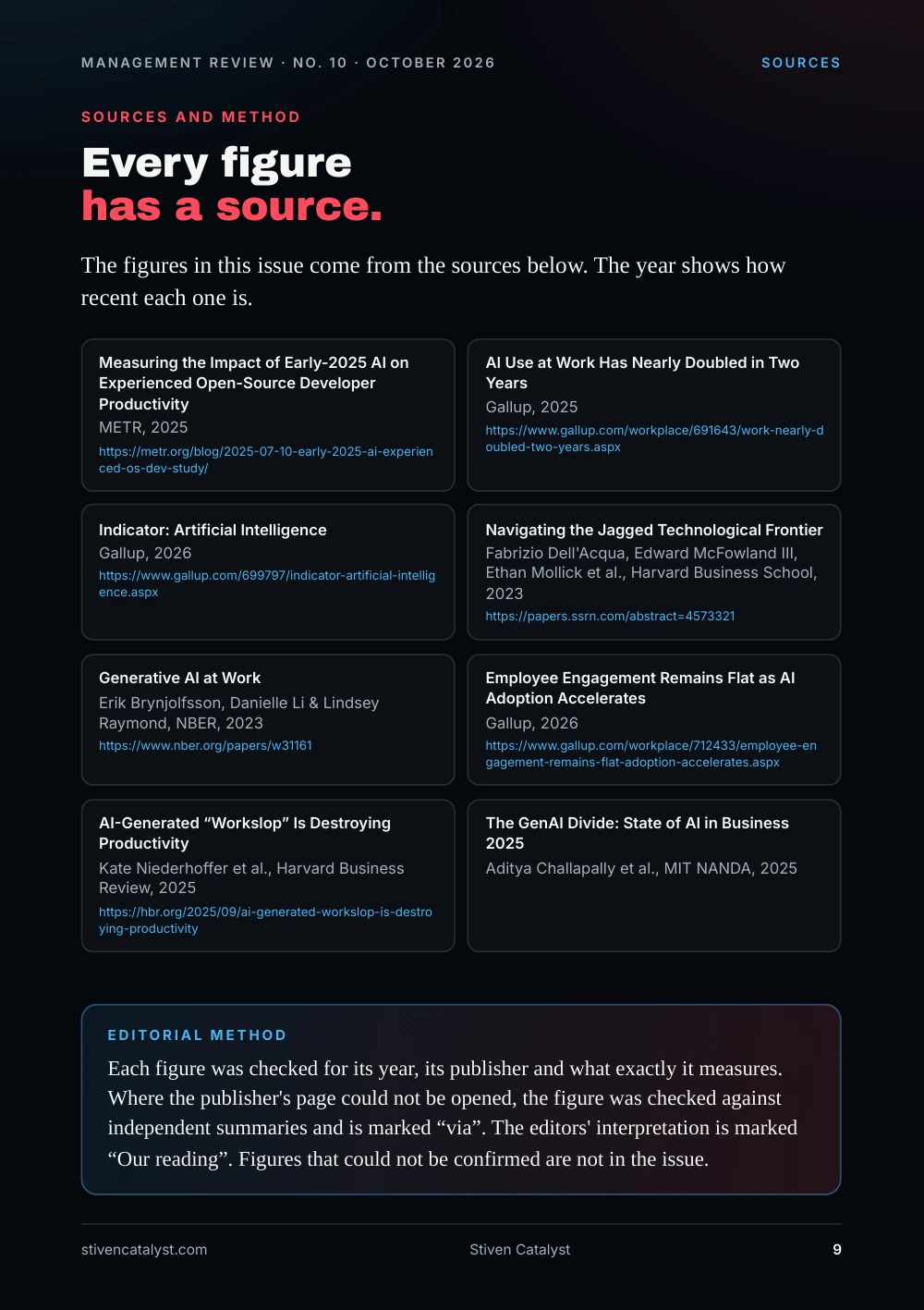
The figures in this issue come from the sources below. The year shows how recent each one is.
- METR, “Measuring the Impact of Early-2025 AI on Experienced Open-Source Developer Productivity”, 2025. https://metr.org/blog/2025-07-10-early-2025-ai-experienced-os-dev-study/
- Gallup, “AI Use at Work Has Nearly Doubled in Two Years”, 2025. https://www.gallup.com/workplace/691643/work-nearly-doubled-two-years.aspx
- Gallup, “Indicator: Artificial Intelligence”, 2026. https://www.gallup.com/699797/indicator-artificial-intelligence.aspx
- Fabrizio Dell'Acqua, Edward McFowland III, Ethan Mollick et al., Harvard Business School, “Navigating the Jagged Technological Frontier”, 2023. https://papers.ssrn.com/abstract=4573321
- Erik Brynjolfsson, Danielle Li & Lindsey Raymond, NBER, “Generative AI at Work”, 2023. https://www.nber.org/papers/w31161
- Gallup, “Employee Engagement Remains Flat as AI Adoption Accelerates”, 2026. https://www.gallup.com/workplace/712433/employee-engagement-remains-flat-adoption-accelerates.aspx
- Kate Niederhoffer et al., Harvard Business Review, “AI-Generated “Workslop” Is Destroying Productivity”, 2025. https://hbr.org/2025/09/ai-generated-workslop-is-destroying-productivity
- Aditya Challapally et al., MIT NANDA, “The GenAI Divide: State of AI in Business 2025”, 2025.
Edit orial me thod
Each figure was checked for its year, its publisher and what exactly it measures. Where the publisher's page could not be opened, the figure was checked against independent summaries and is marked “via”. The editors' interpretation is marked “Our reading”. Figures that could not be confirmed are not in the issue.