In 1996 Michael Lombardo and Robert Eichinger wrote that successful managers learn roughly 70% from tough jobs, 20% from people and 10% from courses and reading. Behind it lies research by the Center for Creative Leadership, in which 191 executives described 616 key events of their careers. A 2018 review found the evidence for the 70% weak. Studies show that challenge teaches up to a point, that feedback keeps it useful, and where 70-20-10 goes wrong in practice.
Management Review · First series · October 2026 · No. 36
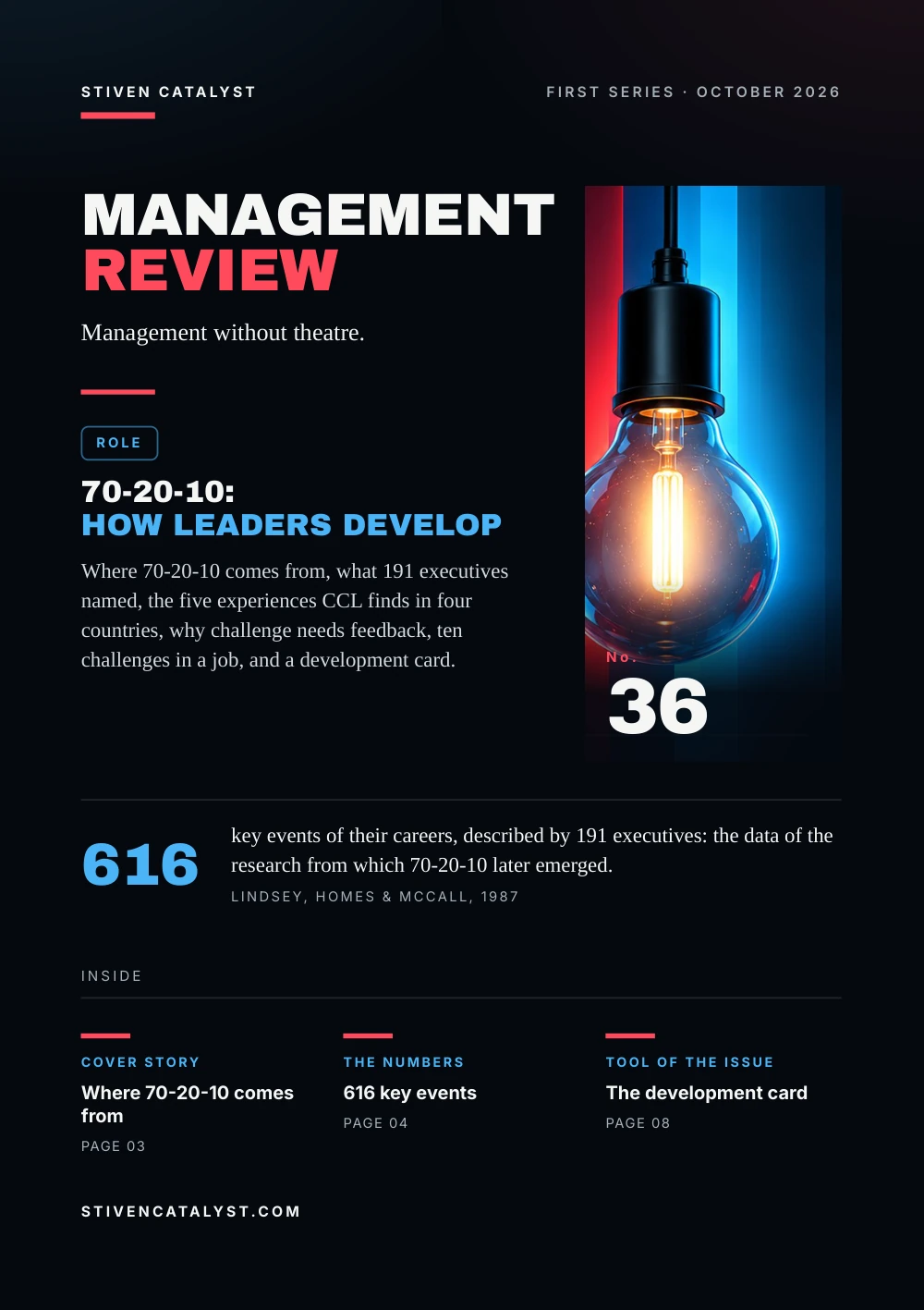
70-20-10: how leaders develop
Where 70-20-10 comes from, what 191 executives named, the five experiences CCL finds in four countries, why challenge needs feedback, ten challenges in a job, and a development card.
- No.
- 36
- Pages
- 10
- Sources
- 8
- Topics
- Role
Stiven CatalystFirst series · October 2026
ManagementReview
Management without theatre.
Role
70-20-10:how leaders develop
Where 70-20-10 comes from, what 191 executives named, the five experiences CCL finds in four countries, why challenge needs feedback, ten challenges in a job, and a development card.

No.36
616
key events of their careers, described by 191 executives: the data of the research from which 70-20-10 later emerged.Lindsey, Homes & McCall, 1987
stivencatalyst.com
No. 36 · Role
In this issue
Few leaders are made in a classroom. 70-20-10 says so in three numbers, and few rules in leadership development are quoted more often. This issue asks where the numbers come from, what the data behind them show, and what a manager can do with them.
- 03Cover storyWhere 70-20-10 comes from
- 04The numbersWhat 191 executives named
- 05The modelThree sources, five experiences
- 06What the research saysChallenge teaches, up to a point
- 07How it is measuredHow much does a job teach?
- 08Tool of the issueThe development card
- 09SourcesSources and method
How to read this issue
Figure
Every figure has its source and year at the foot of its page.
Our reading
Where the editors interpret rather than the research, it says so.
Practice
The steps and the card are proposals to try, not research results.
Cover story
Where 70-20-10comes from
The rule has no study of its own. Its best-known source is one sentence in The Career Architect Development Planner of 1996: lessons learned by successful and effective managers come “roughly” 70% from tough jobs, 20% from people, mostly the boss, and 10% from courses and reading.
- 1981–82Three CCL researchers and four corporations start asking executives how they developed.
- 1987CCL's technical report: 191 executives, 616 key events, 1,547 lessons.
- 1988McCall, Lombardo and Morrison tell the findings in The Lessons of Experience.
- 1996Lombardo and Eichinger: “roughly” 70, 20 and 10.
The 191 were seen by their companies as high potentials or as having lived up to their potential. Each named at least three events that lastingly changed how they managed, and what they learned. The researchers warned that the sample may not stand for all executives, and that all of it was self-report.
Our reading
70-20-10 sums up what successful executives remembered about their careers. It does not measure how much anyone learns where.
Sources: Michael M. Lombardo & Robert W. Eichinger, Lominger, 1996 (via Charles Jennings, 2011); Esther H. Lindsey, Virginia Homes & Morgan W. McCall, Jr., Center for Creative Leadership, 1987
The 1996 sentence is confirmed only through independent summaries; we could not see the book. How the three numbers were derived from the data is not shown in any source we could check.
The numbers
What 191 executivesnamed
The 1987 technical report gives the number of events of each kind. Grouped as the report groups them, challenging assignments are the largest block, but not 70%.
The 616 key events, in the report's groups (share of events)
Count hardships, early jobs and first supervision as work too, and the split becomes 73% work, 18% people and 6% courses: close to 70-20-10. Whether Lombardo and Eichinger grouped the events this way, the sources we checked do not say. The shares count events that people remembered, not hours of learning.
Our reading
The same data give 48% or 73%, depending on what counts as a job.
Source: Esther H. Lindsey, Virginia Homes & Morgan W. McCall, Jr., Center for Creative Leadership, 1987
Shares worked out by the editors from the event counts in the report (616 events), rounded. Executives from six large corporations, data from the 1980s.
The model
Three sources,five experiences
The Center for Creative Leadership presents 70-20-10 as a guideline with three clusters of experience. In a 2016 white paper it also names what the rule leaves out.
01
Challenging assignments
new, difficult work that stretches the person
02
Developmental relationships
bosses who teach, model, push and mentor
03
Coursework and training
in CCL's view, an amplifier of the other two
The basic five: experiences that teach leadership in all four countries (CCL, 2016)
- 01
Bosses and superiors
- 02
Turnarounds
- 03
Increases in scope
- 04
Horizontal moves
- 05
New initiatives
CCL asked 393 top and senior executives in China, India, Singapore and the United States. Each of the five was cited by at least 20% of interviewees in three of the four countries; coursework and training by only 9–15%. CCL also notes that the rule says neither which experiences teach most nor what each one teaches.
Our reading
The ratio says little. The list of experiences says more, and it can be planned.
Sources: Center for Creative Leadership, 2025; Meena Surie Wilson, Ellen Van Velsor, Anand Chandrasekar & Corey Criswell, Center for Creative Leadership, 2016
Interviews from 2005 to 2009: 234 in the United States, 71 in India, 54 in China, 34 in Singapore; self-reports. CCL calls 70-20-10 research-based but does not show how the ratio was calculated.
More in the essayLeadership without a title
What the research says
Challenge teaches,up t o a point
D. Scott DeRue and Ned Wellman studied 225 on-the-job experiences of 60 managers. Leadership skills grew with the challenge of an experience, but with diminishing returns; access to feedback offset the decline at high levels of challenge.
In the Australian public sector, Samantha Johnson, Deborah Blackman and Fiona Buick found middle managers willing to keep learning, yet 70-20-10 was not building the capability it promised. They name four misconceptions:
Four misconceptions in practice (Johnson et al., 2018)
- unstructured experience will build capability by itself
- social learning, read too narrowly
- behaviour will change after a course, without active support
- the three parts need not be planned together
Alan Clardy reviewed five strands of literature in 2018. The evidence that 70% or more of learning at work is informal is weak, he concludes, and the rule should be set aside.
Our reading
Experience is not a plan. Stretch, feedback and a course chosen for the job have to be put together on purpose.
Sources: D. Scott DeRue & Ned Wellman, Journal of Applied Psychology, 2009; Samantha J. Johnson, Deborah A. Blackman & Fiona Buick, Human Resource Development Quarterly, 2018; Alan Clardy, Human Resource Development Review, 2018
DeRue and Wellman: one study with 60 managers. Johnson et al.: qualitative data from one public sector. Clardy reviews the claim about informal learning at work in general, not only for leaders.
How it is measured
How much doesa job teach?
Instead of shares, CCL's research counts challenges. Cynthia McCauley lists ten that make an assignment developmental; many can be added to a current job without changing it.
The task
- Unfamiliar responsibilities
- New directions
- Inherited problems
- High stakes
- Scope and scale
The people
- Problems with employees
- External pressure
- Influence without authority
- Work across cultures
- Work group diversity
Hypothetical example, a shift leader
- Assignment
- move the returns area to a new hall within six weeks
- Challenges
- unfamiliar responsibilities, high stakes, influence without authority
- Feedback
- the site manager every Friday, a peer from the other shift
Three challenges and feedback every week. The case is invented.
Sources: Cynthia D. McCauley, Center for Creative Leadership, 2006 (via Leadership Now, 2006); D. Scott DeRue & Ned Wellman, Journal of Applied Psychology, 2009
List after McCauley (2006); the two groups are the editors'. More challenge is not always better: after DeRue and Wellman, add feedback before adding challenge.
Tool of the issue
The developmentcard
One skill per card, filled in with your manager. If the gap shows in a KPI, first check that it is a matter of skill at all.
01The skillone, as others would see it: what will I do differently?
02The assignmenta real piece of work, and which of the ten challenges it holds
03Feedbackfrom whom, how often, and the first date
04Someone to learn froma boss, a peer or a mentor who does it well
05Course or readingonly what supports the assignment, and when
06What I learnedafter 90 days: what changed, and what comes next
Sources: Center for Creative Leadership, 2025; D. Scott DeRue & Ned Wellman, Journal of Applied Psychology, 2009; Samantha J. Johnson, Deborah A. Blackman & Fiona Buick, Human Resource Development Quarterly, 2018
A practice proposed by the editors, after CCL's three sources, DeRue & Wellman (2009) on feedback and Johnson et al. (2018) on planning the parts together. No ratio is prescribed.
Open the tool: KPI Diagnosticstivencatalyst.com/tools/kpi-diagnostic/
Sources and method
Every figurehas a source.
The figures in this issue come from the sources below. The year shows how recent each one is.
- The Career Architect Development PlannerMichael M. Lombardo & Robert W. Eichinger, Lominger, 1996 · via Charles Jennings, 2011https://charles-jennings.blogspot.com/2011/08/social-workplace-learning-through.html
- Key Events in Executives' Lives (Technical Report No. 32)Esther H. Lindsey, Virginia Homes & Morgan W. McCall, Jr., Center for Creative Leadership, 1987https://www.ccl.org/wp-content/uploads/2026/02/key-events-in-executives-lives-research-paper-center-for-creative-leadership.pdf
- The 70-20-10 Rule for Leadership DevelopmentCenter for Creative Leadership, 2025https://www.ccl.org/articles/leading-effectively-articles/70-20-10-rule/
- Grooming Top Leaders: Cultural Perspectives from China, India, Singapore, and the United StatesMeena Surie Wilson, Ellen Van Velsor, Anand Chandrasekar & Corey Criswell, Center for Creative Leadership, 2016https://cclinnovation.org/wp-content/uploads/2020/02/groomingtopleaders.pdf
- Developing leaders via experience: The role of developmental challenge, learning orientation, and feedback availabilityD. Scott DeRue & Ned Wellman, Journal of Applied Psychology, 2009https://pubmed.ncbi.nlm.nih.gov/19594230/
- The 70:20:10 framework and the transfer of learningSamantha J. Johnson, Deborah A. Blackman & Fiona Buick, Human Resource Development Quarterly, 2018https://doi.org/10.1002/hrdq.21330
- 70-20-10 and the Dominance of Informal Learning: A Fact in Search of EvidenceAlan Clardy, Human Resource Development Review, 2018https://doi.org/10.1177/1534484318759399
- Developmental Assignments: Creating Learning Experiences without Changing JobsCynthia D. McCauley, Center for Creative Leadership, 2006 · via Leadership Now, 2006https://www.leadershipnow.com/leadingblog/2006/11/how_to_enhance_your_potential.html
Editorial method
Each figure was checked for its year, its publisher and what exactly it measures. Where the publisher's page could not be opened, the figure was checked against independent summaries and is marked “via”. The editors' interpretation is marked “Our reading”. Figures that could not be confirmed are not in the issue.
ManagementReview
Management without theatre.
Every issue, one management question, checked against the best research.
All issues
stivencatalyst.com/magazine/management-review.html
Management Review · No. 36 · October 2026 · Stiven Catalyst
Click or swipe a page to turn it. The arrow keys work too.
Management Review · No. 36
The figures of the issue
The charts of the printed pages, with their sources.
Source: Esther H. Lindsey, Virginia Homes & Morgan W. McCall, Jr., Center for Creative Leadership, 1987
The whole text Read the issue as text For reading on a small screen, searching or a screen reader. The same words, without the page design.
In this issue
Few leaders are made in a classroom. 70-20-10 says so in three numbers, and few rules in leadership development are quoted more often. This issue asks where the numbers come from, what the data behind them show, and what a manager can do with them.
In 1996 Michael Lombardo and Robert Eichinger wrote that successful managers learn roughly 70% from tough jobs, 20% from people and 10% from courses and reading. Behind it lies research by the Center for Creative Leadership, in which 191 executives described 616 key events of their careers. A 2018 review found the evidence for the 70% weak. Studies show that challenge teaches up to a point, that feedback keeps it useful, and where 70-20-10 goes wrong in practice.
Stiven Janaqi, Editor
Cover story
Where 70-20-10 comes from
The rule has no study of its own. Its best-known source is one sentence in The Career Architect Development Planner of 1996: lessons learned by successful and effective managers come “roughly” 70% from tough jobs, 20% from people, mostly the boss, and 10% from courses and reading.
- 1981–82 Three CCL researchers and four corporations start asking executives how they developed.
- 1987 CCL's technical report: 191 executives, 616 key events, 1,547 lessons.
- 1988 McCall, Lombardo and Morrison tell the findings in The Lessons of Experience.
- 1996 Lombardo and Eichinger: “roughly” 70, 20 and 10.
The 191 were seen by their companies as high potentials or as having lived up to their potential. Each named at least three events that lastingly changed how they managed, and what they learned. The researchers warned that the sample may not stand for all executives, and that all of it was self-report.
Our reading
70-20-10 sums up what successful executives remembered about their careers. It does not measure how much anyone learns where.
The 1996 sentence is confirmed only through independent summaries; we could not see the book. How the three numbers were derived from the data is not shown in any source we could check.
Sources: Michael M. Lombardo & Robert W. Eichinger, Lominger, 1996 (via Charles Jennings, 2011); Esther H. Lindsey, Virginia Homes & Morgan W. McCall, Jr., Center for Creative Leadership, 1987
The numbers
What 191 executives named
The 1987 technical report gives the number of events of each kind. Grouped as the report groups them, challenging assignments are the largest block, but not 70%.
The 616 key events, in the report's groups (share of events): Challenging assignments 48%, Other people, mostly bosses 18%, Hardships 17%, Early work, first supervision, personal 11%, Coursework 6%.
Count hardships, early jobs and first supervision as work too, and the split becomes 73% work, 18% people and 6% courses: close to 70-20-10. Whether Lombardo and Eichinger grouped the events this way, the sources we checked do not say. The shares count events that people remembered, not hours of learning.
Our reading
The same data give 48% or 73%, depending on what counts as a job.
Shares worked out by the editors from the event counts in the report (616 events), rounded. Executives from six large corporations, data from the 1980s.
Source: Esther H. Lindsey, Virginia Homes & Morgan W. McCall, Jr., Center for Creative Leadership, 1987
The model
Three sources, five experiences
The Center for Creative Leadership presents 70-20-10 as a guideline with three clusters of experience. In a 2016 white paper it also names what the rule leaves out.
- Challenging assignments. new, difficult work that stretches the person
- Developmental relationships. bosses who teach, model, push and mentor
- Coursework and training. in CCL's view, an amplifier of the other two
The basic five: experiences that teach leadership in all four countries (CCL, 2016)
- Bosses and superiors.
- Turnarounds.
- Increases in scope.
- Horizontal moves.
- New initiatives.
CCL asked 393 top and senior executives in China, India, Singapore and the United States. Each of the five was cited by at least 20% of interviewees in three of the four countries; coursework and training by only 9–15%. CCL also notes that the rule says neither which experiences teach most nor what each one teaches.
Our reading
The ratio says little. The list of experiences says more, and it can be planned.
Interviews from 2005 to 2009: 234 in the United States, 71 in India, 54 in China, 34 in Singapore; self-reports. CCL calls 70-20-10 research-based but does not show how the ratio was calculated.
Sources: Center for Creative Leadership, 2025; Meena Surie Wilson, Ellen Van Velsor, Anand Chandrasekar & Corey Criswell, Center for Creative Leadership, 2016
More in the essay: Leadership without a title
What the research says
Challenge teaches, up t o a point
D. Scott DeRue and Ned Wellman studied 225 on-the-job experiences of 60 managers. Leadership skills grew with the challenge of an experience, but with diminishing returns; access to feedback offset the decline at high levels of challenge.
In the Australian public sector, Samantha Johnson, Deborah Blackman and Fiona Buick found middle managers willing to keep learning, yet 70-20-10 was not building the capability it promised. They name four misconceptions:
Four misconcep tions in practice (Johnson e t al., 2018)
- unstructured experience will build capability by itself
- social learning, read too narrowly
- behaviour will change after a course, without active support
- the three parts need not be planned together
Alan Clardy reviewed five strands of literature in 2018. The evidence that 70% or more of learning at work is informal is weak, he concludes, and the rule should be set aside.
Our reading
Experience is not a plan. Stretch, feedback and a course chosen for the job have to be put together on purpose.
DeRue and Wellman: one study with 60 managers. Johnson et al.: qualitative data from one public sector. Clardy reviews the claim about informal learning at work in general, not only for leaders.
Sources: D. Scott DeRue & Ned Wellman, Journal of Applied Psychology, 2009; Samantha J. Johnson, Deborah A. Blackman & Fiona Buick, Human Resource Development Quarterly, 2018; Alan Clardy, Human Resource Development Review, 2018
How it is measured
How much does a job teach?
Instead of shares, CCL's research counts challenges. Cynthia McCauley lists ten that make an assignment developmental; many can be added to a current job without changing it.
The task
- Unfamiliar responsibilities
- New directions
- Inherited problems
- High stakes
- Scope and scale
The people
- Problems with employees
- External pressure
- Influence without authority
- Work across cultures
- Work group diversity
Hypothe tical example, a shif t leader
- Assignment: move the returns area to a new hall within six weeks
- Challenges: unfamiliar responsibilities, high stakes, influence without authority
- Feedback: the site manager every Friday, a peer from the other shift
Three challenges and feedback every week. The case is invented.
List after McCauley (2006); the two groups are the editors'. More challenge is not always better: after DeRue and Wellman, add feedback before adding challenge.
Sources: Cynthia D. McCauley, Center for Creative Leadership, 2006 (via Leadership Now, 2006); D. Scott DeRue & Ned Wellman, Journal of Applied Psychology, 2009
Tool of the issue
The development card
One skill per card, filled in with your manager. If the gap shows in a KPI, first check that it is a matter of skill at all.
- The skill one, as others would see it: what will I do differently?
- The assignment a real piece of work, and which of the ten challenges it holds
- Feedback from whom, how often, and the first date
- Someone
t o learn from a boss, a peer or a mentor who does it well - Course or reading only what supports the assignment, and when
- What I learned after 90 days: what changed, and what comes next
A practice proposed by the editors, after CCL's three sources, DeRue & Wellman (2009) on feedback and Johnson et al. (2018) on planning the parts together. No ratio is prescribed.
Sources: Center for Creative Leadership, 2025; D. Scott DeRue & Ned Wellman, Journal of Applied Psychology, 2009; Samantha J. Johnson, Deborah A. Blackman & Fiona Buick, Human Resource Development Quarterly, 2018
Open the tool: KPI Diagnostic
Sources and method
Every figure has a source.
The figures in this issue come from the sources below. The year shows how recent each one is.
- Michael M. Lombardo & Robert W. Eichinger, Lominger, “The Career Architect Development Planner”, 1996 (via Charles Jennings, 2011). https://charles-jennings.blogspot.com/2011/08/social-workplace-learning-through.html
- Esther H. Lindsey, Virginia Homes & Morgan W. McCall, Jr., Center for Creative Leadership, “Key Events in Executives' Lives (Technical Report No. 32)”, 1987. https://www.ccl.org/wp-content/uploads/2026/02/key-events-in-executives-lives-research-paper-center-for-creative-leadership.pdf
- Center for Creative Leadership, “The 70-20-10 Rule for Leadership Development”, 2025. https://www.ccl.org/articles/leading-effectively-articles/70-20-10-rule/
- Meena Surie Wilson, Ellen Van Velsor, Anand Chandrasekar & Corey Criswell, Center for Creative Leadership, “Grooming Top Leaders: Cultural Perspectives from China, India, Singapore, and the United States”, 2016. https://cclinnovation.org/wp-content/uploads/2020/02/groomingtopleaders.pdf
- D. Scott DeRue & Ned Wellman, Journal of Applied Psychology, “Developing leaders via experience: The role of developmental challenge, learning orientation, and feedback availability”, 2009. https://pubmed.ncbi.nlm.nih.gov/19594230/
- Samantha J. Johnson, Deborah A. Blackman & Fiona Buick, Human Resource Development Quarterly, “The 70:20:10 framework and the transfer of learning”, 2018. https://doi.org/10.1002/hrdq.21330
- Alan Clardy, Human Resource Development Review, “70-20-10 and the Dominance of Informal Learning: A Fact in Search of Evidence”, 2018. https://doi.org/10.1177/1534484318759399
- Cynthia D. McCauley, Center for Creative Leadership, “Developmental Assignments: Creating Learning Experiences without Changing Jobs”, 2006 (via Leadership Now, 2006). https://www.leadershipnow.com/leadingblog/2006/11/how_to_enhance_your_potential.html
Edit orial me thod
Each figure was checked for its year, its publisher and what exactly it measures. Where the publisher's page could not be opened, the figure was checked against independent summaries and is marked “via”. The editors' interpretation is marked “Our reading”. Figures that could not be confirmed are not in the issue.
Management Review · Monthly edition