In 1998 Schmidt and Hunter put the validity of the structured interview at 0.51, level with tests of mental ability. In 2022 Sackett and colleagues corrected the corrections behind such figures: 0.42, now the highest, while the unstructured interview fell to 0.19. Campion's fifteen components show what structure means. A study with random answers shows why a free conversation feels better than it predicts, and a guide shows how to build an interview.
Management Review · Second series · November 2026 · No. 65
The structured interview: same questions, same scale
How the 1998 validity figures were revised in 2022, what fell and by how much, Campion's fifteen components, a study in which random answers felt informative, how much structure research interviews use, and an interview guide.
- No.
- 65
- Pages
- 10
- Sources
- 8
- Topics
- People
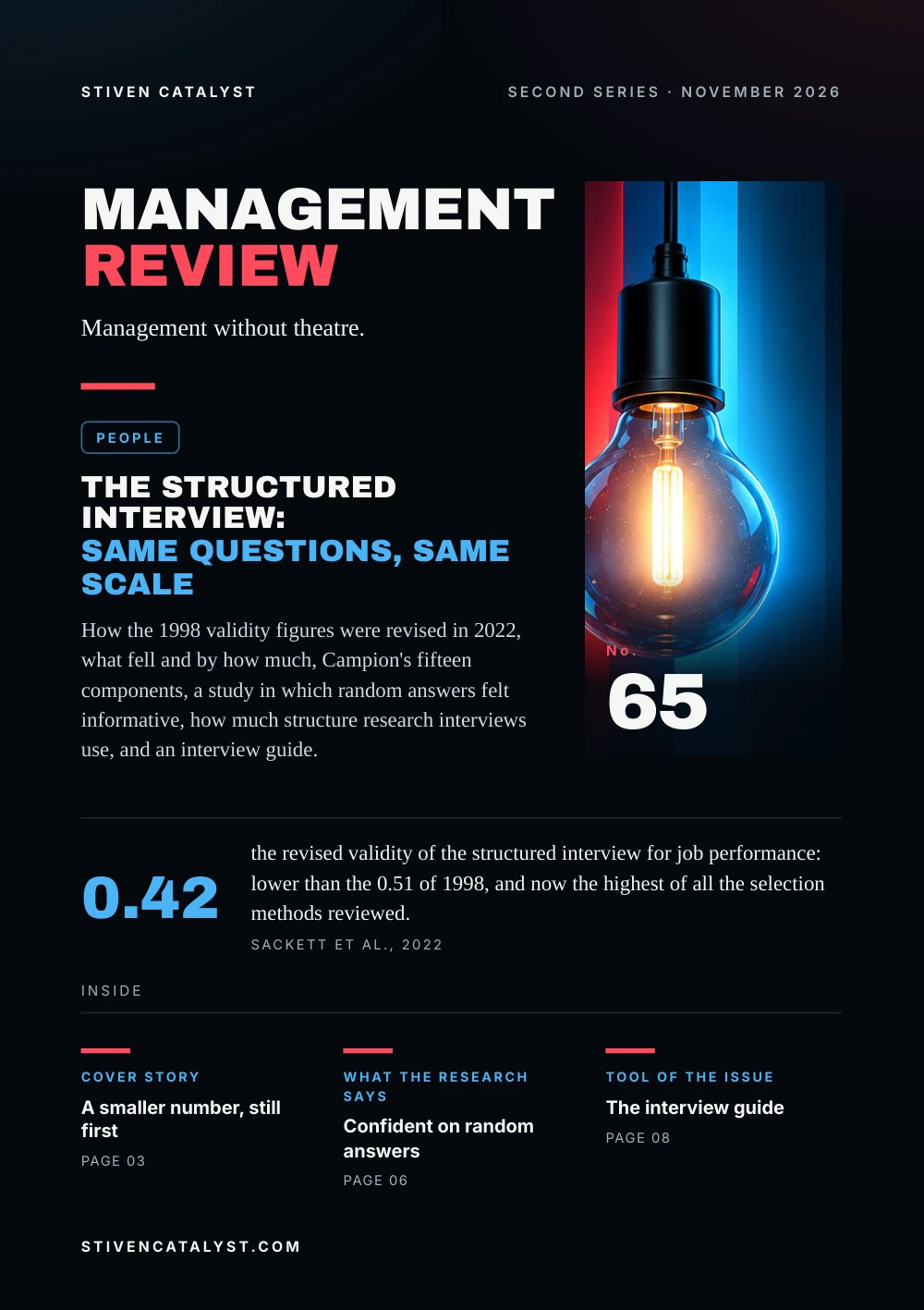
Stiven CatalystSecond series · November 2026
ManagementReview
Management without theatre.
People
The structured interview:same questions, same scale
How the 1998 validity figures were revised in 2022, what fell and by how much, Campion's fifteen components, a study in which random answers felt informative, how much structure research interviews use, and an interview guide.

No.65
0.42
the revised validity of the structured interview for job performance: lower than the 0.51 of 1998, and now the highest of all the selection methods reviewed.Sackett et al., 2022
stivencatalyst.com
No. 65 · People
In this issue
Almost nobody is hired without an interview, and most interviews are conversations. This issue looks at the alternative: the same job-related questions for every candidate, scored against a scale written in advance.
- 03Cover storyA smaller number, still first
- 04The numbersWhat fell, and by how much
- 05The modelFifteen ways to add structure
- 06What the research saysConfident on random answers
- 07How it is measuredCount the parts, score each answer
- 08Tool of the issueThe structured interview guide
- 09SourcesSources and method
How to read this issue
Figure
Every figure has its source and year at the foot of its page.
Our reading
Where the editors interpret rather than the research, it says so.
Practice
The steps and the card are proposals to try, not research results.
Cover story
A smaller number,still first
In 1998 Frank Schmidt and John Hunter summed up 85 years of research on hiring. The structured interview predicted job performance as well as a test of general mental ability: 0.51. In 2022 Paul Sackett and colleagues went back over the evidence. The structured interview fell to 0.42, and came out on top.
0.28observed in the studies behind the 1998 figure
0.37corrected for unreliable performance ratings
0.51also corrected for range restriction, the step Sackett et al. dropped
That correction assumes the people studied were selected on the method, so their scores vary less than applicants'. Many studies tested employees never hired on that interview; correcting them anyway inflated the figures. The authors kept 0.37, added a newer meta-analysis (0.45) and arrived at 0.42.
“Our field's selection procedures are still valid, just not as valid as we thought they were.”
Our reading
The revision did not change the advice. It changed the size of the promise: a good interview helps you choose, it does not see through people.
Sources: Frank L. Schmidt & John E. Hunter, Psychological Bulletin 124(2), 1998; Michael A. McDaniel, Deborah L. Whetzel, Frank L. Schmidt & Steven D. Maurer, Journal of Applied Psychology 79(4), 1994 (via Sackett et al., 2022); Paul R. Sackett, Charlene Zhang, Christopher M. Berry & Filip Lievens, Journal of Applied Psychology 107(11), 2022
Validity: the correlation between a method's score and later job performance (0 none, 1 perfect). The steps are as Sackett et al. describe the 1998 source, McDaniel et al. (1994). The quote is theirs.
The numbers
What fell,and by how much
Sackett and colleagues set their estimates next to those of 1998. Most methods that ranked high then still do, but 0.10 to 0.20 lower. The unstructured interview was halved.
Validity for job performance, 1998 and 2022 estimates
The four strongest in 2022 all measure the job itself. The structured interview also varies most between studies: in about one setting in ten it falls below 0.18.
Our reading
On average the method is at the top. Whether your interview is depends on how it is built.
Sources: Paul R. Sackett, Charlene Zhang, Christopher M. Berry & Filip Lievens, Journal of Applied Psychology 107(11), 2022; Frank L. Schmidt & John E. Hunter, Psychological Bulletin 124(2), 1998
Mean estimates from the comparison table in Sackett et al. (2022). The four strongest include biodata (0.38), not shown. 0.18: lower end of the 80% credibility interval.
The model
Fif teen wayst o add structure
Structure is not one thing. In 1997 Michael Campion, David Palmer and James Campion defined it as any enhancement that makes an interview more standard, or helps the interviewer decide what to ask and how to judge the answers. They listed fifteen components in two groups.
Content
- Questions from a job analysis
- The same questions for everyone
- Limited prompting and follow-up
- Better types of questions
- More questions, a longer interview
- Control of other information
- Candidate's questions at the end
Evaluation
- A rating for each answer
- Anchored rating scales
- Detailed notes
- Several interviewers
- The same interviewers for all
- No discussion between interviews
- Interviewer training
- Combining scores by formula
The two question types studied most both predict performance: situational questions (“what would you do if…”) tend to measure job knowledge, past-behaviour questions (“tell me about a time…”) experience.
Our reading
Each component moves a decision out of the mood of the moment and into the guide.
Sources: Michael A. Campion, David K. Palmer & James E. Campion, Personnel Psychology 50(3), 1997 (via Levashina et al., 2014); Julia Levashina, Christopher J. Hartwell, Frederick P. Morgeson & Michael A. Campion, Personnel Psychology 67(1), 2014
Labels shortened. In 2014 Levashina and colleagues had 30 selection experts sort the fifteen; 14 fell into Campion's groups. They propose three more: limiting small talk, telling candidates what is assessed, recording interviews.
What the research says
Confident onrandom answers
Jason Dana, Robyn Dawes and Nathanial Peterson asked 76 students to predict another student's grades for a semester. They were given the earlier grade average; they also held a 20-minute unstructured interview. In one condition, the student interviewed secretly answered at random after the break.
How well predictions matched the grades (correlation), Study 1
Those who had heard random answers said they had learned as much as the others. In a third study, 96 of 169 students (57%) said they would rather have a random interview than none.
Our reading
An interview always feels informative. The feeling is not evidence; the score against the job is.
Source: Jason Dana, Robyn Dawes & Nathanial Peterson, Judgment and Decision Making 8(5), 2013
Students predicting grades, not managers hiring, and the interviews were unstructured. The study shows how an interview can feel useful and still lower accuracy, not how much it does so at work.
How it is measured
Count the par ts,score each answer
Levashina and colleagues counted the components in 104 interviews described in research from 1997 to 2010. On average they used six of the fifteen. Some were almost always there, others almost never.
Share of 104 interviews in research, 1997–2010, using each component
Anchors pay. Across 19 studies of past-behaviour interviews, Taylor and Small (2002) found a validity of 0.35 with anchored scales and 0.26 without, and slightly closer agreement between interviewers (0.77 against 0.73).
Sources: Julia Levashina, Christopher J. Hartwell, Frederick P. Morgeson & Michael A. Campion, Personnel Psychology 67(1), 2014; Paul J. Taylor & Bruce Small, Journal of Occupational and Organizational Psychology 75(3), 2002 (via Levashina et al., 2014)
Counts from the content analysis by Levashina et al. (2014), of interviews described in research, not a survey of employers. Taylor and Small's figures are uncorrected, as Levashina et al. report them.
More in the essayLeading people without losing the person
Tool of the issue
The structuredinterview guide
One guide per role, used for every candidate. Write the questions and the anchors before the first interview, score each answer on its own, and only then talk with the other interviewers.
01Role and what it needsfour to six things the job needs, from those who do it
02Questionsper need, one “tell me about a time” and one “what would you do”; same order for all
03Anchorswhat a 1, 3 and 5 answer sounds like, written in advance
04Follow-upplanned and neutral, the same for every candidate
05Notes and scorewhat was said, not impressions; score 1–5 after each answer
06Independent scoringeach interviewer scores alone; discuss only when all scores are in
Sources: Michael A. Campion, David K. Palmer & James E. Campion, Personnel Psychology 50(3), 1997 (via Levashina et al., 2014); Julia Levashina, Christopher J. Hartwell, Frederick P. Morgeson & Michael A. Campion, Personnel Psychology 67(1), 2014; Google re:Work, 2026
A practice proposed by the editors, after Campion et al.'s components and Levashina et al.'s advice to probe only with planned, neutral follow-ups. Google's re:Work guide describes rubrics with examples of poor, borderline, solid and outstanding answers.
Open the tool: ATS CVstivencatalyst.com/tools/ats-cv/
Sources and method
Every figurehas a source.
The figures in this issue come from the sources below. The year shows how recent each one is.
- The validity and utility of selection methods in personnel psychology: Practical and theoretical implications of 85 years of research findingsFrank L. Schmidt & John E. Hunter, Psychological Bulletin 124(2), 1998https://doi.org/10.1037/0033-2909.124.2.262
- The validity of employment interviews: A comprehensive review and meta-analysisMichael A. McDaniel, Deborah L. Whetzel, Frank L. Schmidt & Steven D. Maurer, Journal of Applied Psychology 79(4), 1994 · via Sackett et al., 2022https://doi.org/10.1037/0021-9010.79.4.599
- Revisiting meta-analytic estimates of validity in personnel selection: Addressing systematic overcorrection for restriction of rangePaul R. Sackett, Charlene Zhang, Christopher M. Berry & Filip Lievens, Journal of Applied Psychology 107(11), 2022https://doi.org/10.1037/apl0000994
- A review of structure in the selection interviewMichael A. Campion, David K. Palmer & James E. Campion, Personnel Psychology 50(3), 1997 · via Levashina et al., 2014https://doi.org/10.1111/j.1744-6570.1997.tb00709.x
- The structured employment interview: Narrative and quantitative review of the research literatureJulia Levashina, Christopher J. Hartwell, Frederick P. Morgeson & Michael A. Campion, Personnel Psychology 67(1), 2014https://doi.org/10.1111/peps.12052
- Belief in the unstructured interview: The persistence of an illusionJason Dana, Robyn Dawes & Nathanial Peterson, Judgment and Decision Making 8(5), 2013https://doi.org/10.1017/S1930297500003612
- Asking applicants what they would do versus what they did do: A meta-analytic comparison of situational and past behaviour employment interview questionsPaul J. Taylor & Bruce Small, Journal of Occupational and Organizational Psychology 75(3), 2002 · via Levashina et al., 2014https://doi.org/10.1348/096317902320369712
- A guide to structured interviewing for better hiring practicesGoogle re:Work, 2026https://rework.withgoogle.com/intl/en/guides/a-guide-to-structured-interviewing-for-better-hiring-practices
Editorial method
Each figure was checked for its year, its publisher and what exactly it measures. Where the publisher's page could not be opened, the figure was checked against independent summaries and is marked “via”. The editors' interpretation is marked “Our reading”. Figures that could not be confirmed are not in the issue.
ManagementReview
Management without theatre.
Every issue, one management question, checked against the best research.
All issues
stivencatalyst.com/magazine/management-review.html
Management Review · No. 65 · November 2026 · Stiven Catalyst
Click or swipe a page to turn it. The arrow keys work too.
Management Review · No. 65
The figures of the issue
The charts of the printed pages, with their sources.
Sources: Paul R. Sackett, Charlene Zhang, Christopher M. Berry & Filip Lievens, Journal of Applied Psychology 107(11), 2022; Frank L. Schmidt & John E. Hunter, Psychological Bulletin 124(2), 1998
Source: Jason Dana, Robyn Dawes & Nathanial Peterson, Judgment and Decision Making 8(5), 2013
Source: Julia Levashina, Christopher J. Hartwell, Frederick P. Morgeson & Michael A. Campion, Personnel Psychology 67(1), 2014
The whole text Read the issue as text For reading on a small screen, searching or a screen reader. The same words, without the page design.
In this issue
Almost nobody is hired without an interview, and most interviews are conversations. This issue looks at the alternative: the same job-related questions for every candidate, scored against a scale written in advance.
In 1998 Schmidt and Hunter put the validity of the structured interview at 0.51, level with tests of mental ability. In 2022 Sackett and colleagues corrected the corrections behind such figures: 0.42, now the highest, while the unstructured interview fell to 0.19. Campion's fifteen components show what structure means. A study with random answers shows why a free conversation feels better than it predicts, and a guide shows how to build an interview.
Stiven Janaqi, Editor
Cover story
A smaller number, still first
In 1998 Frank Schmidt and John Hunter summed up 85 years of research on hiring. The structured interview predicted job performance as well as a test of general mental ability: 0.51. In 2022 Paul Sackett and colleagues went back over the evidence. The structured interview fell to 0.42, and came out on top.
- 0.28 observed in the studies behind the 1998 figure
- 0.37 corrected for unreliable performance ratings
- 0.51 also corrected for range restriction, the step Sackett et al. dropped
That correction assumes the people studied were selected on the method, so their scores vary less than applicants'. Many studies tested employees never hired on that interview; correcting them anyway inflated the figures. The authors kept 0.37, added a newer meta-analysis (0.45) and arrived at 0.42.
Our field's selection procedures are still valid, just not as valid as we thought they were.
Our reading
The revision did not change the advice. It changed the size of the promise: a good interview helps you choose, it does not see through people.
Validity: the correlation between a method's score and later job performance (0 none, 1 perfect). The steps are as Sackett et al. describe the 1998 source, McDaniel et al. (1994). The quote is theirs.
Sources: Frank L. Schmidt & John E. Hunter, Psychological Bulletin 124(2), 1998; Michael A. McDaniel, Deborah L. Whetzel, Frank L. Schmidt & Steven D. Maurer, Journal of Applied Psychology 79(4), 1994 (via Sackett et al., 2022); Paul R. Sackett, Charlene Zhang, Christopher M. Berry & Filip Lievens, Journal of Applied Psychology 107(11), 2022
The numbers
What fell, and by how much
Sackett and colleagues set their estimates next to those of 1998. Most methods that ranked high then still do, but 0.10 to 0.20 lower. The unstructured interview was halved.
Validity for job performance, 1998 and 2022 estimates: Structured interview: 1998 0.51, 2022 0.42; Job knowledge test: 1998 0.48, 2022 0.40; Work sample test: 1998 0.54, 2022 0.33; Mental ability test: 1998 0.51, 2022 0.31; Unstructured interview: 1998 0.38, 2022 0.19.
The four strongest in 2022 all measure the job itself. The structured interview also varies most between studies: in about one setting in ten it falls below 0.18.
Our reading
On average the method is at the top. Whether your interview is depends on how it is built.
Mean estimates from the comparison table in Sackett et al. (2022). The four strongest include biodata (0.38), not shown. 0.18: lower end of the 80% credibility interval.
Sources: Paul R. Sackett, Charlene Zhang, Christopher M. Berry & Filip Lievens, Journal of Applied Psychology 107(11), 2022; Frank L. Schmidt & John E. Hunter, Psychological Bulletin 124(2), 1998
The model
Fif teen ways t o add structure
Structure is not one thing. In 1997 Michael Campion, David Palmer and James Campion defined it as any enhancement that makes an interview more standard, or helps the interviewer decide what to ask and how to judge the answers. They listed fifteen components in two groups.
Content
- Questions from a job analysis
- The same questions for everyone
- Limited prompting and follow-up
- Better types of questions
- More questions, a longer interview
- Control of other information
- Candidate's questions at the end
Evaluation
- A rating for each answer
- Anchored rating scales
- Detailed notes
- Several interviewers
- The same interviewers for all
- No discussion between interviews
- Interviewer training
- Combining scores by formula
The two question types studied most both predict performance: situational questions (“what would you do if…”) tend to measure job knowledge, past-behaviour questions (“tell me about a time…”) experience.
Our reading
Each component moves a decision out of the mood of the moment and into the guide.
Labels shortened. In 2014 Levashina and colleagues had 30 selection experts sort the fifteen; 14 fell into Campion's groups. They propose three more: limiting small talk, telling candidates what is assessed, recording interviews.
Sources: Michael A. Campion, David K. Palmer & James E. Campion, Personnel Psychology 50(3), 1997 (via Levashina et al., 2014); Julia Levashina, Christopher J. Hartwell, Frederick P. Morgeson & Michael A. Campion, Personnel Psychology 67(1), 2014
What the research says
Confident on random answers
Jason Dana, Robyn Dawes and Nathanial Peterson asked 76 students to predict another student's grades for a semester. They were given the earlier grade average; they also held a 20-minute unstructured interview. In one condition, the student interviewed secretly answered at random after the break.
How well predictions matched the grades (correlation), Study 1: Earlier grades alone 0.65, Without interview 0.61, With interview 0.31.
Those who had heard random answers said they had learned as much as the others. In a third study, 96 of 169 students (57%) said they would rather have a random interview than none.
Our reading
An interview always feels informative. The feeling is not evidence; the score against the job is.
Students predicting grades, not managers hiring, and the interviews were unstructured. The study shows how an interview can feel useful and still lower accuracy, not how much it does so at work.
Source: Jason Dana, Robyn Dawes & Nathanial Peterson, Judgment and Decision Making 8(5), 2013
How it is measured
Count the par ts, score each answer
Levashina and colleagues counted the components in 104 interviews described in research from 1997 to 2010. On average they used six of the fifteen. Some were almost always there, others almost never.
Share of 104 interviews in research, 1997–2010, using each component: The same questions for everyone 74%, Questions from a job analysis 71%, Anchored rating scales 66%, Interviewer training 52%, Detailed notes 19%, No discussion between interviews 4%.
Anchors pay. Across 19 studies of past-behaviour interviews, Taylor and Small (2002) found a validity of 0.35 with anchored scales and 0.26 without, and slightly closer agreement between interviewers (0.77 against 0.73).
Counts from the content analysis by Levashina et al. (2014), of interviews described in research, not a survey of employers. Taylor and Small's figures are uncorrected, as Levashina et al. report them.
Sources: Julia Levashina, Christopher J. Hartwell, Frederick P. Morgeson & Michael A. Campion, Personnel Psychology 67(1), 2014; Paul J. Taylor & Bruce Small, Journal of Occupational and Organizational Psychology 75(3), 2002 (via Levashina et al., 2014)
More in the essay: Leading people without losing the person
Tool of the issue
The structured interview guide
One guide per role, used for every candidate. Write the questions and the anchors before the first interview, score each answer on its own, and only then talk with the other interviewers.
- Role and what it needs four to six things the job needs, from those who do it
- Questions per need, one “tell me about a time” and one “what would you do”; same order for all
- Anchors what a 1, 3 and 5 answer sounds like, written in advance
- Follow-up planned and neutral, the same for every candidate
- Notes and score what was said, not impressions; score 1–5 after each answer
- Independent scoring each interviewer scores alone; discuss only when all scores are in
A practice proposed by the editors, after Campion et al.'s components and Levashina et al.'s advice to probe only with planned, neutral follow-ups. Google's re:Work guide describes rubrics with examples of poor, borderline, solid and outstanding answers.
Sources: Michael A. Campion, David K. Palmer & James E. Campion, Personnel Psychology 50(3), 1997 (via Levashina et al., 2014); Julia Levashina, Christopher J. Hartwell, Frederick P. Morgeson & Michael A. Campion, Personnel Psychology 67(1), 2014; Google re:Work, 2026
Open the tool: ATS CV
Sources and method
Every figure has a source.
The figures in this issue come from the sources below. The year shows how recent each one is.
- Frank L. Schmidt & John E. Hunter, Psychological Bulletin 124(2), “The validity and utility of selection methods in personnel psychology: Practical and theoretical implications of 85 years of research findings”, 1998. https://doi.org/10.1037/0033-2909.124.2.262
- Michael A. McDaniel, Deborah L. Whetzel, Frank L. Schmidt & Steven D. Maurer, Journal of Applied Psychology 79(4), “The validity of employment interviews: A comprehensive review and meta-analysis”, 1994 (via Sackett et al., 2022). https://doi.org/10.1037/0021-9010.79.4.599
- Paul R. Sackett, Charlene Zhang, Christopher M. Berry & Filip Lievens, Journal of Applied Psychology 107(11), “Revisiting meta-analytic estimates of validity in personnel selection: Addressing systematic overcorrection for restriction of range”, 2022. https://doi.org/10.1037/apl0000994
- Michael A. Campion, David K. Palmer & James E. Campion, Personnel Psychology 50(3), “A review of structure in the selection interview”, 1997 (via Levashina et al., 2014). https://doi.org/10.1111/j.1744-6570.1997.tb00709.x
- Julia Levashina, Christopher J. Hartwell, Frederick P. Morgeson & Michael A. Campion, Personnel Psychology 67(1), “The structured employment interview: Narrative and quantitative review of the research literature”, 2014. https://doi.org/10.1111/peps.12052
- Jason Dana, Robyn Dawes & Nathanial Peterson, Judgment and Decision Making 8(5), “Belief in the unstructured interview: The persistence of an illusion”, 2013. https://doi.org/10.1017/S1930297500003612
- Paul J. Taylor & Bruce Small, Journal of Occupational and Organizational Psychology 75(3), “Asking applicants what they would do versus what they did do: A meta-analytic comparison of situational and past behaviour employment interview questions”, 2002 (via Levashina et al., 2014). https://doi.org/10.1348/096317902320369712
- Google re:Work, “A guide to structured interviewing for better hiring practices”, 2026. https://rework.withgoogle.com/intl/en/guides/a-guide-to-structured-interviewing-for-better-hiring-practices
Edit orial me thod
Each figure was checked for its year, its publisher and what exactly it measures. Where the publisher's page could not be opened, the figure was checked against independent summaries and is marked “via”. The editors' interpretation is marked “Our reading”. Figures that could not be confirmed are not in the issue.
Management Review · Monthly edition