Gallup finds 22% of employees lonely on a given day, more among those working remotely. Across 148 studies, people with stronger relationships had 50% higher odds of survival. Being among people and being supported are not the same, and Gallup's data hint at what helps. In Japan, lonelier employees were more likely to have left six months later. Three questions and a card close the issue.
Management Review · Third series · November 2026 · No. 104
Someone t o talk t o: connection at work
One employee in five lonely on any given day, 148 studies of relationships and survival, the difference between people around you and people who support you, a study of loneliness and leaving, three questions, and a card.
- No.
- 104
- Pages
- 10
- Sources
- 5
- Topics
- People
- Online since
- 7 November 2026
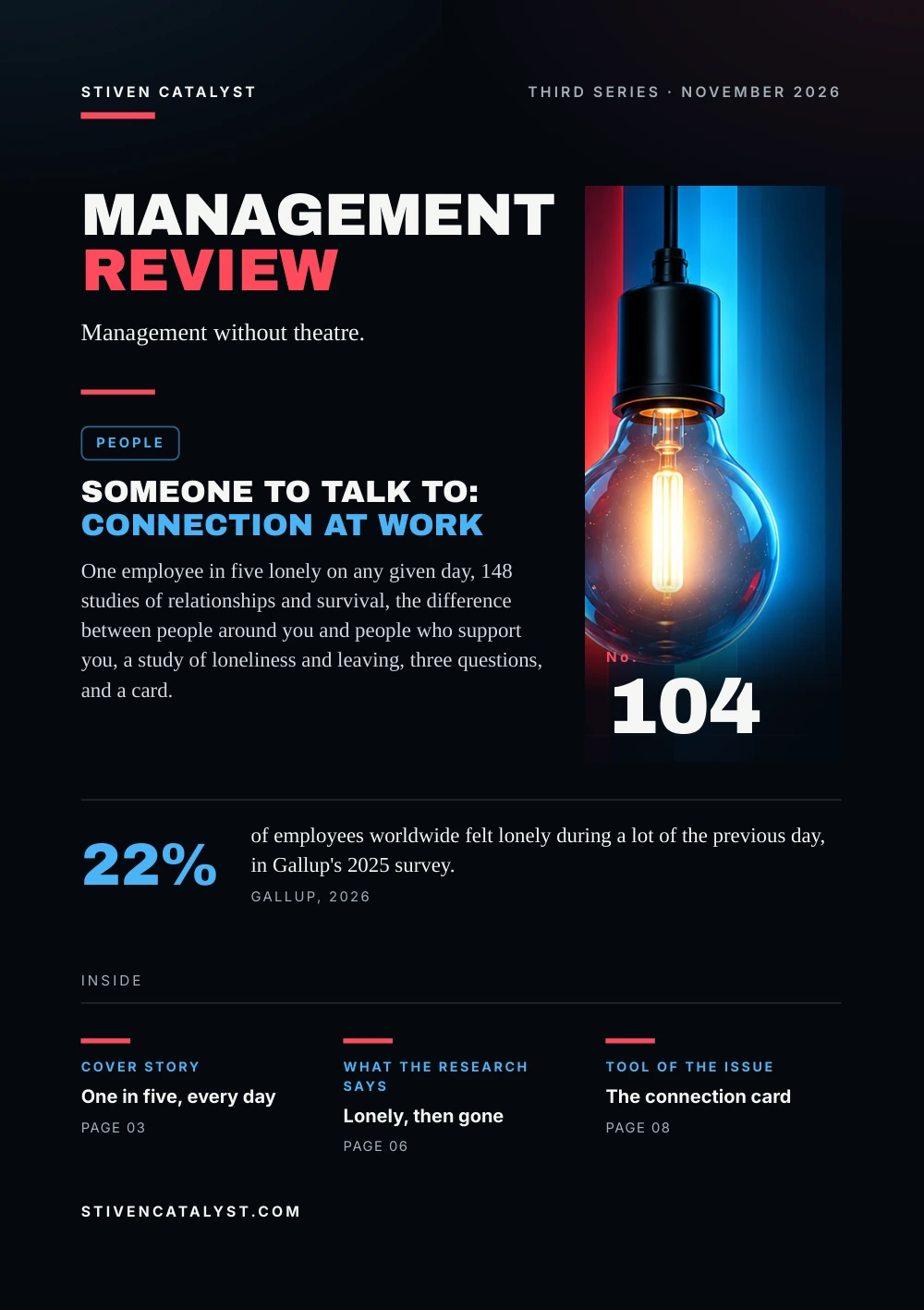
Stiven CatalystThird series · November 2026
ManagementReview
Management without theatre.
People
Someone to talk to:connection at work
One employee in five lonely on any given day, 148 studies of relationships and survival, the difference between people around you and people who support you, a study of loneliness and leaving, three questions, and a card.

No.104
22%
of employees worldwide felt lonely during a lot of the previous day, in Gallup's 2025 survey.Gallup, 2026
stivencatalyst.com
No. 104 · People
In this issue
Work is where many adults spend most of their waking hours with other people, and also where some spend them alone: on a night shift, at a remote desk, as the only one of their trade. Who a person can turn to rarely appears in a KPI. This issue asks what that costs in health and in people who leave.
- 03Cover storyOne in five, every day
- 04The numbers148 studies, one direction
- 05The modelAround people, or held by them
- 06What the research saysLonely, then gone
- 07How it is measuredThree questions
- 08Tool of the issueThe connection card
- 09SourcesSources and method
How to read this issue
Figure
Every figure has its source and year at the foot of its page.
Our reading
Where the editor interprets rather than the research, it says so.
Practice
The steps and the card are proposals to try, not research results.
Cover story
One in five,every day
Each year Gallup's World Poll asks employed adults whether they felt certain emotions during a lot of the day before. For 2025, with 141,444 employed respondents, 22% said they had felt lonely, as in 2024 and up from 20% in 2023. Where people work made the clearest difference.
Employees who felt lonely a lot of the previous day, by place of work, world (2025 data)
Age, sex and rank mattered little: 23% of managers and 21% of other employees. Regions differed more, from 28% in South Asia and sub-Saharan Africa to 13% in Europe.
Our reading
Managers were not spared. The person who checks on the team may be the one nobody checks on.
Source: Gallup, 2026
Gallup, State of the Global Workplace 2026, global data summary, read in full: adults aged 15 and over in employment, surveyed in 2025 by phone or in person. Self-report about one day; hybrid and remote may differ in jobs as well as in place.
The numbers
148 studies,one direction
Julianne Holt-Lunstad, Timothy Smith and Bradley Layton pooled 148 studies with 308,849 people, followed for 7.5 years on average. Those with stronger social relationships had 50% higher odds of being alive at the end, across age, sex, initial health and cause of death.
Higher odds of survival, by how relationships were measured (2010)
Our reading
The simplest measure, living with someone, said least. How embedded a person is said most.
Source: Julianne Holt-Lunstad, Timothy B. Smith & J. Bradley Layton, PLOS Medicine 7(7), 2010
Holt-Lunstad et al. (2010), PLOS Medicine, read in full; bars are odds ratios from its Table 4 written as percent higher odds. For living alone the interval includes no effect. Observational studies, not trials; the authors call it comparable with quitting smoking. Mental health at work is No. 75.
The model
Around people,or held by them
The review separates two sides of relationships. Structural: how many people a person is connected to and takes part with. Functional: the support received and the support a person believes is there. The two correlate only moderately, typically 0.20 to 0.30.
Structural: who is around
- Size of the network
- Taking part with others
- At work: a crew, a shift, a team
Functional: who would help
- Support a person receives
- Support a person believes is there
- At work: someone to ask, someone who notices
In a US study reported in 2024, Gallup found employees with a best friend at work 21% less likely to be lonely, and engaged employees 64% less likely. Only about two in ten US employees report such a friend. Worldwide, actively disengaged workers were lonely almost as often as the unemployed: 31% against 32%.
Our reading
Putting people in one room builds the left column. The right one grows from work done together and help that comes.
Sources: Julianne Holt-Lunstad, Timothy B. Smith & J. Bradley Layton, PLOS Medicine 7(7), 2010; Ryan Pendell, Gallup, 2024; Alok Patel & Stephanie Plowman, Gallup, 2022
Columns: Holt-Lunstad et al. (2010); the work examples are the editors'. Gallup figures: Pendell (2024), whose 31% and 32% are from the 2024 world report, and Patel & Plowman (2022); associations, not effects. Engagement is No. 9, onboarding and buddies No. 24.
What the research says
Lonely,then gone
Natsu Sasaki and colleagues at the University of Tokyo measured loneliness at work among 706 full-time employees in February 2024 and asked again in August. Within those six months, 47 had left their job or moved to another employer. Before, studies had linked such loneliness only to the wish to leave.
6.7%of the 706 had left within six months
1.46odds of leaving per standard deviation more loneliness, three-question scale
1.42the same on a 16-item scale; 1.31 on a single question
All three measures pointed the same way, after adjusting for sex, age, marital status, occupation and contract. Loneliness went with changing employer, not with ending up unemployed, though only 12 had. The link held when those near retirement age were left out.
Our reading
The lonely did not drop out of work. They took their work somewhere else.
Source: Natsu Sasaki, Kanami Tsuno, Reiko Kuroda, Kotaro Imamura, Hisashi Eguchi, Akihito Shimazu & Norito Kawakami, Journal of Occupational Health 67(1), 2025
Sasaki et al. (2025), Journal of Occupational Health, read in full in PubMed Central. An online panel in Japan, more graduates than average, only 47 leavers, turnover self-reported; workplace support and personality were not controlled. Why people leave in general is No. 14.
How it is measured
Threequestions
The shortest scale in the Tokyo study took three items from a standard loneliness scale and added “in your workplace or at work” to each. Each is answered hardly ever (1), some of the time (2) or often (3), so the total runs from 3 to 9.
At work, how often do you feel…
…that you lack companionship?
At work, how often do you feel…
…left out?
At work, how often do you feel…
…isolated from others?
In the study the average was 4.6. Those who stayed scored 4.59 at the start, those who later left 5.36. Gallup's one question works for a day: did you feel lonely during a lot of yesterday?
Our reading
Ask without names and report only a team's total. A lonely person will not say so to a form that names them.
Sources: Natsu Sasaki, Kanami Tsuno, Reiko Kuroda, Kotaro Imamura, Hisashi Eguchi, Akihito Shimazu & Norito Kawakami, Journal of Occupational Health 67(1), 2025; Gallup, 2026
Items from Sasaki et al. (2025), who adapted a short form of the UCLA Loneliness Scale; the authors say this three-item version is not fully validated. The callout's advice is the editors'. Speaking up without fear is No. 4, incivility No. 79.
Tool of the issue
The connectioncard
One card per team, reviewed monthly. What a leader decides to do about it goes into the routine in Leader Standard Work, so it is checked off like any other task and not left to the quiet weeks.
01Who works alonenights, remote, the only one of a trade, the newest
02Who each one asks when stucka name for every person; a blank is the finding
03Work done togethera task each person shares with someone, not only a shared room
04The three questionsanonymous, team total from 3 to 9 per person, compared with last time
05Who left, and who they talked toin the exit talk: whom they could turn to, and when that stopped
06This month's stepone change, written into the leader's routine
Sources: Julianne Holt-Lunstad, Timothy B. Smith & J. Bradley Layton, PLOS Medicine 7(7), 2010; Gallup, 2026; Natsu Sasaki, Kanami Tsuno, Reiko Kuroda, Kotaro Imamura, Hisashi Eguchi, Akihito Shimazu & Norito Kawakami, Journal of Occupational Health 67(1), 2025
The card is the editors' proposal, built on the review's two sides of relationships, Gallup's data and the Tokyo study; it is not a tested instrument, and it shows only whether a team is connected, not why.
Open the tool: Leader Standard Workstivencatalyst.com/tools/leader-standard-work/
Sources and method
Every figurehas a source.
The figures in this issue come from the sources below. The year shows how recent each one is.
- State of the Global Workplace: 2026 global data summaryGallup, 2026https://www.gallup.com/workplace/697904/state-of-the-global-workplace-global-data.aspx
- Social Relationships and Mortality Risk: A Meta-analytic ReviewJulianne Holt-Lunstad, Timothy B. Smith & J. Bradley Layton, PLOS Medicine 7(7), 2010https://doi.org/10.1371/journal.pmed.1000316
- 1 in 5 Employees Worldwide Feel LonelyRyan Pendell, Gallup, 2024https://www.gallup.com/workplace/645566/employees-worldwide-feel-lonely.aspx
- The Increasing Importance of a Best Friend at WorkAlok Patel & Stephanie Plowman, Gallup, 2022https://www.gallup.com/workplace/397058/increasing-importance-best-friend-work.aspx
- Workplace loneliness and job turnover: a 6-month prospective studyNatsu Sasaki, Kanami Tsuno, Reiko Kuroda, Kotaro Imamura, Hisashi Eguchi, Akihito Shimazu & Norito Kawakami, Journal of Occupational Health 67(1), 2025https://doi.org/10.1093/joccuh/uiaf009
Editorial method
Each figure was checked for its year, its publisher and what it measures, in the full text where it could be opened. A source read only in a summary, an abstract or excerpts is marked “via”. A figure not confirmed in what was read is marked so on its page, or left out. The editor's interpretation is marked “Our reading”.
ManagementReview
Management without theatre.
Every issue, one management question, checked against the best research.
All issues
stivencatalyst.com/magazine/management-review.html
Management Review · No. 104 · November 2026 · Stiven Catalyst
Edited by Stiven Janaqi, who answers for it; “the editors” in this publication means him. Its texts, translations, layout and the checking of figures against their sources are done in working sessions with Claude, an AI model by Anthropic.
stivencatalyst.com/how-this-is-made.html
 Next issue
Maintenance that fits how things fail
Click or swipe a page to turn it. The arrow keys work too.
Management Review · No. 104
The figures of the issue
The charts of the printed pages, with their sources.
Gallup, State of the Global Workplace 2026, global data summary, read in full: adults aged 15 and over in employment, surveyed in 2025 by phone or in person. Self-report about one day; hybrid and remote may differ in jobs as well as in place.
Source: Gallup, 2026
Holt-Lunstad et al. (2010), PLOS Medicine, read in full; bars are odds ratios from its Table 4 written as percent higher odds. For living alone the interval includes no effect. Observational studies, not trials; the authors call it comparable with quitting smoking. Mental health at work is No. 75.
Source: Julianne Holt-Lunstad, Timothy B. Smith & J. Bradley Layton, PLOS Medicine 7(7), 2010
The whole text Read the issue as text For reading on a small screen, searching or a screen reader. The same words, without the page design.
In this issue
Work is where many adults spend most of their waking hours with other people, and also where some spend them alone: on a night shift, at a remote desk, as the only one of their trade. Who a person can turn to rarely appears in a KPI. This issue asks what that costs in health and in people who leave.
Gallup finds 22% of employees lonely on a given day, more among those working remotely. Across 148 studies, people with stronger relationships had 50% higher odds of survival. Being among people and being supported are not the same, and Gallup's data hint at what helps. In Japan, lonelier employees were more likely to have left six months later. Three questions and a card close the issue.
Stiven Janaqi, Editor
Cover story
One in five, every day
Each year Gallup's World Poll asks employed adults whether they felt certain emotions during a lot of the day before. For 2025, with 141,444 employed respondents, 22% said they had felt lonely, as in 2024 and up from 20% in 2023. Where people work made the clearest difference.
Employees who felt lonely a lot of the previous day, by place of work, world (2025 data): Fully remote 24%, Hybrid 24%, On-site, job could be remote 18%, On-site, job cannot be remote 21%.
Age, sex and rank mattered little: 23% of managers and 21% of other employees. Regions differed more, from 28% in South Asia and sub-Saharan Africa to 13% in Europe.
Our reading
Managers were not spared. The person who checks on the team may be the one nobody checks on.
Gallup, State of the Global Workplace 2026, global data summary, read in full: adults aged 15 and over in employment, surveyed in 2025 by phone or in person. Self-report about one day; hybrid and remote may differ in jobs as well as in place.
Source: Gallup, 2026
The numbers
148 studies, one direction
Julianne Holt-Lunstad, Timothy Smith and Bradley Layton pooled 148 studies with 308,849 people, followed for 7.5 years on average. Those with stronger social relationships had 50% higher odds of being alive at the end, across age, sex, initial health and cause of death.
Higher odds of survival, by how relationships were measured (2010): Complex measures of integration 91%, Social integration 52%, Social networks 45%, Not lonely 45%, Feeling supported 35%, Not living alone 19%.
Our reading
The simplest measure, living with someone, said least. How embedded a person is said most.
Holt-Lunstad et al. (2010), PLOS Medicine, read in full; bars are odds ratios from its Table 4 written as percent higher odds. For living alone the interval includes no effect. Observational studies, not trials; the authors call it comparable with quitting smoking. Mental health at work is No. 75.
Source: Julianne Holt-Lunstad, Timothy B. Smith & J. Bradley Layton, PLOS Medicine 7(7), 2010
The model
Around people, or held by them
The review separates two sides of relationships. Structural: how many people a person is connected to and takes part with. Functional: the support received and the support a person believes is there. The two correlate only moderately, typically 0.20 to 0.30.
Structural: who is around
- Size of the network
- Taking part with others
- At work: a crew, a shift, a team
Functional: who would help
- Support a person receives
- Support a person believes is there
- At work: someone to ask, someone who notices
In a US study reported in 2024, Gallup found employees with a best friend at work 21% less likely to be lonely, and engaged employees 64% less likely. Only about two in ten US employees report such a friend. Worldwide, actively disengaged workers were lonely almost as often as the unemployed: 31% against 32%.
Our reading
Putting people in one room builds the left column. The right one grows from work done together and help that comes.
Columns: Holt-Lunstad et al. (2010); the work examples are the editors'. Gallup figures: Pendell (2024), whose 31% and 32% are from the 2024 world report, and Patel & Plowman (2022); associations, not effects. Engagement is No. 9, onboarding and buddies No. 24.
Sources: Julianne Holt-Lunstad, Timothy B. Smith & J. Bradley Layton, PLOS Medicine 7(7), 2010; Ryan Pendell, Gallup, 2024; Alok Patel & Stephanie Plowman, Gallup, 2022
What the research says
Lonely, then gone
Natsu Sasaki and colleagues at the University of Tokyo measured loneliness at work among 706 full-time employees in February 2024 and asked again in August. Within those six months, 47 had left their job or moved to another employer. Before, studies had linked such loneliness only to the wish to leave.
- 6.7% of the 706 had left within six months
- 1.46 odds of leaving per standard deviation more loneliness, three-question scale
- 1.42 the same on a 16-item scale; 1.31 on a single question
All three measures pointed the same way, after adjusting for sex, age, marital status, occupation and contract. Loneliness went with changing employer, not with ending up unemployed, though only 12 had. The link held when those near retirement age were left out.
Our reading
The lonely did not drop out of work. They took their work somewhere else.
Sasaki et al. (2025), Journal of Occupational Health, read in full in PubMed Central. An online panel in Japan, more graduates than average, only 47 leavers, turnover self-reported; workplace support and personality were not controlled. Why people leave in general is No. 14.
Source: Natsu Sasaki, Kanami Tsuno, Reiko Kuroda, Kotaro Imamura, Hisashi Eguchi, Akihito Shimazu & Norito Kawakami, Journal of Occupational Health 67(1), 2025
How it is measured
Three questions
The shortest scale in the Tokyo study took three items from a standard loneliness scale and added “in your workplace or at work” to each. Each is answered hardly ever (1), some of the time (2) or often (3), so the total runs from 3 to 9.
- At work, how o
f ten do you feel…. …that you lack companionship? - At work, how o
f ten do you feel…. …left out? - At work, how o
f ten do you feel…. …isolated from others?
In the study the average was 4.6. Those who stayed scored 4.59 at the start, those who later left 5.36. Gallup's one question works for a day: did you feel lonely during a lot of yesterday?
Our reading
Ask without names and report only a team's total. A lonely person will not say so to a form that names them.
Items from Sasaki et al. (2025), who adapted a short form of the UCLA Loneliness Scale; the authors say this three-item version is not fully validated. The callout's advice is the editors'. Speaking up without fear is No. 4, incivility No. 79.
Sources: Natsu Sasaki, Kanami Tsuno, Reiko Kuroda, Kotaro Imamura, Hisashi Eguchi, Akihito Shimazu & Norito Kawakami, Journal of Occupational Health 67(1), 2025; Gallup, 2026
Tool of the issue
The connection card
One card per team, reviewed monthly. What a leader decides to do about it goes into the routine in Leader Standard Work, so it is checked off like any other task and not left to the quiet weeks.
- Who works alone nights, remote, the only one of a trade, the newest
- Who each one asks when stuck a name for every person; a blank is the finding
- Work done
t oge ther a task each person shares with someone, not only a shared room - The three questions anonymous, team total from 3 to 9 per person, compared with last time
- Who le
f t, and who the y talkedt o in the exit talk: whom they could turn to, and when that stopped - This month's step one change, written into the leader's routine
The card is the editors' proposal, built on the review's two sides of relationships, Gallup's data and the Tokyo study; it is not a tested instrument, and it shows only whether a team is connected, not why.
Sources: Julianne Holt-Lunstad, Timothy B. Smith & J. Bradley Layton, PLOS Medicine 7(7), 2010; Gallup, 2026; Natsu Sasaki, Kanami Tsuno, Reiko Kuroda, Kotaro Imamura, Hisashi Eguchi, Akihito Shimazu & Norito Kawakami, Journal of Occupational Health 67(1), 2025
Open the tool: Leader Standard Work
Sources and method
Every figure has a source.
The figures in this issue come from the sources below. The year shows how recent each one is.
- Gallup, “State of the Global Workplace: 2026 global data summary”, 2026. https://www.gallup.com/workplace/697904/state-of-the-global-workplace-global-data.aspx
- Julianne Holt-Lunstad, Timothy B. Smith & J. Bradley Layton, PLOS Medicine 7(7), “Social Relationships and Mortality Risk: A Meta-analytic Review”, 2010. https://doi.org/10.1371/journal.pmed.1000316
- Ryan Pendell, Gallup, “1 in 5 Employees Worldwide Feel Lonely”, 2024. https://www.gallup.com/workplace/645566/employees-worldwide-feel-lonely.aspx
- Alok Patel & Stephanie Plowman, Gallup, “The Increasing Importance of a Best Friend at Work”, 2022. https://www.gallup.com/workplace/397058/increasing-importance-best-friend-work.aspx
- Natsu Sasaki, Kanami Tsuno, Reiko Kuroda, Kotaro Imamura, Hisashi Eguchi, Akihito Shimazu & Norito Kawakami, Journal of Occupational Health 67(1), “Workplace loneliness and job turnover: a 6-month prospective study”, 2025. https://doi.org/10.1093/joccuh/uiaf009
Edit orial me thod
Each figure was checked for its year, its publisher and what it measures, in the full text where it could be opened. A source read only in a summary, an abstract or excerpts is marked “via”. A figure not confirmed in what was read is marked so on its page, or left out. The editor's interpretation is marked “Our reading”.
Edited by Stiven Janaqi, who answers for it; “the editors” in this publication means him. Its texts, translations, layout and the checking of figures against their sources are done in working sessions with Claude, an AI model by Anthropic. How this is made
Management Review · Monthly edition