In this issue
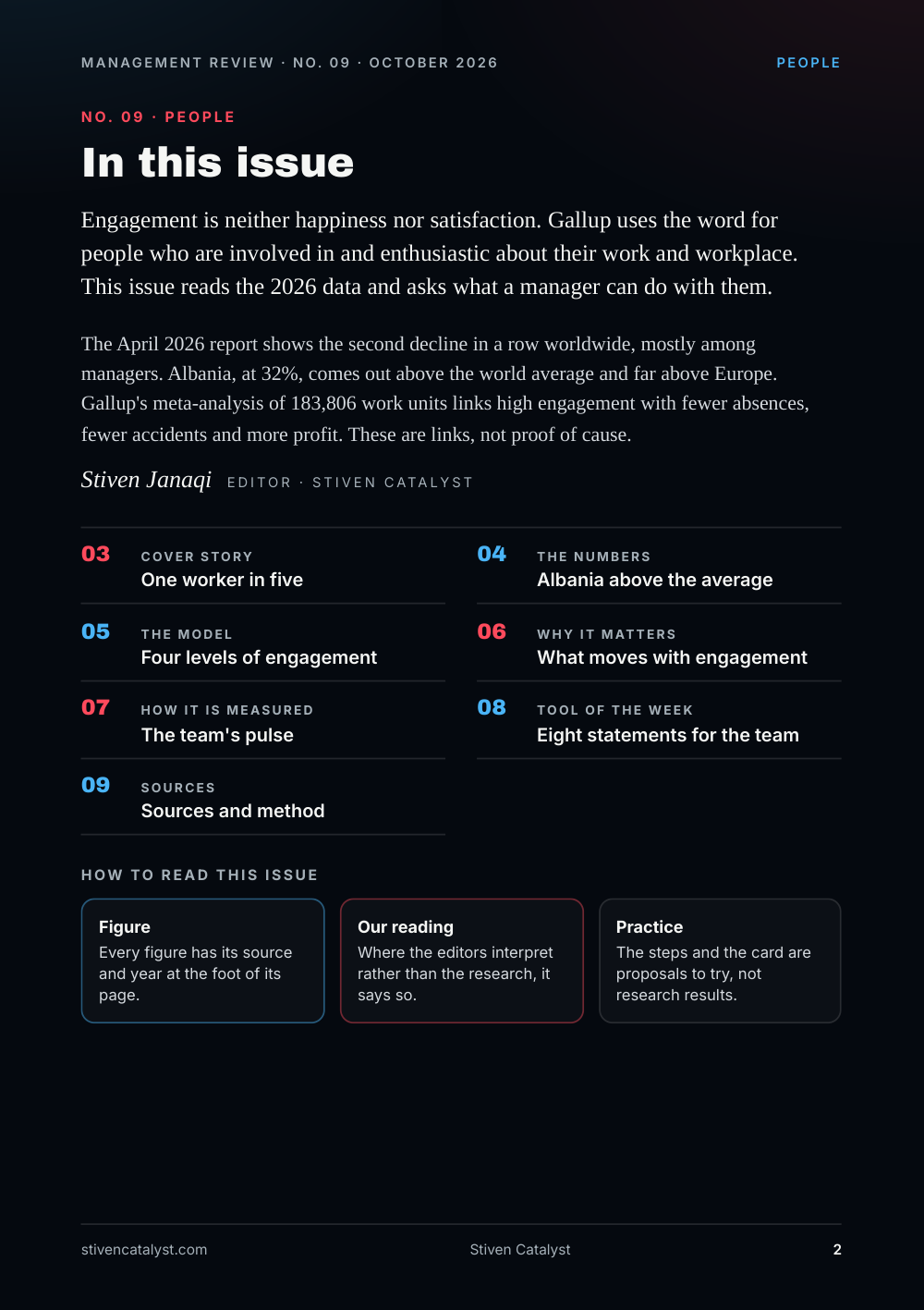
Engagement is neither happiness nor satisfaction. Gallup uses the word for people who are involved in and enthusiastic about their work and workplace. This issue reads the 2026 data and asks what a manager can do with them.
The April 2026 report shows the second decline in a row worldwide, mostly among managers. Albania, at 32%, comes out above the world average and far above Europe. Gallup's meta-analysis of 183,806 work units links high engagement with fewer absences, fewer accidents and more profit. These are links, not proof of cause.
Stiven Janaqi, Editor
Cover story
One worker in five
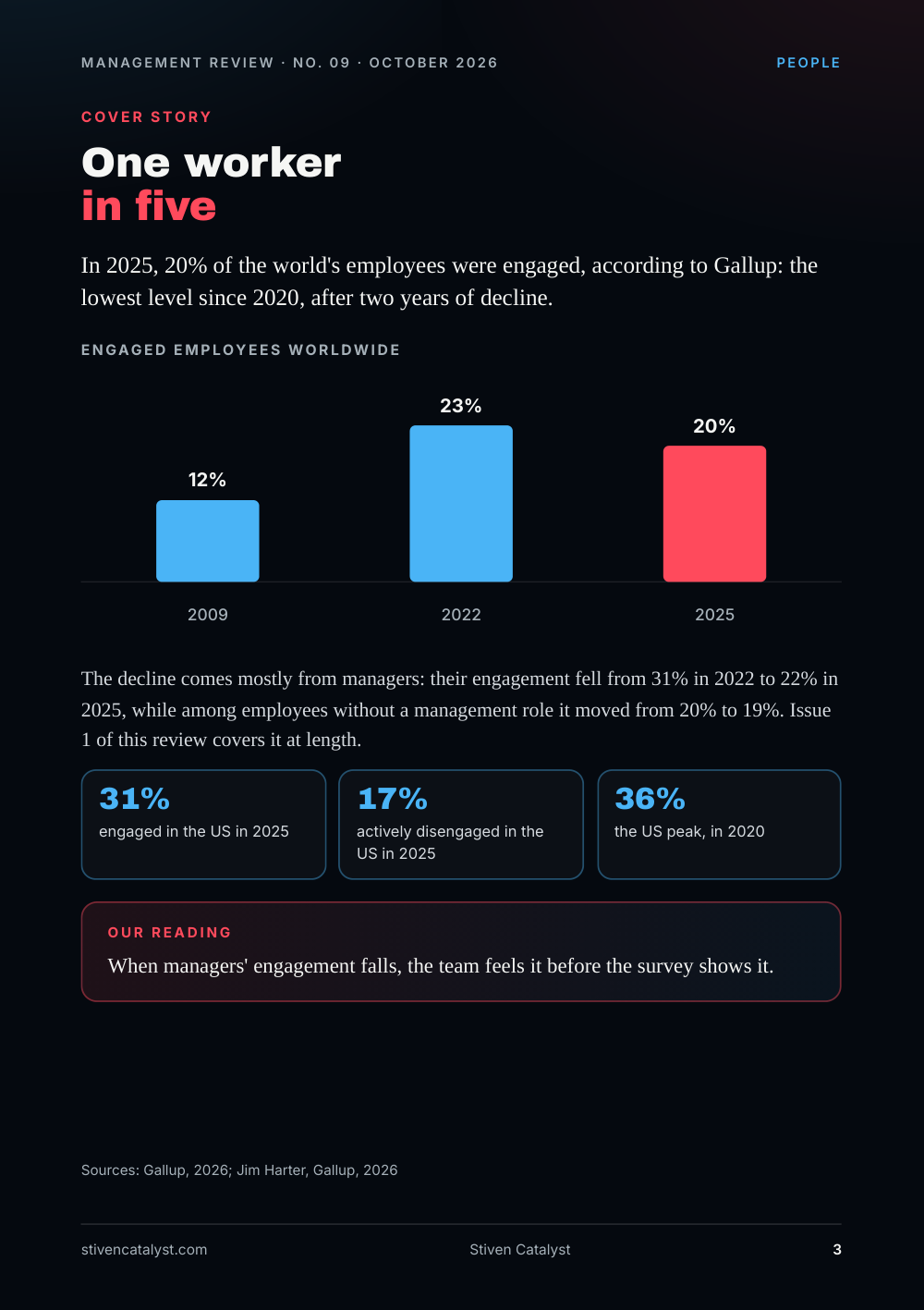
In 2025, 20% of the world's employees were engaged, according to Gallup: the lowest level since 2020, after two years of decline.
Engaged employees worldwide: 2009 12%, 2022 23%, 2025 20%.
The decline comes mostly from managers: their engagement fell from 31% in 2022 to 22% in 2025, while among employees without a management role it moved from 20% to 19%. Issue 1 of this review covers it at length.
- 31% engaged in the US in 2025
- 17% actively disengaged in the US in 2025
- 36% the US peak, in 2020
Our reading
When managers' engagement falls, the team feels it before the survey shows it.
Sources: Gallup, 2026; Jim Harter, Gallup, 2026
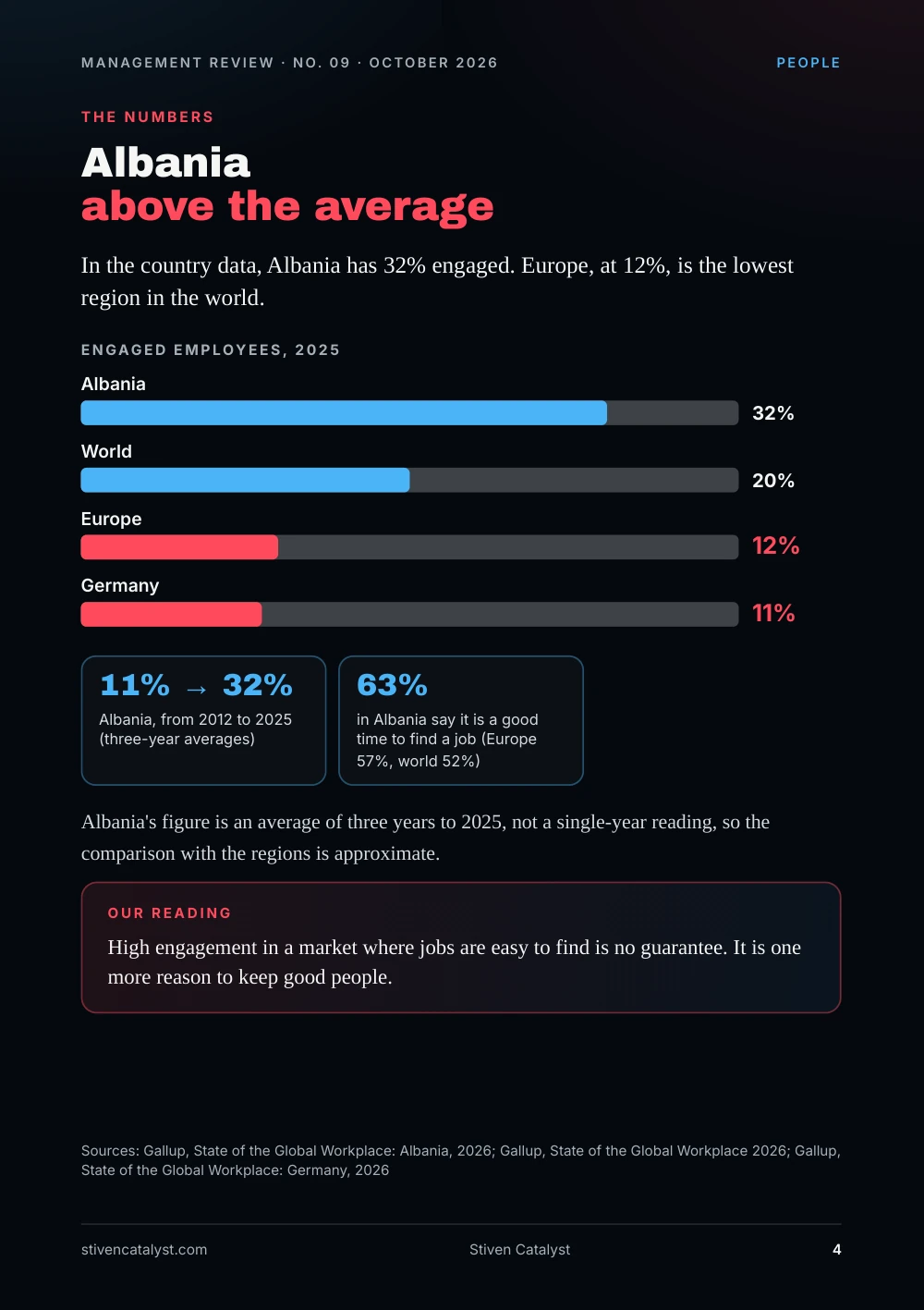
The numbers
Albania above the average
In the country data, Albania has 32% engaged. Europe, at 12%, is the lowest region in the world.
Engaged employees, 2025: Albania 32%, World 20%, Europe 12%, Germany 11%.
- 11% → 32% Albania, from 2012 to 2025 (three-year averages)
- 63% in Albania say it is a good time to find a job (Europe 57%, world 52%)
Albania's figure is an average of three years to 2025, not a single-year reading, so the comparison with the regions is approximate.
Our reading
High engagement in a market where jobs are easy to find is no guarantee. It is one more reason to keep good people.
Sources: Gallup, State of the Global Workplace: Albania, 2026; Gallup, State of the Global Workplace 2026; Gallup, State of the Global Workplace: Germany, 2026
The model
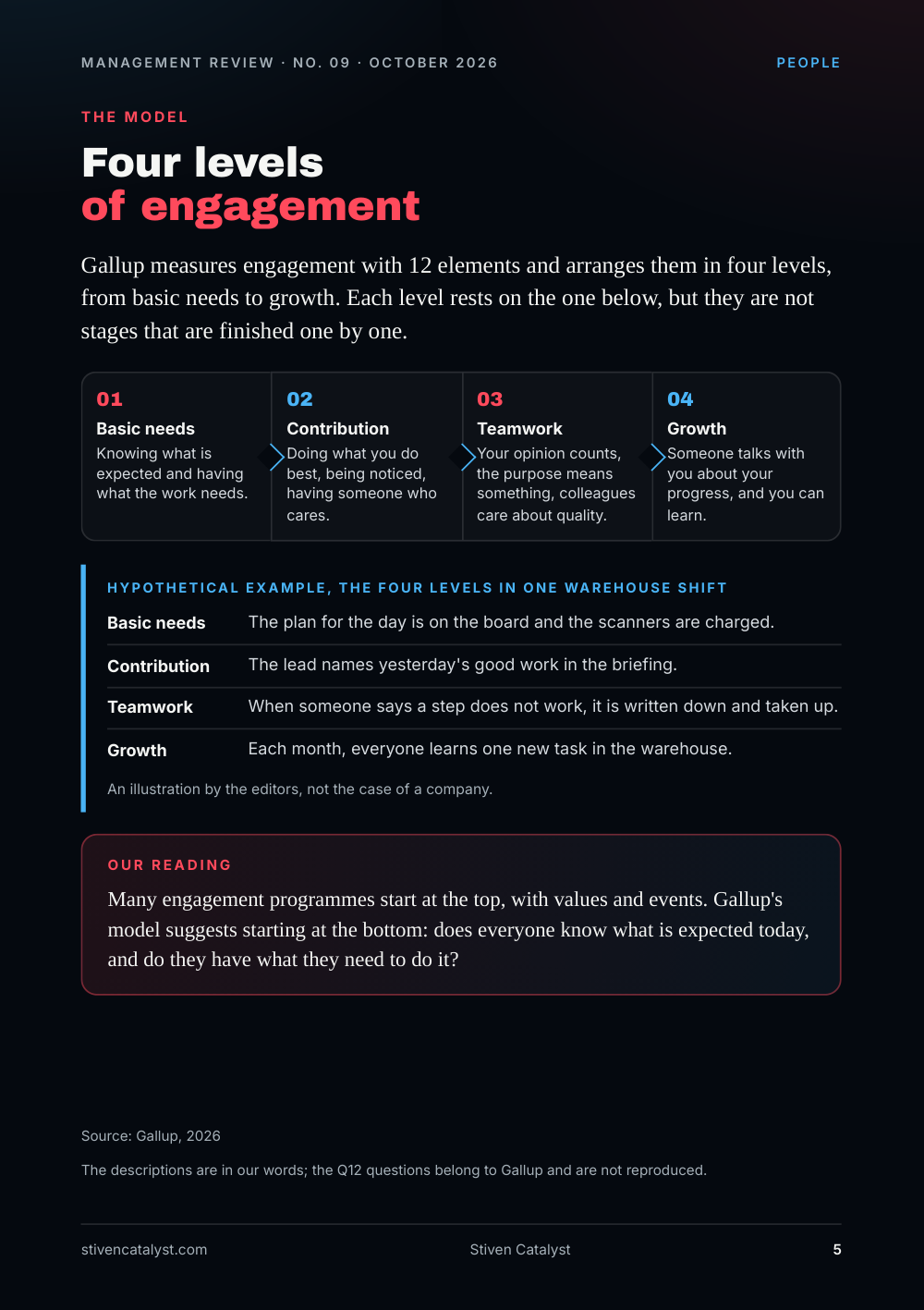
Four levels of engagement
Gallup measures engagement with 12 elements and arranges them in four levels, from basic needs to growth. Each level rests on the one below, but they are not stages that are finished one by one.
- Basic needs. Knowing what is expected and having what the work needs.
- Contribution. Doing what you do best, being noticed, having someone who cares.
- Teamwork. Your opinion counts, the purpose means something, colleagues care about quality.
- Growth. Someone talks with you about your progress, and you can learn.
Hypothe tical example, the four levels in one warehouse shif t
- Basic needs: The plan for the day is on the board and the scanners are charged.
- Contribution: The lead names yesterday's good work in the briefing.
- Teamwork: When someone says a step does not work, it is written down and taken up.
- Growth: Each month, everyone learns one new task in the warehouse.
An illustration by the editors, not the case of a company.
Our reading
Many engagement programmes start at the top, with values and events. Gallup's model suggests starting at the bottom: does everyone know what is expected today, and do they have what they need to do it?
The descriptions are in our words; the Q12 questions belong to Gallup and are not reproduced.
Source: Gallup, 2026
Why it matters
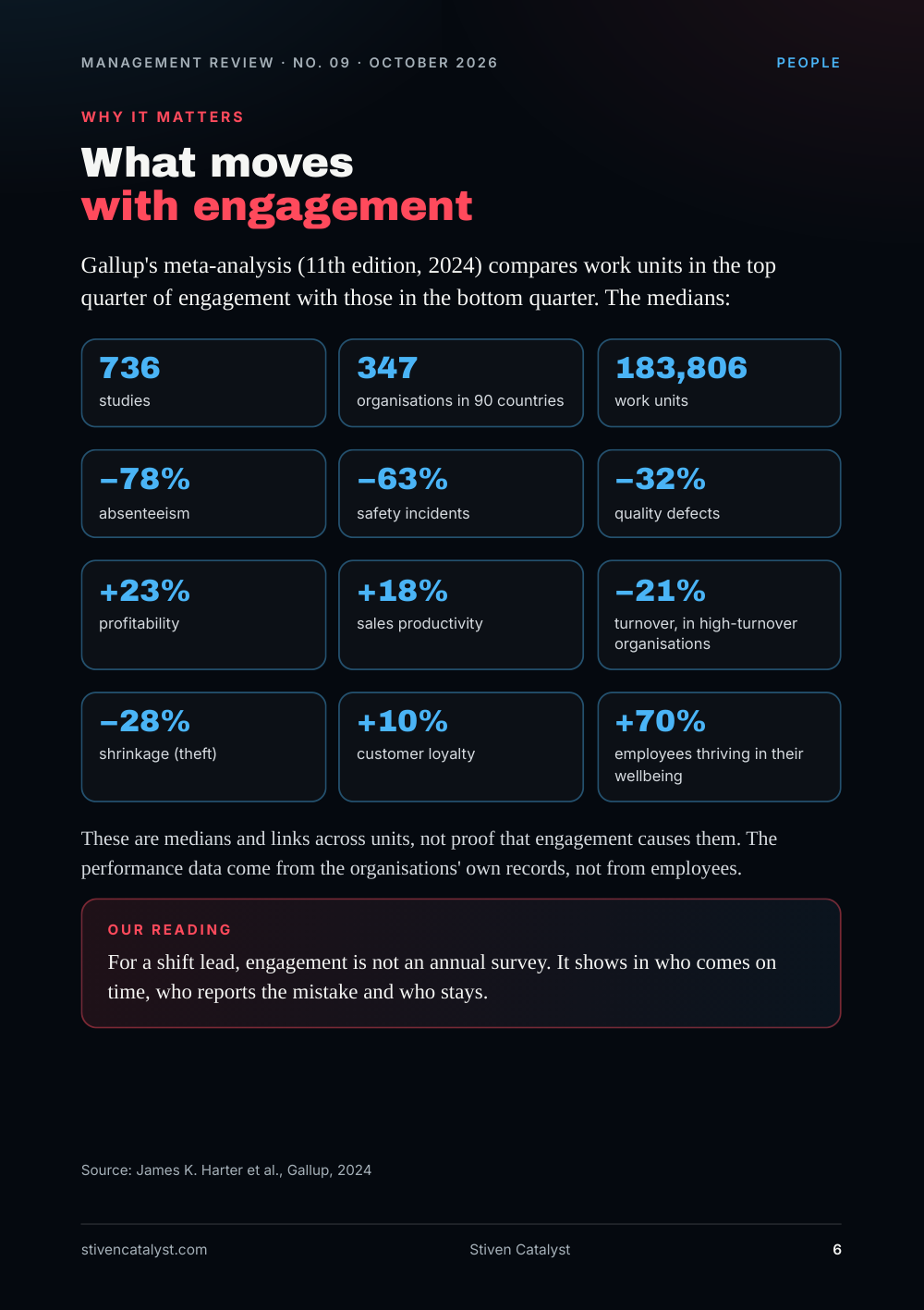
What moves with engagement
Gallup's meta-analysis (11th edition, 2024) compares work units in the top quarter of engagement with those in the bottom quarter. The medians:
- 736 studies
- 347 organisations in 90 countries
- 183,806 work units
- −78% absenteeism
- −63% safety incidents
- −32% quality defects
- +23% profitability
- +18% sales productivity
- −21% turnover, in high-turnover organisations
- −28% shrinkage (theft)
- +10% customer loyalty
- +70% employees thriving in their wellbeing
These are medians and links across units, not proof that engagement causes them. The performance data come from the organisations' own records, not from employees.
Our reading
For a shift lead, engagement is not an annual survey. It shows in who comes on time, who reports the mistake and who stays.
Source: James K. Harter et al., Gallup, 2024
How it is measured
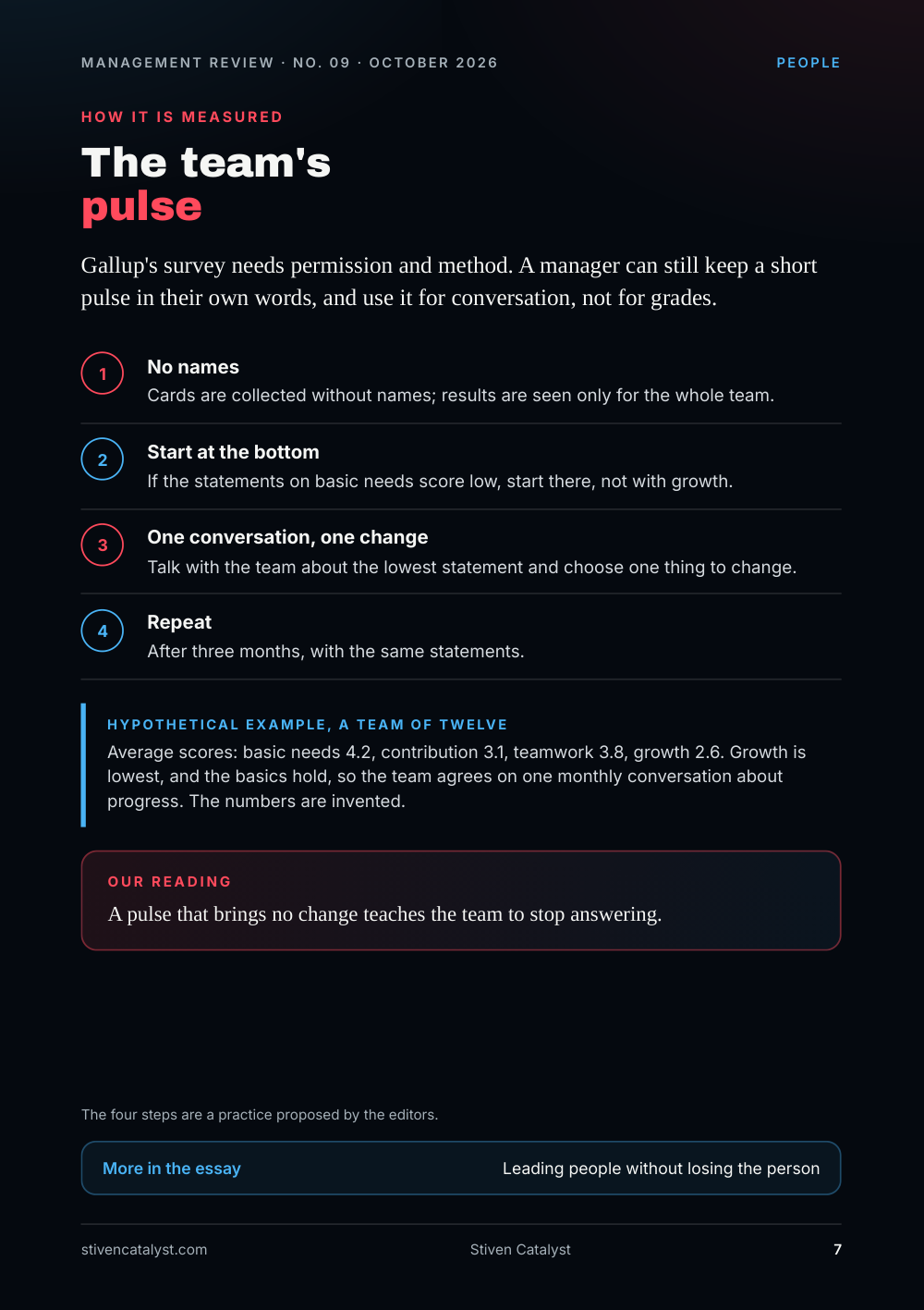
The team's pulse
Gallup's survey needs permission and method. A manager can still keep a short pulse in their own words, and use it for conversation, not for grades.
- No names. Cards are collected without names; results are seen only for the whole team.
- Sta
r t at the bot t om. If the statements on basic needs score low, start there, not with growth. - One conversation, one change. Talk with the team about the lowest statement and choose one thing to change.
- Repeat. After three months, with the same statements.
Hypoth
Our reading
A pulse that brings no change teaches the team to stop answering.
The four steps are a practice proposed by the editors.
More in the essay: Leading people without losing the person
Tool of the week
Eight statements for the team
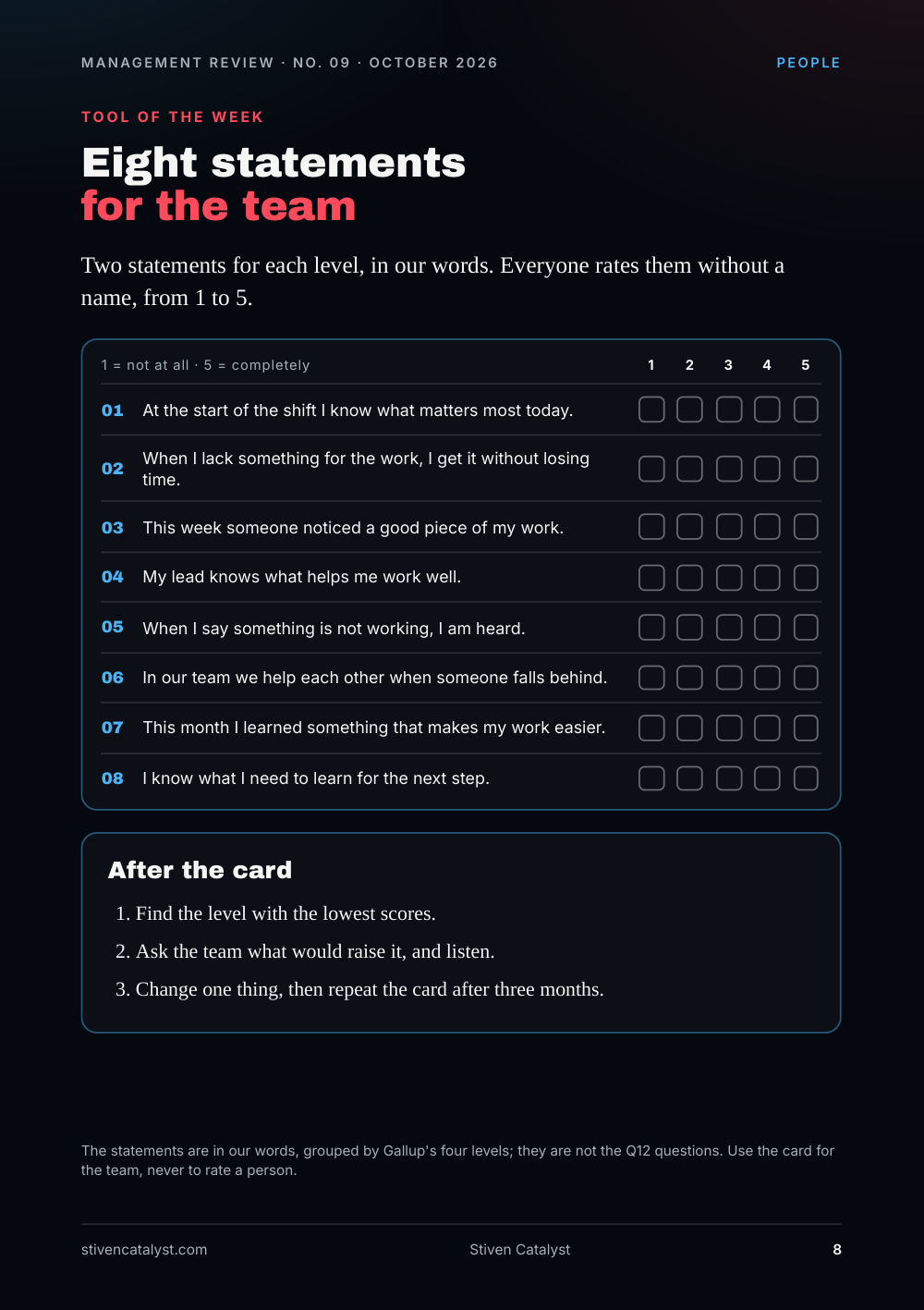
Two statements for each level, in our words. Everyone rates them without a name, from 1 to 5.
1 = not at all · 5 = completely
- At the start of the shift I know what matters most today.
- When I lack something for the work, I get it without losing time.
- This week someone noticed a good piece of my work.
- My lead knows what helps me work well.
- When I say something is not working, I am heard.
- In our team we help each other when someone falls behind.
- This month I learned something that makes my work easier.
- I know what I need to learn for the next step.
Af ter the card
- Find the level with the lowest scores.
- Ask the team what would raise it, and listen.
- Change one thing, then repeat the card after three months.
The statements are in our words, grouped by Gallup's four levels; they are not the Q12 questions. Use the card for the team, never to rate a person.
Sources and method
Every figure has a source.
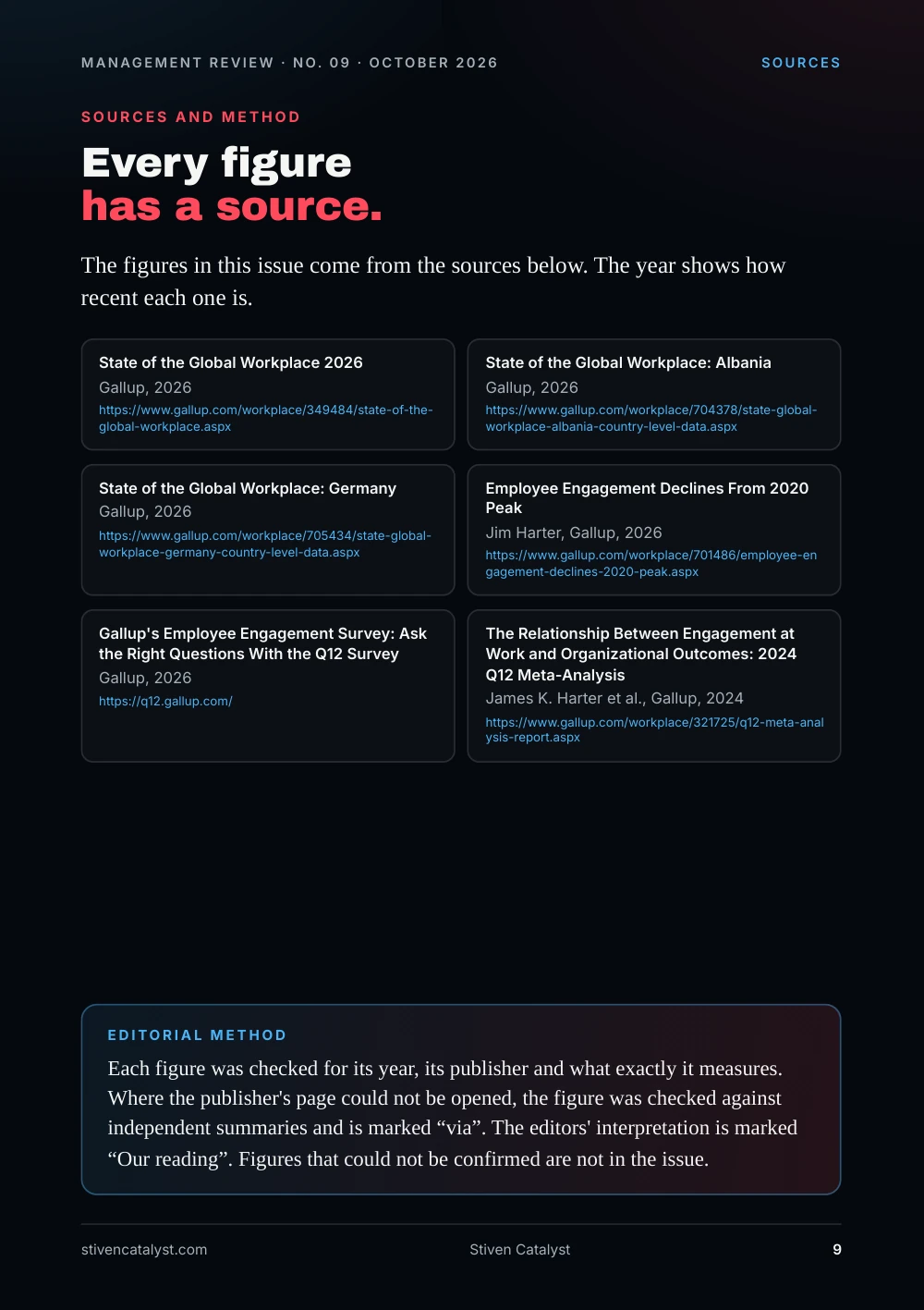
The figures in this issue come from the sources below. The year shows how recent each one is.
- Gallup, “State of the Global Workplace 2026”, 2026. https://www.gallup.com/workplace/349484/state-of-the-global-workplace.aspx
- Gallup, “State of the Global Workplace: Albania”, 2026. https://www.gallup.com/workplace/704378/state-global-workplace-albania-country-level-data.aspx
- Gallup, “State of the Global Workplace: Germany”, 2026. https://www.gallup.com/workplace/705434/state-global-workplace-germany-country-level-data.aspx
- Jim Harter, Gallup, “Employee Engagement Declines From 2020 Peak”, 2026. https://www.gallup.com/workplace/701486/employee-engagement-declines-2020-peak.aspx
- Gallup, “Gallup's Employee Engagement Survey: Ask the Right Questions With the Q12 Survey”, 2026. https://q12.gallup.com/
- James K. Harter et al., Gallup, “The Relationship Between Engagement at Work and Organizational Outcomes: 2024 Q12 Meta-Analysis”, 2024. https://www.gallup.com/workplace/321725/q12-meta-analysis-report.aspx
Edit orial me thod
Each figure was checked for its year, its publisher and what exactly it measures. Where the publisher's page could not be opened, the figure was checked against independent summaries and is marked “via”. The editors' interpretation is marked “Our reading”. Figures that could not be confirmed are not in the issue.