In this issue
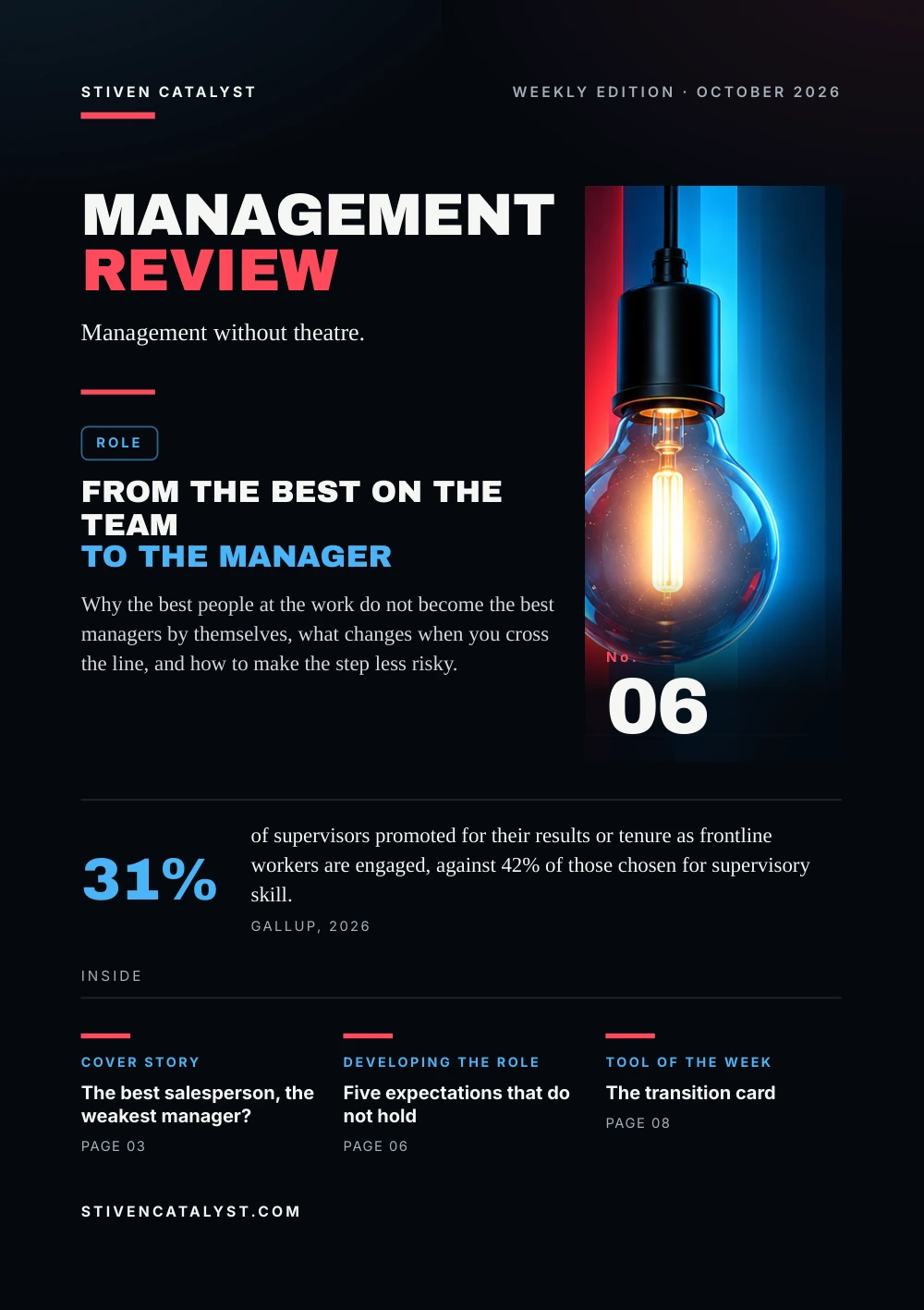
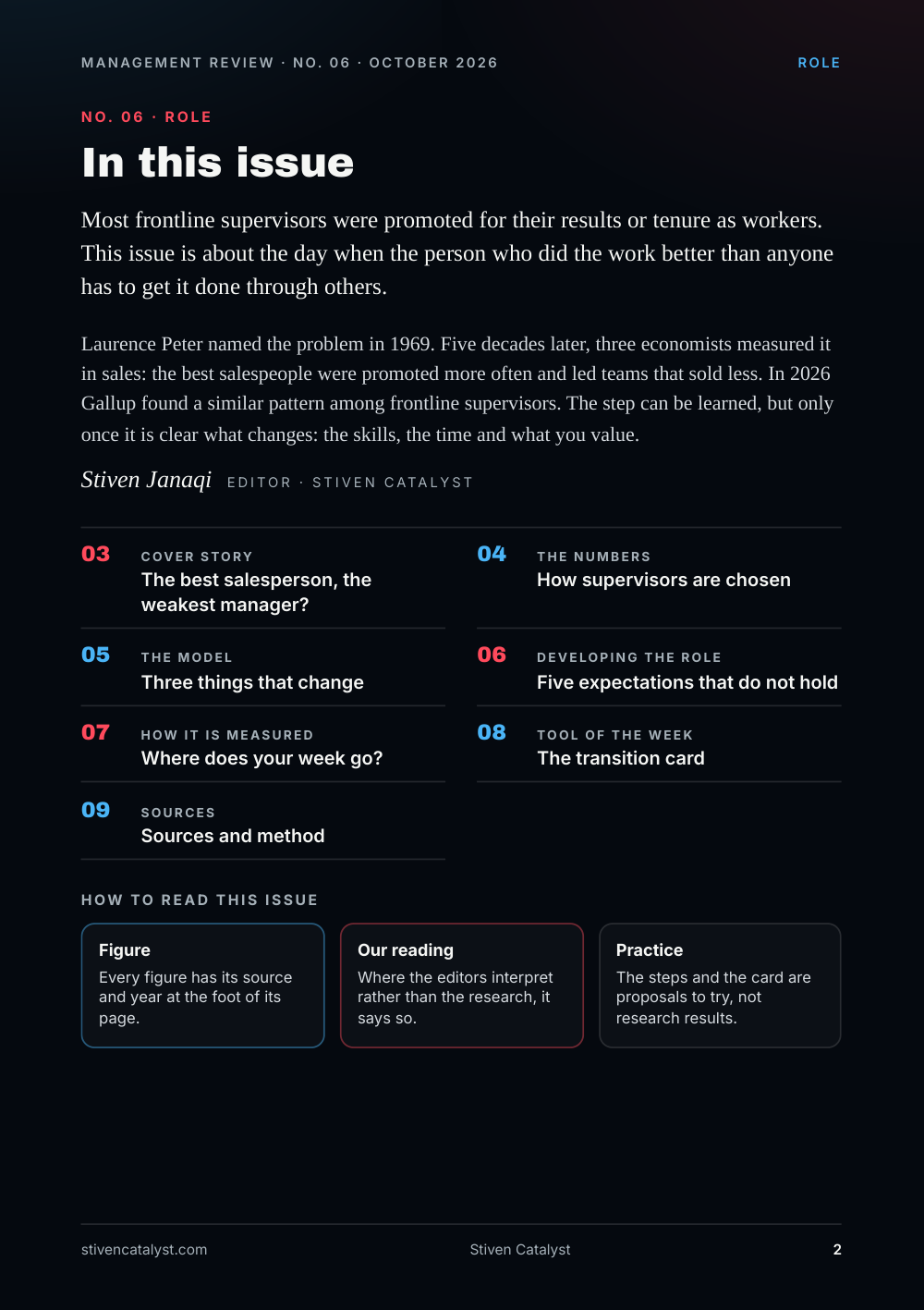
Most frontline supervisors were promoted for their results or tenure as workers. This issue is about the day when the person who did the work better than anyone has to get it done through others.
Laurence Peter named the problem in 1969. Five decades later, three economists measured it in sales: the best salespeople were promoted more often and led teams that sold less. In 2026 Gallup found a similar pattern among frontline supervisors. The step can be learned, but only once it is clear what changes: the skills, the time and what you value.
Stiven Janaqi, Editor
Cover story
The best salesperson, the weakest manager?
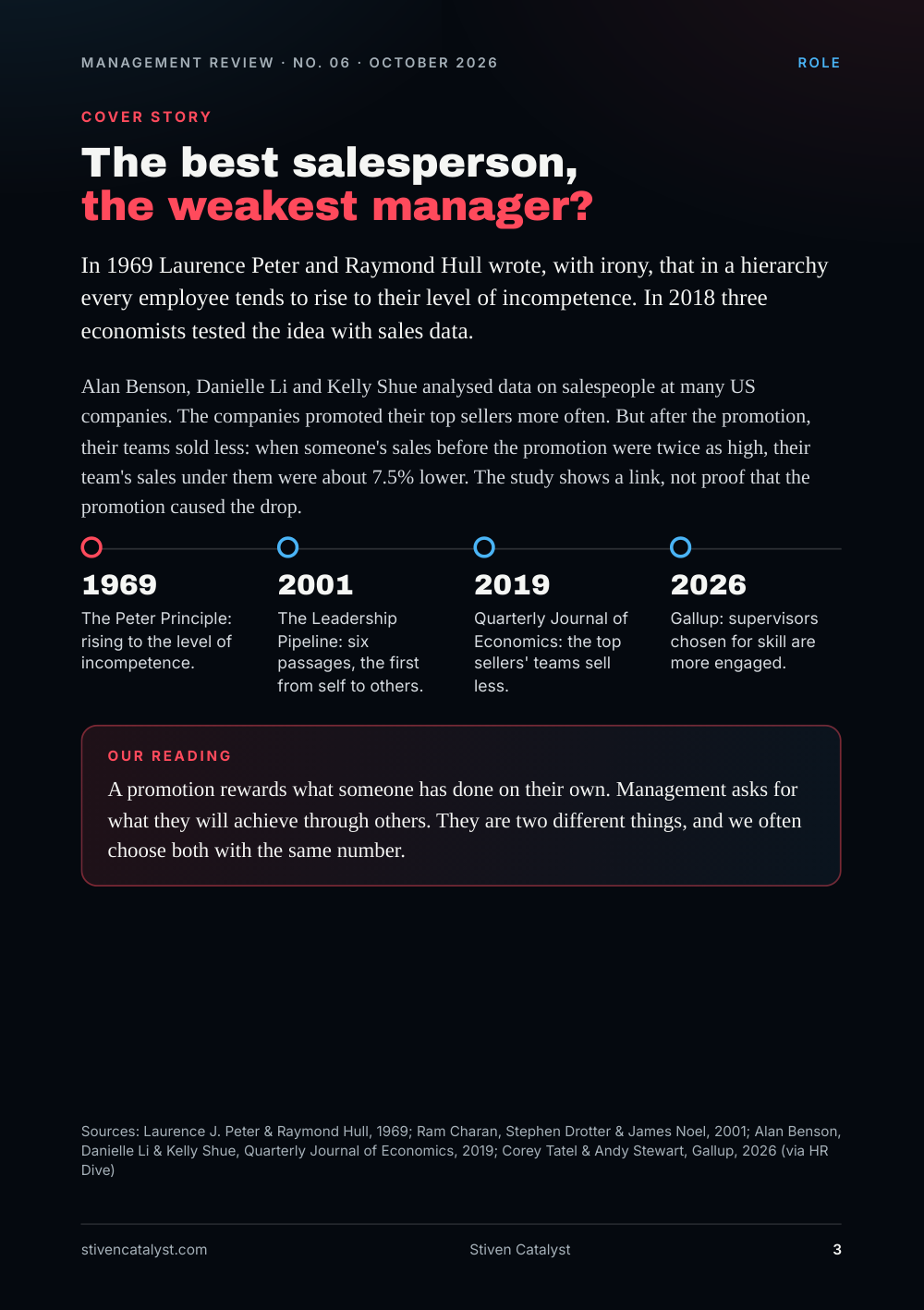
In 1969 Laurence Peter and Raymond Hull wrote, with irony, that in a hierarchy every employee tends to rise to their level of incompetence. In 2018 three economists tested the idea with sales data.
Alan Benson, Danielle Li and Kelly Shue analysed data on salespeople at many US companies. The companies promoted their top sellers more often. But after the promotion, their teams sold less: when someone's sales before the promotion were twice as high, their team's sales under them were about 7.5% lower. The study shows a link, not proof that the promotion caused the drop.
- 1969 The Peter Principle: rising to the level of incompetence.
- 2001 The Leadership Pipeline: six passages, the first from self to others.
- 2019 Quarterly Journal of Economics: the top sellers' teams sell less.
- 2026 Gallup: supervisors chosen for skill are more engaged.
Our reading
A promotion rewards what someone has done on their own. Management asks for what they will achieve through others. They are two different things, and we often choose both with the same number.
Sources: Laurence J. Peter & Raymond Hull, 1969; Ram Charan, Stephen Drotter & James Noel, 2001; Alan Benson, Danielle Li & Kelly Shue, Quarterly Journal of Economics, 2019; Corey Tatel & Andy Stewart, Gallup, 2026 (via HR Dive)
The numbers
How supervisors are chosen
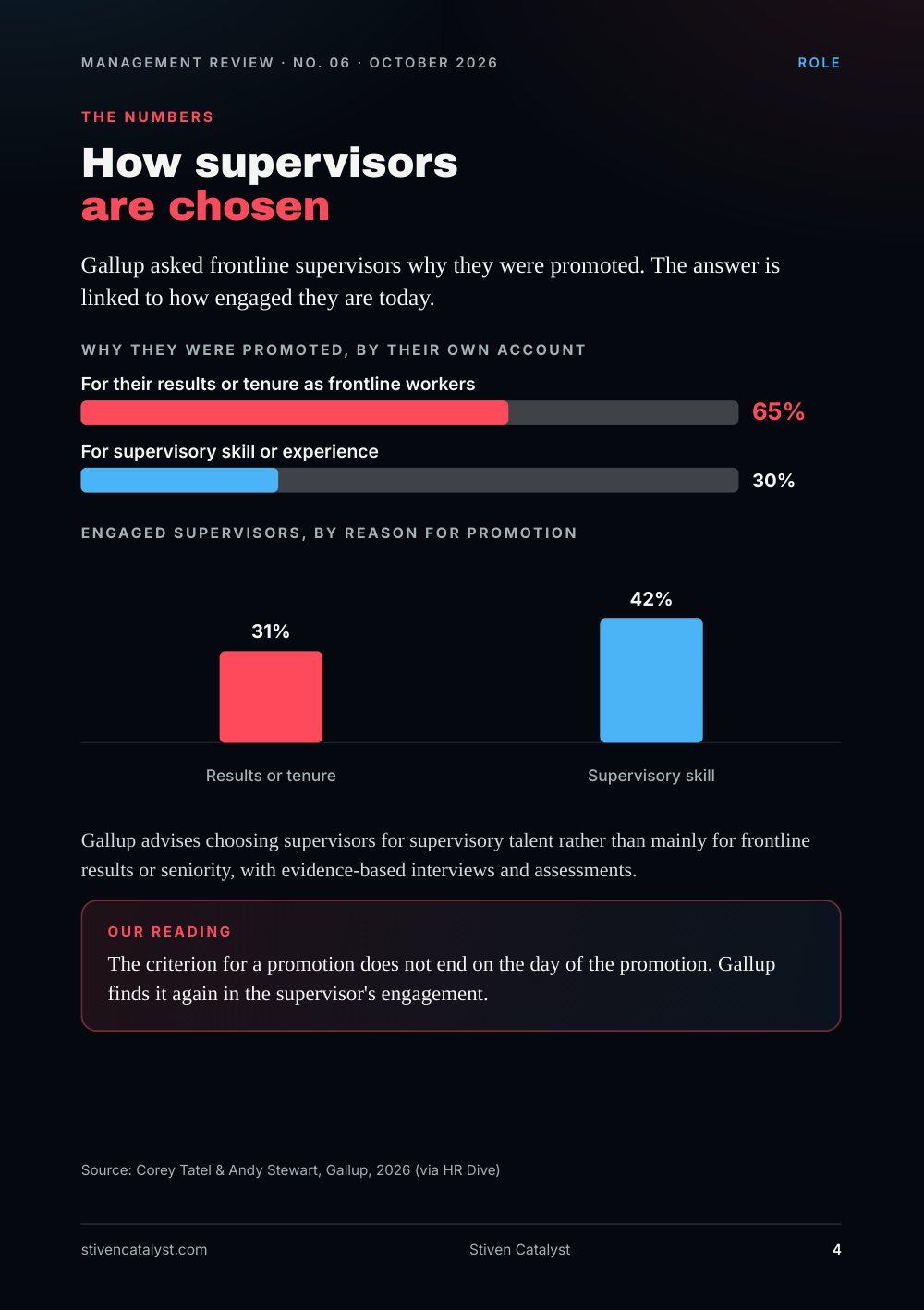
Gallup asked frontline supervisors why they were promoted. The answer is linked to how engaged they are today.
Why they were promoted, by their own account: For their results or tenure as frontline workers 65%, For supervisory skill or experience 30%.
Engaged supervisors, by reason for promotion: Results or tenure 31%, Supervisory skill 42%.
Gallup advises choosing supervisors for supervisory talent rather than mainly for frontline results or seniority, with evidence-based interviews and assessments.
Our reading
The criterion for a promotion does not end on the day of the promotion. Gallup finds it again in the supervisor's engagement.
Source: Corey Tatel & Andy Stewart, Gallup, 2026 (via HR Dive)
The model
Three things that change
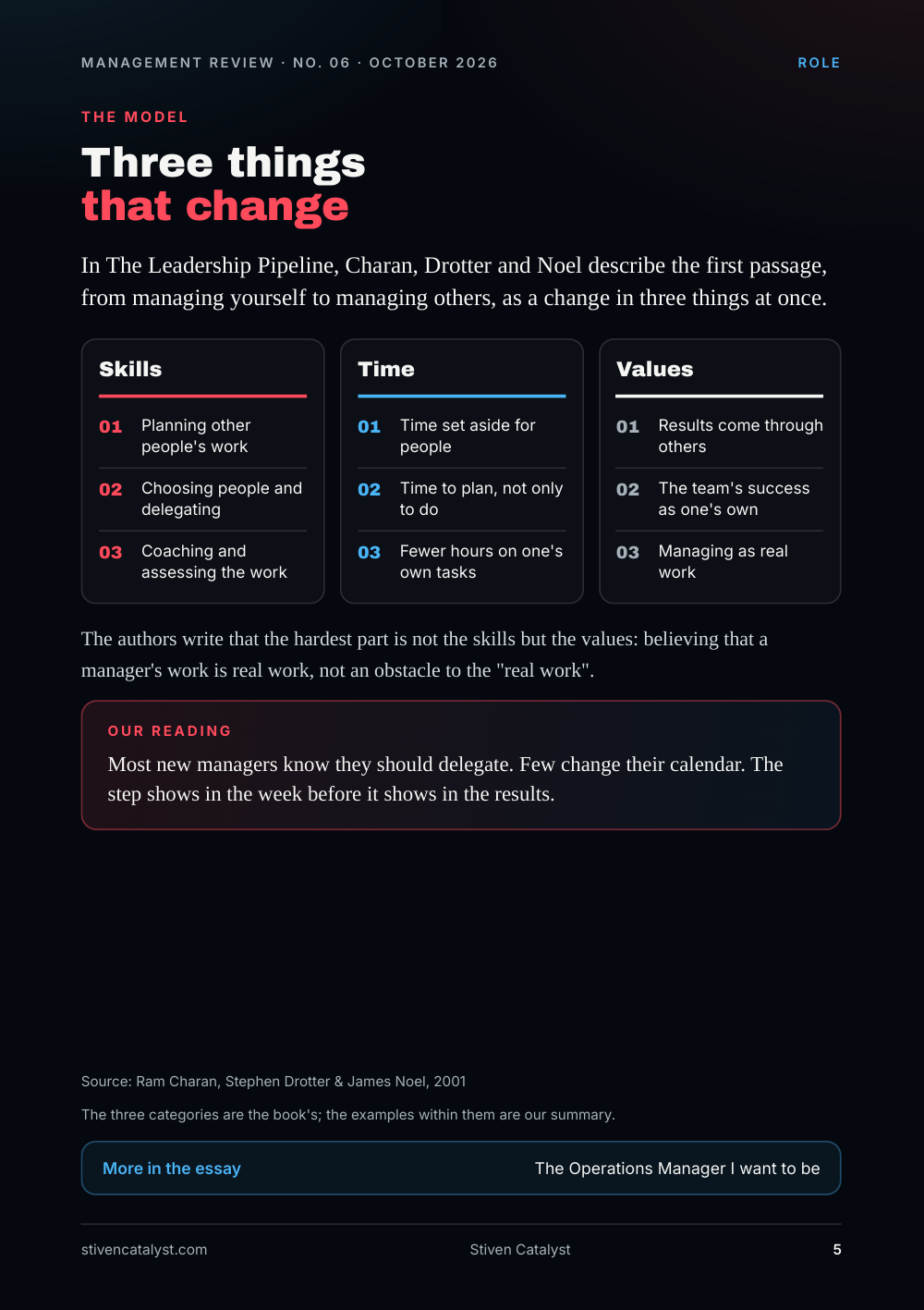
In The Leadership Pipeline, Charan, Drotter and Noel describe the first passage, from managing yourself to managing others, as a change in three things at once.
Skills
- 01. Planning other people's work
- 02. Choosing people and delegating
- 03. Coaching and assessing the work
Time
- 01. Time set aside for people
- 02. Time to plan, not only to do
- 03. Fewer hours on one's own tasks
Values
- 01. Results come through others
- 02. The team's success as one's own
- 03. Managing as real work
The authors write that the hardest part is not the skills but the values: believing that a manager's work is real work, not an obstacle to the "real work".
Our reading
Most new managers know they should delegate. Few change their calendar. The step shows in the week before it shows in the results.
The three categories are the book's; the examples within them are our summary.
Source: Ram Charan, Stephen Drotter & James Noel, 2001
More in the essay: The Operations Manager I want to be
Developing the role
Five expectations that do not hold
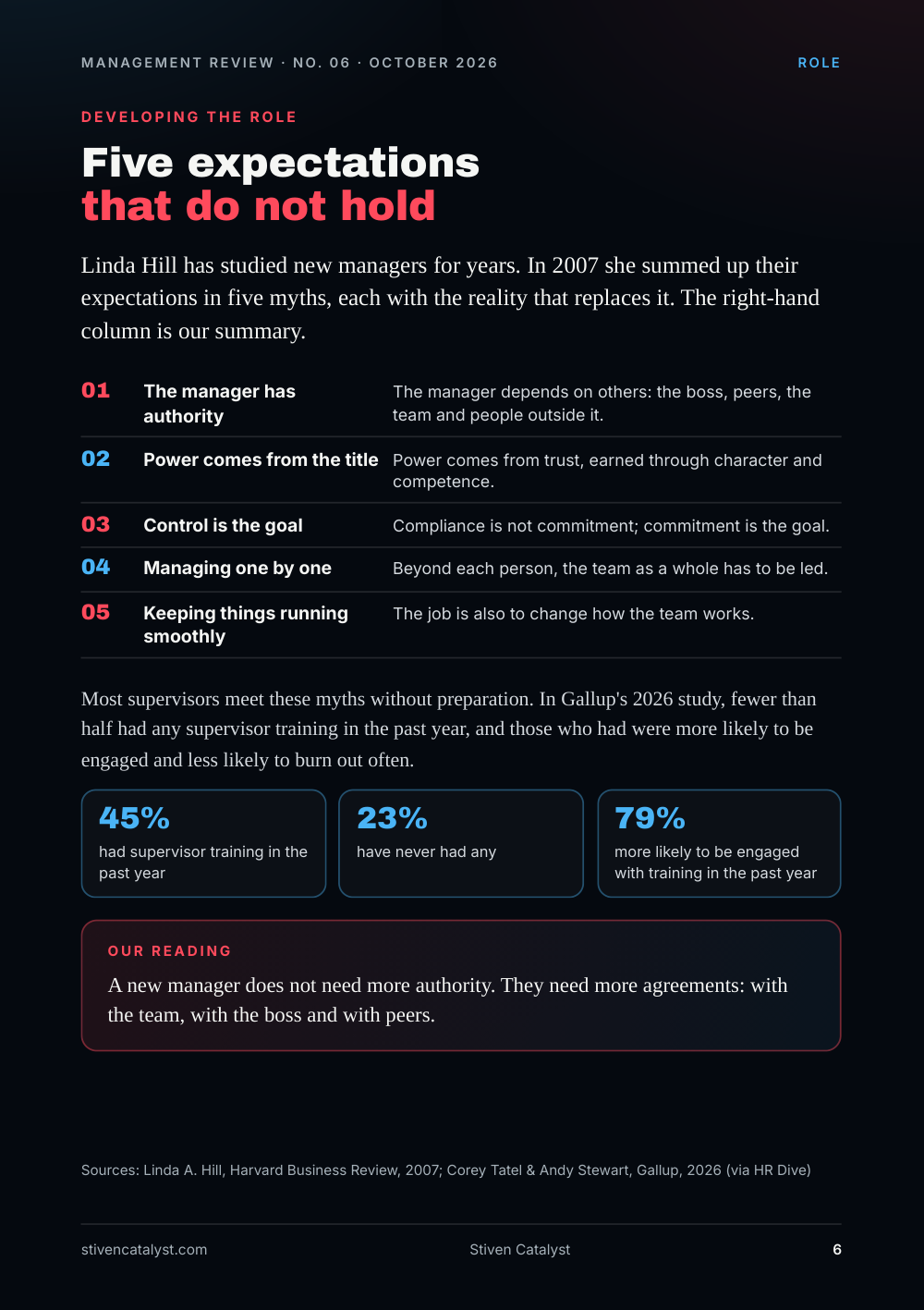
Linda Hill has studied new managers for years. In 2007 she summed up their expectations in five myths, each with the reality that replaces it. The right-hand column is our summary.
- The manager has authori
t y. The manager depends on others: the boss, peers, the team and people outside it. - Power comes from the title. Power comes from trust, earned through character and competence.
- Control is the goal. Compliance is not commitment; commitment is the goal.
- Managing one by one. Beyond each person, the team as a whole has to be led.
- Keeping things running smoothly. The job is also to change how the team works.
Most supervisors meet these myths without preparation. In Gallup's 2026 study, fewer than half had any supervisor training in the past year, and those who had were more likely to be engaged and less likely to burn out often.
- 45% had supervisor training in the past year
- 23% have never had any
- 79% more likely to be engaged with training in the past year
Our reading
A new manager does not need more authority. They need more agreements: with the team, with the boss and with peers.
Sources: Linda A. Hill, Harvard Business Review, 2007; Corey Tatel & Andy Stewart, Gallup, 2026 (via HR Dive)
How it is measured
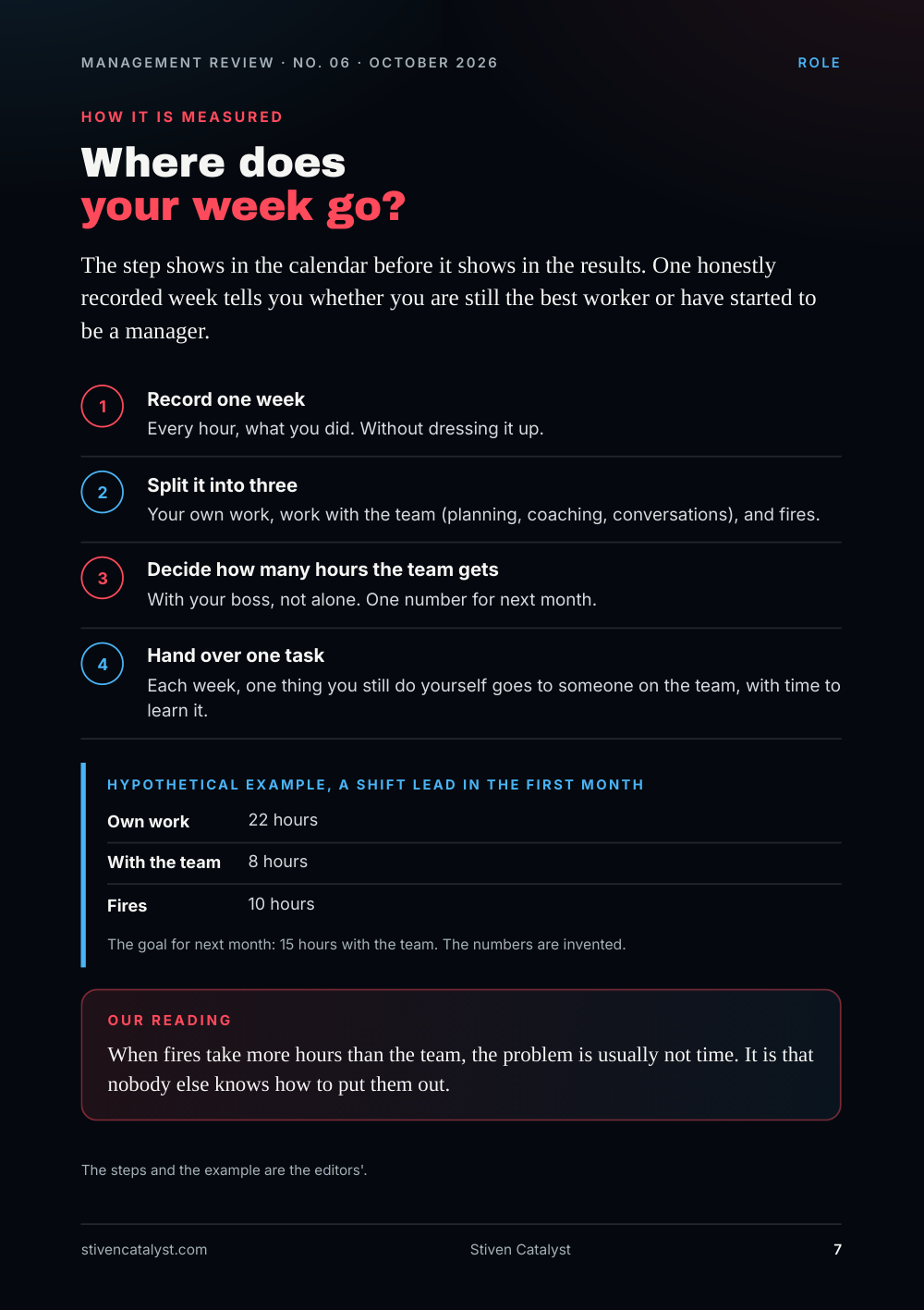
Where does your week go?
The step shows in the calendar before it shows in the results. One honestly recorded week tells you whether you are still the best worker or have started to be a manager.
- Record one week. Every hour, what you did. Without dressing it up.
- Split it in
t o three. Your own work, work with the team (planning, coaching, conversations), and fires. - Decide how many hours the team g
e ts. With your boss, not alone. One number for next month. - Hand over one task. Each week, one thing you still do yourself goes to someone on the team, with time to learn it.
Hypothe tical example, a shif t lead in the first month
- Own work: 22 hours
- With the team: 8 hours
- Fires: 10 hours
The goal for next month: 15 hours with the team. The numbers are invented.
Our reading
When fires take more hours than the team, the problem is usually not time. It is that nobody else knows how to put them out.
The steps and the example are the editors'.
Tool of the week
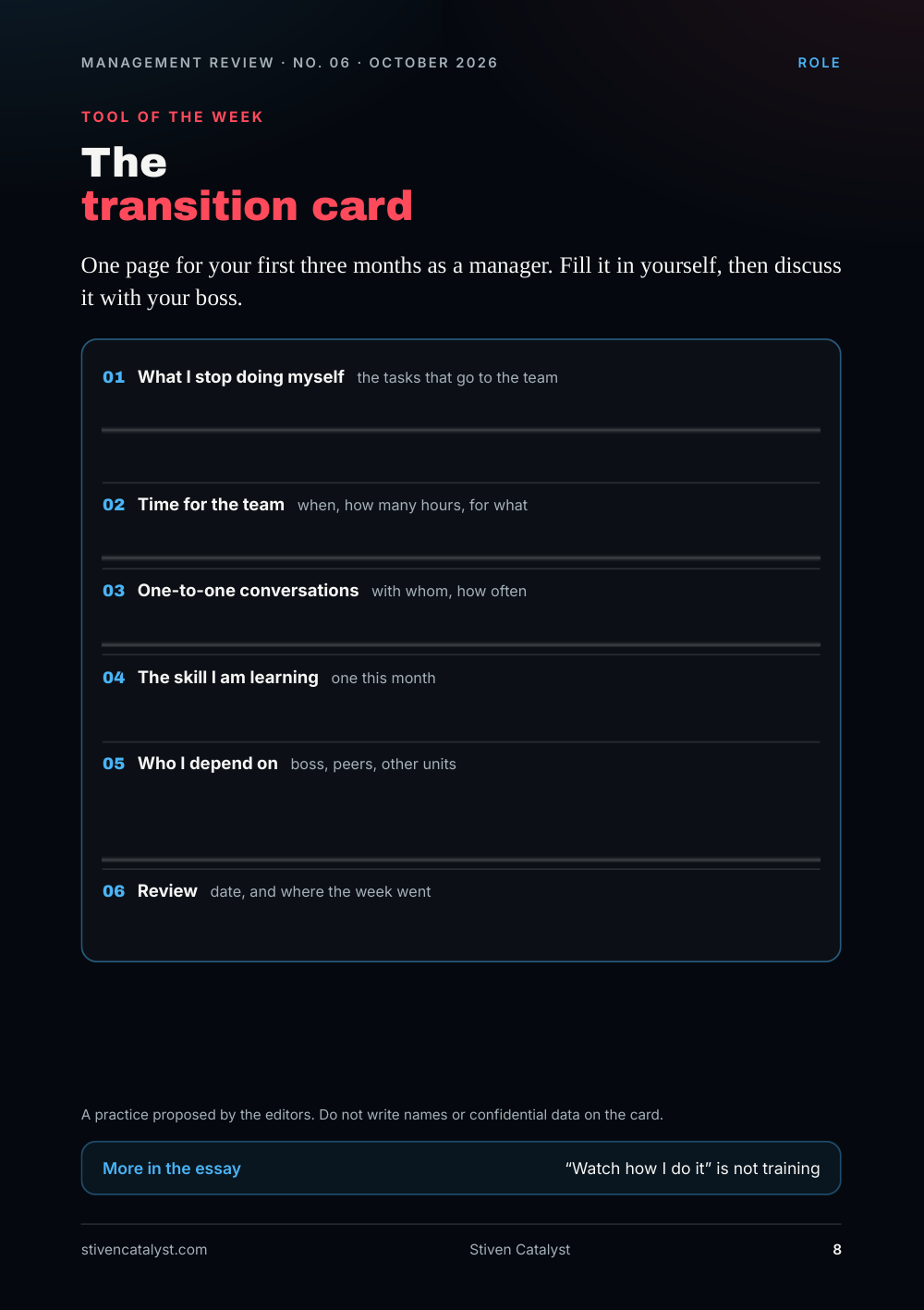
The transition card
One page for your first three months as a manager. Fill it in yourself, then discuss it with your boss.
- What I s
t op doing myself the tasks that go to the team - Time for the team when, how many hours, for what
- One-
t o-one conversations with whom, how often - The skill I am learning one this month
- Who I depend on boss, peers, other units
- Review date, and where the week went
A practice proposed by the editors. Do not write names or confidential data on the card.
More in the essay: “Watch how I do it” is not training
Sources and method
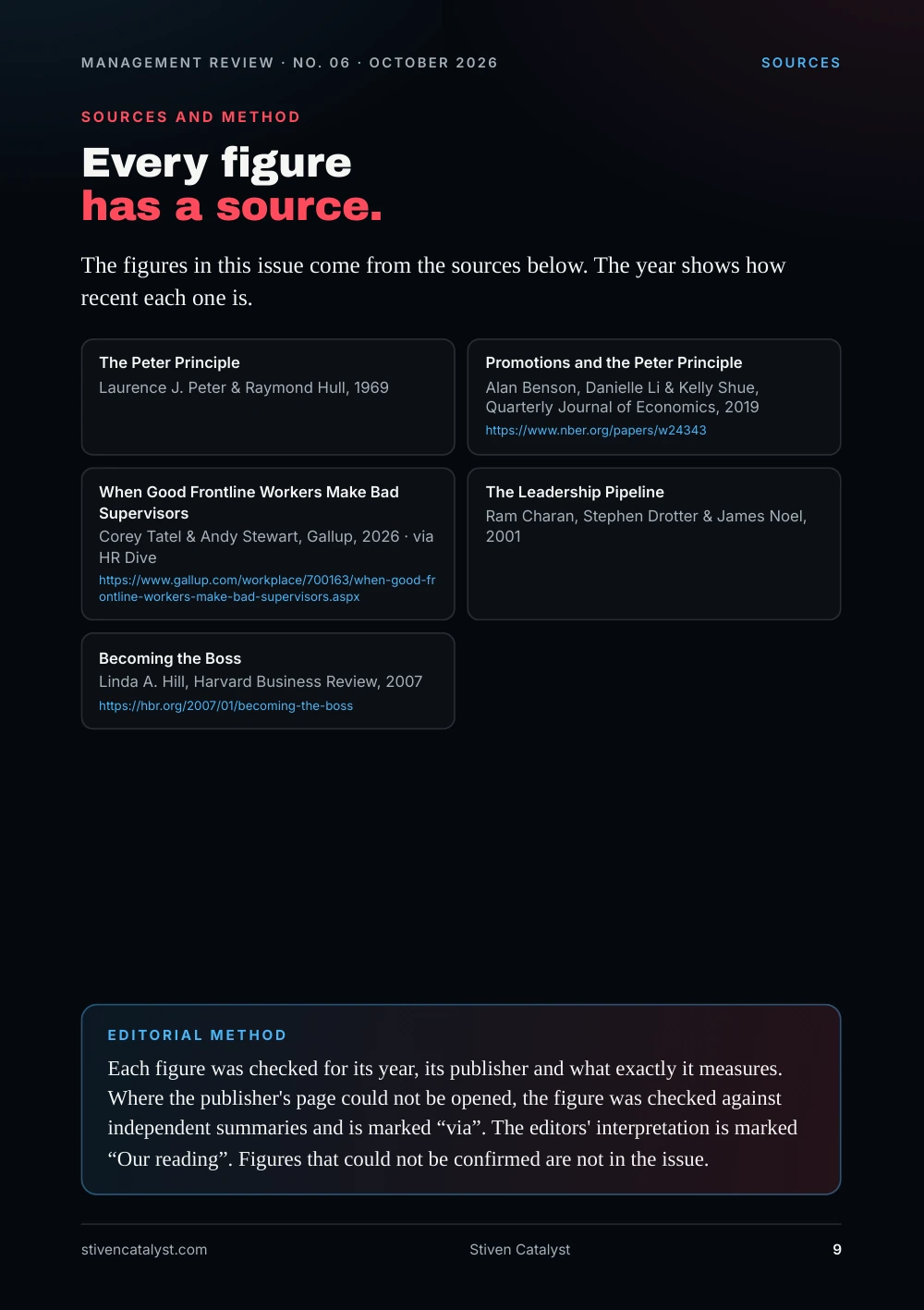
Every figure has a source.
The figures in this issue come from the sources below. The year shows how recent each one is.
- Laurence J. Peter & Raymond Hull, “The Peter Principle”, 1969.
- Alan Benson, Danielle Li & Kelly Shue, Quarterly Journal of Economics, “Promotions and the Peter Principle”, 2019. https://www.nber.org/papers/w24343
- Corey Tatel & Andy Stewart, Gallup, “When Good Frontline Workers Make Bad Supervisors”, 2026 (via HR Dive). https://www.gallup.com/workplace/700163/when-good-frontline-workers-make-bad-supervisors.aspx
- Ram Charan, Stephen Drotter & James Noel, “The Leadership Pipeline”, 2001.
- Linda A. Hill, Harvard Business Review, “Becoming the Boss”, 2007. https://hbr.org/2007/01/becoming-the-boss
Edit orial me thod
Each figure was checked for its year, its publisher and what exactly it measures. Where the publisher's page could not be opened, the figure was checked against independent summaries and is marked “via”. The editors' interpretation is marked “Our reading”. Figures that could not be confirmed are not in the issue.