In a trial with 3,597 postal workers, training raised knowledge but not the lifting, and back injuries were no fewer than after a video. A Cochrane review of nine trials with 20,101 workers found none in which training prevented back pain. In Europe 43% of workers report backache. EU law and HSE put avoiding and reducing the load first; HSE's filter shows the weight that is low risk falling with the hands' distance from the waist. A card for one task closes the issue.
Management Review · Third series · November 2026 · No. 99
Lif ting and the back: technique is not enough
Postal workers who learned to lift, nine trials with 20,101 workers, what the law puts before training, where the hands are, and a card for one handling task.
- No.
- 99
- Pages
- 10
- Sources
- 6
- Topics
- People
- Online since
- 3 November 2026
Stiven CatalystThird series · November 2026
ManagementReview
Management without theatre.
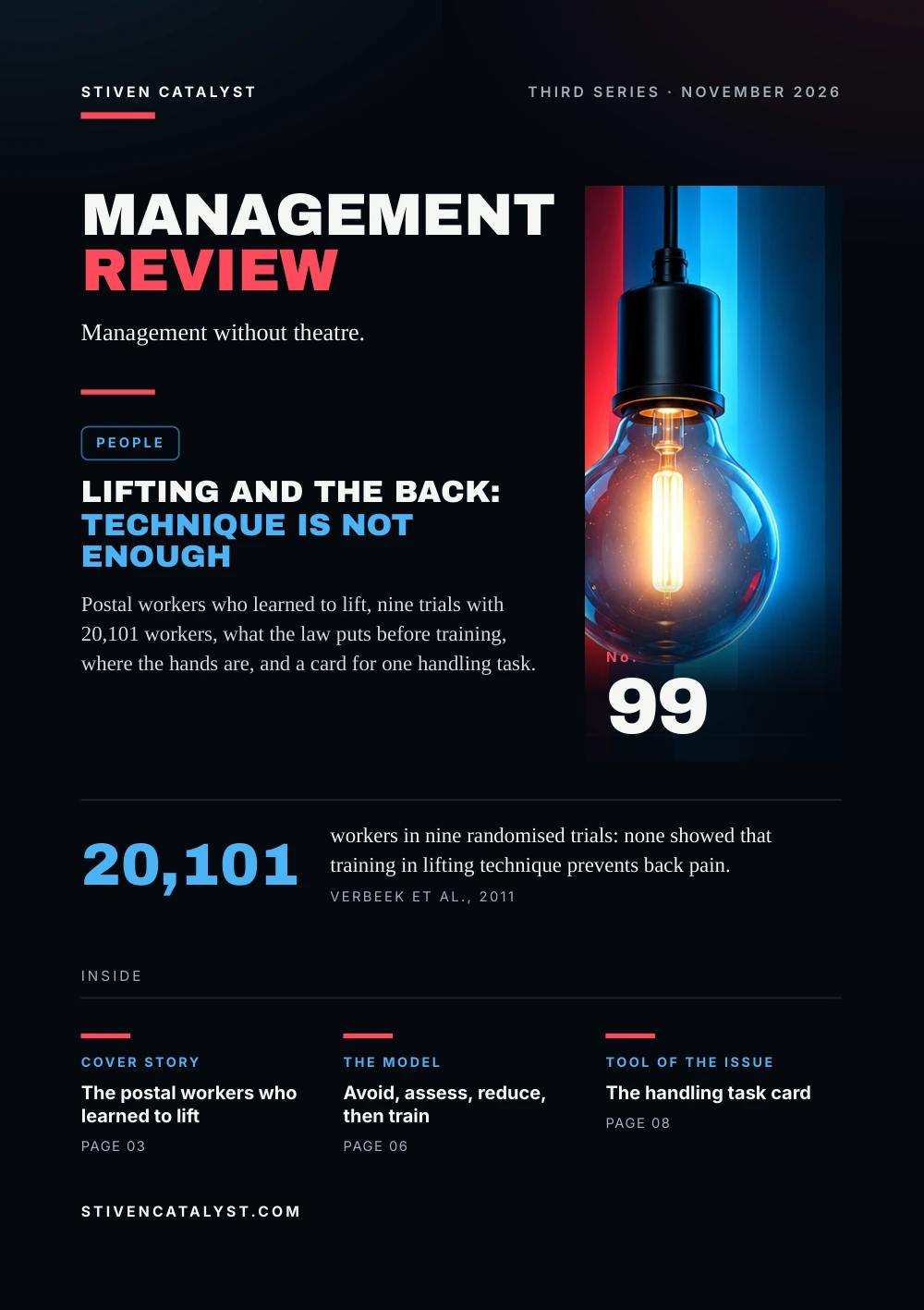
People
Lifting and the back:technique is not enough
Postal workers who learned to lift, nine trials with 20,101 workers, what the law puts before training, where the hands are, and a card for one handling task.

No.99
20,101
workers in nine randomised trials: none showed that training in lifting technique prevents back pain.Verbeek et al., 2011
stivencatalyst.com
No. 99 · People
In this issue
When backs hurt in a warehouse, a kitchen or on a ward, the usual answer is a course: bend the knees, keep the back straight. It is cheap, it can be signed off, and it puts the answer in the worker's body. This issue asks what the trials found, and what comes before the course.
- 03Cover storyThe postal workers who learned to lift
- 04The numbersHow common the sore back is
- 05What the research saysNine trials, one answer
- 06The modelAvoid, assess, reduce, then train
- 07How it is measuredWhere the hands are
- 08Tool of the issueThe handling task card
- 09SourcesSources and method
How to read this issue
Figure
Every figure has its source and year at the foot of its page.
Our reading
Where the editor interprets rather than the research, it says so.
Practice
The steps and the card are proposals to try, not research results.
Cover story
The postal workerswho learned t o lif t
In a US postal trial, 3,597 workers were randomised in clusters. One group got two sessions of 1.5 hours on proper lifting and carrying, with supervisors involved and follow-up at work; the other got the usual video. The researchers then counted back injuries for five and a half years.
1.08odds of back injury, trained against video: no difference (95% interval 0.56 to 2.08)
5.5 yrsof follow-up, rated high quality by the reviewers
The researchers reported separately what had changed: the workers knew more, but their lifting and handling did not improve significantly. Martimo and colleagues, who pooled this trial with ten other studies in the BMJ in 2008, concluded that the findings challenge the widespread practice of advising workers on correct lifting technique.
Our reading
Knowing how to lift and lifting that way are two things. Neither one changes how heavy the box is or where it sits.
Sources: Kari-Pekka Martimo, Jos Verbeek, Jaro Karppinen et al., BMJ 336(7641), 2008; Jos H. Verbeek, Kari-Pekka Martimo, Jaro Karppinen, P. Paul F. M. Kuijer, Eira Viikari-Juntura & Esa-Pekka Takala, Cochrane Database of Systematic Reviews, 2011
Daltroy et al. (1997) as Martimo et al. (2008) report it; the odds ratio is the reviewers', adjusted for clustering. The change in knowledge but not in behaviour is from the trial's separate report (1993), as both reviews cite it.
The numbers
How commonthe sore back is
EU-OSHA put the European surveys together in 2019. Roughly three in five workers reported a musculoskeletal complaint in the past year, and of all workers with a work-related health problem, 60% named these disorders as the most serious one.
Workers reporting each complaint in the past 12 months, EU-28, 2015
32%carry or move heavy loads at least a quarter of the time (2015)
22%of injuries in Great Britain with over seven days off came from handling, lifting or carrying (2024/25)
Our reading
Handling injuries seldom make the list of specified injuries, which are mostly fractures: 5% of them, against 22% of the long absences. The cost shows up as days off.
Sources: European Agency for Safety and Health at Work (EU-OSHA); authors Jan de Kok et al., 2019; Health and Safety Executive, 2025
Bars: self-reports in the European Working Conditions Survey, 31,612 workers, any cause, not only lifting. Figures: EWCS 2015; HSE, employer reports under RIDDOR, provisional. The ranking of injury kinds is in No. 15.
What the research says
Nine trials,one answer
Jos Verbeek and colleagues updated the Cochrane review in 2011: nine randomised trials with 20,101 workers and nine cohort studies with 1,280, among carers lifting patients, mail and baggage handlers, and construction workers. Training was compared with nothing, a video, back belts, exercise or other education.
Training against nothing
back pain similar; odds ratio 1.17, interval 0.68 to 2.02 (moderate quality)
Intensive training against a video
similar; in one trial a measuring device gave constant feedback on back load
Training against back belts or exercise
similar (belts: low quality; exercise: cohort studies only)
Training with lifting aids
one trial, 346 nurses: similar after a year (low quality)
Where compliance was checked, four of six studies saw lifting change, and still back pain did not. The reviewers note that the textbook leg lift has itself been questioned on biomechanical grounds.
Our reading
The review tested the worker's technique, not the job. Workplace redesign was outside its scope, so it says little about what redesign would do.
Source: Jos H. Verbeek, Kari-Pekka Martimo, Jaro Karppinen, P. Paul F. M. Kuijer, Eira Viikari-Juntura & Esa-Pekka Takala, Cochrane Database of Systematic Reviews, 2011
Odds ratio from the review's abstract, seven trials, 19,317 workers. Confidence intervals are wide because the reviewers corrected for clustered designs. A reader's comment of 2007, printed with the review, warns that no evidence of effect is not evidence of no effect.
The model
Avoid, assess,reduce, then train
Germany's Lastenhandhabungsverordnung, which carries out EU Directive 90/269/EEC, sets an order: first avoid hazardous handling by organisation or mechanical equipment; where it cannot be avoided, assess it and keep the risk as low as possible. Instruction is a duty of its own. HSE's guide puts training after avoiding and reducing.
The load
- weight, shape and size
- where it is gripped
- centre of gravity, sudden movement
The task
- posture, twisting, distance from the body
- how far, how often, how long
- a pace the worker cannot change; rest
The workplace
- headroom, changes of level
- heat, humidity, light
- an even, non-slip floor; footwear
HSE puts it plainly: information and training alone will not ensure safe handling, and on its own training cannot make up for missing aids, badly designed tasks, unsuitable loads or an unsuitable workplace.
Our reading
Most of these features belong to the job, not to the worker's spine. The manager owns them.
Sources: Lastenhandhabungsverordnung, Federal Government of Germany (BGBl. I 1996, p. 1841), implementing Council Directive 90/269/EEC, 2020; Health and Safety Executive, 2020
Features from the annex of the Lastenhandhabungsverordnung (§ 2, annex), shortened by the editors; the order of measures from § 2 and from HSE's INDG143. Heat and handling together are in No. 84; floors and footwear in No. 100.
How it is measured
Where thehands are
HSE's risk filter does not set a safe limit; it marks tasks that are low risk. The weight in each box assumes a load easily gripped with both hands, a stable stance and reasonable conditions. It falls as the hands move away from the waist.
HSE filter, men, load close to the body, kg by zone of the hands
Arms extended
lower values: 15 kg instead of 25 between elbow and knuckle; women's values are about two thirds
Look closer if
the torso twists, lifts come more than once every two minutes, a team lifts, or a load is carried beyond about 10 m
Source: Health and Safety Executive, 2020
Values from figure 1 of HSE's INDG143 (2020), men, hands close to the body; women 7, 13, 16, 13, 7 kg. Zones as HSE draws them, between shoulder, elbow, knuckle and mid-shin height; short names by the editors. Guidelines for groups, not limits for a person. Injury rates are in No. 87, fatigue in No. 89.
Tool of the issue
The handlingtask card
One card per handling task, filled in where the task is done and with the people who do it. The questions follow the legal order: can it go, can it be lighter or closer, and only then what people need to know. The full assessment belongs in Risk Assessment.
01Task and loadwhat, from where to where, heaviest weight, how it is gripped
02Where the hands golowest and highest point, arms close or extended, twisting
03How often, how farlifts per hour, carrying distance, pace set by whom
04Can it be avoided?deliver to the point of use, conveyor, truck, hoist, store at waist height
05Can it be reduced?smaller packs, handles, shorter route, rotation, ask the supplier
06Owner, date, then the briefingwho changes what by when; what people are told about the task that remains
Sources: Lastenhandhabungsverordnung, Federal Government of Germany (BGBl. I 1996, p. 1841), implementing Council Directive 90/269/EEC, 2020; Health and Safety Executive, 2020
The card is the editors' proposal, built on the order of measures in the Lastenhandhabungsverordnung and HSE's INDG143, not a tested instrument. The author has no essay on lifting; none is linked.
Open the tool: Risk Assessmentstivencatalyst.com/tools/risk-assessment/
Sources and method
Every figurehas a source.
The figures in this issue come from the sources below. The year shows how recent each one is.
- Effect of training and lifting equipment for preventing back pain in lifting and handling: systematic reviewKari-Pekka Martimo, Jos Verbeek, Jaro Karppinen et al., BMJ 336(7641), 2008https://doi.org/10.1136/bmj.39463.418380.BE
- Manual material handling advice and assistive devices for preventing and treating back pain in workers (Cochrane review, CD005958.pub3)Jos H. Verbeek, Kari-Pekka Martimo, Jaro Karppinen, P. Paul F. M. Kuijer, Eira Viikari-Juntura & Esa-Pekka Takala, Cochrane Database of Systematic Reviews, 2011https://doi.org/10.1002/14651858.CD005958.pub3
- Work-related musculoskeletal disorders: prevalence, costs and demographics in the EU (European Risk Observatory report)European Agency for Safety and Health at Work (EU-OSHA); authors Jan de Kok et al., 2019https://doi.org/10.2802/66947
- Kind of accident statistics in Great Britain, 2025Health and Safety Executive, 2025https://www.hse.gov.uk/statistics/assets/docs/kinds-of-accident.pdf
- Manual handling at work: a brief guide (INDG143, rev4)Health and Safety Executive, 2020https://www.hse.gov.uk/pubns/indg143.pdf
- Lastenhandhabungsverordnung (LasthandhabV) of 4 December 1996, as last amended on 19 June 2020Lastenhandhabungsverordnung, Federal Government of Germany (BGBl. I 1996, p. 1841), implementing Council Directive 90/269/EEC, 2020https://www.gesetze-im-internet.de/lasthandhabv/BJNR184200996.html
Editorial method
Each figure was checked for its year, its publisher and what it measures, in the full text where it could be opened. A source read only in a summary, an abstract or excerpts is marked “via”. A figure not confirmed in what was read is marked so on its page, or left out. The editor's interpretation is marked “Our reading”.
ManagementReview
Management without theatre.
Every issue, one management question, checked against the best research.
All issues
stivencatalyst.com/magazine/management-review.html
Management Review · No. 99 · November 2026 · Stiven Catalyst
Edited by Stiven Janaqi, who answers for it; “the editors” in this publication means him. Its texts, translations, layout and the checking of figures against their sources are done in working sessions with Claude, an AI model by Anthropic.
stivencatalyst.com/how-this-is-made.html
 Next issue
Slips, trips and falls: the ordinary accident
Click or swipe a page to turn it. The arrow keys work too.
Management Review · No. 99
The figures of the issue
The charts of the printed pages, with their sources.
Bars: self-reports in the European Working Conditions Survey, 31,612 workers, any cause, not only lifting. Figures: EWCS 2015; HSE, employer reports under RIDDOR, provisional. The ranking of injury kinds is in No. 15.
Source: European Agency for Safety and Health at Work (EU-OSHA); authors Jan de Kok et al., 2019
Values from figure 1 of HSE's INDG143 (2020), men, hands close to the body; women 7, 13, 16, 13, 7 kg. Zones as HSE draws them, between shoulder, elbow, knuckle and mid-shin height; short names by the editors. Guidelines for groups, not limits for a person. Injury rates are in No. 87, fatigue in No. 89.
Source: Health and Safety Executive, 2020
The whole text Read the issue as text For reading on a small screen, searching or a screen reader. The same words, without the page design.
In this issue
When backs hurt in a warehouse, a kitchen or on a ward, the usual answer is a course: bend the knees, keep the back straight. It is cheap, it can be signed off, and it puts the answer in the worker's body. This issue asks what the trials found, and what comes before the course.
In a trial with 3,597 postal workers, training raised knowledge but not the lifting, and back injuries were no fewer than after a video. A Cochrane review of nine trials with 20,101 workers found none in which training prevented back pain. In Europe 43% of workers report backache. EU law and HSE put avoiding and reducing the load first; HSE's filter shows the weight that is low risk falling with the hands' distance from the waist. A card for one task closes the issue.
Stiven Janaqi, Editor
Cover story
The postal workers who learned t o lif t
In a US postal trial, 3,597 workers were randomised in clusters. One group got two sessions of 1.5 hours on proper lifting and carrying, with supervisors involved and follow-up at work; the other got the usual video. The researchers then counted back injuries for five and a half years.
- 1.08 odds of back injury, trained against video: no difference (95% interval 0.56 to 2.08)
- 5.5 yrs of follow-up, rated high quality by the reviewers
The researchers reported separately what had changed: the workers knew more, but their lifting and handling did not improve significantly. Martimo and colleagues, who pooled this trial with ten other studies in the BMJ in 2008, concluded that the findings challenge the widespread practice of advising workers on correct lifting technique.
Our reading
Knowing how to lift and lifting that way are two things. Neither one changes how heavy the box is or where it sits.
Daltroy et al. (1997) as Martimo et al. (2008) report it; the odds ratio is the reviewers', adjusted for clustering. The change in knowledge but not in behaviour is from the trial's separate report (1993), as both reviews cite it.
Sources: Kari-Pekka Martimo, Jos Verbeek, Jaro Karppinen et al., BMJ 336(7641), 2008; Jos H. Verbeek, Kari-Pekka Martimo, Jaro Karppinen, P. Paul F. M. Kuijer, Eira Viikari-Juntura & Esa-Pekka Takala, Cochrane Database of Systematic Reviews, 2011
The numbers
How common the sore back is
EU-OSHA put the European surveys together in 2019. Roughly three in five workers reported a musculoskeletal complaint in the past year, and of all workers with a work-related health problem, 60% named these disorders as the most serious one.
Workers reporting each complaint in the past 12 months, EU-28, 2015: One or more musculoskeletal disorders 58%, Backache 43%, Shoulders, neck or upper limbs 41%, Lower limbs 29%.
- 32% carry or move heavy loads at least a quarter of the time (2015)
- 22% of injuries in Great Britain with over seven days off came from handling, lifting or carrying (2024/25)
Our reading
Handling injuries seldom make the list of specified injuries, which are mostly fractures: 5% of them, against 22% of the long absences. The cost shows up as days off.
Bars: self-reports in the European Working Conditions Survey, 31,612 workers, any cause, not only lifting. Figures: EWCS 2015; HSE, employer reports under RIDDOR, provisional. The ranking of injury kinds is in No. 15.
Sources: European Agency for Safety and Health at Work (EU-OSHA); authors Jan de Kok et al., 2019; Health and Safety Executive, 2025
What the research says
Nine trials, one answer
Jos Verbeek and colleagues updated the Cochrane review in 2011: nine randomised trials with 20,101 workers and nine cohort studies with 1,280, among carers lifting patients, mail and baggage handlers, and construction workers. Training was compared with nothing, a video, back belts, exercise or other education.
- Training against nothing. back pain similar; odds ratio 1.17, interval 0.68 to 2.02 (moderate quality)
- Intensive training against a video. similar; in one trial a measuring device gave constant feedback on back load
- Training against back belts or exercise. similar (belts: low quality; exercise: cohort studies only)
- Training with li
f ting aids. one trial, 346 nurses: similar after a year (low quality)
Where compliance was checked, four of six studies saw lifting change, and still back pain did not. The reviewers note that the textbook leg lift has itself been questioned on biomechanical grounds.
Our reading
The review tested the worker's technique, not the job. Workplace redesign was outside its scope, so it says little about what redesign would do.
Odds ratio from the review's abstract, seven trials, 19,317 workers. Confidence intervals are wide because the reviewers corrected for clustered designs. A reader's comment of 2007, printed with the review, warns that no evidence of effect is not evidence of no effect.
Source: Jos H. Verbeek, Kari-Pekka Martimo, Jaro Karppinen, P. Paul F. M. Kuijer, Eira Viikari-Juntura & Esa-Pekka Takala, Cochrane Database of Systematic Reviews, 2011
The model
Avoid, assess, reduce, then train
Germany's Lastenhandhabungsverordnung, which carries out EU Directive 90/269/EEC, sets an order: first avoid hazardous handling by organisation or mechanical equipment; where it cannot be avoided, assess it and keep the risk as low as possible. Instruction is a duty of its own. HSE's guide puts training after avoiding and reducing.
The load
- weight, shape and size
- where it is gripped
- centre of gravity, sudden movement
The task
- posture, twisting, distance from the body
- how far, how often, how long
- a pace the worker cannot change; rest
The workplace
- headroom, changes of level
- heat, humidity, light
- an even, non-slip floor; footwear
HSE puts it plainly: information and training alone will not ensure safe handling, and on its own training cannot make up for missing aids, badly designed tasks, unsuitable loads or an unsuitable workplace.
Our reading
Most of these features belong to the job, not to the worker's spine. The manager owns them.
Features from the annex of the Lastenhandhabungsverordnung (§ 2, annex), shortened by the editors; the order of measures from § 2 and from HSE's INDG143. Heat and handling together are in No. 84; floors and footwear in No. 100.
Sources: Lastenhandhabungsverordnung, Federal Government of Germany (BGBl. I 1996, p. 1841), implementing Council Directive 90/269/EEC, 2020; Health and Safety Executive, 2020
How it is measured
Where the hands are
HSE's risk filter does not set a safe limit; it marks tasks that are low risk. The weight in each box assumes a load easily gripped with both hands, a stable stance and reasonable conditions. It falls as the hands move away from the waist.
HSE filter, men, load close to the body, kg by zone of the hands: Above shoulder 10, Chest 20, Waist 25, Knee 20, Near floor 10.
- Arms extended. lower values: 15 kg instead of 25 between elbow and knuckle; women's values are about two thirds
- Look closer if. the torso twists, lifts come more than once every two minutes, a team lifts, or a load is carried beyond about 10 m
Values from figure 1 of HSE's INDG143 (2020), men, hands close to the body; women 7, 13, 16, 13, 7 kg. Zones as HSE draws them, between shoulder, elbow, knuckle and mid-shin height; short names by the editors. Guidelines for groups, not limits for a person. Injury rates are in No. 87, fatigue in No. 89.
Source: Health and Safety Executive, 2020
Tool of the issue
The handling task card
One card per handling task, filled in where the task is done and with the people who do it. The questions follow the legal order: can it go, can it be lighter or closer, and only then what people need to know. The full assessment belongs in Risk Assessment.
- Task and load what, from where to where, heaviest weight, how it is gripped
- Where the hands go lowest and highest point, arms close or extended, twisting
- How o
f ten, how far lifts per hour, carrying distance, pace set by whom - Can it be avoided? deliver to the point of use, conveyor, truck, hoist, store at waist height
- Can it be reduced? smaller packs, handles, shorter route, rotation, ask the supplier
- Owner, date, then the briefing who changes what by when; what people are told about the task that remains
The card is the editors' proposal, built on the order of measures in the Lastenhandhabungsverordnung and HSE's INDG143, not a tested instrument. The author has no essay on lifting; none is linked.
Sources: Lastenhandhabungsverordnung, Federal Government of Germany (BGBl. I 1996, p. 1841), implementing Council Directive 90/269/EEC, 2020; Health and Safety Executive, 2020
Open the tool: Risk Assessment
Sources and method
Every figure has a source.
The figures in this issue come from the sources below. The year shows how recent each one is.
- Kari-Pekka Martimo, Jos Verbeek, Jaro Karppinen et al., BMJ 336(7641), “Effect of training and lifting equipment for preventing back pain in lifting and handling: systematic review”, 2008. https://doi.org/10.1136/bmj.39463.418380.BE
- Jos H. Verbeek, Kari-Pekka Martimo, Jaro Karppinen, P. Paul F. M. Kuijer, Eira Viikari-Juntura & Esa-Pekka Takala, Cochrane Database of Systematic Reviews, “Manual material handling advice and assistive devices for preventing and treating back pain in workers (Cochrane review, CD005958.pub3)”, 2011. https://doi.org/10.1002/14651858.CD005958.pub3
- European Agency for Safety and Health at Work (EU-OSHA); authors Jan de Kok et al., “Work-related musculoskeletal disorders: prevalence, costs and demographics in the EU (European Risk Observatory report)”, 2019. https://doi.org/10.2802/66947
- Health and Safety Executive, “Kind of accident statistics in Great Britain, 2025”, 2025. https://www.hse.gov.uk/statistics/assets/docs/kinds-of-accident.pdf
- Health and Safety Executive, “Manual handling at work: a brief guide (INDG143, rev4)”, 2020. https://www.hse.gov.uk/pubns/indg143.pdf
- Lastenhandhabungsverordnung, Federal Government of Germany (BGBl. I 1996, p. 1841), implementing Council Directive 90/269/EEC, “Lastenhandhabungsverordnung (LasthandhabV) of 4 December 1996, as last amended on 19 June 2020”, 2020. https://www.gesetze-im-internet.de/lasthandhabv/BJNR184200996.html
Edit orial me thod
Each figure was checked for its year, its publisher and what it measures, in the full text where it could be opened. A source read only in a summary, an abstract or excerpts is marked “via”. A figure not confirmed in what was read is marked so on its page, or left out. The editor's interpretation is marked “Our reading”.
Edited by Stiven Janaqi, who answers for it; “the editors” in this publication means him. Its texts, translations, layout and the checking of figures against their sources are done in working sessions with Claude, an AI model by Anthropic. How this is made
Management Review · Monthly edition