From the editor
Clear ideas for better management.
This edition is built on data, practical tools and clear thinking about management.
There are no invented statistics and no empty jargon, and every idea has to lead to a concrete action.
The aim is simple: to help managers, teams and organisations make better decisions and build stronger processes.
The edition has three parts: the big picture, managers under pressure, and practice you can start on Monday.
Stiven Janaqi, Editor
Cover story
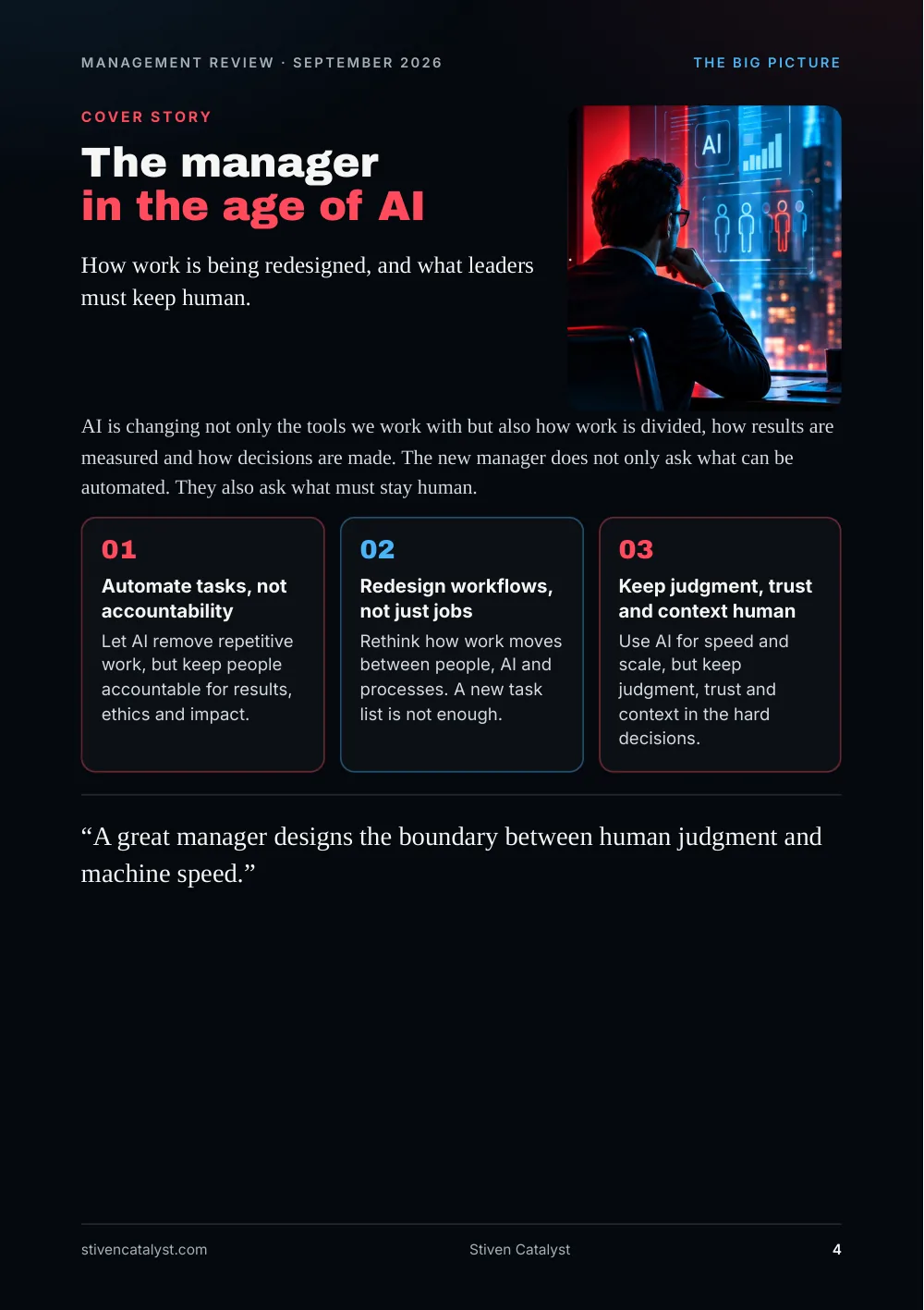
The manager in the age of AI
How work is being redesigned, and what leaders must keep human.
AI is changing not only the tools we work with but also how work is divided, how results are measured and how decisions are made. The new manager does not only ask what can be automated. They also ask what must stay human.
- Automate tasks, not accountability Let AI remove repetitive work, but keep people accountable for results, ethics and impact.
- Redesign workflows, not just jobs Rethink how work moves between people, AI and processes. A new task list is not enough.
- Keep judgment, trust and context human Use AI for speed and scale, but keep judgment, trust and context in the hard decisions.
A great manager designs the boundary between human judgment and machine speed.
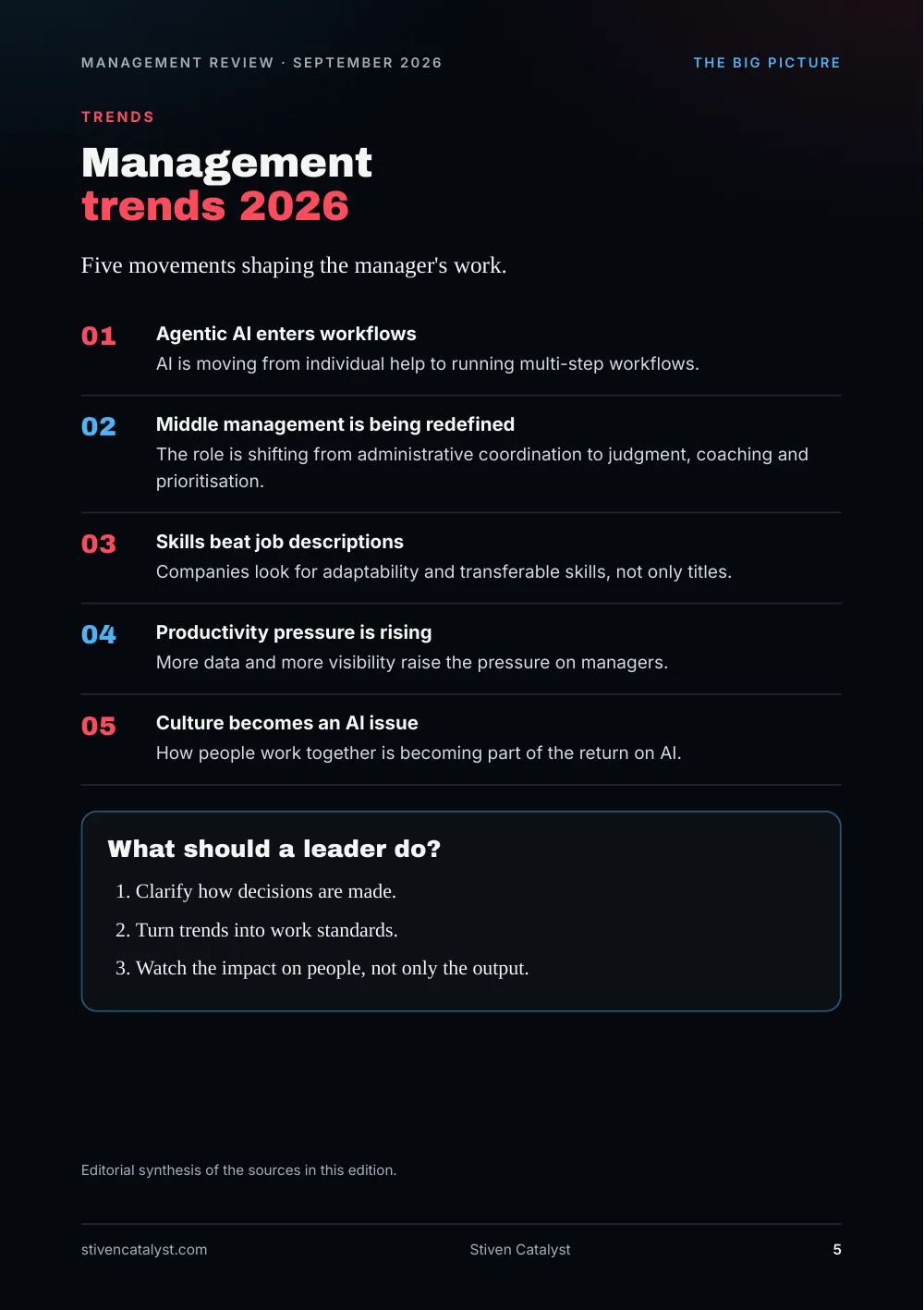
Trends
Management trends 2026
Five movements shaping the manager's work.
- Agentic AI enters workflows AI is moving from individual help to running multi-step workflows.
- Middle management is being redefined The role is shifting from administrative coordination to judgment, coaching and prioritisation.
- Skills beat job descriptions Companies look for adaptability and transferable skills, not only titles.
- Productivity pressure is rising More data and more visibility raise the pressure on managers.
- Culture becomes an AI issue How people work together is becoming part of the return on AI.
What should a leader do?
- Clarify how decisions are made.
- Turn trends into work standards.
- Watch the impact on people, not only the output.
Editorial synthesis of the sources in this edition.
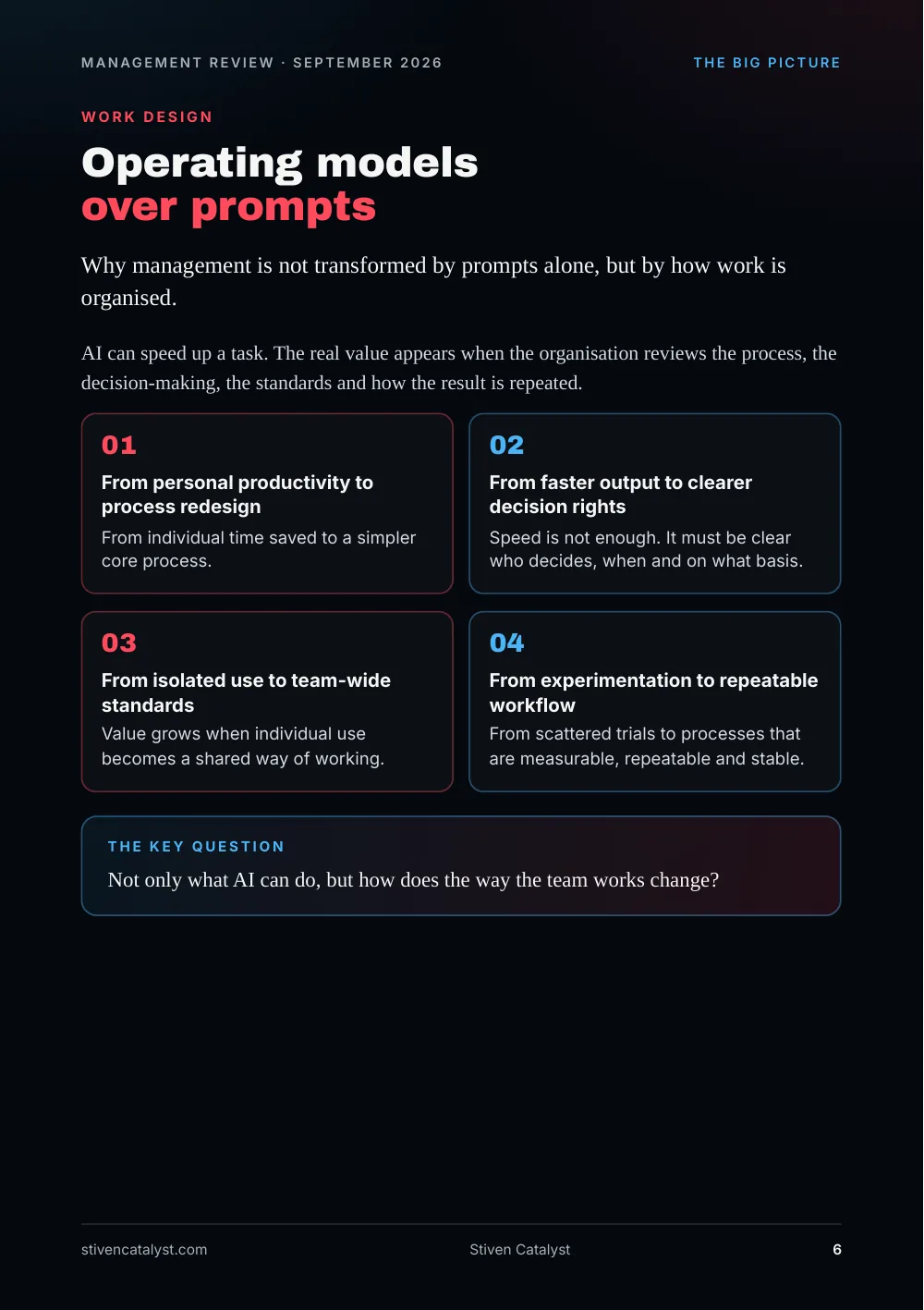
Work design
Operating models over prompts
Why management is not transformed by prompts alone, but by how work is organised.
AI can speed up a task. The real value appears when the organisation reviews the process, the decision-making, the standards and how the result is repeated.
- From personal productivity to process redesign From individual time saved to a simpler core process.
- From faster output to clearer decision rights Speed is not enough. It must be clear who decides, when and on what basis.
- From isolated use to team-wide standards Value grows when individual use becomes a shared way of working.
- From experimentation to repeatable workflow From scattered trials to processes that are measurable, repeatable and stable.
The key question
Not only what AI can do, but how does the way the team works change?
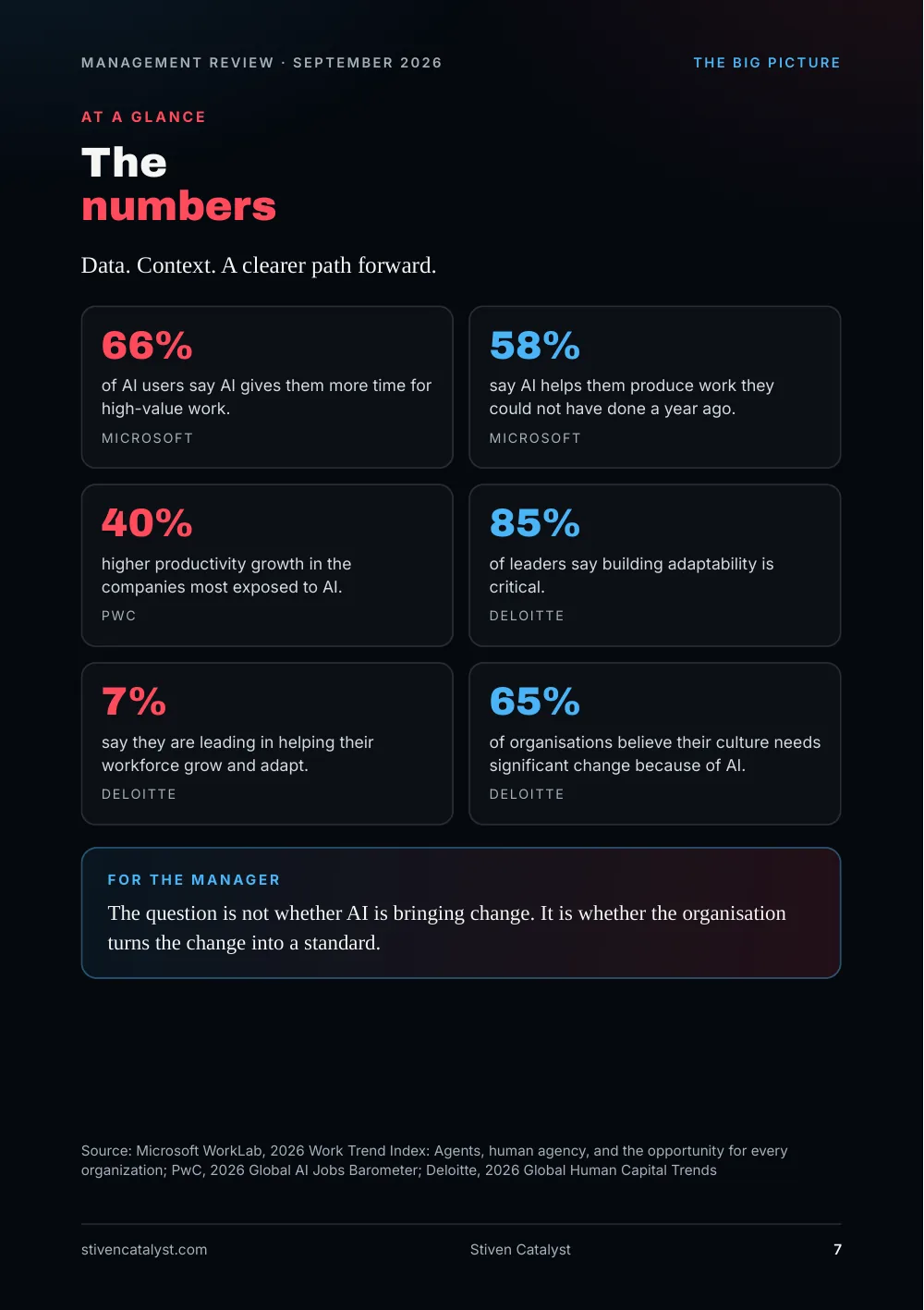
At a glance
The numbers
Data. Context. A clearer path forward.
- 66% of AI users say AI gives them more time for high-value work.
- 58% say AI helps them produce work they could not have done a year ago.
- 40% higher productivity growth in the companies most exposed to AI.
- 85% of leaders say building adaptability is critical.
- 7% say they are leading in helping their workforce grow and adapt.
- 65% of organisations believe their culture needs significant change because of AI.
For the manager
The question is not whether AI is bringing change. It is whether the organisation turns the change into a standard.
Source: Microsoft WorkLab, 2026 Work Trend Index: Agents, human agency, and the opportunity for every organization; PwC, 2026 Global AI Jobs Barometer; Deloitte, 2026 Global Human Capital Trends
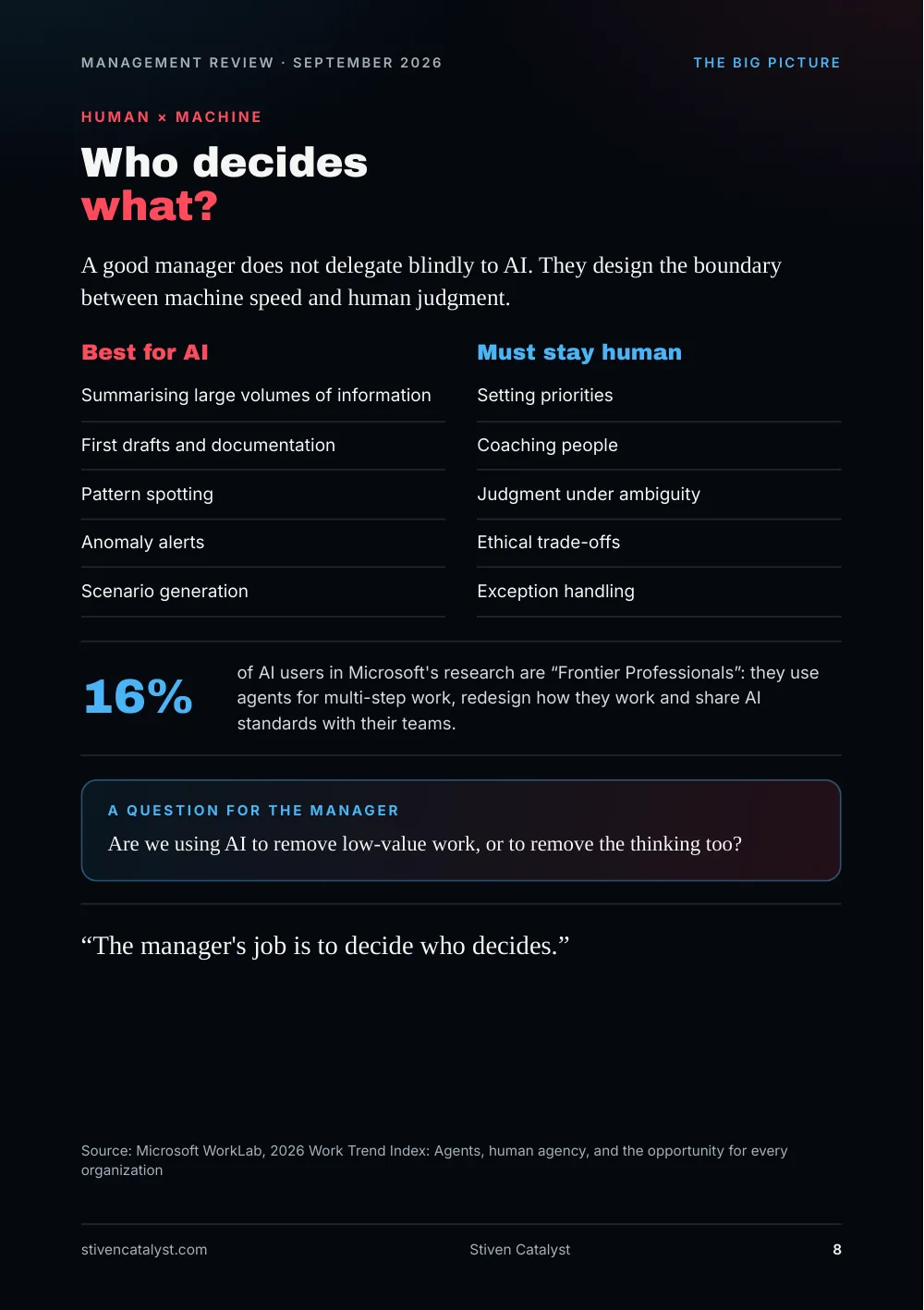
Human × machine
Who decides what?
A good manager does not delegate blindly to AI. They design the boundary between machine speed and human judgment.
Best for AI
- Summarising large volumes of information
- First drafts and documentation
- Pattern spotting
- Anomaly alerts
- Scenario generation
Must stay human
- Setting priorities
- Coaching people
- Judgment under ambiguity
- Ethical trade-offs
- Exception handling
16% of AI users in Microsoft's research are “Frontier Professionals”: they use agents for multi-step work, redesign how they work and share AI standards with their teams.
A question for the manager
Are we using AI to remove low-value work, or to remove the thinking too?
The manager's job is to decide who decides.
Source: Microsoft WorkLab, 2026 Work Trend Index: Agents, human agency, and the opportunity for every organization
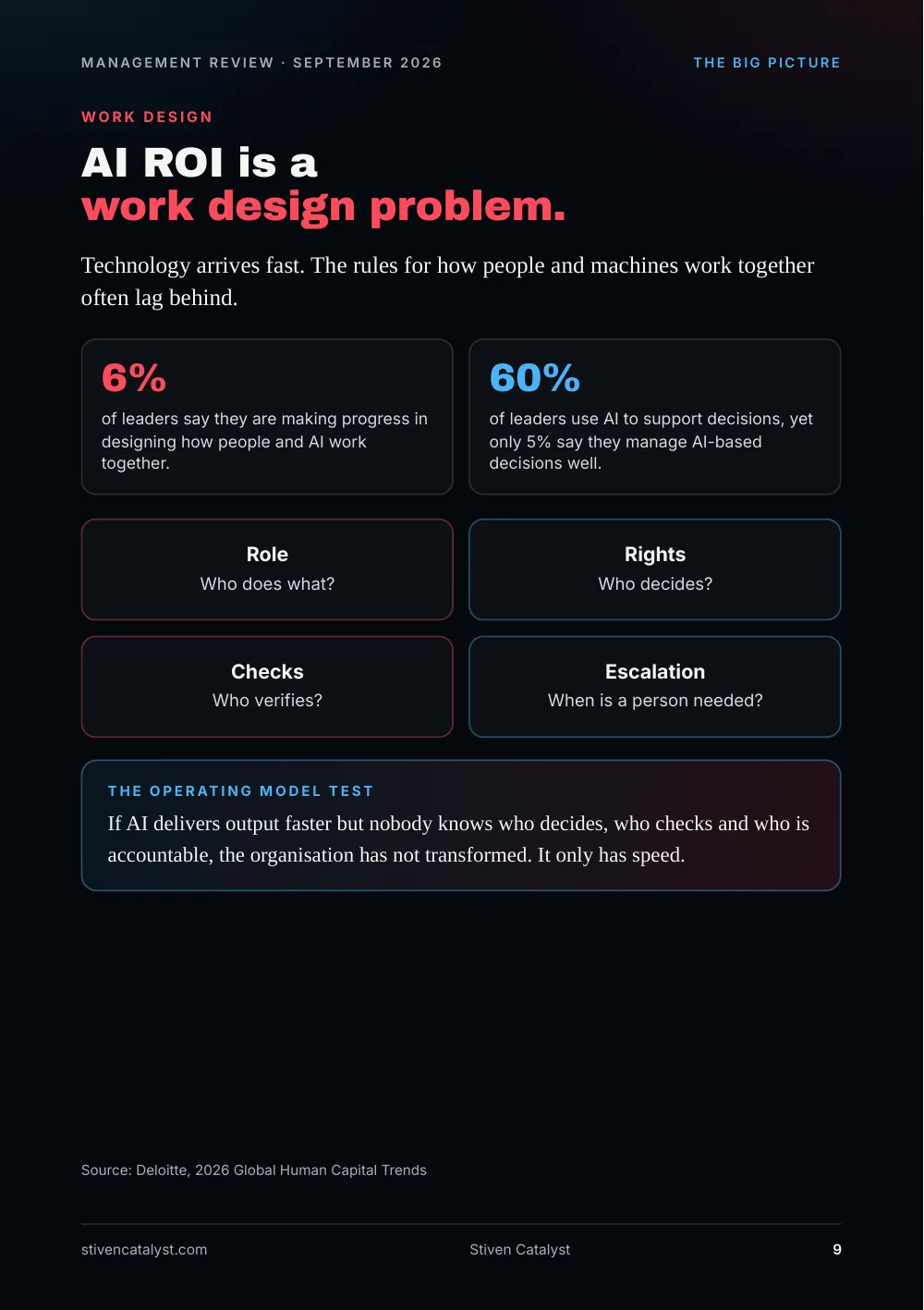
Work design
AI ROI is a work design problem.
Technology arrives fast. The rules for how people and machines work together often lag behind.
- 6% of leaders say they are making progress in designing how people and AI work together.
- 60% of leaders use AI to support decisions, yet only 5% say they manage AI-based decisions well.
- Role Who does what?
- Rights Who decides?
- Checks Who verifies?
- Escalation When is a person needed?
The operating model test
If AI delivers output faster but nobody knows who decides, who checks and who is accountable, the organisation has not transformed. It only has speed.
Source: Deloitte, 2026 Global Human Capital Trends
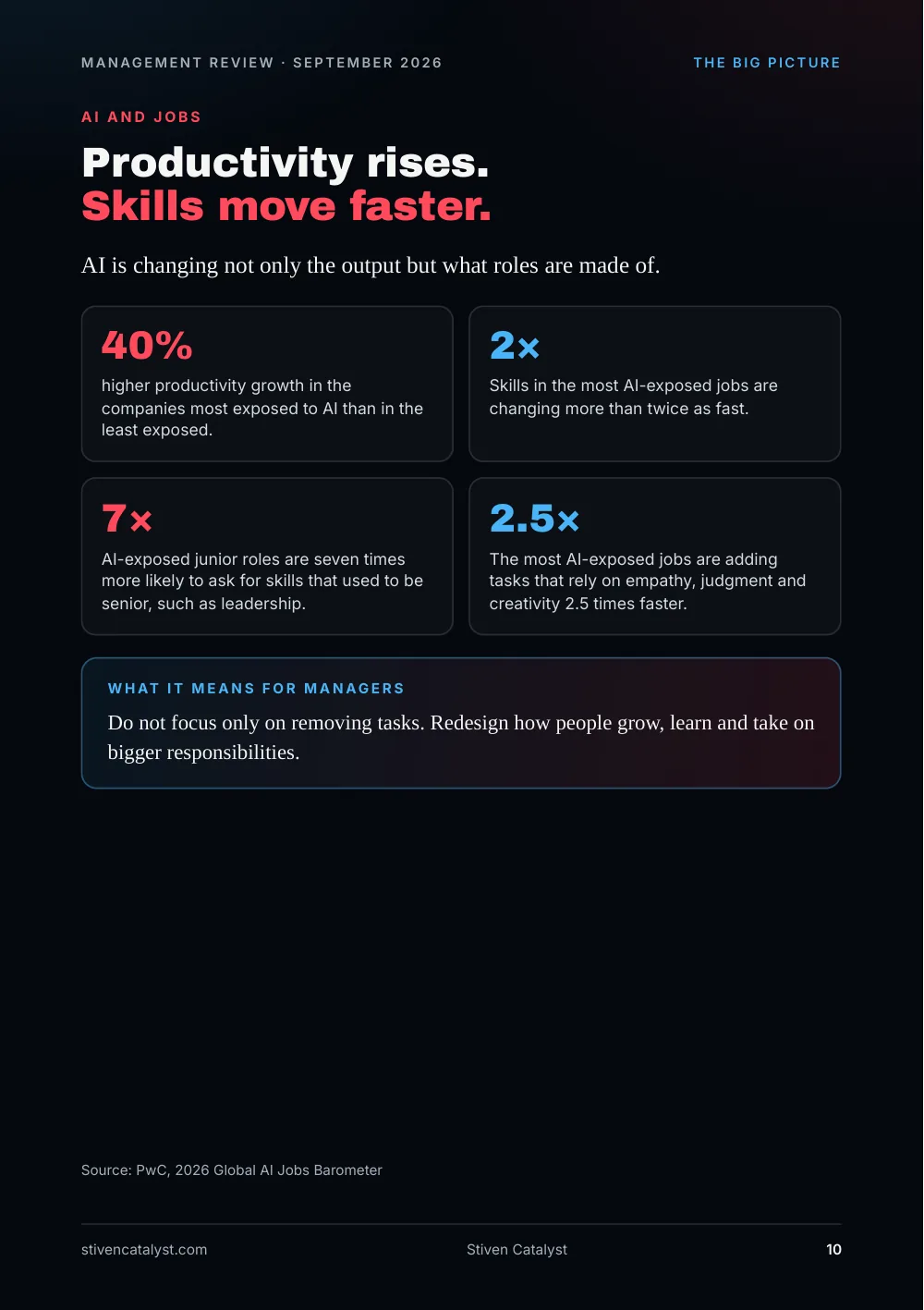
AI and jobs
Productivity rises. Skills move faster.
AI is changing not only the output but what roles are made of.
- 40% higher productivity growth in the companies most exposed to AI than in the least exposed.
- 2× Skills in the most AI-exposed jobs are changing more than twice as fast.
- 7× AI-exposed junior roles are seven times more likely to ask for skills that used to be senior, such as leadership.
- 2.5× The most AI-exposed jobs are adding tasks that rely on empathy, judgment and creativity 2.5 times faster.
What it means for managers
Do not focus only on removing tasks. Redesign how people grow, learn and take on bigger responsibilities.
Source: PwC, 2026 Global AI Jobs Barometer
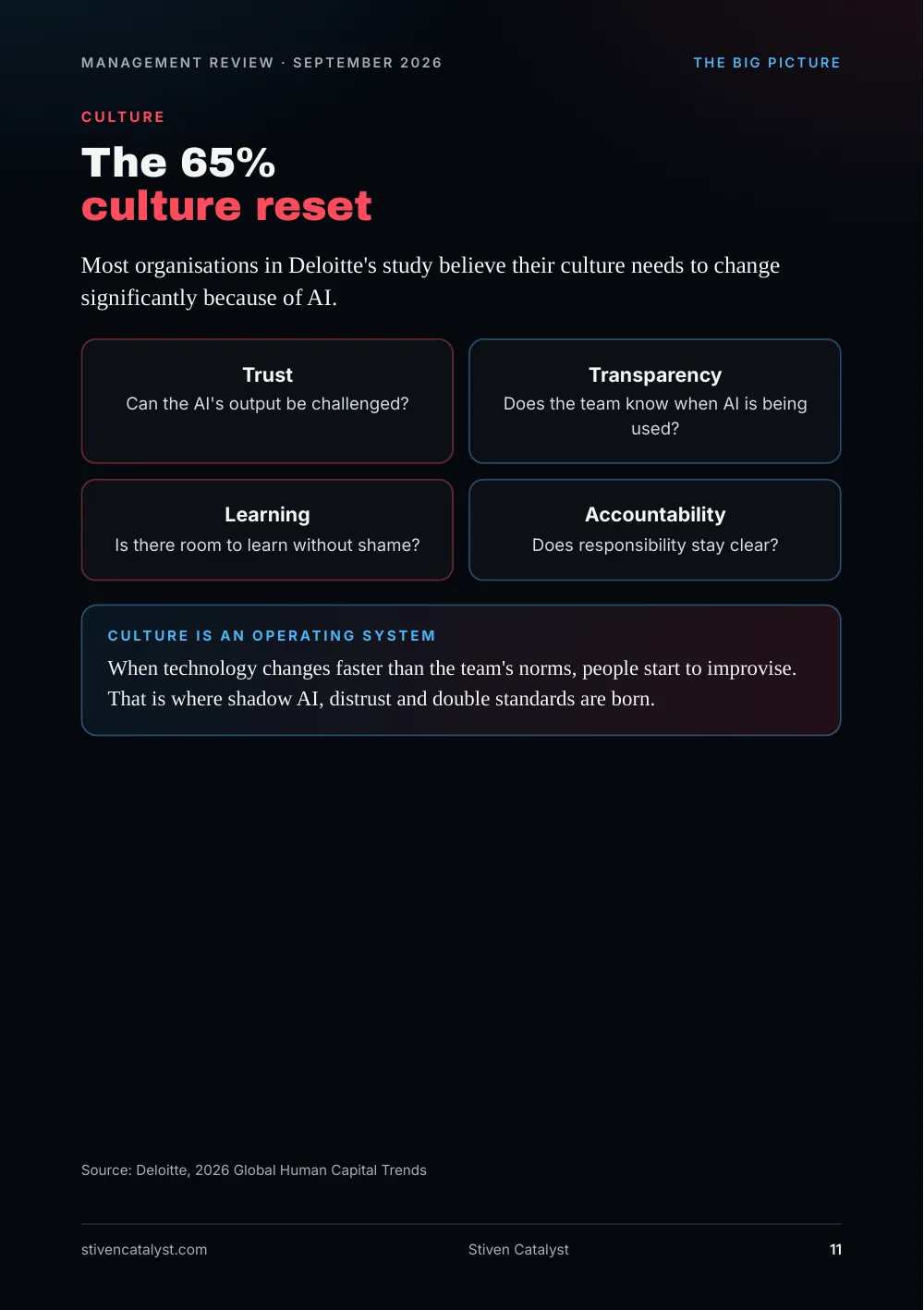
Culture
The 65% culture reset
Most organisations in Deloitte's study believe their culture needs to change significantly because of AI.
- Trust Can the AI's output be challenged?
- Transparency Does the team know when AI is being used?
- Learning Is there room to learn without shame?
- Accountability Does responsibility stay clear?
Culture is an operating system
When technology changes faster than the team's norms, people start to improvise. That is where shadow AI, distrust and double standards are born.
Source: Deloitte, 2026 Global Human Capital Trends
People and performance
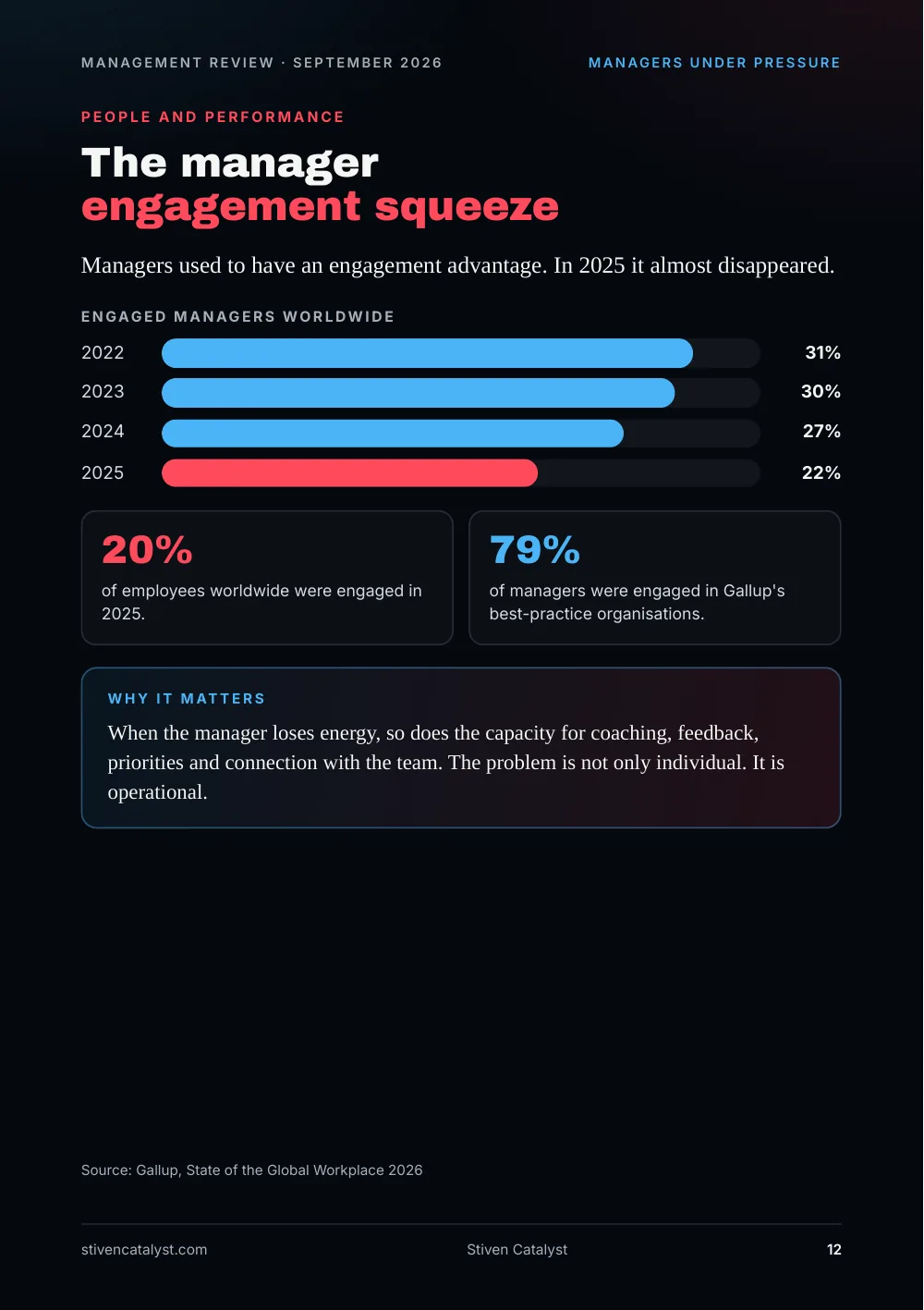
The manager engagement squeeze
Managers used to have an engagement advantage. In 2025 it almost disappeared.
Engaged managers worldwide: 2022 31%, 2023 30%, 2024 27%, 2025 22%.
- 20% of employees worldwide were engaged in 2025.
- 79% of managers were engaged in Gallup's best-practice organisations.
Why it matters
When the manager loses energy, so does the capacity for coaching, feedback, priorities and connection with the team. The problem is not only individual. It is operational.
Source: Gallup, State of the Global Workplace 2026
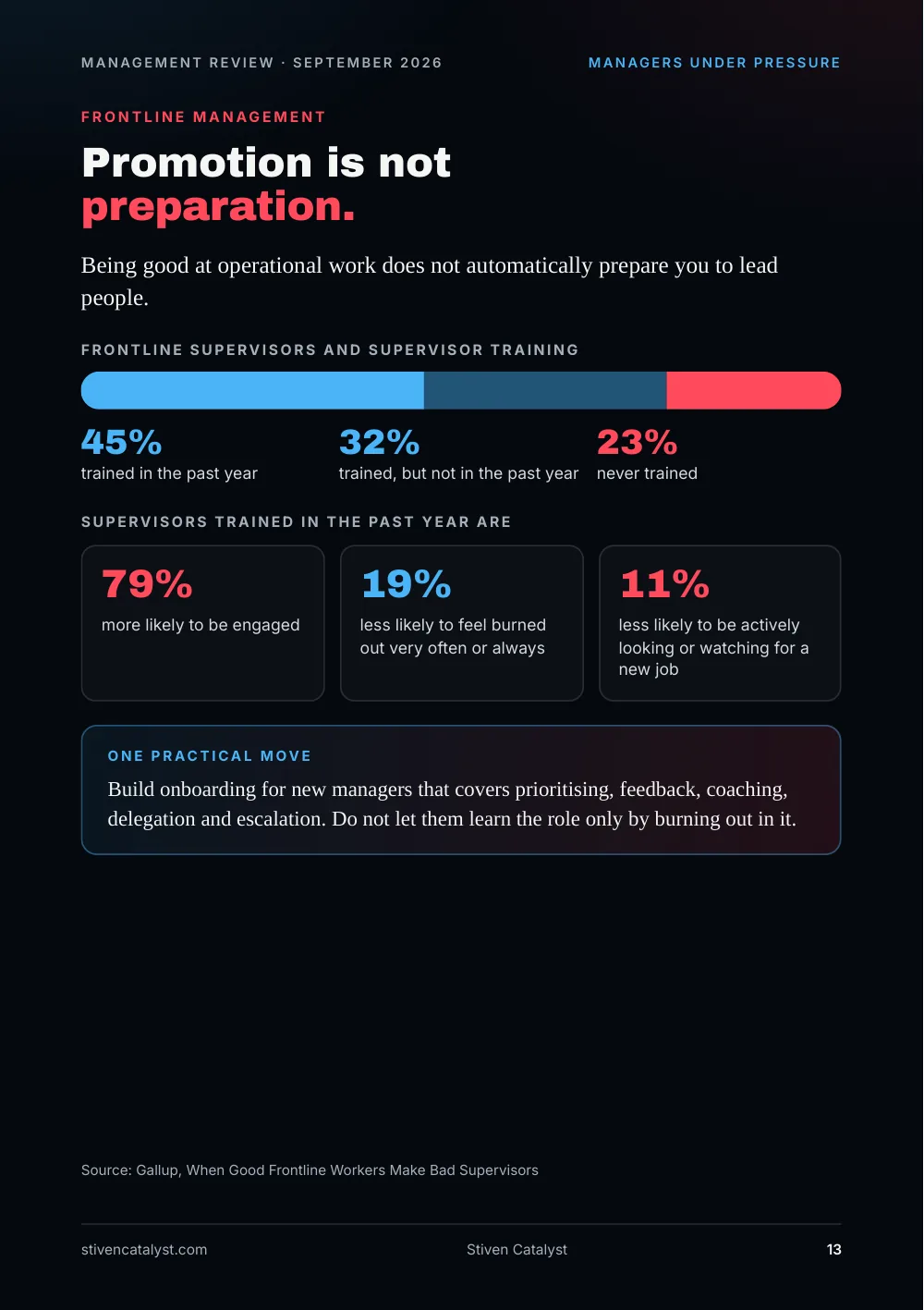
Frontline management
Promotion is not preparation.
Being good at operational work does not automatically prepare you to lead people.
Frontline supervisors and supervisor training:
- 45% trained in the past year
- 32% trained, but not in the past year
- 23% never trained
Supervisors trained in the past year are:
- 79% more likely to be engaged
- 19% less likely to feel burned out very often or always
- 11% less likely to be actively looking or watching for a new job
One practical move
Build onboarding for new managers that covers prioritising, feedback, coaching, delegation and escalation. Do not let them learn the role only by burning out in it.
Source: Gallup, When Good Frontline Workers Make Bad Supervisors
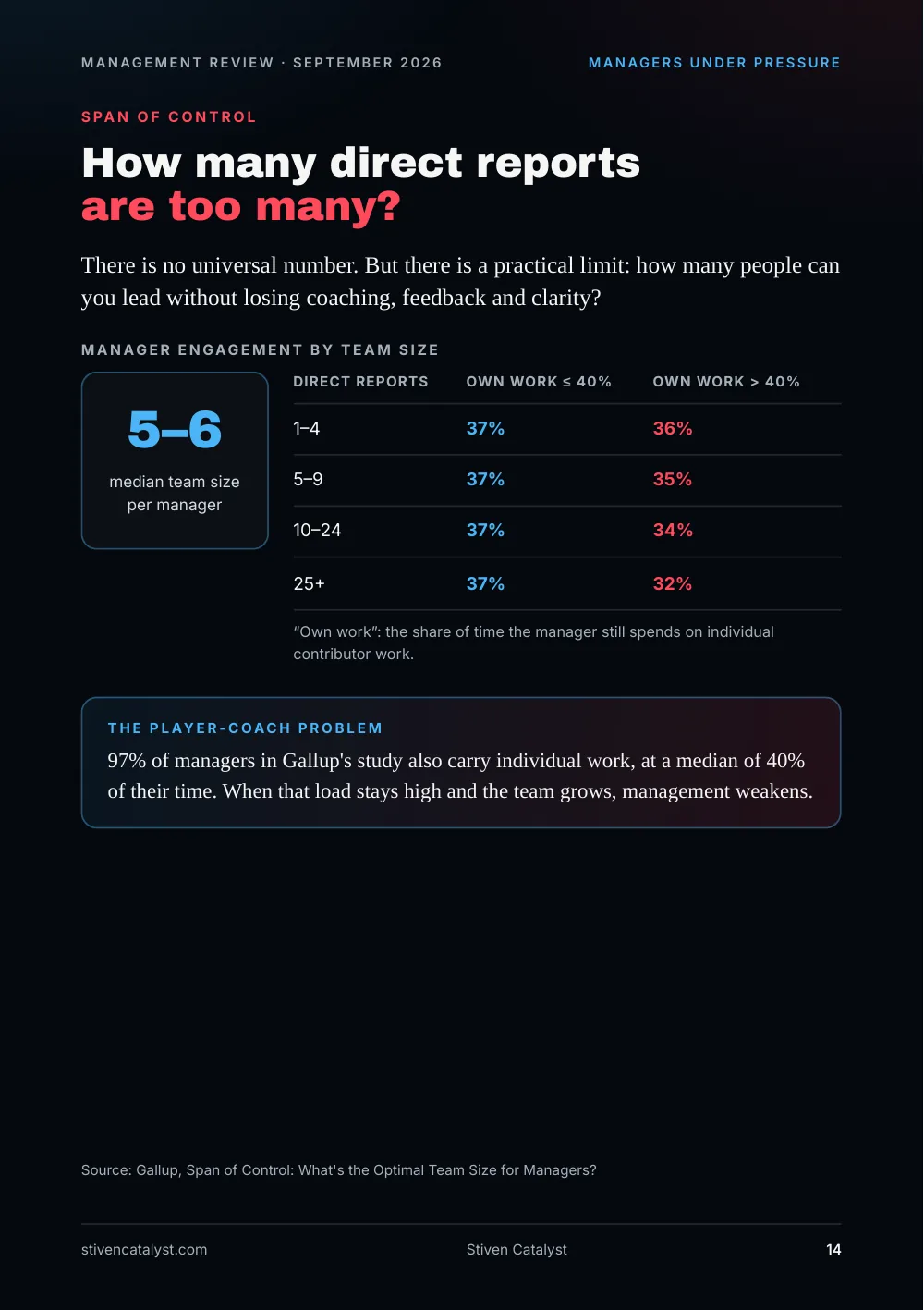
Span of control
How many direct reports are too many?
There is no universal number. But there is a practical limit: how many people can you lead without losing coaching, feedback and clarity?
5–6 median team size per manager.
Manager engagement by team size:
- Direct reports 1–4: Own work ≤ 40% 37%, Own work > 40% 36%
- Direct reports 5–9: Own work ≤ 40% 37%, Own work > 40% 35%
- Direct reports 10–24: Own work ≤ 40% 37%, Own work > 40% 34%
- Direct reports 25+: Own work ≤ 40% 37%, Own work > 40% 32%
“Own work”: the share of time the manager still spends on individual contributor work.
The player-coach problem
97% of managers in Gallup's study also carry individual work, at a median of 40% of their time. When that load stays high and the team grows, management weakens.
Source: Gallup, Span of Control: What's the Optimal Team Size for Managers?
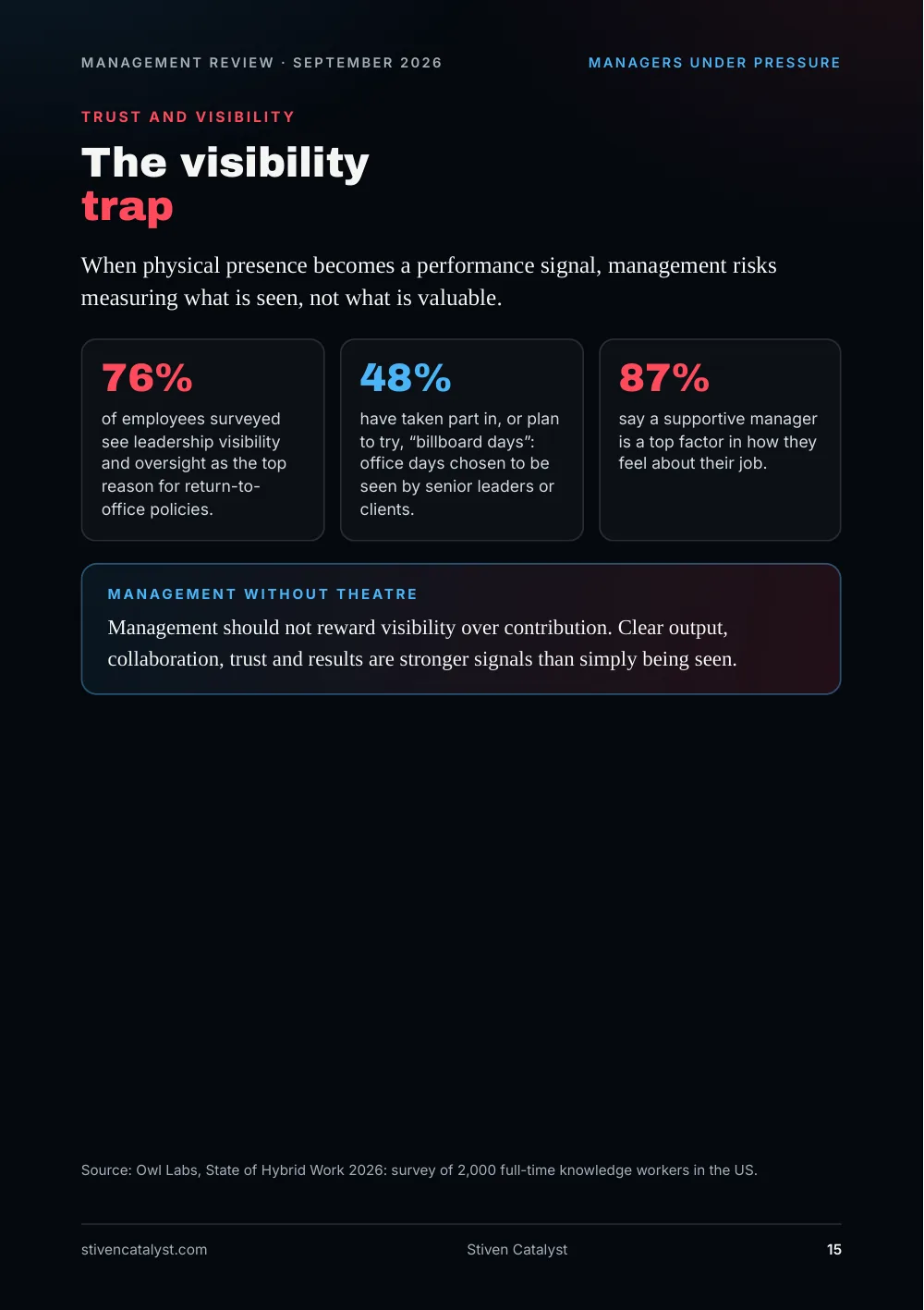
Trust and visibility
The visibility trap
When physical presence becomes a performance signal, management risks measuring what is seen, not what is valuable.
- 76% of employees surveyed see leadership visibility and oversight as the top reason for return-to-office policies.
- 48% have taken part in, or plan to try, “billboard days”: office days chosen to be seen by senior leaders or clients.
- 87% say a supportive manager is a top factor in how they feel about their job.
Management without theatre
Management should not reward visibility over contribution. Clear output, collaboration, trust and results are stronger signals than simply being seen.
Source: Owl Labs, State of Hybrid Work 2026: survey of 2,000 full-time knowledge workers in the US.
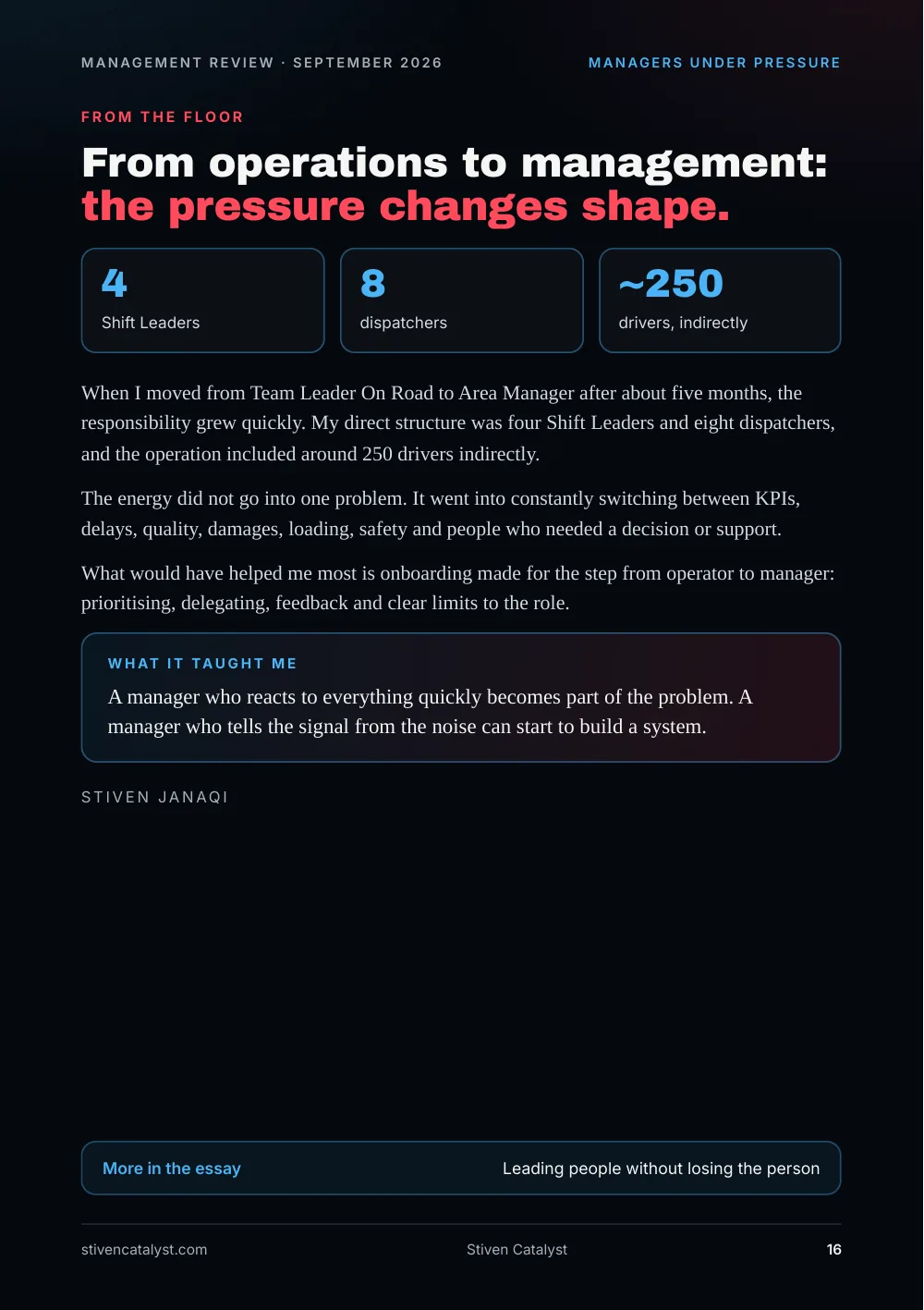
From the floor
From operations to management: the pressure changes shape.
- 4 Shift Leaders
- 8 dispatchers
- ~250 drivers, indirectly
When I moved from Team Leader On Road to Area Manager after about five months, the responsibility grew quickly. My direct structure was four Shift Leaders and eight dispatchers, and the operation included around 250 drivers indirectly.
The energy did not go into one problem. It went into constantly switching between KPIs, delays, quality, damages, loading, safety and people who needed a decision or support.
What would have helped me most is onboarding made for the step from operator to manager: prioritising, delegating, feedback and clear limits to the role.
What it taught me
A manager who reacts to everything quickly becomes part of the problem. A manager who tells the signal from the noise can start to build a system.
Stiven Janaqi
More in the essay: Leading people without losing the person
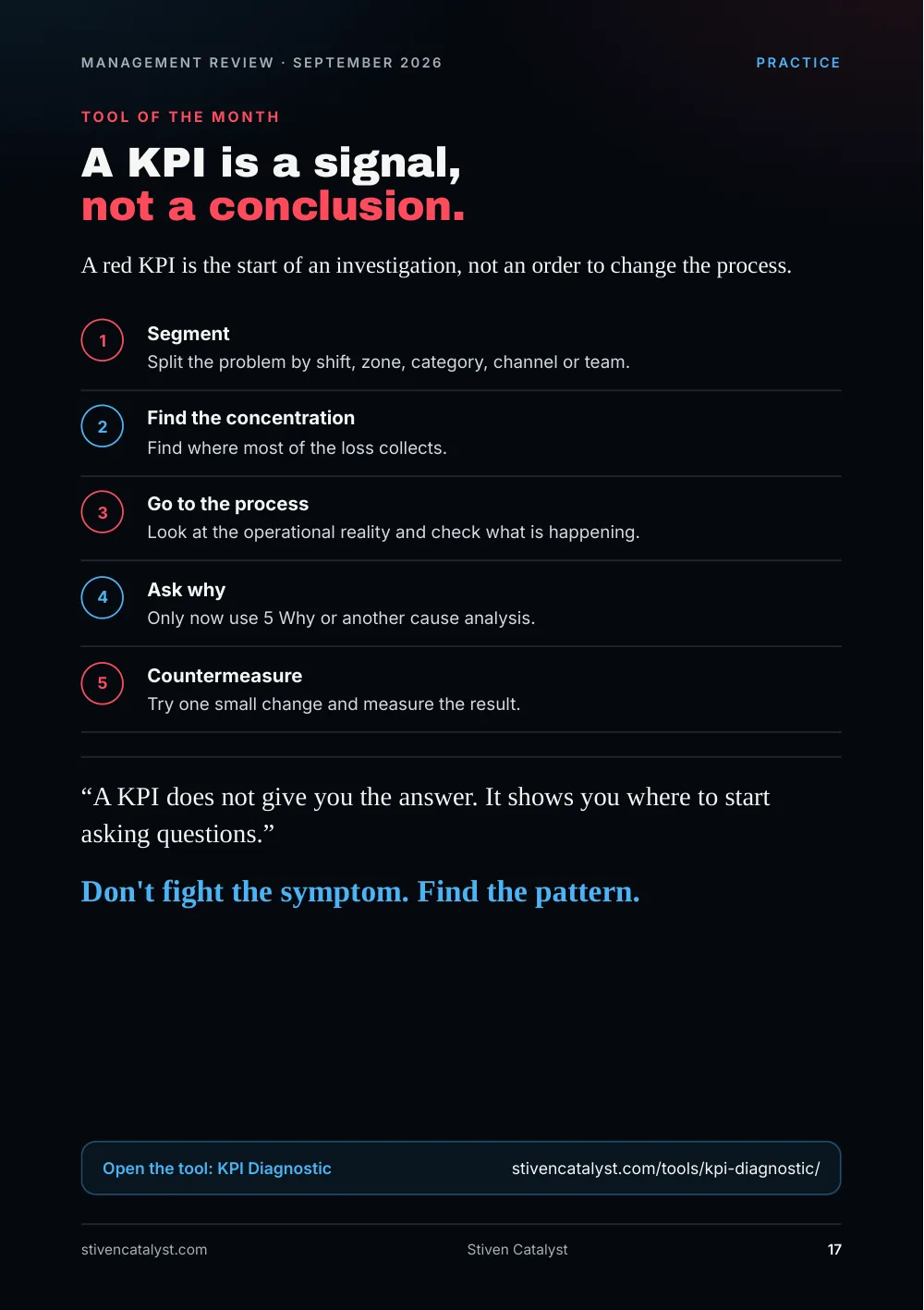
Tool of the month
A KPI is a signal, not a conclusion.
A red KPI is the start of an investigation, not an order to change the process.
- Segment Split the problem by shift, zone, category, channel or team.
- Find the concentration Find where most of the loss collects.
- Go to the process Look at the operational reality and check what is happening.
- Ask why Only now use 5 Why or another cause analysis.
- Countermeasure Try one small change and measure the result.
A KPI does not give you the answer. It shows you where to start asking questions.
Don't fight the symptom. Find the pattern.
Open the tool: KPI Diagnostic
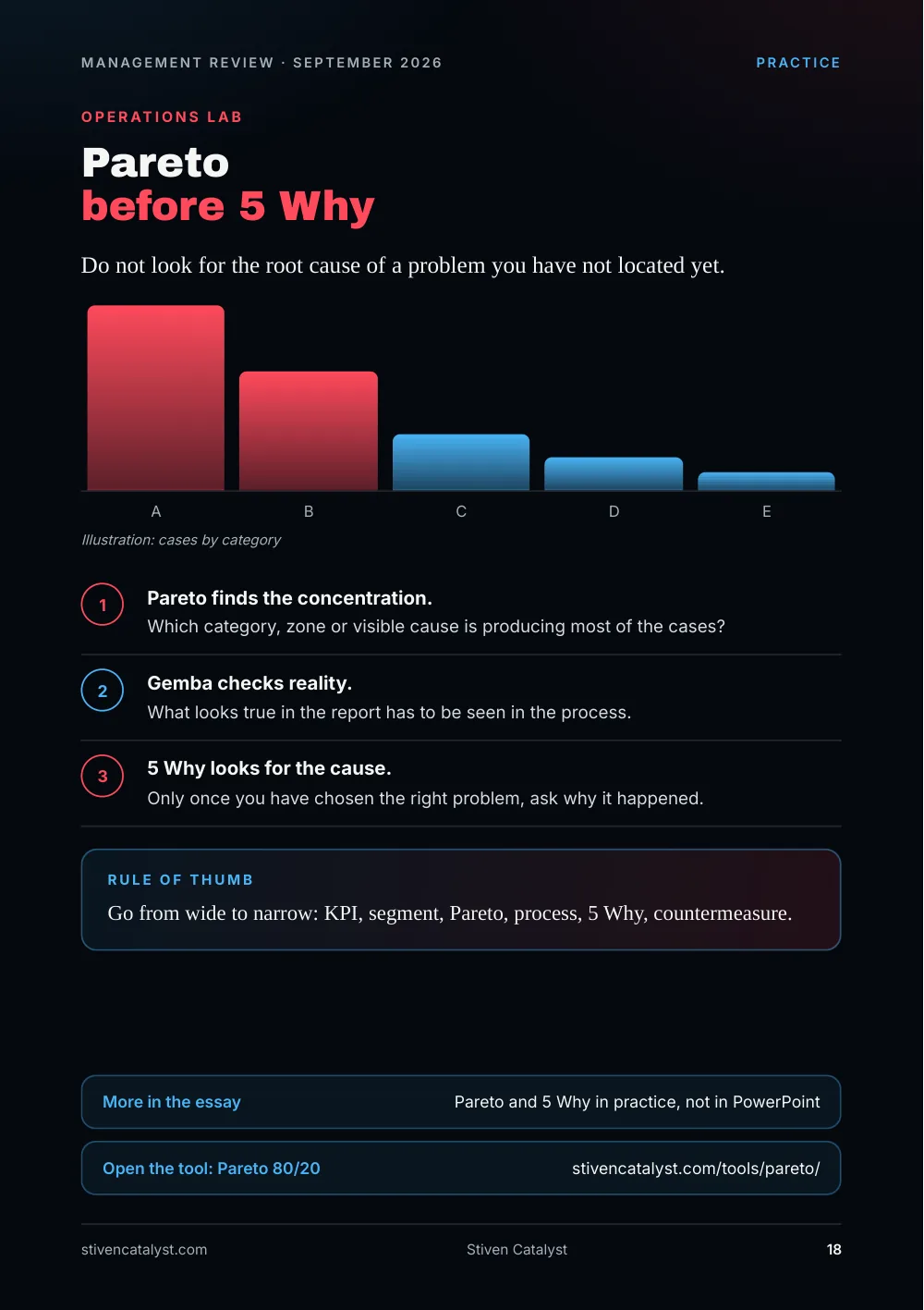
Operations lab
Pareto before 5 Why
Do not look for the root cause of a problem you have not located yet.
- Pareto finds the concentration. Which category, zone or visible cause is producing most of the cases?
- Gemba checks reality. What looks true in the report has to be seen in the process.
- 5 Why looks for the cause. Only once you have chosen the right problem, ask why it happened.
Rule of thumb
Go from wide to narrow: KPI, segment, Pareto, process, 5 Why, countermeasure.
More in the essay: Pareto and 5 Why in practice, not in PowerPoint
Open the tool: Pareto 80/20
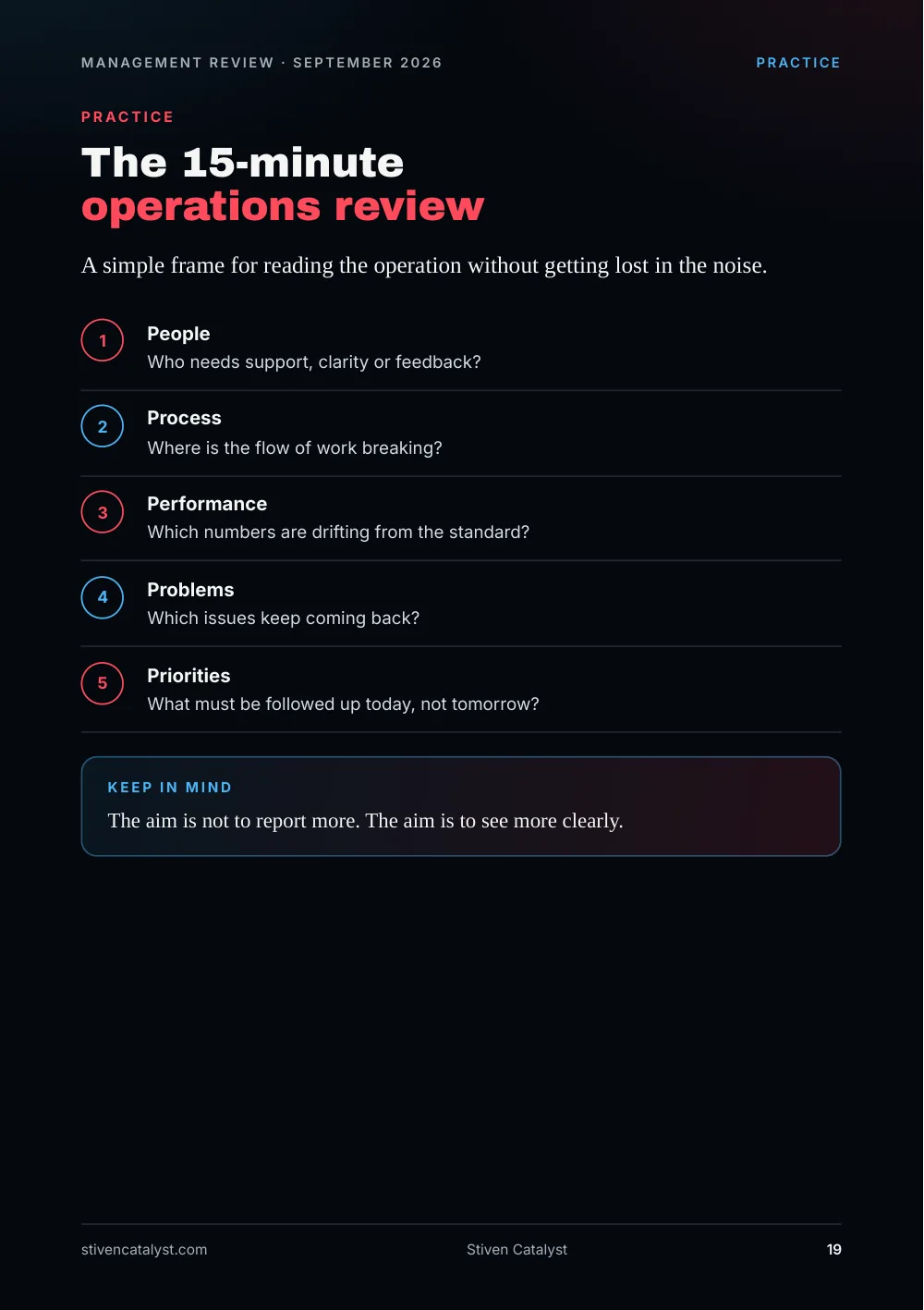
Practice
The 15-minute operations review
A simple frame for reading the operation without getting lost in the noise.
- People Who needs support, clarity or feedback?
- Process Where is the flow of work breaking?
- Performance Which numbers are drifting from the standard?
- Problems Which issues keep coming back?
- Priorities What must be followed up today, not tomorrow?
Keep in mind
The aim is not to report more. The aim is to see more clearly.
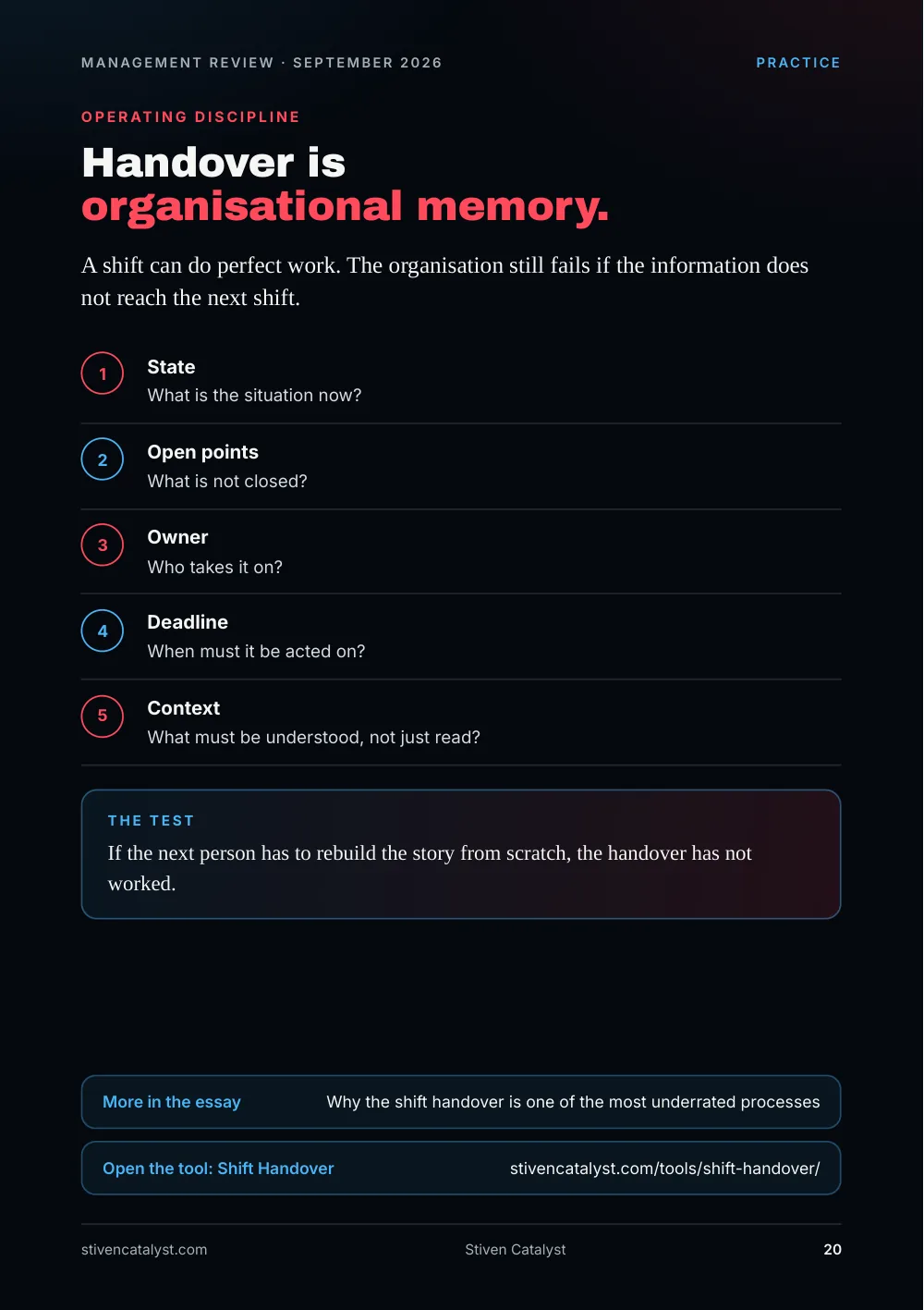
Operating discipline
Handover is organisational memory.
A shift can do perfect work. The organisation still fails if the information does not reach the next shift.
- State What is the situation now?
- Open points What is not closed?
- Owner Who takes it on?
- Deadline When must it be acted on?
- Context What must be understood, not just read?
The test
If the next person has to rebuild the story from scratch, the handover has not worked.
More in the essay: Why the shift handover is one of the most underrated processes
Open the tool: Shift Handover
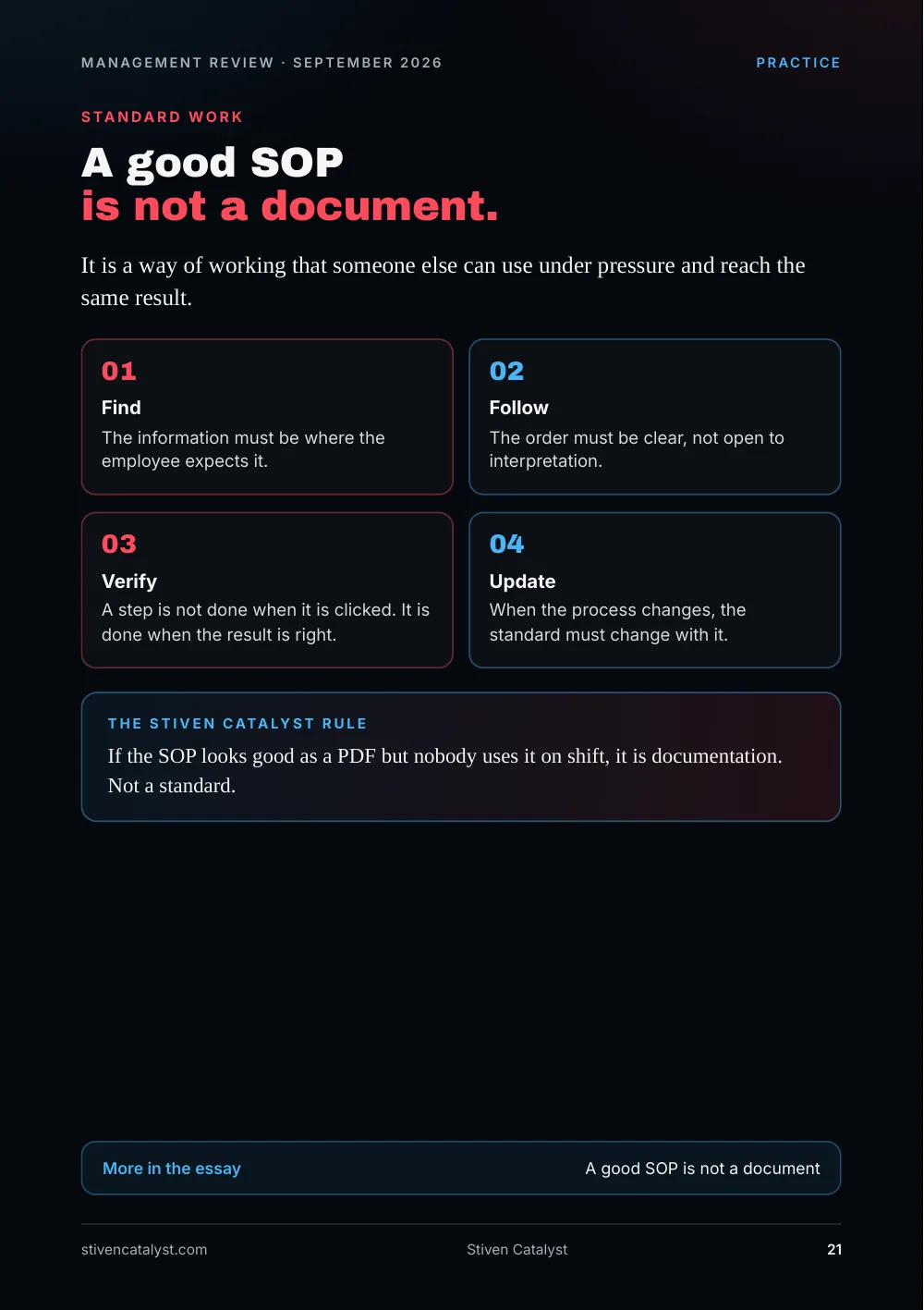
Standard work
A good SOP is not a document.
It is a way of working that someone else can use under pressure and reach the same result.
- Find The information must be where the employee expects it.
- Follow The order must be clear, not open to interpretation.
- Verify A step is not done when it is clicked. It is done when the result is right.
- Update When the process changes, the standard must change with it.
The Stiven Catalyst rule
If the SOP looks good as a PDF but nobody uses it on shift, it is documentation. Not a standard.
More in the essay: A good SOP is not a document
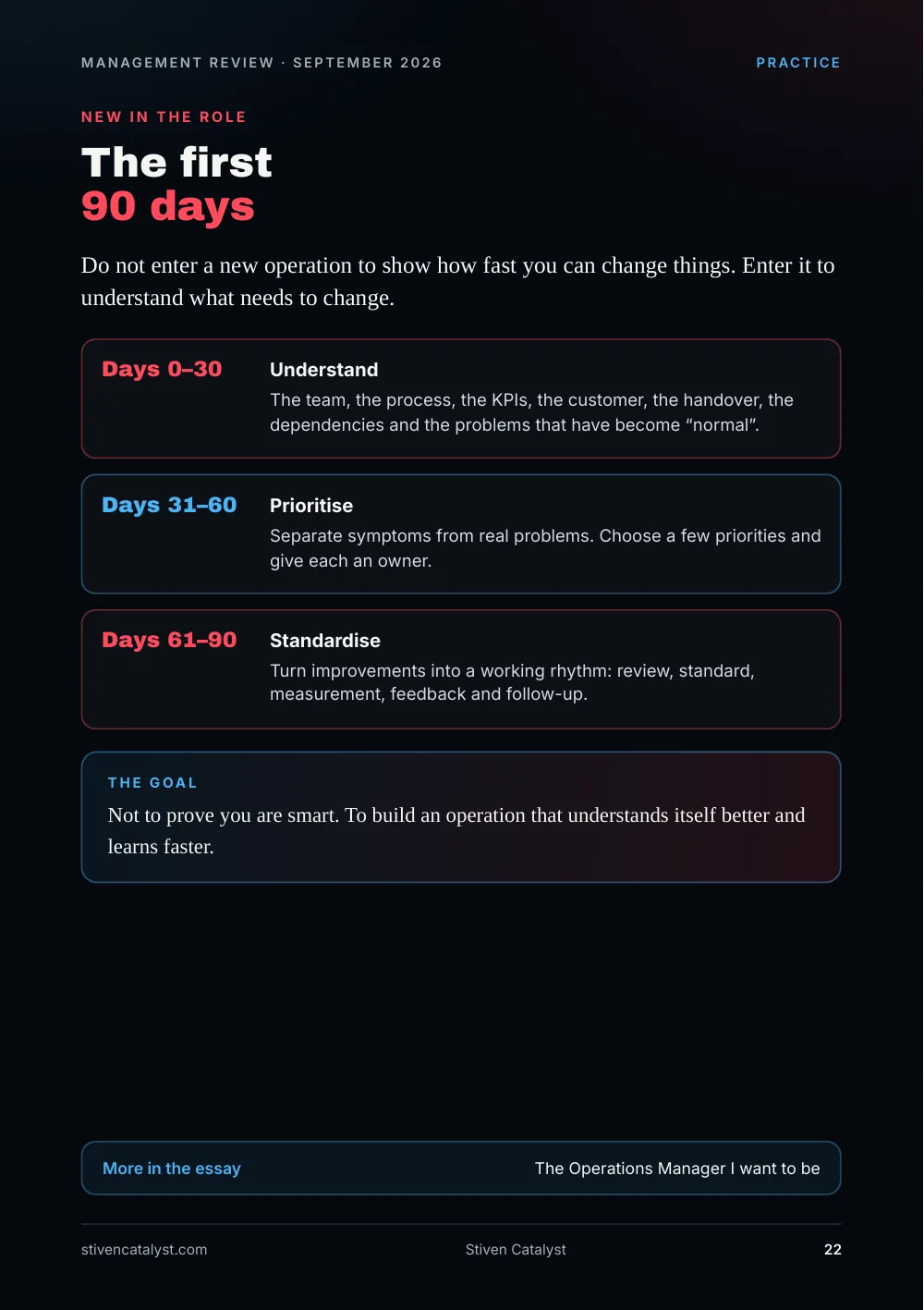
New in the role
The first 90 days
Do not enter a new operation to show how fast you can change things. Enter it to understand what needs to change.
- Days 0–30: Understand The team, the process, the KPIs, the customer, the handover, the dependencies and the problems that have become “normal”.
- Days 31–60: Prioritise Separate symptoms from real problems. Choose a few priorities and give each an owner.
- Days 61–90: Standardise Turn improvements into a working rhythm: review, standard, measurement, feedback and follow-up.
The goal
Not to prove you are smart. To build an operation that understands itself better and learns faster.
More in the essay: The Operations Manager I want to be
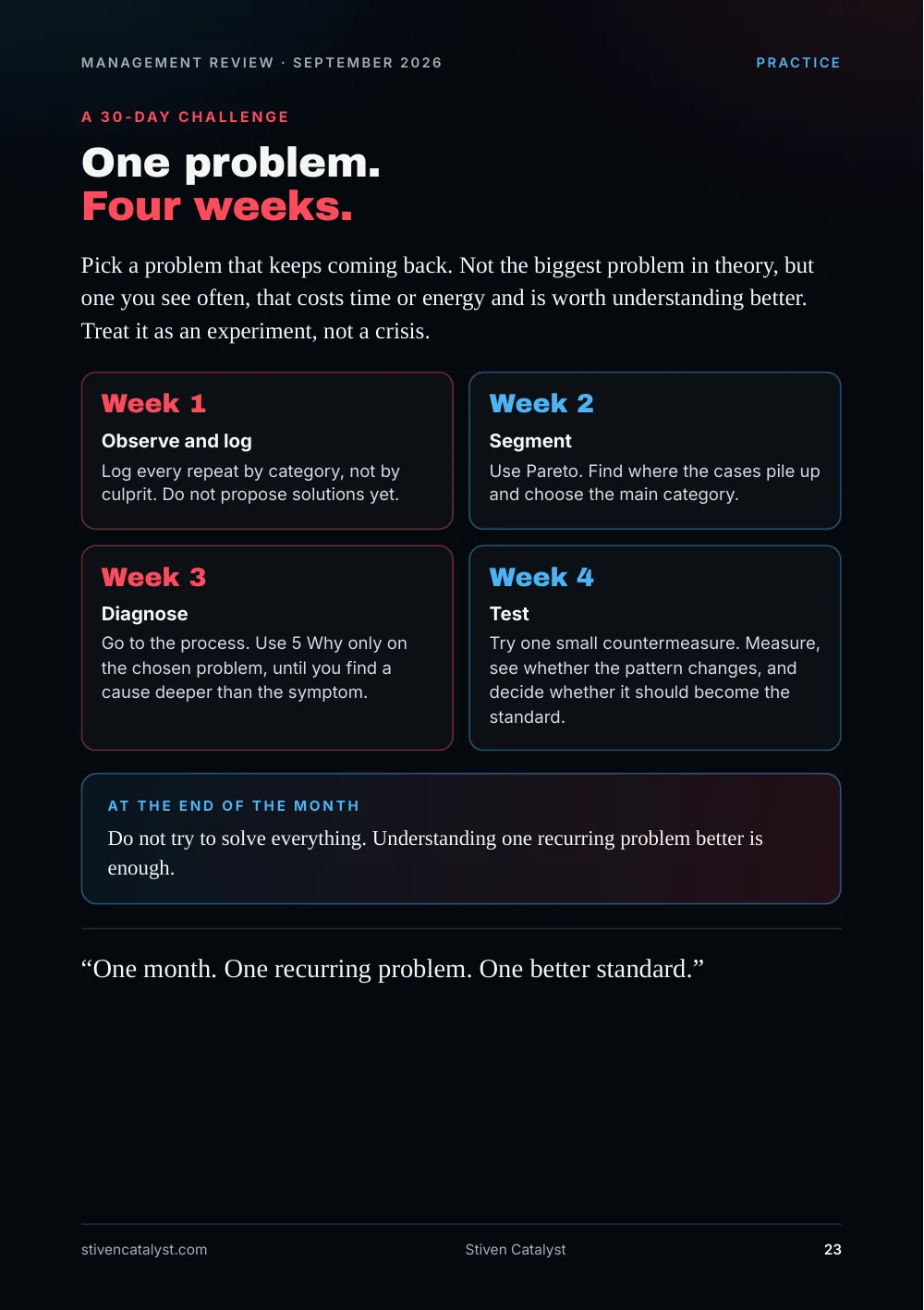
A 30-day challenge
One problem. Four weeks.
Pick a problem that keeps coming back. Not the biggest problem in theory, but one you see often, that costs time or energy and is worth understanding better. Treat it as an experiment, not a crisis.
- Week 1: Observe and log Log every repeat by category, not by culprit. Do not propose solutions yet.
- Week 2: Segment Use Pareto. Find where the cases pile up and choose the main category.
- Week 3: Diagnose Go to the process. Use 5 Why only on the chosen problem, until you find a cause deeper than the symptom.
- Week 4: Test Try one small countermeasure. Measure, see whether the pattern changes, and decide whether it should become the standard.
At the end of the month
Do not try to solve everything. Understanding one recurring problem better is enough.
One month. One recurring problem. One better standard.
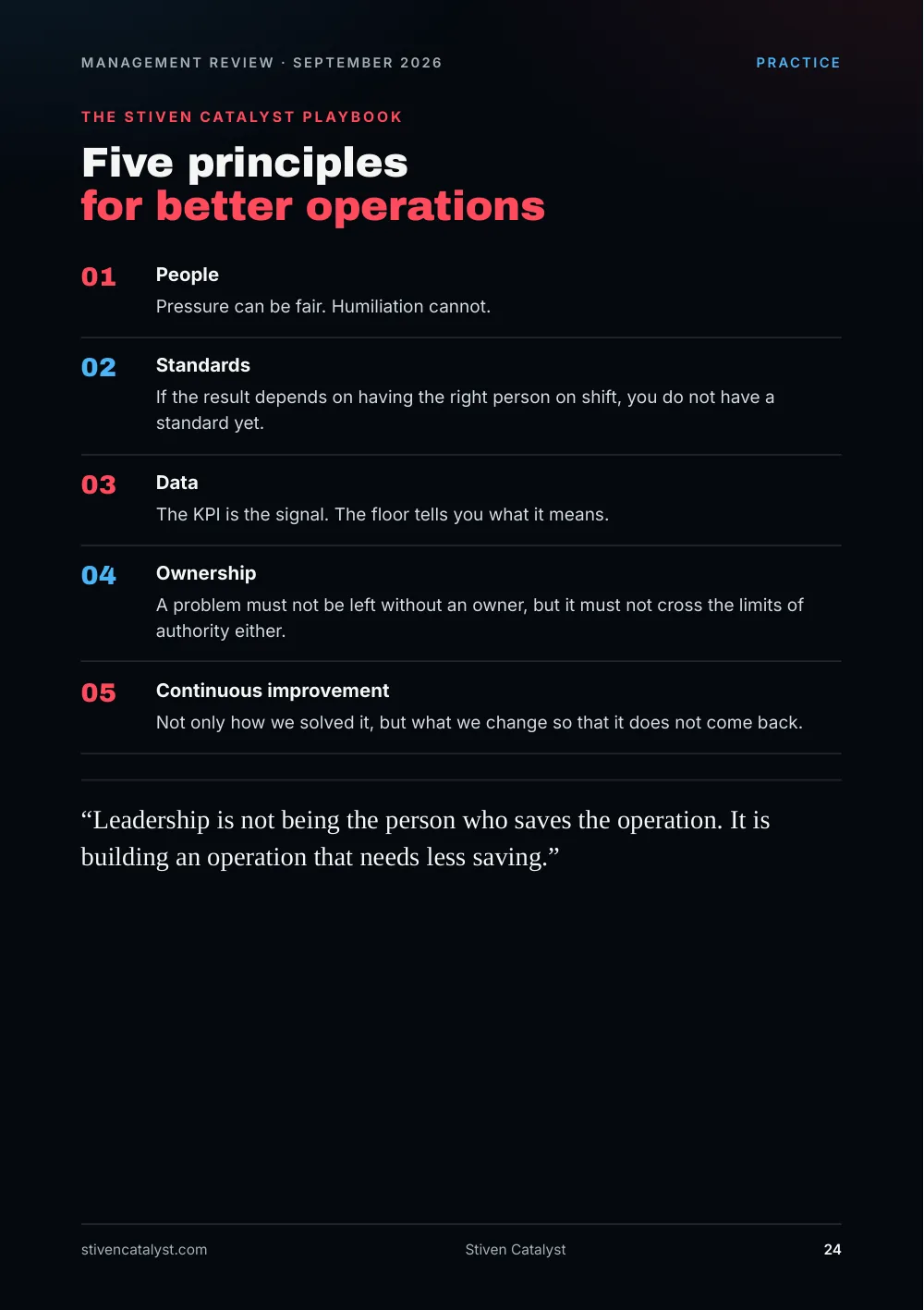
The Stiven Catalyst playbook
Five principles for better operations
- People Pressure can be fair. Humiliation cannot.
- Standards If the result depends on having the right person on shift, you do not have a standard yet.
- Data The KPI is the signal. The floor tells you what it means.
- Ownership A problem must not be left without an owner, but it must not cross the limits of authority either.
- Continuous improvement Not only how we solved it, but what we change so that it does not come back.
Leadership is not being the person who saves the operation. It is building an operation that needs less saving.
Sources and method
No invented stats. No empty jargon.
Every number in this edition is tied to an identifiable source. The data is there to build the argument, not as decoration.
- Microsoft WorkLab, “2026 Work Trend Index: Agents, human agency, and the opportunity for every organization”. https://www.microsoft.com/en-us/worklab/work-trend-index/agents-human-agency-and-the-opportunity-for-every-organization
- Deloitte, “2026 Global Human Capital Trends”. https://www.deloitte.com/us/en/insights/topics/talent/human-capital-trends.html
- PwC, “2026 Global AI Jobs Barometer”. https://www.pwc.com/gx/en/issues/artificial-intelligence/job-barometer/2026.html
- Gallup, “State of the Global Workplace 2026”. https://www.gallup.com/workplace/349484/state-of-the-global-workplace.aspx
- Gallup, 2026, “When Good Frontline Workers Make Bad Supervisors”. https://www.gallup.com/workplace/700163/when-good-frontline-workers-make-bad-supervisors.aspx
- Gallup, 2026, “Span of Control: What's the Optimal Team Size for Managers?”. https://www.gallup.com/workplace/700718/span-control-optimal-team-size-managers.aspx
- Owl Labs, “State of Hybrid Work 2026”. https://resources.owllabs.com/blog/2026-state-of-hybrid-work
Editorial method
The sources were checked for year, publisher and the exact meaning of each metric. Where an idea is editorial interpretation, it is kept clearly apart from the statistics. Personal experience is used only where it is documented from real work.