Gary Klein described the pre-mortem in Harvard Business Review in 2007. Daniel Kahneman wrote that its main virtue is to make doubts legitimate. In a 1994 study, students finished their thesis later than even their worst-case forecast. The figure most often quoted for the method, 30%, goes back to a 1989 study whose abstract describes something else: how people explain an outcome they take as certain. A 2010 experiment found that the pre-mortem lowered confidence in a plan more than other kinds of critique.
Management Review · Second series · November 2026 · No. 44
The pre-mor tem: failure before it happens
Why doubts go unsaid, a thesis that took longer than the worst case, Klein's five steps, what the 30% really measured, what to count afterwards, and a pre-mortem sheet.
- No.
- 44
- Pages
- 10
- Sources
- 7
- Topics
- Strategy
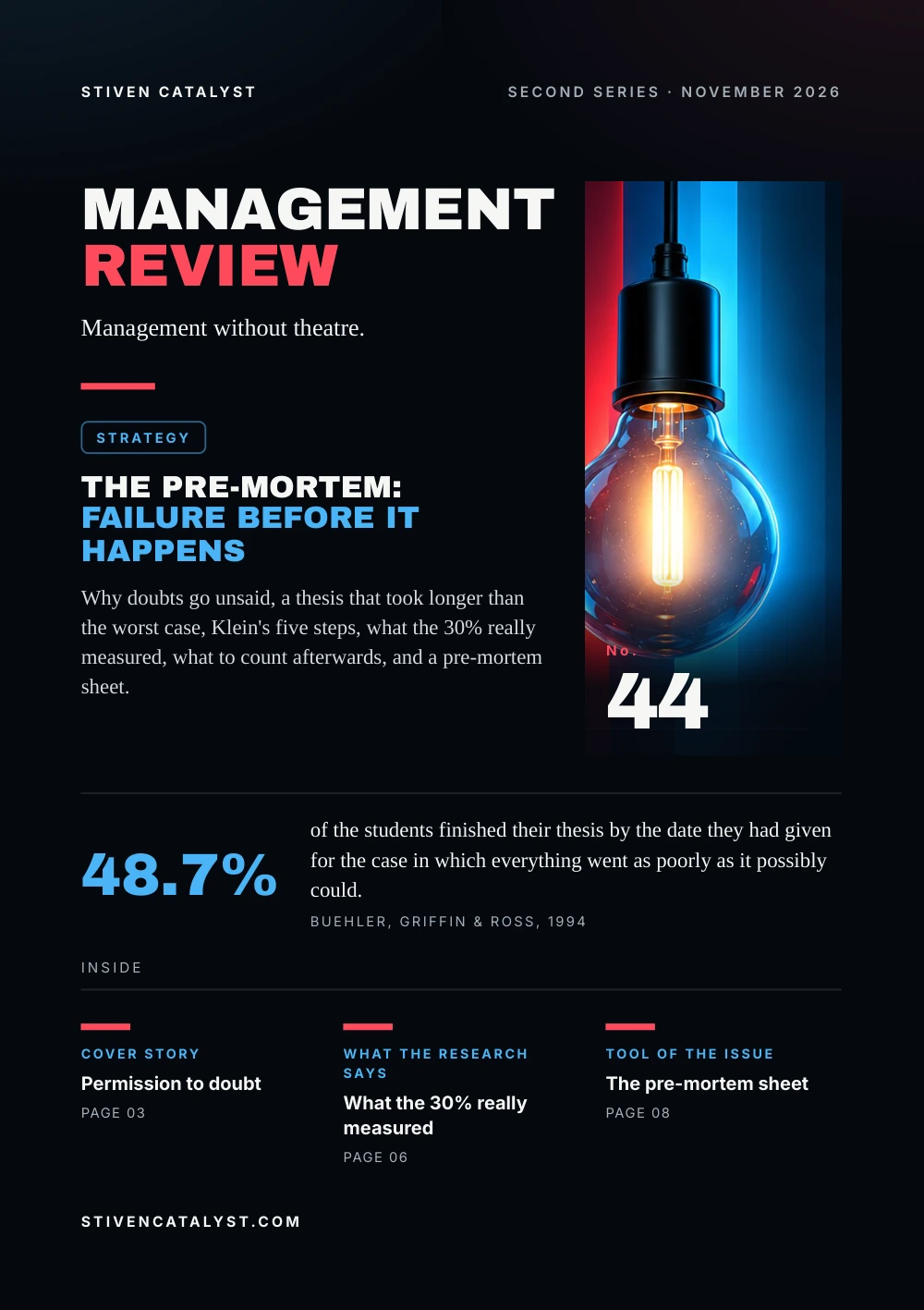
Stiven CatalystSecond series · November 2026
ManagementReview
Management without theatre.
Strategy
The pre-mortem:failure before it happens
Why doubts go unsaid, a thesis that took longer than the worst case, Klein's five steps, what the 30% really measured, what to count afterwards, and a pre-mortem sheet.

No.44
48.7%
of the students finished their thesis by the date they had given for the case in which everything went as poorly as it possibly could.Buehler, Griffin & Ross, 1994
stivencatalyst.com
No. 44 · Strategy
In this issue
Most plans are reviewed by the people who wrote them, at the moment they most want them to work. This issue is about a short meeting that starts from the opposite assumption: the plan has already failed, and the team explains why.
- 03Cover storyPermission to doubt
- 04The numbersLater than the worst case
- 05The modelFive steps, half an hour
- 06What the research saysWhat the 30% really measured
- 07How it is measuredDid the plan change?
- 08Tool of the issueThe pre-mortem sheet
- 09SourcesSources and method
How to read this issue
Figure
Every figure has its source and year at the foot of its page.
Our reading
Where the editors interpret rather than the research, it says so.
Practice
The steps and the card are proposals to try, not research results.
Cover story
Permissiont o doubt
Projects fail at a spectacular rate, Gary Klein wrote in 2007, and one reason is that too many people keep their reservations to themselves while the plan is being made. His remedy turns the usual question around: not what might go wrong, but what did go wrong.
“The main virtue of the premortem is that it legitimizes doubts.”
As a team converges on a decision, Daniel Kahneman wrote, public doubts are gradually suppressed and in the end treated as a sign of flawed loyalty; only supporters keep a voice, and confidence grows. In one of Klein's sessions, a team member who had said nothing in a long kickoff pointed out that an algorithm would not run quickly on the laptops used in the field. The developers had a shortcut they had been reluctant to mention, and it went into the plan.
Our reading
Teams rarely lack the knowledge of what could fail. They lack a moment in which saying it counts as a contribution, not as disloyalty.
Sources: Gary Klein, Harvard Business Review, 2007; Daniel Kahneman, Farrar, Straus and Giroux, 2011 (via Bloomberg, excerpt of 24 October 2011)
Kahneman's words are quoted from an excerpt of Thinking, Fast and Slow that Bloomberg published in 2011. The laptop case is Klein's own account; we could not check it independently.
The numbers
Later thanthe worst case
In 1994 Roger Buehler, Dale Griffin and Michael Ross asked 37 psychology students at the University of Waterloo, in the last term of their honours thesis, when they would hand it in: their best estimate, and the dates if everything went as well, or as badly, as possible.
Days to finish the thesis, average of 33 students, 1994
Only 29.7% finished by their best estimate, 10.8% by the best-case date, 48.7% by the worst-case date. The worst-case forecasts were less biased but no more accurate: they missed by 23.2 days on average, the best estimates by 22.6.
Our reading
Imagining the worst case still starts from the plan. The pre-mortem starts from the failure and asks how it came about.
Source: Roger Buehler, Dale Griffin & Michael Ross, Journal of Personality and Social Psychology, 1994
Averages of the 33 students who had finished when the records closed. The gap between the worst case and the actual time was not statistically significant. One group, one task.
The model
Five steps,half an hour
Klein's pre-mortem comes at the start of a project, once the team knows the plan. In 2021 he wrote that it can take as little as 20 to 30 minutes.
- 01
Brief
The team goes through the plan.
- 02
Failure
The leader declares it has failed: a fiasco, and that much is certain.
- 03
Alone
Two minutes each to write every reason why.
- 04
In turn
One different reason each, the leader first, all on the board.
- 05
Strengthen
The leader reviews the list and strengthens the plan.
Klein later added two minutes in which each person writes actions they can take, and a rating of each problem for likelihood, impact and ease of prevention. Kahneman places the session where an organisation has almost reached an important decision but has not yet committed itself.
Our reading
Timing matters as much as method: before the decision, a doubt is input; after it, the same doubt sounds like opposition.
Sources: Gary Klein, Harvard Business Review, 2007; Gary Klein, Psychology Today, 2021; Daniel Kahneman, Farrar, Straus and Giroux, 2011 (via Bloomberg, excerpt of 24 October 2011)
The steps follow Klein (2007; 2021); in 2007 the round began with the project manager, in 2021 with the team leader. The grouping into five is the editors'.
More in the essayHigh-volume days: the standard under pressure
What the research says
What the 30%really measured
Klein cites a 1989 study by Deborah Mitchell, Jay Russo and Nancy Pennington: imagining that an event has already occurred, he wrote, raises the ability to correctly identify reasons for future outcomes by 30%. The study's abstract describes something narrower.
Mitchell et al., 1989
Varied whether an event lay in the future or the past, and whether it was certain. Time had little effect; certainty mattered: explanations of sure events were longer, with more episodic reasons. No measure of correct reasons is reported.
Veinott, Klein & Wiggins, 2010
178 students reviewed a university's plan for an H1N1 outbreak. Pros and cons, cons only and the pre-mortem all lowered confidence more than the baseline; the pre-mortem most.
Gallop, Willy & Bischoff, 2016
Teams of experienced programme managers and engineers had 45 minutes on one torpedo case. As judged by an expert panel, pre-mortem teams found more quality risks and plan changes than brainstorming teams.
Our reading
The studies share a frame, not a number: the failure is taken as certain. That is the part a team can keep.
Sources: Gary Klein, Harvard Business Review, 2007; Deborah J. Mitchell, J. Edward Russo & Nancy Pennington, Journal of Behavioral Decision Making, 1989 (via Crossref, abstract); Beth Veinott, Gary Klein & Sterling Wiggins, Proceedings of the 7th ISCRAM Conference, Seattle, 2010 (via Gary Klein, Psychology Today, 2021); David Gallop, Chris Willy & John Bischoff, Journal of Enterprise Transformation, 2016 (via ResearchGate, abstract)
We could not read the full 1989 paper and give no figure from it. The later studies used one scenario each; lower confidence is not yet a better plan, and we found no study of real project results.
How it is measured
Did the planchange?
A pre-mortem is not judged by the length of its list. In Klein's account, it pays off as a stronger plan and as a team that picks up early signs of trouble once the work is under way. Four counts show whether that happened.
Voices
How many people gave at least one reason? A list written by two people is theirs, not the team's.
New reasons
How many had not come up in the kickoff or the risk list?
Changes
How many led to a change in the plan, with an owner and a date?
Early signs
For the top reasons: which signal shows early that it is happening, and who watches it?
Hypothetical example, a pre-mortem before a peak week in a warehouse
- Voices
- 9 in the room, 8 gave a reason
- Reasons
- 23 on the board, 7 never raised before
- Changes
- 4 to the plan, 2 warning signs with an owner
The line that counts is the last one: what the session changed. The numbers are invented.
Sources: Gary Klein, Harvard Business Review, 2007; Daniel Kahneman, Farrar, Straus and Giroux, 2011 (via Bloomberg, excerpt of 24 October 2011)
The counts and the example are the editors', drawn from the benefits Klein lists. Kahneman warns that the pre-mortem is no panacea and gives no complete protection against nasty surprises.
Tool of the issue
The pre-mor temshee t
Run it before the plan is approved, not after. Read the second line aloud, give everyone two minutes alone, and take the top reasons to the 5 Whys sheet to reach a cause you can change.
01Plan and decisionwhat we are about to commit to, and by when
02The failure“It is [date]. We carried out the plan as written. It failed.”
03Why it failedtwo minutes alone, then one reason each, in turn
04Top three reasonslikelihood, impact, how easy to prevent
05Changes to the planwhat changes, who owns it, by when
06Early warning signswhat we will see first, and who watches for it
Sources: Gary Klein, Harvard Business Review, 2007; Gary Klein, Psychology Today, 2021; Daniel Kahneman, Farrar, Straus and Giroux, 2011 (via Bloomberg, excerpt of 24 October 2011)
A practice proposed by the editors, after Klein (2007; 2021) and Kahneman (2011).
Open the tool: 5 Whysstivencatalyst.com/tools/five-whys/
Sources and method
Every figurehas a source.
The figures in this issue come from the sources below. The year shows how recent each one is.
- Performing a Project PremortemGary Klein, Harvard Business Review, 2007https://hbr.org/2007/09/performing-a-project-premortem
- Thinking, Fast and SlowDaniel Kahneman, Farrar, Straus and Giroux, 2011 · via Bloomberg, excerpt of 24 October 2011
- Exploring the “planning fallacy”: Why people underestimate their task completion timesRoger Buehler, Dale Griffin & Michael Ross, Journal of Personality and Social Psychology, 1994https://doi.org/10.1037/0022-3514.67.3.366
- The Pre-Mortem MethodGary Klein, Psychology Today, 2021https://www.psychologytoday.com/us/blog/seeing-what-others-dont/202101/the-pre-mortem-method
- Back to the future: Temporal perspective in the explanation of eventsDeborah J. Mitchell, J. Edward Russo & Nancy Pennington, Journal of Behavioral Decision Making, 1989 · via Crossref, abstracthttps://doi.org/10.1002/bdm.3960020103
- Evaluating the Effectiveness of the PreMortem Technique on Plan ConfidenceBeth Veinott, Gary Klein & Sterling Wiggins, Proceedings of the 7th ISCRAM Conference, Seattle, 2010 · via Gary Klein, Psychology Today, 2021https://idl.iscram.org/files/veinott/2010/1049_Veinott_etal2010.pdf
- How to catch a black swan: Measuring the benefits of the premortem technique for risk identificationDavid Gallop, Chris Willy & John Bischoff, Journal of Enterprise Transformation, 2016 · via ResearchGate, abstracthttps://doi.org/10.1080/19488289.2016.1240118
Editorial method
Each figure was checked for its year, its publisher and what exactly it measures. Where the publisher's page could not be opened, the figure was checked against independent summaries and is marked “via”. The editors' interpretation is marked “Our reading”. Figures that could not be confirmed are not in the issue.
ManagementReview
Management without theatre.
Every issue, one management question, checked against the best research.
All issues
stivencatalyst.com/magazine/management-review.html
Management Review · No. 44 · November 2026 · Stiven Catalyst
Click or swipe a page to turn it. The arrow keys work too.
Management Review · No. 44
The figures of the issue
The charts of the printed pages, with their sources.
Source: Roger Buehler, Dale Griffin & Michael Ross, Journal of Personality and Social Psychology, 1994
The whole text Read the issue as text For reading on a small screen, searching or a screen reader. The same words, without the page design.
In this issue
Most plans are reviewed by the people who wrote them, at the moment they most want them to work. This issue is about a short meeting that starts from the opposite assumption: the plan has already failed, and the team explains why.
Gary Klein described the pre-mortem in Harvard Business Review in 2007. Daniel Kahneman wrote that its main virtue is to make doubts legitimate. In a 1994 study, students finished their thesis later than even their worst-case forecast. The figure most often quoted for the method, 30%, goes back to a 1989 study whose abstract describes something else: how people explain an outcome they take as certain. A 2010 experiment found that the pre-mortem lowered confidence in a plan more than other kinds of critique.
Stiven Janaqi, Editor
Cover story
Permission t o doubt
Projects fail at a spectacular rate, Gary Klein wrote in 2007, and one reason is that too many people keep their reservations to themselves while the plan is being made. His remedy turns the usual question around: not what might go wrong, but what did go wrong.
The main virtue of the premortem is that it legitimizes doubts.
As a team converges on a decision, Daniel Kahneman wrote, public doubts are gradually suppressed and in the end treated as a sign of flawed loyalty; only supporters keep a voice, and confidence grows. In one of Klein's sessions, a team member who had said nothing in a long kickoff pointed out that an algorithm would not run quickly on the laptops used in the field. The developers had a shortcut they had been reluctant to mention, and it went into the plan.
Our reading
Teams rarely lack the knowledge of what could fail. They lack a moment in which saying it counts as a contribution, not as disloyalty.
Kahneman's words are quoted from an excerpt of Thinking, Fast and Slow that Bloomberg published in 2011. The laptop case is Klein's own account; we could not check it independently.
Sources: Gary Klein, Harvard Business Review, 2007; Daniel Kahneman, Farrar, Straus and Giroux, 2011 (via Bloomberg, excerpt of 24 October 2011)
The numbers
Later than the worst case
In 1994 Roger Buehler, Dale Griffin and Michael Ross asked 37 psychology students at the University of Waterloo, in the last term of their honours thesis, when they would hand it in: their best estimate, and the dates if everything went as well, or as badly, as possible.
Days to finish the thesis, average of 33 students, 1994: Best case 27.4, Best estimate 33.9, Worst case 48.6, Actual 55.5.
Only 29.7% finished by their best estimate, 10.8% by the best-case date, 48.7% by the worst-case date. The worst-case forecasts were less biased but no more accurate: they missed by 23.2 days on average, the best estimates by 22.6.
Our reading
Imagining the worst case still starts from the plan. The pre-mortem starts from the failure and asks how it came about.
Averages of the 33 students who had finished when the records closed. The gap between the worst case and the actual time was not statistically significant. One group, one task.
Source: Roger Buehler, Dale Griffin & Michael Ross, Journal of Personality and Social Psychology, 1994
The model
Five steps, half an hour
Klein's pre-mortem comes at the start of a project, once the team knows the plan. In 2021 he wrote that it can take as little as 20 to 30 minutes.
- Brief. The team goes through the plan.
- Failure. The leader declares it has failed: a fiasco, and that much is certain.
- Alone. Two minutes each to write every reason why.
- In turn. One different reason each, the leader first, all on the board.
- Strengthen. The leader reviews the list and strengthens the plan.
Klein later added two minutes in which each person writes actions they can take, and a rating of each problem for likelihood, impact and ease of prevention. Kahneman places the session where an organisation has almost reached an important decision but has not yet committed itself.
Our reading
Timing matters as much as method: before the decision, a doubt is input; after it, the same doubt sounds like opposition.
The steps follow Klein (2007; 2021); in 2007 the round began with the project manager, in 2021 with the team leader. The grouping into five is the editors'.
Sources: Gary Klein, Harvard Business Review, 2007; Gary Klein, Psychology Today, 2021; Daniel Kahneman, Farrar, Straus and Giroux, 2011 (via Bloomberg, excerpt of 24 October 2011)
More in the essay: High-volume days: the standard under pressure
What the research says
What the 30% really measured
Klein cites a 1989 study by Deborah Mitchell, Jay Russo and Nancy Pennington: imagining that an event has already occurred, he wrote, raises the ability to correctly identify reasons for future outcomes by 30%. The study's abstract describes something narrower.
- Mi
t chelle t al., 1989. Varied whether an event lay in the future or the past, and whether it was certain. Time had little effect; certainty mattered: explanations of sure events were longer, with more episodic reasons. No measure of correct reasons is reported. - Veino
t t, Klein & Wiggins, 2010. 178 students reviewed a university's plan for an H1N1 outbreak. Pros and cons, cons only and the pre-mortem all lowered confidence more than the baseline; the pre-mortem most. - Gallop, Willy & Bischoff, 2016. Teams of experienced programme managers and engineers had 45 minutes on one torpedo case. As judged by an expert panel, pre-mortem teams found more quality risks and plan changes than brainstorming teams.
Our reading
The studies share a frame, not a number: the failure is taken as certain. That is the part a team can keep.
We could not read the full 1989 paper and give no figure from it. The later studies used one scenario each; lower confidence is not yet a better plan, and we found no study of real project results.
Sources: Gary Klein, Harvard Business Review, 2007; Deborah J. Mitchell, J. Edward Russo & Nancy Pennington, Journal of Behavioral Decision Making, 1989 (via Crossref, abstract); Beth Veinott, Gary Klein & Sterling Wiggins, Proceedings of the 7th ISCRAM Conference, Seattle, 2010 (via Gary Klein, Psychology Today, 2021); David Gallop, Chris Willy & John Bischoff, Journal of Enterprise Transformation, 2016 (via ResearchGate, abstract)
How it is measured
Did the plan change?
A pre-mortem is not judged by the length of its list. In Klein's account, it pays off as a stronger plan and as a team that picks up early signs of trouble once the work is under way. Four counts show whether that happened.
- Voices. How many people gave at least one reason? A list written by two people is theirs, not the team's.
- New reasons. How many had not come up in the kickoff or the risk list?
- Changes. How many led to a change in the plan, with an owner and a date?
- Early signs. For the top reasons: which signal shows early that it is happening, and who watches it?
Hypothe tical example, a pre-mor tem before a peak week in a warehouse
- Voices: 9 in the room, 8 gave a reason
- Reasons: 23 on the board, 7 never raised before
- Changes: 4 to the plan, 2 warning signs with an owner
The line that counts is the last one: what the session changed. The numbers are invented.
The counts and the example are the editors', drawn from the benefits Klein lists. Kahneman warns that the pre-mortem is no panacea and gives no complete protection against nasty surprises.
Sources: Gary Klein, Harvard Business Review, 2007; Daniel Kahneman, Farrar, Straus and Giroux, 2011 (via Bloomberg, excerpt of 24 October 2011)
Tool of the issue
The pre-mor tem shee t
Run it before the plan is approved, not after. Read the second line aloud, give everyone two minutes alone, and take the top reasons to the 5 Whys sheet to reach a cause you can change.
- Plan and decision what we are about to commit to, and by when
- The failure “It is [date]. We carried out the plan as written. It failed.”
- Why it failed two minutes alone, then one reason each, in turn
T op three reasons likelihood, impact, how easy to prevent- Changes
t o the plan what changes, who owns it, by when - Early warning signs what we will see first, and who watches for it
A practice proposed by the editors, after Klein (2007; 2021) and Kahneman (2011).
Sources: Gary Klein, Harvard Business Review, 2007; Gary Klein, Psychology Today, 2021; Daniel Kahneman, Farrar, Straus and Giroux, 2011 (via Bloomberg, excerpt of 24 October 2011)
Open the tool: 5 Whys
Sources and method
Every figure has a source.
The figures in this issue come from the sources below. The year shows how recent each one is.
- Gary Klein, Harvard Business Review, “Performing a Project Premortem”, 2007. https://hbr.org/2007/09/performing-a-project-premortem
- Daniel Kahneman, Farrar, Straus and Giroux, “Thinking, Fast and Slow”, 2011 (via Bloomberg, excerpt of 24 October 2011).
- Roger Buehler, Dale Griffin & Michael Ross, Journal of Personality and Social Psychology, “Exploring the “planning fallacy”: Why people underestimate their task completion times”, 1994. https://doi.org/10.1037/0022-3514.67.3.366
- Gary Klein, Psychology Today, “The Pre-Mortem Method”, 2021. https://www.psychologytoday.com/us/blog/seeing-what-others-dont/202101/the-pre-mortem-method
- Deborah J. Mitchell, J. Edward Russo & Nancy Pennington, Journal of Behavioral Decision Making, “Back to the future: Temporal perspective in the explanation of events”, 1989 (via Crossref, abstract). https://doi.org/10.1002/bdm.3960020103
- Beth Veinott, Gary Klein & Sterling Wiggins, Proceedings of the 7th ISCRAM Conference, Seattle, “Evaluating the Effectiveness of the PreMortem Technique on Plan Confidence”, 2010 (via Gary Klein, Psychology Today, 2021). https://idl.iscram.org/files/veinott/2010/1049_Veinott_etal2010.pdf
- David Gallop, Chris Willy & John Bischoff, Journal of Enterprise Transformation, “How to catch a black swan: Measuring the benefits of the premortem technique for risk identification”, 2016 (via ResearchGate, abstract). https://doi.org/10.1080/19488289.2016.1240118
Edit orial me thod
Each figure was checked for its year, its publisher and what exactly it measures. Where the publisher's page could not be opened, the figure was checked against independent summaries and is marked “via”. The editors' interpretation is marked “Our reading”. Figures that could not be confirmed are not in the issue.
Management Review · Monthly edition