In a randomised experiment in 28 Gap stores, more stable schedules went with 7% higher median sales. In a survey of 27,792 hourly workers at 80 large US firms, a third had less than a week's notice of their schedule. Ending on-call shifts went with a fall in distress more than seven times larger than a raise of $4 an hour. Four sides of a stable roster, five numbers to watch, the legal floor and a card for the next roster close the issue.
Management Review · Third series · November 2026 · No. 81
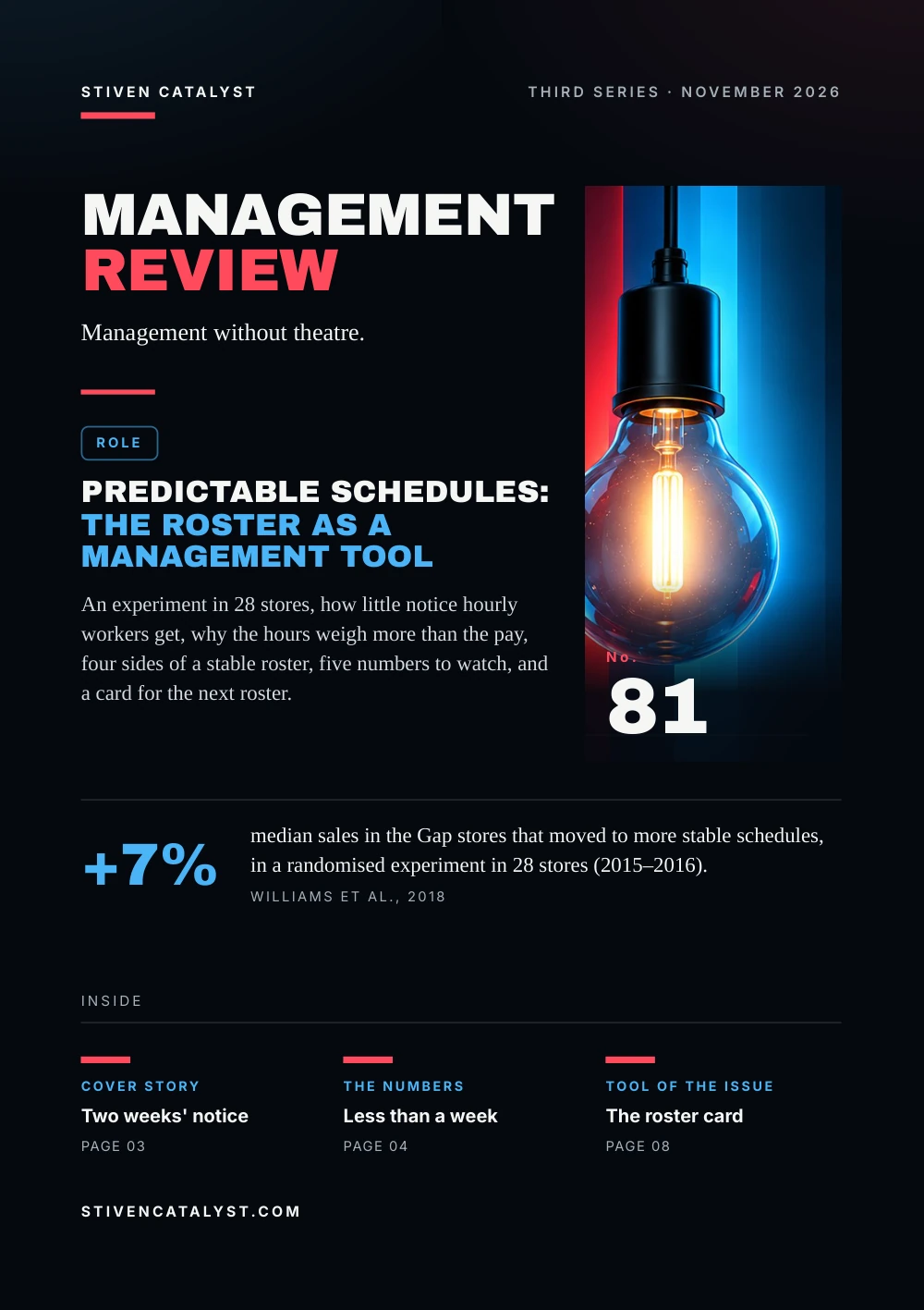
Predictable schedules: the roster as a management t ool
An experiment in 28 stores, how little notice hourly workers get, why the hours weigh more than the pay, four sides of a stable roster, five numbers to watch, and a card for the next roster.
- No.
- 81
- Pages
- 10
- Sources
- 4
- Topics
- Role
- Online since
- 1 November 2026
Stiven CatalystThird series · November 2026
ManagementReview
Management without theatre.
Role
Predictable schedules:the roster as a management tool
An experiment in 28 stores, how little notice hourly workers get, why the hours weigh more than the pay, four sides of a stable roster, five numbers to watch, and a card for the next roster.

No.81
+7%
median sales in the Gap stores that moved to more stable schedules, in a randomised experiment in 28 stores (2015–2016).Williams et al., 2018
stivencatalyst.com
No. 81 · Role
In this issue
For people paid by the hour, the roster decides when they earn, sleep and see their families. It is usually treated as an output of the forecast. The research of the last decade treats it as a lever: on the health of the team and on the results of the site.
- 03Cover storyTwo weeks' notice
- 04The numbersLess than a week
- 05What the research saysTime weighs more than pay
- 06The modelFour sides of a stable roster
- 07How it is measuredFive numbers for a roster
- 08Tool of the issueThe roster card
- 09SourcesSources and method
How to read this issue
Figure
Every figure has its source and year at the foot of its page.
Our reading
Where the editor interprets rather than the research, it says so.
Practice
The steps and the card are proposals to try, not research results.
Cover story
Two weeks'notice
On 1 October 2015 Gap required all its US stores to publish schedules two weeks ahead and stopped on-call shifts. Researchers from three universities then tested five more practices from November 2015 to August 2016: in 19 stores in San Francisco and Chicago, against 9 that kept the usual roster.
Shift swapping by app
Staff swap shifts without the manager; the manager posts extra shifts.
Stable shift structure
Standard start and end times for the store.
Core scheduling
The same days and times for each person, week after week.
Part-time Plus
A core team promised, softly, 20 hours a week or more.
Targeted extra staffing
Extra hours at fixed times in 13 stores, paid by Gap.
+7%median sales in the stores with the practices
+5%sales per hour of labour
Our reading
The schedule was not a cost to cut here. Kept steady, it paid for itself.
Source: Joan C. Williams, Susan J. Lambert, Saravanan Kesavan et al., WorkLife Law, UC Hastings College of the Law, 2018
Results as the researchers estimated them (difference-in-differences, 35 weeks). Gap took part and gave a $50,000 seed grant. At the end Gap cut the notice from two weeks to ten days.
The numbers
Less thana week
The Shift Project surveyed 27,792 hourly workers at 80 large US retail and food-service firms in 2016 and 2017. They were recruited through Facebook advertisements and weighted to match the workforce.
Notice of the weekly schedule, share of workers (2016–2017)
50%worked a “clopening”: a closing shift, then an opening one less than 11 hours later, in the past month
26%worked on call in the past month
14%had a shift cancelled with less than 24 hours' notice
Half had no say at all in their schedule. Between the best and the worst week of the month, hours swung by 32% on average.
Our reading
Two weeks' notice was the exception, not the rule. For most, next week was still open.
Source: Daniel Schneider & Kristen Harknett, American Sociological Review 84(1), 2019
Workers' own reports; the bars count workers and add to 101% by rounding. US retail and food service, not a probability sample. Read in the full text of the article.
What the research says
Time weighsmore than pay
In the same data, every form of unstable scheduling went with more psychological distress, and most with worse sleep and less happiness. Schneider and Harknett then set changes to the schedule beside raises in the minimum wage.
Estimated fall in psychological distress for the workers affected, percentage points
Of the workers who had a shift cancelled at short notice, 65% reported distress, against under 45% of the others. Work-life conflict accounted for 76% of the link between instability and distress, household economic insecurity for 42%, each measured on its own.
Our reading
The hours hurt less through the money than through the life around them.
Source: Daniel Schneider & Kristen Harknett, American Sociological Review 84(1), 2019
A cross-sectional survey: associations, not proof of cause. The “effects” are differences in predicted shares, as the authors say; the wage base is $7.25. Read in the full text.
The model
Four sides ofa stable roster
The Gap study measured stability on four sides, each with its own data: the published schedules, the time clock and two surveys of staff.
01
Consistency
Same days, times and hours each week. Same start or end hour: under 3 in 10 shifts without the practices, over 3 in 9 with them.
02
Predictability
The shift worked is the shift published. Changed by 15 minutes or more: 46% of shifts without the practices, 41% with them.
03
Adequacy
Enough hours for those who want them. Part-time Plus: 21 hours a week before, 26 after; the average did not rise.
04
Input
A say in when one works. Input into the days worked: 75% with the practices, 66% without.
Demand was not the main cause of instability: week-to-week traffic explained only 30% of the swings in weekly payroll hours. Managers named three causes at headquarters: shipments, promotions changed at the last minute, and visits by leaders.
Our reading
Much of a store's instability is made upstream. The roster is where it lands.
Source: Joan C. Williams, Susan J. Lambert, Saravanan Kesavan et al., WorkLife Law, UC Hastings College of the Law, 2018
Definitions and results condensed from Williams et al. (2018): weeks with the practices against weeks without; survey answers for input. Demand and capacity in one plan are in No. 59.
More in the essayHigh-volume days: the standard under pressure
How it is measured
Five numbersfor a roster
The two studies measured stability with simple counts. A manager can take them from the published roster and the time clock, period after period.
Notice
Days from publishing the roster to its first shift.
Changed shifts
Share of shifts worked 15 minutes or more off the published start or end.
Hours swing
Most minus fewest weekly hours in four weeks, divided by the most.
Late cancellations
Shifts cancelled with less than 24 hours' notice.
Clopenings
A closing shift followed by an opening one less than 11 hours later.
The legal floor: under Directive (EU) 2019/1152, a worker whose pattern is mostly unpredictable may refuse work outside agreed reference hours and days, or without reasonable notice. In Germany, for work on call, the notice is at least four days.
Sources: Joan C. Williams, Susan J. Lambert, Saravanan Kesavan et al., WorkLife Law, UC Hastings College of the Law, 2018; Daniel Schneider & Kristen Harknett, American Sociological Review 84(1), 2019; European Parliament and Council of the European Union, Official Journal L 186, 2019; Bundesministerium der Justiz, gesetze-im-internet.de, 2000
Definitions from Williams et al. (2018) and Schneider & Harknett (2019); the selection is the editors'. Article 10 of the directive and § 12 TzBfG, summarised, not legal advice. Rest and the body clock are in No. 45.
Tool of the issue
The rostercard
One card per roster: filled in when it is published, checked when the period ends. Shift Capacity turns the volume forecast into heads per shift before the roster is written.
01Published, first shiftthe two dates, and the notice in days
02Reference hours and daysthe time frame in which work can be asked
03Core shiftswho keeps the same days and times as last period
04Changes after publishingshifts moved 15 minutes or more; asked by the site or by the worker
05Late cancellations, clopeningshow many, and for whom
06What drove the changesdemand, a delivery, a promotion, a visit, an absence; what to plan next time
Sources: Joan C. Williams, Susan J. Lambert, Saravanan Kesavan et al., WorkLife Law, UC Hastings College of the Law, 2018; Daniel Schneider & Kristen Harknett, American Sociological Review 84(1), 2019; European Parliament and Council of the European Union, Official Journal L 186, 2019
A card the editors propose, after Williams et al. (2018), Schneider & Harknett (2019) and Article 10 of Directive (EU) 2019/1152.
Open the tool: Shift Capacitystivencatalyst.com/tools/shift-capacity/
Sources and method
Every figurehas a source.
The figures in this issue come from the sources below. The year shows how recent each one is.
- Stable Scheduling Increases Productivity and Sales: The Stable Scheduling StudyJoan C. Williams, Susan J. Lambert, Saravanan Kesavan et al., WorkLife Law, UC Hastings College of the Law, 2018https://worklifelaw.org/publications/Stable-Scheduling-Study-Report.pdf
- Consequences of Routine Work-Schedule Instability for Worker Health and Well-BeingDaniel Schneider & Kristen Harknett, American Sociological Review 84(1), 2019https://doi.org/10.1177/0003122418823184
- Directive (EU) 2019/1152 on transparent and predictable working conditions in the European Union, Articles 1, 4, 10 and 21European Parliament and Council of the European Union, Official Journal L 186, 2019https://eur-lex.europa.eu/eli/dir/2019/1152/oj/eng
- Teilzeit- und Befristungsgesetz (TzBfG), § 12 Arbeit auf AbrufBundesministerium der Justiz, gesetze-im-internet.de, 2000https://www.gesetze-im-internet.de/tzbfg/__12.html
Editorial method
Each figure was checked for its year, its publisher and what it measures, in the full text where it could be opened. A source read only in a summary, an abstract or excerpts is marked “via”. A figure not confirmed in what was read is marked so on its page, or left out. The editor's interpretation is marked “Our reading”.
ManagementReview
Management without theatre.
Every issue, one management question, checked against the best research.
All issues
stivencatalyst.com/magazine/management-review.html
Management Review · No. 81 · November 2026 · Stiven Catalyst
Edited by Stiven Janaqi, who answers for it; “the editors” in this publication means him. Its texts, translations, layout and the checking of figures against their sources are done in working sessions with Claude, an AI model by Anthropic.
stivencatalyst.com/how-this-is-made.html
 Next issue
Regression to the mean
Click or swipe a page to turn it. The arrow keys work too.
Management Review · No. 81
The figures of the issue
The charts of the printed pages, with their sources.
Workers' own reports; the bars count workers and add to 101% by rounding. US retail and food service, not a probability sample. Read in the full text of the article.
Source: Daniel Schneider & Kristen Harknett, American Sociological Review 84(1), 2019
A cross-sectional survey: associations, not proof of cause. The “effects” are differences in predicted shares, as the authors say; the wage base is $7.25. Read in the full text.
Source: Daniel Schneider & Kristen Harknett, American Sociological Review 84(1), 2019
The whole text Read the issue as text For reading on a small screen, searching or a screen reader. The same words, without the page design.
In this issue
For people paid by the hour, the roster decides when they earn, sleep and see their families. It is usually treated as an output of the forecast. The research of the last decade treats it as a lever: on the health of the team and on the results of the site.
In a randomised experiment in 28 Gap stores, more stable schedules went with 7% higher median sales. In a survey of 27,792 hourly workers at 80 large US firms, a third had less than a week's notice of their schedule. Ending on-call shifts went with a fall in distress more than seven times larger than a raise of $4 an hour. Four sides of a stable roster, five numbers to watch, the legal floor and a card for the next roster close the issue.
Stiven Janaqi, Editor
Cover story
Two weeks' notice
On 1 October 2015 Gap required all its US stores to publish schedules two weeks ahead and stopped on-call shifts. Researchers from three universities then tested five more practices from November 2015 to August 2016: in 19 stores in San Francisco and Chicago, against 9 that kept the usual roster.
- Shi
f t swapping by app. Staff swap shifts without the manager; the manager posts extra shifts. - Stable shi
f t structure. Standard start and end times for the store. - Core scheduling. The same days and times for each person, week after week.
- Pa
r t-time Plus. A core team promised, softly, 20 hours a week or more. - Targ
e ted extra staffing. Extra hours at fixed times in 13 stores, paid by Gap.
- +7% median sales in the stores with the practices
- +5% sales per hour of labour
Our reading
The schedule was not a cost to cut here. Kept steady, it paid for itself.
Results as the researchers estimated them (difference-in-differences, 35 weeks). Gap took part and gave a $50,000 seed grant. At the end Gap cut the notice from two weeks to ten days.
Source: Joan C. Williams, Susan J. Lambert, Saravanan Kesavan et al., WorkLife Law, UC Hastings College of the Law, 2018
The numbers
Less than a week
The Shift Project surveyed 27,792 hourly workers at 80 large US retail and food-service firms in 2016 and 2017. They were recruited through Facebook advertisements and weighted to match the workforce.
Notice of the weekly schedule, share of workers (2016–2017): 0–2 days 16%, 3–6 days 18%, 1–2 weeks 30%, More than 2 weeks 37%.
- 50% worked a “clopening”: a closing shift, then an opening one less than 11 hours later, in the past month
- 26% worked on call in the past month
- 14% had a shift cancelled with less than 24 hours' notice
Half had no say at all in their schedule. Between the best and the worst week of the month, hours swung by 32% on average.
Our reading
Two weeks' notice was the exception, not the rule. For most, next week was still open.
Workers' own reports; the bars count workers and add to 101% by rounding. US retail and food service, not a probability sample. Read in the full text of the article.
Source: Daniel Schneider & Kristen Harknett, American Sociological Review 84(1), 2019
What the research says
Time weighs more than pay
In the same data, every form of unstable scheduling went with more psychological distress, and most with worse sleep and less happiness. Schneider and Harknett then set changes to the schedule beside raises in the minimum wage.
Estimated fall in psychological distress for the workers affected, percentage points: No more on-call shifts 15, 72 hours' notice, not 0–2 days 4.5, $4 an hour more pay 2.
Of the workers who had a shift cancelled at short notice, 65% reported distress, against under 45% of the others. Work-life conflict accounted for 76% of the link between instability and distress, household economic insecurity for 42%, each measured on its own.
Our reading
The hours hurt less through the money than through the life around them.
A cross-sectional survey: associations, not proof of cause. The “effects” are differences in predicted shares, as the authors say; the wage base is $7.25. Read in the full text.
Source: Daniel Schneider & Kristen Harknett, American Sociological Review 84(1), 2019
The model
Four sides of a stable roster
The Gap study measured stability on four sides, each with its own data: the published schedules, the time clock and two surveys of staff.
- Consistency. Same days, times and hours each week. Same start or end hour: under 3 in 10 shifts without the practices, over 3 in 9 with them.
- Predictabili
t y. The shift worked is the shift published. Changed by 15 minutes or more: 46% of shifts without the practices, 41% with them. - Adequacy. Enough hours for those who want them. Part-time Plus: 21 hours a week before, 26 after; the average did not rise.
- Input. A say in when one works. Input into the days worked: 75% with the practices, 66% without.
Demand was not the main cause of instability: week-to-week traffic explained only 30% of the swings in weekly payroll hours. Managers named three causes at headquarters: shipments, promotions changed at the last minute, and visits by leaders.
Our reading
Much of a store's instability is made upstream. The roster is where it lands.
Definitions and results condensed from Williams et al. (2018): weeks with the practices against weeks without; survey answers for input. Demand and capacity in one plan are in No. 59.
Source: Joan C. Williams, Susan J. Lambert, Saravanan Kesavan et al., WorkLife Law, UC Hastings College of the Law, 2018
More in the essay: High-volume days: the standard under pressure
How it is measured
Five numbers for a roster
The two studies measured stability with simple counts. A manager can take them from the published roster and the time clock, period after period.
- Notice. Days from publishing the roster to its first shift.
- Changed shi
f ts. Share of shifts worked 15 minutes or more off the published start or end. - Hours swing. Most minus fewest weekly hours in four weeks, divided by the most.
- Late cancellations. Shifts cancelled with less than 24 hours' notice.
- Clopenings. A closing shift followed by an opening one less than 11 hours later.
The legal floor: under Directive (EU) 2019/1152, a worker whose pattern is mostly unpredictable may refuse work outside agreed reference hours and days, or without reasonable notice. In Germany, for work on call, the notice is at least four days.
Definitions from Williams et al. (2018) and Schneider & Harknett (2019); the selection is the editors'. Article 10 of the directive and § 12 TzBfG, summarised, not legal advice. Rest and the body clock are in No. 45.
Sources: Joan C. Williams, Susan J. Lambert, Saravanan Kesavan et al., WorkLife Law, UC Hastings College of the Law, 2018; Daniel Schneider & Kristen Harknett, American Sociological Review 84(1), 2019; European Parliament and Council of the European Union, Official Journal L 186, 2019; Bundesministerium der Justiz, gesetze-im-internet.de, 2000
Tool of the issue
The roster card
One card per roster: filled in when it is published, checked when the period ends. Shift Capacity turns the volume forecast into heads per shift before the roster is written.
- Published, first shi
f t the two dates, and the notice in days - Reference hours and days the time frame in which work can be asked
- Core shi
f ts who keeps the same days and times as last period - Changes a
f ter publishing shifts moved 15 minutes or more; asked by the site or by the worker - Late cancellations, clopenings how many, and for whom
- What drove the changes demand, a delivery, a promotion, a visit, an absence; what to plan next time
A card the editors propose, after Williams et al. (2018), Schneider & Harknett (2019) and Article 10 of Directive (EU) 2019/1152.
Sources: Joan C. Williams, Susan J. Lambert, Saravanan Kesavan et al., WorkLife Law, UC Hastings College of the Law, 2018; Daniel Schneider & Kristen Harknett, American Sociological Review 84(1), 2019; European Parliament and Council of the European Union, Official Journal L 186, 2019
Open the tool: Shift Capacity
Sources and method
Every figure has a source.
The figures in this issue come from the sources below. The year shows how recent each one is.
- Joan C. Williams, Susan J. Lambert, Saravanan Kesavan et al., WorkLife Law, UC Hastings College of the Law, “Stable Scheduling Increases Productivity and Sales: The Stable Scheduling Study”, 2018. https://worklifelaw.org/publications/Stable-Scheduling-Study-Report.pdf
- Daniel Schneider & Kristen Harknett, American Sociological Review 84(1), “Consequences of Routine Work-Schedule Instability for Worker Health and Well-Being”, 2019. https://doi.org/10.1177/0003122418823184
- European Parliament and Council of the European Union, Official Journal L 186, “Directive (EU) 2019/1152 on transparent and predictable working conditions in the European Union, Articles 1, 4, 10 and 21”, 2019. https://eur-lex.europa.eu/eli/dir/2019/1152/oj/eng
- Bundesministerium der Justiz, gesetze-im-internet.de, “Teilzeit- und Befristungsgesetz (TzBfG), § 12 Arbeit auf Abruf”, 2000. https://www.gesetze-im-internet.de/tzbfg/__12.html
Edit orial me thod
Each figure was checked for its year, its publisher and what it measures, in the full text where it could be opened. A source read only in a summary, an abstract or excerpts is marked “via”. A figure not confirmed in what was read is marked so on its page, or left out. The editor's interpretation is marked “Our reading”.
Edited by Stiven Janaqi, who answers for it; “the editors” in this publication means him. Its texts, translations, layout and the checking of figures against their sources are done in working sessions with Claude, an AI model by Anthropic. How this is made
Management Review · Monthly edition