In this issue
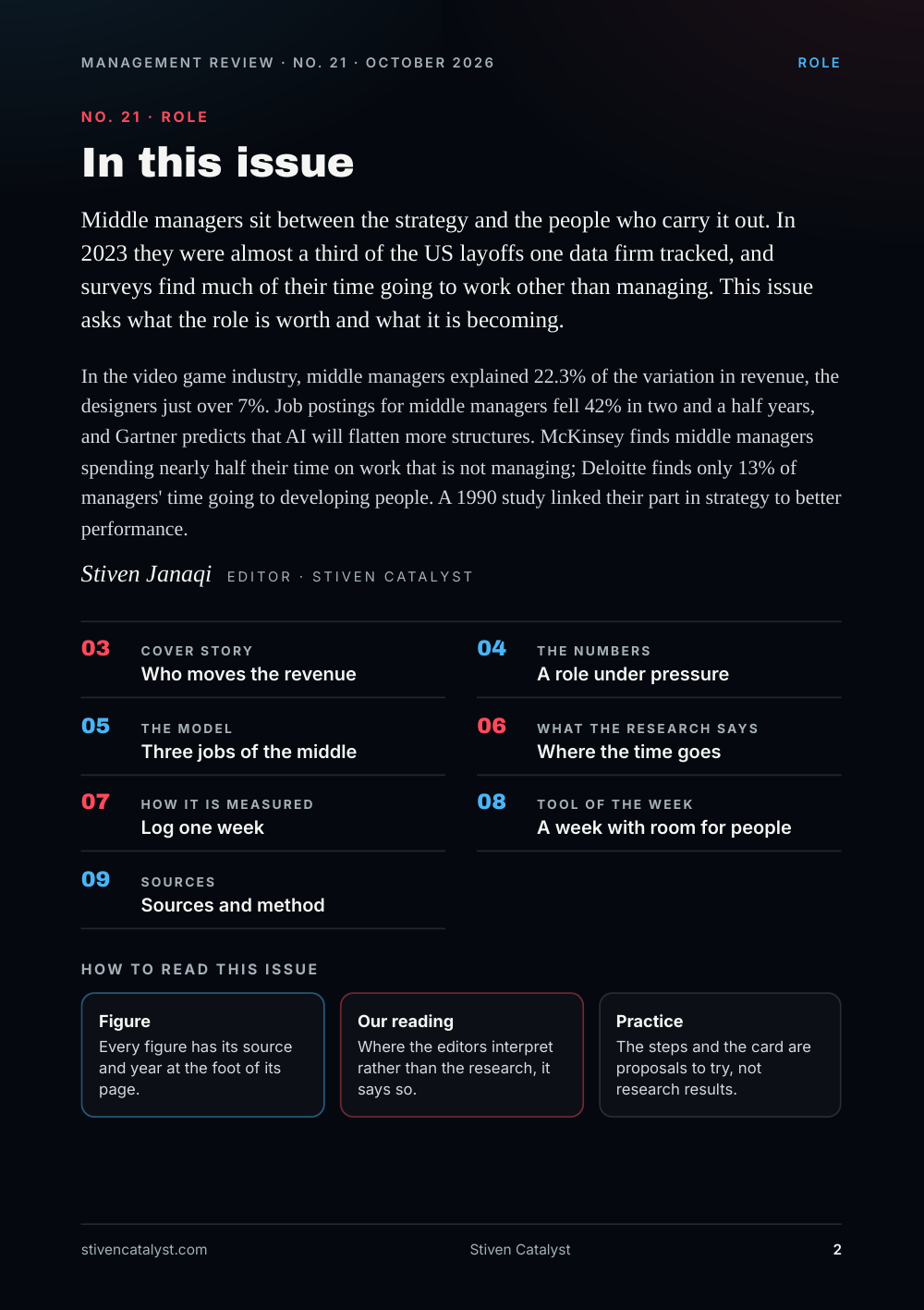
Middle managers sit between the strategy and the people who carry it out. In 2023 they were almost a third of the US layoffs one data firm tracked, and surveys find much of their time going to work other than managing. This issue asks what the role is worth and what it is becoming.
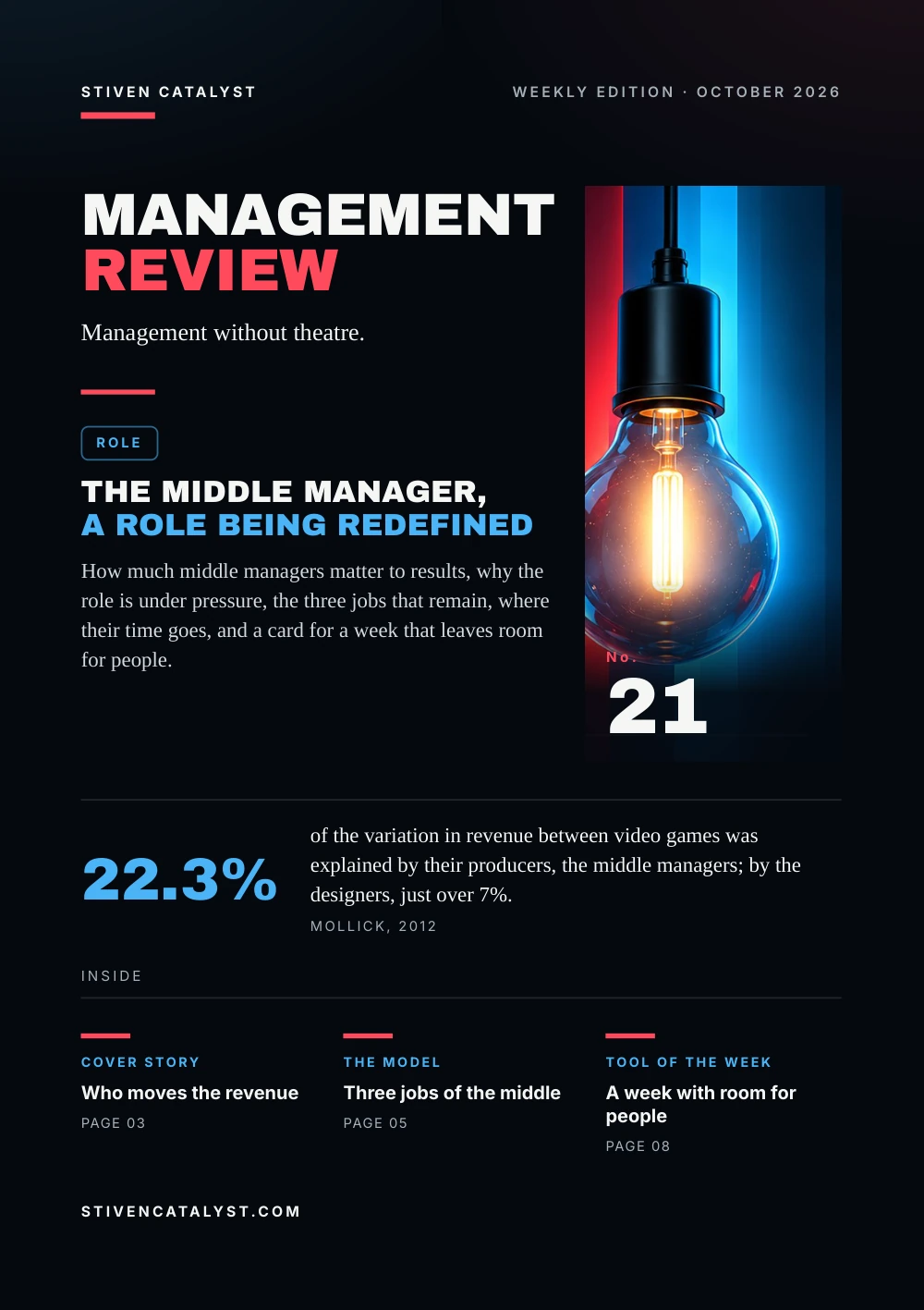
In the video game industry, middle managers explained 22.3% of the variation in revenue, the designers just over 7%. Job postings for middle managers fell 42% in two and a half years, and Gartner predicts that AI will flatten more structures. McKinsey finds middle managers spending nearly half their time on work that is not managing; Deloitte finds only 13% of managers' time going to developing people. A 1990 study linked their part in strategy to better performance.
Stiven Janaqi, Editor
Cover story
Who moves the revenue
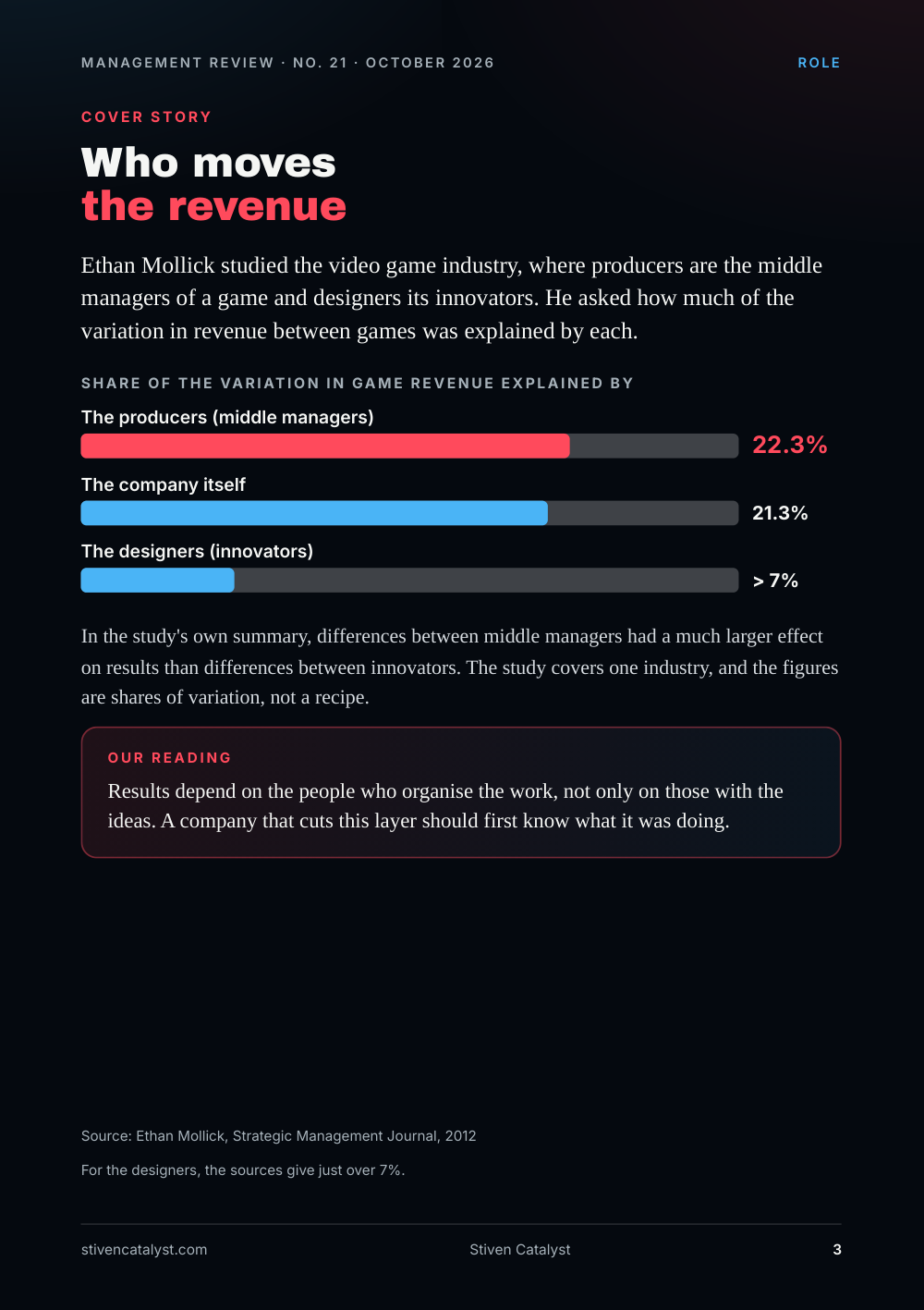
Ethan Mollick studied the video game industry, where producers are the middle managers of a game and designers its innovators. He asked how much of the variation in revenue between games was explained by each.
Share of the variation in game revenue explained by: The producers (middle managers) 22.3%, The company itself 21.3%, The designers (innovators) > 7%.
In the study's own summary, differences between middle managers had a much larger effect on results than differences between innovators. The study covers one industry, and the figures are shares of variation, not a recipe.
Our reading
Results depend on the people who organise the work, not only on those with the ideas. A company that cuts this layer should first know what it was doing.
For the designers, the sources give just over 7%.
Source: Ethan Mollick, Strategic Management Journal, 2012
The numbers
A role under pressure
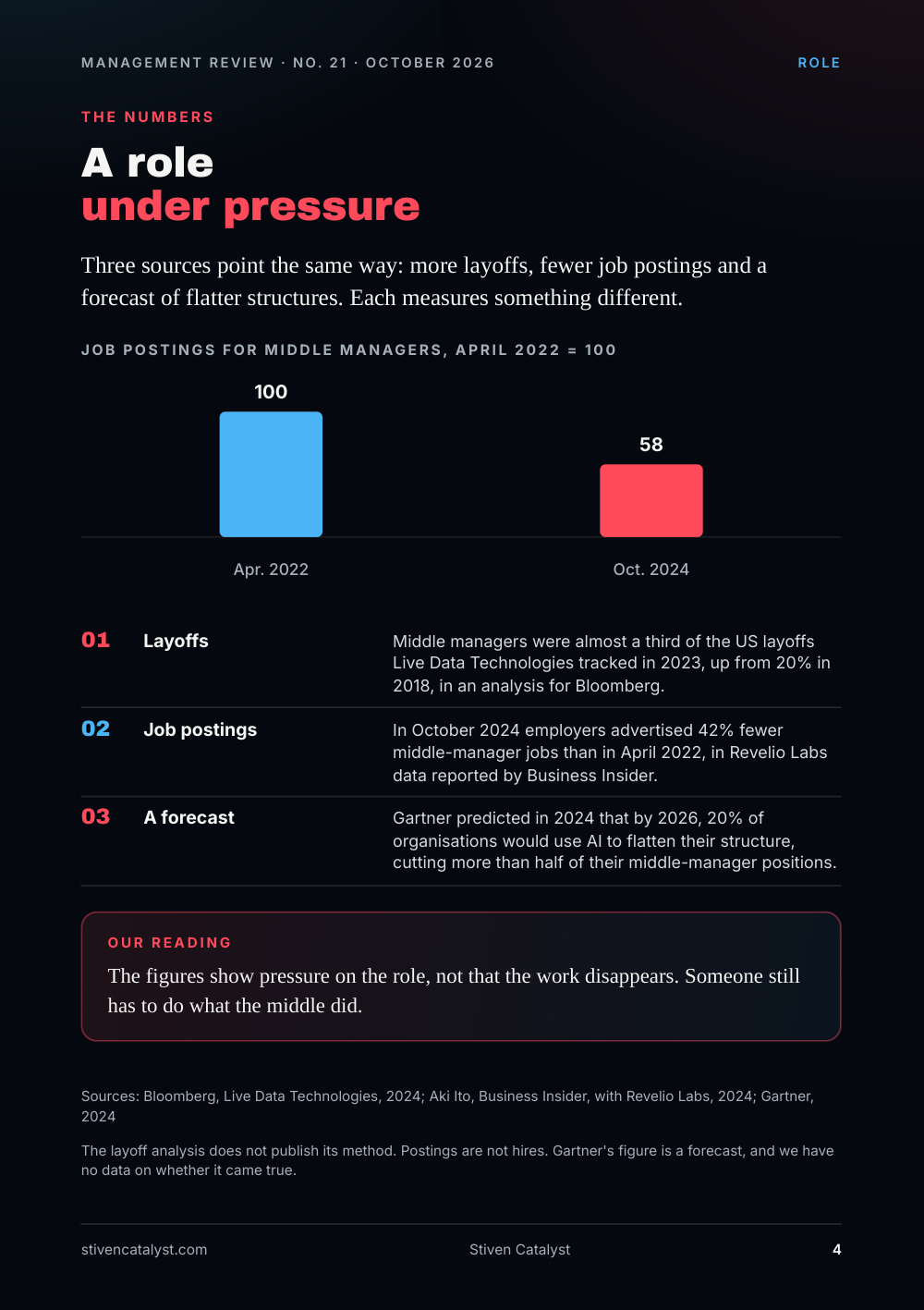
Three sources point the same way: more layoffs, fewer job postings and a forecast of flatter structures. Each measures something different.
Job postings for middle managers, April 2022 = 100: Apr. 2022 100, Oct. 2024 58.
- Layoffs. Middle managers were almost a third of the US layoffs Live Data Technologies tracked in 2023, up from 20% in 2018, in an analysis for Bloomberg.
- Job postings. In October 2024 employers advertised 42% fewer middle-manager jobs than in April 2022, in Revelio Labs data reported by Business Insider.
- A forecast. Gartner predicted in 2024 that by 2026, 20% of organisations would use AI to flatten their structure, cutting more than half of their middle-manager positions.
Our reading
The figures show pressure on the role, not that the work disappears. Someone still has to do what the middle did.
The layoff analysis does not publish its method. Postings are not hires. Gartner's figure is a forecast, and we have no data on whether it came true.
Sources: Bloomberg, Live Data Technologies, 2024; Aki Ito, Business Insider, with Revelio Labs, 2024; Gartner, 2024
The model
Three jobs of the middle
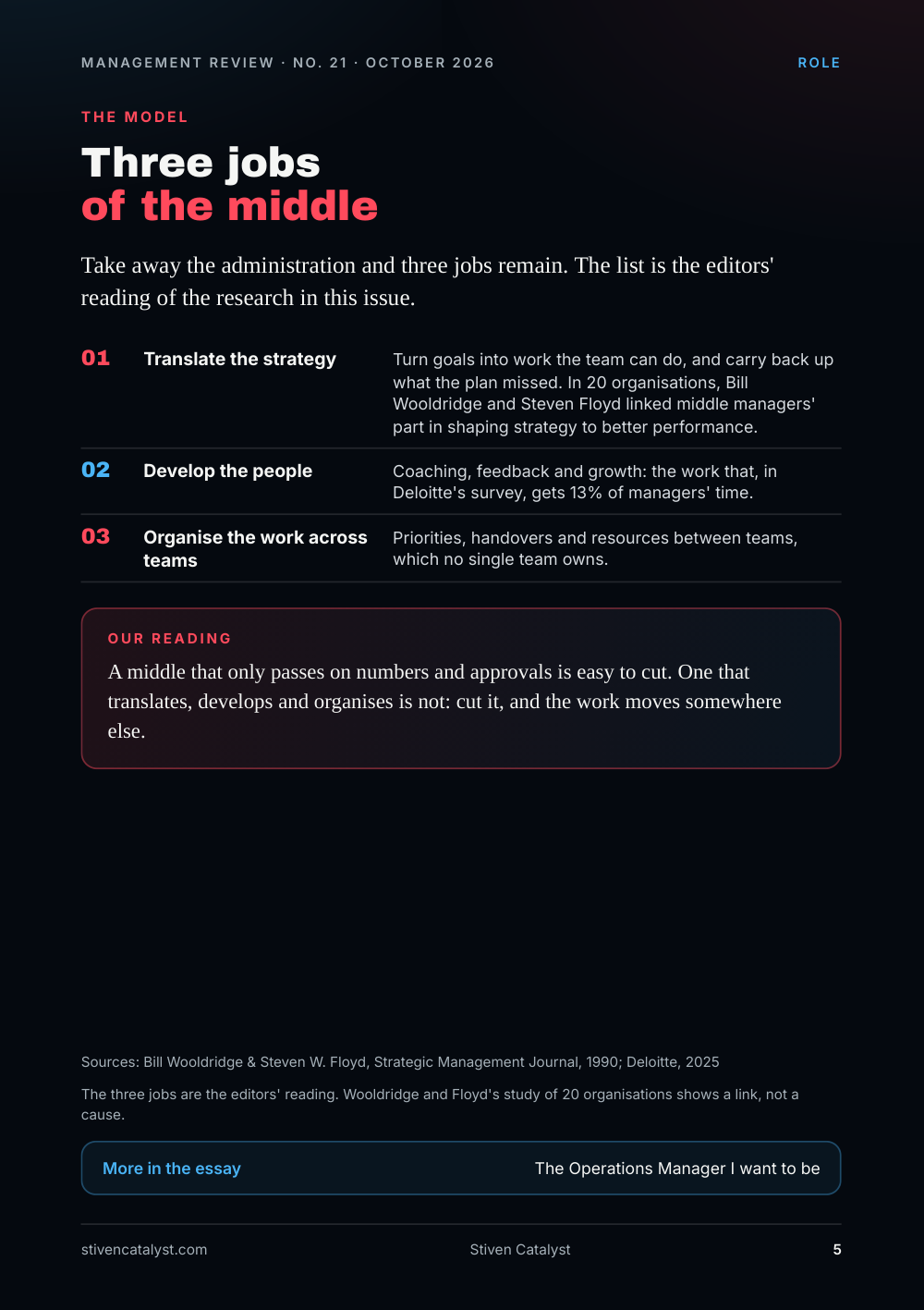
Take away the administration and three jobs remain. The list is the editors' reading of the research in this issue.
- Translate the strategy. Turn goals into work the team can do, and carry back up what the plan missed. In 20 organisations, Bill Wooldridge and Steven Floyd linked middle managers' part in shaping strategy to better performance.
- Develop the people. Coaching, feedback and growth: the work that, in Deloitte's survey, gets 13% of managers' time.
- Organise the work across teams. Priorities, handovers and resources between teams, which no single team owns.
Our reading
A middle that only passes on numbers and approvals is easy to cut. One that translates, develops and organises is not: cut it, and the work moves somewhere else.
The three jobs are the editors' reading. Wooldridge and Floyd's study of 20 organisations shows a link, not a cause.
Sources: Bill Wooldridge & Steven W. Floyd, Strategic Management Journal, 1990; Deloitte, 2025
More in the essay: The Operations Manager I want to be
What the research says
Where the time goes
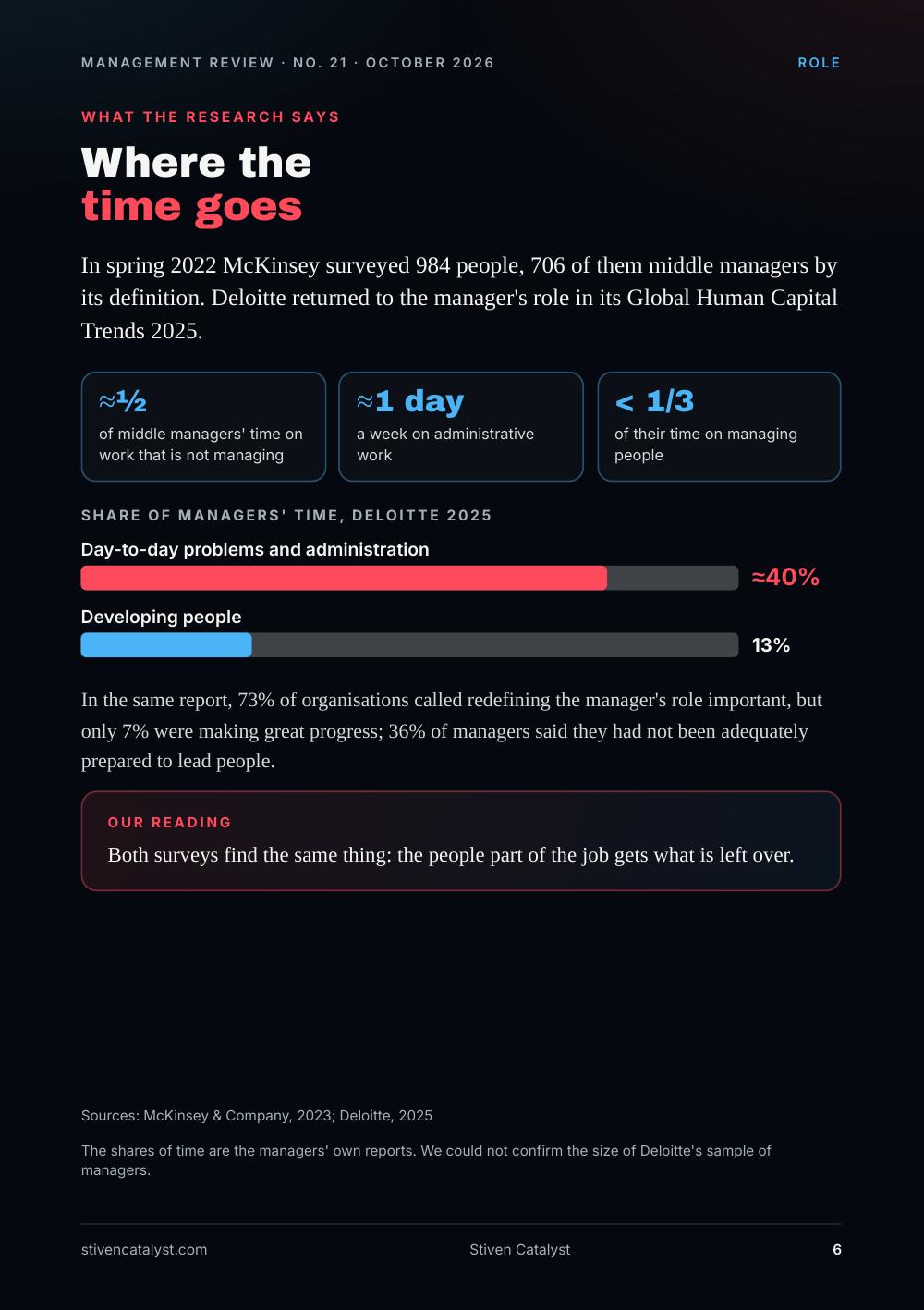
In spring 2022 McKinsey surveyed 984 people, 706 of them middle managers by its definition. Deloitte returned to the manager's role in its Global Human Capital Trends 2025.
- ≈½ of middle managers' time on work that is not managing
- ≈1 day a week on administrative work
- < 1/3 of their time on managing people
Share of managers' time, Deloitte 2025: Day-to-day problems and administration ≈40%, Developing people 13%.
In the same report, 73% of organisations called redefining the manager's role important, but only 7% were making great progress; 36% of managers said they had not been adequately prepared to lead people.
Our reading
Both surveys find the same thing: the people part of the job gets what is left over.
The shares of time are the managers' own reports. We could not confirm the size of Deloitte's sample of managers.
Sources: McKinsey & Company, 2023; Deloitte, 2025
How it is measured
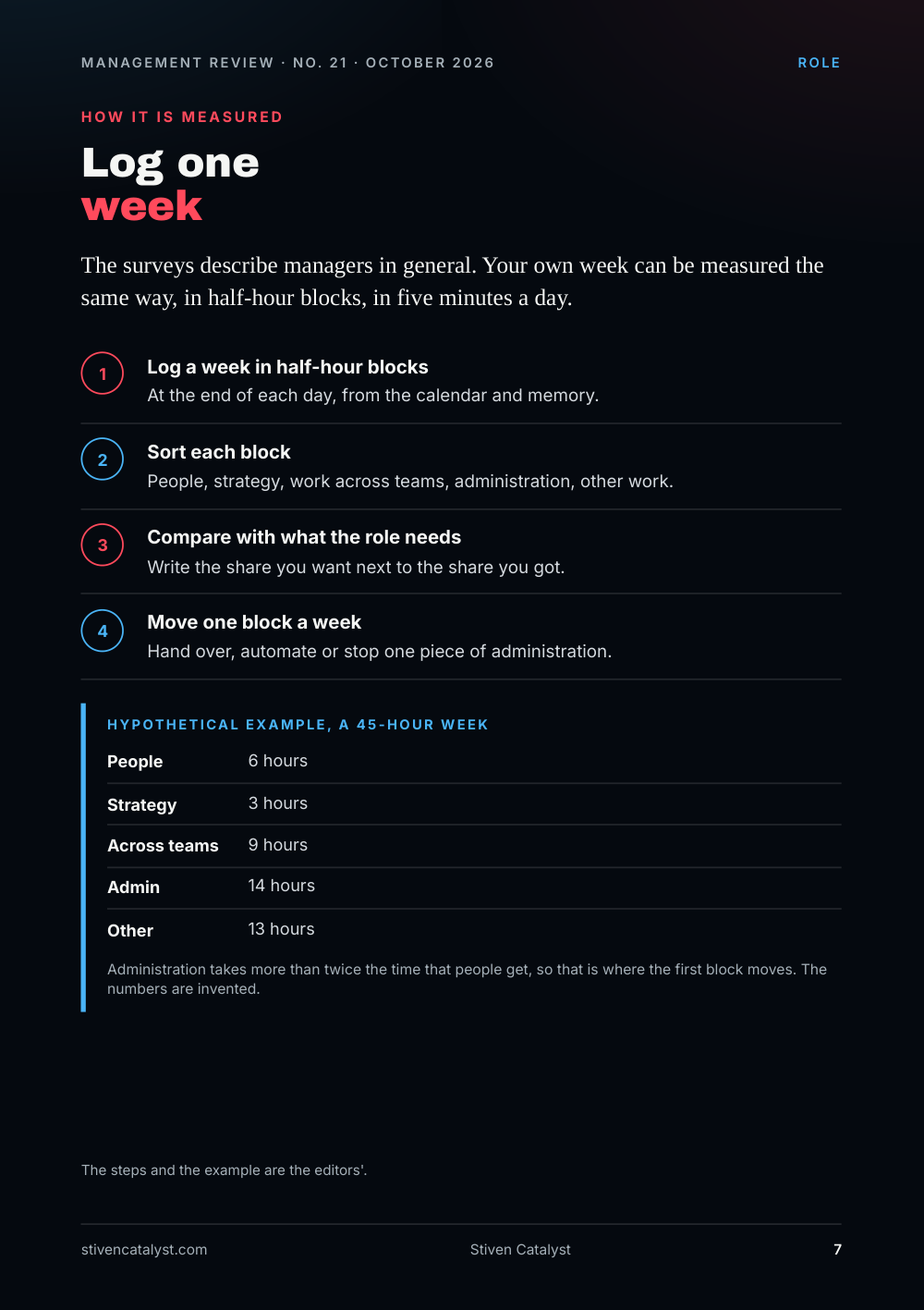
Log one week
The surveys describe managers in general. Your own week can be measured the same way, in half-hour blocks, in five minutes a day.
- Log a week in half-hour blocks. At the end of each day, from the calendar and memory.
- So
r t each block. People, strategy, work across teams, administration, other work. - Compare with what the role needs. Write the share you want next to the share you got.
- Move one block a week. Hand over, automate or stop one piece of administration.
Hypothe tical example, a 45-hour week
- People: 6 hours
- Strategy: 3 hours
- Across teams: 9 hours
- Admin: 14 hours
- Other: 13 hours
Administration takes more than twice the time that people get, so that is where the first block moves. The numbers are invented.
The steps and the example are the editors'.
Tool of the week
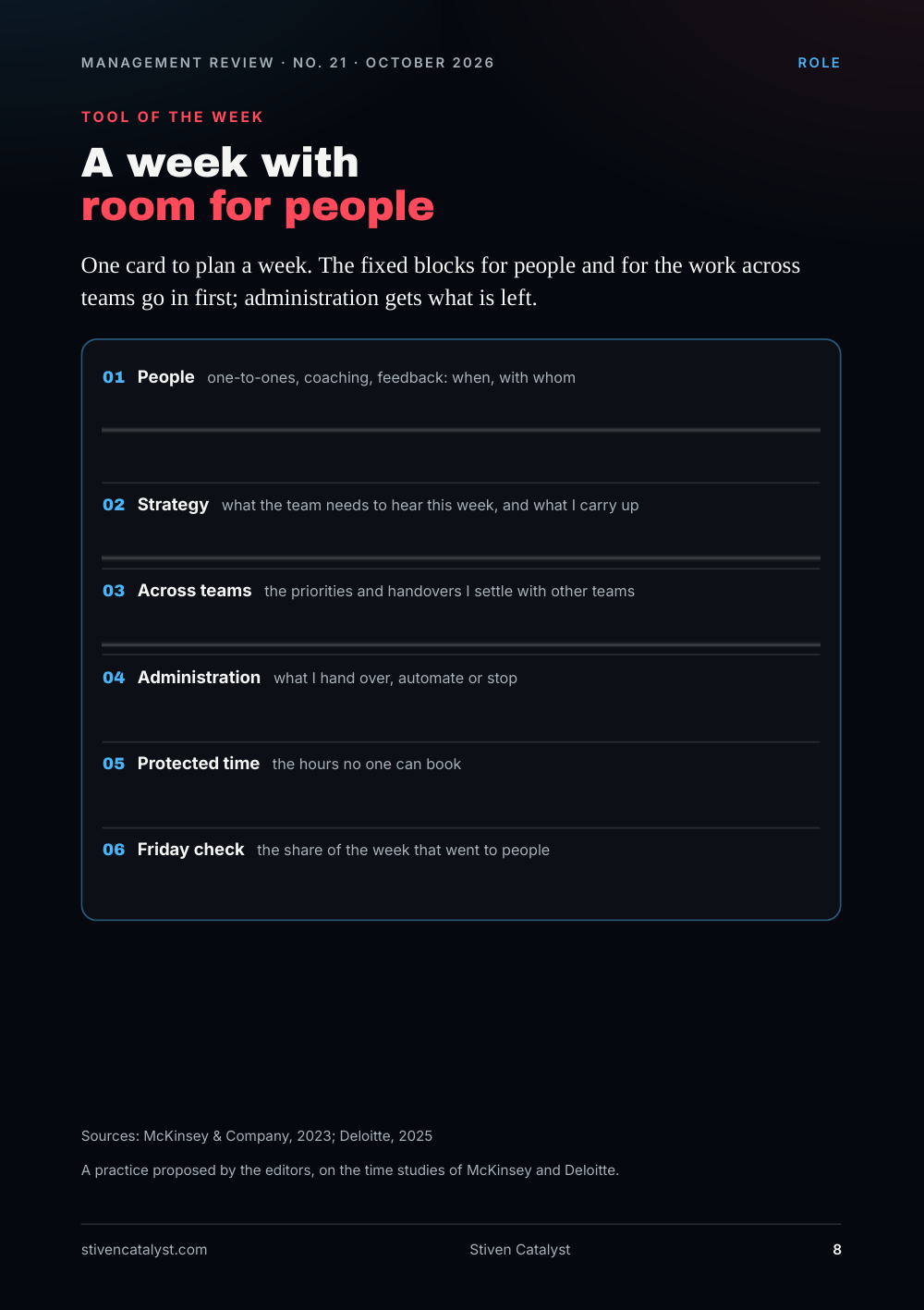
A week with room for people
One card to plan a week. The fixed blocks for people and for the work across teams go in first; administration gets what is left.
- People one-to-ones, coaching, feedback: when, with whom
- Strategy what the team needs to hear this week, and what I carry up
- Across teams the priorities and handovers I settle with other teams
- Administration what I hand over, automate or stop
- Protected time the hours no one can book
- Friday check the share of the week that went to people
A practice proposed by the editors, on the time studies of McKinsey and Deloitte.
Sources: McKinsey & Company, 2023; Deloitte, 2025
Sources and method
Every figure has a source.
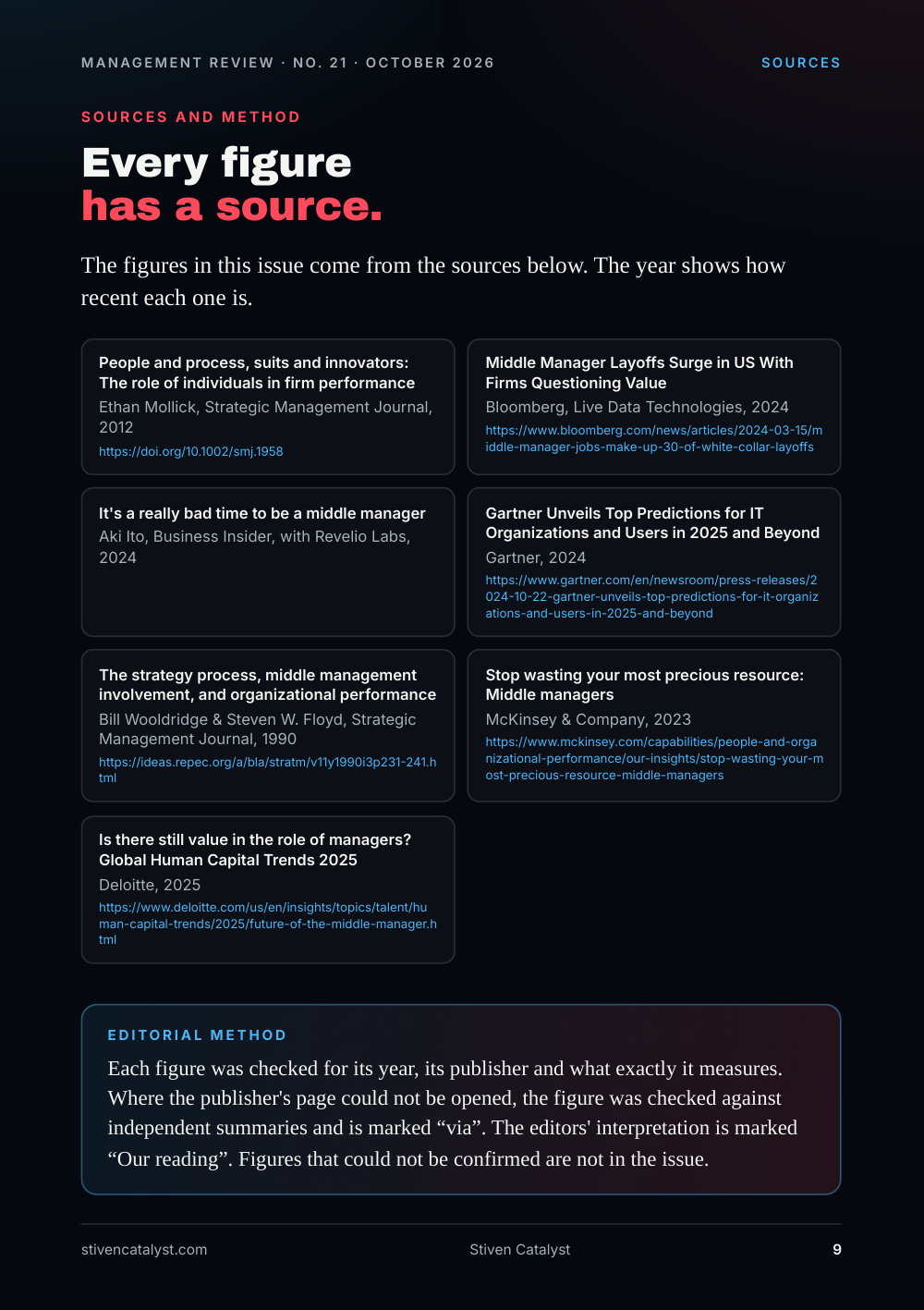
The figures in this issue come from the sources below. The year shows how recent each one is.
- Ethan Mollick, Strategic Management Journal, “People and process, suits and innovators: The role of individuals in firm performance”, 2012. https://doi.org/10.1002/smj.1958
- Bloomberg, Live Data Technologies, “Middle Manager Layoffs Surge in US With Firms Questioning Value”, 2024. https://www.bloomberg.com/news/articles/2024-03-15/middle-manager-jobs-make-up-30-of-white-collar-layoffs
- Aki Ito, Business Insider, with Revelio Labs, “It's a really bad time to be a middle manager”, 2024.
- Gartner, “Gartner Unveils Top Predictions for IT Organizations and Users in 2025 and Beyond”, 2024. https://www.gartner.com/en/newsroom/press-releases/2024-10-22-gartner-unveils-top-predictions-for-it-organizations-and-users-in-2025-and-beyond
- Bill Wooldridge & Steven W. Floyd, Strategic Management Journal, “The strategy process, middle management involvement, and organizational performance”, 1990. https://ideas.repec.org/a/bla/stratm/v11y1990i3p231-241.html
- McKinsey & Company, “Stop wasting your most precious resource: Middle managers”, 2023. https://www.mckinsey.com/capabilities/people-and-organizational-performance/our-insights/stop-wasting-your-most-precious-resource-middle-managers
- Deloitte, “Is there still value in the role of managers? Global Human Capital Trends 2025”, 2025. https://www.deloitte.com/us/en/insights/topics/talent/human-capital-trends/2025/future-of-the-middle-manager.html
Edit orial me thod
Each figure was checked for its year, its publisher and what exactly it measures. Where the publisher's page could not be opened, the figure was checked against independent summaries and is marked “via”. The editors' interpretation is marked “Our reading”. Figures that could not be confirmed are not in the issue.