In 1954 Toyota let each process take parts from the one before, instead of having them pushed on. Half a century later, a team at BBC Worldwide put limits on its boards and delivered sooner and more evenly. Two researchers of operations argue that pull is, in essence, a cap on work in process. In Rome, six judges who kept fewer cases open at once finished them sooner. The Kanban Guide names four measures, and a card helps set up one board.
Management Review · Second series · November 2026 · No. 66
Kanban: the limit on work in process
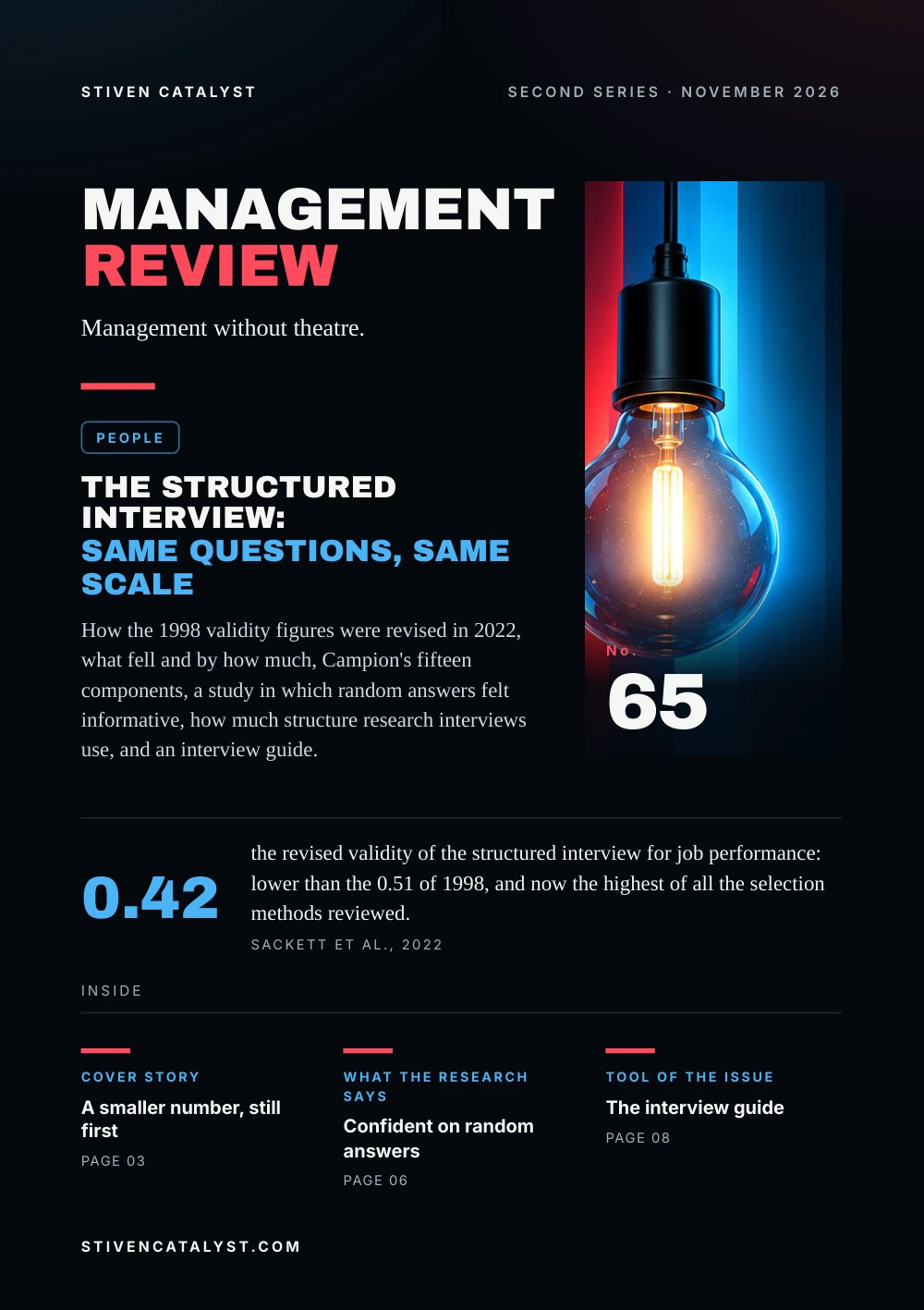
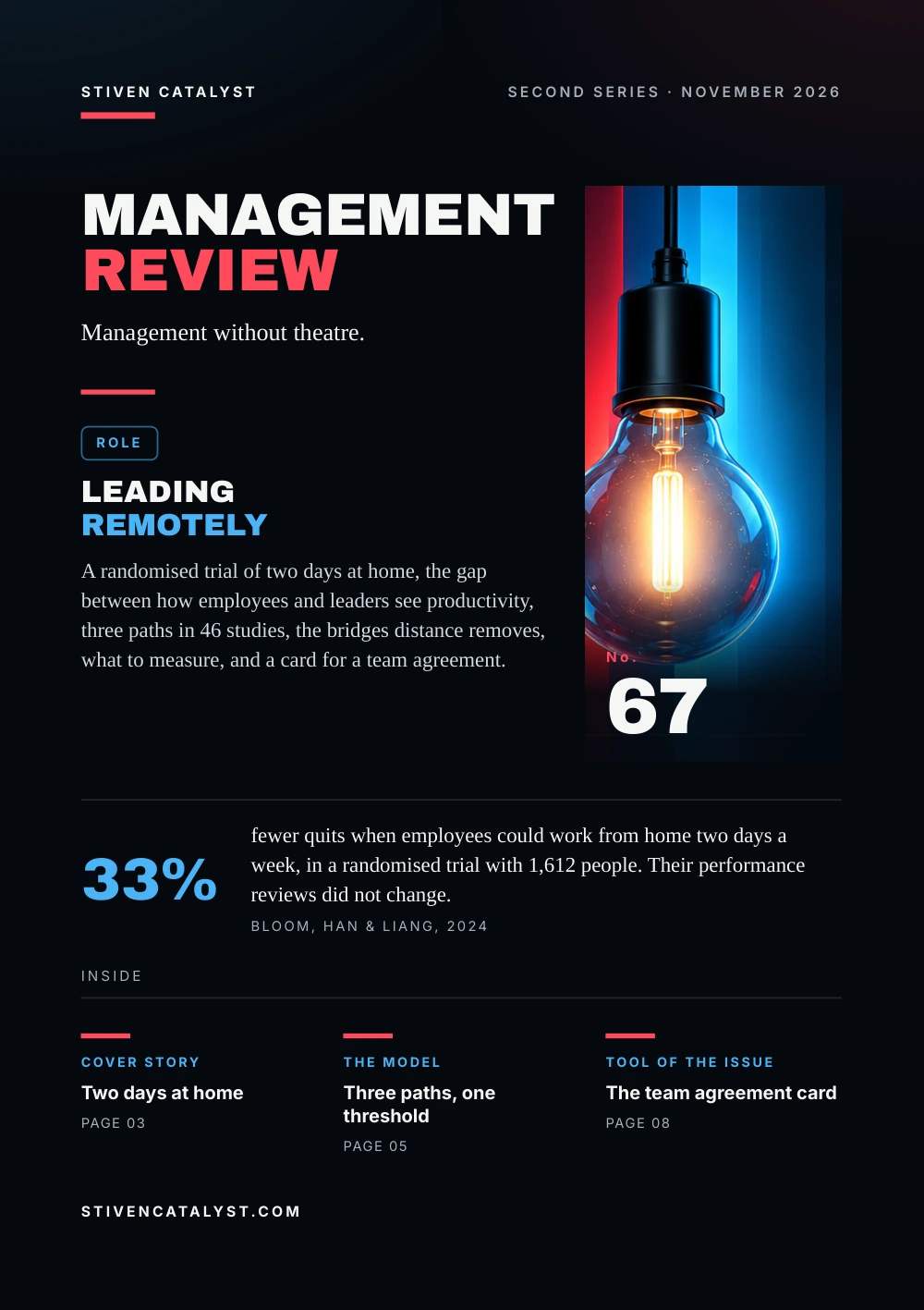
Toyota's supermarket method of 1954, a BBC Worldwide team with limits on its board, pull as a cap on open work, judges in Rome who juggled fewer cases, four flow measures, and a card for one board.
- No.
- 66
- Pages
- 10
- Sources
- 7
- Topics
- Operations
Stiven CatalystSecond series · November 2026
ManagementReview
Management without theatre.
Operations
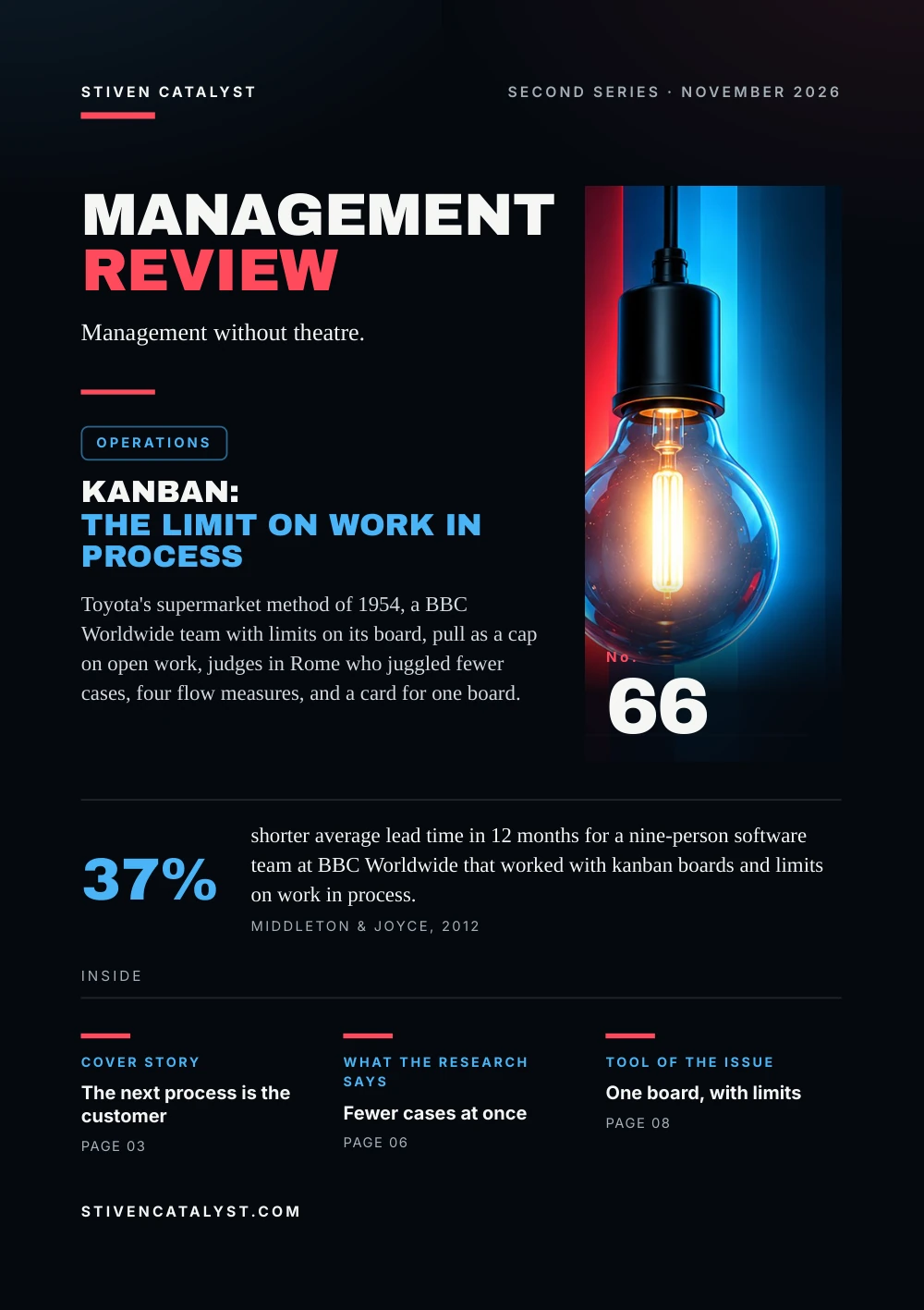
Kanban:the limit on work in process
Toyota's supermarket method of 1954, a BBC Worldwide team with limits on its board, pull as a cap on open work, judges in Rome who juggled fewer cases, four flow measures, and a card for one board.

No.66
37%
shorter average lead time in 12 months for a nine-person software team at BBC Worldwide that worked with kanban boards and limits on work in process.Middleton & Joyce, 2012
stivencatalyst.com
No. 66 · Operations
In this issue
A board full of cards looks like a busy team. Often it is a team that has started more than it can finish. This issue is about kanban and the limit it puts on work in process: how many things may be open at once, and what happens when the limit is reached.
- 03Cover storyThe next process is the customer
- 04The numbersLimits on the board
- 05The modelPull is a limit
- 06What the research saysFewer cases at once
- 07How it is measuredFour measures, one oldest card
- 08Tool of the issueOne board, with limits
- 09SourcesSources and method
How to read this issue
Figure
Every figure has its source and year at the foot of its page.
Our reading
Where the editors interpret rather than the research, it says so.
Practice
The steps and the card are proposals to try, not research results.
Cover story
The next processis the cust omer
According to Toyota's own history, each part in its machining plant once travelled with a voucher and was carried to the next plant whether that plant needed it or not. Parts piled up, and assembly built whatever it had parts for.
Early in the month, assembly reached roughly half the plan. At the end of the month, with all parts in, the conveyors ran faster to catch up, with the same people who had waited for parts at the start. In 1954, as volumes grew, Toyota introduced what it called the supermarket method.
“The subsequent process is the 'customer' and the prior process is the 'supermarket'.”
01
Supermarket
the earlier process: it holds parts and replaces only what was taken
02
Customer
the later process: it takes what it needs, when it needs it
03
Kanban
the card added later: product name, number and quantity
Our reading
Push sends work on because it is finished. Pull starts work because there is room for it.
Source: Toyota Motor Corporation, 2012
Toyota's history says the idea came from a 1954 trade-press report on a Lockheed aircraft plant, when supermarkets were still rare in Japan. Other tellings credit Taiichi Ohno's look at US supermarkets; we could not check his book, so we follow Toyota.
The numbers
Limits onthe board
In April 2008 a nine-person software team at BBC Worldwide drew its stages on kanban boards and put each piece of work on a card. There was more work in process than anyone had realised. Peter Middleton and David Joyce followed the team for a year.
Working days, one BBC Worldwide team, 2008–2009
The limits came from the constraints: with fewer testers and analysts than developers, they followed what those could handle, and moved when the constraints moved. Defects reported by customers fell by 24%.
Our reading
The limit did not make anyone work faster. It made the queue visible, at the stage where it formed.
Source: Peter Middleton & David Joyce, IEEE Transactions on Engineering Management 59(1), 2012 (via Accepted version, Queen's University Belfast research portal)
Upper limit: the upper control limit of lead time, a measure of spread (−47%). Development time covers nine months. One case; the team also cut work smaller and grew in skill.
The model
Pull isa limit
Wallace Hopp and Mark Spearman argued in 2004 that the practitioner literature had simplified “pull” until it was misunderstood. Their definition is short: pull is essentially a mechanism for limiting work in process. A kanban card is one such mechanism: no free card, no new start.
A workflow with a limit, after the Kanban Guide
- 01
Work item
what one card stands for
- 02
Started
the point where it counts as open
- 03
States, with a limit
new work only below the limit
- 04
Finished
the point where it leaves
David Anderson dates kanban in knowledge work to 2004, when he designed a pull system for a maintenance team at Microsoft. It had no physical board. In his telling, the cards went up on a whiteboard at Corbis in 2007, at a team member's suggestion. His book Kanban followed in 2010.
Our reading
A board without limits is a picture of overload. The limit is what turns it into a pull system.
Sources: Wallace J. Hopp & Mark L. Spearman, Manufacturing & Service Operations Management 6(2), 2004 (via Abstract at Crossref); John Coleman & Daniel Vacanti, 2025; David J. Anderson, 2014
The definition is Hopp & Spearman's; the chain follows the elements of a workflow in the Kanban Guide (2025). The history is Anderson's own account. The reading is the editors'.
What the research says
Fewer casesat once
Decio Coviello, Andrea Ichino and Nicola Persico studied Italian judges who received the same workload by lottery. Those who juggled more trials at once, instead of working on a few in sequence, took longer to complete their cases. The quality of rulings, measured by appeals, did not suffer.
Then came a test in Rome's labour appeals court. From January 2011, six judges in one section scheduled all the hearings a new case would need up front, so that cases finished before new ones crowded in. 44 judges in four other sections kept the old way. The data run from 2005 to 2014.
12%shorter average case duration, against the other judges
111 daysless per case, by the authors' estimate
Our reading
Nobody worked harder. The judges started less at once, and finished what they had started.
Sources: Decio Coviello, Andrea Ichino & Nicola Persico, Journal of the European Economic Association 13(5), 2015 (via Abstract at RePEc; NBER Working Paper 16502, 2010); Robert L. Bray, Decio Coviello, Andrea Ichino & Nicola Persico, Manufacturing & Service Operations Management 18(4), 2016 (via Abstract at Crossref; working paper of March 2016)
Not a random assignment: the section's president asked to take part. A difference-in-differences study with six treated judges; a placebo test supports it. Their rulings were also appealed less often. Not every study finds lower WIP better on every measure (see No. 58).
How it is measured
Four measures,one oldest card
The Kanban Guide by John Coleman and Daniel Vacanti asks every kanban system to track four flow measures, each counted between the points where the team says work starts and finishes.
Work in process
items started but not finished
Throughput
items finished per unit of time
Work item age
time since an open item started
Cycle time
time from start to finish
The guide pairs them with a service level expectation, such as “85% of work items will be finished in eight days or less”. At BBC Worldwide the daily stand-up, about 15 minutes at the board, checked the cards, then blocked work, then clusters, then priorities.
Hypothetical example, a returns desk board on a Monday
- Open
- 14 cards against a limit of 12
- Oldest
- 11 days; 85% usually close within 6
The average looks fine; the oldest card and the overrun show where to act. The numbers are invented.
Sources: John Coleman & Daniel Vacanti, 2025; Peter Middleton & David Joyce, IEEE Transactions on Engineering Management 59(1), 2012 (via Accepted version, Queen's University Belfast research portal)
The four definitions and the example of an expectation are from the Kanban Guide; the stand-up from Middleton & Joyce. How the three averages relate is the subject of No. 58. The example is the editors'.
More in the essayTen minutes before the shift: what the team needs to know before the work starts
Tool of the issue
One board,with limits
One team, one flow of work. Count what is open today before you set any limit, start the limits near that count, and lower them only after a review.
01Work item and flowwhat one card stands for; where work starts and finishes
02Columns and limitseach stage, today's count, its limit
03Pull rulewho starts new work, and only below the limit
04Exceptionswhat may jump the queue, and who decides
05Blocked itemsmarked on the card; who removes the block, by when
06Weekly reviewoldest card, finished items, is each limit still right
Sources: John Coleman & Daniel Vacanti, 2025; Wallace J. Hopp & Mark L. Spearman, Manufacturing & Service Operations Management 6(2), 2004 (via Abstract at Crossref); Peter Middleton & David Joyce, IEEE Transactions on Engineering Management 59(1), 2012 (via Accepted version, Queen's University Belfast research portal)
A practice proposed by the editors, after the Kanban Guide, Hopp & Spearman and the BBC Worldwide team, which set its limits from its constraints and changed them as they moved.
Open the tool: Shift Handoverstivencatalyst.com/tools/shift-handover/
Sources and method
Every figurehas a source.
The figures in this issue come from the sources below. The year shows how recent each one is.
- 75 Years of Toyota: Supermarket MethodToyota Motor Corporation, 2012https://www.toyota-global.com/company/history_of_toyota/75years/text/taking_on_the_automotive_business/chapter2/section7/item4.html
- Lean Software Management: BBC Worldwide Case StudyPeter Middleton & David Joyce, IEEE Transactions on Engineering Management 59(1), 2012 · via Accepted version, Queen's University Belfast research portalhttps://doi.org/10.1109/TEM.2010.2081675
- To Pull or Not to Pull: What Is the Question?Wallace J. Hopp & Mark L. Spearman, Manufacturing & Service Operations Management 6(2), 2004 · via Abstract at Crossrefhttps://doi.org/10.1287/msom.1030.0028
- A Brief History of Kanban for Knowledge WorkDavid J. Anderson, 2014https://djaa.com/brief-history-kanban-knowledge-work/
- The Inefficiency of Worker Time UseDecio Coviello, Andrea Ichino & Nicola Persico, Journal of the European Economic Association 13(5), 2015 · via Abstract at RePEc; NBER Working Paper 16502, 2010https://doi.org/10.1111/jeea.12129
- Multitasking, Multiarmed Bandits, and the Italian JudiciaryRobert L. Bray, Decio Coviello, Andrea Ichino & Nicola Persico, Manufacturing & Service Operations Management 18(4), 2016 · via Abstract at Crossref; working paper of March 2016https://doi.org/10.1287/msom.2016.0586
- The Kanban GuideJohn Coleman & Daniel Vacanti, 2025https://kanbanguides.org/english/
Editorial method
Each figure was checked for its year, its publisher and what exactly it measures. Where the publisher's page could not be opened, the figure was checked against independent summaries and is marked “via”. The editors' interpretation is marked “Our reading”. Figures that could not be confirmed are not in the issue.
ManagementReview
Management without theatre.
Every issue, one management question, checked against the best research.
All issues
stivencatalyst.com/magazine/management-review.html
Management Review · No. 66 · November 2026 · Stiven Catalyst
Click or swipe a page to turn it. The arrow keys work too.
Management Review · No. 66
The figures of the issue
The charts of the printed pages, with their sources.
Source: Peter Middleton & David Joyce, IEEE Transactions on Engineering Management 59(1), 2012 (via Accepted version, Queen's University Belfast research portal)
The whole text Read the issue as text For reading on a small screen, searching or a screen reader. The same words, without the page design.
In this issue
A board full of cards looks like a busy team. Often it is a team that has started more than it can finish. This issue is about kanban and the limit it puts on work in process: how many things may be open at once, and what happens when the limit is reached.
In 1954 Toyota let each process take parts from the one before, instead of having them pushed on. Half a century later, a team at BBC Worldwide put limits on its boards and delivered sooner and more evenly. Two researchers of operations argue that pull is, in essence, a cap on work in process. In Rome, six judges who kept fewer cases open at once finished them sooner. The Kanban Guide names four measures, and a card helps set up one board.
Stiven Janaqi, Editor
Cover story
The next process is the cust omer
According to Toyota's own history, each part in its machining plant once travelled with a voucher and was carried to the next plant whether that plant needed it or not. Parts piled up, and assembly built whatever it had parts for.
Early in the month, assembly reached roughly half the plan. At the end of the month, with all parts in, the conveyors ran faster to catch up, with the same people who had waited for parts at the start. In 1954, as volumes grew, Toyota introduced what it called the supermarket method.
The subsequent process is the 'customer' and the prior process is the 'supermarket'.
- Supermark
e t. the earlier process: it holds parts and replaces only what was taken - Cus
t omer. the later process: it takes what it needs, when it needs it - Kanban. the card added later: product name, number and quantity
Our reading
Push sends work on because it is finished. Pull starts work because there is room for it.
Toyota's history says the idea came from a 1954 trade-press report on a Lockheed aircraft plant, when supermarkets were still rare in Japan. Other tellings credit Taiichi Ohno's look at US supermarkets; we could not check his book, so we follow Toyota.
Source: Toyota Motor Corporation, 2012
The numbers
Limits on the board
In April 2008 a nine-person software team at BBC Worldwide drew its stages on kanban boards and put each piece of work on a card. There was more work in process than anyone had realised. Peter Middleton and David Joyce followed the team for a year.
Working days, one BBC Worldwide team, 2008–2009: Lead time, mean: Before 22.8, After 14.4; Its upper limit: Before 70.7, After 37.3; Development time: Before 9.2, After 2.5; Blocked, per month: Before 25.8, After 4.9.
The limits came from the constraints: with fewer testers and analysts than developers, they followed what those could handle, and moved when the constraints moved. Defects reported by customers fell by 24%.
Our reading
The limit did not make anyone work faster. It made the queue visible, at the stage where it formed.
Upper limit: the upper control limit of lead time, a measure of spread (−47%). Development time covers nine months. One case; the team also cut work smaller and grew in skill.
Source: Peter Middleton & David Joyce, IEEE Transactions on Engineering Management 59(1), 2012 (via Accepted version, Queen's University Belfast research portal)
The model
Pull is a limit
Wallace Hopp and Mark Spearman argued in 2004 that the practitioner literature had simplified “pull” until it was misunderstood. Their definition is short: pull is essentially a mechanism for limiting work in process. A kanban card is one such mechanism: no free card, no new start.
A workflow with a limit, af ter the Kanban Guide
- Work item. what one card stands for
- Sta
r ted. the point where it counts as open - States, with a limit. new work only below the limit
- Finished. the point where it leaves
David Anderson dates kanban in knowledge work to 2004, when he designed a pull system for a maintenance team at Microsoft. It had no physical board. In his telling, the cards went up on a whiteboard at Corbis in 2007, at a team member's suggestion. His book Kanban followed in 2010.
Our reading
A board without limits is a picture of overload. The limit is what turns it into a pull system.
The definition is Hopp & Spearman's; the chain follows the elements of a workflow in the Kanban Guide (2025). The history is Anderson's own account. The reading is the editors'.
Sources: Wallace J. Hopp & Mark L. Spearman, Manufacturing & Service Operations Management 6(2), 2004 (via Abstract at Crossref); John Coleman & Daniel Vacanti, 2025; David J. Anderson, 2014
What the research says
Fewer cases at once
Decio Coviello, Andrea Ichino and Nicola Persico studied Italian judges who received the same workload by lottery. Those who juggled more trials at once, instead of working on a few in sequence, took longer to complete their cases. The quality of rulings, measured by appeals, did not suffer.
Then came a test in Rome's labour appeals court. From January 2011, six judges in one section scheduled all the hearings a new case would need up front, so that cases finished before new ones crowded in. 44 judges in four other sections kept the old way. The data run from 2005 to 2014.
- 12% shorter average case duration, against the other judges
- 111 days less per case, by the authors' estimate
Our reading
Nobody worked harder. The judges started less at once, and finished what they had started.
Not a random assignment: the section's president asked to take part. A difference-in-differences study with six treated judges; a placebo test supports it. Their rulings were also appealed less often. Not every study finds lower WIP better on every measure (see No. 58).
Sources: Decio Coviello, Andrea Ichino & Nicola Persico, Journal of the European Economic Association 13(5), 2015 (via Abstract at RePEc; NBER Working Paper 16502, 2010); Robert L. Bray, Decio Coviello, Andrea Ichino & Nicola Persico, Manufacturing & Service Operations Management 18(4), 2016 (via Abstract at Crossref; working paper of March 2016)
How it is measured
Four measures, one oldest card
The Kanban Guide by John Coleman and Daniel Vacanti asks every kanban system to track four flow measures, each counted between the points where the team says work starts and finishes.
- Work in process. items started but not finished
- Throughput. items finished per unit of time
- Work item age. time since an open item started
- Cycle time. time from start to finish
The guide pairs them with a service level expectation, such as “85% of work items will be finished in eight days or less”. At BBC Worldwide the daily stand-up, about 15 minutes at the board, checked the cards, then blocked work, then clusters, then priorities.
Hypothe tical example, a re turns desk board on a Monday
- Open: 14 cards against a limit of 12
- Oldest: 11 days; 85% usually close within 6
The average looks fine; the oldest card and the overrun show where to act. The numbers are invented.
The four definitions and the example of an expectation are from the Kanban Guide; the stand-up from Middleton & Joyce. How the three averages relate is the subject of No. 58. The example is the editors'.
Sources: John Coleman & Daniel Vacanti, 2025; Peter Middleton & David Joyce, IEEE Transactions on Engineering Management 59(1), 2012 (via Accepted version, Queen's University Belfast research portal)
More in the essay: Ten minutes before the shift: what the team needs to know before the work starts
Tool of the issue
One board, with limits
One team, one flow of work. Count what is open today before you set any limit, start the limits near that count, and lower them only after a review.
- Work item and flow what one card stands for; where work starts and finishes
- Columns and limits each stage, today's count, its limit
- Pull rule who starts new work, and only below the limit
- Exce
p tions what may jump the queue, and who decides - Blocked items marked on the card; who removes the block, by when
- Weekly review oldest card, finished items, is each limit still right
A practice proposed by the editors, after the Kanban Guide, Hopp & Spearman and the BBC Worldwide team, which set its limits from its constraints and changed them as they moved.
Sources: John Coleman & Daniel Vacanti, 2025; Wallace J. Hopp & Mark L. Spearman, Manufacturing & Service Operations Management 6(2), 2004 (via Abstract at Crossref); Peter Middleton & David Joyce, IEEE Transactions on Engineering Management 59(1), 2012 (via Accepted version, Queen's University Belfast research portal)
Open the tool: Shift Handover
Sources and method
Every figure has a source.
The figures in this issue come from the sources below. The year shows how recent each one is.
- Toyota Motor Corporation, “75 Years of Toyota: Supermarket Method”, 2012. https://www.toyota-global.com/company/history_of_toyota/75years/text/taking_on_the_automotive_business/chapter2/section7/item4.html
- Peter Middleton & David Joyce, IEEE Transactions on Engineering Management 59(1), “Lean Software Management: BBC Worldwide Case Study”, 2012 (via Accepted version, Queen's University Belfast research portal). https://doi.org/10.1109/TEM.2010.2081675
- Wallace J. Hopp & Mark L. Spearman, Manufacturing & Service Operations Management 6(2), “To Pull or Not to Pull: What Is the Question?”, 2004 (via Abstract at Crossref). https://doi.org/10.1287/msom.1030.0028
- David J. Anderson, “A Brief History of Kanban for Knowledge Work”, 2014. https://djaa.com/brief-history-kanban-knowledge-work/
- Decio Coviello, Andrea Ichino & Nicola Persico, Journal of the European Economic Association 13(5), “The Inefficiency of Worker Time Use”, 2015 (via Abstract at RePEc; NBER Working Paper 16502, 2010). https://doi.org/10.1111/jeea.12129
- Robert L. Bray, Decio Coviello, Andrea Ichino & Nicola Persico, Manufacturing & Service Operations Management 18(4), “Multitasking, Multiarmed Bandits, and the Italian Judiciary”, 2016 (via Abstract at Crossref; working paper of March 2016). https://doi.org/10.1287/msom.2016.0586
- John Coleman & Daniel Vacanti, “The Kanban Guide”, 2025. https://kanbanguides.org/english/
Edit orial me thod
Each figure was checked for its year, its publisher and what exactly it measures. Where the publisher's page could not be opened, the figure was checked against independent summaries and is marked “via”. The editors' interpretation is marked “Our reading”. Figures that could not be confirmed are not in the issue.
Management Review · Monthly edition