Erin Meyer places countries on eight scales and warns that a position means something only next to another. GLOBE asked managers in 62 societies how things are and how they should be; Albania's managers describe more loyalty to the group than West Germany's, and less planning for the future. Hofstede's own data hold only two scores for Albania. A meta-analysis of 10,632 teams finds that diversity is both an asset and a liability. A scale for cultural intelligence measures a person, and a card helps a team agree its norms.
Management Review · Second series · November 2026 · No. 55
Multicultural teams: mapping the differences
Erin Meyer's eight scales, Albania and Germany in GLOBE, what its managers say is done and should be, a meta-analysis of 10,632 teams, a scale for cultural intelligence, and a card for team norms.
- No.
- 55
- Pages
- 10
- Sources
- 6
- Topics
- People
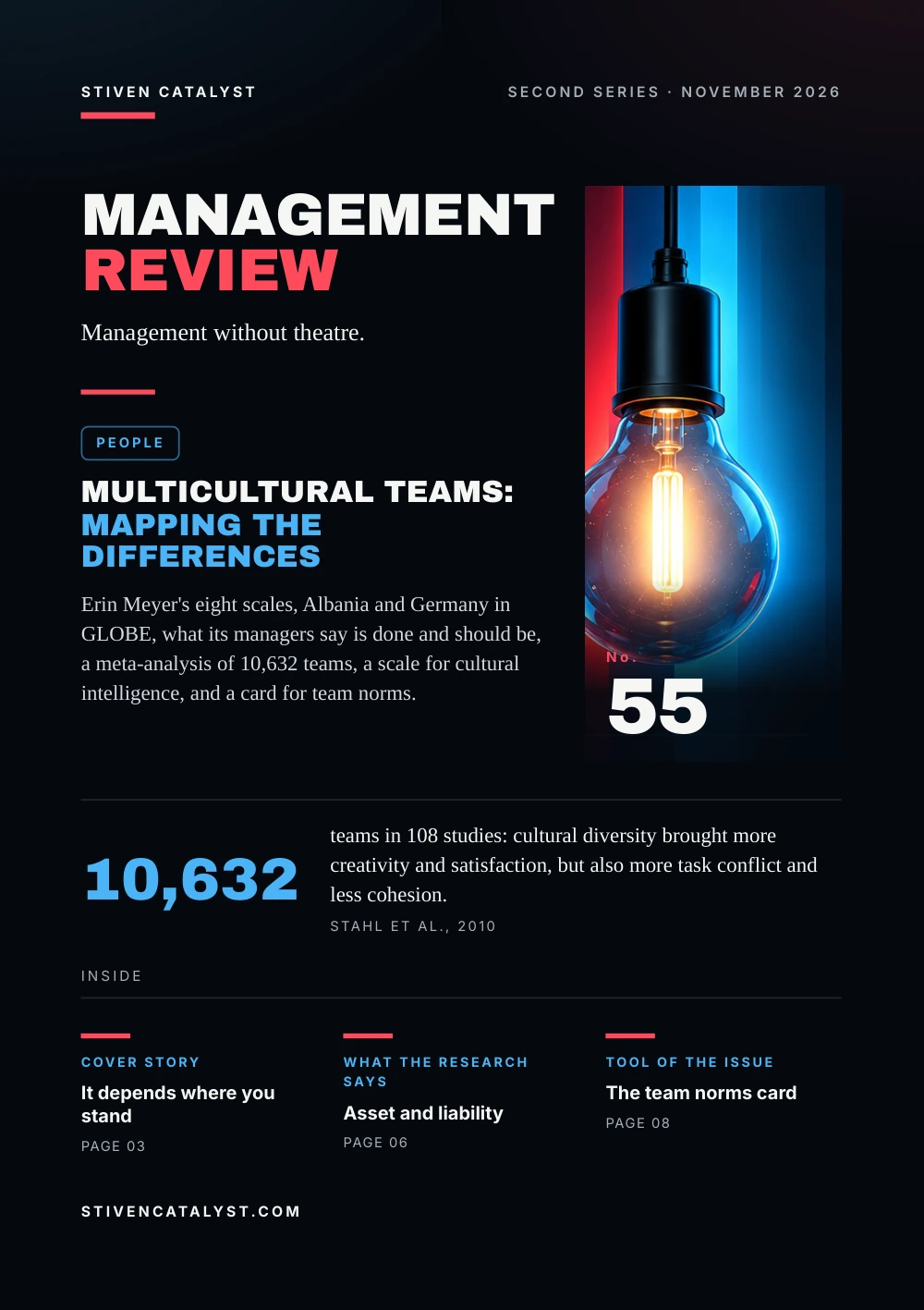
Stiven CatalystSecond series · November 2026
ManagementReview
Management without theatre.
People
Multicultural teams:mapping the differences
Erin Meyer's eight scales, Albania and Germany in GLOBE, what its managers say is done and should be, a meta-analysis of 10,632 teams, a scale for cultural intelligence, and a card for team norms.

No.55
10,632
teams in 108 studies: cultural diversity brought more creativity and satisfaction, but also more task conflict and less cohesion.Stahl et al., 2010
stivencatalyst.com
No. 55 · People
In this issue
More and more teams are made of people who grew up in different countries. The differences that hurt are rarely the visible ones; they are in how people give feedback, disagree, decide and keep time. This issue maps them, without turning a country's score into a judgement about a person.
- 03Cover storyIt depends where you stand
- 04The numbersAlbania and Germany, side by side
- 05The modelWhat is done, what should be
- 06What the research saysAsset and liability
- 07How it is measuredMeasure the person, not the passport
- 08Tool of the issueThe team norms card
- 09SourcesSources and method
How to read this issue
Figure
Every figure has its source and year at the foot of its page.
Our reading
Where the editors interpret rather than the research, it says so.
Practice
The steps and the card are proposals to try, not research results.
Cover story
It dependswhere you stand
Erin Meyer of INSEAD built the Culture Map from eight scales, the management behaviours where she finds cultural gaps most often. She presented it in Harvard Business Review in 2014 and in a book the same year.
01
Communicating
explicit and literal, or layered and implied
02
Evaluating
frank or diplomatic negative feedback
03
Persuading
principles first, or applications first
04
Leading
egalitarian or hierarchical
05
Deciding
by consensus or from the top
06
Trusting
built through the task or through the relationship
07
Disagreeing
open confrontation seen as useful, or as harmful
08
Scheduling
a linear plan, or a flexible one
A Mexican marketing director at Heineken in Amsterdam found his Dutch team ignored his authority. A Chinese manager in Monterrey found the Mexicans strikingly egalitarian. Mexico sits between the Netherlands and China on the Leading scale, so both were right.
“What matters is the position of one country relative to another.”
Source: Erin Meyer, Harvard Business Review, 2014
The two managers are Meyer's examples; she does not give their real names. The profiles describe a society at large, she writes, not every person in it. The descriptions of the scales are condensed by the editors.
The numbers
Albania and Germany,side by side
In the GLOBE study (next page), middle managers rated how things are in their society, from 1 to 7. Albania and the West German sample on four of its nine dimensions, from the 2004 data:
GLOBE practices, 1 to 7
Hofstede's own data (2015) hold only two of his six scores for Albania, on a scale to 100: long-term orientation 61, against Germany's 83, and indulgence 15, against 40. His site advises taking dimension scores “with a grain of salt”.
Our reading
The chart describes two countries, not your two colleagues.
Sources: Robert J. House, Paul J. Hanges, Mansour Javidan, Peter W. Dorfman & Vipin Gupta (eds.), Sage, 2004 (via GLOBE Project, society-level data, 2004); Geert Hofstede, 2015
Averages of managers' answers, not descriptions of individuals; rounded. “In-group loyalty” is GLOBE's in-group collectivism. Other Hofstede scores for Albania found online cite no published study, so we leave them out.
More in the essayFrom Albania to Germany: what I have changed in the way I lead
The model
What is done,what should be
The GLOBE study, founded by Robert House, asked more than 17,000 middle managers in 62 societies about nine dimensions of culture, twice: how things are in their society, and how they should be. Albania was one of the 62.
GLOBE scores from 1 to 7, practices and values
GLOBE counts power distance among the dimensions nobody wants: managers in both countries want less of it. On rules, its uncertainty avoidance, they part: the Albanian managers want more, the German managers fewer.
Our reading
What managers say is done and what they say should be done are two different maps. In a mixed team, ask about both.
Source: Robert J. House, Paul J. Hanges, Mansour Javidan, Peter W. Dorfman & Vipin Gupta (eds.), Sage, 2004 (via GLOBE Project, society-level data, 2004)
Scores rounded from GLOBE's society-level data (2004); Germany is the West German sample. Averages of managers' answers, not of every person.
What the research says
Asse tand liabilit y
Günter Stahl, Martha Maznevski, Andreas Voigt and Karsten Jonsen pooled 108 studies of 10,632 teams. Cultural diversity had no direct link with team performance; it pulled the way teams work in two directions.
Average correlation with cultural diversity
Context changed the picture. Diverse teams had more conflict when the task was complex, when they sat together rather than apart, and, against the authors' hypothesis, when they had been together longer. Communication suffered in larger teams.
Our reading
Time alone does not close the gaps. Someone has to name them and agree how the team will work.
Source: Günter K. Stahl, Martha L. Maznevski, Andreas Voigt & Karsten Jonsen, Journal of International Business Studies 41(4), 2010
Weighted mean correlations, small by the usual standard; creativity rests on only 5 effect sizes, social integration on 22. The authors' own summary: diversity “can be both an asset and a liability”.
How it is measured
Measure the person,not the passpor t
Soon Ang, Linn Van Dyne and colleagues built a 20-item scale for cultural intelligence (CQ), the capability to work effectively in culturally diverse settings. Each statement is rated from 1 to 7. They tested it on 1,360 people, then in three studies with 794 people in the USA and Singapore.
01
Metacognitive
checking what you think you know about a culture while you deal with it
02
Cognitive
knowing values, languages and the rules of gesture elsewhere
03
Motivational
enjoying contact and trusting yourself to adjust
04
Behavioural
changing pace, pauses and gestures when the situation needs it
The parts predicted different things: the first two cultural judgement and decisions, the last two adapting to a new culture, the first and last task performance.
Hypothetical example, a check after meetings
- Method
- each member writes the decision and the next step in one line
- Six meetings
- 21 of 30 lines matched
The gap shows where a “yes” meant “I heard you”. The numbers are invented.
Source: Soon Ang, Linn Van Dyne, Christine Koh, K. Yee Ng, Klaus J. Templer, Cheryl Tay & N. Anand Chandrasekar, Management and Organization Review 3(3), 2007 (via Abstract at Crossref; items at FernUniversität in Hagen)
CQ is a self-assessment of one person, unlike the country scores on the earlier pages. The item summaries and the meeting check are the editors'.
More in the essayTeams with many languages and many countries
Tool of the issue
The teamnorms card
Jeanne Brett, Kristin Behfar and Mary Kern found that the most successful multicultural teams they studied adapted, changed the team's shape, had a manager set norms early, and only as a last resort let someone leave. One manager told the members they had been chosen for their expertise, not their English. Fill in the card together in the first week.
01Working languagewhich one, and what is always put in writing
02Saying something is wrongin private or in the group, how direct
03Disagreeinghow to disagree in a meeting; who asks the quiet ones
04Decidingwho decides what, and when a decision counts as made
05Timewhat “on time” and “deadline” mean here
06Checking understandingshow me how you would do it, not “did you understand?”
Sources: Jeanne Brett, Kristin Behfar & Mary C. Kern, Harvard Business Review, 2006; Erin Meyer, Harvard Business Review, 2014
A practice proposed by the editors, after Brett, Behfar and Kern's managerial intervention and Meyer's eight scales. Review it when someone joins the team.
Open the tool: Shift Handoverstivencatalyst.com/tools/shift-handover/
Sources and method
Every figurehas a source.
The figures in this issue come from the sources below. The year shows how recent each one is.
- Navigating the Cultural MinefieldErin Meyer, Harvard Business Review, 2014https://hbr.org/2014/05/navigating-the-cultural-minefield
- Culture, Leadership, and Organizations: The GLOBE Study of 62 SocietiesRobert J. House, Paul J. Hanges, Mansour Javidan, Peter W. Dorfman & Vipin Gupta (eds.), Sage, 2004 · via GLOBE Project, society-level data, 2004https://globeproject.com/study_2004_2007
- Dimension data matrix: six dimensions as in Cultures and Organizations, 3rd ed. (version 2015 12 08)Geert Hofstede, 2015https://geerthofstede.com/research-and-vsm/dimension-data-matrix/
- Unraveling the effects of cultural diversity in teams: A meta-analysis of research on multicultural work groupsGünter K. Stahl, Martha L. Maznevski, Andreas Voigt & Karsten Jonsen, Journal of International Business Studies 41(4), 2010https://doi.org/10.1057/jibs.2009.85
- Cultural Intelligence: Its Measurement and Effects on Cultural Judgment and Decision Making, Cultural Adaptation and Task PerformanceSoon Ang, Linn Van Dyne, Christine Koh, K. Yee Ng, Klaus J. Templer, Cheryl Tay & N. Anand Chandrasekar, Management and Organization Review 3(3), 2007 · via Abstract at Crossref; items at FernUniversität in Hagenhttps://doi.org/10.1111/j.1740-8784.2007.00082.x
- Managing Multicultural TeamsJeanne Brett, Kristin Behfar & Mary C. Kern, Harvard Business Review, 2006https://hbr.org/2006/11/managing-multicultural-teams
Editorial method
Each figure was checked for its year, its publisher and what exactly it measures. Where the publisher's page could not be opened, the figure was checked against independent summaries and is marked “via”. The editors' interpretation is marked “Our reading”. Figures that could not be confirmed are not in the issue.
ManagementReview
Management without theatre.
Every issue, one management question, checked against the best research.
All issues
stivencatalyst.com/magazine/management-review.html
Management Review · No. 55 · November 2026 · Stiven Catalyst
Click or swipe a page to turn it. The arrow keys work too.
Management Review · No. 55
The figures of the issue
The charts of the printed pages, with their sources.
Source: Robert J. House, Paul J. Hanges, Mansour Javidan, Peter W. Dorfman & Vipin Gupta (eds.), Sage, 2004 (via GLOBE Project, society-level data, 2004)
Source: Robert J. House, Paul J. Hanges, Mansour Javidan, Peter W. Dorfman & Vipin Gupta (eds.), Sage, 2004 (via GLOBE Project, society-level data, 2004)
Source: Günter K. Stahl, Martha L. Maznevski, Andreas Voigt & Karsten Jonsen, Journal of International Business Studies 41(4), 2010
The whole text Read the issue as text For reading on a small screen, searching or a screen reader. The same words, without the page design.
In this issue
More and more teams are made of people who grew up in different countries. The differences that hurt are rarely the visible ones; they are in how people give feedback, disagree, decide and keep time. This issue maps them, without turning a country's score into a judgement about a person.
Erin Meyer places countries on eight scales and warns that a position means something only next to another. GLOBE asked managers in 62 societies how things are and how they should be; Albania's managers describe more loyalty to the group than West Germany's, and less planning for the future. Hofstede's own data hold only two scores for Albania. A meta-analysis of 10,632 teams finds that diversity is both an asset and a liability. A scale for cultural intelligence measures a person, and a card helps a team agree its norms.
Stiven Janaqi, Editor
Cover story
It depends where you stand
Erin Meyer of INSEAD built the Culture Map from eight scales, the management behaviours where she finds cultural gaps most often. She presented it in Harvard Business Review in 2014 and in a book the same year.
- Communicating. explicit and literal, or layered and implied
- Evaluating. frank or diplomatic negative feedback
- Persuading. principles first, or applications first
- Leading. egalitarian or hierarchical
- Deciding. by consensus or from the top
- Trusting. built through the task or through the relationship
- Disagreeing. open confrontation seen as useful, or as harmful
- Scheduling. a linear plan, or a flexible one
A Mexican marketing director at Heineken in Amsterdam found his Dutch team ignored his authority. A Chinese manager in Monterrey found the Mexicans strikingly egalitarian. Mexico sits between the Netherlands and China on the Leading scale, so both were right.
What matters is the position of one country relative to another.
The two managers are Meyer's examples; she does not give their real names. The profiles describe a society at large, she writes, not every person in it. The descriptions of the scales are condensed by the editors.
Source: Erin Meyer, Harvard Business Review, 2014
The numbers
Albania and Germany, side by side
In the GLOBE study (next page), middle managers rated how things are in their society, from 1 to 7. Albania and the West German sample on four of its nine dimensions, from the 2004 data:
GLOBE practices, 1 to 7: In-group loyalty: Albania 5.7, Germany 4.0; Humane orientation: Albania 4.6, Germany 3.2; Performance: Albania 4.8, Germany 4.2; Future orientation: Albania 3.9, Germany 4.3.
Hofstede's own data (2015) hold only two of his six scores for Albania, on a scale to 100: long-term orientation 61, against Germany's 83, and indulgence 15, against 40. His site advises taking dimension scores “with a grain of salt”.
Our reading
The chart describes two countries, not your two colleagues.
Averages of managers' answers, not descriptions of individuals; rounded. “In-group loyalty” is GLOBE's in-group collectivism. Other Hofstede scores for Albania found online cite no published study, so we leave them out.
Sources: Robert J. House, Paul J. Hanges, Mansour Javidan, Peter W. Dorfman & Vipin Gupta (eds.), Sage, 2004 (via GLOBE Project, society-level data, 2004); Geert Hofstede, 2015
More in the essay: From Albania to Germany: what I have changed in the way I lead
The model
What is done, what should be
The GLOBE study, founded by Robert House, asked more than 17,000 middle managers in 62 societies about nine dimensions of culture, twice: how things are in their society, and how they should be. Albania was one of the 62.
GLOBE scores from 1 to 7, practices and values: Power · Albania: As is 4.6, Should be 3.5; Power · Germany: As is 5.3, Should be 2.5; Rules · Albania: As is 4.6, Should be 5.4; Rules · Germany: As is 5.2, Should be 3.3.
GLOBE counts power distance among the dimensions nobody wants: managers in both countries want less of it. On rules, its uncertainty avoidance, they part: the Albanian managers want more, the German managers fewer.
Our reading
What managers say is done and what they say should be done are two different maps. In a mixed team, ask about both.
Scores rounded from GLOBE's society-level data (2004); Germany is the West German sample. Averages of managers' answers, not of every person.
Source: Robert J. House, Paul J. Hanges, Mansour Javidan, Peter W. Dorfman & Vipin Gupta (eds.), Sage, 2004 (via GLOBE Project, society-level data, 2004)
What the research says
Asse t and liabilit y
Günter Stahl, Martha Maznevski, Andreas Voigt and Karsten Jonsen pooled 108 studies of 10,632 teams. Cultural diversity had no direct link with team performance; it pulled the way teams work in two directions.
Average correlation with cultural diversity: Creativity +0.16, Satisfaction +0.15, Task conflict +0.10, Social integration −0.07.
Context changed the picture. Diverse teams had more conflict when the task was complex, when they sat together rather than apart, and, against the authors' hypothesis, when they had been together longer. Communication suffered in larger teams.
Our reading
Time alone does not close the gaps. Someone has to name them and agree how the team will work.
Weighted mean correlations, small by the usual standard; creativity rests on only 5 effect sizes, social integration on 22. The authors' own summary: diversity “can be both an asset and a liability”.
Source: Günter K. Stahl, Martha L. Maznevski, Andreas Voigt & Karsten Jonsen, Journal of International Business Studies 41(4), 2010
How it is measured
Measure the person, not the passpor t
Soon Ang, Linn Van Dyne and colleagues built a 20-item scale for cultural intelligence (CQ), the capability to work effectively in culturally diverse settings. Each statement is rated from 1 to 7. They tested it on 1,360 people, then in three studies with 794 people in the USA and Singapore.
- M
e tacognitive. checking what you think you know about a culture while you deal with it - Cognitive. knowing values, languages and the rules of gesture elsewhere
- Motivational. enjoying contact and trusting yourself to adjust
- Behavioural. changing pace, pauses and gestures when the situation needs it
The parts predicted different things: the first two cultural judgement and decisions, the last two adapting to a new culture, the first and last task performance.
Hypothe tical example, a check af ter mee tings
- M
e thod: each member writes the decision and the next step in one line - Six me
e tings: 21 of 30 lines matched
The gap shows where a “yes” meant “I heard you”. The numbers are invented.
CQ is a self-assessment of one person, unlike the country scores on the earlier pages. The item summaries and the meeting check are the editors'.
Source: Soon Ang, Linn Van Dyne, Christine Koh, K. Yee Ng, Klaus J. Templer, Cheryl Tay & N. Anand Chandrasekar, Management and Organization Review 3(3), 2007 (via Abstract at Crossref; items at FernUniversität in Hagen)
More in the essay: Teams with many languages and many countries
Tool of the issue
The team norms card
Jeanne Brett, Kristin Behfar and Mary Kern found that the most successful multicultural teams they studied adapted, changed the team's shape, had a manager set norms early, and only as a last resort let someone leave. One manager told the members they had been chosen for their expertise, not their English. Fill in the card together in the first week.
- Working language which one, and what is always put in writing
- Saying som
e thing is wrong in private or in the group, how direct - Disagreeing how to disagree in a meeting; who asks the quiet ones
- Deciding who decides what, and when a decision counts as made
- Time what “on time” and “deadline” mean here
- Checking understanding show me how you would do it, not “did you understand?”
A practice proposed by the editors, after Brett, Behfar and Kern's managerial intervention and Meyer's eight scales. Review it when someone joins the team.
Sources: Jeanne Brett, Kristin Behfar & Mary C. Kern, Harvard Business Review, 2006; Erin Meyer, Harvard Business Review, 2014
Open the tool: Shift Handover
Sources and method
Every figure has a source.
The figures in this issue come from the sources below. The year shows how recent each one is.
- Erin Meyer, Harvard Business Review, “Navigating the Cultural Minefield”, 2014. https://hbr.org/2014/05/navigating-the-cultural-minefield
- Robert J. House, Paul J. Hanges, Mansour Javidan, Peter W. Dorfman & Vipin Gupta (eds.), Sage, “Culture, Leadership, and Organizations: The GLOBE Study of 62 Societies”, 2004 (via GLOBE Project, society-level data, 2004). https://globeproject.com/study_2004_2007
- Geert Hofstede, “Dimension data matrix: six dimensions as in Cultures and Organizations, 3rd ed. (version 2015 12 08)”, 2015. https://geerthofstede.com/research-and-vsm/dimension-data-matrix/
- Günter K. Stahl, Martha L. Maznevski, Andreas Voigt & Karsten Jonsen, Journal of International Business Studies 41(4), “Unraveling the effects of cultural diversity in teams: A meta-analysis of research on multicultural work groups”, 2010. https://doi.org/10.1057/jibs.2009.85
- Soon Ang, Linn Van Dyne, Christine Koh, K. Yee Ng, Klaus J. Templer, Cheryl Tay & N. Anand Chandrasekar, Management and Organization Review 3(3), “Cultural Intelligence: Its Measurement and Effects on Cultural Judgment and Decision Making, Cultural Adaptation and Task Performance”, 2007 (via Abstract at Crossref; items at FernUniversität in Hagen). https://doi.org/10.1111/j.1740-8784.2007.00082.x
- Jeanne Brett, Kristin Behfar & Mary C. Kern, Harvard Business Review, “Managing Multicultural Teams”, 2006. https://hbr.org/2006/11/managing-multicultural-teams
Edit orial me thod
Each figure was checked for its year, its publisher and what exactly it measures. Where the publisher's page could not be opened, the figure was checked against independent summaries and is marked “via”. The editors' interpretation is marked “Our reading”. Figures that could not be confirmed are not in the issue.
Management Review · Monthly edition