Employers surveyed by the World Economic Forum expect people alone to do a third of work tasks by 2030, down from 47%, and count AI, leadership and talent management among the skills on the rise. A 2003 study shows which tasks computers take: those that follow explicit rules. In Germany, robots hit new entrants rather than the workers already in place, and a 2026 US study sees a similar pattern with AI. The IAB finds that a computer could do 61% of the core tasks in transport and logistics.
Management Review · First series · October 2026 · No. 39
Aut omation and the future of roles
Who does the work tasks in 2030, which skills rise, which tasks machines take, who bears the change, how much of a role a computer could do, and a card for the tasks of a role.
- No.
- 39
- Pages
- 10
- Sources
- 7
- Topics
- AI
Stiven CatalystFirst series · October 2026
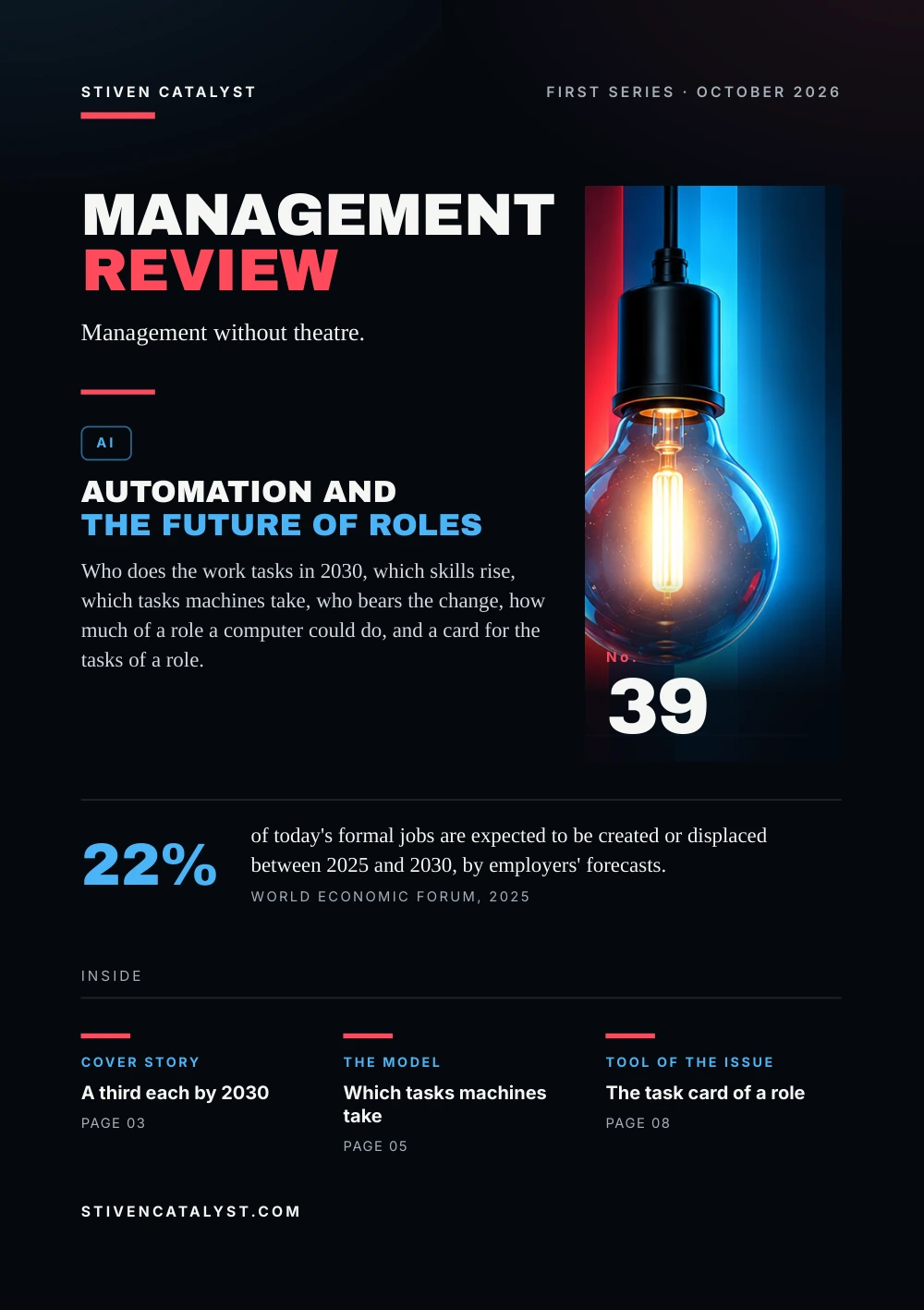
ManagementReview
Management without theatre.
AI
Automation andthe future of roles
Who does the work tasks in 2030, which skills rise, which tasks machines take, who bears the change, how much of a role a computer could do, and a card for the tasks of a role.

No.39
22%
of today's formal jobs are expected to be created or displaced between 2025 and 2030, by employers' forecasts.World Economic Forum, 2025
stivencatalyst.com
No. 39 · AI
In this issue
Automation rarely removes a whole job at once. It takes over tasks, and the role around them changes. This issue asks which tasks move, which skills rise, and what the manager of a warehouse, delivery or hotel team can do.
- 03Cover storyA third each by 2030
- 04The numbersThe skills on the rise
- 05The modelWhich tasks machines take
- 06What the research saysWho bears the change
- 07How it is measuredHow much of a role a computer could do
- 08Tool of the issueThe task card of a role
- 09SourcesSources and method
How to read this issue
Figure
Every figure has its source and year at the foot of its page.
Our reading
Where the editors interpret rather than the research, it says so.
Practice
The steps and the card are proposals to try, not research results.
Cover story
A third eachby 2030
For its Future of Jobs Report 2025, the World Economic Forum asked more than 1,000 employers, with over 14 million workers in 55 economies, who does the work tasks today and who will do them in 2030: people, technology, or the two together.
Share of work tasks done mainly by…, employers' estimates
Employers expect 170 million jobs to be created and 92 million displaced by 2030, a churn of 22% of 1.2 billion formal jobs. Delivery drivers and general and operations managers are among the roles growing most in numbers; stock-keeping clerks, cashiers, cleaners and housekeepers among those shrinking most.
Our reading
The forecast is less about jobs that vanish than about the same jobs done with a different mix of tasks.
Source: World Economic Forum, 2025
Employers' expectations, not measurements; shares of tasks, not of the amount of work. The net gain is 78 million jobs. 47 + 30 + 22 = 99 because of rounding.
The numbers
The skillson the rise
The same employers said which skills will matter more or less by 2030. The net figure is the share expecting a skill to grow minus the share expecting it to shrink.
Skills growing in importance, 2025–2030, net share of employers (points)
Only two skills fall on balance, most of all manual dexterity, endurance and precision (−24). Of every 100 workers, 59 would need training by 2030: 29 could be upskilled in their role, 19 moved to another role, and 11 would probably not get the training they need.
Our reading
Next to technology, leadership and talent management rise almost as fast. Someone has to rebuild the team around the new tasks.
Source: World Economic Forum, 2025
Employers' expectations (Future of Jobs Survey 2024), not measurements of skills. The six of 26 skills shown are our choice.
The model
Which tasksmachines take
In 2003 David Autor, Frank Levy and Richard Murnane argued that computers substitute for people in tasks that can be done by following explicit rules, and complement them in non-routine problem-solving and complex communication.
Follows explicit rulesManual to analytic work
Routine manual
Picking or sorting, repetitive assembly. Substantial substitution.
rule-based · manualRoutine cognitive
Record-keeping, calculation, repetitive customer service. Substantial substitution.
rule-based · analyticNon-routine manual
Janitorial work, truck driving. Little substitution or support.
no fixed rule · manualNon-routine cognitive
Testing ideas, selling, managing others. Strong complementarity.
no fixed rule · analyticIn US data from 1960 to 1998, computerisation went with less routine work and more non-routine cognitive work, even within occupations of the same name. The OECD saw the same with AI in 2023: employers were about twice as likely to say AI had automated repetitive tasks as created them.
Our reading
For a team, the useful question is not whether a job disappears but which of its tasks follow a rule a machine can read.
Sources: David H. Autor, Frank Levy & Richard J. Murnane, The Quarterly Journal of Economics, 2003; OECD, 2023
Examples and effects are those of the 2003 study, written for computers before generative AI.
What the research says
Who bearsthe change
Wolfgang Dauth and colleagues followed German workers from 1994 to 2014, as robots spread through industry. Robots cost manufacturing jobs; new service jobs fully offset them.
01
Germany, robots
Workers in place mostly stayed and took on new tasks in the same plant. Young entrants bore the loss.
02
US, robots
Each extra robot per 1,000 workers cut the employment-to-population ratio by 0.2 percentage points and wages by 0.42%.
03
US, AI, 2026
Employment of 22- to 25-year-olds in AI-exposed jobs is 19% behind the path of less exposed peers, mostly through less hiring.
In the OECD's 2022 surveys and interviews, many early AI adopters adjusted through slower hiring, quits and retirement rather than dismissals. Where firms consulted them, workers were 9 points more likely to say AI had improved their health and safety.
Our reading
The change shows first in the role that is never posted. For the team already there, it shows as new tasks, and someone has to teach them.
Sources: Wolfgang Dauth, Sebastian Findeisen, Jens Suedekum & Nicole Woessner, Journal of the European Economic Association, 2021 (via Working paper version, 2018); Daron Acemoglu & Pascual Restrepo, Journal of Political Economy, 2020 (via IDEAS/RePEc); Erik Brynjolfsson, Bharat Chandar & Ruyu Chen, Stanford Digital Economy Lab, 2026; OECD, 2023
Robots in industry are not AI in services, and the Germany–US gap has several possible causes. The 2026 figures and the OECD link are correlations, not proof of cause.
More in the essay“Watch how I do it” is not training
How it is measured
How much of a rolea computer could do
Since 2013 the IAB, research institute of Germany's Federal Employment Agency, has asked of each core task of every occupation: could a computer or computer-controlled machine do it fully automatically? Their share is the substitution potential.
Core tasks a computer could do, Germany, 2022 (%)
In 2022, 38% of employees subject to social insurance worked in occupations where over 70% of core tasks could be automated (34% in 2019). For hotel management assistants, the share rose from 50% to 67%.
Hypothetical example, a delivery-station dispatcher
- Core tasks
- 10; a system could do 4 in full: 40%
- Hours
- the 4 take 22 of 40 weekly hours: 55%
The role and the hours are invented.
Source: Katharina Grienberger, Britta Matthes & Wiebke Paulus, IAB, 2024
Technical feasibility, not a forecast of job losses. The IAB weights core tasks equally, blind to their hours; the example shows why hours matter.
Tool of the issue
The task cardof a role
One card per role, filled in with the people who do it. List the tasks with their hours a week, then sort them: a few tasks usually take most of the time, and that is where to look first.
01Rolethe role, how many people do it, who filled in the card
02Tasks and hoursevery core task, hours a week, the largest first
03Rule or judgementdoes it follow an explicit rule? manual or analytic?
04What a machine could doin full, in part or not at all, and with which system
05What the person does insteadthe new task, or what the freed hours go to
06Skill and trainingwhat to learn, who teaches it, by when; who on the team was asked
Sources: David H. Autor, Frank Levy & Richard J. Murnane, The Quarterly Journal of Economics, 2003; Katharina Grienberger, Britta Matthes & Wiebke Paulus, IAB, 2024; OECD, 2023
A practice proposed by the editors, after the task model of Autor, Levy & Murnane (2003), the IAB method (2024) and the OECD finding that outcomes are better where workers are trained and consulted (2023).
Open the tool: Pareto 80/20stivencatalyst.com/tools/pareto/
Sources and method
Every figurehas a source.
The figures in this issue come from the sources below. The year shows how recent each one is.
- The Future of Jobs Report 2025World Economic Forum, 2025https://reports.weforum.org/docs/WEF_Future_of_Jobs_Report_2025.pdf
- The Skill Content of Recent Technological Change: An Empirical ExplorationDavid H. Autor, Frank Levy & Richard J. Murnane, The Quarterly Journal of Economics, 2003https://doi.org/10.1162/003355303322552801
- OECD Employment Outlook 2023: Artificial Intelligence and the Labour MarketOECD, 2023https://doi.org/10.1787/08785bba-en
- The Adjustment of Labor Markets to RobotsWolfgang Dauth, Sebastian Findeisen, Jens Suedekum & Nicole Woessner, Journal of the European Economic Association, 2021 · via Working paper version, 2018https://doi.org/10.1093/jeea/jvab012
- Robots and Jobs: Evidence from US Labor MarketsDaron Acemoglu & Pascual Restrepo, Journal of Political Economy, 2020 · via IDEAS/RePEchttps://doi.org/10.1086/705716
- Canaries in the Coal Mine? Six Facts about the Recent Employment Effects of Artificial Intelligence (revised August 2026)Erik Brynjolfsson, Bharat Chandar & Ruyu Chen, Stanford Digital Economy Lab, 2026https://digitaleconomy.stanford.edu/publications/canaries-in-the-coal-mine/
- Folgen des technologischen Wandels für den Arbeitsmarkt: Vor allem Hochqualifizierte bekommen die Digitalisierung verstärkt zu spüren (IAB-Kurzbericht 5/2024)Katharina Grienberger, Britta Matthes & Wiebke Paulus, IAB, 2024https://doku.iab.de/kurzber/2024/kb2024-05.pdf
Editorial method
Each figure was checked for its year, its publisher and what exactly it measures. Where the publisher's page could not be opened, the figure was checked against independent summaries and is marked “via”. The editors' interpretation is marked “Our reading”. Figures that could not be confirmed are not in the issue.
ManagementReview
Management without theatre.
Every issue, one management question, checked against the best research.
All issues
stivencatalyst.com/magazine/management-review.html
Management Review · No. 39 · October 2026 · Stiven Catalyst
Click or swipe a page to turn it. The arrow keys work too.
Management Review · No. 39
The figures of the issue
The charts of the printed pages, with their sources.
Source: World Economic Forum, 2025
Source: World Economic Forum, 2025
Source: Katharina Grienberger, Britta Matthes & Wiebke Paulus, IAB, 2024
The whole text Read the issue as text For reading on a small screen, searching or a screen reader. The same words, without the page design.
In this issue
Automation rarely removes a whole job at once. It takes over tasks, and the role around them changes. This issue asks which tasks move, which skills rise, and what the manager of a warehouse, delivery or hotel team can do.
Employers surveyed by the World Economic Forum expect people alone to do a third of work tasks by 2030, down from 47%, and count AI, leadership and talent management among the skills on the rise. A 2003 study shows which tasks computers take: those that follow explicit rules. In Germany, robots hit new entrants rather than the workers already in place, and a 2026 US study sees a similar pattern with AI. The IAB finds that a computer could do 61% of the core tasks in transport and logistics.
Stiven Janaqi, Editor
Cover story
A third each by 2030
For its Future of Jobs Report 2025, the World Economic Forum asked more than 1,000 employers, with over 14 million workers in 55 economies, who does the work tasks today and who will do them in 2030: people, technology, or the two together.
Share of work tasks done mainly by…, employers' estimates: People alone: Now 47%, By 2030 33%; People and technology together: Now 30%, By 2030 33%; Technology: Now 22%, By 2030 34%.
Employers expect 170 million jobs to be created and 92 million displaced by 2030, a churn of 22% of 1.2 billion formal jobs. Delivery drivers and general and operations managers are among the roles growing most in numbers; stock-keeping clerks, cashiers, cleaners and housekeepers among those shrinking most.
Our reading
The forecast is less about jobs that vanish than about the same jobs done with a different mix of tasks.
Employers' expectations, not measurements; shares of tasks, not of the amount of work. The net gain is 78 million jobs. 47 + 30 + 22 = 99 because of rounding.
Source: World Economic Forum, 2025
The numbers
The skills on the rise
The same employers said which skills will matter more or less by 2030. The net figure is the share expecting a skill to grow minus the share expecting it to shrink.
Skills growing in importance, 2025–2030, net share of employers (points): AI and big data 87, Resilience, flexibility and agility 66, Leadership and social influence 58, Talent management 58, Service orientation and customer service 41, Resource management and operations 24.
Only two skills fall on balance, most of all manual dexterity, endurance and precision (−24). Of every 100 workers, 59 would need training by 2030: 29 could be upskilled in their role, 19 moved to another role, and 11 would probably not get the training they need.
Our reading
Next to technology, leadership and talent management rise almost as fast. Someone has to rebuild the team around the new tasks.
Employers' expectations (Future of Jobs Survey 2024), not measurements of skills. The six of 26 skills shown are our choice.
Source: World Economic Forum, 2025
The model
Which tasks machines take
In 2003 David Autor, Frank Levy and Richard Murnane argued that computers substitute for people in tasks that can be done by following explicit rules, and complement them in non-routine problem-solving and complex communication.
Follows explicit rules × Manual to analytic work:
- Routine manual (rule-based · manual). Picking or sorting, repetitive assembly. Substantial substitution.
- Routine cognitive (rule-based · analytic). Record-keeping, calculation, repetitive customer service. Substantial substitution.
- Non-routine manual (no fixed rule · manual). Janitorial work, truck driving. Little substitution or support.
- Non-routine cognitive (no fixed rule · analytic). Testing ideas, selling, managing others. Strong complementarity.
In US data from 1960 to 1998, computerisation went with less routine work and more non-routine cognitive work, even within occupations of the same name. The OECD saw the same with AI in 2023: employers were about twice as likely to say AI had automated repetitive tasks as created them.
Our reading
For a team, the useful question is not whether a job disappears but which of its tasks follow a rule a machine can read.
Examples and effects are those of the 2003 study, written for computers before generative AI.
Sources: David H. Autor, Frank Levy & Richard J. Murnane, The Quarterly Journal of Economics, 2003; OECD, 2023
What the research says
Who bears the change
Wolfgang Dauth and colleagues followed German workers from 1994 to 2014, as robots spread through industry. Robots cost manufacturing jobs; new service jobs fully offset them.
- Germany, robots. Workers in place mostly stayed and took on new tasks in the same plant. Young entrants bore the loss.
- US, robots. Each extra robot per 1,000 workers cut the employment-to-population ratio by 0.2 percentage points and wages by 0.42%.
- US, AI, 2026. Employment of 22- to 25-year-olds in AI-exposed jobs is 19% behind the path of less exposed peers, mostly through less hiring.
In the OECD's 2022 surveys and interviews, many early AI adopters adjusted through slower hiring, quits and retirement rather than dismissals. Where firms consulted them, workers were 9 points more likely to say AI had improved their health and safety.
Our reading
The change shows first in the role that is never posted. For the team already there, it shows as new tasks, and someone has to teach them.
Robots in industry are not AI in services, and the Germany–US gap has several possible causes. The 2026 figures and the OECD link are correlations, not proof of cause.
Sources: Wolfgang Dauth, Sebastian Findeisen, Jens Suedekum & Nicole Woessner, Journal of the European Economic Association, 2021 (via Working paper version, 2018); Daron Acemoglu & Pascual Restrepo, Journal of Political Economy, 2020 (via IDEAS/RePEc); Erik Brynjolfsson, Bharat Chandar & Ruyu Chen, Stanford Digital Economy Lab, 2026; OECD, 2023
More in the essay: “Watch how I do it” is not training
How it is measured
How much of a role a computer could do
Since 2013 the IAB, research institute of Germany's Federal Employment Agency, has asked of each core task of every occupation: could a computer or computer-controlled machine do it fully automatically? Their share is the substitution potential.
Core tasks a computer could do, Germany, 2022 (%): Manufacturing 87.9, Management and organisation 68.0, Transport and logistics 61.2, Food and hospitality 49.5, Health care 26.5.
In 2022, 38% of employees subject to social insurance worked in occupations where over 70% of core tasks could be automated (34% in 2019). For hotel management assistants, the share rose from 50% to 67%.
Hypothe tical example, a delivery-station dispat cher
- Core tasks: 10; a system could do 4 in full: 40%
- Hours: the 4 take 22 of 40 weekly hours: 55%
The role and the hours are invented.
Technical feasibility, not a forecast of job losses. The IAB weights core tasks equally, blind to their hours; the example shows why hours matter.
Source: Katharina Grienberger, Britta Matthes & Wiebke Paulus, IAB, 2024
Tool of the issue
The task card of a role
One card per role, filled in with the people who do it. List the tasks with their hours a week, then sort them: a few tasks usually take most of the time, and that is where to look first.
- Role the role, how many people do it, who filled in the card
- Tasks and hours every core task, hours a week, the largest first
- Rule or judgement does it follow an explicit rule? manual or analytic?
- What a machine could do in full, in part or not at all, and with which system
- What the person does instead the new task, or what the freed hours go to
- Skill and training what to learn, who teaches it, by when; who on the team was asked
A practice proposed by the editors, after the task model of Autor, Levy & Murnane (2003), the IAB method (2024) and the OECD finding that outcomes are better where workers are trained and consulted (2023).
Sources: David H. Autor, Frank Levy & Richard J. Murnane, The Quarterly Journal of Economics, 2003; Katharina Grienberger, Britta Matthes & Wiebke Paulus, IAB, 2024; OECD, 2023
Open the tool: Pareto 80/20
Sources and method
Every figure has a source.
The figures in this issue come from the sources below. The year shows how recent each one is.
- World Economic Forum, “The Future of Jobs Report 2025”, 2025. https://reports.weforum.org/docs/WEF_Future_of_Jobs_Report_2025.pdf
- David H. Autor, Frank Levy & Richard J. Murnane, The Quarterly Journal of Economics, “The Skill Content of Recent Technological Change: An Empirical Exploration”, 2003. https://doi.org/10.1162/003355303322552801
- OECD, “OECD Employment Outlook 2023: Artificial Intelligence and the Labour Market”, 2023. https://doi.org/10.1787/08785bba-en
- Wolfgang Dauth, Sebastian Findeisen, Jens Suedekum & Nicole Woessner, Journal of the European Economic Association, “The Adjustment of Labor Markets to Robots”, 2021 (via Working paper version, 2018). https://doi.org/10.1093/jeea/jvab012
- Daron Acemoglu & Pascual Restrepo, Journal of Political Economy, “Robots and Jobs: Evidence from US Labor Markets”, 2020 (via IDEAS/RePEc). https://doi.org/10.1086/705716
- Erik Brynjolfsson, Bharat Chandar & Ruyu Chen, Stanford Digital Economy Lab, “Canaries in the Coal Mine? Six Facts about the Recent Employment Effects of Artificial Intelligence (revised August 2026)”, 2026. https://digitaleconomy.stanford.edu/publications/canaries-in-the-coal-mine/
- Katharina Grienberger, Britta Matthes & Wiebke Paulus, IAB, “Folgen des technologischen Wandels für den Arbeitsmarkt: Vor allem Hochqualifizierte bekommen die Digitalisierung verstärkt zu spüren (IAB-Kurzbericht 5/2024)”, 2024. https://doku.iab.de/kurzber/2024/kb2024-05.pdf
Edit orial me thod
Each figure was checked for its year, its publisher and what exactly it measures. Where the publisher's page could not be opened, the figure was checked against independent summaries and is marked “via”. The editors' interpretation is marked “Our reading”. Figures that could not be confirmed are not in the issue.
Management Review · Monthly edition