The IAB counts paid and unpaid overtime, which lengthen working time, and hours banked on time accounts, which only move it. Paid overtime per employee fell from 46.3 hours in 1991 to 13.1 in 2025; unpaid, at 17.8, has been higher every year since 2002. Managers work the most unpaid hours. A meta-analysis links days over 12 hours with more safety incidents, but found little for overtime as such. A weekly card closes the issue.
Management Review · Third series · November 2026 · No. 102
Over time: the number that borrows from t omorrow
Three kinds of overtime and why only two lengthen the year, how much is worked in Germany, who works it unpaid, what long days and weeks do to safety, and a weekly overtime card.
- No.
- 102
- Pages
- 10
- Sources
- 6
- Topics
- KPIs
- Online since
- 7 November 2026
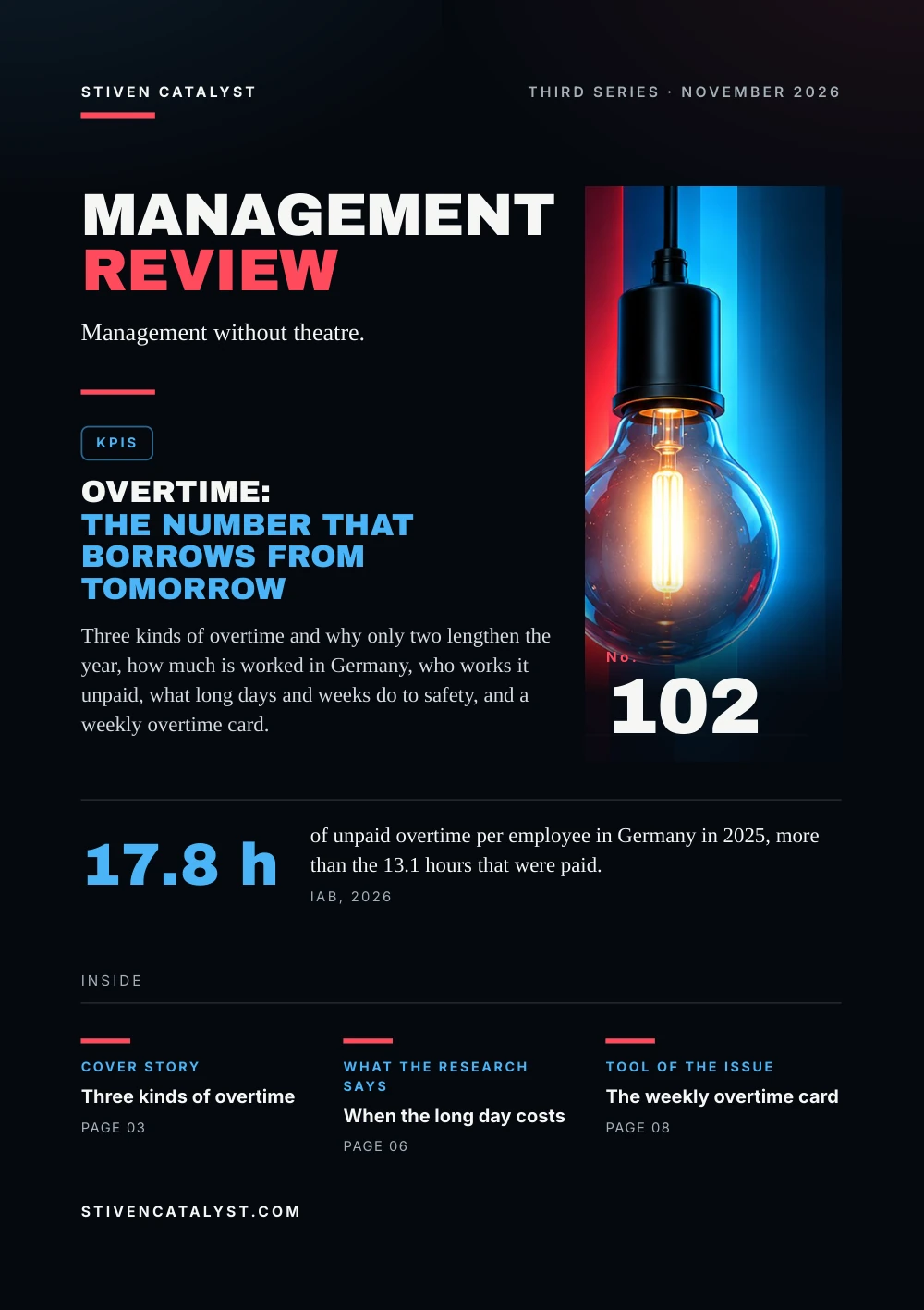
Stiven CatalystThird series · November 2026
ManagementReview
Management without theatre.
KPIs
Overtime:the number that borrows from tomorrow
Three kinds of overtime and why only two lengthen the year, how much is worked in Germany, who works it unpaid, what long days and weeks do to safety, and a weekly overtime card.

No.102
17.8 h
of unpaid overtime per employee in Germany in 2025, more than the 13.1 hours that were paid.IAB, 2026
stivencatalyst.com
No. 102 · KPIs
In this issue
When someone is off sick or the volume rises, the quickest answer is to ask the team to stay longer. It works this week. If it becomes the plan, the hours are borrowed from the people's rest, from next month and from the safety margin. This issue treats overtime as a number to be read, not only paid.
- 03Cover storyThree kinds of overtime
- 04The numbersOvertime in Germany, 1991 and 2025
- 05The modelWho works which overtime
- 06What the research saysWhen the long day costs
- 07How it is measuredCount the hours, not only the pay
- 08Tool of the issueThe weekly overtime card
- 09SourcesSources and method
How to read this issue
Figure
Every figure has its source and year at the foot of its page.
Our reading
Where the editor interprets rather than the research, it says so.
Practice
The steps and the card are proposals to try, not research results.
Cover story
Three kindsof over time
The IAB's working-time accounts, which feed Germany's national accounts, separate overtime by what happens to it afterwards. Two kinds really lengthen the year. The third only moves hours from one week to another, through a time account.
01
Paid
Compensated in money, sometimes with a premium. Lengthens working time.
02
Unpaid
Neither money nor time off later. Lengthens working time.
03
Banked
Taken back as time off later. Moves hours, does not add them.
In the IAB's analysis of the household panel for 2012, banked hours came to 4.3 a month per employee, about as many as paid and unpaid together (4.4). The IAB sees the long fall of paid overtime mainly in the spread of such accounts.
Our reading
Payroll shows only the first kind. The second is invisible there, and the third is a debt the site owes its people.
Sources: Institut für Arbeitsmarkt- und Berufsforschung (IAB), Forschungsbereich Prognosen und gesamtwirtschaftliche Analysen, 2026; Enzo Weber, Susanne Wanger, Roland Weigand & Ines Zapf, IAB, 2014
IAB, FAQ on the working-time accounts (2026), and Weber, Wanger, Weigand and Zapf (IAB, 2014), Socio-Economic Panel 2012, hours per employee and month. The IAB calls the first two definitive, the third transitory overtime.
The numbers
Over time in Germany,1991 and 2025
The IAB spreads the overtime worked over all 42.2 million employees, part-timers and those who never stay late included. In 2025 that made 13.1 paid and 17.8 unpaid hours each: about 553 million paid and 753 million unpaid hours in the year.
Overtime hours per employee and year, Germany (IAB, 2026)
2.4%of all hours employees worked in 2025 were paid or unpaid overtime
−1.4 hchange in time-account balances per employee in 2025: more taken off than banked
Our reading
An average spread over everyone hides the shape. On a real site a few people carry most of the hours.
Source: Institut für Arbeitsmarkt- und Berufsforschung (IAB), Forschungsbereich Prognosen und gesamtwirtschaftliche Analysen, 2026
IAB, Arbeitszeitrechnung, time series as of August 2026, annual figures; mainly from household surveys, modelled, revised each summer. Unpaid hours peaked at 35.1 in 2007. The 2.4% is the editors' sum: 1,306 million of 53,624 million hours.
The model
Who workswhich over time
Paid overtime belongs to the shop floor, unpaid overtime to the office and the manager's desk. The higher the position, the more of the extra hours go unpaid.
Overtime hours per employee and month by position, Germany, 2012 (IAB, 2014)
The same holds for very long weeks. In 2025, 7.1% of full-time workers usually worked 49 hours or more, Destatis reports; in leadership positions nearly a quarter, against 6.1% of the others.
Our reading
A manager's own unpaid evening is a signal the team reads. It tells them what a normal week looks like here.
Sources: Enzo Weber, Susanne Wanger, Roland Weigand & Ines Zapf, IAB, 2014; Statistisches Bundesamt (Destatis), nach der Arbeitskräfteerhebung, 2026
IAB (2014), table 2: Socio-Economic Panel 2012, averages over all employees in each group, part-timers included; four of fourteen groups shown. Destatis (2026): labour force survey, self-reported usual hours, full-time only.
What the research says
When the long daycosts
Dagfinn Matre and colleagues at Norway's National Institute of Occupational Health screened 10,072 studies and kept 22 on long hours and accidents, near misses and injuries. They based their conclusions on the studies with a moderate risk of bias and rated the certainty of each result.
Relative risk of a safety incident, studies with moderate risk of bias (2021)
Only the 12-hour day was clearly significant; the 55-hour week was significant in all studies but not in the moderate set. Overtime as such rested on one such study with a poor definition, and the review could not confirm a rise after the eighth or ninth hour.
Our reading
“Overtime” is too loose a word for risk. What matters is how long the day and the week become, and for whom.
Source: Dagfinn Matre, Marit Skogstad, Tom Sterud, Karl-Christian Nordby, Stein Knardahl, Jan Olav Christensen & Jenny-Anne S. Lie, Scandinavian Journal of Work, Environment & Health 47(6), 2021
Matre et al. (2021), random-effects meta-analysis; certainty low for all contrasts. 1.0 means no difference; days against ≤8 h, weeks against 35–40 h. 15 of the 22 studies included night work; the studies of errors, by nurses and interns, had a high risk of bias. Night shifts are in No. 45, hours awake in No. 89.
How it is measured
Count the hours,not only the pay
German law sets the frame: eight hours a working day, up to ten if eight is the average over six months or 24 weeks, and eleven hours' rest. The employer must record the time worked beyond eight hours and keep it for two years.
Paid hours
from payroll, per person, not only the team total
Unpaid hours
clock-out against the end of the shift; the work done after logging off
Account balance
hours banked and not yet taken back, and since when
Long days and short rests
days over ten hours; fewer than eleven hours between two shifts
Very long weeks
weeks of 55 hours or more, the threshold WHO and ILO use
WHO and ILO estimate that 488 million people, 8.9% of the world's population, worked 55 hours a week or more in 2016, and attribute 745,194 deaths from heart disease and stroke to it. In Europe the share was 3.5%, the lowest of any region.
Sources: Bundesministerium der Justiz, gesetze-im-internet.de, 2024; Frank Pega, Bálint Náfrádi, Natalie C. Momen, Yuka Ujita, Kai N. Streicher, Annette M. Prüss-Üstün et al., Environment International 154, 2021
Arbeitszeitgesetz §§ 3, 5 and 16(2), as amended in 2024; exceptions by collective agreement are not shown. The rows are the editors' proposal. Pega et al. (2021): modelled estimates against 35–40 hours, evidence rated moderate, causation not certain.
Tool of the issue
The weeklyover time card
One card per team and week, filled in by the shift lead before the weekly review. It turns overtime from a cost line into a question: what gap did it cover, and when is it paid back? Shift Capacity shows the gap and the planned overtime before the week begins.
01Team, week, planned hoursfrom the plan, before the week
02Overtime: paid, unpaid, bankedthree numbers, not one
03Who carried itthe three people with the most hours
04Limits toucheddays over ten hours, rests under eleven, weeks of 55 or more
05The gap it coveredabsence, volume above forecast, a vacancy, rework
06Paid back bytime off planned, or the fix to the plan, with a name
Sources: Institut für Arbeitsmarkt- und Berufsforschung (IAB), Forschungsbereich Prognosen und gesamtwirtschaftliche Analysen, 2026; Bundesministerium der Justiz, gesetze-im-internet.de, 2024; Dagfinn Matre, Marit Skogstad, Tom Sterud, Karl-Christian Nordby, Stein Knardahl, Jan Olav Christensen & Jenny-Anne S. Lie, Scandinavian Journal of Work, Environment & Health 47(6), 2021
The card is the editors' proposal, built on the IAB's three kinds, the limits of the Arbeitszeitgesetz and the thresholds in Matre et al. (2021) and Pega et al. (2021); it is not legal advice. The essay linked below gives the author's checks before a day when the plan is not enough.
More in the essayHigh-volume days: the standard under pressure
Open the tool: Shift Capacitystivencatalyst.com/tools/shift-capacity/
Sources and method
Every figurehas a source.
The figures in this issue come from the sources below. The year shows how recent each one is.
- IAB-Arbeitszeitrechnung: Durchschnittliche Arbeitszeit und ihre Komponenten in Deutschland (Zeitreihe ab 1991, Stand August 2026) und FAQ zur IAB-ArbeitszeitrechnungInstitut für Arbeitsmarkt- und Berufsforschung (IAB), Forschungsbereich Prognosen und gesamtwirtschaftliche Analysen, 2026https://iab.de/daten/iab-arbeitszeitrechnung/
- Verbreitung von Überstunden in Deutschland (Aktuelle Berichte 7/2014)Enzo Weber, Susanne Wanger, Roland Weigand & Ines Zapf, IAB, 2014https://doku.iab.de/aktuell/2014/aktueller_bericht_1407.pdf
- Indikatoren zur Qualität der Arbeit: Überlange ArbeitszeitenStatistisches Bundesamt (Destatis), nach der Arbeitskräfteerhebung, 2026https://www.destatis.de/DE/Themen/Arbeit/Arbeitsmarkt/Indikatoren-Qualitaet-Arbeit/Dimension-3/ueberlange-arbeitszeiten.html
- Safety incidents associated with extended working hours. A systematic review and meta-analysisDagfinn Matre, Marit Skogstad, Tom Sterud, Karl-Christian Nordby, Stein Knardahl, Jan Olav Christensen & Jenny-Anne S. Lie, Scandinavian Journal of Work, Environment & Health 47(6), 2021https://doi.org/10.5271/sjweh.3958
- Global, regional, and national burdens of ischemic heart disease and stroke attributable to exposure to long working hours for 194 countries, 2000–2016 (WHO/ILO Joint Estimates)Frank Pega, Bálint Náfrádi, Natalie C. Momen, Yuka Ujita, Kai N. Streicher, Annette M. Prüss-Üstün et al., Environment International 154, 2021https://doi.org/10.1016/j.envint.2021.106595
- Arbeitszeitgesetz (ArbZG), § 3 Arbeitszeit der Arbeitnehmer, § 5 Ruhezeit und § 16 Aushang und Arbeitszeitnachweise, zuletzt geändert am 23. Oktober 2024Bundesministerium der Justiz, gesetze-im-internet.de, 2024https://www.gesetze-im-internet.de/arbzg/
Editorial method
Each figure was checked for its year, its publisher and what it measures, in the full text where it could be opened. A source read only in a summary, an abstract or excerpts is marked “via”. A figure not confirmed in what was read is marked so on its page, or left out. The editor's interpretation is marked “Our reading”.
ManagementReview
Management without theatre.
Every issue, one management question, checked against the best research.
All issues
stivencatalyst.com/magazine/management-review.html
Management Review · No. 102 · November 2026 · Stiven Catalyst
Edited by Stiven Janaqi, who answers for it; “the editors” in this publication means him. Its texts, translations, layout and the checking of figures against their sources are done in working sessions with Claude, an AI model by Anthropic.
stivencatalyst.com/how-this-is-made.html
 Next issue
The learning curve: every repetition counts
Click or swipe a page to turn it. The arrow keys work too.
Management Review · No. 102
The figures of the issue
The charts of the printed pages, with their sources.
IAB, Arbeitszeitrechnung, time series as of August 2026, annual figures; mainly from household surveys, modelled, revised each summer. Unpaid hours peaked at 35.1 in 2007. The 2.4% is the editors' sum: 1,306 million of 53,624 million hours.
Source: Institut für Arbeitsmarkt- und Berufsforschung (IAB), Forschungsbereich Prognosen und gesamtwirtschaftliche Analysen, 2026
IAB (2014), table 2: Socio-Economic Panel 2012, averages over all employees in each group, part-timers included; four of fourteen groups shown. Destatis (2026): labour force survey, self-reported usual hours, full-time only.
Source: Enzo Weber, Susanne Wanger, Roland Weigand & Ines Zapf, IAB, 2014
Matre et al. (2021), random-effects meta-analysis; certainty low for all contrasts. 1.0 means no difference; days against ≤8 h, weeks against 35–40 h. 15 of the 22 studies included night work; the studies of errors, by nurses and interns, had a high risk of bias. Night shifts are in No. 45, hours awake in No. 89.
Source: Dagfinn Matre, Marit Skogstad, Tom Sterud, Karl-Christian Nordby, Stein Knardahl, Jan Olav Christensen & Jenny-Anne S. Lie, Scandinavian Journal of Work, Environment & Health 47(6), 2021
The whole text Read the issue as text For reading on a small screen, searching or a screen reader. The same words, without the page design.
In this issue
When someone is off sick or the volume rises, the quickest answer is to ask the team to stay longer. It works this week. If it becomes the plan, the hours are borrowed from the people's rest, from next month and from the safety margin. This issue treats overtime as a number to be read, not only paid.
The IAB counts paid and unpaid overtime, which lengthen working time, and hours banked on time accounts, which only move it. Paid overtime per employee fell from 46.3 hours in 1991 to 13.1 in 2025; unpaid, at 17.8, has been higher every year since 2002. Managers work the most unpaid hours. A meta-analysis links days over 12 hours with more safety incidents, but found little for overtime as such. A weekly card closes the issue.
Stiven Janaqi, Editor
Cover story
Three kinds of over time
The IAB's working-time accounts, which feed Germany's national accounts, separate overtime by what happens to it afterwards. Two kinds really lengthen the year. The third only moves hours from one week to another, through a time account.
- Paid. Compensated in money, sometimes with a premium. Lengthens working time.
- Unpaid. Neither money nor time off later. Lengthens working time.
- Banked. Taken back as time off later. Moves hours, does not add them.
In the IAB's analysis of the household panel for 2012, banked hours came to 4.3 a month per employee, about as many as paid and unpaid together (4.4). The IAB sees the long fall of paid overtime mainly in the spread of such accounts.
Our reading
Payroll shows only the first kind. The second is invisible there, and the third is a debt the site owes its people.
IAB, FAQ on the working-time accounts (2026), and Weber, Wanger, Weigand and Zapf (IAB, 2014), Socio-Economic Panel 2012, hours per employee and month. The IAB calls the first two definitive, the third transitory overtime.
Sources: Institut für Arbeitsmarkt- und Berufsforschung (IAB), Forschungsbereich Prognosen und gesamtwirtschaftliche Analysen, 2026; Enzo Weber, Susanne Wanger, Roland Weigand & Ines Zapf, IAB, 2014
The numbers
Over time in Germany, 1991 and 2025
The IAB spreads the overtime worked over all 42.2 million employees, part-timers and those who never stay late included. In 2025 that made 13.1 paid and 17.8 unpaid hours each: about 553 million paid and 753 million unpaid hours in the year.
Overtime hours per employee and year, Germany (IAB, 2026): Paid: 1991 46.3, 2025 13.1; Unpaid: 1991 25.9, 2025 17.8.
- 2.4% of all hours employees worked in 2025 were paid or unpaid overtime
- −1.4 h change in time-account balances per employee in 2025: more taken off than banked
Our reading
An average spread over everyone hides the shape. On a real site a few people carry most of the hours.
IAB, Arbeitszeitrechnung, time series as of August 2026, annual figures; mainly from household surveys, modelled, revised each summer. Unpaid hours peaked at 35.1 in 2007. The 2.4% is the editors' sum: 1,306 million of 53,624 million hours.
Source: Institut für Arbeitsmarkt- und Berufsforschung (IAB), Forschungsbereich Prognosen und gesamtwirtschaftliche Analysen, 2026
The model
Who works which over time
Paid overtime belongs to the shop floor, unpaid overtime to the office and the manager's desk. The higher the position, the more of the extra hours go unpaid.
Overtime hours per employee and month by position, Germany, 2012 (IAB, 2014): Skilled workers: Paid 4.4, Unpaid 0.5; Qualified office work: Paid 1.4, Unpaid 1.6; Highly qualified, leading: Paid 2.3, Unpaid 7.3; Broad leadership duties: Paid 0.4, Unpaid 14.6.
The same holds for very long weeks. In 2025, 7.1% of full-time workers usually worked 49 hours or more, Destatis reports; in leadership positions nearly a quarter, against 6.1% of the others.
Our reading
A manager's own unpaid evening is a signal the team reads. It tells them what a normal week looks like here.
IAB (2014), table 2: Socio-Economic Panel 2012, averages over all employees in each group, part-timers included; four of fourteen groups shown. Destatis (2026): labour force survey, self-reported usual hours, full-time only.
Sources: Enzo Weber, Susanne Wanger, Roland Weigand & Ines Zapf, IAB, 2014; Statistisches Bundesamt (Destatis), nach der Arbeitskräfteerhebung, 2026
What the research says
When the long day costs
Dagfinn Matre and colleagues at Norway's National Institute of Occupational Health screened 10,072 studies and kept 22 on long hours and accidents, near misses and injuries. They based their conclusions on the studies with a moderate risk of bias and rated the certainty of each result.
Relative risk of a safety incident, studies with moderate risk of bias (2021): Day >8 h 0.93, Day ≥12 h 1.24, Overtime 1.08, Week 49–54 h 1.02, Week >55 h 1.24.
Only the 12-hour day was clearly significant; the 55-hour week was significant in all studies but not in the moderate set. Overtime as such rested on one such study with a poor definition, and the review could not confirm a rise after the eighth or ninth hour.
Our reading
“Overtime” is too loose a word for risk. What matters is how long the day and the week become, and for whom.
Matre et al. (2021), random-effects meta-analysis; certainty low for all contrasts. 1.0 means no difference; days against ≤8 h, weeks against 35–40 h. 15 of the 22 studies included night work; the studies of errors, by nurses and interns, had a high risk of bias. Night shifts are in No. 45, hours awake in No. 89.
Source: Dagfinn Matre, Marit Skogstad, Tom Sterud, Karl-Christian Nordby, Stein Knardahl, Jan Olav Christensen & Jenny-Anne S. Lie, Scandinavian Journal of Work, Environment & Health 47(6), 2021
How it is measured
Count the hours, not only the pay
German law sets the frame: eight hours a working day, up to ten if eight is the average over six months or 24 weeks, and eleven hours' rest. The employer must record the time worked beyond eight hours and keep it for two years.
- Paid hours. from payroll, per person, not only the team total
- Unpaid hours. clock-out against the end of the shift; the work done after logging off
- Account balance. hours banked and not yet taken back, and since when
- Long days and sho
r t rests. days over ten hours; fewer than eleven hours between two shifts - Very long weeks. weeks of 55 hours or more, the threshold WHO and ILO use
WHO and ILO estimate that 488 million people, 8.9% of the world's population, worked 55 hours a week or more in 2016, and attribute 745,194 deaths from heart disease and stroke to it. In Europe the share was 3.5%, the lowest of any region.
Arbeitszeitgesetz §§ 3, 5 and 16(2), as amended in 2024; exceptions by collective agreement are not shown. The rows are the editors' proposal. Pega et al. (2021): modelled estimates against 35–40 hours, evidence rated moderate, causation not certain.
Sources: Bundesministerium der Justiz, gesetze-im-internet.de, 2024; Frank Pega, Bálint Náfrádi, Natalie C. Momen, Yuka Ujita, Kai N. Streicher, Annette M. Prüss-Üstün et al., Environment International 154, 2021
Tool of the issue
The weekly over time card
One card per team and week, filled in by the shift lead before the weekly review. It turns overtime from a cost line into a question: what gap did it cover, and when is it paid back? Shift Capacity shows the gap and the planned overtime before the week begins.
- Team, week, planned hours from the plan, before the week
- Ove
r time: paid, unpaid, banked three numbers, not one - Who carried it the three people with the most hours
- Limits
t ouched days over ten hours, rests under eleven, weeks of 55 or more - The gap it covered absence, volume above forecast, a vacancy, rework
- Paid back by time off planned, or the fix to the plan, with a name
The card is the editors' proposal, built on the IAB's three kinds, the limits of the Arbeitszeitgesetz and the thresholds in Matre et al. (2021) and Pega et al. (2021); it is not legal advice. The essay linked below gives the author's checks before a day when the plan is not enough.
Sources: Institut für Arbeitsmarkt- und Berufsforschung (IAB), Forschungsbereich Prognosen und gesamtwirtschaftliche Analysen, 2026; Bundesministerium der Justiz, gesetze-im-internet.de, 2024; Dagfinn Matre, Marit Skogstad, Tom Sterud, Karl-Christian Nordby, Stein Knardahl, Jan Olav Christensen & Jenny-Anne S. Lie, Scandinavian Journal of Work, Environment & Health 47(6), 2021
More in the essay: High-volume days: the standard under pressure
Open the tool: Shift Capacity
Sources and method
Every figure has a source.
The figures in this issue come from the sources below. The year shows how recent each one is.
- Institut für Arbeitsmarkt- und Berufsforschung (IAB), Forschungsbereich Prognosen und gesamtwirtschaftliche Analysen, “IAB-Arbeitszeitrechnung: Durchschnittliche Arbeitszeit und ihre Komponenten in Deutschland (Zeitreihe ab 1991, Stand August 2026) und FAQ zur IAB-Arbeitszeitrechnung”, 2026. https://iab.de/daten/iab-arbeitszeitrechnung/
- Enzo Weber, Susanne Wanger, Roland Weigand & Ines Zapf, IAB, “Verbreitung von Überstunden in Deutschland (Aktuelle Berichte 7/2014)”, 2014. https://doku.iab.de/aktuell/2014/aktueller_bericht_1407.pdf
- Statistisches Bundesamt (Destatis), nach der Arbeitskräfteerhebung, “Indikatoren zur Qualität der Arbeit: Überlange Arbeitszeiten”, 2026. https://www.destatis.de/DE/Themen/Arbeit/Arbeitsmarkt/Indikatoren-Qualitaet-Arbeit/Dimension-3/ueberlange-arbeitszeiten.html
- Dagfinn Matre, Marit Skogstad, Tom Sterud, Karl-Christian Nordby, Stein Knardahl, Jan Olav Christensen & Jenny-Anne S. Lie, Scandinavian Journal of Work, Environment & Health 47(6), “Safety incidents associated with extended working hours. A systematic review and meta-analysis”, 2021. https://doi.org/10.5271/sjweh.3958
- Frank Pega, Bálint Náfrádi, Natalie C. Momen, Yuka Ujita, Kai N. Streicher, Annette M. Prüss-Üstün et al., Environment International 154, “Global, regional, and national burdens of ischemic heart disease and stroke attributable to exposure to long working hours for 194 countries, 2000–2016 (WHO/ILO Joint Estimates)”, 2021. https://doi.org/10.1016/j.envint.2021.106595
- Bundesministerium der Justiz, gesetze-im-internet.de, “Arbeitszeitgesetz (ArbZG), § 3 Arbeitszeit der Arbeitnehmer, § 5 Ruhezeit und § 16 Aushang und Arbeitszeitnachweise, zuletzt geändert am 23. Oktober 2024”, 2024. https://www.gesetze-im-internet.de/arbzg/
Edit orial me thod
Each figure was checked for its year, its publisher and what it measures, in the full text where it could be opened. A source read only in a summary, an abstract or excerpts is marked “via”. A figure not confirmed in what was read is marked so on its page, or left out. The editor's interpretation is marked “Our reading”.
Edited by Stiven Janaqi, who answers for it; “the editors” in this publication means him. Its texts, translations, layout and the checking of figures against their sources are done in working sessions with Claude, an AI model by Anthropic. How this is made
Management Review · Monthly edition