Richard Ryan and Edward Deci named three needs: autonomy, competence and relatedness. In 99 studies, autonomy carried most of what the needs explain in engagement, competence most of it in task performance. A manager's support for autonomy goes with wanting and valuing the work, not with pressure. Over 40 years of research, intrinsic motivation predicted the quality of work, incentives its quantity. And the style can be learned: in one study, within five weeks.
Management Review · Second series · November 2026 · No. 60
Motivation: aut onomy, compe tence, relatedness
Three needs behind motivation, what 99 studies show each one carries, the line from “have to” to “want to”, what pay buys, how support for autonomy is learned, and a card for one role.
- No.
- 60
- Pages
- 10
- Sources
- 8
- Topics
- People
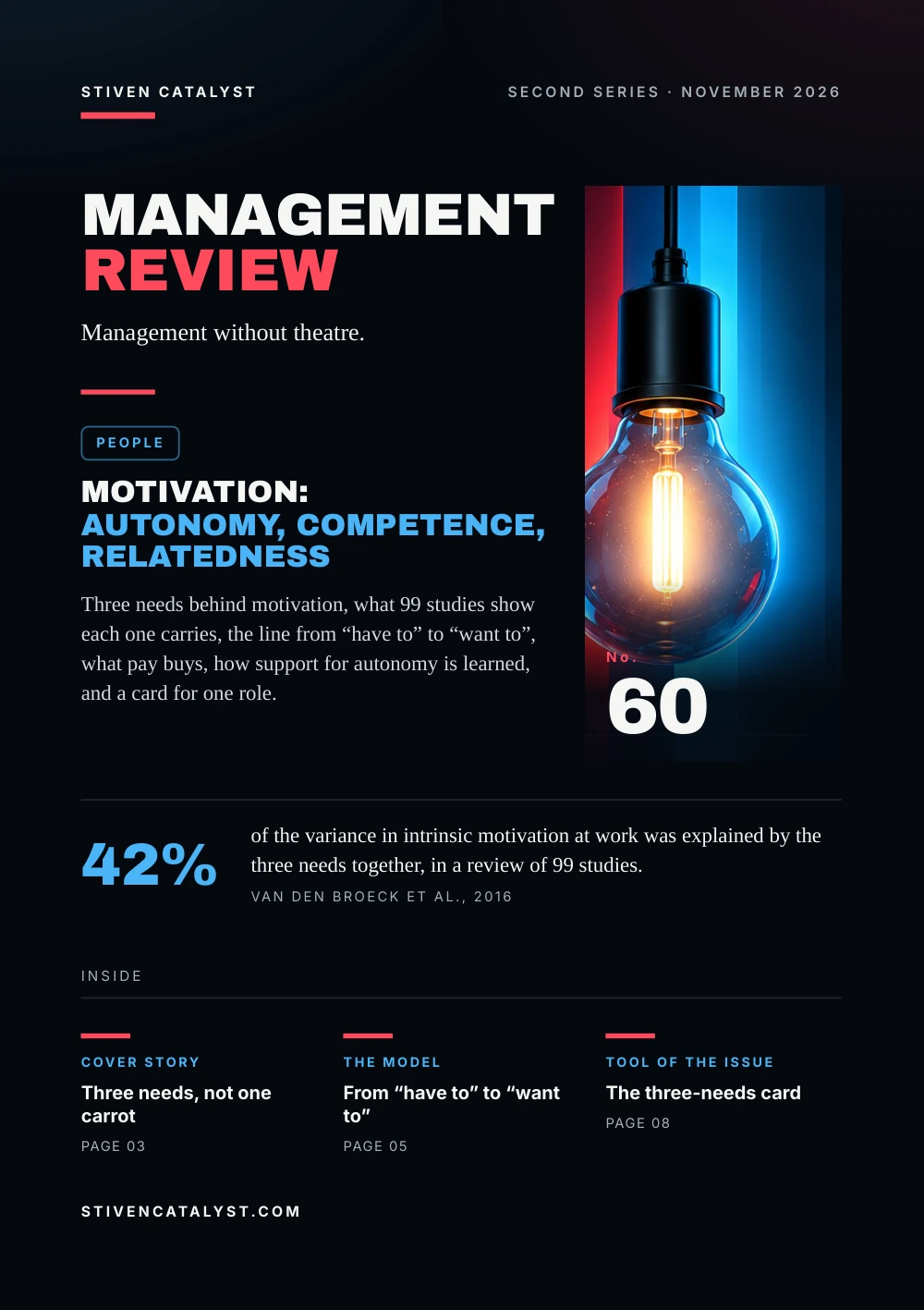
Stiven CatalystSecond series · November 2026
ManagementReview
Management without theatre.
People
Motivation:autonomy, competence, relatedness
Three needs behind motivation, what 99 studies show each one carries, the line from “have to” to “want to”, what pay buys, how support for autonomy is learned, and a card for one role.

No.60
42%
of the variance in intrinsic motivation at work was explained by the three needs together, in a review of 99 studies.Van den Broeck et al., 2016
stivencatalyst.com
No. 60 · People
In this issue
Most talk about motivation asks how much of it people have. Self-determination theory asks what kind: whether people work because they want to, because they see the point, or because they feel pushed. This issue is about the three needs behind that difference and what a manager can do about each.
- 03Cover storyThree needs, not one carrot
- 04The numbersWhich need carries what
- 05The modelFrom “have to” to “want to”
- 06What the research saysPay buys quantity
- 07How it is measuredAsk why, not how much
- 08Tool of the issueThe three-needs card
- 09SourcesSources and method
How to read this issue
Figure
Every figure has its source and year at the foot of its page.
Our reading
Where the editors interpret rather than the research, it says so.
Practice
The steps and the card are proposals to try, not research results.
Cover story
Three needs,not one carrot
In 2000 Richard Ryan and Edward Deci summed up their research: people can be curious and engaged, or like the many who “wait listlessly for the weekend as they go about their jobs”. The difference, they argued, lies in three needs.
01
Autonomy
acting with a sense of choice and ownership, not pushed and pulled from outside
02
Competence
feeling able to master the work and to grow new skills
03
Relatedness
feeling connected to others: belonging, caring and being cared for
Autonomy is the most misunderstood of the three, because it does not mean independence. Anja Van den Broeck and colleagues give an example: a manager asks someone to finish a task over lunch. If the person agrees willingly, the need is met; if they feel forced, it is thwarted. The task is the same.
Our reading
Autonomy is not the absence of a manager. It is the difference between “I agreed” and “I had no choice”.
Sources: Richard M. Ryan & Edward L. Deci, American Psychologist 55(1), 2000; Anja Van den Broeck, D. Lance Ferris, Chu-Hsiang Chang & Christopher C. Rosen, Journal of Management 42(5), 2016
The definitions follow Ryan & Deci (2000) and Van den Broeck et al. (2016), whose lunch example this is. The quotation is from the American Psychologist; the translation is ours.
The numbers
Which needcarries what
Anja Van den Broeck and colleagues pooled 99 studies with 119 samples of adults at work. Each need predicted outcomes on its own, but not equally. This is how the three shared what they explain:
Share of what the three needs explain, by need
Together the needs explained 43% of the variance in engagement and 17% in task performance. Of the three, autonomy was most closely related to job satisfaction (ρ = 0.69), competence to task performance (0.40).
Our reading
Choice keeps people engaged; feeling able shows in the work itself. A team needs both, and a manager feeds them in different ways.
Source: Anja Van den Broeck, D. Lance Ferris, Chu-Hsiang Chang & Christopher C. Rosen, Journal of Management 42(5), 2016
Relative weights from the authors' Table 7; ρ is a correlation corrected for measurement error. The studies measure needs and outcomes side by side: they show association, not cause.
The model
From “have t o”t o “want t o”
The theory does not set intrinsic against extrinsic motivation. It places the reasons for working on a line, from none to the work itself. Along it, a rule can be taken in until it becomes one's own.
- 01
No motivation
going through the motions
- 02
External
for a reward, or to avoid a punishment
- 03
Introjected
to avoid guilt, or to feel worth something
- 04
Identified
because I see its value
- 05
Intrinsic
because the work itself satisfies
Manager's support for autonomy, correlation with each reason (72 studies)
Our reading
A standard explained is half accepted. The reason behind a rule is what moves it from “have to” towards “want to”.
Sources: Richard M. Ryan & Edward L. Deci, American Psychologist 55(1), 2000; Gavin R. Slemp, Margaret L. Kern, Kent J. Patrick & Richard M. Ryan, Motivation and Emotion 42(5), 2018
The line follows Ryan & Deci (2000), who also place integrated regulation before intrinsic motivation. Slemp et al. pooled 32,870 people; ρ corrected for measurement error, mostly cross-sectional studies.
More in the essayLeading people without losing the person
What the research says
Pay buysquantit y
Christopher Cerasoli, Jessica Nicklin and Michael Ford pooled 40 years of research from school, work and sport. Intrinsic motivation predicted performance moderately to strongly, whether incentives were offered or not.
212,468people, in 183 effect sizes
ρ = 0.21–0.45between intrinsic motivation and performance
Weighed together, intrinsic motivation explained more of the quality of performance, incentives more of its quantity. Where incentives were tied directly to performance, intrinsic motivation counted for less. In a study of 166 bank employees in Norway, the amount of pay did not predict need satisfaction or intrinsic motivation; the manager's support for employees' needs did.
Our reading
A bonus can count pieces. Care for the work is what shows in quality, and a bonus on every piece can crowd it out.
Sources: Christopher P. Cerasoli, Jessica M. Nicklin & Michael T. Ford, Psychological Bulletin 140(4), 2014 (via Abstract (PubMed) and Deci, Olafsen & Ryan (2017)); Anja H. Olafsen, Hallgeir Halvari, Jacques Forest & Edward L. Deci, Scandinavian Journal of Psychology 56(4), 2015 (via Abstract and Deci, Olafsen & Ryan (2017)); Edward L. Deci, Anja H. Olafsen & Richard M. Ryan, Annual Review of Organizational Psychology and Organizational Behavior 4, 2017
Cerasoli et al. from the abstract and the summary by Deci, Olafsen & Ryan (2017); the full article was not available to us. The bank study is a single survey (Olafsen et al., 2015).
How it is measured
Ask why,not how much
The Multidimensional Work Motivation Scale, tested with 3,435 workers in seven languages and nine countries, does not ask how motivated someone is. Its 19 items ask for the reasons behind their effort at work, from none to the work itself.
What employees are asked about their manager (Deci et al., 2017)
- acknowledges my point of view
- offers choices and encourages initiative
- gives meaningful feedback and optimally challenging tasks
- gives a reason when asking for something
The style can be learned. In a study published in 1989, Deci and colleagues trained the managers of one division of a large company; their employees later reported more job satisfaction and more trust in top management. Patricia Hardré and Johnmarshall Reeve trained 25 managers with 169 employees: five weeks later the trained managers were more autonomy supportive, and their employees more autonomously motivated and engaged than a control group's.
Sources: Marylène Gagné, Jacques Forest, Maarten Vansteenkiste et al., European Journal of Work and Organizational Psychology 24(2), 2015 (via Abstract (RePEc/HAL) and Deci, Olafsen & Ryan (2017)); Edward L. Deci, Anja H. Olafsen & Richard M. Ryan, Annual Review of Organizational Psychology and Organizational Behavior 4, 2017; Patricia L. Hardré & Johnmarshall Reeve, International Journal of Training and Development 13(3), 2009 (via Abstract and Deci, Olafsen & Ryan (2017)); Gavin R. Slemp, Margaret L. Kern, Kent J. Patrick & Richard M. Ryan, Motivation and Emotion 42(5), 2018
The scale is copyrighted, so we name what it measures, not its items. The four lines summarise the behaviours listed by Deci et al. Slemp et al. (2018) note that both training studies had small samples.
Tool of the issue
The three-needscard
Take one role in your team, not one person. For each need, write what the job gives today and one change you can make this month. Then ask the people in the role whether you got it right.
01Rolewhich role, how many people, the main task
02Autonomywhere they can choose how; one rule to explain with its reason
03Competencehow they see they do it well; one stretch task or piece of feedback
04Relatednesswho they depend on and who notices their work; one moment together
05Changesone per need, with an owner and a date
06Asked backwhat the people in the role said, in their words
Sources: Richard M. Ryan & Edward L. Deci, American Psychologist 55(1), 2000; Edward L. Deci, Anja H. Olafsen & Richard M. Ryan, Annual Review of Organizational Psychology and Organizational Behavior 4, 2017
A practice proposed by the editors, after the three needs of Ryan & Deci (2000) and the managerial behaviours listed by Deci, Olafsen & Ryan (2017). The card is not a measurement scale.
Open the tool: KPI Diagnosticstivencatalyst.com/tools/kpi-diagnostic/
Sources and method
Every figurehas a source.
The figures in this issue come from the sources below. The year shows how recent each one is.
- Self-Determination Theory and the Facilitation of Intrinsic Motivation, Social Development, and Well-BeingRichard M. Ryan & Edward L. Deci, American Psychologist 55(1), 2000https://doi.org/10.1037/0003-066X.55.1.68
- A Review of Self-Determination Theory's Basic Psychological Needs at WorkAnja Van den Broeck, D. Lance Ferris, Chu-Hsiang Chang & Christopher C. Rosen, Journal of Management 42(5), 2016https://doi.org/10.1177/0149206316632058
- Leader autonomy support in the workplace: A meta-analytic reviewGavin R. Slemp, Margaret L. Kern, Kent J. Patrick & Richard M. Ryan, Motivation and Emotion 42(5), 2018https://doi.org/10.1007/s11031-018-9698-y
- Intrinsic motivation and extrinsic incentives jointly predict performance: A 40-year meta-analysisChristopher P. Cerasoli, Jessica M. Nicklin & Michael T. Ford, Psychological Bulletin 140(4), 2014 · via Abstract (PubMed) and Deci, Olafsen & Ryan (2017)https://doi.org/10.1037/a0035661
- Show them the money? The role of pay, managerial need support, and justice in a self-determination theory model of intrinsic work motivationAnja H. Olafsen, Hallgeir Halvari, Jacques Forest & Edward L. Deci, Scandinavian Journal of Psychology 56(4), 2015 · via Abstract and Deci, Olafsen & Ryan (2017)https://doi.org/10.1111/sjop.12211
- Self-Determination Theory in Work Organizations: The State of a ScienceEdward L. Deci, Anja H. Olafsen & Richard M. Ryan, Annual Review of Organizational Psychology and Organizational Behavior 4, 2017https://doi.org/10.1146/annurev-orgpsych-032516-113108
- The Multidimensional Work Motivation Scale: Validation evidence in seven languages and nine countriesMarylène Gagné, Jacques Forest, Maarten Vansteenkiste et al., European Journal of Work and Organizational Psychology 24(2), 2015 · via Abstract (RePEc/HAL) and Deci, Olafsen & Ryan (2017)https://doi.org/10.1080/1359432X.2013.877892
- Training corporate managers to adopt a more autonomy-supportive motivating style toward employees: an intervention studyPatricia L. Hardré & Johnmarshall Reeve, International Journal of Training and Development 13(3), 2009 · via Abstract and Deci, Olafsen & Ryan (2017)https://doi.org/10.1111/j.1468-2419.2009.00325.x
Editorial method
Each figure was checked for its year, its publisher and what exactly it measures. Where the publisher's page could not be opened, the figure was checked against independent summaries and is marked “via”. The editors' interpretation is marked “Our reading”. Figures that could not be confirmed are not in the issue.
ManagementReview
Management without theatre.
Every issue, one management question, checked against the best research.
All issues
stivencatalyst.com/magazine/management-review.html
Management Review · No. 60 · November 2026 · Stiven Catalyst
Click or swipe a page to turn it. The arrow keys work too.
Management Review · No. 60
The figures of the issue
The charts of the printed pages, with their sources.
Source: Anja Van den Broeck, D. Lance Ferris, Chu-Hsiang Chang & Christopher C. Rosen, Journal of Management 42(5), 2016
Source: Gavin R. Slemp, Margaret L. Kern, Kent J. Patrick & Richard M. Ryan, Motivation and Emotion 42(5), 2018
The whole text Read the issue as text For reading on a small screen, searching or a screen reader. The same words, without the page design.
In this issue
Most talk about motivation asks how much of it people have. Self-determination theory asks what kind: whether people work because they want to, because they see the point, or because they feel pushed. This issue is about the three needs behind that difference and what a manager can do about each.
Richard Ryan and Edward Deci named three needs: autonomy, competence and relatedness. In 99 studies, autonomy carried most of what the needs explain in engagement, competence most of it in task performance. A manager's support for autonomy goes with wanting and valuing the work, not with pressure. Over 40 years of research, intrinsic motivation predicted the quality of work, incentives its quantity. And the style can be learned: in one study, within five weeks.
Stiven Janaqi, Editor
Cover story
Three needs, not one carrot
In 2000 Richard Ryan and Edward Deci summed up their research: people can be curious and engaged, or like the many who “wait listlessly for the weekend as they go about their jobs”. The difference, they argued, lies in three needs.
- Au
t onomy. acting with a sense of choice and ownership, not pushed and pulled from outside - Comp
e tence. feeling able to master the work and to grow new skills - Relatedness. feeling connected to others: belonging, caring and being cared for
Autonomy is the most misunderstood of the three, because it does not mean independence. Anja Van den Broeck and colleagues give an example: a manager asks someone to finish a task over lunch. If the person agrees willingly, the need is met; if they feel forced, it is thwarted. The task is the same.
Our reading
Autonomy is not the absence of a manager. It is the difference between “I agreed” and “I had no choice”.
The definitions follow Ryan & Deci (2000) and Van den Broeck et al. (2016), whose lunch example this is. The quotation is from the American Psychologist; the translation is ours.
Sources: Richard M. Ryan & Edward L. Deci, American Psychologist 55(1), 2000; Anja Van den Broeck, D. Lance Ferris, Chu-Hsiang Chang & Christopher C. Rosen, Journal of Management 42(5), 2016
The numbers
Which need carries what
Anja Van den Broeck and colleagues pooled 99 studies with 119 samples of adults at work. Each need predicted outcomes on its own, but not equally. This is how the three shared what they explain:
Share of what the three needs explain, by need: Autonomy: Engagement 62.8%, Task performance 19.6%; Competence: Engagement 12.8%, Task performance 64.1%; Relatedness: Engagement 24.5%, Task performance 16.3%.
Together the needs explained 43% of the variance in engagement and 17% in task performance. Of the three, autonomy was most closely related to job satisfaction (ρ = 0.69), competence to task performance (0.40).
Our reading
Choice keeps people engaged; feeling able shows in the work itself. A team needs both, and a manager feeds them in different ways.
Relative weights from the authors' Table 7; ρ is a correlation corrected for measurement error. The studies measure needs and outcomes side by side: they show association, not cause.
Source: Anja Van den Broeck, D. Lance Ferris, Chu-Hsiang Chang & Christopher C. Rosen, Journal of Management 42(5), 2016
The model
From “have t o” t o “want t o”
The theory does not set intrinsic against extrinsic motivation. It places the reasons for working on a line, from none to the work itself. Along it, a rule can be taken in until it becomes one's own.
- No motivation. going through the motions
- External. for a reward, or to avoid a punishment
- Introjected. to avoid guilt, or to feel worth something
- Identified. because I see its value
- Intrinsic. because the work itself satisfies
Manager's support for autonomy, correlation with each reason (72 studies): Intrinsic 0.38, Identified 0.31, Introjected −0.04, External 0.00.
Our reading
A standard explained is half accepted. The reason behind a rule is what moves it from “have to” towards “want to”.
The line follows Ryan & Deci (2000), who also place integrated regulation before intrinsic motivation. Slemp et al. pooled 32,870 people; ρ corrected for measurement error, mostly cross-sectional studies.
Sources: Richard M. Ryan & Edward L. Deci, American Psychologist 55(1), 2000; Gavin R. Slemp, Margaret L. Kern, Kent J. Patrick & Richard M. Ryan, Motivation and Emotion 42(5), 2018
More in the essay: Leading people without losing the person
What the research says
Pay buys quantit y
Christopher Cerasoli, Jessica Nicklin and Michael Ford pooled 40 years of research from school, work and sport. Intrinsic motivation predicted performance moderately to strongly, whether incentives were offered or not.
- 212,468 people, in 183 effect sizes
- ρ = 0.21–0.45 between intrinsic motivation and performance
Weighed together, intrinsic motivation explained more of the quality of performance, incentives more of its quantity. Where incentives were tied directly to performance, intrinsic motivation counted for less. In a study of 166 bank employees in Norway, the amount of pay did not predict need satisfaction or intrinsic motivation; the manager's support for employees' needs did.
Our reading
A bonus can count pieces. Care for the work is what shows in quality, and a bonus on every piece can crowd it out.
Cerasoli et al. from the abstract and the summary by Deci, Olafsen & Ryan (2017); the full article was not available to us. The bank study is a single survey (Olafsen et al., 2015).
Sources: Christopher P. Cerasoli, Jessica M. Nicklin & Michael T. Ford, Psychological Bulletin 140(4), 2014 (via Abstract (PubMed) and Deci, Olafsen & Ryan (2017)); Anja H. Olafsen, Hallgeir Halvari, Jacques Forest & Edward L. Deci, Scandinavian Journal of Psychology 56(4), 2015 (via Abstract and Deci, Olafsen & Ryan (2017)); Edward L. Deci, Anja H. Olafsen & Richard M. Ryan, Annual Review of Organizational Psychology and Organizational Behavior 4, 2017
How it is measured
Ask why, not how much
The Multidimensional Work Motivation Scale, tested with 3,435 workers in seven languages and nine countries, does not ask how motivated someone is. Its 19 items ask for the reasons behind their effort at work, from none to the work itself.
What employees are asked about their manager (Deci e t al., 2017)
- acknowledges my point of view
- offers choices and encourages initiative
- gives meaningful feedback and optimally challenging tasks
- gives a reason when asking for something
The style can be learned. In a study published in 1989, Deci and colleagues trained the managers of one division of a large company; their employees later reported more job satisfaction and more trust in top management. Patricia Hardré and Johnmarshall Reeve trained 25 managers with 169 employees: five weeks later the trained managers were more autonomy supportive, and their employees more autonomously motivated and engaged than a control group's.
The scale is copyrighted, so we name what it measures, not its items. The four lines summarise the behaviours listed by Deci et al. Slemp et al. (2018) note that both training studies had small samples.
Sources: Marylène Gagné, Jacques Forest, Maarten Vansteenkiste et al., European Journal of Work and Organizational Psychology 24(2), 2015 (via Abstract (RePEc/HAL) and Deci, Olafsen & Ryan (2017)); Edward L. Deci, Anja H. Olafsen & Richard M. Ryan, Annual Review of Organizational Psychology and Organizational Behavior 4, 2017; Patricia L. Hardré & Johnmarshall Reeve, International Journal of Training and Development 13(3), 2009 (via Abstract and Deci, Olafsen & Ryan (2017)); Gavin R. Slemp, Margaret L. Kern, Kent J. Patrick & Richard M. Ryan, Motivation and Emotion 42(5), 2018
Tool of the issue
The three-needs card
Take one role in your team, not one person. For each need, write what the job gives today and one change you can make this month. Then ask the people in the role whether you got it right.
- Role which role, how many people, the main task
- Au
t onomy where they can choose how; one rule to explain with its reason - Comp
e tence how they see they do it well; one stretch task or piece of feedback - Relatedness who they depend on and who notices their work; one moment together
- Changes one per need, with an owner and a date
- Asked back what the people in the role said, in their words
A practice proposed by the editors, after the three needs of Ryan & Deci (2000) and the managerial behaviours listed by Deci, Olafsen & Ryan (2017). The card is not a measurement scale.
Sources: Richard M. Ryan & Edward L. Deci, American Psychologist 55(1), 2000; Edward L. Deci, Anja H. Olafsen & Richard M. Ryan, Annual Review of Organizational Psychology and Organizational Behavior 4, 2017
Open the tool: KPI Diagnostic
Sources and method
Every figure has a source.
The figures in this issue come from the sources below. The year shows how recent each one is.
- Richard M. Ryan & Edward L. Deci, American Psychologist 55(1), “Self-Determination Theory and the Facilitation of Intrinsic Motivation, Social Development, and Well-Being”, 2000. https://doi.org/10.1037/0003-066X.55.1.68
- Anja Van den Broeck, D. Lance Ferris, Chu-Hsiang Chang & Christopher C. Rosen, Journal of Management 42(5), “A Review of Self-Determination Theory's Basic Psychological Needs at Work”, 2016. https://doi.org/10.1177/0149206316632058
- Gavin R. Slemp, Margaret L. Kern, Kent J. Patrick & Richard M. Ryan, Motivation and Emotion 42(5), “Leader autonomy support in the workplace: A meta-analytic review”, 2018. https://doi.org/10.1007/s11031-018-9698-y
- Christopher P. Cerasoli, Jessica M. Nicklin & Michael T. Ford, Psychological Bulletin 140(4), “Intrinsic motivation and extrinsic incentives jointly predict performance: A 40-year meta-analysis”, 2014 (via Abstract (PubMed) and Deci, Olafsen & Ryan (2017)). https://doi.org/10.1037/a0035661
- Anja H. Olafsen, Hallgeir Halvari, Jacques Forest & Edward L. Deci, Scandinavian Journal of Psychology 56(4), “Show them the money? The role of pay, managerial need support, and justice in a self-determination theory model of intrinsic work motivation”, 2015 (via Abstract and Deci, Olafsen & Ryan (2017)). https://doi.org/10.1111/sjop.12211
- Edward L. Deci, Anja H. Olafsen & Richard M. Ryan, Annual Review of Organizational Psychology and Organizational Behavior 4, “Self-Determination Theory in Work Organizations: The State of a Science”, 2017. https://doi.org/10.1146/annurev-orgpsych-032516-113108
- Marylène Gagné, Jacques Forest, Maarten Vansteenkiste et al., European Journal of Work and Organizational Psychology 24(2), “The Multidimensional Work Motivation Scale: Validation evidence in seven languages and nine countries”, 2015 (via Abstract (RePEc/HAL) and Deci, Olafsen & Ryan (2017)). https://doi.org/10.1080/1359432X.2013.877892
- Patricia L. Hardré & Johnmarshall Reeve, International Journal of Training and Development 13(3), “Training corporate managers to adopt a more autonomy-supportive motivating style toward employees: an intervention study”, 2009 (via Abstract and Deci, Olafsen & Ryan (2017)). https://doi.org/10.1111/j.1468-2419.2009.00325.x
Edit orial me thod
Each figure was checked for its year, its publisher and what exactly it measures. Where the publisher's page could not be opened, the figure was checked against independent summaries and is marked “via”. The editors' interpretation is marked “Our reading”. Figures that could not be confirmed are not in the issue.
Management Review · Monthly edition