David Collis and Michael Rukstad ask whether a company can state its strategy in 35 words or fewer: its objective, scope and advantage. In a 2012 online poll in Germany, 44% said they knew their employer's course for the year. A.G. Lafley and Roger Martin reduce strategy to five linked choices, Japanese firms have deployed it with hoshin kanri since the 1960s, and Richard Rumelt names the kernel of a good strategy: a diagnosis, a guiding policy and coherent actions.
Management Review · Monthly edition · October 2026 · No. 33
Strategy on one page
Strategy in 35 words, how many people know the course, the five choices of Playing to Win, hoshin kanri and catchball, Rumelt's kernel, and a card for a strategy on one page.
- No.
- 33
- Pages
- 10
- Sources
- 8
- Topics
- Strategy
Stiven CatalystMonthly edition · October 2026
ManagementReview
Management without theatre.
Strategy
Strategyon one page
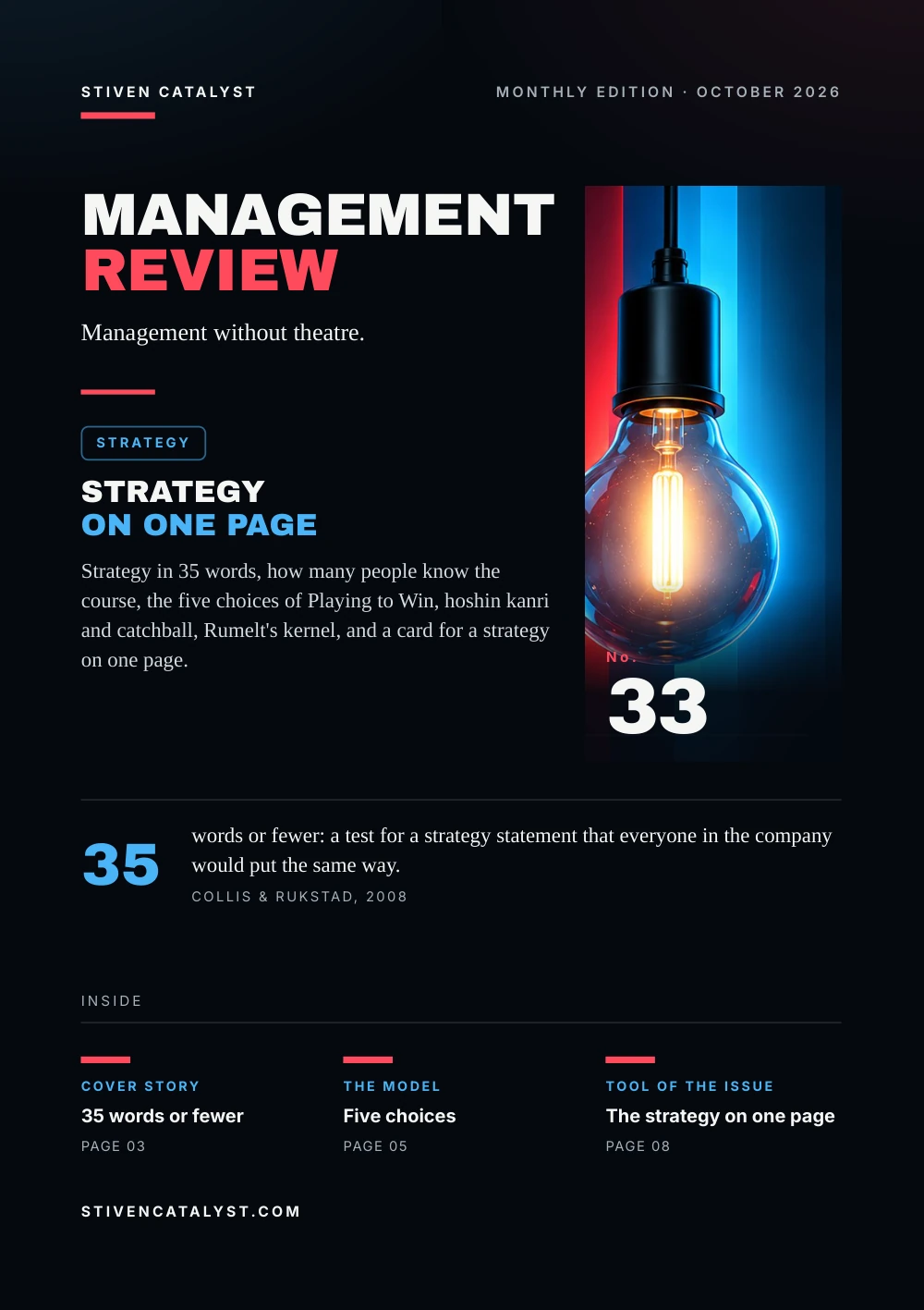
Strategy in 35 words, how many people know the course, the five choices of Playing to Win, hoshin kanri and catchball, Rumelt's kernel, and a card for a strategy on one page.

No.33
35
words or fewer: a test for a strategy statement that everyone in the company would put the same way.Collis & Rukstad, 2008
stivencatalyst.com
No. 33 · Strategy
In this issue
A strategy that lives in a long document rarely reaches the people who carry it out. This issue looks at what fits on one page, who decides what goes on it, and how to test whether it is a strategy at all.
- 03Cover story35 words or fewer
- 04The numbersWho knows the course
- 05The modelFive choices, one cascade
- 06What the research saysHoshin kanri and catchball
- 07How it is measuredIs it a strategy at all?
- 08Tool of the issueThe strategy on one page
- 09SourcesSources and method
How to read this issue
Figure
Every figure has its source and year at the foot of its page.
Our reading
Where the editors interpret rather than the research, it says so.
Practice
The steps and the card are proposals to try, not research results.
Cover story
35 wordsor fewer
In 2008 David Collis and Michael Rukstad opened their Harvard Business Review article with two questions: can you sum up your company's strategy in 35 words or fewer, and would your colleagues put it the same way?
01
Objective
the end the strategy aims at, with an end point and a time frame
02
Scope
the part of the landscape in which the firm will operate
03
Advantage
the means by which the firm will reach the objective
Their verdict: most executives cannot state the objective, scope and advantage of their business in a simple statement, and if they can't, neither can anyone else. Their example was Edward Jones, a brokerage in St. Louis: by the authors' account, just about every one of its 37,000 employees could state its short strategy statement.
Our reading
The 35 words are not the strategy. They test whether there is one that people can repeat.
Source: David J. Collis & Michael G. Rukstad, Harvard Business Review, 2008
The 35 words are the authors' test, not a measured figure. The Edward Jones claim is theirs too; one of them had worked with the firm for more than ten years.
The numbers
Who knowsthe course
In 2012 the job site StepStone asked its users in an online poll whether they knew their employer's course for the year. The answers of specialists and managers in Germany:
Know their employer's course for 2012, Germany
The European average of the poll was 41%. A figure quoted far more often says that 95% of employees do not know or do not understand their company's strategy. It comes from the abstract of a 2005 Harvard Business Review article by Robert Kaplan and David Norton, which gives no sample, year or method; we found no survey behind it.
Our reading
A number without a source can travel far. Asking your own team takes one meeting.
Sources: StepStone survey, reported by Deutsche Handwerks Zeitung, 2012; Robert S. Kaplan & David P. Norton, Harvard Business Review, 2005
A self-selected online poll and self-reports; it is not clear whether the 4,800 or so respondents were in Germany alone. For Albania we have no comparable figure.
The model
Five choices,one cascade
In Playing to Win (2013), A.G. Lafley and Roger Martin treat strategy as five linked choices, each a question. Where to play and how to win sit at the centre.
- 01
Aspiration
What is our winning aspiration?
- 02
Where to play
Where will we play?
- 03
How to win
How will we win there?
- 04
Capabilities
What capabilities must we have?
- 05
Systems
What management systems do we need?
The choices depend on each other: the aspiration sets the level of ambition, where to play narrows how to win, and capabilities and systems serve the choices above them. The cascade runs both ways, and a market is attractive only together with a way to win in it.
Our reading
Most plans answer the first question and skip the next two. Where to play and how to win are where the hard choices are.
Source: A.G. Lafley & Roger L. Martin, Harvard Business Review Press, 2013
The cascade is confirmed only in summaries of the book. The publisher credits the method with Lafley's decade at Procter & Gamble; that is its claim, not an independent measurement.
More in the essayFrom retail to logistics and hospitality: the industry changes, the management problems do not
What the research says
Hoshin kanriand cat chball
Hoshin kanri, or policy deployment, has been a management system in many Japanese companies since the 1960s, used to tie strategy to quality management. In the West few firms used it, apart from some pioneers.
- 1960sJapanese firms use hoshin kanri to tie strategy to quality management.
- 1991Yoji Akao's book on policy deployment appears in English.
- 2001Tennant and Roberts describe catchball at Rover Group.
Catchball is the process by which teams build consensus on the targets and measures passed down to them. Tennant and Roberts based one on the Delphi technique and used it at the UK carmaker Rover Group to shape its quality strategy. At the University of East Anglia, Barry Witcher's team held over 100 interviews in three UK subsidiaries of Japanese firms and followed key policy decisions through the process.
The four activities of the yearly cycle in Witcher's FAIR model
- 01
Focus
- 02
Alignment
- 03
Integration
- 04
Review
Sources: Yoji Akao (ed.), Productivity Press, 1991; C. Tennant & P. Roberts, Long Range Planning, 2001; University of East Anglia, research of Barry J. Witcher, 2014
The research on hoshin kanri is mostly case studies: it describes how firms use it, not whether a one-page strategy improves results. The FAIR model rests on one source.
How it is measured
Is it a strategyat all?
Richard Rumelt calls the core of a good strategy its kernel. A plan that does not name and analyse its obstacles is, in his terms, only a goal, a budget or a wish list.
01
Diagnosis
defines and explains the challenge, cutting away what is superficial
02
Guiding policy
the overall approach to the challenge, which focuses the effort
03
Coherent actions
coordinated, feasible steps and resources that carry out the policy
Four signs of bad strategy
- fluff: the ordinary dressed in big words
- failure to face the challenge
- goals mistaken for strategy
- bad strategic objectives: a mixed list of tasks without focus
Hypothetical example, a regional warehouse
- Diagnosis
- most late shipments start with orders released after 14:00
- Policy
- fix the afternoon peak before adding new services
- Actions
- an earlier order cut-off, a second picking wave, a daily check at 15:00
Three lines a team can check every week. The case is invented.
Source: Richard P. Rumelt, Crown Business, 2011
The kernel and the four signs follow Rumelt (2011); the example is the editors'.
Tool of the issue
The strategyon one page
Write it with the team, keep it to one page, and ask three colleagues to repeat it in their own words. Where their versions differ, the strategy is not yet clear.
01Objectivewhat, and by when
02Scopewhere we play: customers, places, services, and what we leave out
03Advantagewhy customers choose us over others
04Diagnosisthe main obstacle, in one sentence
05Three actionscoherent, each with an owner and a date
06Catchballwho read it, what came back, what changed
Sources: David J. Collis & Michael G. Rukstad, Harvard Business Review, 2008; Richard P. Rumelt, Crown Business, 2011; C. Tennant & P. Roberts, Long Range Planning, 2001
A practice proposed by the editors, after Collis & Rukstad (2008), Rumelt (2011) and catchball in hoshin kanri.
Open the tool: KPI Diagnosticstivencatalyst.com/tools/kpi-diagnostic/
Sources and method
Every figurehas a source.
The figures in this issue come from the sources below. The year shows how recent each one is.
- Can You Say What Your Strategy Is?David J. Collis & Michael G. Rukstad, Harvard Business Review, 2008https://hbr.org/2008/04/can-you-say-what-your-strategy-is
- Umfrage von StepStone: Viele Arbeitnehmer kennen Unternehmensstrategie nichtStepStone survey, reported by Deutsche Handwerks Zeitung, 2012
- The Office of Strategy ManagementRobert S. Kaplan & David P. Norton, Harvard Business Review, 2005https://pubmed.ncbi.nlm.nih.gov/16250626/
- Playing to Win: How Strategy Really WorksA.G. Lafley & Roger L. Martin, Harvard Business Review Press, 2013
- Hoshin Kanri: Policy Deployment for Successful TQMYoji Akao (ed.), Productivity Press, 1991
- Hoshin Kanri: Implementing the Catchball ProcessC. Tennant & P. Roberts, Long Range Planning, 2001https://wrap.warwick.ac.uk/11819
- Improving strategy management in operations through Hoshin Kanri (REF2014 impact case study)University of East Anglia, research of Barry J. Witcher, 2014https://impact.ref.ac.uk/casestudies/CaseStudy.aspx?Id=7658
- Good Strategy Bad Strategy: The Difference and Why It MattersRichard P. Rumelt, Crown Business, 2011
Editorial method
Each figure was checked for its year, its publisher and what exactly it measures. Where the publisher's page could not be opened, the figure was checked against independent summaries and is marked “via”. The editors' interpretation is marked “Our reading”. Figures that could not be confirmed are not in the issue.
ManagementReview
Management without theatre.
Every issue, one management question, checked against the best research.
All issues
stivencatalyst.com/magazine/management-review.html
Management Review · No. 33 · October 2026 · Stiven Catalyst
Click or swipe a page to turn it. The arrow keys work too.
Management Review · No. 33
The figures of the issue
The charts of the printed pages, with their sources.
Source: StepStone survey, reported by Deutsche Handwerks Zeitung, 2012
The whole text Read the issue as text For reading on a small screen, searching or a screen reader. The same words, without the page design.
In this issue
A strategy that lives in a long document rarely reaches the people who carry it out. This issue looks at what fits on one page, who decides what goes on it, and how to test whether it is a strategy at all.
David Collis and Michael Rukstad ask whether a company can state its strategy in 35 words or fewer: its objective, scope and advantage. In a 2012 online poll in Germany, 44% said they knew their employer's course for the year. A.G. Lafley and Roger Martin reduce strategy to five linked choices, Japanese firms have deployed it with hoshin kanri since the 1960s, and Richard Rumelt names the kernel of a good strategy: a diagnosis, a guiding policy and coherent actions.
Stiven Janaqi, Editor
Cover story
35 words or fewer
In 2008 David Collis and Michael Rukstad opened their Harvard Business Review article with two questions: can you sum up your company's strategy in 35 words or fewer, and would your colleagues put it the same way?
- Objective. the end the strategy aims at, with an end point and a time frame
- Scope. the part of the landscape in which the firm will operate
- Advantage. the means by which the firm will reach the objective
Their verdict: most executives cannot state the objective, scope and advantage of their business in a simple statement, and if they can't, neither can anyone else. Their example was Edward Jones, a brokerage in St. Louis: by the authors' account, just about every one of its 37,000 employees could state its short strategy statement.
Our reading
The 35 words are not the strategy. They test whether there is one that people can repeat.
The 35 words are the authors' test, not a measured figure. The Edward Jones claim is theirs too; one of them had worked with the firm for more than ten years.
Source: David J. Collis & Michael G. Rukstad, Harvard Business Review, 2008
The numbers
Who knows the course
In 2012 the job site StepStone asked its users in an online poll whether they knew their employer's course for the year. The answers of specialists and managers in Germany:
Know their employer's course for 2012, Germany: Knew it 44%, Had a rough idea 23%, Did not know it 33%.
The European average of the poll was 41%. A figure quoted far more often says that 95% of employees do not know or do not understand their company's strategy. It comes from the abstract of a 2005 Harvard Business Review article by Robert Kaplan and David Norton, which gives no sample, year or method; we found no survey behind it.
Our reading
A number without a source can travel far. Asking your own team takes one meeting.
A self-selected online poll and self-reports; it is not clear whether the 4,800 or so respondents were in Germany alone. For Albania we have no comparable figure.
Sources: StepStone survey, reported by Deutsche Handwerks Zeitung, 2012; Robert S. Kaplan & David P. Norton, Harvard Business Review, 2005
The model
Five choices, one cascade
In Playing to Win (2013), A.G. Lafley and Roger Martin treat strategy as five linked choices, each a question. Where to play and how to win sit at the centre.
- Aspiration. What is our winning aspiration?
- Where
t o play. Where will we play? - How
t o win. How will we win there? - Capabilities. What capabilities must we have?
- Systems. What management systems do we need?
The choices depend on each other: the aspiration sets the level of ambition, where to play narrows how to win, and capabilities and systems serve the choices above them. The cascade runs both ways, and a market is attractive only together with a way to win in it.
Our reading
Most plans answer the first question and skip the next two. Where to play and how to win are where the hard choices are.
The cascade is confirmed only in summaries of the book. The publisher credits the method with Lafley's decade at Procter & Gamble; that is its claim, not an independent measurement.
Source: A.G. Lafley & Roger L. Martin, Harvard Business Review Press, 2013
More in the essay: From retail to logistics and hospitality: the industry changes, the management problems do not
What the research says
Hoshin kanri and cat chball
Hoshin kanri, or policy deployment, has been a management system in many Japanese companies since the 1960s, used to tie strategy to quality management. In the West few firms used it, apart from some pioneers.
- 1960s Japanese firms use hoshin kanri to tie strategy to quality management.
- 1991 Yoji Akao's book on policy deployment appears in English.
- 2001 Tennant and Roberts describe catchball at Rover Group.
Catchball is the process by which teams build consensus on the targets and measures passed down to them. Tennant and Roberts based one on the Delphi technique and used it at the UK carmaker Rover Group to shape its quality strategy. At the University of East Anglia, Barry Witcher's team held over 100 interviews in three UK subsidiaries of Japanese firms and followed key policy decisions through the process.
The four activities of the yearly cycle in Wit cher's FAIR model
- Focus.
- Alignment.
- Integration.
- Review.
The research on hoshin kanri is mostly case studies: it describes how firms use it, not whether a one-page strategy improves results. The FAIR model rests on one source.
Sources: Yoji Akao (ed.), Productivity Press, 1991; C. Tennant & P. Roberts, Long Range Planning, 2001; University of East Anglia, research of Barry J. Witcher, 2014
How it is measured
Is it a strategy at all?
Richard Rumelt calls the core of a good strategy its kernel. A plan that does not name and analyse its obstacles is, in his terms, only a goal, a budget or a wish list.
- Diagnosis. defines and explains the challenge, cutting away what is superficial
- Guiding policy. the overall approach to the challenge, which focuses the effort
- Coherent actions. coordinated, feasible steps and resources that carry out the policy
Four signs of bad strategy
- fluff: the ordinary dressed in big words
- failure to face the challenge
- goals mistaken for strategy
- bad strategic objectives: a mixed list of tasks without focus
Hypothe tical example, a regional warehouse
- Diagnosis: most late shipments start with orders released after 14:00
- Policy: fix the afternoon peak before adding new services
- Actions: an earlier order cut-off, a second picking wave, a daily check at 15:00
Three lines a team can check every week. The case is invented.
The kernel and the four signs follow Rumelt (2011); the example is the editors'.
Source: Richard P. Rumelt, Crown Business, 2011
Tool of the issue
The strategy on one page
Write it with the team, keep it to one page, and ask three colleagues to repeat it in their own words. Where their versions differ, the strategy is not yet clear.
- Objective what, and by when
- Scope where we play: customers, places, services, and what we leave out
- Advantage why customers choose us over others
- Diagnosis the main obstacle, in one sentence
- Three actions coherent, each with an owner and a date
- Ca
t chball who read it, what came back, what changed
A practice proposed by the editors, after Collis & Rukstad (2008), Rumelt (2011) and catchball in hoshin kanri.
Sources: David J. Collis & Michael G. Rukstad, Harvard Business Review, 2008; Richard P. Rumelt, Crown Business, 2011; C. Tennant & P. Roberts, Long Range Planning, 2001
Open the tool: KPI Diagnostic
Sources and method
Every figure has a source.
The figures in this issue come from the sources below. The year shows how recent each one is.
- David J. Collis & Michael G. Rukstad, Harvard Business Review, “Can You Say What Your Strategy Is?”, 2008. https://hbr.org/2008/04/can-you-say-what-your-strategy-is
- StepStone survey, reported by Deutsche Handwerks Zeitung, “Umfrage von StepStone: Viele Arbeitnehmer kennen Unternehmensstrategie nicht”, 2012.
- Robert S. Kaplan & David P. Norton, Harvard Business Review, “The Office of Strategy Management”, 2005. https://pubmed.ncbi.nlm.nih.gov/16250626/
- A.G. Lafley & Roger L. Martin, Harvard Business Review Press, “Playing to Win: How Strategy Really Works”, 2013.
- Yoji Akao (ed.), Productivity Press, “Hoshin Kanri: Policy Deployment for Successful TQM”, 1991.
- C. Tennant & P. Roberts, Long Range Planning, “Hoshin Kanri: Implementing the Catchball Process”, 2001. https://wrap.warwick.ac.uk/11819
- University of East Anglia, research of Barry J. Witcher, “Improving strategy management in operations through Hoshin Kanri (REF2014 impact case study)”, 2014. https://impact.ref.ac.uk/casestudies/CaseStudy.aspx?Id=7658
- Richard P. Rumelt, Crown Business, “Good Strategy Bad Strategy: The Difference and Why It Matters”, 2011.
Edit orial me thod
Each figure was checked for its year, its publisher and what exactly it measures. Where the publisher's page could not be opened, the figure was checked against independent summaries and is marked “via”. The editors' interpretation is marked “Our reading”. Figures that could not be confirmed are not in the issue.
Management Review · Monthly edition