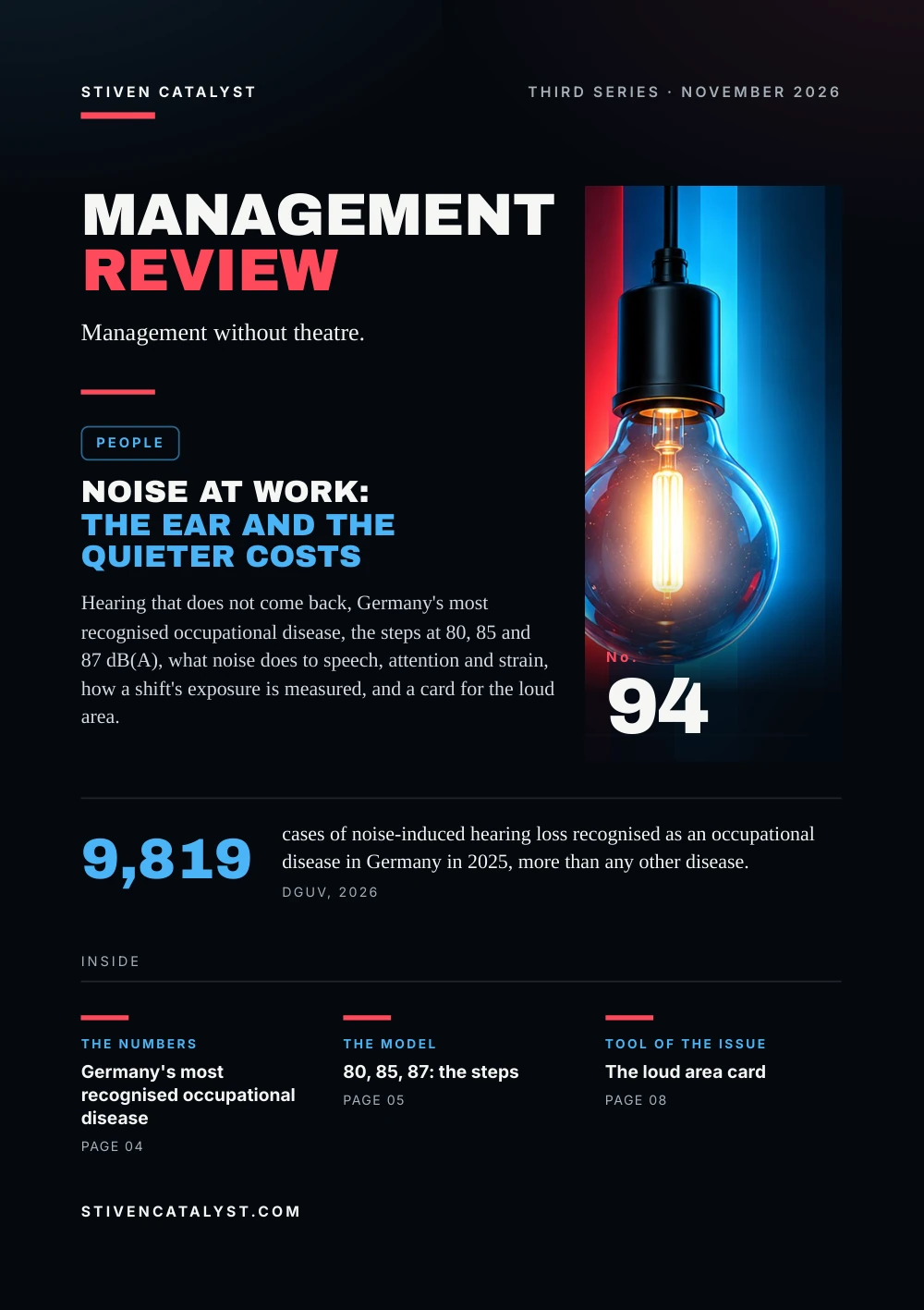
In a simulation, a second nurse lifted the catch of a wrong vial from 54% to 100%, and of a dose error only from 9% to 33%. A review of 13 hospital studies found too little evidence that double checks lower errors, and none that they lower harm. ISMP explains which errors a second person catches. Scanning at the bedside went with 41% fewer administration errors, and its override logs show where it is bypassed. A card closes the issue.
Management Review · Third series · November 2026 · No. 95
The second check: what it cat ches
Two nurses and a planted error, thirteen studies of the double check, the errors a second person catches and those they repeat, what bedside scanning changed, the overrides that show where it is bypassed, and a card.
- No.
- 95
- Pages
- 10
- Sources
- 4
- Topics
- Operations
- Online since
- 3 November 2026
Stiven CatalystThird series · November 2026
ManagementReview
Management without theatre.
Operations
The second check:what it catches
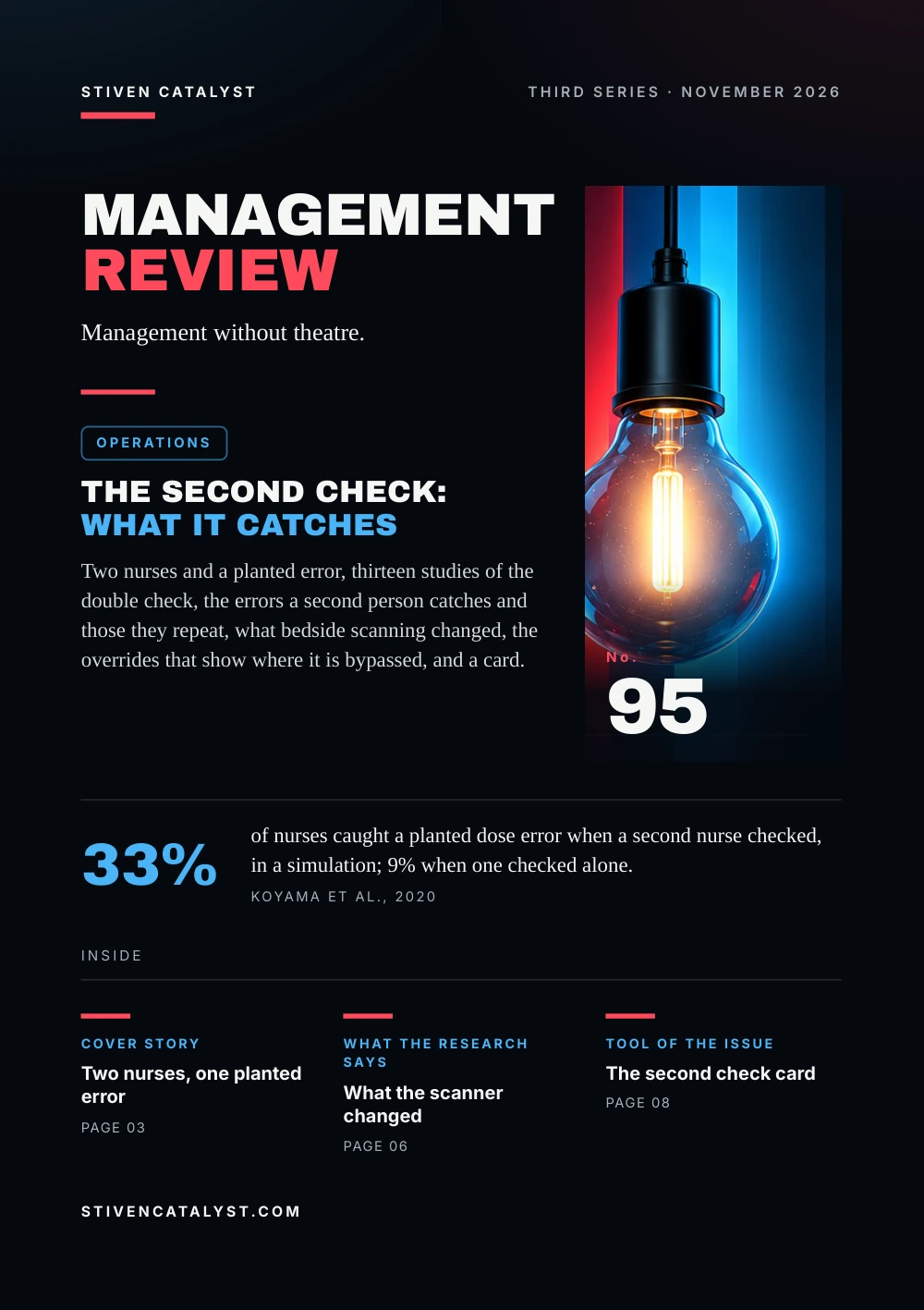
Two nurses and a planted error, thirteen studies of the double check, the errors a second person catches and those they repeat, what bedside scanning changed, the overrides that show where it is bypassed, and a card.

No.95
33%
of nurses caught a planted dose error when a second nurse checked, in a simulation; 9% when one checked alone.Koyama et al., 2020
stivencatalyst.com
No. 95 · Operations
In this issue
Wherever a mistake is costly, a second person is asked to check: the dose, the load, the payment, the release. The rule feels safe and costs a second person's time. This issue asks when the second check catches errors, when it only feels safe, and what changed where a device took over part of it.
- 03Cover storyTwo nurses, one planted error
- 04The numbersThirteen studies, three good ones
- 05The modelWhat a second person catches
- 06What the research saysWhat the scanner changed
- 07How it is measuredCount the overrides
- 08Tool of the issueThe second check card
- 09SourcesSources and method
How to read this issue
Figure
Every figure has its source and year at the foot of its page.
Our reading
Where the editor interprets rather than the research, it says so.
Practice
The steps and the card are proposals to try, not research results.
Cover story
Two nurses,one planted error
In a trial in a medical education centre, 43 pairs of emergency and intensive care nurses cared for a simulated patient. Two errors were planted: a wrong vial and a wrong weight-based dose. One group gave a drug that policy said needed a second check, insulin; the other a drug that needed one, midazolam.
Nurses who caught the planted error, by kind of check (simulation, 2018)
With two, every wrong vial was found, and two dose errors in three still went through. Both errors were found more often when the checker worked independently than when told what to expect, and the review notes that deference to a more senior nurse was seen in this trial.
Our reading
A second look reads the label. It does not redo the arithmetic unless the check asks for it.
Source: Alain K. Koyama, Claire-Sophie Sheridan Maddox, Ling Li, Tracey Bucknall & Johanna I. Westbrook, BMJ Quality & Safety 29(7), 2020
Douglass et al. (2018) as reported in the review by Koyama et al. (2020). Small groups, wide confidence intervals; the two groups gave different drugs, and nurses may check insulin more closely anyway.
The numbers
Thir teen studies,three good ones
Alain Koyama and colleagues searched five databases up to October 2018 for hospital studies of double checks when medicines are given. They found 13. Of the three of good quality, one linked double checks with fewer errors, one found no clear link, and one counted only whether the steps were followed.
0 / 13studies measured harm to patients
52–97%of doses were double-checked, where studies of adults counted it
Steps of the double check followed, one children's hospital, 2,000 observed doses (2014)
Our reading
The step followed least was the calculation, the kind of error the checkers in the simulation missed most.
Source: Alain K. Koyama, Claire-Sophie Sheridan Maddox, Ling Li, Tracey Bucknall & Johanna I. Westbrook, BMJ Quality & Safety 29(7), 2020
The bars are the four weakest of 15 steps (Alsulami et al., 2014, as the review lists them); the other 11 were followed in 90% or more. Five of the 13 studies counted errors from self-reports or incident reports, which undercount them.
The model
What a secondperson cat ches
The Institute for Safe Medication Practices (ISMP, 2019) still backs the manual independent double check, but for a few high-risk tasks only, and only when done properly. It separates the errors a second person tends to catch from those they tend to repeat.
Usually caught: slips of one person
- A miscalculated dose
- Another person rarely makes the same slip
- If the checker works alone, from the source
Often repeated: errors from the setting
- Look-alike packages and labels
- A complex task, unclear information
- The checker works in the same conditions
Holding up a syringe and saying “This is 5 units of insulin, can you check it?” is ISMP's example of a check that is not independent. Failed checks come back to four habits: checking by routine, stopping once the first details look right, deferring to rank, and trusting that the other will catch it.
Our reading
A check that is told the answer confirms it. Give the checker the source, not the result.
Sources: Institute for Safe Medication Practices, ISMP Medication Safety Alert! Acute Care 24, 2019; Alain K. Koyama, Claire-Sophie Sheridan Maddox, Ling Li, Tracey Bucknall & Johanna I. Westbrook, BMJ Quality & Safety 29(7), 2020
ISMP (2019), read in full; the columns follow its distinction between errors from within a person and from outside, the wording is the editors'. ISMP cites studies, mostly in pharmacies and simulations, in which such checks found up to 95% of errors; the 2020 review found little evidence of that at the bedside.
What the research says
What the scannerchanged
In 2010 Eric Poon and colleagues compared units of an academic medical centre before and after a bar-code system that checks each medicine against an electronic administration record. Observers watched 14,041 administrations and reviewed 3,082 transcribed orders.
Rates per 100 observed administrations; transcription per 100 orders (2010)
Timing errors fell by 27.3%, but potential harm from them did not change significantly. The authors' verdict: fewer errors, not none. ISMP calls scanning more reliable than a second nurse for confirming drug, dose and patient, and sees the second nurse as the better check for pump settings and mixed-up lines.
Our reading
A scanner makes the comparison every time, tired or not. It cannot check what is never scanned.
Sources: Eric G. Poon et al., New England Journal of Medicine 362(18), 2010 (via the abstract at PubMed); Institute for Safe Medication Practices, ISMP Medication Safety Alert! Acute Care 24, 2019
Before-and-after study in one centre, not a randomised trial; figures from the abstract only (the NEJM full text did not open), hence “via”. Errors and harm leave out timing errors; transcription is per order reviewed.
How it is measured
Count theoverrides
Ross Koppel and colleagues studied bar-code systems in five hospitals (2003–2006), watching nurses in two, and read a month of override logs from four. A dose charted without a confirming scan is an override: 10.3% on the medicine side, 4.2% on the patient side.
Medicine overrides by stated reason, one month, four hospitals (2005)
Among the 15 workarounds: copies of wristband codes stuck to carts, doorframes or belt rings; one package scanned twice for a full dose; alarms muted; a second nurse signing without looking.
Our reading
An override log lists where the system and the work do not fit. Read it as that before reading it for names.
Source: Ross Koppel, Tosha Wetterneck, Joel Leon Telles & Ben-Tzion Karsh, Journal of the American Medical Informatics Association 15(4), 2008
Koppel et al. (2008). The reasons are the nurses' own entries; they show which causes exist, not how often each occurs. The authors found no workaround malicious. The linked essay is the author's view of what a scan proves. Checklists are in No. 85, mistake-proofing in No. 46.
More in the essayThe scanner is a witness, not a judge
Tool of the issue
The secondcheck card
One card for each check a team relies on, by a person or a device. The Poka-Yoke Register keeps devices such as a blocking scan on a test schedule: plant a deliberate error and see whether the check stops it.
01The error it must catchone named error, such as wrong dose or wrong patient, not “mistakes”
02From a person or the setting?a slip is caught by a second person; look-alike labels may fool both
03Could a device do it?a scan, a hard stop, a fixed setting; keep people for what devices cannot check
04Independent?the checker works from the source, not from what the first person says
05Last planted errordate, and whether the check stopped it
06Skipped or overridden this monthhow many times, and the reasons given
Sources: Institute for Safe Medication Practices, ISMP Medication Safety Alert! Acute Care 24, 2019; Alain K. Koyama, Claire-Sophie Sheridan Maddox, Ling Li, Tracey Bucknall & Johanna I. Westbrook, BMJ Quality & Safety 29(7), 2020; Ross Koppel, Tosha Wetterneck, Joel Leon Telles & Ben-Tzion Karsh, Journal of the American Medical Informatics Association 15(4), 2008
The card is the editors' proposal, built on ISMP's advice, the review and the override study; it is not a tested instrument. Testing with a planted error is how the simulation measured detection.
Open the tool: Poka-Yoke Registerstivencatalyst.com/tools/poka-yoke/
Sources and method
Every figurehas a source.
The figures in this issue come from the sources below. The year shows how recent each one is.
- Effectiveness of double checking to reduce medication administration errors: a systematic reviewAlain K. Koyama, Claire-Sophie Sheridan Maddox, Ling Li, Tracey Bucknall & Johanna I. Westbrook, BMJ Quality & Safety 29(7), 2020https://doi.org/10.1136/bmjqs-2019-009552
- Independent Double Checks: Worth the Effort if Used Judiciously and ProperlyInstitute for Safe Medication Practices, ISMP Medication Safety Alert! Acute Care 24, 2019https://home.ecri.org/blogs/ismp-alerts-and-articles-library/independent-double-checks-worth-the-effort-if-used-judiciously-and-properly
- Effect of Bar-Code Technology on the Safety of Medication AdministrationEric G. Poon et al., New England Journal of Medicine 362(18), 2010 · via the abstract at PubMedhttps://doi.org/10.1056/NEJMsa0907115
- Workarounds to Barcode Medication Administration Systems: Their Occurrences, Causes, and Threats to Patient SafetyRoss Koppel, Tosha Wetterneck, Joel Leon Telles & Ben-Tzion Karsh, Journal of the American Medical Informatics Association 15(4), 2008https://pmc.ncbi.nlm.nih.gov/articles/PMC2442264/
Editorial method
Each figure was checked for its year, its publisher and what it measures, in the full text where it could be opened. A source read only in a summary, an abstract or excerpts is marked “via”. A figure not confirmed in what was read is marked so on its page, or left out. The editor's interpretation is marked “Our reading”.
ManagementReview
Management without theatre.
Every issue, one management question, checked against the best research.
All issues
stivencatalyst.com/magazine/management-review.html
Management Review · No. 95 · November 2026 · Stiven Catalyst
Edited by Stiven Janaqi, who answers for it; “the editors” in this publication means him. Its texts, translations, layout and the checking of figures against their sources are done in working sessions with Claude, an AI model by Anthropic.
stivencatalyst.com/how-this-is-made.html
 Next issue
Check the AI's sources before it goes out
Click or swipe a page to turn it. The arrow keys work too.
Management Review · No. 95
The figures of the issue
The charts of the printed pages, with their sources.
Douglass et al. (2018) as reported in the review by Koyama et al. (2020). Small groups, wide confidence intervals; the two groups gave different drugs, and nurses may check insulin more closely anyway.
Source: Alain K. Koyama, Claire-Sophie Sheridan Maddox, Ling Li, Tracey Bucknall & Johanna I. Westbrook, BMJ Quality & Safety 29(7), 2020
The bars are the four weakest of 15 steps (Alsulami et al., 2014, as the review lists them); the other 11 were followed in 90% or more. Five of the 13 studies counted errors from self-reports or incident reports, which undercount them.
Source: Alain K. Koyama, Claire-Sophie Sheridan Maddox, Ling Li, Tracey Bucknall & Johanna I. Westbrook, BMJ Quality & Safety 29(7), 2020
Before-and-after study in one centre, not a randomised trial; figures from the abstract only (the NEJM full text did not open), hence “via”. Errors and harm leave out timing errors; transcription is per order reviewed.
Source: Eric G. Poon et al., New England Journal of Medicine 362(18), 2010 (via the abstract at PubMed)
Koppel et al. (2008). The reasons are the nurses' own entries; they show which causes exist, not how often each occurs. The authors found no workaround malicious. The linked essay is the author's view of what a scan proves. Checklists are in No. 85, mistake-proofing in No. 46.
Source: Ross Koppel, Tosha Wetterneck, Joel Leon Telles & Ben-Tzion Karsh, Journal of the American Medical Informatics Association 15(4), 2008
The whole text Read the issue as text For reading on a small screen, searching or a screen reader. The same words, without the page design.
In this issue
Wherever a mistake is costly, a second person is asked to check: the dose, the load, the payment, the release. The rule feels safe and costs a second person's time. This issue asks when the second check catches errors, when it only feels safe, and what changed where a device took over part of it.
In a simulation, a second nurse lifted the catch of a wrong vial from 54% to 100%, and of a dose error only from 9% to 33%. A review of 13 hospital studies found too little evidence that double checks lower errors, and none that they lower harm. ISMP explains which errors a second person catches. Scanning at the bedside went with 41% fewer administration errors, and its override logs show where it is bypassed. A card closes the issue.
Stiven Janaqi, Editor
Cover story
Two nurses, one planted error
In a trial in a medical education centre, 43 pairs of emergency and intensive care nurses cared for a simulated patient. Two errors were planted: a wrong vial and a wrong weight-based dose. One group gave a drug that policy said needed a second check, insulin; the other a drug that needed one, midazolam.
Nurses who caught the planted error, by kind of check (simulation, 2018): Wrong vial: One check 54%, Two checks 100%; Wrong dose: One check 9%, Two checks 33%.
With two, every wrong vial was found, and two dose errors in three still went through. Both errors were found more often when the checker worked independently than when told what to expect, and the review notes that deference to a more senior nurse was seen in this trial.
Our reading
A second look reads the label. It does not redo the arithmetic unless the check asks for it.
Douglass et al. (2018) as reported in the review by Koyama et al. (2020). Small groups, wide confidence intervals; the two groups gave different drugs, and nurses may check insulin more closely anyway.
Source: Alain K. Koyama, Claire-Sophie Sheridan Maddox, Ling Li, Tracey Bucknall & Johanna I. Westbrook, BMJ Quality & Safety 29(7), 2020
The numbers
Thir teen studies, three good ones
Alain Koyama and colleagues searched five databases up to October 2018 for hospital studies of double checks when medicines are given. They found 13. Of the three of good quality, one linked double checks with fewer errors, one found no clear link, and one counted only whether the steps were followed.
- 0 / 13 studies measured harm to patients
- 52–97% of doses were double-checked, where studies of adults counted it
Steps of the double check followed, one children's hospital, 2,000 observed doses (2014): Giving the dose to the patient 83%, Rate of an IV bolus 71%, Labelling flush syringes 67%, Dose calculation 30%.
Our reading
The step followed least was the calculation, the kind of error the checkers in the simulation missed most.
The bars are the four weakest of 15 steps (Alsulami et al., 2014, as the review lists them); the other 11 were followed in 90% or more. Five of the 13 studies counted errors from self-reports or incident reports, which undercount them.
Source: Alain K. Koyama, Claire-Sophie Sheridan Maddox, Ling Li, Tracey Bucknall & Johanna I. Westbrook, BMJ Quality & Safety 29(7), 2020
The model
What a second person cat ches
The Institute for Safe Medication Practices (ISMP, 2019) still backs the manual independent double check, but for a few high-risk tasks only, and only when done properly. It separates the errors a second person tends to catch from those they tend to repeat.
Usually caught: slips of one person
- A miscalculated dose
- Another person rarely makes the same slip
- If the checker works alone, from the source
Of ten repeated: errors from the se t ting
- Look-alike packages and labels
- A complex task, unclear information
- The checker works in the same conditions
Holding up a syringe and saying “This is 5 units of insulin, can you check it?” is ISMP's example of a check that is not independent. Failed checks come back to four habits: checking by routine, stopping once the first details look right, deferring to rank, and trusting that the other will catch it.
Our reading
A check that is told the answer confirms it. Give the checker the source, not the result.
ISMP (2019), read in full; the columns follow its distinction between errors from within a person and from outside, the wording is the editors'. ISMP cites studies, mostly in pharmacies and simulations, in which such checks found up to 95% of errors; the 2020 review found little evidence of that at the bedside.
Sources: Institute for Safe Medication Practices, ISMP Medication Safety Alert! Acute Care 24, 2019; Alain K. Koyama, Claire-Sophie Sheridan Maddox, Ling Li, Tracey Bucknall & Johanna I. Westbrook, BMJ Quality & Safety 29(7), 2020
What the research says
What the scanner changed
In 2010 Eric Poon and colleagues compared units of an academic medical centre before and after a bar-code system that checks each medicine against an electronic administration record. Observers watched 14,041 administrations and reviewed 3,082 transcribed orders.
Rates per 100 observed administrations; transcription per 100 orders (2010): Administration errors: Without scanning 11.5%, With scanning 6.8%; Transcription errors: Without scanning 6.1%, With scanning 0%; Potential harm: Without scanning 3.1%, With scanning 1.6%.
Timing errors fell by 27.3%, but potential harm from them did not change significantly. The authors' verdict: fewer errors, not none. ISMP calls scanning more reliable than a second nurse for confirming drug, dose and patient, and sees the second nurse as the better check for pump settings and mixed-up lines.
Our reading
A scanner makes the comparison every time, tired or not. It cannot check what is never scanned.
Before-and-after study in one centre, not a randomised trial; figures from the abstract only (the NEJM full text did not open), hence “via”. Errors and harm leave out timing errors; transcription is per order reviewed.
Sources: Eric G. Poon et al., New England Journal of Medicine 362(18), 2010 (via the abstract at PubMed); Institute for Safe Medication Practices, ISMP Medication Safety Alert! Acute Care 24, 2019
How it is measured
Count the overrides
Ross Koppel and colleagues studied bar-code systems in five hospitals (2003–2006), watching nurses in two, and read a month of override logs from four. A dose charted without a confirming scan is an override: 10.3% on the medicine side, 4.2% on the patient side.
Medicine overrides by stated reason, one month, four hospitals (2005): Scan failed, cause not given 24,620, Bar code missing or unreadable 5,062, Unusual case, e.g. own medicine 1,385, Partial dose or other form 1,098.
Among the 15 workarounds: copies of wristband codes stuck to carts, doorframes or belt rings; one package scanned twice for a full dose; alarms muted; a second nurse signing without looking.
Our reading
An override log lists where the system and the work do not fit. Read it as that before reading it for names.
Koppel et al. (2008). The reasons are the nurses' own entries; they show which causes exist, not how often each occurs. The authors found no workaround malicious. The linked essay is the author's view of what a scan proves. Checklists are in No. 85, mistake-proofing in No. 46.
Source: Ross Koppel, Tosha Wetterneck, Joel Leon Telles & Ben-Tzion Karsh, Journal of the American Medical Informatics Association 15(4), 2008
More in the essay: The scanner is a witness, not a judge
Tool of the issue
The second check card
One card for each check a team relies on, by a person or a device. The Poka-Yoke Register keeps devices such as a blocking scan on a test schedule: plant a deliberate error and see whether the check stops it.
- The error it must ca
t ch one named error, such as wrong dose or wrong patient, not “mistakes” - From a person or the s
e t ting? a slip is caught by a second person; look-alike labels may fool both - Could a device do it? a scan, a hard stop, a fixed setting; keep people for what devices cannot check
- Independent? the checker works from the source, not from what the first person says
- Last planted error date, and whether the check stopped it
- Skipped or overridden this month how many times, and the reasons given
The card is the editors' proposal, built on ISMP's advice, the review and the override study; it is not a tested instrument. Testing with a planted error is how the simulation measured detection.
Sources: Institute for Safe Medication Practices, ISMP Medication Safety Alert! Acute Care 24, 2019; Alain K. Koyama, Claire-Sophie Sheridan Maddox, Ling Li, Tracey Bucknall & Johanna I. Westbrook, BMJ Quality & Safety 29(7), 2020; Ross Koppel, Tosha Wetterneck, Joel Leon Telles & Ben-Tzion Karsh, Journal of the American Medical Informatics Association 15(4), 2008
Open the tool: Poka-Yoke Register
Sources and method
Every figure has a source.
The figures in this issue come from the sources below. The year shows how recent each one is.
- Alain K. Koyama, Claire-Sophie Sheridan Maddox, Ling Li, Tracey Bucknall & Johanna I. Westbrook, BMJ Quality & Safety 29(7), “Effectiveness of double checking to reduce medication administration errors: a systematic review”, 2020. https://doi.org/10.1136/bmjqs-2019-009552
- Institute for Safe Medication Practices, ISMP Medication Safety Alert! Acute Care 24, “Independent Double Checks: Worth the Effort if Used Judiciously and Properly”, 2019. https://home.ecri.org/blogs/ismp-alerts-and-articles-library/independent-double-checks-worth-the-effort-if-used-judiciously-and-properly
- Eric G. Poon et al., New England Journal of Medicine 362(18), “Effect of Bar-Code Technology on the Safety of Medication Administration”, 2010 (via the abstract at PubMed). https://doi.org/10.1056/NEJMsa0907115
- Ross Koppel, Tosha Wetterneck, Joel Leon Telles & Ben-Tzion Karsh, Journal of the American Medical Informatics Association 15(4), “Workarounds to Barcode Medication Administration Systems: Their Occurrences, Causes, and Threats to Patient Safety”, 2008. https://pmc.ncbi.nlm.nih.gov/articles/PMC2442264/
Edit orial me thod
Each figure was checked for its year, its publisher and what it measures, in the full text where it could be opened. A source read only in a summary, an abstract or excerpts is marked “via”. A figure not confirmed in what was read is marked so on its page, or left out. The editor's interpretation is marked “Our reading”.
Edited by Stiven Janaqi, who answers for it; “the editors” in this publication means him. Its texts, translations, layout and the checking of figures against their sources are done in working sessions with Claude, an AI model by Anthropic. How this is made
Management Review · Monthly edition