The US Army's Opposing Force almost always beats the brigades that come to train against it, and Marilyn Darling and colleagues traced that to its after-action reviews. The Army's 1993 guide defines the review and insists that it is not a critique. A meta-analysis of 46 samples put the average gain from debriefs at about 25%. Soldiers who reviewed their successes as well as their failures improved faster. And a lesson, in the Opposing Force's view, counts as learned only once it has been applied.
Management Review · Second series · November 2026 · No. 49
Af ter Action Review: what did we learn from this
An opponent that almost always wins, a review that is not a critique, what 46 samples of debriefs show, four questions before and after, why to review successes too, and a sheet for your own review.
- No.
- 49
- Pages
- 10
- Sources
- 6
- Topics
- Strategy
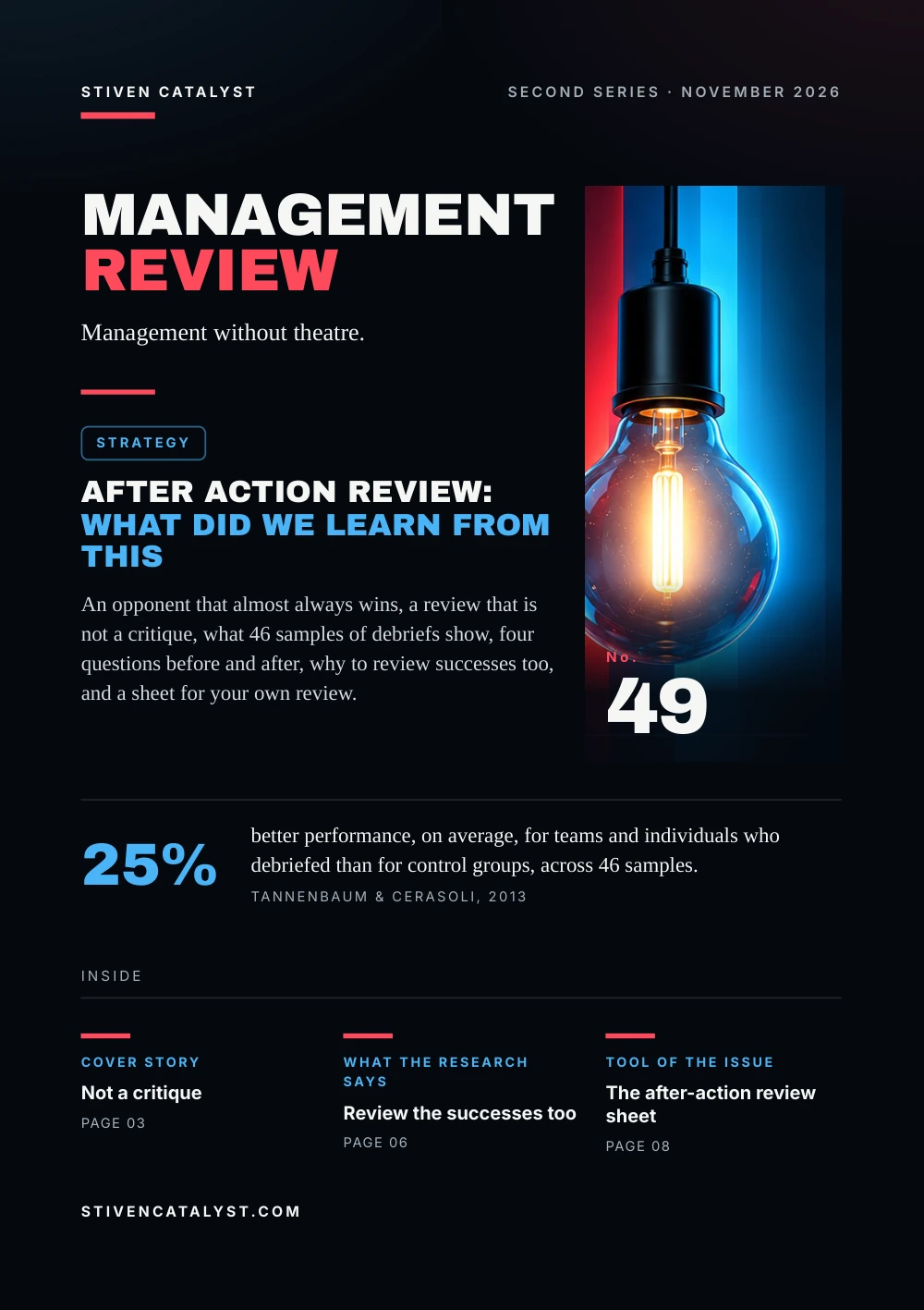
Stiven CatalystSecond series · November 2026
ManagementReview
Management without theatre.
Strategy
After Action Review:what did we learn from this
An opponent that almost always wins, a review that is not a critique, what 46 samples of debriefs show, four questions before and after, why to review successes too, and a sheet for your own review.

No.49
25%
better performance, on average, for teams and individuals who debriefed than for control groups, across 46 samples.Tannenbaum & Cerasoli, 2013
stivencatalyst.com
No. 49 · Strategy
In this issue
Most teams finish a job and go straight on to the next one. This issue is about the short meeting in between: what was supposed to happen, what did happen, why, and what changes next time.
- 03Cover storyNot a critique
- 04The numbersAbout a quarter better
- 05The modelBefore and after the action
- 06What the research saysReview the successes too
- 07How it is measuredA lesson counts when it is applied
- 08Tool of the issueThe after-action review sheet
- 09SourcesSources and method
How to read this issue
Figure
Every figure has its source and year at the foot of its page.
Our reading
Where the editors interpret rather than the research, it says so.
Practice
The steps and the card are proposals to try, not research results.
Cover story
Not acritique
In the California desert, the US Army keeps a standing Opposing Force of 2,500 soldiers. Every month a fresh brigade of more than 4,000 takes it on, with more resources and better data, and it knows the Opposing Force's methods from earlier campaigns. Yet, wrote Marilyn Darling, Charles Parry and Joseph Moore in 2005, the Opposing Force almost always wins.
The authors trace the difference to the after-action review. The Army's 1993 guide defines it as a professional discussion of an event, focused on standards, in which soldiers discover for themselves what happened, why, and how to sustain strengths and improve on weaknesses.
“An AAR is not a critique.”
01
Everyone speaks
no one, whatever their rank, has all the information or the answers
02
Open questions
“what happened when…?” rather than “why didn't you…?”
03
No grades
there are always strengths to sustain and weaknesses to improve
Our reading
A critique tells people what they did wrong. A review lets them find it themselves, which is why they remember it.
Sources: Marilyn Darling, Charles Parry & Joseph Moore, Harvard Business Review 83(7), 2005 (via PubMed abstract; CBS MoneyWatch reprint, 2008); Headquarters, Department of the Army, 1993
The Opposing Force's size and record are as the 2005 article's summary gives them. The definition and the three cards follow TC 25-20 (1993), in our words; the Army issued a newer guide in 2013 (page 5).
The numbers
About a quar terbe t ter
In 2013 Scott Tannenbaum and Christopher Cerasoli pooled 46 samples with 2,136 participants: teams and individuals, simulations and real work, medicine and other fields. On average, those who debriefed performed about 25% better than those who did not.
Average gain over the control group, by kind of debrief, 2013
The debriefs studied lasted about 18 minutes on average, and longer sessions were not more effective. In 2021 Nathanael Keiser and Winfred Arthur, across 61 studies, found an even larger average effect.
Our reading
A review does not need to be long. It needs to measure the same thing it set out to improve.
Sources: Scott I. Tannenbaum & Christopher P. Cerasoli, Human Factors 55(1), 2013; Nathanael L. Keiser & Winfred Arthur Jr., Journal of Applied Psychology 106(7), 2021 (via Abstract; QIC-WD research summary, 2021)
The percentages are the authors' conversion of the effect size (d = 0.67 overall; 0.79 in Keiser & Arthur). Only 6 samples came from real work. Many studies were not randomised, so the authors urge care about cause.
The model
Before andaf ter the action
The Army's 2013 guide gives every review the same four parts, in training and in operations. The answers to the last one name who is responsible for each change.
What was supposed to happen?
The intent, the objectives and the standard, as the plan stated them.
What happened?
From as many viewpoints as possible, until everyone shares one picture.
What was right or wrong with it?
Strong and weak points, measured against the intent and the standard.
What will we do differently next time?
The team finds its own solutions and names who makes each change.
Darling, Parry and Moore start the cycle earlier, with a before-action review of four questions: What are our intended results and metrics? What challenges do we anticipate? What have we or others learned from similar projects? What will enable us to succeed this time?
Our reading
The review before the action writes the first answer of the review after it: what was supposed to happen.
Sources: U.S. Army Combined Arms Center, Training Management Directorate, 2013; Headquarters, Department of the Army, 1993; Marilyn Darling, Charles Parry & Joseph Moore, Harvard Business Review 83(7), 2005 (via PubMed abstract; CBS MoneyWatch reprint, 2008)
The four parts follow the Army's 2013 guide, in our words; the 1993 circular follows a similar sequence. The before-action questions are quoted from Darling et al. The reading is the editors'.
What the research says
Review thesuccesses t oo
Shmuel Ellis and Inbar Davidi followed 98 soldiers of an Israeli elite unit through a navigation course. After every exercise a commander reviewed each soldier one to one, for about 14 minutes: in one company only what had gone wrong, in the other failures and successes.
Mean navigation score, three exercises in the second week, 2005
The company that also reviewed its successes improved significantly faster, though the exercises got harder each day. At first the soldiers explained failures in more detail than successes; where both were reviewed, the gap closed. In a 2021 meta-analysis, team reviews of team results worked best when the team led them.
Our reading
A success that nobody examines is a success nobody can repeat on purpose.
Sources: Shmuel Ellis & Inbar Davidi, Journal of Applied Psychology 90(5), 2005; Nathanael L. Keiser & Winfred Arthur Jr., Journal of Applied Psychology 106(7), 2021 (via Abstract; QIC-WD research summary, 2021)
A quasi-experiment: whole companies were assigned, not soldiers. The score weights points reached, pace and map use; only the second week was compared. Keiser & Arthur: abstract.
How it is measured
A lesson countswhen it is applied
After-action reviews became a popular business tool after Shell began experimenting with them in 1998, Darling and colleagues write, but most corporate reviews are a pro-forma wrap-up: lessons are drawn, and rarely learned. The Opposing Force counts a lesson as learned only once it has been applied and validated.
Changes done on time
Of the changes agreed in the fourth question, how many were made by the date set.
Repeat findings
Issues that come back in a later review: a lesson drawn, but not yet learned.
The result you reviewed
A team review is judged by the team's result, not by one person's.
Hypothetical example, a month of reviews in a warehouse
- Reviews
- 8 planned, 6 held
- Changes
- 14 agreed, 8 done by the date
- Repeats
- 3 issues already raised in an earlier review
The last line shows lessons drawn but not learned. The numbers are invented.
Sources: Marilyn Darling, Charles Parry & Joseph Moore, Harvard Business Review 83(7), 2005 (via PubMed abstract; CBS MoneyWatch reprint, 2008); Scott I. Tannenbaum & Christopher P. Cerasoli, Human Factors 55(1), 2013
Shell and the Opposing Force's rule are from Darling et al. (2005); judging a team review by the team's result follows Tannenbaum & Cerasoli. The three counts and the example are the editors'.
More in the essayWhen improvement fades
Tool of the issue
The af ter-actionreview shee t
Fill it in soon after the event, with the people who took part. Write facts, not blame, and leave no line in the last box without a person and a date.
01Event and who took partone event or phase, not a whole month
02What was supposed to happenthe goal, the plan and the standard, as they stood before
03What actually happenedthe facts, from more than one point of view
04What went well, and whywhat we keep, so we can repeat it on purpose
05What did not, and whycauses, not culprits; ask why until you reach something you can change
06What we do differently next timeeach change with an owner and a date; check it at the next review
Sources: U.S. Army Combined Arms Center, Training Management Directorate, 2013; Shmuel Ellis & Inbar Davidi, Journal of Applied Psychology 90(5), 2005; Marilyn Darling, Charles Parry & Joseph Moore, Harvard Business Review 83(7), 2005 (via PubMed abstract; CBS MoneyWatch reprint, 2008)
A practice proposed by the editors, after the Army's four questions, the review of successes and failures in Ellis & Davidi, and Darling et al.
Open the tool: 5 Whysstivencatalyst.com/tools/five-whys/
Sources and method
Every figurehas a source.
The figures in this issue come from the sources below. The year shows how recent each one is.
- Learning in the Thick of ItMarilyn Darling, Charles Parry & Joseph Moore, Harvard Business Review 83(7), 2005 · via PubMed abstract; CBS MoneyWatch reprint, 2008https://hbr.org/2005/07/learning-in-the-thick-of-it
- TC 25-20: A Leader's Guide to After-Action ReviewsHeadquarters, Department of the Army, 1993
- The Leader's Guide to After-Action Reviews (AAR)U.S. Army Combined Arms Center, Training Management Directorate, 2013
- Do Team and Individual Debriefs Enhance Performance? A Meta-AnalysisScott I. Tannenbaum & Christopher P. Cerasoli, Human Factors 55(1), 2013https://doi.org/10.1177/0018720812448394
- A meta-analysis of the effectiveness of the after-action review (or debrief) and factors that influence its effectivenessNathanael L. Keiser & Winfred Arthur Jr., Journal of Applied Psychology 106(7), 2021 · via Abstract; QIC-WD research summary, 2021https://doi.org/10.1037/apl0000821
- After-Event Reviews: Drawing Lessons From Successful and Failed ExperienceShmuel Ellis & Inbar Davidi, Journal of Applied Psychology 90(5), 2005https://doi.org/10.1037/0021-9010.90.5.857
Editorial method
Each figure was checked for its year, its publisher and what exactly it measures. Where the publisher's page could not be opened, the figure was checked against independent summaries and is marked “via”. The editors' interpretation is marked “Our reading”. Figures that could not be confirmed are not in the issue.
ManagementReview
Management without theatre.
Every issue, one management question, checked against the best research.
All issues
stivencatalyst.com/magazine/management-review.html
Management Review · No. 49 · November 2026 · Stiven Catalyst
Click or swipe a page to turn it. The arrow keys work too.
Management Review · No. 49
The figures of the issue
The charts of the printed pages, with their sources.
Source: Scott I. Tannenbaum & Christopher P. Cerasoli, Human Factors 55(1), 2013
Source: Shmuel Ellis & Inbar Davidi, Journal of Applied Psychology 90(5), 2005
The whole text Read the issue as text For reading on a small screen, searching or a screen reader. The same words, without the page design.
In this issue
Most teams finish a job and go straight on to the next one. This issue is about the short meeting in between: what was supposed to happen, what did happen, why, and what changes next time.
The US Army's Opposing Force almost always beats the brigades that come to train against it, and Marilyn Darling and colleagues traced that to its after-action reviews. The Army's 1993 guide defines the review and insists that it is not a critique. A meta-analysis of 46 samples put the average gain from debriefs at about 25%. Soldiers who reviewed their successes as well as their failures improved faster. And a lesson, in the Opposing Force's view, counts as learned only once it has been applied.
Stiven Janaqi, Editor
Cover story
Not a critique
In the California desert, the US Army keeps a standing Opposing Force of 2,500 soldiers. Every month a fresh brigade of more than 4,000 takes it on, with more resources and better data, and it knows the Opposing Force's methods from earlier campaigns. Yet, wrote Marilyn Darling, Charles Parry and Joseph Moore in 2005, the Opposing Force almost always wins.
The authors trace the difference to the after-action review. The Army's 1993 guide defines it as a professional discussion of an event, focused on standards, in which soldiers discover for themselves what happened, why, and how to sustain strengths and improve on weaknesses.
An AAR is not a critique.
- Everyone speaks. no one, whatever their rank, has all the information or the answers
- Open questions. “what happened when…?” rather than “why didn't you…?”
- No grades. there are always strengths to sustain and weaknesses to improve
Our reading
A critique tells people what they did wrong. A review lets them find it themselves, which is why they remember it.
The Opposing Force's size and record are as the 2005 article's summary gives them. The definition and the three cards follow TC 25-20 (1993), in our words; the Army issued a newer guide in 2013 (page 5).
Sources: Marilyn Darling, Charles Parry & Joseph Moore, Harvard Business Review 83(7), 2005 (via PubMed abstract; CBS MoneyWatch reprint, 2008); Headquarters, Department of the Army, 1993
The numbers
About a quar ter be t ter
In 2013 Scott Tannenbaum and Christopher Cerasoli pooled 46 samples with 2,136 participants: teams and individuals, simulations and real work, medicine and other fields. On average, those who debriefed performed about 25% better than those who did not.
Average gain over the control group, by kind of debrief, 2013: All 46 samples 25%, Team debrief, team result measured 38%, Team debrief, individual result measured 16%, In real work, not simulation 21%.
The debriefs studied lasted about 18 minutes on average, and longer sessions were not more effective. In 2021 Nathanael Keiser and Winfred Arthur, across 61 studies, found an even larger average effect.
Our reading
A review does not need to be long. It needs to measure the same thing it set out to improve.
The percentages are the authors' conversion of the effect size (d = 0.67 overall; 0.79 in Keiser & Arthur). Only 6 samples came from real work. Many studies were not randomised, so the authors urge care about cause.
Sources: Scott I. Tannenbaum & Christopher P. Cerasoli, Human Factors 55(1), 2013; Nathanael L. Keiser & Winfred Arthur Jr., Journal of Applied Psychology 106(7), 2021 (via Abstract; QIC-WD research summary, 2021)
The model
Before and af ter the action
The Army's 2013 guide gives every review the same four parts, in training and in operations. The answers to the last one name who is responsible for each change.
- What was supposed
t o happen?. The intent, the objectives and the standard, as the plan stated them. - What happened?. From as many viewpoints as possible, until everyone shares one picture.
- What was right or wrong with it?. Strong and weak points, measured against the intent and the standard.
- What will we do differently next time?. The team finds its own solutions and names who makes each change.
Darling, Parry and Moore start the cycle earlier, with a before-action review of four questions: What are our intended results and metrics? What challenges do we anticipate? What have we or others learned from similar projects? What will enable us to succeed this time?
Our reading
The review before the action writes the first answer of the review after it: what was supposed to happen.
The four parts follow the Army's 2013 guide, in our words; the 1993 circular follows a similar sequence. The before-action questions are quoted from Darling et al. The reading is the editors'.
Sources: U.S. Army Combined Arms Center, Training Management Directorate, 2013; Headquarters, Department of the Army, 1993; Marilyn Darling, Charles Parry & Joseph Moore, Harvard Business Review 83(7), 2005 (via PubMed abstract; CBS MoneyWatch reprint, 2008)
What the research says
Review the successes t oo
Shmuel Ellis and Inbar Davidi followed 98 soldiers of an Israeli elite unit through a navigation course. After every exercise a commander reviewed each soldier one to one, for about 14 minutes: in one company only what had gone wrong, in the other failures and successes.
Mean navigation score, three exercises in the second week, 2005: Successes and failures: 1st exercise 46.4, 3rd exercise 76.4; Failures only: 1st exercise 54.4, 3rd exercise 71.3.
The company that also reviewed its successes improved significantly faster, though the exercises got harder each day. At first the soldiers explained failures in more detail than successes; where both were reviewed, the gap closed. In a 2021 meta-analysis, team reviews of team results worked best when the team led them.
Our reading
A success that nobody examines is a success nobody can repeat on purpose.
A quasi-experiment: whole companies were assigned, not soldiers. The score weights points reached, pace and map use; only the second week was compared. Keiser & Arthur: abstract.
Sources: Shmuel Ellis & Inbar Davidi, Journal of Applied Psychology 90(5), 2005; Nathanael L. Keiser & Winfred Arthur Jr., Journal of Applied Psychology 106(7), 2021 (via Abstract; QIC-WD research summary, 2021)
How it is measured
A lesson counts when it is applied
After-action reviews became a popular business tool after Shell began experimenting with them in 1998, Darling and colleagues write, but most corporate reviews are a pro-forma wrap-up: lessons are drawn, and rarely learned. The Opposing Force counts a lesson as learned only once it has been applied and validated.
- Changes done on time. Of the changes agreed in the fourth question, how many were made by the date set.
- Repeat findings. Issues that come back in a later review: a lesson drawn, but not yet learned.
- The result you reviewed. A team review is judged by the team's result, not by one person's.
Hypothe tical example, a month of reviews in a warehouse
- Reviews: 8 planned, 6 held
- Changes: 14 agreed, 8 done by the date
- Repeats: 3 issues already raised in an earlier review
The last line shows lessons drawn but not learned. The numbers are invented.
Shell and the Opposing Force's rule are from Darling et al. (2005); judging a team review by the team's result follows Tannenbaum & Cerasoli. The three counts and the example are the editors'.
Sources: Marilyn Darling, Charles Parry & Joseph Moore, Harvard Business Review 83(7), 2005 (via PubMed abstract; CBS MoneyWatch reprint, 2008); Scott I. Tannenbaum & Christopher P. Cerasoli, Human Factors 55(1), 2013
More in the essay: When improvement fades
Tool of the issue
The af ter-action review shee t
Fill it in soon after the event, with the people who took part. Write facts, not blame, and leave no line in the last box without a person and a date.
- Event and who
t ook par t one event or phase, not a whole month - What was supposed
t o happen the goal, the plan and the standard, as they stood before - What actually happened the facts, from more than one point of view
- What went well, and why what we keep, so we can repeat it on purpose
- What did not, and why causes, not culprits; ask why until you reach something you can change
- What we do differently next time each change with an owner and a date; check it at the next review
A practice proposed by the editors, after the Army's four questions, the review of successes and failures in Ellis & Davidi, and Darling et al.
Sources: U.S. Army Combined Arms Center, Training Management Directorate, 2013; Shmuel Ellis & Inbar Davidi, Journal of Applied Psychology 90(5), 2005; Marilyn Darling, Charles Parry & Joseph Moore, Harvard Business Review 83(7), 2005 (via PubMed abstract; CBS MoneyWatch reprint, 2008)
Open the tool: 5 Whys
Sources and method
Every figure has a source.
The figures in this issue come from the sources below. The year shows how recent each one is.
- Marilyn Darling, Charles Parry & Joseph Moore, Harvard Business Review 83(7), “Learning in the Thick of It”, 2005 (via PubMed abstract; CBS MoneyWatch reprint, 2008). https://hbr.org/2005/07/learning-in-the-thick-of-it
- Headquarters, Department of the Army, “TC 25-20: A Leader's Guide to After-Action Reviews”, 1993.
- U.S. Army Combined Arms Center, Training Management Directorate, “The Leader's Guide to After-Action Reviews (AAR)”, 2013.
- Scott I. Tannenbaum & Christopher P. Cerasoli, Human Factors 55(1), “Do Team and Individual Debriefs Enhance Performance? A Meta-Analysis”, 2013. https://doi.org/10.1177/0018720812448394
- Nathanael L. Keiser & Winfred Arthur Jr., Journal of Applied Psychology 106(7), “A meta-analysis of the effectiveness of the after-action review (or debrief) and factors that influence its effectiveness”, 2021 (via Abstract; QIC-WD research summary, 2021). https://doi.org/10.1037/apl0000821
- Shmuel Ellis & Inbar Davidi, Journal of Applied Psychology 90(5), “After-Event Reviews: Drawing Lessons From Successful and Failed Experience”, 2005. https://doi.org/10.1037/0021-9010.90.5.857
Edit orial me thod
Each figure was checked for its year, its publisher and what exactly it measures. Where the publisher's page could not be opened, the figure was checked against independent summaries and is marked “via”. The editors' interpretation is marked “Our reading”. Figures that could not be confirmed are not in the issue.
Management Review · Monthly edition