In a 2019 Gallup study, 28% of full-time employees felt burned out very often or always. In Germany 48% often work under strong deadline or performance pressure; in Europe more than 40% report severe time pressure. The WHO counts burnout as an occupational phenomenon, not a medical condition. Gallup links it most strongly to unfair treatment, unmanageable workload, unclear roles, little support from the manager and unreasonable time pressure; Maslach and Leiter name six areas where job and person may not fit.
Management Review · Monthly edition · October 2026 · No. 29
Burnout and workload
How often people feel burned out, pressure in Germany and Europe, what the WHO counts as burnout, Gallup's five factors, six areas of worklife, and a card for a talk about workload.
- No.
- 29
- Pages
- 10
- Sources
- 8
- Topics
- People
Stiven CatalystMonthly edition · October 2026
ManagementReview
Management without theatre.
People
Burnoutand workload
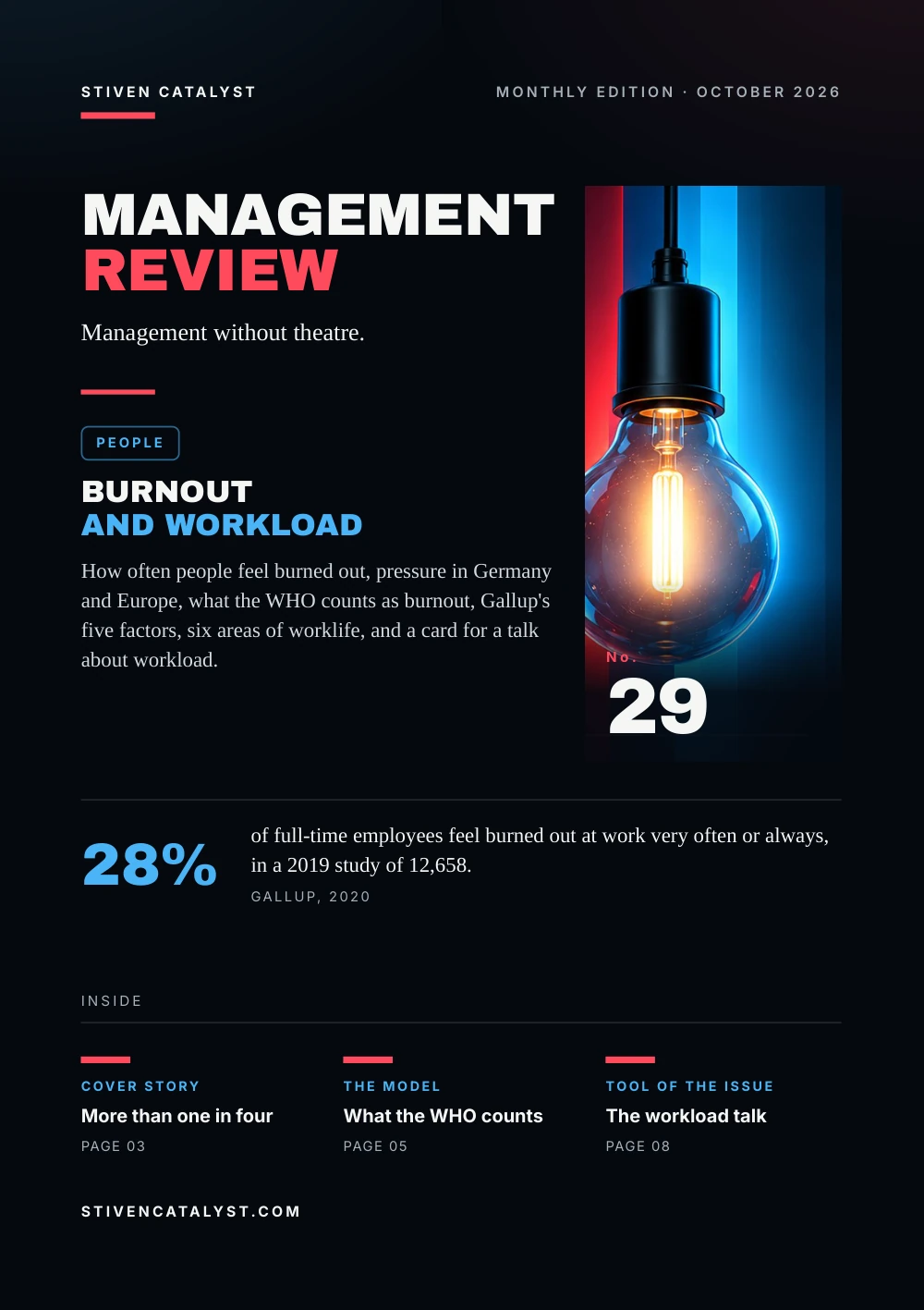
How often people feel burned out, pressure in Germany and Europe, what the WHO counts as burnout, Gallup's five factors, six areas of worklife, and a card for a talk about workload.

No.29
28%
of full-time employees feel burned out at work very often or always, in a 2019 study of 12,658.Gallup, 2020
stivencatalyst.com
No. 29 · People
In this issue
Burnout is often treated as a personal problem. The WHO places it in the job: chronic stress at work that has not been managed. This issue looks at how common it is, what goes with it, and what a manager can change in the work.
- 03Cover storyMore than one in four
- 04The numbersPressure in Germany and Europe
- 05The modelWhat the WHO counts as burnout
- 06What the research saysWhat goes with burnout
- 07How it is measuredWhere the job does not fit
- 08Tool of the issueThe workload talk
- 09SourcesSources and method
How to read this issue
Figure
Every figure has its source and year at the foot of its page.
Our reading
Where the editors interpret rather than the research, it says so.
Practice
The steps and the card are proposals to try, not research results.
Cover story
More thanone in four
In a 2019 study Gallup asked 12,658 full-time employees how often they feel burned out at work. 28% answered very often or always; 76% at least sometimes.
How often full-time employees feel burned out at work (2019)
A 2018 Gallup study of about 7,500 full-time employees found 23% very often or always, and 44% sometimes. The samples differ, so the two figures do not make a trend.
Our reading
The largest group is the 48% who answer sometimes. Burnout shows up in degrees, not only in rare cases.
Sources: Gallup, 2020; Ben Wigert & Sangeeta Agrawal, Gallup, 2018
Self-reports, not diagnoses; the texts we saw do not name the country of the samples.
The numbers
Pressure inGermany and Europe
The German BIBB/BAuA survey of 2018 asked over 20,000 employed people about their work. 48% often work under strong deadline or performance pressure, fewer than in 2006 and 2012.
Often under strong deadline or performance pressure, Germany
Of those exposed, 67% feel burdened by it, up from 65% in 2012. In spring 2025 EU-OSHA asked over 28,000 workers in the EU, Iceland, Norway and Switzerland by telephone:
> 40%report severe time pressure
≈ 1 in 3feel their efforts go unnoticed
≈ 30%report poor communication or cooperation
Sources: Bundesanstalt für Arbeitsschutz und Arbeitsmedizin (BAuA), 2020; EU-OSHA, 2025
Self-reports; the German figures are from 2018, and EU-OSHA gives only rounded values. For Albania we have no comparable data on burnout.
The model
What the WHOcounts as burnout
In May 2019 the World Health Organization included burn-out in its International Classification of Diseases, ICD-11, as an occupational phenomenon. “It is not classified as a medical condition.”
It describes a syndrome resulting from chronic workplace stress that has not been successfully managed, with three dimensions:
01
Exhaustion
feelings of energy depletion or exhaustion
02
Distance
more mental distance from one's job, or negativism or cynicism about it
03
Efficacy
reduced professional efficacy
It refers only to work and should not be used for other areas of life. In ICD-11 it has the code QD85, among problems associated with employment, in the chapter on factors influencing health status, not among the diseases. ICD-11 came into effect on 1 January 2022.
Our reading
The definition points at work, not at the person: stress at work that has not been managed. Managing the work is a manager's job; diagnosing a person is not.
Sources: World Health Organization, 2019; World Health Organization, 2025
The current ICD-11 entry words the third dimension as a sense of ineffectiveness and lack of accomplishment. This issue describes a definition and gives no medical advice.
More in the essayLeading people without losing the person
What the research says
What goeswith burnout
In 2018 Ben Wigert and Sangeeta Agrawal of Gallup named the five factors most strongly linked to burnout among about 7,500 full-time employees.
Gallup's order, 2018
- unfair treatment at work
- unmanageable workload
- lack of role clarity
- lack of communication and support from the manager
- unreasonable time pressure
2.3×as likely to report high burnout, for those often treated unfairly at work
≈ 70%less likely to feel burned out regularly, for those who feel supported by their manager
70%less likely to report high burnout, for those who often or always have enough time for all their work
Employees who felt burned out were 63% more likely to take a sick day and 2.6 times as likely to be actively looking for another job.
Our reading
All five factors are decided at work. That is where a manager can look first.
Sources: Ben Wigert & Sangeeta Agrawal, Gallup, 2018; Gallup, 2020
Associations from self-reports, not proof of cause. In 2020 Gallup put unclear communication from managers and lack of manager support in third and fourth place.
How it is measured
Where the jobdoes not fit
Christina Maslach and Michael Leiter describe six areas of worklife in which a person and the job can be mismatched. The bigger the mismatch, the more likely burnout; the better the match, the more likely engagement.
01
Workload
Can the work be done in the time there is?
02
Control
Who decides how the work is done?
03
Reward
Is the effort seen and rewarded?
04
Community
Do people help each other?
05
Fairness
Are work and decisions shared fairly?
06
Values
Does the work fit what people think is right?
A meta-analysis by Eean Crawford, Jeffery LePine and Bruce Rich found that job demands go with more burnout, and job resources with less burnout and more engagement. Demands that people see as hindrances go with less engagement; demands they see as challenges, with more.
Sources: Christina Maslach & Michael P. Leiter, World Psychiatry, 2016; Eean R. Crawford, Jeffery A. LePine & Bruce L. Rich, Journal of Applied Psychology, 2010
The questions are the editors', after the six areas. Correlations, not proof of cause; Maslach and Leiter note that few studies evaluate interventions.
Tool of the issue
The workloadtalk
Fifteen minutes, one to one, every few weeks. The talk is about the work, not about health: the manager listens, asks, and writes down one change.
01Loadwhat is on the list this week, and what could wait
02Timewhere deadlines collide, and who set them
03Decisionswhat you can decide yourself, and where you wait for others
04Fairnesswhere work or credit feels unevenly shared
05Supportwhat I can take off, decide or ask for on your behalf
06One changewhat, who, by when; look at it again next time
Sources: Ben Wigert & Sangeeta Agrawal, Gallup, 2018; Christina Maslach & Michael P. Leiter, World Psychiatry, 2016
A practice proposed by the editors, after Gallup's five factors (2018) and the six areas of worklife. It does not replace medical help.
Sources and method
Every figurehas a source.
The figures in this issue come from the sources below. The year shows how recent each one is.
- Gallup's Perspective on Employee Burnout: Causes and CuresGallup, 2020https://www.gallup.com/file/workplace/282668/Gallups%20Perspective%20on%20Employee%20Burnout%20Causes%20and%20Cures.pdf
- OSH Pulse 2025: Occupational safety and health in the era of climate and digital changeEU-OSHA, 2025https://osha.europa.eu/en/publications/osh-pulse-2025-occupational-safety-and-health-era-climate-and-digital-change
- Understanding the burnout experience: recent research and its implications for psychiatryChristina Maslach & Michael P. Leiter, World Psychiatry, 2016https://doi.org/10.1002/wps.20311
- Linking job demands and resources to employee engagement and burnout: A theoretical extension and meta-analytic testEean R. Crawford, Jeffery A. LePine & Bruce L. Rich, Journal of Applied Psychology, 2010https://doi.org/10.1037/a0019364
- Burn-out an “occupational phenomenon”: International Classification of DiseasesWorld Health Organization, 2019https://www.who.int/news/item/28-05-2019-burn-out-an-occupational-phenomenon-international-classification-of-diseases
- Stressreport Deutschland 2019Bundesanstalt für Arbeitsschutz und Arbeitsmedizin (BAuA), 2020https://www.baua.de/EN/Service/Publications/Report/Stress-report-2019
- Employee Burnout, Part 1: The 5 Main CausesBen Wigert & Sangeeta Agrawal, Gallup, 2018https://www.gallup.com/workplace/237059/employee-burnout-part-main-causes.aspx
- ICD-11 for Mortality and Morbidity Statistics (2025-01): QD85 BurnoutWorld Health Organization, 2025https://icd.who.int/browse/2025-01/mms/en#129180281
Editorial method
Each figure was checked for its year, its publisher and what exactly it measures. Where the publisher's page could not be opened, the figure was checked against independent summaries and is marked “via”. The editors' interpretation is marked “Our reading”. Figures that could not be confirmed are not in the issue.
ManagementReview
Management without theatre.
Every issue, one management question, checked against the best research.
All issues
stivencatalyst.com/magazine/management-review.html
Management Review · No. 29 · October 2026 · Stiven Catalyst
Click or swipe a page to turn it. The arrow keys work too.
Management Review · No. 29
The figures of the issue
The charts of the printed pages, with their sources.
Source: Gallup, 2020
Source: Bundesanstalt für Arbeitsschutz und Arbeitsmedizin (BAuA), 2020
The whole text Read the issue as text For reading on a small screen, searching or a screen reader. The same words, without the page design.
In this issue
Burnout is often treated as a personal problem. The WHO places it in the job: chronic stress at work that has not been managed. This issue looks at how common it is, what goes with it, and what a manager can change in the work.
In a 2019 Gallup study, 28% of full-time employees felt burned out very often or always. In Germany 48% often work under strong deadline or performance pressure; in Europe more than 40% report severe time pressure. The WHO counts burnout as an occupational phenomenon, not a medical condition. Gallup links it most strongly to unfair treatment, unmanageable workload, unclear roles, little support from the manager and unreasonable time pressure; Maslach and Leiter name six areas where job and person may not fit.
Stiven Janaqi, Editor
Cover story
More than one in four
In a 2019 study Gallup asked 12,658 full-time employees how often they feel burned out at work. 28% answered very often or always; 76% at least sometimes.
How often full-time employees feel burned out at work (2019): Always 7%, Very often 21%, Sometimes 48%, Rarely 20%, Never 4%.
A 2018 Gallup study of about 7,500 full-time employees found 23% very often or always, and 44% sometimes. The samples differ, so the two figures do not make a trend.
Our reading
The largest group is the 48% who answer sometimes. Burnout shows up in degrees, not only in rare cases.
Self-reports, not diagnoses; the texts we saw do not name the country of the samples.
Sources: Gallup, 2020; Ben Wigert & Sangeeta Agrawal, Gallup, 2018
The numbers
Pressure in Germany and Europe
The German BIBB/BAuA survey of 2018 asked over 20,000 employed people about their work. 48% often work under strong deadline or performance pressure, fewer than in 2006 and 2012.
Often under strong deadline or performance pressure, Germany: 2006 54%, 2012 52%, 2018 48%.
Of those exposed, 67% feel burdened by it, up from 65% in 2012. In spring 2025 EU-OSHA asked over 28,000 workers in the EU, Iceland, Norway and Switzerland by telephone:
- > 40% report severe time pressure
- ≈ 1 in 3 feel their efforts go unnoticed
- ≈ 30% report poor communication or cooperation
Self-reports; the German figures are from 2018, and EU-OSHA gives only rounded values. For Albania we have no comparable data on burnout.
Sources: Bundesanstalt für Arbeitsschutz und Arbeitsmedizin (BAuA), 2020; EU-OSHA, 2025
The model
What the WHO counts as burnout
In May 2019 the World Health Organization included burn-out in its International Classification of Diseases, ICD-11, as an occupational phenomenon. “It is not classified as a medical condition.”
It describes a syndrome resulting from chronic workplace stress that has not been successfully managed, with three dimensions:
- Exhaustion. feelings of energy depletion or exhaustion
- Distance. more mental distance from one's job, or negativism or cynicism about it
- Efficacy. reduced professional efficacy
It refers only to work and should not be used for other areas of life. In ICD-11 it has the code QD85, among problems associated with employment, in the chapter on factors influencing health status, not among the diseases. ICD-11 came into effect on 1 January 2022.
Our reading
The definition points at work, not at the person: stress at work that has not been managed. Managing the work is a manager's job; diagnosing a person is not.
The current ICD-11 entry words the third dimension as a sense of ineffectiveness and lack of accomplishment. This issue describes a definition and gives no medical advice.
Sources: World Health Organization, 2019; World Health Organization, 2025
More in the essay: Leading people without losing the person
What the research says
What goes with burnout
In 2018 Ben Wigert and Sangeeta Agrawal of Gallup named the five factors most strongly linked to burnout among about 7,500 full-time employees.
Gallup's order, 2018
- unfair treatment at work
- unmanageable workload
- lack of role clarity
- lack of communication and support from the manager
- unreasonable time pressure
- 2.3× as likely to report high burnout, for those often treated unfairly at work
- ≈ 70% less likely to feel burned out regularly, for those who feel supported by their manager
- 70% less likely to report high burnout, for those who often or always have enough time for all their work
Employees who felt burned out were 63% more likely to take a sick day and 2.6 times as likely to be actively looking for another job.
Our reading
All five factors are decided at work. That is where a manager can look first.
Associations from self-reports, not proof of cause. In 2020 Gallup put unclear communication from managers and lack of manager support in third and fourth place.
Sources: Ben Wigert & Sangeeta Agrawal, Gallup, 2018; Gallup, 2020
How it is measured
Where the job does not fit
Christina Maslach and Michael Leiter describe six areas of worklife in which a person and the job can be mismatched. The bigger the mismatch, the more likely burnout; the better the match, the more likely engagement.
- Workload. Can the work be done in the time there is?
- Control. Who decides how the work is done?
- Reward. Is the effort seen and rewarded?
- Communi
t y. Do people help each other? - Fairness. Are work and decisions shared fairly?
- Values. Does the work fit what people think is right?
A meta-analysis by Eean Crawford, Jeffery LePine and Bruce Rich found that job demands go with more burnout, and job resources with less burnout and more engagement. Demands that people see as hindrances go with less engagement; demands they see as challenges, with more.
The questions are the editors', after the six areas. Correlations, not proof of cause; Maslach and Leiter note that few studies evaluate interventions.
Sources: Christina Maslach & Michael P. Leiter, World Psychiatry, 2016; Eean R. Crawford, Jeffery A. LePine & Bruce L. Rich, Journal of Applied Psychology, 2010
Tool of the issue
The workload talk
Fifteen minutes, one to one, every few weeks. The talk is about the work, not about health: the manager listens, asks, and writes down one change.
- Load what is on the list this week, and what could wait
- Time where deadlines collide, and who set them
- Decisions what you can decide yourself, and where you wait for others
- Fairness where work or credit feels unevenly shared
- Suppo
r t what I can take off, decide or ask for on your behalf - One change what, who, by when; look at it again next time
A practice proposed by the editors, after Gallup's five factors (2018) and the six areas of worklife. It does not replace medical help.
Sources: Ben Wigert & Sangeeta Agrawal, Gallup, 2018; Christina Maslach & Michael P. Leiter, World Psychiatry, 2016
Sources and method
Every figure has a source.
The figures in this issue come from the sources below. The year shows how recent each one is.
- Gallup, “Gallup's Perspective on Employee Burnout: Causes and Cures”, 2020. https://www.gallup.com/file/workplace/282668/Gallups%20Perspective%20on%20Employee%20Burnout%20Causes%20and%20Cures.pdf
- EU-OSHA, “OSH Pulse 2025: Occupational safety and health in the era of climate and digital change”, 2025. https://osha.europa.eu/en/publications/osh-pulse-2025-occupational-safety-and-health-era-climate-and-digital-change
- Christina Maslach & Michael P. Leiter, World Psychiatry, “Understanding the burnout experience: recent research and its implications for psychiatry”, 2016. https://doi.org/10.1002/wps.20311
- Eean R. Crawford, Jeffery A. LePine & Bruce L. Rich, Journal of Applied Psychology, “Linking job demands and resources to employee engagement and burnout: A theoretical extension and meta-analytic test”, 2010. https://doi.org/10.1037/a0019364
- World Health Organization, “Burn-out an “occupational phenomenon”: International Classification of Diseases”, 2019. https://www.who.int/news/item/28-05-2019-burn-out-an-occupational-phenomenon-international-classification-of-diseases
- Bundesanstalt für Arbeitsschutz und Arbeitsmedizin (BAuA), “Stressreport Deutschland 2019”, 2020. https://www.baua.de/EN/Service/Publications/Report/Stress-report-2019
- Ben Wigert & Sangeeta Agrawal, Gallup, “Employee Burnout, Part 1: The 5 Main Causes”, 2018. https://www.gallup.com/workplace/237059/employee-burnout-part-main-causes.aspx
- World Health Organization, “ICD-11 for Mortality and Morbidity Statistics (2025-01): QD85 Burnout”, 2025. https://icd.who.int/browse/2025-01/mms/en#129180281
Edit orial me thod
Each figure was checked for its year, its publisher and what exactly it measures. Where the publisher's page could not be opened, the figure was checked against independent summaries and is marked “via”. The editors' interpretation is marked “Our reading”. Figures that could not be confirmed are not in the issue.
Management Review · Monthly edition