In 1956, 56 US foremen averaged one activity every 48 seconds. Decades later, 27 CEOs worked on most weekends and spent 28% of their working time alone, mostly in pieces of an hour or less. Peter Drucker's advice from 1967 still stands: record the time, prune it, then consolidate it. An experiment with quiet time was credited with a team of engineers launching on time, and John Kotter shows why some short conversations are not lost time at all.
Management Review · Second series · November 2026 · No. 47
Where the manager's week goes
A foreman's 48 seconds, the weekends and the time alone of 27 CEOs, Drucker's time log, an experiment with quiet time, the two-minute conversation, and a card for logging one week.
- No.
- 47
- Pages
- 10
- Sources
- 6
- Topics
- Role
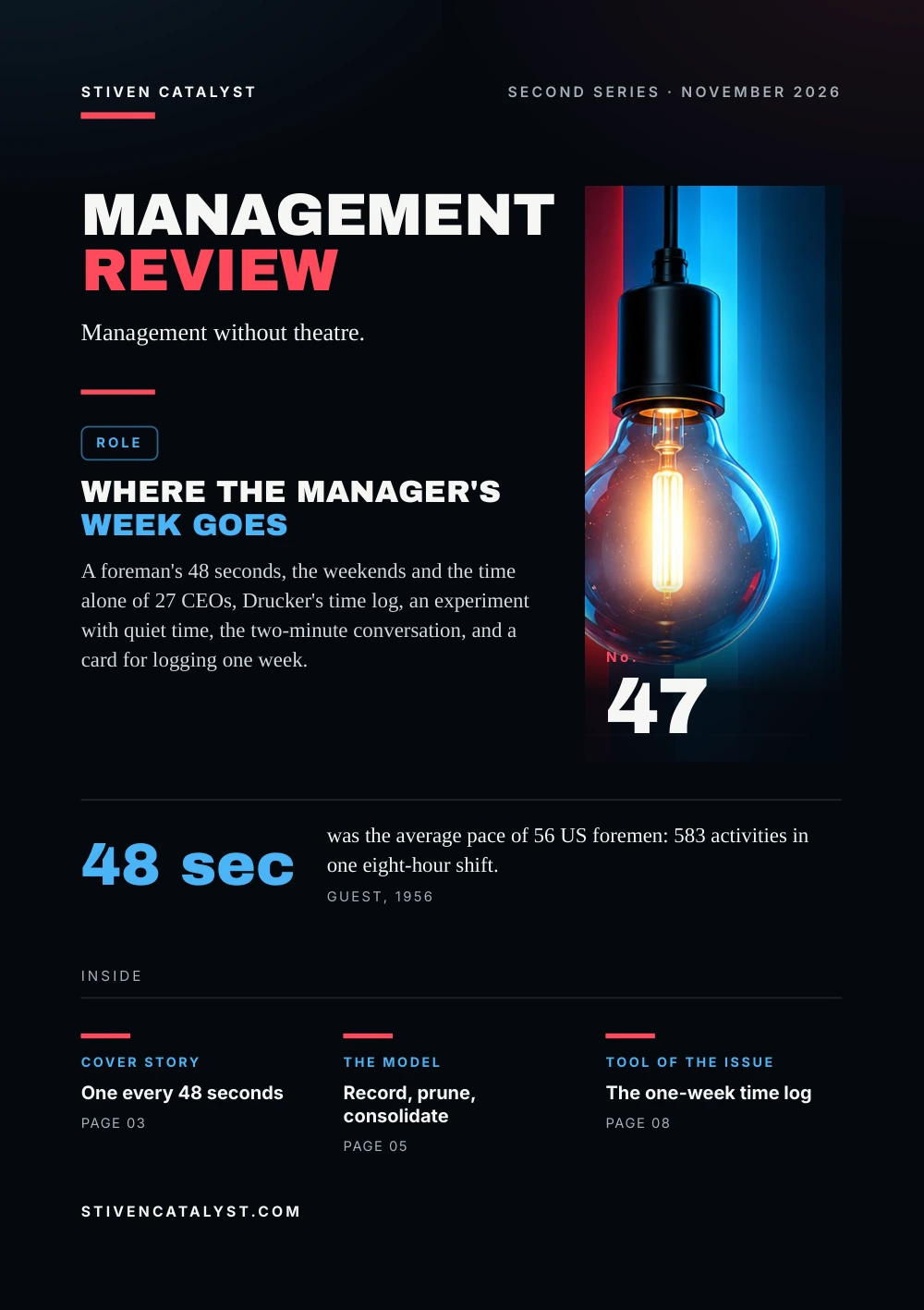
Stiven CatalystSecond series · November 2026
ManagementReview
Management without theatre.
Role
Where the manager'sweek goes
A foreman's 48 seconds, the weekends and the time alone of 27 CEOs, Drucker's time log, an experiment with quiet time, the two-minute conversation, and a card for logging one week.

No.47
48 sec
was the average pace of 56 US foremen: 583 activities in one eight-hour shift.Guest, 1956
stivencatalyst.com
No. 47 · Role
In this issue
Most managers can say where their week should go. Few can say where it went. This issue is about the difference: what the studies of managers' time have found, from the shop floor to the head office, and how to measure your own week before trying to change it.
- 03Cover storyOne every 48 seconds
- 04The numbersWeekends, and time alone
- 05The modelRecord, prune, consolidate
- 06What the research saysQuiet time, and the two-minute talk
- 07How it is measuredFifteen-minute blocks
- 08Tool of the issueThe one-week time log
- 09SourcesSources and method
How to read this issue
Figure
Every figure has its source and year at the foot of its page.
Our reading
Where the editors interpret rather than the research, it says so.
Practice
The steps and the card are proposals to try, not research results.
Cover story
One every48 seconds
In 1975 Henry Mintzberg brought together the studies that had followed managers at work, from foremen to company presidents, in the United States, Canada, Sweden and Britain. On the shop floor and at the top, the pace was the same: unrelenting.
583activities in one eight-hour shift, for 56 US foremen (Guest, 1956)
30 minwithout interruption only about once every two days, for 160 British managers (Stewart, 1967)
93%of the meetings and calls of Mintzberg's five chief executives were arranged ad hoc
His chief executives started only 32% of their own contacts. Yet the effective ones still steered their time, Mintzberg found: they used their obligations for their own ends, and turned what they wanted to do into obligations, a project others had to report on, a visit announced in public.
“Free time is made, not found.”
Our reading
A week is rarely lost in the large blocks on the calendar. It goes in the small pieces between them.
Source: Henry Mintzberg, Harvard Business Review, 1975
Old studies, each with its year: Guest observed one shift per foreman, Stewart's managers kept diaries, Mintzberg observed five chief executives for a week each. All figures as Mintzberg reports them.
The numbers
Weekends,and time alone
Michael Porter and Nitin Nohria had the assistants of 27 CEOs of large companies code their time in 15-minute blocks, around the clock, for a quarter each, and check it with the CEO. Beyond the 62.5-hour week, the data show when the work happened and how much of it was the CEO's own.
Average hours of work per day, 27 CEOs
79%of weekend days included work
70%of vacation days included work
28%of working time alone; 59% of it in blocks of an hour or less, 18% in blocks of two hours or more
Our reading
The scarce resource is not hours. It is hours in one piece.
Source: Michael E. Porter & Nitin Nohria, Harvard Business Review, 2018
Time alone ranged from 10% to 48% between CEOs. The article does not say whether the weekend and vacation averages count only the days with work. Large, mostly public companies; the study began in 2006.
The model
Record, prune,consolidate
In The Effective Executive (1967), Peter Drucker writes that effective executives do not start with their tasks; they start with their time, and first find out where it actually goes. He sets out three steps.
- 01
Record
Write down where the time goes as it happens, not afterwards from memory.
- 02
Prune
Cut what brings nothing; hand over what others can do.
- 03
Consolidate
Gather the time you control into the largest possible blocks.
Three questions for the log
- What would happen if this were not done at all?
- Which of these could someone else do just as well, if not better?
- What do I do that wastes your time? This one is for the team.
Our reading
The log comes first because memory flatters. It remembers the week we planned, not the one we had.
Source: Peter F. Drucker, Harper & Row, 1967 (via Psychology Today, 2022)
The steps and questions follow Drucker; we did not see the book itself and confirmed them in independent summaries. The reading is the editors'.
More in the essayThe Operations Manager I want to be
What the research says
Quie t time, andthe two-minute talk
Leslie Perlow spent nine months with software engineers under deadline. Of their exchanges with colleagues, they judged 96% helpful but only 10% urgent. So she set quiet time: three mornings a week without interruptions (phases 1 and 3), and a phase with fixed hours for talking (phase 2).
Engineers rating their productivity above average
The vice president credited the experiment with the product's on-time launch, the second in the division's history. Nine months after it ended, little was left, yet even two years on, managers checked up on the engineers less often. John Kotter's study of 15 general managers (1976–1981) adds the other side: a two-minute talk in the corridor can do the work of a 15–30 minute meeting, when the manager has a clear agenda and a network of relationships.
Our reading
Not every interruption is waste. The ones to move are those that could have waited.
Sources: Leslie A. Perlow, Administrative Science Quarterly, 1999 (via interruptions.net, full text); John P. Kotter, Harvard Business Review, 1982
One team, self-ratings on a 1–5 scale, no control group. The phase-2 mornings were quiet by default too.
How it is measured
Fif teen-minuteblocks
Oriana Bandiera and colleagues also cut the week of 1,114 manufacturing CEOs in six countries, Germany among them, into 15-minute blocks. Each morning they asked for the day's plan, each evening for what had happened: 50 hours a week on average.
Log as it happens
In 15-minute blocks, from the first call to the last email.
Fix the categories first
Planned or not, alone or with whom, and on what.
Compare morning and evening
What was planned, what was done, what took its place.
Count the blocks in one piece
An hour or more alone, without interruption.
Definitions decide the result. In Bandiera's study, emergencies took 4% of CEO time and just under 10% of planned activities were cancelled; Porter and Nohria counted 36% of time as reacting to unfolding issues. The questions were different.
Hypothetical example, a shift manager's week
- Logged
- 47 hours, 188 blocks
- Unplanned
- 71 blocks, 52 of which could have waited
- In one piece
- two blocks of an hour alone
The 52 blocks that could have waited are where next week's quiet morning comes from. The numbers are invented.
Sources: Oriana Bandiera, Andrea Prat, Stephen Hansen & Raffaella Sadun, Journal of Political Economy, 2020 (via LSE Research Online, accepted manuscript); Michael E. Porter & Nitin Nohria, Harvard Business Review, 2018; Peter F. Drucker, Harper & Row, 1967 (via Psychology Today, 2022)
Bandiera's data come from one week per CEO, collected by phone with the CEO or an assistant. The steps and the example are the editors'.
Tool of the issue
The one-weektime log
One card a day, for one ordinary week. Write as you go, not in the evening. On Friday, add up the blocks by category and sort them with the Pareto tool: start with the two or three that take the most time.
01This morning's planthe three things that must happen today
02The log15-minute blocks: what, with whom, planned or not
03In one pieceblocks of an hour or more alone, without interruption
04Could have waitedinterruptions that were not urgent: who, about what
05Drop or hand overwhat would happen if it were not done; who else could do it
06Next week's blockone protected block: day, hours, purpose, who knows about it
Sources: Peter F. Drucker, Harper & Row, 1967 (via Psychology Today, 2022); Michael E. Porter & Nitin Nohria, Harvard Business Review, 2018; Leslie A. Perlow, Administrative Science Quarterly, 1999 (via interruptions.net, full text)
A practice proposed by the editors, after Drucker's three steps, the 15-minute blocks of the CEO studies and Perlow's quiet time.
Open the tool: Pareto 80/20stivencatalyst.com/tools/pareto/
Sources and method
Every figurehas a source.
The figures in this issue come from the sources below. The year shows how recent each one is.
- The Manager's Job: Folklore and FactHenry Mintzberg, Harvard Business Review, 1975https://hbr.org/1990/03/the-managers-job-folklore-and-fact
- How CEOs Manage TimeMichael E. Porter & Nitin Nohria, Harvard Business Review, 2018https://hbr.org/2018/07/how-ceos-manage-time
- The Effective ExecutivePeter F. Drucker, Harper & Row, 1967 · via Psychology Today, 2022
- The Time Famine: Toward a Sociology of Work TimeLeslie A. Perlow, Administrative Science Quarterly, 1999 · via interruptions.net, full texthttps://doi.org/10.2307/2667031
- What Effective General Managers Really DoJohn P. Kotter, Harvard Business Review, 1982https://hbr.org/1999/03/what-effective-general-managers-really-do
- CEO Behavior and Firm PerformanceOriana Bandiera, Andrea Prat, Stephen Hansen & Raffaella Sadun, Journal of Political Economy, 2020 · via LSE Research Online, accepted manuscripthttps://doi.org/10.1086/705331
Editorial method
Each figure was checked for its year, its publisher and what exactly it measures. Where the publisher's page could not be opened, the figure was checked against independent summaries and is marked “via”. The editors' interpretation is marked “Our reading”. Figures that could not be confirmed are not in the issue.
ManagementReview
Management without theatre.
Every issue, one management question, checked against the best research.
All issues
stivencatalyst.com/magazine/management-review.html
Management Review · No. 47 · November 2026 · Stiven Catalyst
Click or swipe a page to turn it. The arrow keys work too.
Management Review · No. 47
The figures of the issue
The charts of the printed pages, with their sources.
Source: Michael E. Porter & Nitin Nohria, Harvard Business Review, 2018
Source: Leslie A. Perlow, Administrative Science Quarterly, 1999 (via interruptions.net, full text)
The whole text Read the issue as text For reading on a small screen, searching or a screen reader. The same words, without the page design.
In this issue
Most managers can say where their week should go. Few can say where it went. This issue is about the difference: what the studies of managers' time have found, from the shop floor to the head office, and how to measure your own week before trying to change it.
In 1956, 56 US foremen averaged one activity every 48 seconds. Decades later, 27 CEOs worked on most weekends and spent 28% of their working time alone, mostly in pieces of an hour or less. Peter Drucker's advice from 1967 still stands: record the time, prune it, then consolidate it. An experiment with quiet time was credited with a team of engineers launching on time, and John Kotter shows why some short conversations are not lost time at all.
Stiven Janaqi, Editor
Cover story
One every 48 seconds
In 1975 Henry Mintzberg brought together the studies that had followed managers at work, from foremen to company presidents, in the United States, Canada, Sweden and Britain. On the shop floor and at the top, the pace was the same: unrelenting.
- 583 activities in one eight-hour shift, for 56 US foremen (Guest, 1956)
- 30 min without interruption only about once every two days, for 160 British managers (Stewart, 1967)
- 93% of the meetings and calls of Mintzberg's five chief executives were arranged ad hoc
His chief executives started only 32% of their own contacts. Yet the effective ones still steered their time, Mintzberg found: they used their obligations for their own ends, and turned what they wanted to do into obligations, a project others had to report on, a visit announced in public.
Free time is made, not found.
Our reading
A week is rarely lost in the large blocks on the calendar. It goes in the small pieces between them.
Old studies, each with its year: Guest observed one shift per foreman, Stewart's managers kept diaries, Mintzberg observed five chief executives for a week each. All figures as Mintzberg reports them.
Source: Henry Mintzberg, Harvard Business Review, 1975
The numbers
Weekends, and time alone
Michael Porter and Nitin Nohria had the assistants of 27 CEOs of large companies code their time in 15-minute blocks, around the clock, for a quarter each, and check it with the CEO. Beyond the 62.5-hour week, the data show when the work happened and how much of it was the CEO's own.
Average hours of work per day, 27 CEOs: Weekday 9.7, Weekend day 3.9, Vacation day 2.4.
- 79% of weekend days included work
- 70% of vacation days included work
- 28% of working time alone; 59% of it in blocks of an hour or less, 18% in blocks of two hours or more
Our reading
The scarce resource is not hours. It is hours in one piece.
Time alone ranged from 10% to 48% between CEOs. The article does not say whether the weekend and vacation averages count only the days with work. Large, mostly public companies; the study began in 2006.
Source: Michael E. Porter & Nitin Nohria, Harvard Business Review, 2018
The model
Record, prune, consolidate
In The Effective Executive (1967), Peter Drucker writes that effective executives do not start with their tasks; they start with their time, and first find out where it actually goes. He sets out three steps.
- Record. Write down where the time goes as it happens, not afterwards from memory.
- Prune. Cut what brings nothing; hand over what others can do.
- Consolidate. Gather the time you control into the largest possible blocks.
Three questions for the log
- What would happen if this were not done at all?
- Which of these could someone else do just as well, if not better?
- What do I do that wastes your time? This one is for the team.
Our reading
The log comes first because memory flatters. It remembers the week we planned, not the one we had.
The steps and questions follow Drucker; we did not see the book itself and confirmed them in independent summaries. The reading is the editors'.
Source: Peter F. Drucker, Harper & Row, 1967 (via Psychology Today, 2022)
More in the essay: The Operations Manager I want to be
What the research says
Quie t time, and the two-minute talk
Leslie Perlow spent nine months with software engineers under deadline. Of their exchanges with colleagues, they judged 96% helpful but only 10% urgent. So she set quiet time: three mornings a week without interruptions (phases 1 and 3), and a phase with fixed hours for talking (phase 2).
Engineers rating their productivity above average: Phase 1 59%, Phase 2 41%, Phase 3 65%, A month on 47%.
The vice president credited the experiment with the product's on-time launch, the second in the division's history. Nine months after it ended, little was left, yet even two years on, managers checked up on the engineers less often. John Kotter's study of 15 general managers (1976–1981) adds the other side: a two-minute talk in the corridor can do the work of a 15–30 minute meeting, when the manager has a clear agenda and a network of relationships.
Our reading
Not every interruption is waste. The ones to move are those that could have waited.
One team, self-ratings on a 1–5 scale, no control group. The phase-2 mornings were quiet by default too.
Sources: Leslie A. Perlow, Administrative Science Quarterly, 1999 (via interruptions.net, full text); John P. Kotter, Harvard Business Review, 1982
How it is measured
Fif teen-minute blocks
Oriana Bandiera and colleagues also cut the week of 1,114 manufacturing CEOs in six countries, Germany among them, into 15-minute blocks. Each morning they asked for the day's plan, each evening for what had happened: 50 hours a week on average.
- Log as it happens. In 15-minute blocks, from the first call to the last email.
- Fix the categories first. Planned or not, alone or with whom, and on what.
- Compare morning and evening. What was planned, what was done, what took its place.
- Count the blocks in one piece. An hour or more alone, without interruption.
Definitions decide the result. In Bandiera's study, emergencies took 4% of CEO time and just under 10% of planned activities were cancelled; Porter and Nohria counted 36% of time as reacting to unfolding issues. The questions were different.
Hypothe tical example, a shif t manager's week
- Logged: 47 hours, 188 blocks
- Unplanned: 71 blocks, 52 of which could have waited
- In one piece: two blocks of an hour alone
The 52 blocks that could have waited are where next week's quiet morning comes from. The numbers are invented.
Bandiera's data come from one week per CEO, collected by phone with the CEO or an assistant. The steps and the example are the editors'.
Sources: Oriana Bandiera, Andrea Prat, Stephen Hansen & Raffaella Sadun, Journal of Political Economy, 2020 (via LSE Research Online, accepted manuscript); Michael E. Porter & Nitin Nohria, Harvard Business Review, 2018; Peter F. Drucker, Harper & Row, 1967 (via Psychology Today, 2022)
Tool of the issue
The one-week time log
One card a day, for one ordinary week. Write as you go, not in the evening. On Friday, add up the blocks by category and sort them with the Pareto tool: start with the two or three that take the most time.
- This morning's plan the three things that must happen today
- The log 15-minute blocks: what, with whom, planned or not
- In one piece blocks of an hour or more alone, without interruption
- Could have waited interruptions that were not urgent: who, about what
- Drop or hand over what would happen if it were not done; who else could do it
- Next week's block one protected block: day, hours, purpose, who knows about it
A practice proposed by the editors, after Drucker's three steps, the 15-minute blocks of the CEO studies and Perlow's quiet time.
Sources: Peter F. Drucker, Harper & Row, 1967 (via Psychology Today, 2022); Michael E. Porter & Nitin Nohria, Harvard Business Review, 2018; Leslie A. Perlow, Administrative Science Quarterly, 1999 (via interruptions.net, full text)
Open the tool: Pareto 80/20
Sources and method
Every figure has a source.
The figures in this issue come from the sources below. The year shows how recent each one is.
- Henry Mintzberg, Harvard Business Review, “The Manager's Job: Folklore and Fact”, 1975. https://hbr.org/1990/03/the-managers-job-folklore-and-fact
- Michael E. Porter & Nitin Nohria, Harvard Business Review, “How CEOs Manage Time”, 2018. https://hbr.org/2018/07/how-ceos-manage-time
- Peter F. Drucker, Harper & Row, “The Effective Executive”, 1967 (via Psychology Today, 2022).
- Leslie A. Perlow, Administrative Science Quarterly, “The Time Famine: Toward a Sociology of Work Time”, 1999 (via interruptions.net, full text). https://doi.org/10.2307/2667031
- John P. Kotter, Harvard Business Review, “What Effective General Managers Really Do”, 1982. https://hbr.org/1999/03/what-effective-general-managers-really-do
- Oriana Bandiera, Andrea Prat, Stephen Hansen & Raffaella Sadun, Journal of Political Economy, “CEO Behavior and Firm Performance”, 2020 (via LSE Research Online, accepted manuscript). https://doi.org/10.1086/705331
Edit orial me thod
Each figure was checked for its year, its publisher and what exactly it measures. Where the publisher's page could not be opened, the figure was checked against independent summaries and is marked “via”. The editors' interpretation is marked “Our reading”. Figures that could not be confirmed are not in the issue.
Management Review · Monthly edition