James Reason saw that blaming a person is more satisfying than fixing a system, and wanted a shared line between blameless and blameworthy acts. In the 2025 NHS Staff Survey, 86% of staff said they were encouraged to report errors, but only 59% that those involved were treated fairly. David Marx separates human error, at-risk behaviour and recklessness. A trust in Liverpool replaced culpability with repair, and Sidney Dekker asks who gets to draw the line.
Management Review · Second series · November 2026 · No. 50
Just culture: accountabilit y without fear
Reason's line between blameless and blameworthy, how many NHS staff think people involved in errors are treated fairly, Marx's three behaviours, a trust that moved from blame to repair, who draws the line, and a card for the decision after an error.
- No.
- 50
- Pages
- 10
- Sources
- 8
- Topics
- People
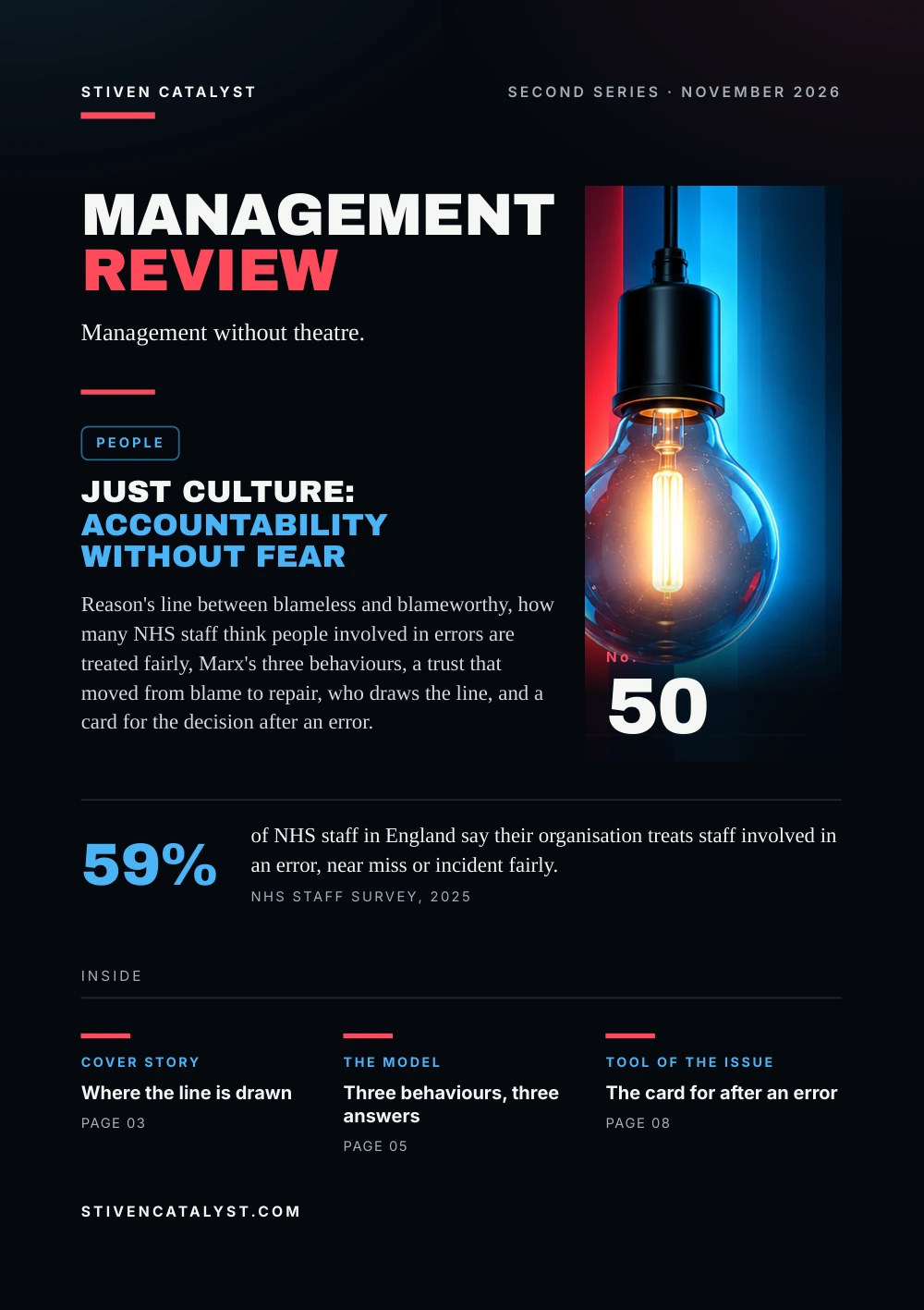
Stiven CatalystSecond series · November 2026
ManagementReview
Management without theatre.
People
Just culture:accountability without fear
Reason's line between blameless and blameworthy, how many NHS staff think people involved in errors are treated fairly, Marx's three behaviours, a trust that moved from blame to repair, who draws the line, and a card for the decision after an error.

No.50
59%
of NHS staff in England say their organisation treats staff involved in an error, near miss or incident fairly.NHS Staff Survey, 2025
stivencatalyst.com
No. 50 · People
In this issue
When something goes wrong, a team quickly learns what is safer: to speak up or to keep quiet. This issue is about drawing the line between an honest mistake and behaviour that deserves a consequence, so that people keep reporting and are still held to account.
- 03Cover storyWhere the line is drawn
- 04The numbersEncouraged to report, not sure it is safe
- 05The modelThree behaviours, three answers
- 06What the research saysNot who is to blame, but who was hurt
- 07How it is measuredWho draws the line
- 08Tool of the issueThe card for after an error
- 09SourcesSources and method
How to read this issue
Figure
Every figure has its source and year at the foot of its page.
Our reading
Where the editors interpret rather than the research, it says so.
Practice
The steps and the card are proposals to try, not research results.
Cover story
Where the lineis drawn
In 2000 the psychologist James Reason described two ways of looking at human error in the BMJ. The person approach looks for the forgetful, inattentive or careless individual. The system approach treats errors as consequences rather than causes, and asks how and why the defences failed.
The person approach
- Who made the mistake?
- Posters, retraining, discipline
- Naming, blaming and shaming
The system approach
- How and why did the defences fail?
- Change the conditions of the work
- Find the weak spots before they line up
Reason knew which one comes easier: “Blaming individuals is emotionally more satisfying than targeting institutions.” Yet learning needs reports, reports need trust, and trust needs a shared understanding of where the line runs between blameless and blameworthy acts. In aviation maintenance, he noted, some 90% of quality lapses were judged blameless.
Our reading
A rule about blame is also a rule about information: whatever gets punished stops being reported.
Sources: James Reason, BMJ 320(7237), 2000; James Reason, Ashgate, 1997 (via ISMP Canada, Hospital News, April 2007; ANA, 2010)
An essay, not a new study; the 90% comes from a 1997 paper by David Marx that we did not see. Reason's book of 1997 already called a just culture an atmosphere of trust with a clear line.
The numbers
Encouraged t o repor t,not sure it is safe
Every year the NHS Staff Survey asks the staff of all trusts in England about errors, near misses and incidents. In autumn 2025, 766,285 people answered, a response rate of 49%. The share who agree:
NHS staff in England who agree, 2025
A third of staff (33.7%) had seen an error, near miss or incident in the last month that could have hurt staff or patients. The share who say those involved are treated fairly has hardly moved: 58.2% in 2022, 59.3% in 2025.
Our reading
Asking for reports is the easy step. Whether people keep reporting depends on what happens next, to the person and to the problem.
Source: Survey Coordination Centre for NHS England, 2026
“Agree” or “strongly agree”, weighted results for the 206 NHS trusts. Self-reports from one health system; for Albania and for other sectors we found no comparable figure.
The model
Three behaviours,three answers
In 2001 David Marx wrote a primer on just culture for hospital executives, from a lawyer's point of view. Judge the behaviour and the risk it carried, he argues, more than the outcome. In his model, as the American Nurses Association summed it up in 2010, each kind of behaviour calls for a different answer.
01
Human error: console
unintentionally doing other than what should have been done; then look at process, training and design
02
At-risk: coach
a choice whose risk was not seen, or was wrongly thought justified; remove the reward for the shortcut
03
Reckless: sanction
conscious disregard of a substantial and unjustifiable risk; remedial or punitive action
EU law draws a similar line for aviation. Regulation 376/2014, applied since November 2015, defines just culture as one where front-line staff are not punished for actions, omissions or decisions in line with their experience and training, but where gross negligence, wilful violations and destructive acts are not tolerated.
Our reading
Most hard cases sit in the middle box: the shortcut everyone takes because the official way is slower.
Sources: David Marx, Trustees of Columbia University, 2001 (via AHRQ PSNet; American Nurses Association, Just Culture position statement, 2010); European Parliament and Council of the EU, 2014
The three behaviours and answers follow the ANA's summary, which credits them to Marx; we did not see the primer, which AHRQ's summary organises around four concepts. The reading is the editors'.
More in the essayHow to talk to someone who made a mistake
What the research says
Not who is t o blame,but who was hur t
In 2016 Mersey Care, an NHS mental health and community trust in the Liverpool region with about 8,000 staff, changed how it responds to incidents. Instead of asking how culpable an error was and what consequence fits, it asked: who is hurt, what do they need, and whose obligation is it to meet those needs?
Disciplinary and suspension cases, two operational units
Over the same years, reports of adverse events rose by 7% to 18% a year, and requests for face-to-face counselling went from an average of 283 to 378 a year. The authors put the economic benefit at about £2.5 million, around 1% of total costs, after crediting only half of the savings they found to the new culture.
Our reading
Fewer cases alone proves little. More reports together with fewer suspensions is the pattern worth looking for.
Source: Mannat Kaur, Robert J. de Boer, Amanda Oates, Joe Rafferty & Sidney Dekker, MATEC Web of Conferences 273, 2019
One trust, before and after (April 2014 to March 2018): the authors say the changes coincided with the new culture, not that it caused them. Two of the five authors worked at Mersey Care.
How it is measured
Who drawsthe line
Sidney Dekker's Just Culture (2007) asks when an honest mistake stops being honest, and then moves the question. In the words of the book's description:
“What matters is not where the line goes, but who gets to draw it.”
We are encouraged to report
Count reports per month, near misses included.
Those involved are treated fairly
Note what happened to the person after each report.
Action is taken
Count reports closed with a change, not only an answer.
We hear what changed
Days from the report to feedback for the person who made it.
Hypothetical example, a quarter in a parcel depot
- Reports
- 31, of them 12 near misses
- Changes
- 9 closed with a change
- Feedback
- on 5 of the 9, after 19 days on average
The reports came; the answers were slow. The numbers are invented.
Sources: Sidney Dekker, Ashgate, 2007 (via Publisher's description); Survey Coordination Centre for NHS England, 2026
The four statements follow questions 19a–d of the NHS Staff Survey; the counts and the example are the editors'. Dekker's sentence is from the publisher's description; the translations are ours.
Tool of the issue
The card foraf ter an error
One card for each person involved, filled in before anyone decides on a consequence. The first lines are about the work and the system; only the last ones are about the person.
01What happenedfacts, times and places; no labels
02Intended or impaired?harm meant, or signs of illness or substances? Then another procedure applies
03The rulewas there a procedure; was it available, workable and in routine use?
04A peer in the same placewould someone with the same training and experience have done the same?
05Behaviour and answerhuman error: console · at-risk: coach · reckless: sanction
06System change and feedbackwhat changes, who owns it, by when; when the reporter hears
Sources: National Patient Safety Agency (England), 2003 (via Flowchart reproduced in an NHS trust's investigation guidelines, Thirlwall Inquiry evidence INQ0003324); David Marx, Trustees of Columbia University, 2001 (via AHRQ PSNet; American Nurses Association, Just Culture position statement, 2010)
A practice proposed by the editors, after the four tests of the NPSA Incident Decision Tree, based on Reason's culpability model, and Marx's three behaviours. It does not replace an investigation or HR procedures.
Open the tool: 5 Whysstivencatalyst.com/tools/five-whys/
Sources and method
Every figurehas a source.
The figures in this issue come from the sources below. The year shows how recent each one is.
- Human error: models and managementJames Reason, BMJ 320(7237), 2000https://doi.org/10.1136/bmj.320.7237.768
- Managing the Risks of Organizational AccidentsJames Reason, Ashgate, 1997 · via ISMP Canada, Hospital News, April 2007; ANA, 2010https://www.ismp-canada.org/download/hnews/HNews0704.pdf
- 2025 NHS Staff Survey: National results briefingSurvey Coordination Centre for NHS England, 2026https://www.nhsstaffsurveys.com/results/national-results/
- Patient Safety and the "Just Culture": A Primer for Health Care ExecutivesDavid Marx, Trustees of Columbia University, 2001 · via AHRQ PSNet; American Nurses Association, Just Culture position statement, 2010https://psnet.ahrq.gov/issue/patient-safety-and-just-culture-primer-health-care-executives
- Regulation (EU) No 376/2014 on the reporting, analysis and follow-up of occurrences in civil aviationEuropean Parliament and Council of the EU, 2014https://eur-lex.europa.eu/eli/reg/2014/376/oj
- Restorative Just Culture: a Study of the Practical and Economic Effects of Implementing Restorative Justice in an NHS TrustMannat Kaur, Robert J. de Boer, Amanda Oates, Joe Rafferty & Sidney Dekker, MATEC Web of Conferences 273, 2019https://doi.org/10.1051/matecconf/201927301007
- Just Culture: Balancing Safety and AccountabilitySidney Dekker, Ashgate, 2007 · via Publisher's description
- Incident Decision TreeNational Patient Safety Agency (England), 2003 · via Flowchart reproduced in an NHS trust's investigation guidelines, Thirlwall Inquiry evidence INQ0003324https://thirlwall.public-inquiry.uk/wp-content/uploads/thirlwall-evidence/INQ0003324_15-16.pdf
Editorial method
Each figure was checked for its year, its publisher and what exactly it measures. Where the publisher's page could not be opened, the figure was checked against independent summaries and is marked “via”. The editors' interpretation is marked “Our reading”. Figures that could not be confirmed are not in the issue.
ManagementReview
Management without theatre.
Every issue, one management question, checked against the best research.
All issues
stivencatalyst.com/magazine/management-review.html
Management Review · No. 50 · November 2026 · Stiven Catalyst
Click or swipe a page to turn it. The arrow keys work too.
Management Review · No. 50
The figures of the issue
The charts of the printed pages, with their sources.
Source: Survey Coordination Centre for NHS England, 2026
Source: Mannat Kaur, Robert J. de Boer, Amanda Oates, Joe Rafferty & Sidney Dekker, MATEC Web of Conferences 273, 2019
The whole text Read the issue as text For reading on a small screen, searching or a screen reader. The same words, without the page design.
In this issue
When something goes wrong, a team quickly learns what is safer: to speak up or to keep quiet. This issue is about drawing the line between an honest mistake and behaviour that deserves a consequence, so that people keep reporting and are still held to account.
James Reason saw that blaming a person is more satisfying than fixing a system, and wanted a shared line between blameless and blameworthy acts. In the 2025 NHS Staff Survey, 86% of staff said they were encouraged to report errors, but only 59% that those involved were treated fairly. David Marx separates human error, at-risk behaviour and recklessness. A trust in Liverpool replaced culpability with repair, and Sidney Dekker asks who gets to draw the line.
Stiven Janaqi, Editor
Cover story
Where the line is drawn
In 2000 the psychologist James Reason described two ways of looking at human error in the BMJ. The person approach looks for the forgetful, inattentive or careless individual. The system approach treats errors as consequences rather than causes, and asks how and why the defences failed.
The person approach
- Who made the mistake?
- Posters, retraining, discipline
- Naming, blaming and shaming
The system approach
- How and why did the defences fail?
- Change the conditions of the work
- Find the weak spots before they line up
Reason knew which one comes easier: “Blaming individuals is emotionally more satisfying than targeting institutions.” Yet learning needs reports, reports need trust, and trust needs a shared understanding of where the line runs between blameless and blameworthy acts. In aviation maintenance, he noted, some 90% of quality lapses were judged blameless.
Our reading
A rule about blame is also a rule about information: whatever gets punished stops being reported.
An essay, not a new study; the 90% comes from a 1997 paper by David Marx that we did not see. Reason's book of 1997 already called a just culture an atmosphere of trust with a clear line.
Sources: James Reason, BMJ 320(7237), 2000; James Reason, Ashgate, 1997 (via ISMP Canada, Hospital News, April 2007; ANA, 2010)
The numbers
Encouraged t o repor t, not sure it is safe
Every year the NHS Staff Survey asks the staff of all trusts in England about errors, near misses and incidents. In autumn 2025, 766,285 people answered, a response rate of 49%. The share who agree:
NHS staff in England who agree, 2025: We are encouraged to report errors 86.2%, Action is taken so they do not recur 67.3%, We hear about the changes made 61.0%, Those involved are treated fairly 59.3%.
A third of staff (33.7%) had seen an error, near miss or incident in the last month that could have hurt staff or patients. The share who say those involved are treated fairly has hardly moved: 58.2% in 2022, 59.3% in 2025.
Our reading
Asking for reports is the easy step. Whether people keep reporting depends on what happens next, to the person and to the problem.
“Agree” or “strongly agree”, weighted results for the 206 NHS trusts. Self-reports from one health system; for Albania and for other sectors we found no comparable figure.
Source: Survey Coordination Centre for NHS England, 2026
The model
Three behaviours, three answers
In 2001 David Marx wrote a primer on just culture for hospital executives, from a lawyer's point of view. Judge the behaviour and the risk it carried, he argues, more than the outcome. In his model, as the American Nurses Association summed it up in 2010, each kind of behaviour calls for a different answer.
- Human error: console. unintentionally doing other than what should have been done; then look at process, training and design
- At-risk: coach. a choice whose risk was not seen, or was wrongly thought justified; remove the reward for the shortcut
- Reckless: sanction. conscious disregard of a substantial and unjustifiable risk; remedial or punitive action
EU law draws a similar line for aviation. Regulation 376/2014, applied since November 2015, defines just culture as one where front-line staff are not punished for actions, omissions or decisions in line with their experience and training, but where gross negligence, wilful violations and destructive acts are not tolerated.
Our reading
Most hard cases sit in the middle box: the shortcut everyone takes because the official way is slower.
The three behaviours and answers follow the ANA's summary, which credits them to Marx; we did not see the primer, which AHRQ's summary organises around four concepts. The reading is the editors'.
Sources: David Marx, Trustees of Columbia University, 2001 (via AHRQ PSNet; American Nurses Association, Just Culture position statement, 2010); European Parliament and Council of the EU, 2014
More in the essay: How to talk to someone who made a mistake
What the research says
Not who is t o blame, but who was hur t
In 2016 Mersey Care, an NHS mental health and community trust in the Liverpool region with about 8,000 staff, changed how it responds to incidents. Instead of asking how culpable an error was and what consequence fits, it asked: who is hurt, what do they need, and whose obligation is it to meet those needs?
Disciplinary and suspension cases, two operational units: Before 66, After 37.
Over the same years, reports of adverse events rose by 7% to 18% a year, and requests for face-to-face counselling went from an average of 283 to 378 a year. The authors put the economic benefit at about £2.5 million, around 1% of total costs, after crediting only half of the savings they found to the new culture.
Our reading
Fewer cases alone proves little. More reports together with fewer suspensions is the pattern worth looking for.
One trust, before and after (April 2014 to March 2018): the authors say the changes coincided with the new culture, not that it caused them. Two of the five authors worked at Mersey Care.
Source: Mannat Kaur, Robert J. de Boer, Amanda Oates, Joe Rafferty & Sidney Dekker, MATEC Web of Conferences 273, 2019
How it is measured
Who draws the line
Sidney Dekker's Just Culture (2007) asks when an honest mistake stops being honest, and then moves the question. In the words of the book's description:
What matters is not where the line goes, but who gets to draw it.
- We are encouraged
t o repor t. Count reports per month, near misses included. - Those involved are treated fairly. Note what happened to the person after each report.
- Action is taken. Count reports closed with a change, not only an answer.
- We hear what changed. Days from the report to feedback for the person who made it.
Hypothe tical example, a quar ter in a parcel depot
- Repo
r ts: 31, of them 12 near misses - Changes: 9 closed with a change
- Feedback: on 5 of the 9, after 19 days on average
The reports came; the answers were slow. The numbers are invented.
The four statements follow questions 19a–d of the NHS Staff Survey; the counts and the example are the editors'. Dekker's sentence is from the publisher's description; the translations are ours.
Sources: Sidney Dekker, Ashgate, 2007 (via Publisher's description); Survey Coordination Centre for NHS England, 2026
Tool of the issue
The card for af ter an error
One card for each person involved, filled in before anyone decides on a consequence. The first lines are about the work and the system; only the last ones are about the person.
- What happened facts, times and places; no labels
- Intended or impaired? harm meant, or signs of illness or substances? Then another procedure applies
- The rule was there a procedure; was it available, workable and in routine use?
- A peer in the same place would someone with the same training and experience have done the same?
- Behaviour and answer human error: console · at-risk: coach · reckless: sanction
- System change and feedback what changes, who owns it, by when; when the reporter hears
A practice proposed by the editors, after the four tests of the NPSA Incident Decision Tree, based on Reason's culpability model, and Marx's three behaviours. It does not replace an investigation or HR procedures.
Sources: National Patient Safety Agency (England), 2003 (via Flowchart reproduced in an NHS trust's investigation guidelines, Thirlwall Inquiry evidence INQ0003324); David Marx, Trustees of Columbia University, 2001 (via AHRQ PSNet; American Nurses Association, Just Culture position statement, 2010)
Open the tool: 5 Whys
Sources and method
Every figure has a source.
The figures in this issue come from the sources below. The year shows how recent each one is.
- James Reason, BMJ 320(7237), “Human error: models and management”, 2000. https://doi.org/10.1136/bmj.320.7237.768
- James Reason, Ashgate, “Managing the Risks of Organizational Accidents”, 1997 (via ISMP Canada, Hospital News, April 2007; ANA, 2010). https://www.ismp-canada.org/download/hnews/HNews0704.pdf
- Survey Coordination Centre for NHS England, “2025 NHS Staff Survey: National results briefing”, 2026. https://www.nhsstaffsurveys.com/results/national-results/
- David Marx, Trustees of Columbia University, “Patient Safety and the "Just Culture": A Primer for Health Care Executives”, 2001 (via AHRQ PSNet; American Nurses Association, Just Culture position statement, 2010). https://psnet.ahrq.gov/issue/patient-safety-and-just-culture-primer-health-care-executives
- European Parliament and Council of the EU, “Regulation (EU) No 376/2014 on the reporting, analysis and follow-up of occurrences in civil aviation”, 2014. https://eur-lex.europa.eu/eli/reg/2014/376/oj
- Mannat Kaur, Robert J. de Boer, Amanda Oates, Joe Rafferty & Sidney Dekker, MATEC Web of Conferences 273, “Restorative Just Culture: a Study of the Practical and Economic Effects of Implementing Restorative Justice in an NHS Trust”, 2019. https://doi.org/10.1051/matecconf/201927301007
- Sidney Dekker, Ashgate, “Just Culture: Balancing Safety and Accountability”, 2007 (via Publisher's description).
- National Patient Safety Agency (England), “Incident Decision Tree”, 2003 (via Flowchart reproduced in an NHS trust's investigation guidelines, Thirlwall Inquiry evidence INQ0003324). https://thirlwall.public-inquiry.uk/wp-content/uploads/thirlwall-evidence/INQ0003324_15-16.pdf
Edit orial me thod
Each figure was checked for its year, its publisher and what exactly it measures. Where the publisher's page could not be opened, the figure was checked against independent summaries and is marked “via”. The editors' interpretation is marked “Our reading”. Figures that could not be confirmed are not in the issue.
Management Review · Monthly edition