Taiichi Ohno made his students stand in a circle on the shop floor and watch. Jim Womack turned the habit into a walk along a whole value stream, with three questions. In 44 neonatal units, almost half the staff were not sure whether their leaders walked at all. In a randomised study in US hospitals, walking around on average made things worse, unless the problems it found were solved. David Mann's four questions show what to ask on the way.
Management Review · First series · October 2026 · No. 40
Gemba: management where the work happens
Ohno's circle on the floor, what staff notice of leaders' walks, Womack's purpose, process and people, a randomised study of walking around, Mann's four questions, and a card for your own walk.
- No.
- 40
- Pages
- 10
- Sources
- 8
- Topics
- Operations
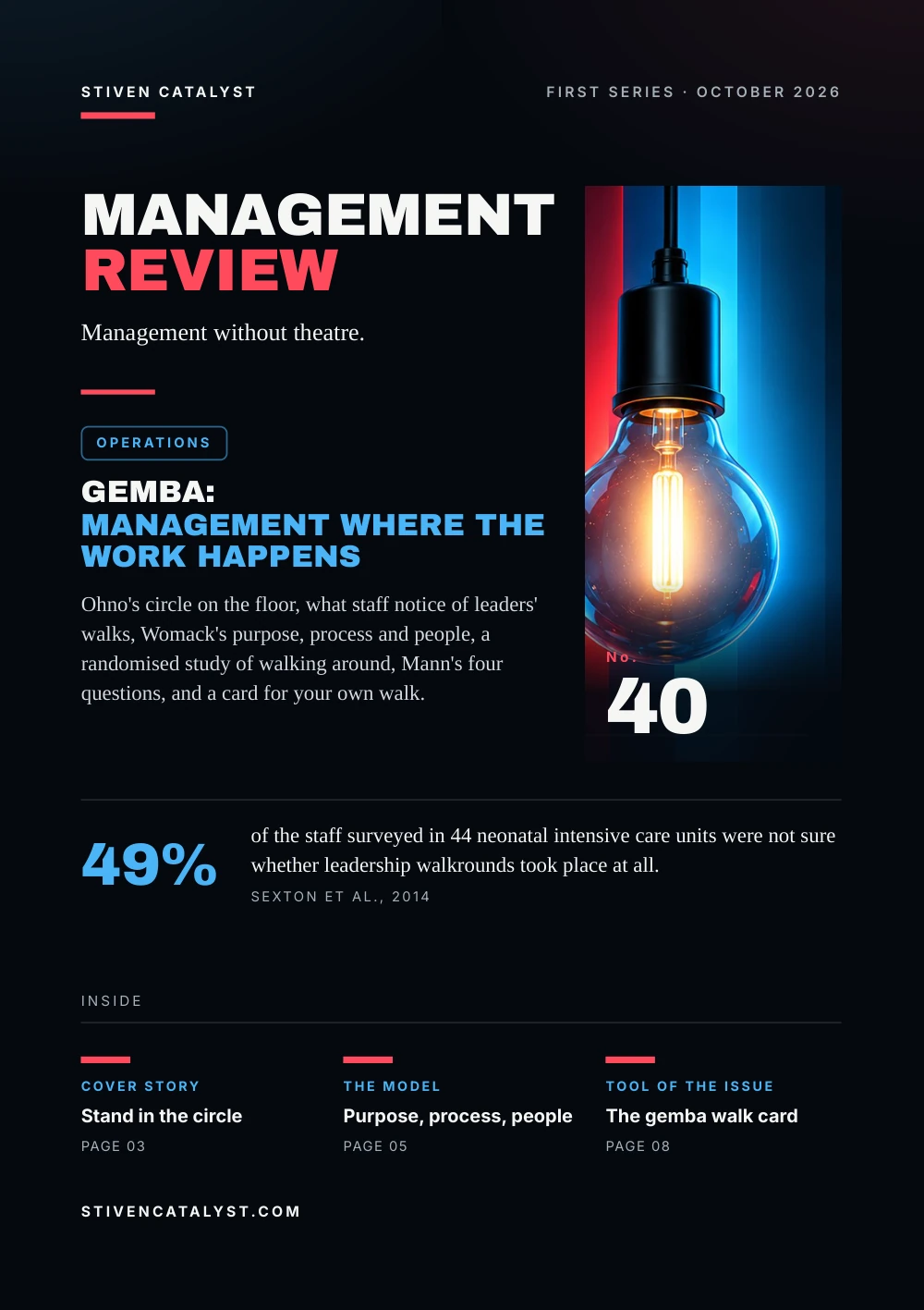
Stiven CatalystFirst series · October 2026
ManagementReview
Management without theatre.
Operations
Gemba:management where the work happens
Ohno's circle on the floor, what staff notice of leaders' walks, Womack's purpose, process and people, a randomised study of walking around, Mann's four questions, and a card for your own walk.

No.40
49%
of the staff surveyed in 44 neonatal intensive care units were not sure whether leadership walkrounds took place at all.Sexton et al., 2014
stivencatalyst.com
No. 40 · Operations
In this issue
A report says what happened. It rarely says how. This issue is about going to the place where the work is done, the gemba, and about what a manager looks for there, asks there, and does afterwards.
- 03Cover storyStand in the circle
- 04The numbersWho notices the walk
- 05The modelPurpose, process, people
- 06What the research saysWhen walking makes it worse
- 07How it is measuredFour questions, one count
- 08Tool of the issueThe gemba walk card
- 09SourcesSources and method
How to read this issue
Figure
Every figure has its source and year at the foot of its page.
Our reading
Where the editors interpret rather than the research, it says so.
Practice
The steps and the card are proposals to try, not research results.
Cover story
Stand inthe circle
According to Teruyuki Minoura, one of his students who later headed Toyota's manufacturing in North America, Taiichi Ohno would take his students to a problem area and draw a circle on the floor, where they were to observe, think and analyse.
“He wanted us to watch and ask 'why' over and over again.”
01
Gemba
“actual place”: where value is created, a shop floor, a ward, a kitchen, a loading ramp
02
Genchi genbutsu
real place, real thing: go and see the facts for yourself
03
Gemba walk
grasping the situation by watching and asking, before taking action
Our reading
The circle is not about standing still. It is about looking long enough to stop seeing what you expected to see.
Sources: John Teresko, IndustryWeek, 2004; Lean Enterprise Institute, 2014
The circle is known from the accounts of Ohno's students; how long they stood in it varies from one telling to another, so we give no figure. The three terms follow the Lean Enterprise Institute's lexicon.
The numbers
Who noticesthe walk
In leadership walkrounds, senior leaders visit frontline staff to talk about safety. J. Bryan Sexton and colleagues asked staff in 44 US neonatal intensive care units about them; 2,073 of 3,294 answered (62.9%).
Staff in 44 neonatal intensive care units, 2014
Units where more staff heard back about what the walkrounds had changed rated their safety culture better and tended to report less burnout. In the adult clinical areas used for comparison, 27.6% had taken part.
Our reading
A walk the team never hears about again is, for the team, a walk that did not happen.
Source: J. Bryan Sexton et al., BMJ Quality & Safety, 2014
Participation and feedback are averages of the units; 49.1% is the share of all who answered. A survey at one point in time: it shows an association, not a cause.
The model
Purpose, process,people
Jim Womack, founder of the Lean Enterprise Institute, collected a decade of his walks in Gemba Walks (2011). Value flows across a company, he argues, while the company is organised in vertical departments. So walk one value stream from end to end, together with everyone who touches it.
01
Purpose
What problem does this process solve for the customer?
02
Process
How does it actually work, step by step?
03
People
Are they engaged in creating, sustaining and improving it?
In the foreword to the book, John Shook recalls how Toyota's chairman Fujio Cho summed up what lean leaders do: go see, ask why, show respect. Womack himself told an audience in 2011 that value is always created at the bottom.
Our reading
Walking alone shows you a department. Walking together shows the handovers between departments, where problems usually wait.
Sources: James P. Womack, Lean Enterprise Institute, 2011 (via Lean Enterprise Institute, press release and excerpt); Jill Jusko, IndustryWeek, 2011; Lean Enterprise Institute, 2014
The three questions follow the Lean Enterprise Institute's lexicon; Cho's words are quoted by Shook. The reading is the editors'.
More in the essayKPIs do not improve in Excel
What the research says
When walkingmakes it worse
Anita Tucker and Sara Singer tested management by walking around in US hospitals chosen at random. For 18 months, senior managers observed frontline work, asked for ideas and worked with staff on the problems. 56 work areas took part; 138 in control hospitals did not.
Problems per work area, on average
On average the programme lowered the staff's rating of improvement compared with the control areas. It worked better where teams took on problems they could solve within 30 days, and where a senior manager was made responsible for seeing a problem resolved. In some of the areas that fell furthest, the time went into ranking problems, and none were solved.
Our reading
Being seen on the floor is not the point. A walk pays only when what it finds gets fixed.
Source: Anita L. Tucker & Sara J. Singer, Production and Operations Management, 2015 (via Harvard Business School, Working Paper 12-113, 2013)
Improvement was rated by nurses on a 1–5 scale, before (2004) and after (2006). The counts per work area come from the 2013 working paper; the published article (2015) reports the same design and findings.
How it is measured
Four questions,one count
David Mann, who wrote Creating a Lean Culture, treats the gemba walk as a repeatable part of a leader's standard work, not a box-checking exercise. He suggests opening with: “I'm really here as a student, and you all are the teachers.” Then four questions:
What's the process here?
Ask to be shown, not told.
How can you tell it's working?
A board, a count or a signal you can see from where you stand.
What do you do when it's not working?
Listen for a way to raise it, not a workaround.
Is there work going on to improve it?
Ask for the last change and who proposed it.
Hypothetical example, a month of walks in a dispatch area
- Walks
- 8 planned, 7 held
- Problems
- 14 found, 9 closed within 30 days
- Feedback
- the team was told about 4 of the 9
The gap is in the last line: the fixes happened, but the team hardly heard of them. The numbers are invented.
Sources: Mark Graban, Lean Blog Podcast #212, 2014; David Mann, Productivity Press, 2005; Anita L. Tucker & Sara J. Singer, Production and Operations Management, 2015 (via Harvard Business School, Working Paper 12-113, 2013); J. Bryan Sexton et al., BMJ Quality & Safety, 2014
The questions and the opening line are Mann's, from a 2014 interview; the hints under them and the example are the editors'. Counting what is closed and told back follows Tucker & Singer and Sexton et al.
Tool of the issue
The gembawalk card
One walk, one process. Write down what you saw, not who did it, and before you leave, set the date when you will come back with an answer.
01Process and placewhich value stream, where it starts and ends
02Purposewhat problem it solves for the customer
03What I sawfacts and places, not opinions or names
04What they do when it failsin the words of the people who do the work
05Problems I take with mewhich can be solved within 30 days; who owns each one
06Told backwhen and how the team hears what changed
Sources: Lean Enterprise Institute, 2014; Mark Graban, Lean Blog Podcast #212, 2014; Anita L. Tucker & Sara J. Singer, Production and Operations Management, 2015 (via Harvard Business School, Working Paper 12-113, 2013)
A practice proposed by the editors, after Womack's three questions, Mann's questions and the findings of Tucker & Singer.
Open the tool: 5 Whysstivencatalyst.com/tools/five-whys/
Sources and method
Every figurehas a source.
The figures in this issue come from the sources below. The year shows how recent each one is.
- Step Inside the CircleJohn Teresko, IndustryWeek, 2004https://www.industryweek.com/leadership/companies-executives/article/21942244/step-inside-the-circle
- Lean Lexicon: gemba; gemba walkLean Enterprise Institute, 2014https://www.lean.org/lexicon-terms/gemba-walk/
- Exposure to Leadership WalkRounds in neonatal intensive care units is associated with a better patient safety culture and less caregiver burnoutJ. Bryan Sexton et al., BMJ Quality & Safety, 2014https://pmc.ncbi.nlm.nih.gov/articles/PMC4167964/
- Gemba WalksJames P. Womack, Lean Enterprise Institute, 2011 · via Lean Enterprise Institute, press release and excerpthttps://www.lean.org/about-lei/press-releases/lean-management-book-gemba-walks-by-james-womack-challenges-the-prevailing-management-system/
- Taking the Gemba WalkJill Jusko, IndustryWeek, 2011https://www.industryweek.com/operations/continuous-improvement/article/21961267/taking-the-gemba-walk
- The Effectiveness of Management-By-Walking-Around: A Randomized Field StudyAnita L. Tucker & Sara J. Singer, Production and Operations Management, 2015 · via Harvard Business School, Working Paper 12-113, 2013https://doi.org/10.1111/poms.12226
- Creating a Lean Culture: David Mann on Leader Standard Work and Lean Management SystemsMark Graban, Lean Blog Podcast #212, 2014https://www.leanblog.org/2014/12/podcast-212-david-mann-creating-a-lean-culture-3rd-ed/
- Creating a Lean Culture: Tools to Sustain Lean ConversionsDavid Mann, Productivity Press, 2005
Editorial method
Each figure was checked for its year, its publisher and what exactly it measures. Where the publisher's page could not be opened, the figure was checked against independent summaries and is marked “via”. The editors' interpretation is marked “Our reading”. Figures that could not be confirmed are not in the issue.
ManagementReview
Management without theatre.
Every issue, one management question, checked against the best research.
All issues
stivencatalyst.com/magazine/management-review.html
Management Review · No. 40 · October 2026 · Stiven Catalyst
Click or swipe a page to turn it. The arrow keys work too.
Management Review · No. 40
The figures of the issue
The charts of the printed pages, with their sources.
Source: J. Bryan Sexton et al., BMJ Quality & Safety, 2014
Source: Anita L. Tucker & Sara J. Singer, Production and Operations Management, 2015 (via Harvard Business School, Working Paper 12-113, 2013)
The whole text Read the issue as text For reading on a small screen, searching or a screen reader. The same words, without the page design.
In this issue
A report says what happened. It rarely says how. This issue is about going to the place where the work is done, the gemba, and about what a manager looks for there, asks there, and does afterwards.
Taiichi Ohno made his students stand in a circle on the shop floor and watch. Jim Womack turned the habit into a walk along a whole value stream, with three questions. In 44 neonatal units, almost half the staff were not sure whether their leaders walked at all. In a randomised study in US hospitals, walking around on average made things worse, unless the problems it found were solved. David Mann's four questions show what to ask on the way.
Stiven Janaqi, Editor
Cover story
Stand in the circle
According to Teruyuki Minoura, one of his students who later headed Toyota's manufacturing in North America, Taiichi Ohno would take his students to a problem area and draw a circle on the floor, where they were to observe, think and analyse.
He wanted us to watch and ask 'why' over and over again.
- Gemba. “actual place”: where value is created, a shop floor, a ward, a kitchen, a loading ramp
- Genchi genbutsu. real place, real thing: go and see the facts for yourself
- Gemba walk. grasping the situation by watching and asking, before taking action
Our reading
The circle is not about standing still. It is about looking long enough to stop seeing what you expected to see.
The circle is known from the accounts of Ohno's students; how long they stood in it varies from one telling to another, so we give no figure. The three terms follow the Lean Enterprise Institute's lexicon.
Sources: John Teresko, IndustryWeek, 2004; Lean Enterprise Institute, 2014
The numbers
Who notices the walk
In leadership walkrounds, senior leaders visit frontline staff to talk about safety. J. Bryan Sexton and colleagues asked staff in 44 US neonatal intensive care units about them; 2,073 of 3,294 answered (62.9%).
Staff in 44 neonatal intensive care units, 2014: Took part in a walkround 20.9%, Heard back about risks it reduced 18.4%, Not sure walkrounds took place 49.1%.
Units where more staff heard back about what the walkrounds had changed rated their safety culture better and tended to report less burnout. In the adult clinical areas used for comparison, 27.6% had taken part.
Our reading
A walk the team never hears about again is, for the team, a walk that did not happen.
Participation and feedback are averages of the units; 49.1% is the share of all who answered. A survey at one point in time: it shows an association, not a cause.
Source: J. Bryan Sexton et al., BMJ Quality & Safety, 2014
The model
Purpose, process, people
Jim Womack, founder of the Lean Enterprise Institute, collected a decade of his walks in Gemba Walks (2011). Value flows across a company, he argues, while the company is organised in vertical departments. So walk one value stream from end to end, together with everyone who touches it.
- Purpose. What problem does this process solve for the customer?
- Process. How does it actually work, step by step?
- People. Are they engaged in creating, sustaining and improving it?
In the foreword to the book, John Shook recalls how Toyota's chairman Fujio Cho summed up what lean leaders do: go see, ask why, show respect. Womack himself told an audience in 2011 that value is always created at the bottom.
Our reading
Walking alone shows you a department. Walking together shows the handovers between departments, where problems usually wait.
The three questions follow the Lean Enterprise Institute's lexicon; Cho's words are quoted by Shook. The reading is the editors'.
Sources: James P. Womack, Lean Enterprise Institute, 2011 (via Lean Enterprise Institute, press release and excerpt); Jill Jusko, IndustryWeek, 2011; Lean Enterprise Institute, 2014
More in the essay: KPIs do not improve in Excel
What the research says
When walking makes it worse
Anita Tucker and Sara Singer tested management by walking around in US hospitals chosen at random. For 18 months, senior managers observed frontline work, asked for ideas and worked with staff on the problems. 56 work areas took part; 138 in control hospitals did not.
Problems per work area, on average: Found 19, Acted on 11.
On average the programme lowered the staff's rating of improvement compared with the control areas. It worked better where teams took on problems they could solve within 30 days, and where a senior manager was made responsible for seeing a problem resolved. In some of the areas that fell furthest, the time went into ranking problems, and none were solved.
Our reading
Being seen on the floor is not the point. A walk pays only when what it finds gets fixed.
Improvement was rated by nurses on a 1–5 scale, before (2004) and after (2006). The counts per work area come from the 2013 working paper; the published article (2015) reports the same design and findings.
Source: Anita L. Tucker & Sara J. Singer, Production and Operations Management, 2015 (via Harvard Business School, Working Paper 12-113, 2013)
How it is measured
Four questions, one count
David Mann, who wrote Creating a Lean Culture, treats the gemba walk as a repeatable part of a leader's standard work, not a box-checking exercise. He suggests opening with: “I'm really here as a student, and you all are the teachers.” Then four questions:
- What's the process here?. Ask to be shown, not told.
- How can you tell it's working?. A board, a count or a signal you can see from where you stand.
- What do you do when it's not working?. Listen for a way to raise it, not a workaround.
- Is there work going on
t o improve it?. Ask for the last change and who proposed it.
Hypothe tical example, a month of walks in a dispat ch area
- Walks: 8 planned, 7 held
- Problems: 14 found, 9 closed within 30 days
- Feedback: the team was told about 4 of the 9
The gap is in the last line: the fixes happened, but the team hardly heard of them. The numbers are invented.
The questions and the opening line are Mann's, from a 2014 interview; the hints under them and the example are the editors'. Counting what is closed and told back follows Tucker & Singer and Sexton et al.
Sources: Mark Graban, Lean Blog Podcast #212, 2014; David Mann, Productivity Press, 2005; Anita L. Tucker & Sara J. Singer, Production and Operations Management, 2015 (via Harvard Business School, Working Paper 12-113, 2013); J. Bryan Sexton et al., BMJ Quality & Safety, 2014
Tool of the issue
The gemba walk card
One walk, one process. Write down what you saw, not who did it, and before you leave, set the date when you will come back with an answer.
- Process and place which value stream, where it starts and ends
- Purpose what problem it solves for the customer
- What I saw facts and places, not opinions or names
- What th
e y do when it fails in the words of the people who do the work - Problems I take with me which can be solved within 30 days; who owns each one
T old back when and how the team hears what changed
A practice proposed by the editors, after Womack's three questions, Mann's questions and the findings of Tucker & Singer.
Sources: Lean Enterprise Institute, 2014; Mark Graban, Lean Blog Podcast #212, 2014; Anita L. Tucker & Sara J. Singer, Production and Operations Management, 2015 (via Harvard Business School, Working Paper 12-113, 2013)
Open the tool: 5 Whys
Sources and method
Every figure has a source.
The figures in this issue come from the sources below. The year shows how recent each one is.
- John Teresko, IndustryWeek, “Step Inside the Circle”, 2004. https://www.industryweek.com/leadership/companies-executives/article/21942244/step-inside-the-circle
- Lean Enterprise Institute, “Lean Lexicon: gemba; gemba walk”, 2014. https://www.lean.org/lexicon-terms/gemba-walk/
- J. Bryan Sexton et al., BMJ Quality & Safety, “Exposure to Leadership WalkRounds in neonatal intensive care units is associated with a better patient safety culture and less caregiver burnout”, 2014. https://pmc.ncbi.nlm.nih.gov/articles/PMC4167964/
- James P. Womack, Lean Enterprise Institute, “Gemba Walks”, 2011 (via Lean Enterprise Institute, press release and excerpt). https://www.lean.org/about-lei/press-releases/lean-management-book-gemba-walks-by-james-womack-challenges-the-prevailing-management-system/
- Jill Jusko, IndustryWeek, “Taking the Gemba Walk”, 2011. https://www.industryweek.com/operations/continuous-improvement/article/21961267/taking-the-gemba-walk
- Anita L. Tucker & Sara J. Singer, Production and Operations Management, “The Effectiveness of Management-By-Walking-Around: A Randomized Field Study”, 2015 (via Harvard Business School, Working Paper 12-113, 2013). https://doi.org/10.1111/poms.12226
- Mark Graban, Lean Blog Podcast #212, “Creating a Lean Culture: David Mann on Leader Standard Work and Lean Management Systems”, 2014. https://www.leanblog.org/2014/12/podcast-212-david-mann-creating-a-lean-culture-3rd-ed/
- David Mann, Productivity Press, “Creating a Lean Culture: Tools to Sustain Lean Conversions”, 2005.
Edit orial me thod
Each figure was checked for its year, its publisher and what exactly it measures. Where the publisher's page could not be opened, the figure was checked against independent summaries and is marked “via”. The editors' interpretation is marked “Our reading”. Figures that could not be confirmed are not in the issue.
Management Review · Monthly edition