In this issue
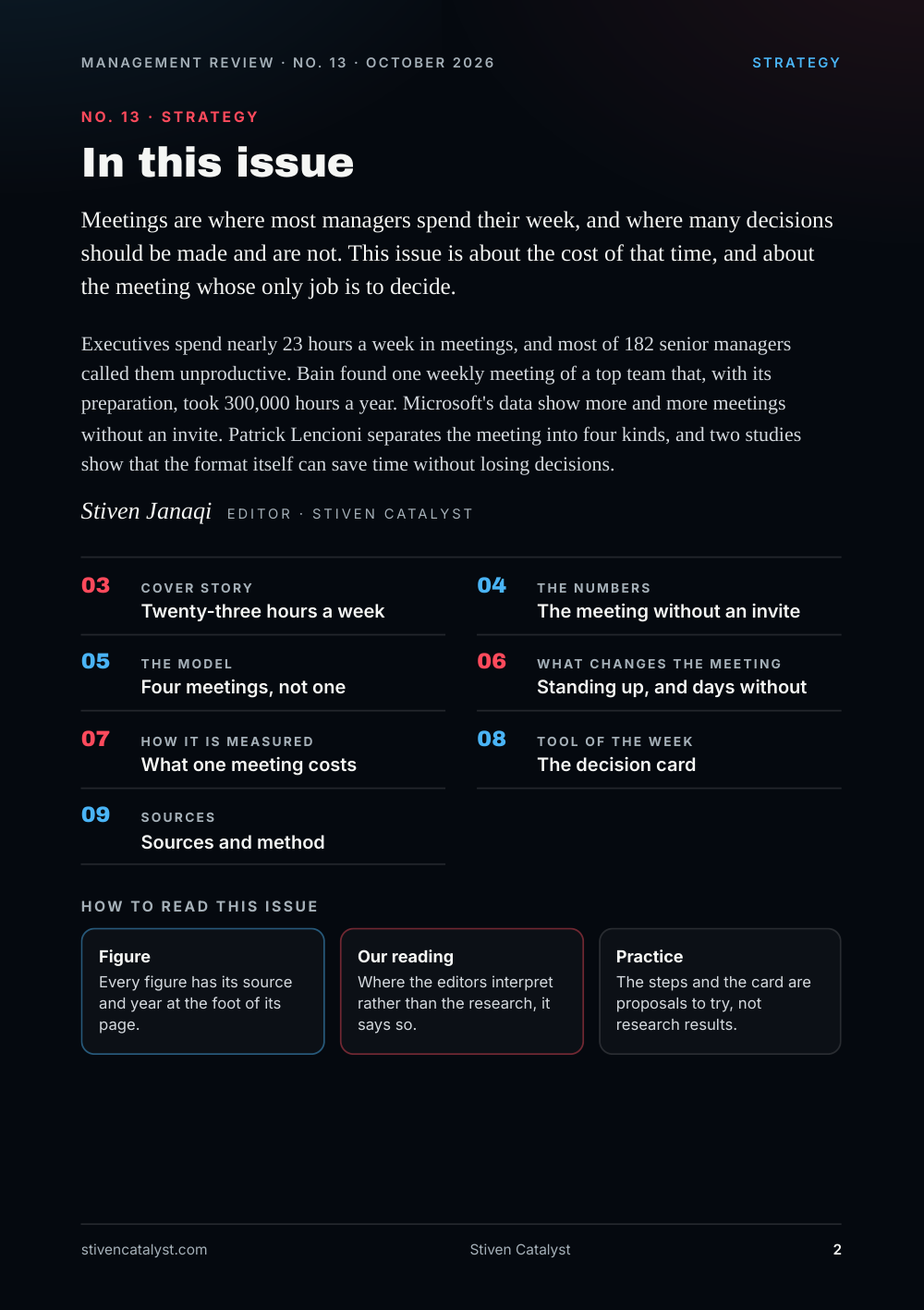
Meetings are where most managers spend their week, and where many decisions should be made and are not. This issue is about the cost of that time, and about the meeting whose only job is to decide.
Executives spend nearly 23 hours a week in meetings, and most of 182 senior managers called them unproductive. Bain found one weekly meeting of a top team that, with its preparation, took 300,000 hours a year. Microsoft's data show more and more meetings without an invite. Patrick Lencioni separates the meeting into four kinds, and two studies show that the format itself can save time without losing decisions.
Stiven Janaqi, Editor
Cover story
Twent y-three hours a week
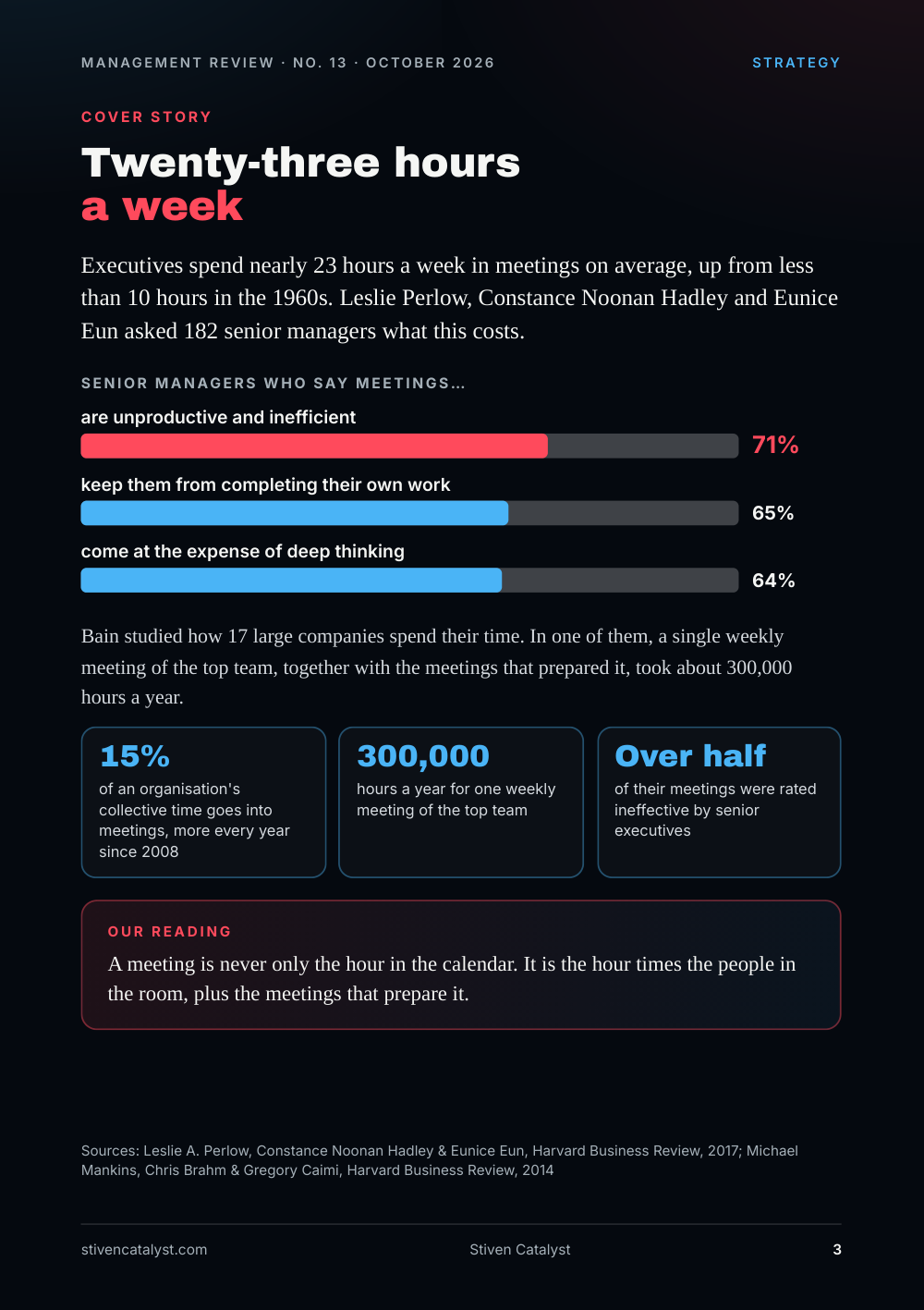
Executives spend nearly 23 hours a week in meetings on average, up from less than 10 hours in the 1960s. Leslie Perlow, Constance Noonan Hadley and Eunice Eun asked 182 senior managers what this costs.
Senior managers who say meetings…: are unproductive and inefficient 71%, keep them from completing their own work 65%, come at the expense of deep thinking 64%.
Bain studied how 17 large companies spend their time. In one of them, a single weekly meeting of the top team, together with the meetings that prepared it, took about 300,000 hours a year.
- 15% of an organisation's collective time goes into meetings, more every year since 2008
- 300,000 hours a year for one weekly meeting of the top team
- Over half of their meetings were rated ineffective by senior executives
Our reading
A meeting is never only the hour in the calendar. It is the hour times the people in the room, plus the meetings that prepare it.
Sources: Leslie A. Perlow, Constance Noonan Hadley & Eunice Eun, Harvard Business Review, 2017; Michael Mankins, Chris Brahm & Gregory Caimi, Harvard Business Review, 2014
The numbers
The mee ting without an invite
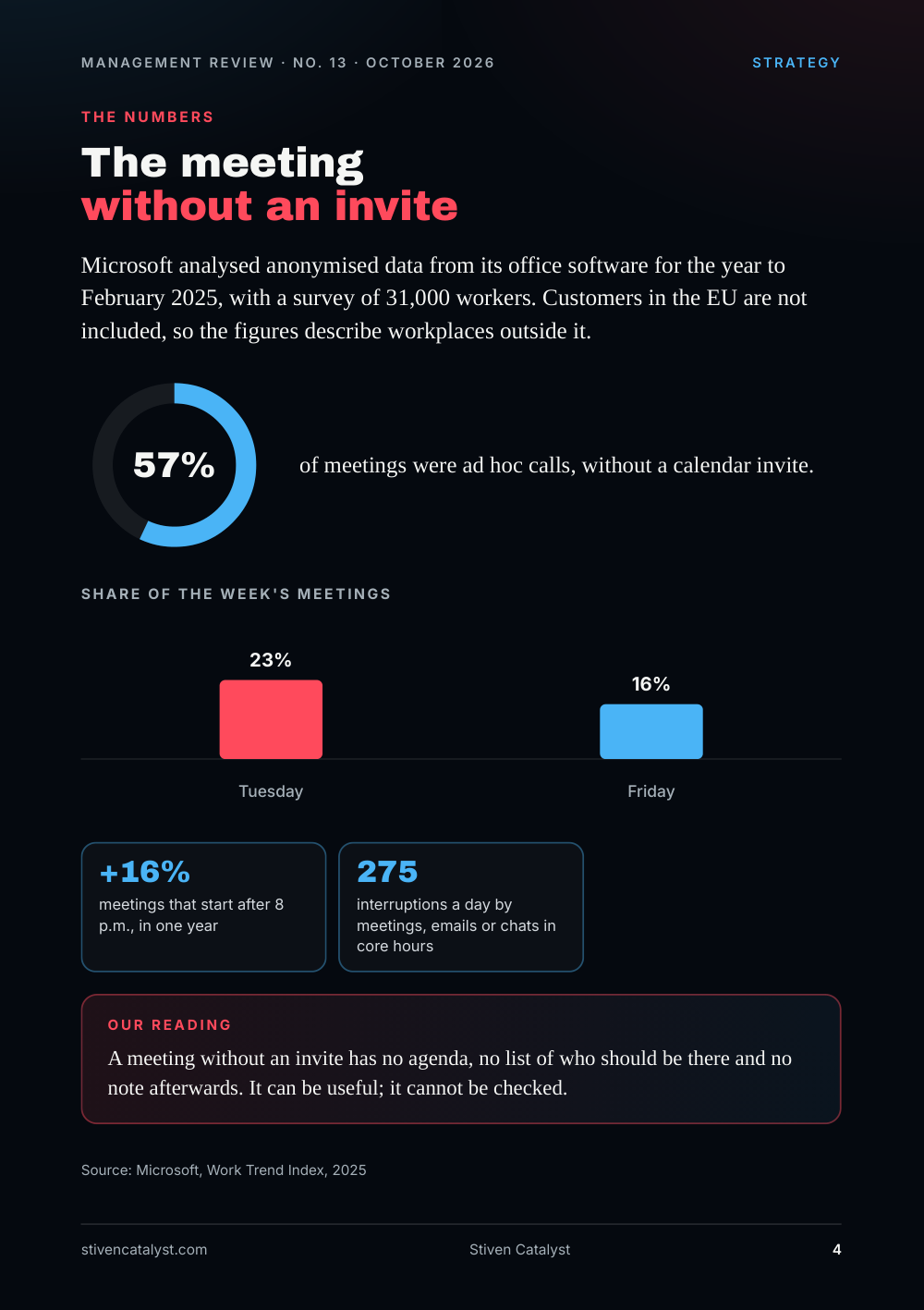
Microsoft analysed anonymised data from its office software for the year to February 2025, with a survey of 31,000 workers. Customers in the EU are not included, so the figures describe workplaces outside it.
57% of meetings were ad hoc calls, without a calendar invite.
Share of the week's meetings: Tuesday 23%, Friday 16%.
- +16% meetings that start after 8 p.m., in one year
- 275 interruptions a day by meetings, emails or chats in core hours
Our reading
A meeting without an invite has no agenda, no list of who should be there and no note afterwards. It can be useful; it cannot be checked.
Source: Microsoft, Work Trend Index, 2025
The model
Four mee tings, not one
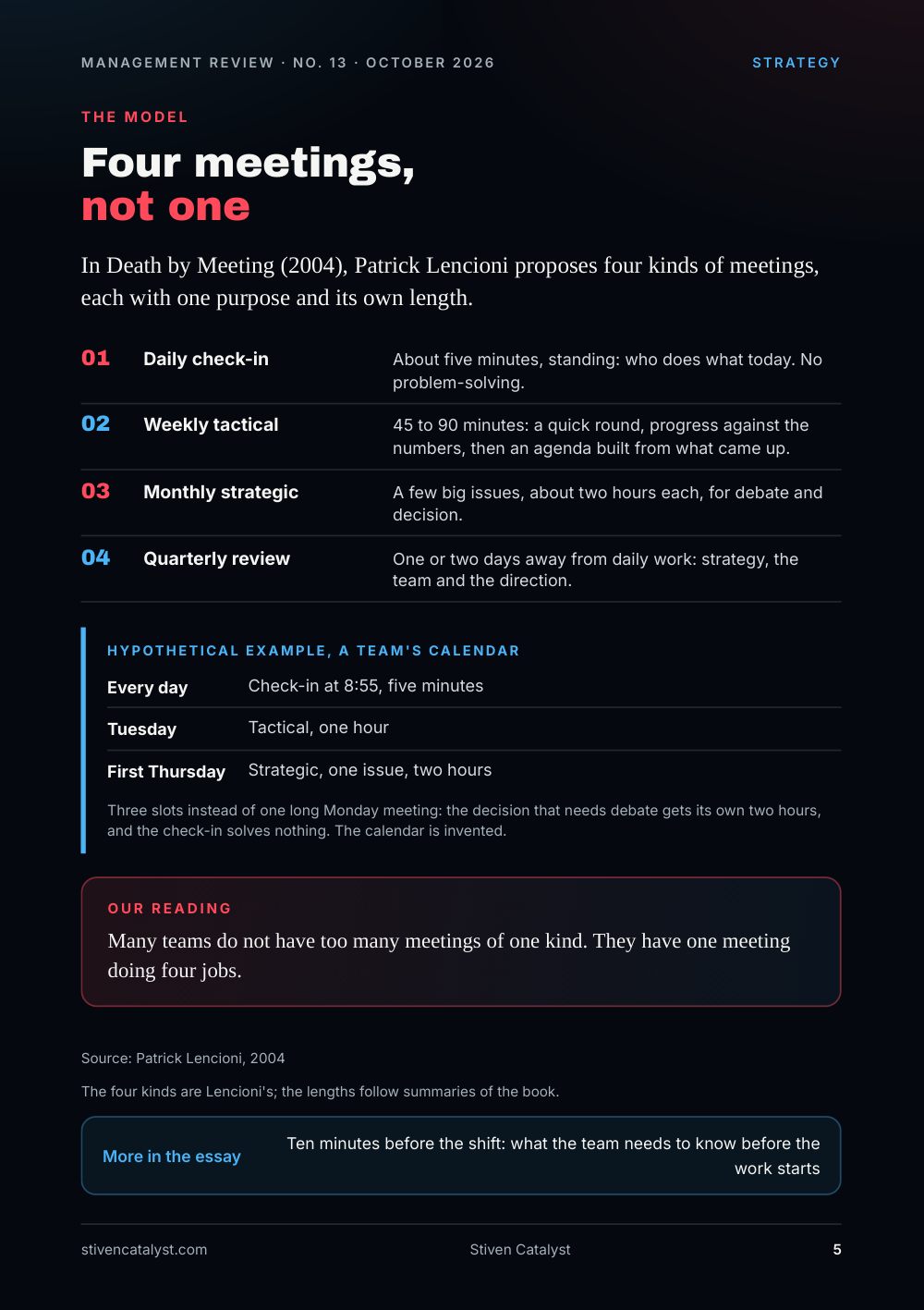
In Death by Meeting (2004), Patrick Lencioni proposes four kinds of meetings, each with one purpose and its own length.
- Daily check-in. About five minutes, standing: who does what today. No problem-solving.
- Weekly tactical. 45 to 90 minutes: a quick round, progress against the numbers, then an agenda built from what came up.
- Monthly strategic. A few big issues, about two hours each, for debate and decision.
- Qua
r terly review. One or two days away from daily work: strategy, the team and the direction.
Hypothe tical example, a team's calendar
- Every day: Check-in at 8:55, five minutes
- Tuesday: Tactical, one hour
- First Thursday: Strategic, one issue, two hours
Three slots instead of one long Monday meeting: the decision that needs debate gets its own two hours, and the check-in solves nothing. The calendar is invented.
Our reading
Many teams do not have too many meetings of one kind. They have one meeting doing four jobs.
The four kinds are Lencioni's; the lengths follow summaries of the book.
Source: Patrick Lencioni, 2004
More in the essay: Ten minutes before the shift: what the team needs to know before the work starts
What changes the meeting
Standing up, and days without
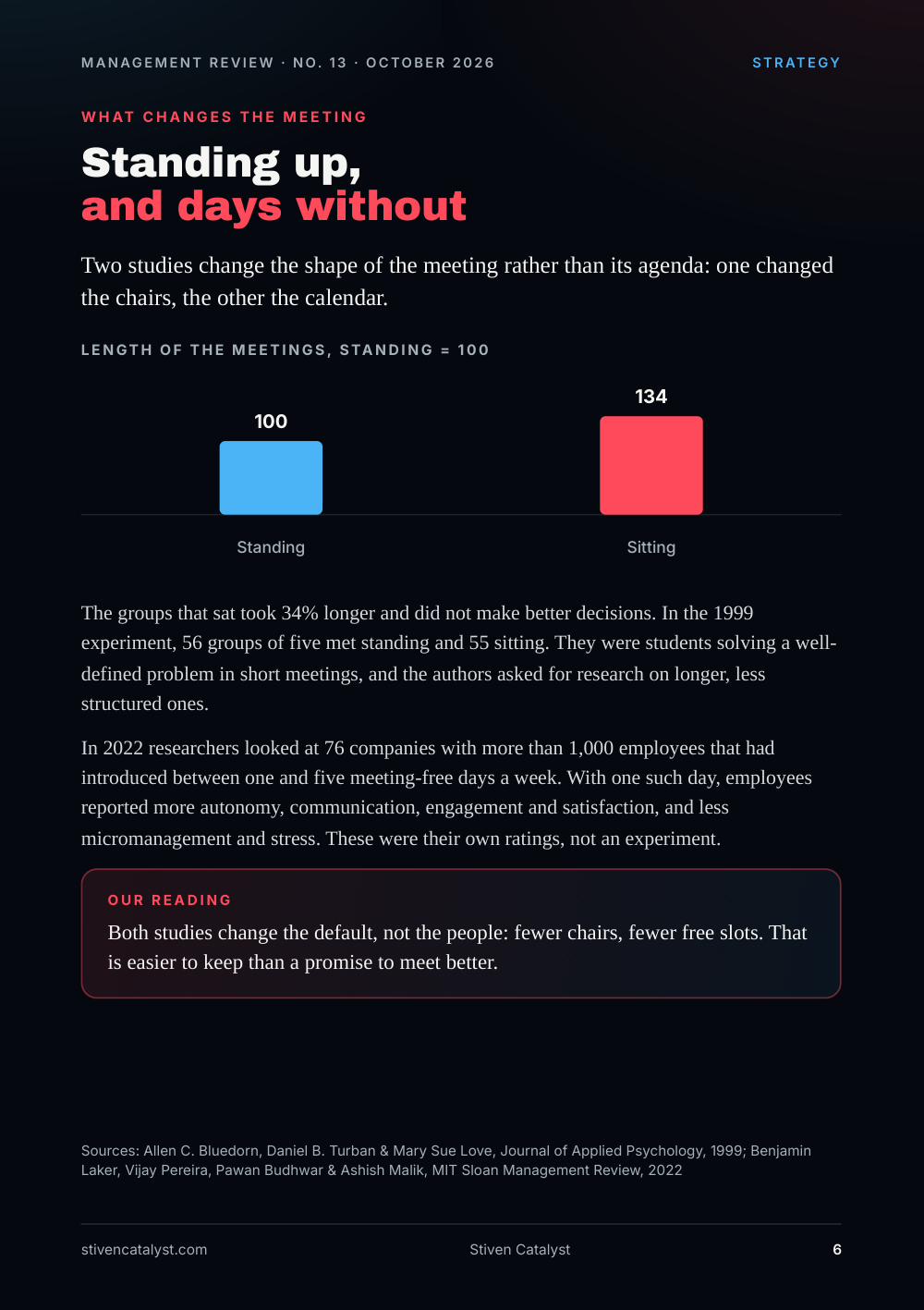
Two studies change the shape of the meeting rather than its agenda: one changed the chairs, the other the calendar.
Length of the meetings, standing = 100: Standing 100, Sitting 134.
The groups that sat took 34% longer and did not make better decisions. In the 1999 experiment, 56 groups of five met standing and 55 sitting. They were students solving a well-defined problem in short meetings, and the authors asked for research on longer, less structured ones.
In 2022 researchers looked at 76 companies with more than 1,000 employees that had introduced between one and five meeting-free days a week. With one such day, employees reported more autonomy, communication, engagement and satisfaction, and less micromanagement and stress. These were their own ratings, not an experiment.
Our reading
Both studies change the default, not the people: fewer chairs, fewer free slots. That is easier to keep than a promise to meet better.
Sources: Allen C. Bluedorn, Daniel B. Turban & Mary Sue Love, Journal of Applied Psychology, 1999; Benjamin Laker, Vijay Pereira, Pawan Budhwar & Ashish Malik, MIT Sloan Management Review, 2022
How it is measured
What one mee ting costs
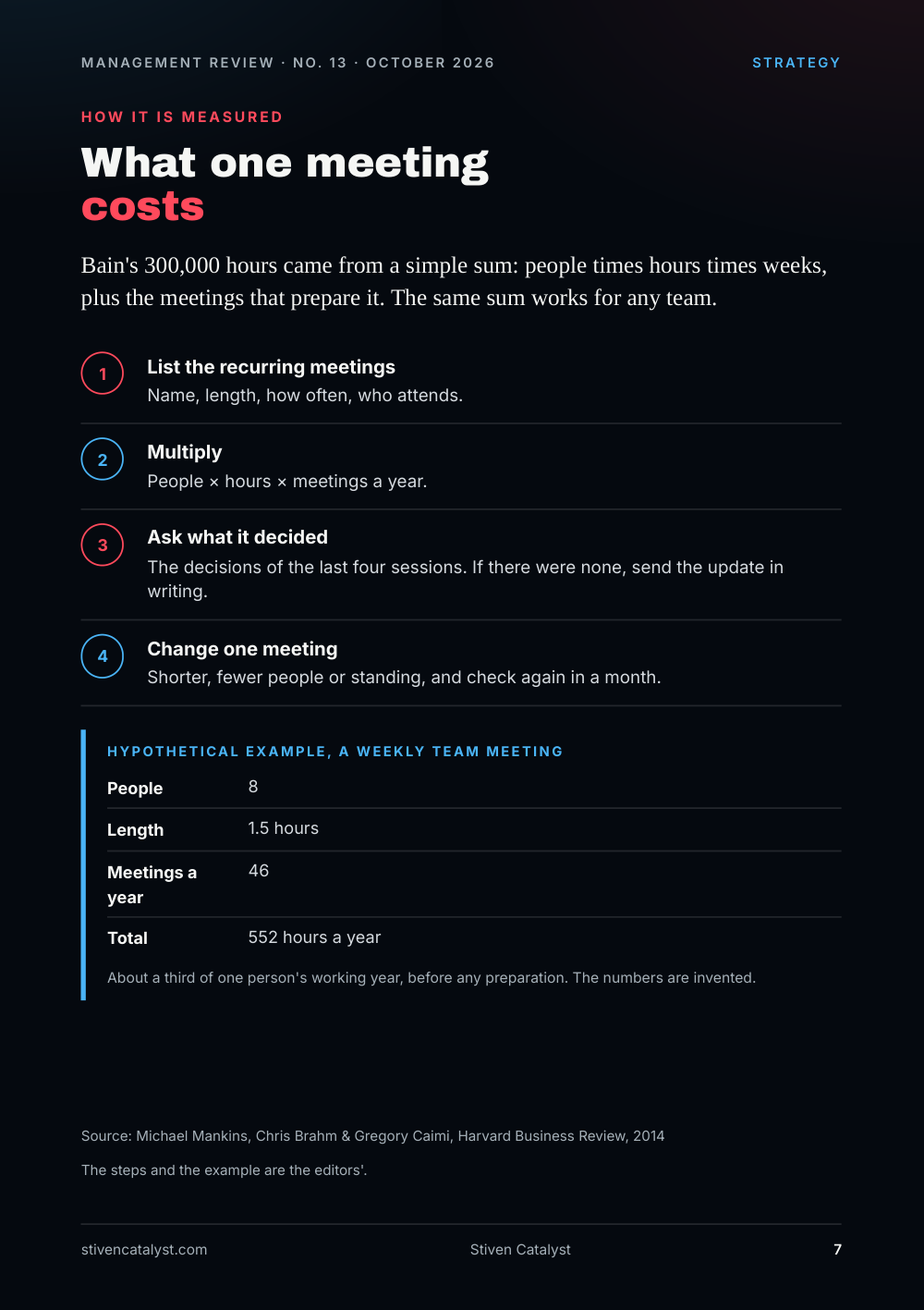
Bain's 300,000 hours came from a simple sum: people times hours times weeks, plus the meetings that prepare it. The same sum works for any team.
- List the recurring me
e tings. Name, length, how often, who attends. - Multiply. People × hours × meetings a year.
- Ask what it decided. The decisions of the last four sessions. If there were none, send the update in writing.
- Change one me
e ting. Shorter, fewer people or standing, and check again in a month.
Hypothe tical example, a weekly team mee ting
- People: 8
- Length: 1.5 hours
- Me
e tings a year: 46 T otal: 552 hours a year
About a third of one person's working year, before any preparation. The numbers are invented.
The steps and the example are the editors'.
Source: Michael Mankins, Chris Brahm & Gregory Caimi, Harvard Business Review, 2014
Tool of the week
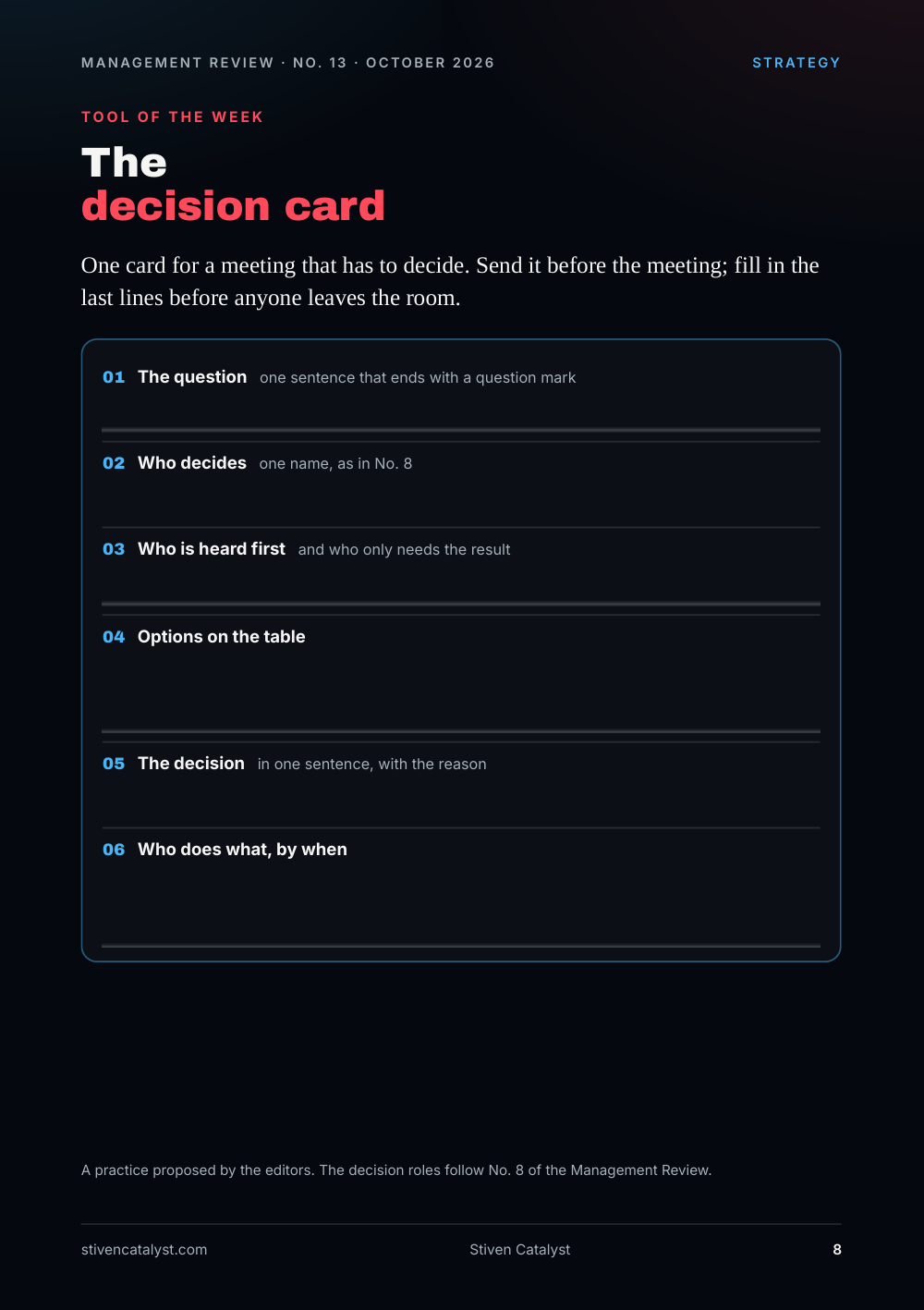
The decision card
One card for a meeting that has to decide. Send it before the meeting; fill in the last lines before anyone leaves the room.
- The question one sentence that ends with a question mark
- Who decides one name, as in No. 8
- Who is heard first and who only needs the result
- O
p tions on the table - The decision in one sentence, with the reason
- Who does what, by when
A practice proposed by the editors. The decision roles follow No. 8 of the Management Review.
Sources and method
Every figure has a source.
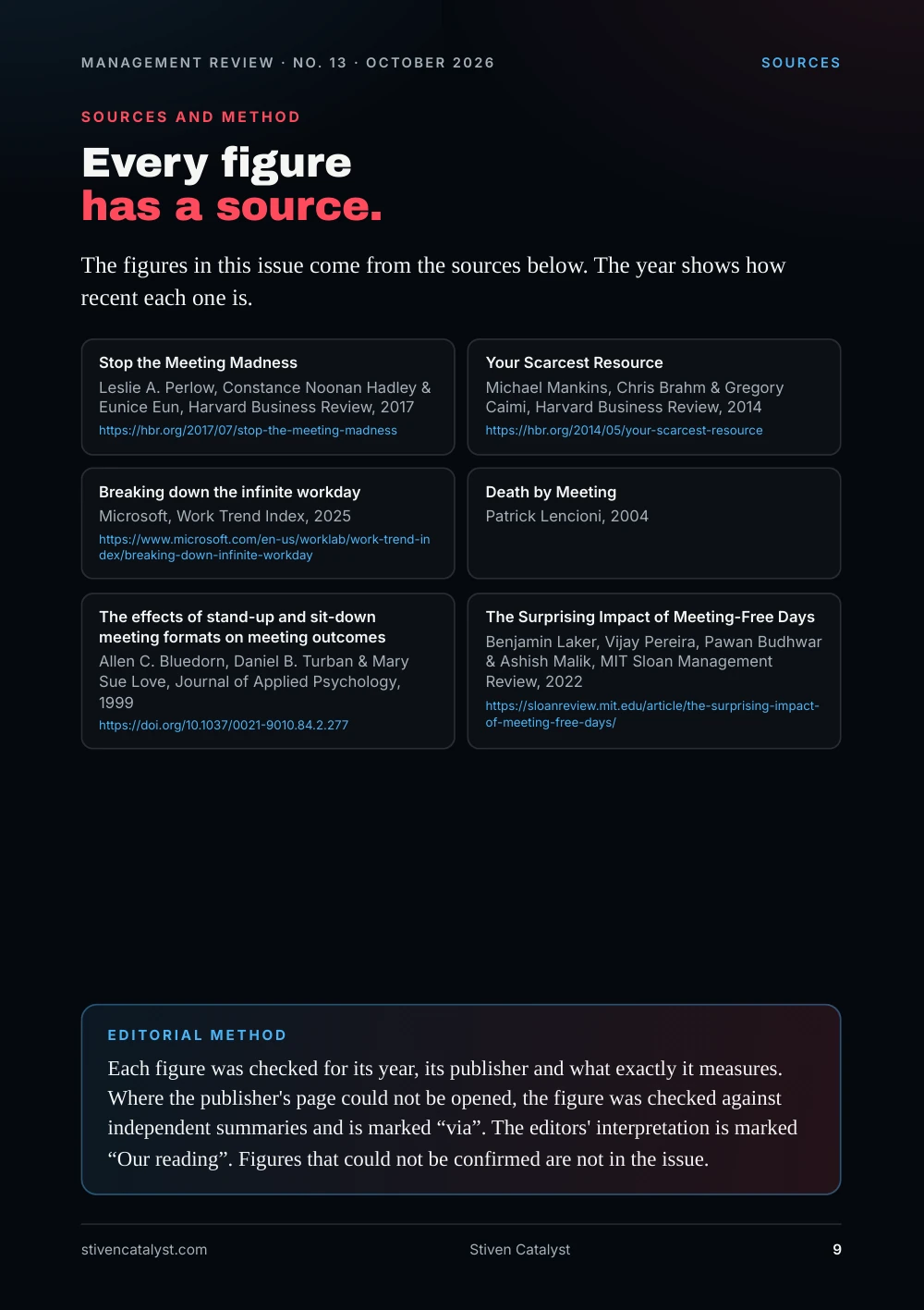
The figures in this issue come from the sources below. The year shows how recent each one is.
- Leslie A. Perlow, Constance Noonan Hadley & Eunice Eun, Harvard Business Review, “Stop the Meeting Madness”, 2017. https://hbr.org/2017/07/stop-the-meeting-madness
- Michael Mankins, Chris Brahm & Gregory Caimi, Harvard Business Review, “Your Scarcest Resource”, 2014. https://hbr.org/2014/05/your-scarcest-resource
- Microsoft, Work Trend Index, “Breaking down the infinite workday”, 2025. https://www.microsoft.com/en-us/worklab/work-trend-index/breaking-down-infinite-workday
- Patrick Lencioni, “Death by Meeting”, 2004.
- Allen C. Bluedorn, Daniel B. Turban & Mary Sue Love, Journal of Applied Psychology, “The effects of stand-up and sit-down meeting formats on meeting outcomes”, 1999. https://doi.org/10.1037/0021-9010.84.2.277
- Benjamin Laker, Vijay Pereira, Pawan Budhwar & Ashish Malik, MIT Sloan Management Review, “The Surprising Impact of Meeting-Free Days”, 2022. https://sloanreview.mit.edu/article/the-surprising-impact-of-meeting-free-days/
Edit orial me thod
Each figure was checked for its year, its publisher and what exactly it measures. Where the publisher's page could not be opened, the figure was checked against independent summaries and is marked “via”. The editors' interpretation is marked “Our reading”. Figures that could not be confirmed are not in the issue.