

In this issue
The first weeks in a job shape whether a new person settles in. This issue looks at what those weeks give them: the rules, a clear role, the culture and, above all, people.
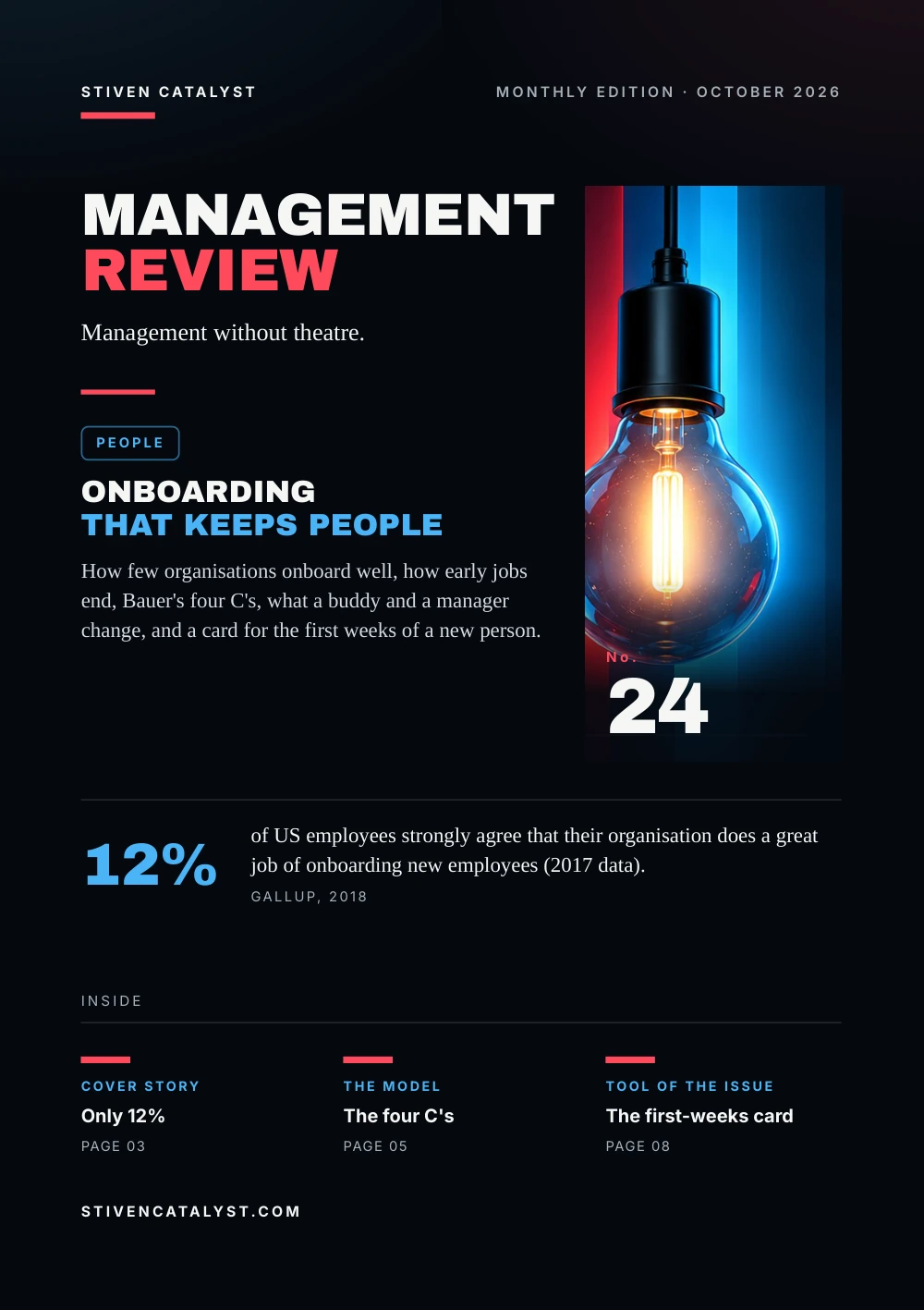
Only 12% of US employees strongly agree that their organisation onboards new people well, and only 29% of new hires feel fully prepared afterwards. Of the jobs that Americans born 1957–1964 started at 18–24, on average 61% ended within a year. Talya Bauer sums up onboarding in four C's. A meta-analysis of 70 samples finds that role clarity, confidence and acceptance by colleagues carry its effects, and at Microsoft new hires who met their buddy more often felt productive sooner.
Stiven Janaqi, Editor
Cover story
Only 12%
Gallup asked US employees whether their organisation does a great job of onboarding new employees. The answer comes from its State of the American Workplace survey of 2017.
12% strongly agree that their organisation onboards new employees very well.
- 29% of new hires feel fully prepared and supported to excel after onboarding
- 2.6× as likely to be extremely satisfied at work, for those who call their onboarding exceptional
Our reading
Onboarding is not a first day. It is the months in which a person learns the role, the place and the people.
The 29% and the 2.6 times come from a Gallup paper of 2019; the second is a correlation, and the method is not shown.
Sources: Gallup, 2018; Gallup, 2019
The numbers
How early jobs end
The US Bureau of Labor Statistics has followed Americans born 1957–1964 since 1979. For every job they started, it records how long the job lasted.
Share of jobs that ended, by age at the start of the job: Aged 18–24: Within 1 year 61%, Within 5 years 87%; Aged 25–34: Within 1 year 41.7%, Within 5 years 74%; Aged 45–54: Within 1 year 21%, Within 5 years 56%.
On average they held 12.9 jobs between the ages of 18 and 58. The figures count every way a job ends: people who quit, layoffs and contracts that run out.
Our reading
A large share of jobs ends within the first year, above all for the young. That year is exactly where onboarding works.
One US generation; the shares are averages per person. For Albania and Germany we have no comparable data.
Source: U.S. Bureau of Labor Statistics, 2025
The model
The four C's
In a guide for the SHRM Foundation, Talya Bauer describes onboarding in four building blocks, from the rules to the relationships.
- Compliance. The rules, policies and legal documents.
- Clarification. The tasks and expectations of the role.
- Culture. The norms and values of the organisation.
- Connection. The relationships with people at work.
Hypothe tical example, a new shif t lead's first week
- Compliance: Safety briefing and contract on day one
- Clarification: The three numbers the shift is judged on
- Culture: How a mistake is reported here
- Connection: Lunch with the buddy, coffee with the night lead
Each C has an owner and a day. The plan is invented.
Our reading
The first two C's can be handed over on paper. The last two only happen between people.
The four C's follow Bauer (2010); the example is the editors'.
Source: Talya N. Bauer, SHRM Foundation, 2010
More in the essay: “Watch how I do it” is not training
What the research says
Clarit y, confidence, accep tance
A meta-analysis of 70 samples of new employees, by Talya Bauer and colleagues, found three links between what an organisation does and how a new person fares: role clarity, confidence in one's own ability and acceptance by colleagues.
Through them, onboarding goes with job satisfaction, commitment, performance, the intention to stay and lower turnover. At Microsoft, a six-month pilot in 2018 with 600 participants gave new hires a buddy.
New hires who said their buddy helped them become productive quickly, by meetings in the first 90 days: At least once 56%, 2–3 times 73%, 4–8 times 86%, More than 8 times 97%.
Our reading
A buddy is not a programme. It is a person with time in the calendar, and the meetings are what count.
Microsoft's figures are self-reports from one company, written up by its employees; the first group includes the others.
Sources: Talya N. Bauer et al., Journal of Applied Psychology, 2007; Dawn Klinghoffer, Candice Young & Dave Haspas, Harvard Business Review, 2019
How it is measured
Measure the first 90 days
Onboarding can be measured like any process: on fixed days, with the same few questions, for every new person.
- Day 30, 60 and 90. A short conversation on fixed days, booked on day one.
- Three questions. Is the role clear? Do you feel able to do it? Do you feel accepted by the team?
- Count the buddy me
e tings. How often did the new person and the buddy actually meet? - See who stays. Of everyone who started, how many are still here after 6 and 12 months.
Hypothe tical example, ten new hires in one quar ter
- Day 30: 8 of 10 say the role is clear
- Day 90: 9 of 10 feel accepted by the team
- 12 months: 8 of 10 still here
The two who said the role was unclear on day 30 are the ones to talk to first. The numbers are invented.
The steps and the example are the editors'; the three questions follow Bauer et al. (2007).
Source: Talya N. Bauer et al., Journal of Applied Psychology, 2007
Tool of the week
The first-weeks card
One card for one new person, filled in by the manager before the first day. At Google, managers got a similar list by email on the Sunday before a new person started.
- Before day one documents ready; the talk about the role and its responsibilities booked
- Buddy name, and how often they meet in the first 90 days
- People
t o mee t five names, and why each one matters - Check-ins once a month for the first six months: the dates
- Open questions how and when the new person can ask anything
- Day 90 role clear? able to do it? accepted by the team?
A practice proposed by the editors, after Google's five actions for managers (Bock, 2015) and Bauer's four C's.
Sources: Laszlo Bock, 2015; Talya N. Bauer, SHRM Foundation, 2010
Sources and method
Every figure has a source.
The figures in this issue come from the sources below. The year shows how recent each one is.
- Gallup, “Why the Onboarding Experience Is Key for Retention”, 2018. https://www.gallup.com/workplace/235121/why-onboarding-experience-key-retention.aspx
- Gallup, “Create an Exceptional Onboarding Journey for Your New Employees”, 2019. https://www.gallup.com/workplace/247076/onboarding-new-employees-perspective-paper.aspx
- U.S. Bureau of Labor Statistics, “Number of Jobs, Labor Market Experience, Marital Status, and Health for those Born 1957-1964”, 2025. https://www.bls.gov/news.release/archives/nlsoy_08262025.htm
- Talya N. Bauer, SHRM Foundation, “Onboarding New Employees: Maximizing Success”, 2010.
- Talya N. Bauer et al., Journal of Applied Psychology, “Newcomer adjustment during organizational socialization: A meta-analytic review of antecedents, outcomes, and methods”, 2007. https://doi.org/10.1037/0021-9010.92.3.707
- Dawn Klinghoffer, Candice Young & Dave Haspas, Harvard Business Review, “Every New Employee Needs an Onboarding “Buddy””, 2019. https://hbr.org/2019/06/every-new-employee-needs-an-onboarding-buddy
- Laszlo Bock, “Work Rules!”, 2015.
Edit orial me thod
Each figure was checked for its year, its publisher and what exactly it measures. Where the publisher's page could not be opened, the figure was checked against independent summaries and is marked “via”. The editors' interpretation is marked “Our reading”. Figures that could not be confirmed are not in the issue.