Across 664 effects, feeling listened to at work went with better outcomes, most of all with the quality of the relationship (0.51). Three quarters of the data were self-reports; with other sources the link is weaker but remains. Good listening has three parts: attention, comprehension and acceptance. In 81 stories from a bank, attention alone was rarely enough: people felt unheard when the expected follow-up never came. A card for the follow-up closes the issue.
Management Review · Third series · November 2026 · No. 101
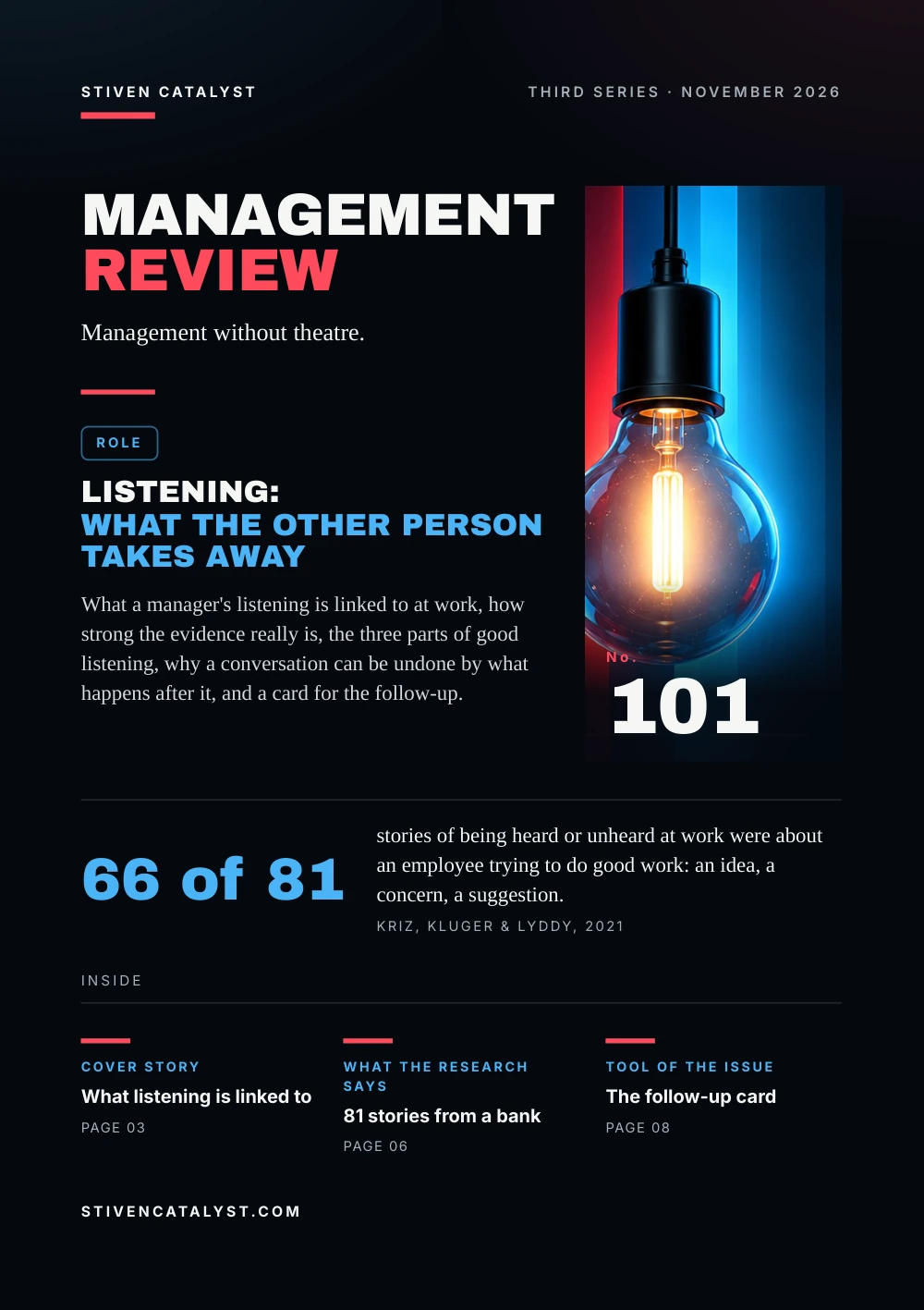
Listening: what the other person takes away
What a manager's listening is linked to at work, how strong the evidence really is, the three parts of good listening, why a conversation can be undone by what happens after it, and a card for the follow-up.
- No.
- 101
- Pages
- 10
- Sources
- 3
- Topics
- Role
- Online since
- 7 November 2026
Stiven CatalystThird series · November 2026
ManagementReview
Management without theatre.
Role
Listening:what the other person takes away
What a manager's listening is linked to at work, how strong the evidence really is, the three parts of good listening, why a conversation can be undone by what happens after it, and a card for the follow-up.

No.101
66 of 81
stories of being heard or unheard at work were about an employee trying to do good work: an idea, a concern, a suggestion.Kriz, Kluger & Lyddy, 2021
stivencatalyst.com
No. 101 · Role
In this issue
Most of what a manager learns is about talking: presenting, deciding, giving feedback. Listening is treated as something everyone can already do. This issue asks what a manager's listening actually changes, for the person speaking and for the work, and what the speaker needs to see before they feel heard.
- 03Cover storyWhat listening is linked to
- 04The numbersHow strong, honestly
- 05The modelThree parts of good listening
- 06What the research says81 stories from a bank
- 07How it is measuredAsk the speaker, not yourself
- 08Tool of the issueThe follow-up card
- 09SourcesSources and method
How to read this issue
Figure
Every figure has its source and year at the foot of its page.
Our reading
Where the editor interprets rather than the research, it says so.
Practice
The steps and the card are proposals to try, not research results.
Cover story
What listeningis linked t o
Avraham Kluger, Herman Aguinis, Guy Itzchakov and colleagues gathered 664 effects from 144 samples, 400,020 observations in all, on how the speaker's sense of being listened to relates to outcomes at work. Managers were the listeners in 36% of the effects, salespeople in 21%. The average correlation was 0.39.
Average correlation with perceived listening, by kind of outcome (2024)
Relationship covers trust, liking and satisfaction with the relationship; thinking includes knowledge and a more balanced view of a topic; feelings include job satisfaction and commitment. The authors' reading: listening may lift performance mainly by building the relationship.
Our reading
The strongest link is with the relationship itself. People work better with someone they trust, and they trust the one who listens.
Source: Avraham N. Kluger, Michal Lehmann, Herman Aguinis, Guy Itzchakov, Galit Gordoni, Jetmir Zyberaj & Cafer Bakaç, Journal of Business and Psychology 39(2), 2024
Kluger et al. (2024), three-level meta-analysis, table 5; correlations weighted by sample, not corrected for reliability. Most data are surveys at one moment, so they show association, not cause. Feedback, the talking side, is in No. 19.
The numbers
How strong,honestly
In 75% of the effects one person answered one questionnaire about both the listening and the outcome. That inflates a correlation. The meta-analysis therefore compared studies by how the two were measured, and the link shrinks, though it does not vanish.
Average correlation of listening with work outcomes, by study design (2024)
Experiments, where listening was made good or poor on purpose, gave 0.39, close to the surveys. Of their 30 effects only one was negative, at −0.04. The authors set this against feedback, where 38% of experimental interventions lowered performance, as No. 19 describes.
Our reading
Even on the strictest reading, listening is not a soft extra. And it rarely does harm, which cannot be said of all management habits.
Source: Avraham N. Kluger, Michal Lehmann, Herman Aguinis, Guy Itzchakov, Galit Gordoni, Jetmir Zyberaj & Cafer Bakaç, Journal of Business and Psychology 39(2), 2024
Kluger et al. (2024), table 7 and discussion. Two sources: listening and outcome reported by different people or records. Outcome later: a predictive design. Effects with outcomes such as burnout or misconduct were weaker (0.17) than with desirable ones (0.43).
The model
Three par tsof good listening
Guy Itzchakov and Jennifer Grau describe a good listening experience in three parts: attention, comprehension and acceptance. The speaker judges all three from small signals, and the meta-analysis lists the signals that tell them the opposite.
Attention
- eye contact, the phone away
- nodding, short sounds
- signal: doing two things at once
Comprehension
- questions that clarify or confirm
- saying back what was heard
- signal: changing the topic
Acceptance
- no judgment, even in disagreement
- “What led to it?” rather than “Why?”
- signal: advice nobody asked for
Even a neutral question can sound like judgment from a manager. “Have you talked to accounting about this?” is often heard as advice and a doubt; “What might you try next?” leaves the next step with the person.
Our reading
The speaker does not hear the intention. They hear the question, the glance at the screen and the advice that came too early.
Sources: Guy Itzchakov & Jennifer Grau, Organizational Dynamics 51(2), 2022; Avraham N. Kluger, Michal Lehmann, Herman Aguinis, Guy Itzchakov, Galit Gordoni, Jetmir Zyberaj & Cafer Bakaç, Journal of Business and Psychology 39(2), 2024
Parts and examples from Itzchakov and Grau (2022), signals of poor listening from Kluger et al. (2024), shortened by the editors. The authors add that field studies of listening training for managers are scarce: they know of two. Coaching is in No. 11.
What the research says
81 st oriesfrom a bank
Tiffany Kriz, Avraham Kluger and Christopher Lyddy interviewed 41 employees of a US bank about a time someone at work had an important chance to listen to them, and took it or missed it. They told 81 stories: 47 of feeling heard, 34 of feeling unheard.
Stories by what decided the outcome, 41 bank employees (2021)
Attentive behaviour in the conversation did not tell the stories apart. What did was whether the listener met the need the speaker came with. Sometimes that took a tool, a change or a reason for a no; one employee stopped bringing ideas after a no without a reason.
Our reading
A warm conversation followed by nothing can do more damage than a short one. It raised the hope that then went unanswered.
Source: Tiffany D. Kriz, Avraham N. Kluger & Christopher J. Lyddy, Frontiers in Psychology 12, 2021
Kriz et al. (2021), table 3: one bank, employees chosen by HR as mid to high performers, stories told in retrospect; the editors grouped the paths. The authors expect the role of action to vary across cultures. Silence and voice are in the treatise's volume 7.
How it is measured
Ask the speaker,not yourself
The meta-analysis defines listening from the speaker's side: their judgment of the listener's interest and reaction. Kriz and colleagues cite a study in which the listeners' ratings of themselves did not match the speakers' ratings at all (−0.06). Your own impression is the weakest measure you have.
One question
after an important conversation: did I listen to you well? researchers suggest one item may be enough
What was asked for
written in the speaker's words: a tool, a change, a decision, or only to be heard
Follow-ups closed
promised follow-ups closed on time, out of all promised
A no with a reason
every rejected idea answered with the reason, in person
Ideas over time
does the same person still bring ideas a month later?
Our reading
The closing rate of follow-ups is a number a manager can see every week. The feeling of being heard is built on it.
Sources: Avraham N. Kluger, Michal Lehmann, Herman Aguinis, Guy Itzchakov, Galit Gordoni, Jetmir Zyberaj & Cafer Bakaç, Journal of Business and Psychology 39(2), 2024; Tiffany D. Kriz, Avraham N. Kluger & Christopher J. Lyddy, Frontiers in Psychology 12, 2021
The rows are the editors' proposal, built on the definition and the single-item remark in Kluger et al. (2024) and the findings of Kriz et al. (2021). The −0.06 is from Bodie et al. (2014) as Kriz et al. report it; that study was not read.
Tool of the issue
The follow-upcard
One card for each conversation that matters: an idea, a concern, a complaint about the work. Filled in by the manager right after, and closed only when the speaker has had an answer. The Action Tracker keeps the follow-ups with an owner and a date.
01Who, when, about whatone conversation per card
02What I heardin their words; said back and confirmed, after “And what else?”
03What they needonly to be heard, or an action: tool, change, decision
04What I will do, by whenor who has the power to act, and when I take it to them
05The answer givendone, under way, or no with the reason; in person
06Did you feel heard?their answer, not mine
Sources: Tiffany D. Kriz, Avraham N. Kluger & Christopher J. Lyddy, Frontiers in Psychology 12, 2021; Guy Itzchakov & Jennifer Grau, Organizational Dynamics 51(2), 2022
The card is the editors' proposal, built on Kriz et al. (2021) and the questions in Itzchakov and Grau (2022); it has not been tested. The essay linked below gives the author's five steps for the talk after a mistake: listen before you judge, end with an action that is checked.
More in the essayHow to talk to someone who made a mistake
Open the tool: Action Trackerstivencatalyst.com/tools/action-tracker/
Sources and method
Every figurehas a source.
The figures in this issue come from the sources below. The year shows how recent each one is.
- A Meta-analytic Systematic Review and Theory of the Effects of Perceived Listening on Work OutcomesAvraham N. Kluger, Michal Lehmann, Herman Aguinis, Guy Itzchakov, Galit Gordoni, Jetmir Zyberaj & Cafer Bakaç, Journal of Business and Psychology 39(2), 2024https://doi.org/10.1007/s10869-023-09897-5
- Feeling Heard: Experiences of Listening (or Not) at WorkTiffany D. Kriz, Avraham N. Kluger & Christopher J. Lyddy, Frontiers in Psychology 12, 2021https://doi.org/10.3389/fpsyg.2021.659087
- High-quality listening in the age of COVID-19: A key to better dyadic communication for more effective organizationsGuy Itzchakov & Jennifer Grau, Organizational Dynamics 51(2), 2022https://doi.org/10.1016/j.orgdyn.2020.100820
Editorial method
Each figure was checked for its year, its publisher and what it measures, in the full text where it could be opened. A source read only in a summary, an abstract or excerpts is marked “via”. A figure not confirmed in what was read is marked so on its page, or left out. The editor's interpretation is marked “Our reading”.
ManagementReview
Management without theatre.
Every issue, one management question, checked against the best research.
All issues
stivencatalyst.com/magazine/management-review.html
Management Review · No. 101 · November 2026 · Stiven Catalyst
Edited by Stiven Janaqi, who answers for it; “the editors” in this publication means him. Its texts, translations, layout and the checking of figures against their sources are done in working sessions with Claude, an AI model by Anthropic.
stivencatalyst.com/how-this-is-made.html
 Next issue
Overtime: the number that borrows from tomorrow
Click or swipe a page to turn it. The arrow keys work too.
Management Review · No. 101
The figures of the issue
The charts of the printed pages, with their sources.
Kluger et al. (2024), three-level meta-analysis, table 5; correlations weighted by sample, not corrected for reliability. Most data are surveys at one moment, so they show association, not cause. Feedback, the talking side, is in No. 19.
Source: Avraham N. Kluger, Michal Lehmann, Herman Aguinis, Guy Itzchakov, Galit Gordoni, Jetmir Zyberaj & Cafer Bakaç, Journal of Business and Psychology 39(2), 2024
Kluger et al. (2024), table 7 and discussion. Two sources: listening and outcome reported by different people or records. Outcome later: a predictive design. Effects with outcomes such as burnout or misconduct were weaker (0.17) than with desirable ones (0.43).
Source: Avraham N. Kluger, Michal Lehmann, Herman Aguinis, Guy Itzchakov, Galit Gordoni, Jetmir Zyberaj & Cafer Bakaç, Journal of Business and Psychology 39(2), 2024
Kriz et al. (2021), table 3: one bank, employees chosen by HR as mid to high performers, stories told in retrospect; the editors grouped the paths. The authors expect the role of action to vary across cultures. Silence and voice are in the treatise's volume 7.
Source: Tiffany D. Kriz, Avraham N. Kluger & Christopher J. Lyddy, Frontiers in Psychology 12, 2021
The whole text Read the issue as text For reading on a small screen, searching or a screen reader. The same words, without the page design.
In this issue
Most of what a manager learns is about talking: presenting, deciding, giving feedback. Listening is treated as something everyone can already do. This issue asks what a manager's listening actually changes, for the person speaking and for the work, and what the speaker needs to see before they feel heard.
Across 664 effects, feeling listened to at work went with better outcomes, most of all with the quality of the relationship (0.51). Three quarters of the data were self-reports; with other sources the link is weaker but remains. Good listening has three parts: attention, comprehension and acceptance. In 81 stories from a bank, attention alone was rarely enough: people felt unheard when the expected follow-up never came. A card for the follow-up closes the issue.
Stiven Janaqi, Editor
Cover story
What listening is linked t o
Avraham Kluger, Herman Aguinis, Guy Itzchakov and colleagues gathered 664 effects from 144 samples, 400,020 observations in all, on how the speaker's sense of being listened to relates to outcomes at work. Managers were the listeners in 36% of the effects, salespeople in 21%. The average correlation was 0.39.
Average correlation with perceived listening, by kind of outcome (2024): Relationship 0.51, Thinking 0.40, Feelings 0.36, Performance 0.36.
Relationship covers trust, liking and satisfaction with the relationship; thinking includes knowledge and a more balanced view of a topic; feelings include job satisfaction and commitment. The authors' reading: listening may lift performance mainly by building the relationship.
Our reading
The strongest link is with the relationship itself. People work better with someone they trust, and they trust the one who listens.
Kluger et al. (2024), three-level meta-analysis, table 5; correlations weighted by sample, not corrected for reliability. Most data are surveys at one moment, so they show association, not cause. Feedback, the talking side, is in No. 19.
Source: Avraham N. Kluger, Michal Lehmann, Herman Aguinis, Guy Itzchakov, Galit Gordoni, Jetmir Zyberaj & Cafer Bakaç, Journal of Business and Psychology 39(2), 2024
The numbers
How strong, honestly
In 75% of the effects one person answered one questionnaire about both the listening and the outcome. That inflates a correlation. The meta-analysis therefore compared studies by how the two were measured, and the link shrinks, though it does not vanish.
Average correlation of listening with work outcomes, by study design (2024): One source vs. two sources: Easier design 0.43, Stricter design 0.26; Same time vs. outcome later: Easier design 0.42, Stricter design 0.27.
Experiments, where listening was made good or poor on purpose, gave 0.39, close to the surveys. Of their 30 effects only one was negative, at −0.04. The authors set this against feedback, where 38% of experimental interventions lowered performance, as No. 19 describes.
Our reading
Even on the strictest reading, listening is not a soft extra. And it rarely does harm, which cannot be said of all management habits.
Kluger et al. (2024), table 7 and discussion. Two sources: listening and outcome reported by different people or records. Outcome later: a predictive design. Effects with outcomes such as burnout or misconduct were weaker (0.17) than with desirable ones (0.43).
Source: Avraham N. Kluger, Michal Lehmann, Herman Aguinis, Guy Itzchakov, Galit Gordoni, Jetmir Zyberaj & Cafer Bakaç, Journal of Business and Psychology 39(2), 2024
The model
Three par ts of good listening
Guy Itzchakov and Jennifer Grau describe a good listening experience in three parts: attention, comprehension and acceptance. The speaker judges all three from small signals, and the meta-analysis lists the signals that tell them the opposite.
At tention
- eye contact, the phone away
- nodding, short sounds
- signal: doing two things at once
Comprehension
- questions that clarify or confirm
- saying back what was heard
- signal: changing the topic
Accep tance
- no judgment, even in disagreement
- “What led to it?” rather than “Why?”
- signal: advice nobody asked for
Even a neutral question can sound like judgment from a manager. “Have you talked to accounting about this?” is often heard as advice and a doubt; “What might you try next?” leaves the next step with the person.
Our reading
The speaker does not hear the intention. They hear the question, the glance at the screen and the advice that came too early.
Parts and examples from Itzchakov and Grau (2022), signals of poor listening from Kluger et al. (2024), shortened by the editors. The authors add that field studies of listening training for managers are scarce: they know of two. Coaching is in No. 11.
Sources: Guy Itzchakov & Jennifer Grau, Organizational Dynamics 51(2), 2022; Avraham N. Kluger, Michal Lehmann, Herman Aguinis, Guy Itzchakov, Galit Gordoni, Jetmir Zyberaj & Cafer Bakaç, Journal of Business and Psychology 39(2), 2024
What the research says
81 st ories from a bank
Tiffany Kriz, Avraham Kluger and Christopher Lyddy interviewed 41 employees of a US bank about a time someone at work had an important chance to listen to them, and took it or missed it. They told 81 stories: 47 of feeling heard, 34 of feeling unheard.
Stories by what decided the outcome, 41 bank employees (2021): Heard: the listener acted 30, Heard: the conversation itself 17, Unheard: shut down or overruled 23, Unheard: open at first, then nothing 11.
Attentive behaviour in the conversation did not tell the stories apart. What did was whether the listener met the need the speaker came with. Sometimes that took a tool, a change or a reason for a no; one employee stopped bringing ideas after a no without a reason.
Our reading
A warm conversation followed by nothing can do more damage than a short one. It raised the hope that then went unanswered.
Kriz et al. (2021), table 3: one bank, employees chosen by HR as mid to high performers, stories told in retrospect; the editors grouped the paths. The authors expect the role of action to vary across cultures. Silence and voice are in the treatise's volume 7.
Source: Tiffany D. Kriz, Avraham N. Kluger & Christopher J. Lyddy, Frontiers in Psychology 12, 2021
How it is measured
Ask the speaker, not yourself
The meta-analysis defines listening from the speaker's side: their judgment of the listener's interest and reaction. Kriz and colleagues cite a study in which the listeners' ratings of themselves did not match the speakers' ratings at all (−0.06). Your own impression is the weakest measure you have.
- One question. after an important conversation: did I listen to you well? researchers suggest one item may be enough
- What was asked for. written in the speaker's words: a tool, a change, a decision, or only to be heard
- Follow-ups closed. promised follow-ups closed on time, out of all promised
- A no with a reason. every rejected idea answered with the reason, in person
- Ideas over time. does the same person still bring ideas a month later?
Our reading
The closing rate of follow-ups is a number a manager can see every week. The feeling of being heard is built on it.
The rows are the editors' proposal, built on the definition and the single-item remark in Kluger et al. (2024) and the findings of Kriz et al. (2021). The −0.06 is from Bodie et al. (2014) as Kriz et al. report it; that study was not read.
Sources: Avraham N. Kluger, Michal Lehmann, Herman Aguinis, Guy Itzchakov, Galit Gordoni, Jetmir Zyberaj & Cafer Bakaç, Journal of Business and Psychology 39(2), 2024; Tiffany D. Kriz, Avraham N. Kluger & Christopher J. Lyddy, Frontiers in Psychology 12, 2021
Tool of the issue
The follow-up card
One card for each conversation that matters: an idea, a concern, a complaint about the work. Filled in by the manager right after, and closed only when the speaker has had an answer. The Action Tracker keeps the follow-ups with an owner and a date.
- Who, when, about what one conversation per card
- What I heard in their words; said back and confirmed, after “And what else?”
- What th
e y need only to be heard, or an action: tool, change, decision - What I will do, by when or who has the power to act, and when I take it to them
- The answer given done, under way, or no with the reason; in person
- Did you feel heard? their answer, not mine
The card is the editors' proposal, built on Kriz et al. (2021) and the questions in Itzchakov and Grau (2022); it has not been tested. The essay linked below gives the author's five steps for the talk after a mistake: listen before you judge, end with an action that is checked.
Sources: Tiffany D. Kriz, Avraham N. Kluger & Christopher J. Lyddy, Frontiers in Psychology 12, 2021; Guy Itzchakov & Jennifer Grau, Organizational Dynamics 51(2), 2022
More in the essay: How to talk to someone who made a mistake
Open the tool: Action Tracker
Sources and method
Every figure has a source.
The figures in this issue come from the sources below. The year shows how recent each one is.
- Avraham N. Kluger, Michal Lehmann, Herman Aguinis, Guy Itzchakov, Galit Gordoni, Jetmir Zyberaj & Cafer Bakaç, Journal of Business and Psychology 39(2), “A Meta-analytic Systematic Review and Theory of the Effects of Perceived Listening on Work Outcomes”, 2024. https://doi.org/10.1007/s10869-023-09897-5
- Tiffany D. Kriz, Avraham N. Kluger & Christopher J. Lyddy, Frontiers in Psychology 12, “Feeling Heard: Experiences of Listening (or Not) at Work”, 2021. https://doi.org/10.3389/fpsyg.2021.659087
- Guy Itzchakov & Jennifer Grau, Organizational Dynamics 51(2), “High-quality listening in the age of COVID-19: A key to better dyadic communication for more effective organizations”, 2022. https://doi.org/10.1016/j.orgdyn.2020.100820
Edit orial me thod
Each figure was checked for its year, its publisher and what it measures, in the full text where it could be opened. A source read only in a summary, an abstract or excerpts is marked “via”. A figure not confirmed in what was read is marked so on its page, or left out. The editor's interpretation is marked “Our reading”.
Edited by Stiven Janaqi, who answers for it; “the editors” in this publication means him. Its texts, translations, layout and the checking of figures against their sources are done in working sessions with Claude, an AI model by Anthropic. How this is made
Management Review · Monthly edition