Over 200 CEOs and company presidents estimate that a mid-level manager in a new role needs 6.2 months on average to give back as much value as they have consumed. Of 1,195 executives surveyed by McKinsey, about a third needed more than 100 days to feel fully comfortable, and culture was the hardest part. Michael Watkins sorts transitions into five situations, John Gabarro found five stages of taking charge, and Matthew Bidwell found that external hires were paid more and rated lower in their first two years.
Management Review · Monthly edition · October 2026 · No. 26
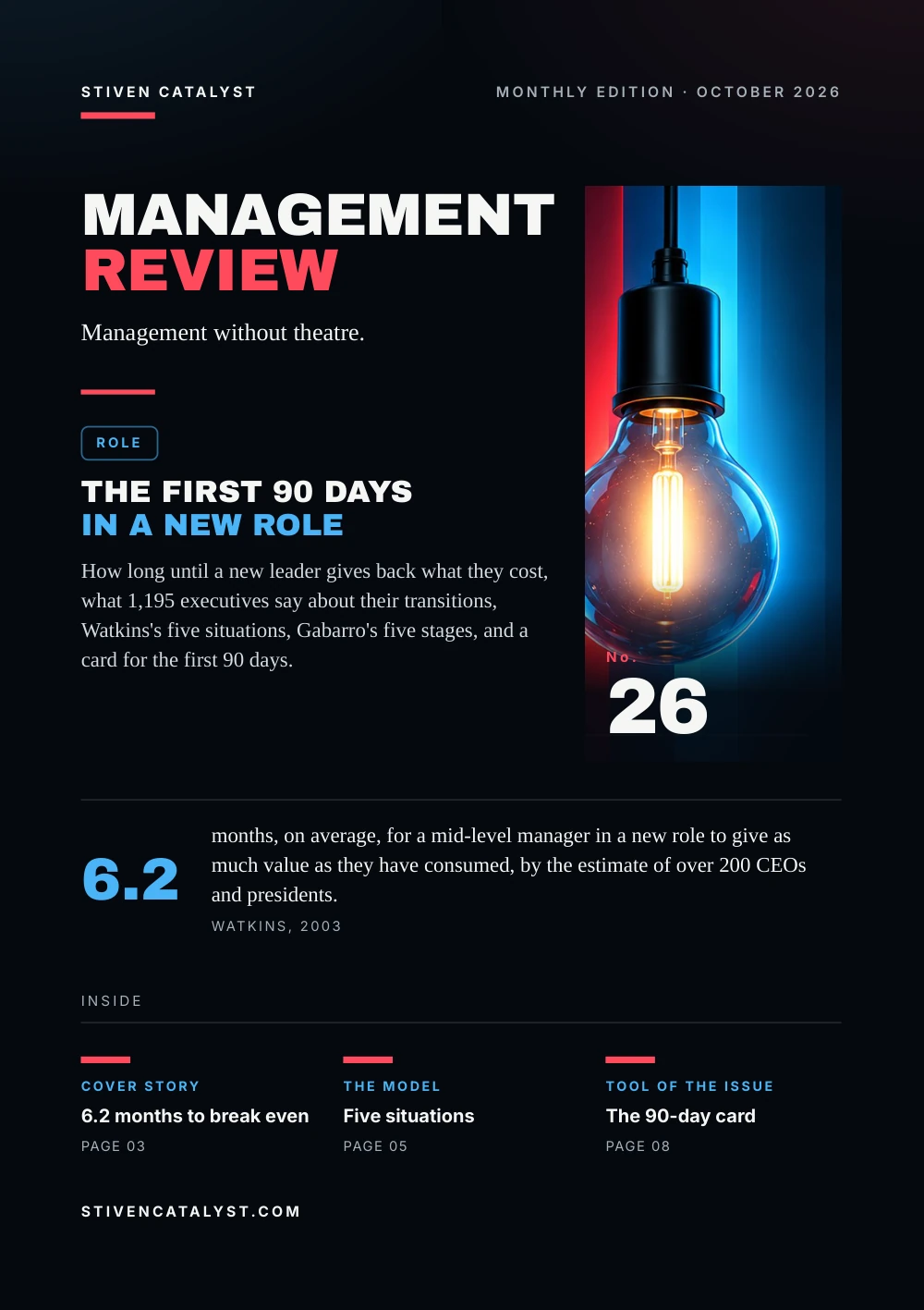
The first 90 days in a new role
How long until a new leader gives back what they cost, what 1,195 executives say about their transitions, Watkins's five situations, Gabarro's five stages, and a card for the first 90 days.
- No.
- 26
- Pages
- 10
- Sources
- 8
- Topics
- Role
Stiven CatalystMonthly edition · October 2026
ManagementReview
Management without theatre.
Role
The first 90 daysin a new role
How long until a new leader gives back what they cost, what 1,195 executives say about their transitions, Watkins's five situations, Gabarro's five stages, and a card for the first 90 days.

No.26
6.2
months, on average, for a mid-level manager in a new role to give as much value as they have consumed, by the estimate of over 200 CEOs and presidents.Watkins, 2003
stivencatalyst.com
No. 26 · Role
In this issue
Every new role starts with a time in which the organisation gives more than it gets. This issue asks how long that time lasts, what makes it go wrong, and what a new leader can do in the first 90 days.
- 03Cover story6.2 months to break even
- 04The numbers1,195 executives look back
- 05The modelFive situations, not one recipe
- 06What the research saysFive stages of taking charge
- 07How it is measuredHow failure is counted
- 08Tool of the issueThe 90-day card
- 09SourcesSources and method
How to read this issue
Figure
Every figure has its source and year at the foot of its page.
Our reading
Where the editors interpret rather than the research, it says so.
Practice
The steps and the card are proposals to try, not research results.
Cover story
6.2 monthst o break even
Michael Watkins calls it the breakeven point: the moment a new leader has given the new organisation as much value as they have consumed from it. Over 200 CEOs and company presidents put the time a typical mid-level manager needs to get there at 6.2 months on average.
Managers in large corporations who take a new leadership role each year, by Watkins's estimate
- 1 in 4takes a new leadership role
- 3 in 4the others
The time varies widely with the situation, and the 6.2 months are an estimate by senior leaders, not a measurement. But if about a quarter of managers enter a new role every year, transitions are not rare events in a large company.
Our reading
Until the breakeven point the organisation is investing in the new leader. A planned start can shorten that time; no plan removes it.
Source: Michael D. Watkins, Harvard Business School Press, 2003
Both figures are estimates from Watkins's book of 2003; the method and the year of the survey are not given.
The numbers
1,195 executiveslook back
In July 2014 McKinsey asked 1,195 C-suite executives about their transitions, the first 18 months in the role. Culture was the area all of them found hardest to understand, whether they came from inside or from outside.
Say more information on the culture would have helped them most in the transition (%)
27%think their organisation had the right resources or programmes to support the move
≈ 1/3needed more than 100 days to feel fully comfortable in the role
Creating a shared vision ranked first among the tasks of a transition, yet only 30% found it easy, and 39% of those whose transition succeeded. With hindsight, the executives say they would have moved faster in every area, most often in putting their team in place.
Source: McKinsey & Company, McKinsey Global Survey, 2015
Self-assessments by executives, with 2014 data; whether a transition succeeded is their own judgment. The size of each group is not given.
The model
Five situations,not one recipe
Michael Watkins sorts the situations a new leader walks into in his STARS model, named after their English initials. His texts of 2003 had four; his 2009 article in Harvard Business Review and the 2013 edition of his book have five.
Start-up
Assemble the people, money and technology to launch a new business or initiative.
Turnaround
Rescue a business or initiative known to be in serious trouble.
Accelerated growth
Lead a business that is expanding fast.
Realignment
Revitalise a once-successful organisation that now has problems.
Sustaining success
Keep a successful organisation vital and take it to the next level.
Some principles hold everywhere: organise to learn the business, set the few priorities that matter most, and secure early wins. How to apply them depends on the situation; a leader who repeats what worked last time may be making a serious mistake.
Our reading
Name the situation before writing the plan for the first 90 days. A turnaround and a role that must sustain success ask for very different first moves.
Sources: Michael D. Watkins, Harvard Business School Press, 2003; Michael D. Watkins, Harvard Business Review, 2009; Michael D. Watkins, Harvard Business Review Press, 2013
The descriptions follow the 2009 article; their wording varies a little between summaries of the book.
More in the essayThe Operations Manager I want to be
What the research says
Five stages oftaking charge
John Gabarro followed 14 successions: a three-year study of four newly appointed division presidents, and ten historical cases that included turnarounds, normal situations, failures and successes. Management style and working relationships made the difference.
The stages of taking charge, after Gabarro
- 01
Taking hold
- 02
Immersion
- 03
Reshaping
- 04
Consolidation
- 05
Refinement
Matthew Bidwell studied six years of personnel data from the US investment-banking division of a large financial firm. External hires were paid about 18–20% more than staff promoted into similar jobs, got significantly lower performance ratings in their first two years, and left more often. Those who stayed beyond two years were promoted faster.
Our reading
A leader from outside starts without the context that insiders have. Building it is part of the work of the first months, not a side task.
Sources: John J. Gabarro, Harvard Business Review, 1985; Matthew Bidwell, Administrative Science Quarterly, 2011
Bidwell's data come from one firm and cover all levels, not only leaders; they show associations, not full proof of cause. On how long each of Gabarro's stages lasts, we have no source we could check.
How it is measured
How failureis counted
There is no single measure of a failed transition. Studies quoted by McKinsey in 2018 find that two years after executive transitions, 27% to 46% are regarded as failures or disappointments: a judgment, not one measured rate.
90%more likely that the team meets its three-year goals, when the transition succeeds
15%lower performance of the direct reports, when the new leader struggles
20%more likely that those direct reports disengage or leave
The figure quoted most often, that 40% of new executives fail within 18 months, goes back at least to Fortune in 1998, which credited the Center for Creative Leadership and the firm Manchester. How the 40% was derived is not shown, so we do not report it as data. Manchester had asked 826 HR specialists why new managers fail.
The reasons they gave
- no good relationships with peers and staff
- unclear about what the boss expects
- too little political skill inside the organisation
- the most important objectives of the role missed
Sources: Scott Keller & Mary Meaney, McKinsey & Company, 2018; Anne Fisher, Fortune, 1998
McKinsey cites the 90%, 15% and 20% from CEB; their method, sample and year are not given. The 27–46% range joins studies with different criteria.
Tool of the issue
The 90-daycard
Fill it in during the first two weeks and look at it again on day 30, 60 and 90. Each line answers one of the reasons new managers fail.
01The situationstart-up, turnaround, accelerated growth, realignment or sustaining success, and why
02What my boss expectsin their words, by when, and how we will both know
03Prioritiesthe few that matter most, and what will not continue
04An early wina result others can see, by day 90
05People to meetpeers and team members, one to one, and when
06The culturewhat surprised me, and whom I can ask
Sources: Michael D. Watkins, Harvard Business Review, 2009; McKinsey & Company, McKinsey Global Survey, 2015; Anne Fisher, Fortune, 1998
A practice proposed by the editors, after Watkins (2009), McKinsey (2015) and the reasons reported by Fortune (1998).
Sources and method
Every figurehas a source.
The figures in this issue come from the sources below. The year shows how recent each one is.
- The First 90 Days: Critical Success Strategies for New Leaders at All LevelsMichael D. Watkins, Harvard Business School Press, 2003
- Picking the Right Transition StrategyMichael D. Watkins, Harvard Business Review, 2009https://hbr.org/2009/01/picking-the-right-transition-strategy
- The First 90 Days, Updated and Expanded: Proven Strategies for Getting Up to Speed Faster and SmarterMichael D. Watkins, Harvard Business Review Press, 2013
- Ascending to the C-suiteMcKinsey & Company, McKinsey Global Survey, 2015https://www.mckinsey.com/featured-insights/leadership/ascending-to-the-c-suite
- Successfully transitioning to new leadership rolesScott Keller & Mary Meaney, McKinsey & Company, 2018https://www.mckinsey.com/capabilities/people-and-organizational-performance/our-insights/successfully-transitioning-to-new-leadership-roles
- When a New Manager Takes ChargeJohn J. Gabarro, Harvard Business Review, 1985https://store.hbr.org/product/when-a-new-manager-takes-charge-hbr-classic/R0701K
- Paying More to Get Less: The Effects of External Hiring versus Internal MobilityMatthew Bidwell, Administrative Science Quarterly, 2011https://doi.org/10.1177/0001839211433562
- Don't Blow Your New JobAnne Fisher, Fortune, 1998
Editorial method
Each figure was checked for its year, its publisher and what exactly it measures. Where the publisher's page could not be opened, the figure was checked against independent summaries and is marked “via”. The editors' interpretation is marked “Our reading”. Figures that could not be confirmed are not in the issue.
ManagementReview
Management without theatre.
Every issue, one management question, checked against the best research.
All issues
stivencatalyst.com/magazine/management-review.html
Management Review · No. 26 · October 2026 · Stiven Catalyst
Click or swipe a page to turn it. The arrow keys work too.
Management Review · No. 26
The figures of the issue
The charts of the printed pages, with their sources.
- 1 in 4takes a new leadership role
- 3 in 4the others
- 1 in 4takes a new leadership role
- 3 in 4the others
Source: Michael D. Watkins, Harvard Business School Press, 2003
Source: McKinsey & Company, McKinsey Global Survey, 2015
The whole text Read the issue as text For reading on a small screen, searching or a screen reader. The same words, without the page design.
In this issue
Every new role starts with a time in which the organisation gives more than it gets. This issue asks how long that time lasts, what makes it go wrong, and what a new leader can do in the first 90 days.
Over 200 CEOs and company presidents estimate that a mid-level manager in a new role needs 6.2 months on average to give back as much value as they have consumed. Of 1,195 executives surveyed by McKinsey, about a third needed more than 100 days to feel fully comfortable, and culture was the hardest part. Michael Watkins sorts transitions into five situations, John Gabarro found five stages of taking charge, and Matthew Bidwell found that external hires were paid more and rated lower in their first two years.
Stiven Janaqi, Editor
Cover story
6.2 months t o break even
Michael Watkins calls it the breakeven point: the moment a new leader has given the new organisation as much value as they have consumed from it. Over 200 CEOs and company presidents put the time a typical mid-level manager needs to get there at 6.2 months on average.
Managers in large corporations who take a new leadership role each year, by Watkins's estimate: 1 in 4 takes a new leadership role, 3 in 4 the others.
The time varies widely with the situation, and the 6.2 months are an estimate by senior leaders, not a measurement. But if about a quarter of managers enter a new role every year, transitions are not rare events in a large company.
Our reading
Until the breakeven point the organisation is investing in the new leader. A planned start can shorten that time; no plan removes it.
Both figures are estimates from Watkins's book of 2003; the method and the year of the survey are not given.
Source: Michael D. Watkins, Harvard Business School Press, 2003
The numbers
1,195 executives look back
In July 2014 McKinsey asked 1,195 C-suite executives about their transitions, the first 18 months in the role. Culture was the area all of them found hardest to understand, whether they came from inside or from outside.
Say more information on the culture would have helped them most in the transition (%): From outside 42%, From inside 29%.
- 27% think their organisation had the right resources or programmes to support the move
- ≈ 1/3 needed more than 100 days to feel fully comfortable in the role
Creating a shared vision ranked first among the tasks of a transition, yet only 30% found it easy, and 39% of those whose transition succeeded. With hindsight, the executives say they would have moved faster in every area, most often in putting their team in place.
Self-assessments by executives, with 2014 data; whether a transition succeeded is their own judgment. The size of each group is not given.
Source: McKinsey & Company, McKinsey Global Survey, 2015
The model
Five situations, not one recipe
Michael Watkins sorts the situations a new leader walks into in his STARS model, named after their English initials. His texts of 2003 had four; his 2009 article in Harvard Business Review and the 2013 edition of his book have five.
- Sta
r t-up. Assemble the people, money and technology to launch a new business or initiative. - Turnaround. Rescue a business or initiative known to be in serious trouble.
- Accelerated growth. Lead a business that is expanding fast.
- Realignment. Revitalise a once-successful organisation that now has problems.
- Sustaining success. Keep a successful organisation vital and take it to the next level.
Some principles hold everywhere: organise to learn the business, set the few priorities that matter most, and secure early wins. How to apply them depends on the situation; a leader who repeats what worked last time may be making a serious mistake.
Our reading
Name the situation before writing the plan for the first 90 days. A turnaround and a role that must sustain success ask for very different first moves.
The descriptions follow the 2009 article; their wording varies a little between summaries of the book.
Sources: Michael D. Watkins, Harvard Business School Press, 2003; Michael D. Watkins, Harvard Business Review, 2009; Michael D. Watkins, Harvard Business Review Press, 2013
More in the essay: The Operations Manager I want to be
What the research says
Five stages of taking charge
John Gabarro followed 14 successions: a three-year study of four newly appointed division presidents, and ten historical cases that included turnarounds, normal situations, failures and successes. Management style and working relationships made the difference.
The stages of taking charge, af ter Gabarro
- Taking hold.
- Immersion.
- Reshaping.
- Consolidation.
- Refinement.
Matthew Bidwell studied six years of personnel data from the US investment-banking division of a large financial firm. External hires were paid about 18–20% more than staff promoted into similar jobs, got significantly lower performance ratings in their first two years, and left more often. Those who stayed beyond two years were promoted faster.
Our reading
A leader from outside starts without the context that insiders have. Building it is part of the work of the first months, not a side task.
Bidwell's data come from one firm and cover all levels, not only leaders; they show associations, not full proof of cause. On how long each of Gabarro's stages lasts, we have no source we could check.
Sources: John J. Gabarro, Harvard Business Review, 1985; Matthew Bidwell, Administrative Science Quarterly, 2011
How it is measured
How failure is counted
There is no single measure of a failed transition. Studies quoted by McKinsey in 2018 find that two years after executive transitions, 27% to 46% are regarded as failures or disappointments: a judgment, not one measured rate.
- 90% more likely that the team meets its three-year goals, when the transition succeeds
- 15% lower performance of the direct reports, when the new leader struggles
- 20% more likely that those direct reports disengage or leave
The figure quoted most often, that 40% of new executives fail within 18 months, goes back at least to Fortune in 1998, which credited the Center for Creative Leadership and the firm Manchester. How the 40% was derived is not shown, so we do not report it as data. Manchester had asked 826 HR specialists why new managers fail.
The reasons the y gave
- no good relationships with peers and staff
- unclear about what the boss expects
- too little political skill inside the organisation
- the most important objectives of the role missed
McKinsey cites the 90%, 15% and 20% from CEB; their method, sample and year are not given. The 27–46% range joins studies with different criteria.
Sources: Scott Keller & Mary Meaney, McKinsey & Company, 2018; Anne Fisher, Fortune, 1998
Tool of the issue
The 90-day card
Fill it in during the first two weeks and look at it again on day 30, 60 and 90. Each line answers one of the reasons new managers fail.
- The situation start-up, turnaround, accelerated growth, realignment or sustaining success, and why
- What my boss expects in their words, by when, and how we will both know
- Priorities the few that matter most, and what will not continue
- An early win a result others can see, by day 90
- People
t o mee t peers and team members, one to one, and when - The culture what surprised me, and whom I can ask
A practice proposed by the editors, after Watkins (2009), McKinsey (2015) and the reasons reported by Fortune (1998).
Sources: Michael D. Watkins, Harvard Business Review, 2009; McKinsey & Company, McKinsey Global Survey, 2015; Anne Fisher, Fortune, 1998
Sources and method
Every figure has a source.
The figures in this issue come from the sources below. The year shows how recent each one is.
- Michael D. Watkins, Harvard Business School Press, “The First 90 Days: Critical Success Strategies for New Leaders at All Levels”, 2003.
- Michael D. Watkins, Harvard Business Review, “Picking the Right Transition Strategy”, 2009. https://hbr.org/2009/01/picking-the-right-transition-strategy
- Michael D. Watkins, Harvard Business Review Press, “The First 90 Days, Updated and Expanded: Proven Strategies for Getting Up to Speed Faster and Smarter”, 2013.
- McKinsey & Company, McKinsey Global Survey, “Ascending to the C-suite”, 2015. https://www.mckinsey.com/featured-insights/leadership/ascending-to-the-c-suite
- Scott Keller & Mary Meaney, McKinsey & Company, “Successfully transitioning to new leadership roles”, 2018. https://www.mckinsey.com/capabilities/people-and-organizational-performance/our-insights/successfully-transitioning-to-new-leadership-roles
- John J. Gabarro, Harvard Business Review, “When a New Manager Takes Charge”, 1985. https://store.hbr.org/product/when-a-new-manager-takes-charge-hbr-classic/R0701K
- Matthew Bidwell, Administrative Science Quarterly, “Paying More to Get Less: The Effects of External Hiring versus Internal Mobility”, 2011. https://doi.org/10.1177/0001839211433562
- Anne Fisher, Fortune, “Don't Blow Your New Job”, 1998.
Edit orial me thod
Each figure was checked for its year, its publisher and what exactly it measures. Where the publisher's page could not be opened, the figure was checked against independent summaries and is marked “via”. The editors' interpretation is marked “Our reading”. Figures that could not be confirmed are not in the issue.
Management Review · Monthly edition